Has An Alt Season Begun? Here’s What The Altcoin Season Index Says

bitcoinistPublished on 2026-06-03Last updated on 2026-06-03

Abstract

The recent rally in some altcoins and Ethereum's recovery have sparked speculation about the start of an altcoin season. However, data from the Altcoin Season Index suggests otherwise. Currently scoring only 36 out of 100, the index indicates the market is not in an alt season, which typically requires a score above 75. This score reflects that less than 75% of the top 100 altcoins have outperformed Bitcoin over the past 90 days. Furthermore, Bitcoin's market dominance has risen to around 59.88%, contradicting the decline expected during an alt season. The analysis concludes that current altcoin gains are likely isolated rallies, not a broad market shift. For a true alt season to begin, Ethereum would need to consistently outperform Bitcoin, and altcoin dominance would have to rise significantly.

Recently, there have been rallies across some altcoins, with Ethereum seeing some recovery as well, pushing the idea of an alt season. With the likes of Hyperliquid pumping to new all-time highs, this has propelled some of the top 100 altcoins by market cap to surpass Bitcoin’s performance during this time. As more altcoins continue to outperform, does this mean that another alt season has begun? This report takes a look at what the data says.

Altcoin Season Index Sitting At A Score Of 36

The Altcoin Season Index has historically been the index that tells when the crypto market has entered an alt season. According to the index, it measures the performance of the top 100 altcoins against that of Bitcoin over a 90-day period and then plots this across a score of 1-100 to show when the market has entered into an alt season.

Historically, the higher the score goes, the more the likelihood that the crypto market is experiencing an alt season. Usually, this means that the Bitcoin outperformance has stalled, and its dominance over the rest of the crypto market has dropped drastically.

Presently, the Altcoin Season Index is reading at a score of 36, according to data from the Coinglass website. Also, the Bitcoin dominance began to recover again during the weekend, rising above 59.88% by the time Sunday rolls around. Naturally, neither of these bodes well for an alt season.
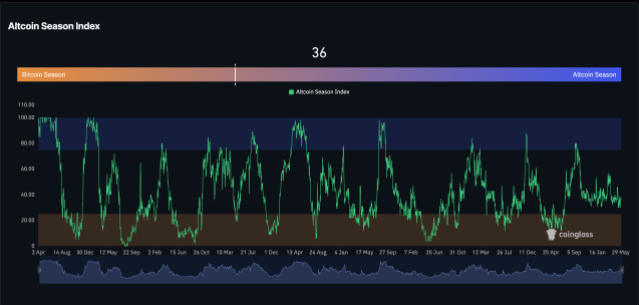
Source: Coinglass

Dissecting The Data For An Alt Season

With the Altcoin Season Index sitting this low at 36, it means that the market is not actually experiencing an alt season. Usually, an alt season would begin with the score sitting above 75. This would mean that 75% of the top 100 altcoins are performing better than Bitcoin in a 3-month timeframe to make this happen.

Additionally, the Bitcoin dominance over the crypto market has continued to rise instead of dropping. This is a sign that the market is actually not moving into an altcoin season. This would only happen when the Bitcoin dominance begins to crash, and the altcoin dominance starts to rise.

Given the data, it suggests that the rallies of some altcoins are only spot rallies. Ethereum is also underperforming compared to Bitcoin during this time, and being the historical leader of the altcoin season, Ethereum would have to begin outperforming Bitcoin to trigger the next alt season.

Altcoin market cap falters | Source: Crypto Total Market Cap Excluding BTC on TradingView.com

Trending Cryptos

Related Questions

QWhat is the current score of the Altcoin Season Index according to the article?

AThe current score of the Altcoin Season Index is 36.

QAccording to the Altcoin Season Index, what score is usually required to indicate the beginning of an alt season?

AAn alt season would usually begin when the Altcoin Season Index score sits above 75.

QWhat does the data suggest about the recent rallies in some altcoins?

AThe data suggests that the recent rallies of some altcoins are only spot rallies and do not signify the start of an alt season.

QWhat trend in Bitcoin dominance is observed, and what does it indicate regarding an alt season?

ABitcoin dominance has continued to rise instead of dropping. This indicates that the market is not moving into an altcoin season, which typically happens when Bitcoin dominance crashes and altcoin dominance rises.

QWhat role does Ethereum play historically in triggering an alt season, and what is its current performance?

AEthereum is the historical leader of the altcoin season. Currently, it is underperforming compared to Bitcoin. For the next alt season to be triggered, Ethereum would need to begin outperforming Bitcoin.

Related Reads

Why Has the Bitcoin Market Stalled Amid Positive Macroeconomic Data?

Bitcoin's price remains stagnant despite positive macroeconomic data, such as stabilized U.S. core inflation at 2.5%, which pushed traditional stock markets to new highs. This indifference signals underlying structural issues in the current market cycle, according to analysts. Bitcoin is trapped in a narrow range between the realized price support at $63,000 and the short-term holder cost basis resistance at $68,700. Short-term holders are sitting on unrealized losses and tend to sell as prices approach their break-even point, creating significant selling pressure. This price compression occurs alongside spot trading volumes at their lowest since 2019, indicating a severe lack of retail interest. While selling pressure has shown signs of exhaustion, buyers have not returned. Capital is flowing into the surging stock market, particularly AI-related sectors, instead of Bitcoin. This is evidenced by minimal inflows into spot Bitcoin ETFs and a continued transfer of coins to exchanges, often a precursor to selling. A major concern is the derivatives market, where leveraged long positions are being aggressively accumulated despite the lack of underlying spot demand. This creates a dangerous liquidity imbalance. A negative macro event or sharp price drop could trigger a cascade of long liquidations, potentially crashing the price to the next key support level around $58,500. For a sustained recovery, Bitcoin needs to firmly break above $68,700, accompanied by a significant rise in spot volumes and renewed ETF inflows. Until then, the risk of a sharp decline remains high.

cryptonews.ru3m ago

Why Has the Bitcoin Market Stalled Amid Positive Macroeconomic Data?

cryptonews.ru3m ago

Asia is Becoming a Testing Ground for Stablecoin-Based Payment Systems

Asia is emerging as the primary testing ground for stablecoin-based payment systems, with Singapore, Hong Kong, and Japan leading the regulatory charge. These jurisdictions are moving from policy consultation to practical implementation, establishing legal frameworks that permit licensed stablecoins for payments and settlements. In 2026, Singapore has authorized major firms like Circle and Coinbase under its digital payment token regime. Hong Kong enacted its Stablecoin Law in 2025, issuing its first two licenses in April 2026. Japan has amended its rules to enhance transaction transparency for crypto exchanges. This regulatory push follows significant existing activity. Hong Kong-based Reap processes about $6 billion annually, with Asia's inter-enterprise stablecoin flows surging from under $100 million monthly in early 2023 to over $3 billion by 2025. The region accounted for $12.5 trillion in stablecoin volume in 2025, with the Singapore-China corridor being the most active. A key insight from a BIS study is that stablecoin transactions are complex; about 60% involve multi-step operations like trading and borrowing, not simple peer-to-peer transfers. This challenges regulators to view stablecoins as programmable settlement tools rather than just digital cash. While progress is uneven—South Korea's legislation is delayed due to debates over issuer eligibility—Asia's advanced banking infrastructure and experience with cross-border finance position it as the natural leader in building the global infrastructure for dollar-denominated stablecoins.

cryptonews.ru4m ago

Asia is Becoming a Testing Ground for Stablecoin-Based Payment Systems

cryptonews.ru4m ago

Former ASML Employee at the Helm, China's AMEC's Peer Files for IPO, Focusing on Integrated Circuit Metrology and Inspection Equipment

Eastern Jingyuan Microelectronics Technology (Beijing) Co., Ltd. ("Eastern Jingyuan"), led by a former ASML employee, has filed for a Shanghai STAR Market IPO. The company specializes in integrated circuit (IC) metrology/inspection equipment and manufacturing EDA software, key upstream segments in the semiconductor supply chain. Driven by demand from automotive electronics and AI, China's semiconductor equipment market is expanding rapidly. Eastern Jingyuan's products, including CD-SEM and EBI equipment, as well as computational lithography software (PanGen), aim to break the dominance of international giants like Applied Materials, ASML-HMI, and Siemens EDA in these high-tech, low-domestication-rate fields. Financially, the company's performance is mixed. While revenue grew from 191 million yuan in 2023 to 375 million yuan in 2024, it dipped to 317 million yuan in 2025. The firm has been consistently unprofitable, with net losses totaling approximately 860 million yuan over the past three years. Its gross margin has declined steadily from 67.5% to 39.7%, and both equipment and software毛利率 lag behind industry peers. High R&D expenses (exceeding 90% of revenue) and rising debt levels further pressure profitability. The IPO aims to raise 2.5 billion yuan to fund R&D upgrades for metrology/inspection equipment and EDA tools, alongside working capital. Despite being a domestic pioneer, the company acknowledges gaps versus international leaders in technology, product breadth, and scale, while also facing growing competition from local rivals.

marsbit8m ago

Former ASML Employee at the Helm, China's AMEC's Peer Files for IPO, Focusing on Integrated Circuit Metrology and Inspection Equipment

marsbit8m ago

The Era of Easy Gains in AI Ends: 13F Rebalancing Map Points the Way – The Latest 13F Reveals Where Top Institutions' Money is Flowing

The era of easy AI profits is ending, as evidenced by the latest 13F filings from major institutions for Q2 2026. These reports, which are delayed by over 45 days, reveal a significant shift in strategy: capital is moving from a broad "AI frenzy" towards assets with strong cash flows, tangible technology, and durable competitive advantages. Key institutional moves highlight this trend. Temasek increased stakes in SpaceX (representing next-gen infrastructure), Alphabet (for its AI infrastructure and cash flow), and semiconductor equipment giant ASML. Baillie Gifford made SpaceX its top holding. Berkshire Hathaway ended its passive stance with a major $10 billion purchase of Alphabet, while Bridgewater maintains significant positions in tech giants but with a balanced, macro-aware approach. Notably, asset manager JingLin dramatically reduced overall exposure by 43%, completely exiting Nvidia and Meta, and pivoting towards semiconductor equipment and optical communication stocks like ASML and Applied Materials. The analysis reveals several key conclusions: 1. **Alphabet is becoming a consensus holding**, valued for its blend of AI infrastructure, stable cash flows, and reasonable valuation. 2. **Nvidia remains core but faces scrutiny**; its future depends on sustaining growth and justifying its valuation. 3. **Capital is flowing upstream** into semiconductor equipment and hardware (e.g., ASML, AMAT), focusing on the "bottlenecks" of AI compute. 4. **SpaceX represents a new theme** in next-generation infrastructure, attracting long-term capital. The article warns against common mistakes when interpreting 13Fs: treating them as real-time trading signals, focusing only on *what* was bought and not *how much*, and ignoring the different investment styles of the reporting funds. Instead, investors should use a disciplined five-step framework: analyze the overall portfolio structure, focus on marginal changes (new adds/sells), identify sector/theme migrations, look for consensus or divergence among multiple funds, and finally, independently verify the current price, valuation, and fundamentals. In essence, 13Fs provide valuable footprints and research clues left by sophisticated investors, but they are not a substitute for one's own analysis and investment thesis.

marsbit10m ago

The Era of Easy Gains in AI Ends: 13F Rebalancing Map Points the Way – The Latest 13F Reveals Where Top Institutions' Money is Flowing

marsbit10m ago

Trading

Spot

Hot Articles

How to Buy ALT

Welcome to HTX.com! We've made purchasing AltLayer (ALT) simple and convenient. Follow our step-by-step guide to embark on your crypto journey.Step 1: Create Your HTX AccountUse your email or phone number to sign up for a free account on HTX. Experience a hassle-free registration journey and unlock all features.Get My AccountStep 2: Go to Buy Crypto and Choose Your Payment MethodCredit/Debit Card: Use your Visa or Mastercard to buy AltLayer (ALT) instantly.Balance: Use funds from your HTX account balance to trade seamlessly.Third Parties: We've added popular payment methods such as Google Pay and Apple Pay to enhance convenience.P2P: Trade directly with other users on HTX.Over-the-Counter (OTC): We offer tailor-made services and competitive exchange rates for traders.Step 3: Store Your AltLayer (ALT)After purchasing your AltLayer (ALT), store it in your HTX account. Alternatively, you can send it elsewhere via blockchain transfer or use it to trade other cryptocurrencies.Step 4: Trade AltLayer (ALT)Easily trade AltLayer (ALT) on HTX's spot market. Simply access your account, select your trading pair, execute your trades, and monitor in real-time. We offer a user-friendly experience for both beginners and seasoned traders.

5.3k Total ViewsPublished 2024.03.29Updated 2026.06.02

How to Buy ALT

Discussions

Welcome to the HTX Community. Here, you can stay informed about the latest platform developments and gain access to professional market insights. Users' opinions on the price of ALT (ALT) are presented below.

活动图片