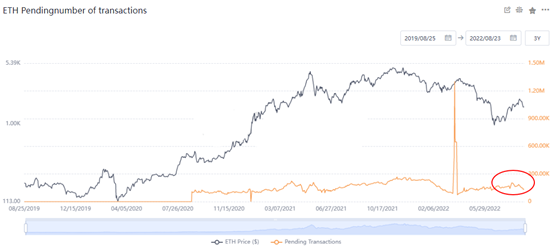
[Ключевая интерпретация] огромный кит поднял 17000 BTC, а неподтвержденные транзакции eth упали до 149000

HTX NewsPublished on 2022-08-24Last updated on 2022-08-24

Abstract

Гигантский кит BTC привлек небольшое количество средств, и ключевая поддержка была подтверждена.

1. Завершение горизонтали BTC

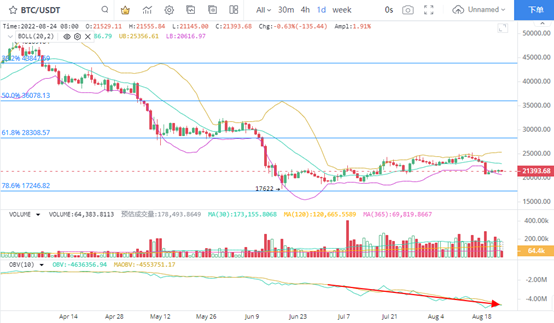
Дневной часовой график K-line показывает, что цена BTC имеет очевидные характеристики горизонтальной корректировки, и цена не сильно отскочила на горизонтальной стадии, что означает, что корректировка может продолжаться еще долгое время. Индикатор obv показывает, что значение этого индикатора движется назад с начала июля. Падение индикатора означает, что BTC набрал больший объем торгов в период падения. Это говорит о том, что BTC будет испытывать большее давление для отскока после того, как падающие трейдеры продолжат наращивать объем и увеличивать оборот. После того как текущий уровень 21000 долларов заблокировал краткосрочных инвесторов.
2. Количество адресов " китов-гигантов" немного увеличилось

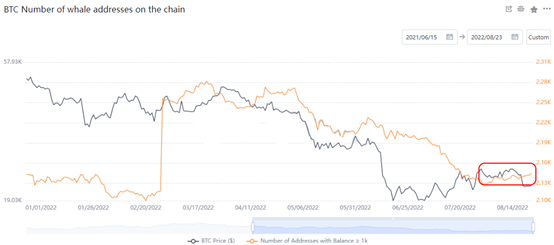
С продолжением шока BTC тенденция снижения количества адресов "китов-гигантов" имеет тенденцию к ослаблению. Количество адресов увеличилось с недавнего минимума 2128 до 2145 23 августа, т.е. на 17. Исходя из расчета 1000 BTC на адрес, 17000 BTC поглощены китом-гигантом. По сравнению с количеством адресов гигантского кита 21 марта в предыдущем периоде, количество адресов гигантского кита все еще относительно снижается. То есть, количество BTC имеет тенденцию к расхождению, и дальнейшие возможности низкого поглощения можно рассматривать после того, как главная сила еще раз подтвердит выход на рынок.
3. Реализованная цена составляет $21669

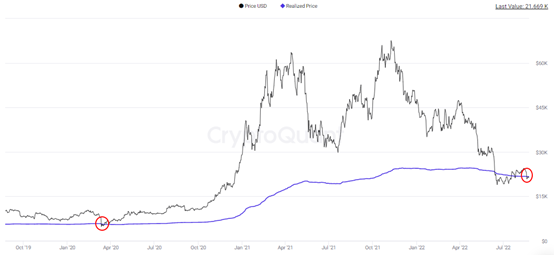
Цена реализации BTC рассчитывается как верхняя граница реализации, деленная на общее предложение монет. Она измеряет средневзвешенную цену предложения, уплаченную всеми участниками рынка за свои монеты. Ее можно интерпретировать как цену поддержки или сопротивления на цепочке.

Когда цена BTC отступает до реализованной цены, отражается соответствующая поддержка. В начале 2020 года BTC завершил формирование дна ниже реализованной цены в $5400, что является типичным торговым сигналом низкого поглощения.

23 августа цена реализации BTC упала до 21669 долл, а текущая цена BTC близка к цене реализации 21300 долл. Согласно этому суждению, BTC может эффективно подтвердить " Бычий" сигнал, если он сможет отскочить выше цены реализации.
4. ETH немного отскочил

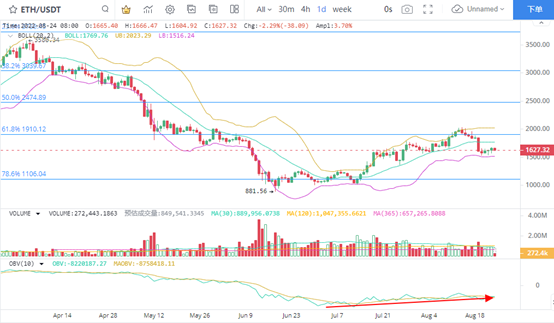
В последней тенденции eth за последние два месяца объем торгов отскочил в период подъема цены, а значение индекса obv немного отскочило, что означает, что объем торгов в период подъема выше. Поэтому, в отличие от BTC, ETH в последнее время активно покупается большим количеством инвесторов. С точки зрения ценовых показателей, ETH колеблется около 1627 доллара ,что все еще ниже соответствующего 1769 доллара ,среднего рельса линии Брин. Согласно этому суждению, ETH находится в относительно слабом операционном состоянии, и ценовые показатели все еще имеют тенденцию к снижению.
5. Количество неподтвержденных транзакций в ETH невелико

Количество неподтвержденных сделок в eth сохраняет тенденцию к снижению, что свидетельствует о том, что накал торгов на текущем рынке относительно низок, а значит, возможностей для дальнейшего укрепления цены ETH немного. До и после 25 марта наблюдалось большое пространство для отскока, а количество неподтвержденных сделок достигло пика в 1,3 миллиона. В настоящее время количество неподтвержденных сделок не только вялое, но и находится в состоянии отката. 24 августа количество неподтвержденных сделок упало до минимума в 149000, что вряд ли будет способствовать росту цены.
Trending Cryptos

Related Reads

Interview with NDV Founder Jason Huang: Piercing the AI Bubble and the MicroStrategy Myth, Seeking the Ultimate Edge in the Crypto Market

In a podcast with WuBlockchain, NDV founder Jason Huang discusses recent market dynamics, expressing a bearish outlook on crypto in the near term. He attributes Bitcoin's recent decline to a combination of cyclical selling pressure, the start of a US stock market correction, and liquidity tightening. A key catalyst is the emerging financial strain on MicroStrategy (MSTR). Huang explains that MSTR's model of borrowing to buy Bitcoin created a positive "flywheel" in a bull market. However, with falling BTC prices turning its stock premium into a discount, the model is now under severe stress. While MSTR only sold 32 BTC recently, the market is "front-running" the fear of its massive 80,000+ BTC holdings potentially being liquidated to meet debt obligations. He believes a true market bottom requires a major, capitulation-level event similar to the FTX collapse. Regarding investments, Huang states his fund is up over 20% this year, outperforming Bitcoin by 50-60%. The strategy involves crypto assets and commodities like oil, gold, and silver, but avoids AI stocks due to a perceived lack of trading edge. He is cautious of crowded trades in semiconductors and sees bubbles in the broader market, citing the hype around a potential SpaceX IPO. Despite short-term pessimism, Huang remains long-term bullish on one crypto innovation: stablecoins. He views them as the clearest example of a "faster, better" financial tool with significant room for global adoption. For the future, he is very bearish on Ethereum. For Bitcoin, he anticipates potential for a significant drop below $48,000 before a eventual rebound, but stresses the need to wait for a true panic-driven bottom marked by widespread despair and disinterest in the market.

marsbit18m ago

Interview with NDV Founder Jason Huang: Piercing the AI Bubble and the MicroStrategy Myth, Seeking the Ultimate Edge in the Crypto Market

marsbit18m ago

Conversation with Jason Huang, Founder of NDV: Puncturing the AI Bubble and the MicroStrategy Myth, Searching for the Ultimate Trump Card in the Crypto Market

In a podcast interview, NDV founder Jason Huang discusses the recent crypto market downturn, attributing the initial phase to typical Bitcoin cycle selling pressure, now compounded by a US stock market correction, tightening liquidity, and MicroStrategy's financial strain. He argues the market hasn't bottomed yet, noting true bear market lows often require a major, despair-inducing event like FTX's collapse. Huang details MicroStrategy's precarious position: its debt-and-equity fueled Bitcoin buying model has reversed into a negative cycle as prices fell. He interprets its sale of just 32 BTC as a signal prioritizing creditors over shareholders, sparking market "front-running" of its larger potential sell-off. A true bottom may arrive only after MicroStrategy resolves its looming debt payments, possibly via a large, private Bitcoin sale. His fund is up ~20% this year, outperforming Bitcoin by 50-60%, by shorting crypto and trading commodities like oil and gold. He avoided AI stocks despite being a heavy user, citing a lack of trading edge in the crowded semiconductor hardware trade, which he views as ripe for a significant correction. Long-term, Huang remains bullish on stablecoins as crypto's clearest, most practical innovation with high growth potential. He is very bearish on Ethereum and skeptical that Bitcoin has found its floor, suggesting $48,000 may not hold. He expects a sharp decline followed by a strong recovery within a year, but only after a major panic event leads to widespread capitulation and despair—the true hallmark of a market bottom.

链捕手23m ago

Conversation with Jason Huang, Founder of NDV: Puncturing the AI Bubble and the MicroStrategy Myth, Searching for the Ultimate Trump Card in the Crypto Market

链捕手23m ago

U.S. Stocks Trend (June 24): Korean Stock Plunge Ripples Global Chip Sector, Micron Tumbles Over 10%, Long-Term Supply Certainty Faces a 'Hard Test'

US Stock Market Trend (June 24): South Korean Market Plunge Disrupts Global Chips, Micron Drops Over 10%, Long-Term Supply Certainty Faces Hard Test On Monday, the South Korean KOSPI index plunged 10%, with SK Hynix and Samsung dropping over 12%, triggered by rumors that SK Hynix might slow its HBM4 production expansion. This shock quickly spread to the U.S. semiconductor sector. Micron plummeted 13.18% to $1,051.77, SanDisk fell 13.64%, and Marvell declined 8%. The Philadelphia Semiconductor Index closed down 7.87%, while the Nasdaq fell 2.21% to 25,587.04 points. The sell-off particularly hit memory chip stocks. Defensive sectors showed relative resilience, with gains in stocks like IBM and Johnson & Johnson. Market volatility spiked, with the VIX index jumping 12.79%. Commodities weakened, with WTI crude oil hitting a near three-month low and gold falling below $4,100. The core issue is not a challenge to AI demand itself, but a market reassessment of overly optimistic capacity expectations for memory chips, especially HBM. The rumor about SK Hynix undermined perceived certainty in the AI infrastructure cycle. Key upcoming events include Thursday's PCE inflation data, which will influence Fed rate expectations, and Micron's earnings report. The market will focus on Micron's HBM gross margins and its long-term capacity guidance. The shift indicates the AI investment cycle is moving from euphoria to rational pricing. Large institutions are questioning the sustainability of AI-related capital expenditure growth. Micron's repricing from an "AI infrastructure staple" to a more cyclical stock highlights this change. Thursday's data and earnings represent a critical juncture for assessing long-term supply certainty, which has now significantly decreased.

marsbit31m ago

U.S. Stocks Trend (June 24): Korean Stock Plunge Ripples Global Chip Sector, Micron Tumbles Over 10%, Long-Term Supply Certainty Faces a 'Hard Test'

marsbit31m ago

Preferred Stock Is Not the Trigger for Corporate Bankruptcy, MicroStrategy's Dollar Reserves Can Cover Dividend and Interest Payments Until February 2027

Preferred Shares Are Not the Catalyst for Corporate Bankruptcy; MicroStrategy's Dollar Reserves Can Cover Dividend and Interest Payments Until February 2027. This article analyzes the nature of preferred shares used by MicroStrategy (MSTR). Legally equity but economically similar to debt, these shares, including its Bitcoin-linked STR convertible preferred notes (STRC), offer fixed or floating dividends. Crucially, MicroStrategy's preferred shares lack rigid redemption clauses, meaning they are not classified as traditional debt. This eliminates principal repayment pressure and means missed dividends do not constitute default or trigger bankruptcy, creating a "self-contradictory virtuous cycle." The article clarifies that if funds are short, MicroStrategy can defer or suspend preferred share dividends (except for non-cumulative types like STRD) without immediate risk. The real potential crisis point lies with its convertible bonds. If a prolonged bear market prevents conversion, MicroStrategy might need to sell Bitcoin to repay these bonds starting from the earliest maturity in September 2027, potentially creating a downward spiral. Preferred dividend suspensions would only exacerbate market panic in such a scenario. Recent financial activity shows MicroStrategy strengthened its position through four weeks of common stock (MSTR) issuances, raising over $851 million without issuing new preferred shares. It increased its dollar reserves to approximately $1.4 billion, which is sufficient to cover all preferred share dividends and interest until around March 2027. While Bitcoin purchases slowed recently, this prioritization of cash reserves enhances the company's near-term financial safety. The analysis concludes that if the Bitcoin bear market ends by early 2025 as anticipated, MicroStrategy can resume issuing MSTR stock in a rising market to replenish reserves and manage future dividend obligations, thereby reducing the long-term pressure from its preferred share structure.

marsbit1h ago

Preferred Stock Is Not the Trigger for Corporate Bankruptcy, MicroStrategy's Dollar Reserves Can Cover Dividend and Interest Payments Until February 2027

marsbit1h ago

Trading

Spot
Futures

Hot Articles

What is $BITCOIN

DIGITAL GOLD ($BITCOIN): A Comprehensive Analysis Introduction to DIGITAL GOLD ($BITCOIN) DIGITAL GOLD ($BITCOIN) is a blockchain-based project operating on the Solana network, which aims to combine the characteristics of traditional precious metals with the innovation of decentralized technologies. While it shares a name with Bitcoin, often referred to as “digital gold” due to its perception as a store of value, DIGITAL GOLD is a separate token designed to create a unique ecosystem within the Web3 landscape. Its goal is to position itself as a viable alternative digital asset, although specifics regarding its applications and functionalities are still developing. What is DIGITAL GOLD ($BITCOIN)? DIGITAL GOLD ($BITCOIN) is a cryptocurrency token explicitly designed for use on the Solana blockchain. In contrast to Bitcoin, which provides a widely recognized value storage role, this token appears to focus on broader applications and characteristics. Notable aspects include: Blockchain Infrastructure: The token is built on the Solana blockchain, known for its capacity to handle high-speed and low-cost transactions. Supply Dynamics: DIGITAL GOLD has a maximum supply capped at 100 quadrillion tokens (100P $BITCOIN), although details regarding its circulating supply are currently undisclosed. Utility: While precise functionalities are not explicitly outlined, there are indications that the token could be utilized for various applications, potentially involving decentralized applications (dApps) or asset tokenization strategies. Who is the Creator of DIGITAL GOLD ($BITCOIN)? At present, the identity of the creators and development team behind DIGITAL GOLD ($BITCOIN) remains unknown. This situation is typical among many innovative projects within the blockchain space, particularly those aligning with decentralized finance and meme coin phenomena. While such anonymity may foster a community-driven culture, it intensifies concerns about governance and accountability. Who are the Investors of DIGITAL GOLD ($BITCOIN)? The available information indicates that DIGITAL GOLD ($BITCOIN) does not have any known institutional backers or prominent venture capital investments. The project seems to operate on a peer-to-peer model focused on community support and adoption rather than traditional funding routes. Its activity and liquidity are primarily situated on decentralized exchanges (DEXs), such as PumpSwap, rather than established centralized trading platforms, further highlighting its grassroots approach. How DIGITAL GOLD ($BITCOIN) Works The operational mechanics of DIGITAL GOLD ($BITCOIN) can be elaborated on based on its blockchain design and network attributes: Consensus Mechanism: By leveraging Solana’s unique proof-of-history (PoH) combined with a proof-of-stake (PoS) model, the project ensures efficient transaction validation contributing to the network's high performance. Tokenomics: While specific deflationary mechanisms have not been extensively detailed, the vast maximum token supply implies that it may cater to microtransactions or niche use cases that are still to be defined. Interoperability: There exists the potential for integration with Solana’s broader ecosystem, including various decentralized finance (DeFi) platforms. However, the details regarding specific integrations remain unspecified. Timeline of Key Events Here is a timeline that highlights significant milestones concerning DIGITAL GOLD ($BITCOIN): 2023: The initial deployment of the token occurs on the Solana blockchain, marked by its contract address. 2024: DIGITAL GOLD gains visibility as it becomes available for trading on decentralized exchanges like PumpSwap, allowing users to trade it against SOL. 2025: The project witnesses sporadic trading activity and potential interest in community-led engagements, although no noteworthy partnerships or technical advancements have been documented as of yet. Critical Analysis Strengths Scalability: The underlying Solana infrastructure supports high transaction volumes, which could enhance the utility of $BITCOIN in various transaction scenarios. Accessibility: The potential low trading price per token could attract retail investors, facilitating wider participation due to fractional ownership opportunities. Risks Lack of Transparency: The absence of publicly known backers, developers, or an audit process may yield skepticism regarding the project's sustainability and trustworthiness. Market Volatility: The trading activity is heavily reliant on speculative behavior, which can result in significant price volatility and uncertainty for investors. Conclusion DIGITAL GOLD ($BITCOIN) emerges as an intriguing yet ambiguous project within the rapidly evolving Solana ecosystem. While it attempts to leverage the “digital gold” narrative, its departure from Bitcoin's established role as a store of value underscores the need for a clearer differentiation of its intended utility and governance structure. Future acceptance and adoption will likely depend on addressing the current opacity and defining its operational and economic strategies more explicitly. Note: This report encompasses synthesised information available as of October 2023, and developments may have transpired beyond the research period.

437 Total ViewsPublished 2025.05.13Updated 2025.05.13

What is $BITCOIN

Discussions

Welcome to the HTX Community. Here, you can stay informed about the latest platform developments and gain access to professional market insights. Users' opinions on the price of BTC (BTC) are presented below.

活动图片