Justin Sun’s Interview with Hurun Report: A New Order and Certainty for Value Flow in the Era of Transformation

marsbitPublished on 2026-05-28Last updated on 2026-05-28

Abstract

In an interview with *Hurun Report*, Justin Sun, founder of TRON, discussed the evolution of the Web3 industry as it moves from initial exploration to large-scale adoption. He emphasized that the core value of blockchain lies in building an open and inclusive internet of value, enabling anyone globally to transfer and use funds efficiently and at low cost, regardless of location or access to banking. Sun highlighted that projects with lasting impact are those built on genuine demand and real-world usage. He pointed to the stablecoin payment ecosystem as the most mature and scalable application currently, noting that TRON has rapidly become one of the world's largest stablecoin networks. The circulation of USDT on TRON has surpassed $86.3 billion, driven by actual use cases such as cross-border transfers and daily payments, demonstrating strong network effects. Regarding strategy, Sun outlined a methodology combining data-driven iteration, rapid execution, and user-centric focus. He cited the decision to partner with Tether to launch TRC-20 USDT as a key strategic move, based on an assessment of market trends and long-term potential, which has become a significant growth engine for the TRON ecosystem. On globalization, Sun stressed the importance of local compliance and cultural adaptation, noting that success in different markets depends on deep understanding and local partnerships. He also addressed the convergence of AI and blockchain, describing it as a transformative d...

As the Web3 industry moves into deeper waters and global financial infrastructure undergoes accelerated restructuring, blockchain is evolving from early exploration to large-scale application. As an authoritative institution with broad influence in business and investment, the in-depth interview by the renowned magazine Hurun Report is regarded as a significant industry indicator. Recently, Justin Sun, founder of TRON, shared his views on key topics such as stablecoin payments, global pathways, and AI integration trends during an interview with Hurun Report. His insights reflect a critical stage where Web3 infrastructure is transitioning from "feasibility verification" to "global adoption."
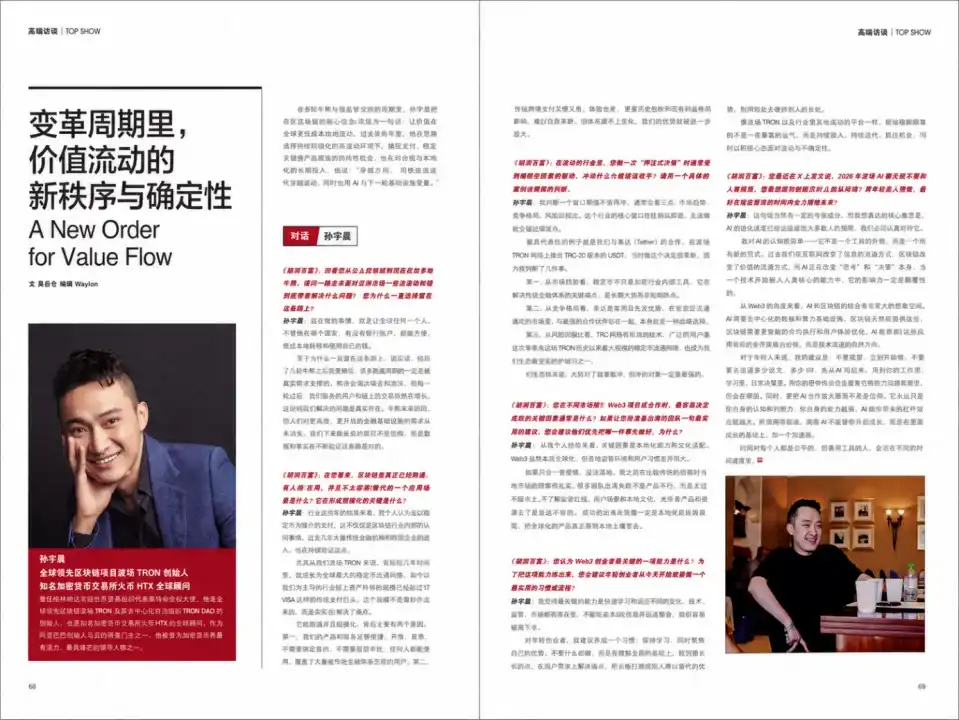
Stablecoins Build Global Value Flow Networks, Web3 Infrastructure Enters Scaling Phase

In the Hurun Report interview, Justin Sun succinctly summarized his long-term core objective: "To enable any individual worldwide, regardless of location or bank account access, to transfer and utilize their funds at low cost and with high efficiency." This statement fundamentally reveals the value essence of blockchain technology—building an open and inclusive value internet.

He further noted that after enduring multiple bull-bear cycles, projects capable of weathering market fluctuations must be rooted in genuine demand and practical utility. The continuous growth in on-chain user scale and transaction volume serves as a key metric for evaluating industry direction. Against this backdrop, the on-chain payment system centered around stablecoins has emerged as the most mature and scalable application scenario.

In the Hurun Report interview, Justin Sun mentioned that TRON has rapidly evolved into one of the world's largest stablecoin circulation networks, with its on-chain asset transfer volume even surpassing certain traditional payment networks. This growth is not driven by short-term market sentiment but by sustained usage in real-world scenarios such as cross-border remittances, value storage, and daily payments. Official data indicates that the circulating volume of USDT on the TRON network now exceeds $86.3 billion, reflecting strong network effects driven by authentic user demand.

From a structural perspective, the scaling of stablecoin payments benefits from two factors: firstly, the open and permissionless nature of blockchain networks enables them to reach user groups underserved by traditional financial systems; secondly, the limitations of traditional cross-border payment systems in terms of efficiency, cost, and user experience create significant opportunities for next-generation infrastructure. Justin Sun believes this trend represents a "natural substitution" of existing financial systems by technological advancement rather than short-term competition.

Globalization Strategy and Technology Integration: Building Long-Term Competitive Advantages in Web3

When discussing enterprise growth and strategic decision-making, Justin Sun presented a highly systematic methodology in the Hurun Report interview. He summarized the key success factors as a combination of "data-driven iteration, rapid execution, and user orientation," emphasizing that in a fast-changing technological environment, single-dimensional capabilities are insufficient for sustaining long-term competitiveness. Synergy among these elements is essential for efficient experimentation and precise decision-making.

At the organizational level, he proposed a management framework based on "clear direction, layered support, and a sense of ownership among all members" to avoid deviations and loss of control during rapid expansion. This flat and agile organizational structure is seen as a crucial foundation for Web3 enterprises to maintain competitiveness in highly uncertain environments.

Regarding critical strategic decisions, Justin Sun reflected on TRON’s collaboration with Tether to launch TRC-20 USDT. He stated that this decision was based on a comprehensive assessment of market trends, competitive landscapes, and risk-reward ratios: stablecoins represent a long-term trend in financial system evolution, top-tier assets exhibit significant network effects, and the upside potential in this field far outweighs potential risks. This partnership has since become a key growth engine for the TRON ecosystem and established its core competitive moat in the stablecoin space.

On global expansion, Justin Sun emphasized that while Web3 inherently possesses cross-border attributes, its practical implementation heavily relies on local compliance and cultural adaptation. In the Hurun Report interview, he pointed out that significant differences exist across markets in regulatory frameworks, user habits, and business environments. The success of a project often depends on the depth of understanding of these differences and the ability to build local partnership networks.

Furthermore, Justin Sun expressed clear views on AI development. In the interview, he noted that AI is not merely a tool upgrade but a reconstruction of "thinking and decision-making capabilities." Its integration with blockchain in areas such as data, computing power, and intelligent execution will become a key direction for the next phase of technological evolution. Blockchain provides decentralized infrastructure for AI, while AI enhances the intelligence and user experience of blockchain systems. The convergence of the two holds long-term strategic value.

For industry participants and young entrepreneurs, Justin Sun’s core advice in the Hurun Report interview is that continuous learning and rapid adaptation are the most critical abilities in highly uncertain environments. At the same time, one should focus investments on building irreplaceable core strengths based on a holistic understanding of the industry, rather than dispersing resources across multiple tracks.

From early-stage technology verification and market exploration to the large-scale application phase represented by stablecoins, and extending to AI integration and global compliance implementation, TRON is driving the adoption and evolution of the value internet through infrastructure capabilities, globalization strategies, and forward-looking technological positioning.


Related Questions

QAccording to Justin Sun's interview with *Hurun Report*, what is described as the most mature and scalable application scenario currently within the Web3 infrastructure evolution?

AAccording to Justin Sun's interview with *Hurun Report*, the on-chain payment system with stablecoins at its core is described as the most mature and currently scalable application scenario.

QWhat key advantages of blockchain networks, as highlighted by Justin Sun, facilitate the large-scale adoption of stablecoin payments compared to traditional systems?

AJustin Sun highlighted that blockchain networks' openness and permissionless nature allow them to reach user groups underserved by traditional finance, while traditional cross-border payment systems' limitations in efficiency, cost, and user experience create significant replacement potential.

QWhat is the long-term goal of Justin Sun and TRON, as summarized in his interview with *Hurun Report*?

AJustin Sun's long-term goal for TRON, as summarized in the interview, is to enable 'anyone in the world, regardless of location or whether they have a bank account, to transfer and use their funds with low cost and high efficiency.'

QWhat strategic factors contributed to the success of TRON's collaboration with Tether to launch TRC-20 USDT, according to Justin Sun's explanation?

AAccording to Justin Sun, the decision was based on a comprehensive judgment of market trends, competitive landscape, and risk-reward ratio, recognizing stablecoins as a long-term trend in financial evolution where leading assets exhibit strong network effects, with the upside far outweighing potential risks.

QHow does Justin Sun view the relationship between AI and blockchain, and what potential does their integration hold?

AJustin Sun views AI as a reconstruction of 'thinking and decision-making capabilities.' He believes the integration of AI and blockchain in data, computing power, and intelligent execution will be a crucial direction for technological evolution, with blockchain providing decentralized infrastructure for AI, and AI enhancing blockchain's intelligence and user experience.

Related Reads

Sharplink CEO: One Million Ethereum Developers, Who Can Compete?

Etherean Ecosystem: One Million Developers and a Formidable Moat The Ethereum network has surpassed a significant milestone: over one million unique lifetime developers, with approximately 232,000 active in the past year. This vast and growing talent pool is Ethereum's core advantage, far more critical than transient metrics like speed or transaction fees. The central question is not which blockchain is fastest, but where the best builders choose to build long-term. Ethereum's answer lies in a decade-long accumulation of infrastructure, standards, tools, liquidity, and collaborative culture that is exceptionally difficult to replicate. It has become the default operating system for programmable finance. This massive developer base is actively working on complex, high-risk challenges that deepen Ethereum's strategic moat: * **Glamsterdam Upgrade (2026):** Focused on core protocol scalability (ePBS, parallel execution) while preserving core values like credible neutrality. * **Synchronous Composability:** Aims to make numerous Rollups interoperate like a single chain, directly addressing fragmentation concerns. * **Quantum Resistance:** Ethereum leads mainstream ecosystems in coordinated preparation for post-quantum cryptography, with a targeted migration plan around 2029. This developer advantage is self-reinforcing, fueled by: * **Deep Composability:** Applications interact like interoperable financial Lego bricks via shared standards (e.g., EVM, Solidity). * **Credible Neutrality:** Secured by over 900,000 validators, making it trusted by major institutions. * **Modularity:** Rollups (Base, Arbitrium, etc.) expand, rather than fracture, the ecosystem into a tightly connected modular internet economy. * **Culture:** Attracts top-tier researchers and standard-setters who guide the entire industry. In essence, while other chains generate activity, Ethereum is consolidating as the trusted, long-term coordination layer for internet-native finance. Its future is being built now by the architects of the next-generation financial infrastructure.

Odaily星球日报26m ago

Sharplink CEO: One Million Ethereum Developers, Who Can Compete?

Odaily星球日报26m ago

Ethereum Reaches the Milestone of One Million Developers, Sharplink CEO Delves Deep into Ethereum's Future Possibilities

Ethereum Surpasses One Million Developers Milestone: A Look at Its Unshakeable Dominance and Future Joseph Chalom, CEO of Sharplink, reflects on his recent Asia trip where he engaged deeply with Ethereum developers and ecosystem leaders. The most striking takeaway was not just the industry's vibrancy, but the rigorous, long-term vision of local builders. This context brings to life a pivotal statistic: Ethereum has now surpassed one million cumulative developers (1,012,824), with approximately 232,000 remaining active in the past year—a talent pool unmatched by any other crypto ecosystem. The critical question isn't which blockchain is fastest, but where top developers choose to build long-term. Ethereum's answer is unequivocal. Its decade-long lead stems from a unique convergence of technology, institutional culture, economic systems, and composability, cementing its role as the foundational operating system for programmable finance. This massive developer base is tackling the industry's hardest problems, continuously strengthening Ethereum's moat. Key initiatives include: * **The Glamsterdam Upgrade (planned 2026):** Introducing ePBS and Block-level Access Lists for parallel execution and higher throughput while preserving core values like credible neutrality and fair MEV distribution. * **Synchronous Composability:** Projects are working to enable atomic transactions across dozens of Rollups, making them function as one unified chain and eliminating ecosystem fragmentation. * **Post-Quantum Security:** Ethereum is far ahead in preparing for quantum computing threats, with a dedicated foundation working group and testnets targeting a full migration by ~2029—a crucial factor for institutional adoption. Beyond developers, Ethereum's core network effects are its unparalleled composability and unified standards (like EVM and Solidity), which create a powerful flywheel: more developers → better tools → greater liquidity → more institutional participation. Its other decisive advantages include credible neutrality (over 900k validators), a secure modular architecture with interconnected Rollups, and a deeply entrenched culture shaped by top-tier researchers. Ultimately, there's a vast difference between generating short-term activity and becoming the trusted, long-term coordination layer for global native finance. Major institutions prioritize security, trust, and liquidity—areas where Ethereum holds dominant mindshare. The industry's trajectory shows resources consolidating around unified standards, deep liquidity, and developer consensus. After meeting the builders in Seoul and Hong Kong, Chalom is more convinced than ever: Ethereum's unshakeable future is being built right now.

Foresight News37m ago

Ethereum Reaches the Milestone of One Million Developers, Sharplink CEO Delves Deep into Ethereum's Future Possibilities

Foresight News37m ago

Saylor's Latest Long Read: Bitcoin is Not Money, It's Digital Capital, and Money is Built Upon It

Michael Saylor presents his "Digital Asset Stack" theory, positioning Bitcoin as the foundational layer of digital capital. He argues Bitcoin itself should remain unchanged—no staking, inflation, or protocol alterations. Instead, a five-layer financial architecture should be built atop it: Digital Capital (BTC), Digital Credit (e.g., yield instruments like STRC), Digital Currency (stable, yield-bearing instruments pegged to fiat), Digital Yield (leveraged/structured products), and Digital Equity (e.g., MSTR stock, absorbing residual volatility). Saylor asserts this stack transforms Bitcoin's high-volatility, high-energy capital into tailored products: stable currencies for payments/savings, yield instruments for income seekers, and equity for growth investors. This approach meets diverse needs—corporate treasuries, banks, retirees, emerging market users—without compromising Bitcoin's core properties (scarcity, decentralization). The "killer use case" is rebuilding global money, credit, and capital markets on Bitcoin, bridging the fiat world with a superior digital asset foundation. The system leverages traditional finance principles (risk layering, structured products) while using Bitcoin as the ultimate collateral. This expands Bitcoin's utility, drives adoption, and offers a better monetary experience: digital, yield-bearing, stable-value tools for everyday use.

marsbit50m ago

Saylor's Latest Long Read: Bitcoin is Not Money, It's Digital Capital, and Money is Built Upon It

marsbit50m ago

Can SK Hynix's Stock Double Again in This Rally?

The article discusses the highly optimistic price target of approximately $3,500 for SK Hynix stock, set by Aletheia Capital. This target is significantly above the consensus range of $2,000-$2,520 from major brokerages. The core debate is whether SK Hynix deserves a fundamental re-rating beyond its traditional cyclical discount, based on the long-term impact of AI-driven demand. The $3,500 target hinges on three key assumptions holding simultaneously until at least 2027: 1) Continued shortage and high pricing for HBM (High Bandwidth Memory), a critical component for AI chips; 2) Sustained high prices for standard DRAM, as HBM production consumes capacity and constrains general supply; and 3) Strong AI server demand generating substantial, above-expectation free cash flow. SK Hynix's leading ~58% market share in HBM and its early certification with key clients like Nvidia provide a competitive advantage, allowing it to capture significant supply chain premiums. The HBM shortage is seen not just as a niche growth driver but as a catalyst that amplifies profitability across the entire memory business by tightening overall DRAM supply. However, the article cautions that this target represents an optimistic "tail scenario." Key risks include potential supply increases from competitors (Samsung, Micron) by 2027, a possible slowdown in HBM price growth, and high capital expenditures that could erode the projected free cash flow. The divergence in analyst targets reflects the market's uncertainty over whether the current AI-driven boom will temporarily elevate earnings or permanently raise the memory industry's profit baseline.

marsbit53m ago

Can SK Hynix's Stock Double Again in This Rally?

marsbit53m ago

Trading

Spot
Futures

Hot Articles

How to Buy FLOW

Welcome to HTX.com! We've made purchasing Flow (FLOW) simple and convenient. Follow our step-by-step guide to embark on your crypto journey.Step 1: Create Your HTX AccountUse your email or phone number to sign up for a free account on HTX. Experience a hassle-free registration journey and unlock all features.Get My AccountStep 2: Go to Buy Crypto and Choose Your Payment MethodCredit/Debit Card: Use your Visa or Mastercard to buy Flow (FLOW) instantly.Balance: Use funds from your HTX account balance to trade seamlessly.Third Parties: We've added popular payment methods such as Google Pay and Apple Pay to enhance convenience.P2P: Trade directly with other users on HTX.Over-the-Counter (OTC): We offer tailor-made services and competitive exchange rates for traders.Step 3: Store Your Flow (FLOW)After purchasing your Flow (FLOW), store it in your HTX account. Alternatively, you can send it elsewhere via blockchain transfer or use it to trade other cryptocurrencies.Step 4: Trade Flow (FLOW)Easily trade Flow (FLOW) on HTX's spot market. Simply access your account, select your trading pair, execute your trades, and monitor in real-time. We offer a user-friendly experience for both beginners and seasoned traders.

3.2k Total ViewsPublished 2024.03.29Updated 2026.06.02

How to Buy FLOW

Discussions

Welcome to the HTX Community. Here, you can stay informed about the latest platform developments and gain access to professional market insights. Users' opinions on the price of FLOW (FLOW) are presented below.

活动图片