OpenSea lanza ERC-8257: la tienda de herramientas para AI Agents, compra un NFT para desbloquear la API

marsbitPublished on 2026-05-27Last updated on 2026-05-27

Abstract

OpenSea ha lanzado ERC-8257: un estándar de registro de herramientas en cadena para agentes de IA. Permite a los desarrolladores publicar herramientas (como APIs), establecer reglas de acceso (por ejemplo, poseer un NFT específico) y precios, todo ejecutado automáticamente en la cadena de bloques. Los agentes de IA pueden navegar el registro, cumplir los requisitos (como comprar un NFT) y pagar por el acceso sin intervención humana, permitiendo un ecosistema de herramientas autónomo. Esto también otorga nueva utilidad a los NFTs, que pueden actuar como llaves para servicios. El estándar es combinable con otros como ERC-8004 para identidad de agentes y x402 para pagos. Ya está operativo en Ethereum y Base, y los desarrolladores pueden comenzar a construir con el SDK proporcionado.

Autor: OpenSea

Compilación: Shenchao TechFlow

Introducción de Shenchao: Cuando un Agente de IA es rechazado por una API debido a permisos insuficientes, él mismo va a la cadena y compra un NFT para luego reintentar con éxito—esto no es ciencia ficción, el estándar ERC-8257 recién fusionado por OpenSea hace que esto sea una realidad. Para los poseedores de NFT, tu imagen JPG podría convertirse repentinamente en la llave de la economía de los Agents; para los desarrolladores, la publicación, fijación de precios y control de acceso de las herramientas se realizan completamente en la cadena, sin necesidad de la aprobación de plataformas centralizadas.

App Store le dio a los desarrolladores un lugar para publicar herramientas, a los usuarios un lugar para explorarlas, e incorporó controles de acceso y pagos. El ecosistema de herramientas para AI Agents también necesita una infraestructura similar.

Pero hoy en día, las herramientas para Agents están dispersas en documentación, repositorios de GitHub y directorios centralizados. No existe un registro abierto de herramientas, ni un control de acceso estandarizado; los Agents no pueden explorar las herramientas disponibles y obtenerlas según sea necesario.

Ver a un software pagar de forma autónoma a otro software para obtener acceso, sin ninguna intervención humana—ciertamente se siente un poco extraño. Pero esto es precisamente el punto clave.

ERC-8257: Agent Tool Registry es la capa base que hace que todo esto funcione. Este es el estándar abierto de Ethereum que acabamos de fusionar: un registro en cadena donde cualquiera puede publicar herramientas, declarar reglas de acceso y precios, permitiendo a los Agents satisfacer estos requisitos de forma autónoma.

Para los desarrolladores de herramientas: publícala una vez, establece un umbral de acceso para tus poseedores de NFT, ofrece paquetes de suscripción, limita el número de plazas, y déjalas comerciar en mercados públicos. Tus reglas, ejecutadas en cadena.

Para los Agents: explora el registro, revisa qué se necesita y luego actúa. Compra un NFT, acuña una suscripción, firma un pago. Sin intervención humana.

Imagina esta escena

Un Agente de IA te está ayudando a evaluar el precio de un NFT. Intenta invocar una herramienta de valoración profesional. La herramienta responde: acceso denegado, necesitas poseer un NFT específico para obtener el precio con descuento. El Agent inmediatamente va a la cadena y compra uno, reintenta y obtiene la respuesta.

Segundos, no días. Todo el proceso sin participación humana.

Este es el mundo que ERC-8257 hace posible. No dentro de cinco años. Es hoy.

¿Por qué en la cadena?

La criptografía es la única infraestructura que puede hacer que las reglas de acceso sean a la vez ricas y de autoservicio. x402 lo demostró: pago por uso, acceso inmediato. Pero el pago por uso es solo una forma de acceso. Las señales de trading pueden necesitar limitar plazas. Una API de socio puede estar abierta solo para poseedores. Las suscripciones de investigación pueden necesitar precios escalonados. ERC-8257 maneja todo esto.

Cómo funciona

Registras una herramienta con un manifiesto (funciones de la herramienta, cómo invocarla, tarifas) y un "predicado de acceso". El predicado de acceso es un contrato inteligente que responde solo una pregunta: ¿esta dirección tiene acceso?

El predicado puede verificar cualquier condición: propiedad de NFT, suscripción activa (ERC-5643), lista blanca, prueba ZK, voto de DAO, cantidad apostada. Los predicados son enchufables, siguiendo el mismo patrón que las zonas de Seaport o los hooks de Uniswap v4: un punto de extensión, un espacio de diseño abierto.

ERC-8257 se encarga del descubrimiento y control de acceso. El pago lo manejan los protocolos más adecuados: x402 para micropagos, MPP para facturación medida, otros protocolos pueden unirse según sea necesario. Estas capas son combinables.

¿Qué significa esto para los NFT?

Cada colección de NFT acaba de obtener una nueva utilidad potencial.

Al poseer el token correcto, tu Agent obtiene paquetes de API más baratos. Acuña una plaza limitada, tu Agent obtiene un acceso que otros no pueden comprar por ningún precio. Colecciones de PFP, pases de membresía, obras de arte CC0, cualquier activo en cadena podría convertirse en la llave que el Agent necesita para completar su trabajo.

Aquellos proyectos que construyen identidad alrededor de una comunidad ahora tienen una forma de extender la membresía hacia la economía de los Agents.

Su posición en la pila tecnológica
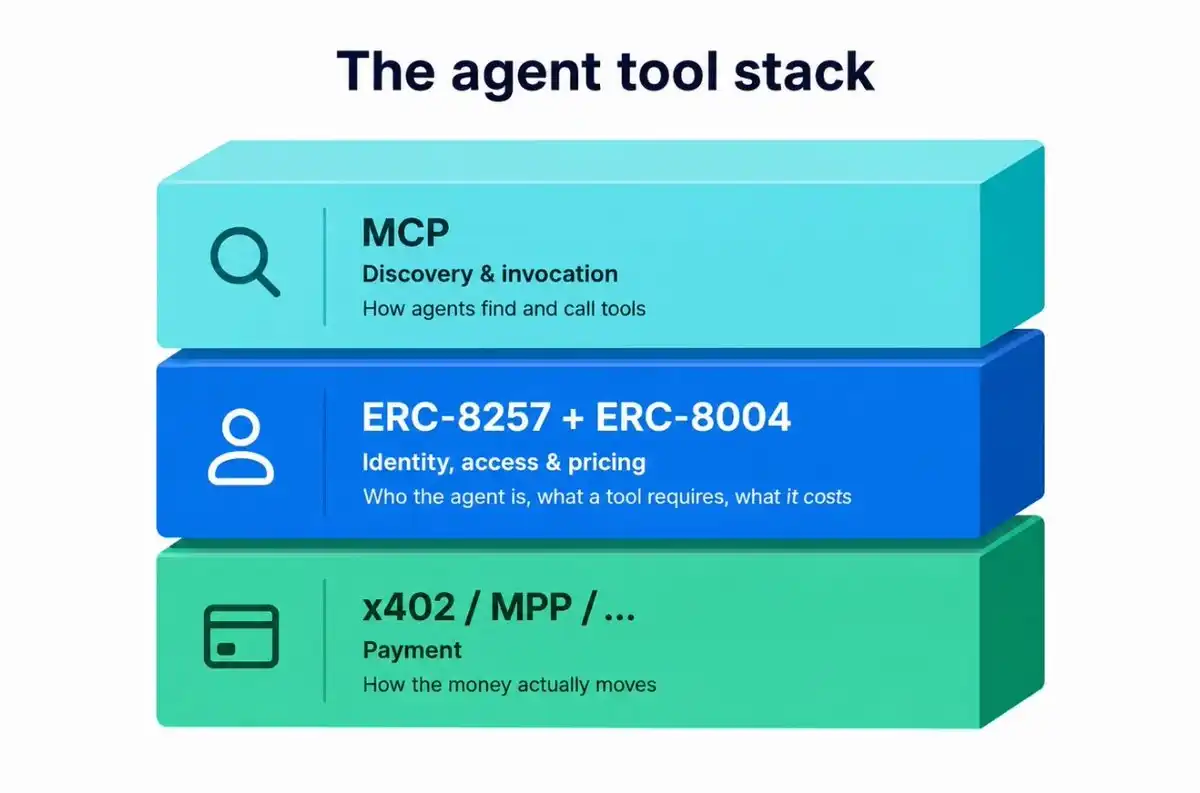
MCP le dice a tu Agent qué herramientas existen. ERC-8004 define la identidad de tu Agent. ERC-8257 especifica cómo usar realmente las herramientas. x402 maneja el pago. Cada capa es combinable.

Los Agents registrados a través de ERC-8004 pueden vincular en su array de servicios herramientas restringidas del registro de ERC-8257. No tienes que elegir entre ellas. Son diferentes capas de la misma pila tecnológica.

Vélo en funcionamiento

nft-appraisal-tool: apunta a cualquier NFT, devolverá una valoración de precio, incluyendo rangos bajo/medio/alto, nivel de confianza, transacciones recientes y casos comparables. Dos niveles: cualquiera a 0.05 dólares por uso, poseedores de CHONK en Base a 0.01 dólares por uso.

Un Agent sin CHONK llama al endpoint de poseedor. Respuesta: 403—predicado de acceso denegado. Necesitas CHONK en Base.

El Agent compra uno, reintenta, la misma llamada retorna éxito.

$ npx @opensea/tool-sdk pay https://nft-appraisal-tool.vercel.app/api/holder --auth siwe \

--body '{"chain":"ethereum","contractAddress":"0x79fcdef22feed20eddacbb2587640e45491b757f","tokenId":"4707"}'

Wallet: 0x3184...0465

Response (403):

{"error":"Predicate gate: access predicate denied","toolId":"2","predicate":"0xc872..."}

El predicado le dice claramente lo que necesita: CHONK en Base. El Agent compra uno en OpenSea y reintenta, la llamada pasa.

$ npx @opensea/tool-sdk pay https://nft-appraisal-tool.vercel.app/api/holder --auth siwe \
--body '{"chain":"ethereum","contractAddress":"0x79fcdef22feed20eddacbb2587640e45491b757f","tokenId":"4707"}'
Wallet: 0x5eca...e2a8

Response (200):
{
"low": {"amount": "1.8", "currency": "ETH", "usd": 5460},
"mid": {"amount": "2.3", "currency": "ETH", "usd": 6970},
"high": {"amount": "3.1", "currency": "ETH", "usd": 9400},
"confidence": "medium",
"reasoning": "Squiggles comparables en este rango de color se vendieron entre 1.9 y 2.6 ETH...",
...
}

No hubo humanos entre el 403 y el 200. Quien posee el NFT de acceso, tiene el acceso.

Qué se puede construir a continuación

Oráculos de precios profesionales. Suscripciones de análisis en cadena. Suscripciones de investigación. APIs de lista blanca para socios. Herramientas con plazas limitadas que se negocian en mercados públicos como cualquier otro activo.

Nada de esto era necesario hace un año. En el momento en que el registro esté en línea, todo se vuelve posible.

Comienza a construir

Ya está disponible en Ethereum y Base.

@opensea/tool-sdk maneja los detalles subyacentes, proporciona andamiaje, puertas de acceso, registro, despliegue en Vercel, Cloudflare o Express. Incluye ejemplos disponibles.

npx @opensea/tool-sdk init my-tool

La especificación completa está en 8257.ai.

Participa

ERC-8257 aún está en etapa de borrador. Ayúdanos a mejorar la especificación antes de que lancemos la versión oficial 1.0 del registro. Publica una herramienta, aunque sea pequeña. Promoveremos proyectos interesantes.

Únete al grupo de Telegram t.me/ERC8257, habla sobre ERC, el SDK de herramientas y más con los autores @CodinCowboy y @ralxz.

Descargo de responsabilidad: Este contenido es solo para fines informativos y no constituye asesoramiento financiero o comercial. La mención de proyectos, productos, servicios o tokens específicos no constituye respaldo, patrocinio o recomendación por parte de OpenSea. OpenSea no garantiza la exactitud o integridad de la información presentada, y los lectores deben verificar de forma independiente cualquier afirmación antes de actuar. Los lectores deben realizar su propia debida diligencia y asumir toda la responsabilidad antes de tomar cualquier decisión.


Related Questions

Q¿Qué es el estándar ERC-8257 presentado por OpenSea y cuál es su objetivo principal?

AERC-8257, denominado 'Agent Tool Registry', es un estándar de registro en cadena (on-chain) recientemente fusionado en Ethereum por OpenSea. Su objetivo principal es servir como infraestructura base para el ecosistema de herramientas de los Agentes de IA, permitiendo a cualquiera publicar herramientas, definir reglas de acceso y precios en la cadena de bloques, y permitiendo que los Agentes las encuentren y utilicen de manera autónoma para completar tareas, sin intervención humana.

QSegún el artículo, ¿cómo funciona el control de acceso en ERC-8257 a través de los 'predicados de acceso'?

AEl control de acceso en ERC-8257 se gestiona mediante 'predicados de acceso' (access predicates). Un predicado es un contrato inteligente que responde a una sola pregunta: '¿Esta dirección tiene acceso?' Este predicado puede verificar cualquier condición definida en cadena, como la propiedad de un NFT, una suscripción activa (ERC-5643), listas blancas, pruebas ZK, votos en un DAO o montos apostados. Es un punto de extensión intercambiable que permite un amplio espacio de diseño para las reglas de acceso.

Q¿Qué impacto podría tener ERC-8257 en el valor y utilidad de los NFTs existentes, según se describe en el texto?

AERC-8257 podría otorgar una nueva utilidad potencial a todas las colecciones de NFTs existentes. Al poseer el token correcto, un Agente de IA podría acceder a herramientas, APIs o servicios con descuentos, paquetes especiales o acceso exclusivo. PFP, pases de membresía o arte CC0 podrían convertirse en 'llaves' que permitan a los Agentes utilizar herramientas necesarias para su trabajo, extendiendo así la membresía de una comunidad al ámbito de la economía de los Agentes.

QEl artículo menciona otras capas técnicas como MCP, ERC-8004 y x402. ¿Cómo se relacionan o complementan con ERC-8257?

AEstas capas son complementarias y componibles dentro de la pila técnica para Agentes de IA. MCP (Model Context Protocol) informa al Agente sobre qué herramientas existen. ERC-8004 define la identidad del Agente en cadena. ERC-8257 especifica cómo usar realmente las herramientas y controla el acceso. x402 maneja los pagos, especialmente los de micropagos. Un Agente registrado con ERC-8004 puede enlazar en su array de servicios herramientas restringidas del registro ERC-8257, mostrando que funcionan en conjunto en diferentes niveles de la misma pila tecnológica.

QEn el ejemplo práctico del 'nft-appraisal-tool', ¿qué acción autónoma realizó el Agente de IA cuando recibió un error 403 y cómo se resolvió la situación?

AEn el ejemplo, cuando el Agente de IA (sin poseer el NFT CHONK) intentó llamar al endpoint especial para poseedores y recibió una respuesta de error 403 (acceso denegado por el predicado), el Agente actuó de manera autónoma. Comprendió que necesitaba el NFT CHONK en la red Base, fue a OpenSea, compró uno y luego reintentó la misma llamada. Esta vez, la llamada fue exitosa (código 200) y obtuvo la valoración del NFT. Todo el proceso, desde la denegación hasta la compra y el nuevo acceso, se realizó sin intervención humana.

Related Reads

Warsh's Debut: Will the FED Chair Who Knows Crypto Best Bring Surprises or Shocks to the Market?

Kevin Warsh, the new Federal Reserve Chairman, prepares for his inaugural press conference amidst a challenging macroeconomic landscape: resurgent inflation, a bond market sell-off, and political pressure from President Trump for rate cuts. Uniquely, Warsh holds indirect investments in over 20 crypto and Web3 entities (e.g., Solana, dYdX), making him the first Fed Chair with disclosed crypto exposure. His stance may combine a hawkish, inflation-focused monetary policy with a crypto-friendly regulatory philosophy that shifts from Powell’s “same risk, same rule” approach toward a framework acknowledging blockchain’s productivity value. Warsh’s leadership could impact crypto markets across three dimensions: a paradigm shift in regulation (potentially accelerating pro-innovation legislation and stable币 rules), a re-pricing of risk premiums based on clearer communication and his view of AI as a structural disinflationary force, and a long-term reallocation of global institutional capital driven by increased legitimacy. Two potential scenarios for the press conference are outlined. A “positive surprise” would involve a dovish-leaning tone on rates coupled with signals of regulatory openness, potentially boosting crypto asset valuations. Conversely, a “negative shock” would see a more hawkish-than-expected stance on inflation and rates, triggering a broad risk-asset selloff that crypto markets would not escape. While ethics rules required Warsh to divest his crypto holdings upon confirmation, his deep understanding of the technology may fundamentally lower policy uncertainty and build a more receptive long-term foundation for digital assets’ integration into the mainstream financial system.

marsbit5h ago

Warsh's Debut: Will the FED Chair Who Knows Crypto Best Bring Surprises or Shocks to the Market?

marsbit5h ago

Trading

Spot
Futures

Hot Articles

How to Buy NFT

Welcome to HTX.com! We've made purchasing AINFT (NFT) simple and convenient. Follow our step-by-step guide to embark on your crypto journey.Step 1: Create Your HTX AccountUse your email or phone number to sign up for a free account on HTX. Experience a hassle-free registration journey and unlock all features.Get My AccountStep 2: Go to Buy Crypto and Choose Your Payment MethodCredit/Debit Card: Use your Visa or Mastercard to buy AINFT (NFT) instantly.Balance: Use funds from your HTX account balance to trade seamlessly.Third Parties: We've added popular payment methods such as Google Pay and Apple Pay to enhance convenience.P2P: Trade directly with other users on HTX.Over-the-Counter (OTC): We offer tailor-made services and competitive exchange rates for traders.Step 3: Store Your AINFT (NFT)After purchasing your AINFT (NFT), store it in your HTX account. Alternatively, you can send it elsewhere via blockchain transfer or use it to trade other cryptocurrencies.Step 4: Trade AINFT (NFT)Easily trade AINFT (NFT) on HTX's spot market. Simply access your account, select your trading pair, execute your trades, and monitor in real-time. We offer a user-friendly experience for both beginners and seasoned traders.

7.1k Total ViewsPublished 2024.03.29Updated 2026.06.02

How to Buy NFT

What is Altura NFT?

Altura: Providing One-Stop NFT Solutions for Game Developers

56.0k Total ViewsPublished 2024.06.12Updated 2024.06.12

What is Altura NFT?

What is AINFT

EternaFi Agents and $AINFT: A Comprehensive Analysis of AI-Powered NFT Infrastructure in the Web3 Ecosystem The intersection of artificial intelligence (AI) and blockchain technology is rapidly evolving, establishing innovative platforms that redefine ownership models and economic participation. EternaFi Agents, along with its native token $AINFT, exemplifies a groundbreaking approach to the tokenization of AI infrastructures through the means of non-fungible tokens (NFTs). Launched in July 2025 by the development team at Nova Club, EternaFi merges the advancements of AI with the decentralized financial mechanisms of blockchain, presenting a unique investment opportunity for participants within the web3 ecosystem. This article aims to provide an in-depth assessment of EternaFi Agents, covering its core components, functionality, and significance within the crypto landscape. Introduction and Project Overview EternaFi Agents stands as a salient example of how blockchain technology can democratize access to advanced AI capabilities. The project endeavors to reshape the paradigm of AI ownership by diversifying economic participation, making sophisticated AI systems accessible to a larger pool of stakeholders. At its core, the project tokenizes a proprietary large language model (LLM) developed by Nova Club, allowing NFT holders to gain fractional exposure to the model's economic performance. By utilizing NFTs representing stakes in the LLM, EternaFi Agents fosters a model wherein stakeholders not only participate in AI service consumption but also enjoy sharing in the economic rewards generated by the platform. This transformative approach enables the development of sustainable revenue models for AI services, all the while promoting broad community engagement and facilitating transparent governance. What is EternaFi Agents? EternaFi Agents represents an AI-NFT infrastructure project that aims to blend the capabilities of AI with blockchain technology in a coherent ecosystem. The essential feature of this project is the creation of NFTs that serve as financial instruments, representing fractions of ownership in Nova Club's proprietary AI infrastructure. Each NFT symbolizes direct exposure to the economic performance of the underlying AI system, providing a lucrative opportunity for investors. The project operates on the Base blockchain, known for its scalability and efficiency, thus ensuring manageable transaction costs while facilitating a seamless operational experience. One of the notable features includes a revenue-sharing mechanism, wherein NFT holders can receive portions of subscription income generated by the AI services provided on the platform. This innovative approach establishes a connection between the success of the AI services and the economic dividends distributed among the holders, thus ensuring an alignment of interests across the community. Who is the Creator of EternaFi Agents? The creative force behind EternaFi Agents is Nova Club, a development team based in Singapore proficient in the amalgamation of AI and blockchain technology. Their prior experience in AI development and cryptocurrency analysis gives credence to the project, contributing a breadth of expertise to the creation of EternaFi Agents. Nova Club’s mission centers on democratizing access to cutting-edge AI technologies while building sustainable economic models that benefit users alongside developers. Their commitment to transparency, community governance, and innovation is reflected in the design and implementation of the EternaFi platform, aiming to establish a unique ecosystem that fosters positive engagement and long-term value creation. Who are the Investors of EternaFi Agents? The specific details concerning investors or investment organizations backing EternaFi Agents are not publicly available. However, EternaFi has adopted an inclusive approach to funding its development through the sale of NFTs to the public, allowing a wide array of participants to invest in the ecosystem. The project’s architecture ensures that core infrastructure is funded responsibly while allowing community members to partake in the ownership and economic returns generated from the AI services. This model emphasizes community engagement by aligning the interests of investors and project developers, creating a collaborative environment where long-term participation is incentivized. How Does EternaFi Agents Work? EternaFi Agents operates through a multifaceted ecosystem where NFTs serve as a primary means of ownership representation within the project. Each NFT holder is entitled to a share of the monthly subscription income produced by the underlying AI-powered platform, thereby positioning NFT ownership as a lucrative investment vehicle. Revenue Generation Mechanism The primary source of revenue generation for the EternaFi platform stems from subscription fees related to the AI services provided. Users can access various tiered services, ranging from basic market analysis tools to comprehensive AI-assisted trading solutions. These services are monetized and form the basis for the revenue-sharing framework, which distributes profits to NFT holders through automated smart contracts. An innovative feature of the EternaFi ecosystem is the revenue-sharing mechanism that operates transparently, ensuring that rewards are allocated based on verifiable metrics from the AI platform's operations. This creates a direct link between the performance of AI services and the returns available to community investors, establishing a sustainable economic model. Staking and Vesting Mechanisms Participants within EternaFi can engage in staking their NFTs to unlock additional economic benefits. The vesting schedule is designed to promote long-term commitment among participants, rewarding those who exhibit ongoing support for the project. This ensures a robust alignment of interests and fosters a sense of community engagement essential for achieving the project's long-term goals. Transparent Governance EternaFi Agents embraces decentralized governance, allowing NFT holders to play an active role in decision-making regarding the platform's development and future directions. The governing structure includes community voting mechanisms, providing NFT holders with the opportunity to influence significant decisions and contributing to a collaborative approach to project growth. Timeline of EternaFi Agents The development trajectory of EternaFi Agents showcases a systematic approach toward building a sustainable AI infrastructure while meeting the needs of community participants. Below is a timeline of important milestones in the project’s history: July 2025: Launch of EternaFi Agents, including the public sale of NFTs and deployment of the $AINFT token on the Base blockchain. Q4 2025: Establishment of market infrastructure including liquidity pools and launch of staking dashboards for NFT holders. 2026: Initiation of community engagement programs, expanding AI capabilities, and integration with cross-chain technologies. Q4 2026: Implementation of the dividend distribution system, allowing NFT holders to reap economic benefits from their investments. These milestones signify the focus on establishing a functional and participative ecosystem while ensuring continuous evolution to meet market demands. Technological Infrastructure and Blockchain Integration EternaFi Agents is anchored in an advanced technological framework combining AI systems with blockchain capabilities. Operating on the Base blockchain, the project leverages the advantages of scalability and low transaction costs. The underlying smart contract architecture governs the NFT ownership, revenue sharing, and community management features, ensuring efficiency and transparency. AI System Development The proprietary large language model underpinning EternaFi Agents has been independently developed and designed to cater to revenue-generating applications without reliance on proprietary external frameworks. This endeavor reflects a commitment to creating a versatile and adaptable AI infrastructure capable of delivering meaningful services to users, thus generating economic value for investors. Security Measures The robustness of EternaFi’s security infrastructure is paramount. Regular audits and stringent security measures ensure the integrity of the AI systems and blockchain mechanisms, safeguarding against potential vulnerabilities while fostering confidence among participants. Conclusion EternaFi Agents signifies a landmark innovation within the realm of artificial intelligence and blockchain technology, opening avenues for community ownership and economic participation in advanced AI capabilities. The project’s comprehensive strategy to tokenize AI infrastructure via NFTs establishes a precedent for future decentralized ecosystems. By harmonizing technical sophistication with user-centric economic models, EternaFi not only fosters engagement but also generates a sustainable revenue-sharing framework for community participants. The significance of EternaFi extends well beyond its operational success as it exemplifies how blockchain can democratize cutting-edge AI technologies, paving the way for future ventures in this intersectional space. The evolution of EternaFi Agents may herald a new era of AI development characterized by participant-driven governance, sustainable economic models, and transparent verification, ultimately contributing to the broader democratization of AI and technology accessibility across industries.

4.0k Total ViewsPublished 2025.08.14Updated 2025.08.14

What is AINFT

Discussions

Welcome to the HTX Community. Here, you can stay informed about the latest platform developments and gain access to professional market insights. Users' opinions on the price of NFT (NFT) are presented below.

活动图片