Se acerca la tormenta Wash

marsbitPublished on 2026-05-19Last updated on 2026-05-19

Abstract

La nueva presidencia de la Fed con Kevin Warsh podría intensificar la presión sobre las acciones estadounidenses, especialmente en un contexto de rendimientos elevados y persistentes de los bonos a largo plazo. El artículo argumenta que la base de la reciente racha alcista del mercado, impulsada por la narrativa de la IA, depende en gran medida de la expectativa de que los tipos de interés a largo plazo caigan y de que la Fed actúe como respaldo implícito. Actualmente, el rendimiento del bono del Tesoro a 30 años supera el 5%, presionado por una inflación persistente, preocupaciones sobre la sostenibilidad fiscal de EE. UU. y una estructura de oferta/demanda desfavorable para los bonos. Esto erosiona la valoración de las acciones, que son sensibles a las tasas de descuento. Warsh, que asumió el 15 de mayo, podría ser más propenso que su predecesor Jerome Powell a mantener una política monetaria restrictiva y a continuar con la reducción del balance de la Fed ("quantitative tightening"). Esta postura podría contribuir a mantener altos los rendimientos de los bonos a largo plazo y reducir la percepción de que la Fed intervendrá rápidamente para calmar los mercados. Aunque el optimismo sobre la IA ha sostenido los mercados, el artículo sostiene que su impacto económico amplio y su capacidad para impulsar la productividad aún no están suficientemente probados como para compensar por sí solos la presión de las altas tasas. Por lo tanto, la llegada de Warsh podría marcar un punt...

Producción | App Miaotou

Autor | Ding Ping, App Huxiao

Imagen destacada | Visual China Group

Wash no es la tormenta en sí, pero puede hacer que el mercado descubra que, cuando llegue la tormenta, la Reserva Federal ya no estará en la misma posición de antes.

En los últimos dos años, gigantes tecnológicos como NVIDIA, Microsoft y Meta han batido constantemente récords de valor de mercado. La IA casi ha redefinido la aversión al riesgo de todo el mercado, y los índices S&P y Nasdaq también han sido impulsados al alza.

Pero si desglosamos esta tendencia alcista, la IA es solo la historia de cara al público. La premisa clave que realmente sostiene la valoración del mercado bursátil estadounidense es otra: las tasas de interés a largo plazo finalmente bajarán.

Solo si esta premisa se mantiene, el mercado se atreverá a seguir pagando una prima alta por las ganancias futuras, a descontar continuamente la narrativa de crecimiento de unas pocas empresas tecnológicas líderes hasta el día de hoy, y a seguir persiguiendo valoraciones de 30, 40 o incluso más veces.

Pero ahora, esta premisa se está volviendo inestable.

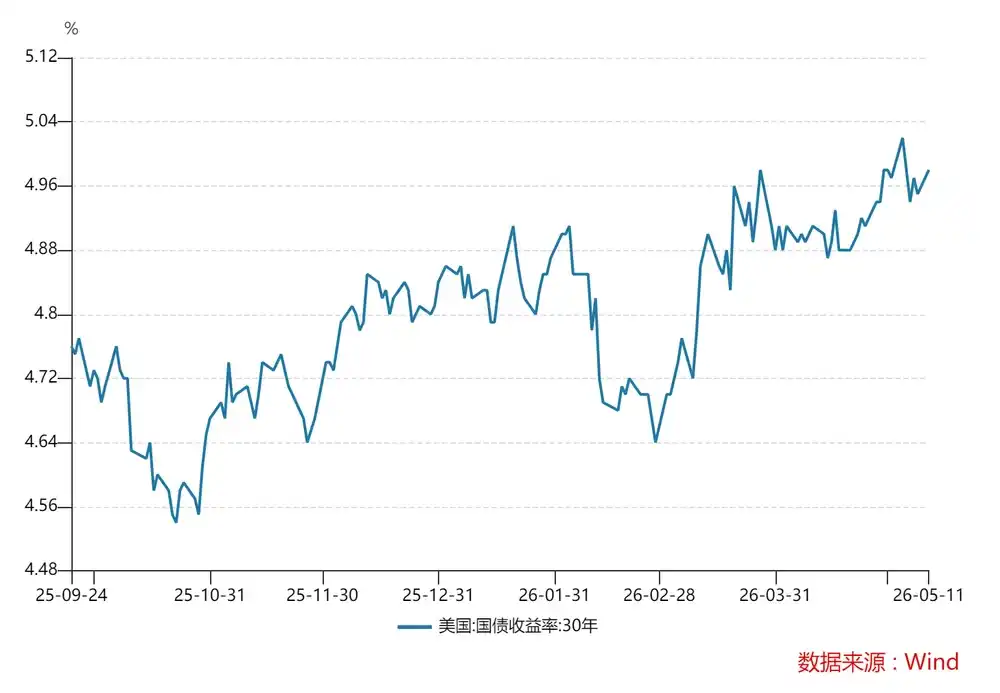
El rendimiento de los bonos del Tesoro estadounidense a 30 años sigue subiendo y recientemente ha superado el nivel alto del 5%. Para un mercado bursátil estadounidense altamente concentrado, caramente valorado y extremadamente dependiente de la narrativa de ganancias futuras, cuanto más tiempo se mantengan altos los tipos de interés a largo plazo, más frágil será el sistema de valoración.

Lo que es peor, esta presión podría aumentar cada vez más.

El 15 de mayo, Jerome Powell, presidente de la Reserva Federal durante ocho años, dejó oficialmente el cargo, y Kevin Wash se convirtió en el nuevo presidente. En comparación con Powell, Wash podría ser más tolerante con la presión del mercado, más firme en la reducción del balance y reduciría el respaldo implícito de la Fed a los mercados financieros.

Una vez que los tipos de interés a largo plazo suban cada vez más y la Reserva Federal ya no tranquilice al mercado con la rapidez de antes, la lógica de prosperidad que sustentaba las altas valoraciones del mercado bursátil estadounidense en el pasado podría comenzar a perder su base.

La vulnerabilidad actual del mercado bursátil estadounidense

Es que los tipos de interés a largo plazo no bajan.

En el último período, el mercado ha centrado excesivamente su atención en si la Reserva Federal recortaría o no las tasas, ignorando un problema: los tipos de interés a largo plazo ya no siguen la política monetaria.

En teoría, si un banco central recorta las tasas, presiona directamente a los tipos de interés a corto plazo. Si el mercado cree que las tasas futuras se mantendrán bajas, los tipos de interés a largo plazo pueden bajar en consecuencia. Pero ahora ha ocurrido algo inesperado: aunque la Reserva Federal no ha subido las tasas, el rendimiento de los bonos del Tesoro a 30 años sigue subiendo, alcanzando un máximo del 5.13% el 15 de mayo. Esto indica que el mercado no cree que el riesgo a largo plazo de Estados Unidos vaya a disminuir, por lo que exige una mayor compensación por riesgo.
Este es precisamente el punto más vulnerable del mercado bursátil estadounidense en este momento.

Hay al menos tres razones por las que los tipos de interés a largo plazo se mantienen altos.

Primero, la inflación no ha retrocedido de manera tan fluida como el mercado esperaba.

Los últimos datos muestran que el IPC de Estados Unidos en abril aumentó un 3.8% interanual, alcanzando un máximo en casi tres años, y el IPC subyacente se amplió al 2.8%. Lo más complicado es que el riesgo de conflicto entre Estados Unidos e Irán no se ha disipado realmente, los precios del petróleo siguen siendo altos, lo que también refuerza las preocupaciones del mercado sobre la inflación importada. Mientras las expectativas de inflación no puedan contenerse por completo, los tipos de interés a largo plazo tendrán dificultades para retroceder.

Segundo, el problema fiscal de Estados Unidos también está debilitando la confianza del mercado en su disciplina fiscal a largo plazo.

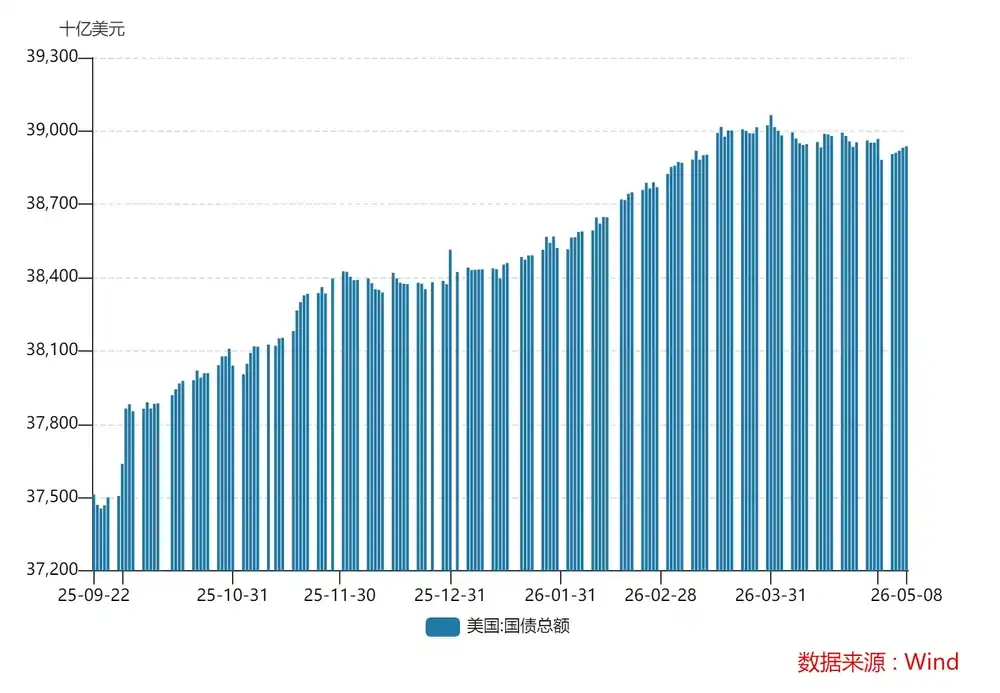
En octubre de 2025, la deuda nacional de Estados Unidos superó los 38 billones de dólares; en solo 5 meses, esta cifra superó los 39 billones de dólares. Detrás de esto hay un déficit fiscal crónico (altos gastos militares y en bienestar social). El Departamento del Tesoro de Estados Unidos emite nuevos bonos para pagar la deuda antigua que vence, y estos nuevos bonos generan mayores gastos por intereses, lo que hace que Estados Unidos caiga en una "esquema Ponzi" de deuda fiscal, es decir, necesita una escala de deuda en constante expansión para mantener la estabilidad del sistema existente.
Tercero, la estructura de oferta y demanda de los bonos del Tesoro estadounidense se está deteriorando.

Por un lado, el Departamento del Tesoro continúa aumentando la emisión de bonos; por otro lado, los inversores extranjeros están reduciendo sus tenencias debido a la desdolarización global. Los sectores oficiales extranjeros están reduciendo la compra de bonos del Tesoro estadounidense, y la proporción de estos en los activos de reserva globales está en una tendencia a la baja, actualmente en un 24%. La oferta aumenta, pero las fuerzas que los absorben se debilitan, y el resultado es que es cada vez más difícil presionar a la baja los tipos de interés a largo plazo.

Cuando estos riesgos no se alivian, los bonos del Tesoro estadounidense dejan de ser un activo seguro, y los inversores naturalmente exigirán una mayor compensación por riesgo.

Esto es especialmente peligroso para el mercado bursátil estadounidense.

Porque el mercado bursátil estadounidense actual no es un mercado generalmente infravalorado que depende del cumplimiento gradual de los resultados, sino un mercado altamente concentrado, sostenido por unas pocas empresas líderes y extremadamente sensible a la tasa de descuento.

Una vez que los tipos de interés a largo plazo se mantengan altos, el descuento de los flujos de efectivo futuros se volverá significativamente más severo, y el rango de tolerancia de la valoración se reducirá rápidamente. En ese momento, las primeras en verse afectadas no serán necesariamente las empresas con los peores fundamentos, sino precisamente aquellas con los mejores fundamentos pero cuyas valoraciones ya están completamente infladas.

Hartnett de Bank of America también señaló que una vez que el rendimiento de los bonos del Tesoro a 30 años supere el 5%, aumentarán los costos de financiamiento del mercado y disminuirá la aversión al riesgo, y las acciones tecnológicas de alta valoración del mercado estadounidense serán las primeras en verse afectadas.

Ya hubo una demostración en octubre de 2023.

En ese momento, el rendimiento de los bonos del Tesoro a 30 años superó brevemente el 5%, y el índice Nasdaq retrocedió aproximadamente un 10% en unos pocos meses. En ese momento, los inversores todavía creían que, si las condiciones financieras seguían deteriorándose, la Reserva Federal finalmente emitiría señales de tranquilización. Pero si, después de que Wash asuma el cargo, esta expectativa comienza a debilitarse, entonces el mismo impacto de los tipos de interés a largo plazo será absorbido por el mercado de una manera completamente diferente.

Mucha gente también gusta comparar el presente con 2007, pero en realidad, lo que vale la pena tomar como referencia no es que las tasas de interés también eran altas entonces, sino que el daño de las altas tasas de interés al sistema financiero nunca ocurre instantáneamente. Es más como una erosión crónica: primero presiona la financiación, luego la valoración, luego el balance, y finalmente obliga a salir al eslabón más débil del sistema.

Lo que realmente explotó en 2007 fue el sector inmobiliario, las hipotecas de alto riesgo y la banca en la sombra; hoy en día, lo más peligroso es que el alto déficit fiscal empuja cada vez más la oferta de deuda a largo plazo, los tipos de interés a largo plazo no bajan, las pérdidas flotantes de los bancos, los riesgos de cola de los bienes raíces comerciales y la dependencia de los activos de riesgo de la liquidez serán gradualmente expuestos.

Por lo tanto, una vez que los tipos de interés a largo plazo no bajen, la base de valoración de este mercado alcista de IA en el mercado estadounidense comenzará a debilitarse.

Este problema será más grave en la era de Wash.

¿Por qué Wash merece la atención del mercado?

Porque Wash tiende a reducir el balance, lo que elevará aún más el rendimiento de los bonos del Tesoro a 30 años y amplificará la vulnerabilidad del mercado bursátil estadounidense.

¿Cómo entender esto?

La reducción del balance de la Reserva Federal significa reducir el tamaño de su balance. Anteriormente, para estimular la economía, la Fed compró muchos activos como bonos del Tesoro y valores respaldados por hipotecas (MBS); al comprar estos activos, inyectó una gran cantidad de fondos al mercado. La reducción del balance implica hacer que estos activos disminuyan, recuperando gradualmente la liquidez del mercado.

También podemos entenderlo simplemente como que la Reserva Federal no asumirá los nuevos bonos del Tesoro o los que venzan, e incluso podría vender los bonos que tiene en su poder.

Como se mencionó anteriormente, actualmente el Departamento del Tesoro de Estados Unidos sigue aumentando la emisión de deuda y los extranjeros siguen reduciendo sus tenencias. Si la Reserva Federal también reduce su balance, entonces los nuevos bonos y los bonos del Tesoro que vencen solo podrán fluir hacia el mercado, y será el mercado quien determine el nivel de las tasas de interés, lo que resultará en un aumento continuo del rendimiento de los bonos del Tesoro. Esto también conducirá a una carga de intereses cada vez más pesada para las finanzas, lo que es muy peligroso para un sistema que depende de emitir nueva deuda para pagar la antigua. Una vez que el costo de los intereses sea demasiado alto para ser sostenido, surgirá la crisis de la deuda estadounidense.

El exsecretario del Tesoro de Estados Unidos, Henry Paulson, también advirtió que una vez que los bonos del Tesoro estadounidense comiencen a perder compradores en el mercado, el "ancla libre de riesgo" de todo el sistema financiero se verá afectada.

Si las consecuencias son tan graves, ¿por qué Wash todavía tiende a reducir el balance? Esto se debe a su experiencia.

Wash se desempeñó como gobernador de la Reserva Federal entre 2006 y 2011, y esta experiencia es fundamental para juzgar su inclinación política. Vivió completamente la última ronda de expansión crediticia antes de la crisis financiera, la crisis financiera global de 2008 y el inicio de las tasas de interés cero y el QE (flexibilización cuantitativa).

No es una persona que niegue completamente el rescate en crisis; por el contrario, en los momentos de mayor riesgo sistémico, apoyó que la Reserva Federal actuara como prestamista de último recurso y reconoció la necesidad de herramientas no convencionales. Pero cada vez dudaba más: ¿debería el QE a largo plazo después de la crisis seguir existiendo a largo plazo?

Porque desde su perspectiva, la economía estadounidense después de la crisis no se recuperó en la misma medida que los precios de los activos. La recuperación de la economía real no fue muy fuerte, la mejora de la productividad fue limitada, pero los precios de los activos financieros se recuperaron rápidamente impulsados por la liquidez, incluso superando los niveles previos a la crisis.

Esto llevó a Wash a formar un juicio muy típico: el QE quizás sea muy bueno para elevar los precios de los activos financieros, pero no necesariamente igual de bueno para reparar la economía real. Una vez que el mercado comienza a asumir que "la Reserva Federal finalmente siempre respaldará los precios de los activos", el sistema financiero se volverá cada vez más dependiente de la liquidez, la aversión al riesgo se verá suprimida a largo plazo y las burbujas y desajustes de activos se volverán cada vez más graves.

Por lo tanto, en su lógica, si la Reserva Federal mantiene un balance muy grande a largo plazo y suprime la prima de plazo durante mucho tiempo, el mercado finalmente será cada vez menos capaz de funcionar independientemente de la liquidez del banco central. En su opinión, la reducción del balance no solo recupera la liquidez, sino que también es una forma en que la Reserva Federal se retira activamente del papel de "estabilizador de las condiciones financieras".

Esta es también la razón por la cual Wash estaría más inclinado que Powell a avanzar en el QT (ajuste cuantitativo).

Por lo tanto, después de que Wash asuma el cargo, el entorno de altas tasas de interés será más severo, y la Reserva Federal no necesariamente intervendrá para tranquilizar al mercado con la rapidez de antes. Una vez que se forme esta expectativa, la presión sobre el ya frágil sistema de altas valoraciones del mercado bursátil estadounidense actual se amplificará aún más.

La narrativa de la IA tampoco puede digerir las altas tasas de interés

Por supuesto, que el rendimiento de los bonos del Tesoro a 30 años se mantenga en un nivel alto no es absoluta y completamente negativo para el mercado bursátil estadounidense.

Si la economía estadounidense continúa mostrando una fortaleza superior a lo esperado, las ganancias corporativas se revisan constantemente al alza, y especialmente si la IA realmente puede transformarse rápidamente en una mejora generalizada de la productividad, entonces, incluso si los tipos de interés a largo plazo son relativamente altos, los activos de riesgo no necesariamente colapsarán. En última instancia, lo que realmente determina si el mercado puede digerir las altas tasas de interés es el crecimiento económico en sí mismo.

Durante el último año, una de las razones principales por las que el mercado bursátil estadounidense, especialmente las acciones tecnológicas, continuó subiendo en un entorno de altas tasas de interés, fue la dependencia de este juicio optimista: la IA mejoraría significativamente las ganancias corporativas, impulsaría la productividad y abriría un nuevo espacio de crecimiento para la economía estadounidense.

Pero el problema es que actualmente la narrativa de la IA se concentra más en unas pocas empresas líderes y en el nivel del mercado de capitales, y aún no se ha demostrado suficientemente que pueda transformarse rápida y ampliamente en una mejora de los fundamentos de toda la economía.

Tomemos NVIDIA como ejemplo. De hecho, ha creado un retorno de capital asombroso y una gran imaginación en el mercado, pero este tipo de empresas tienen características comunes: altas barreras tecnológicas, alta concentración de ganancias y una capacidad limitada para absorber empleo (hasta el año fiscal 2026, el número total de empleados globales de NVIDIA era de solo 42,000). Su efecto de derrame en la economía en general no es tan fuerte como lo refleja el sentimiento del mercado.

En otras palabras, la IA puede elevar la valoración de empresas como NVIDIA y Microsoft en poco tiempo, pero no necesariamente puede, en el mismo corto período, respaldar un empleo, inversión y expansión del sector real más amplios.

Lo más realista es que Estados Unidos enfrenta actualmente problemas de escasez de electricidad, infraestructura y apoyo industrial. Cuanto más rápido se expanda la industria de la IA, más fácil será que el capital, la energía y el talento se dirijan aún más hacia los sectores tecnológicos líderes, haciendo que la ya desequilibrada asignación de recursos se concentre aún más en los sectores tecnológicos de vanguardia.

Esto no significa que la IA no sea efectiva, solo enfatiza que aún no es lo suficientemente rápida como para cubrir la presión de valoración causada por la permanencia de los altos tipos de interés a largo plazo.

Es decir, el mercado cree que está operando con la IA, pero en realidad sigue operando con otra cosa: bajos tipos de interés a largo plazo y el respaldo de la Reserva Federal. Mientras estas dos premisas sigan vigentes, las altas valoraciones podrán seguir justificándose; una vez que estas dos premisas comiencen a debilitarse, por fuerte que sea la IA, solo retrasará la reevaluación, no la cancelará.

Wash no es la fuente del riesgo, pero podría ser la persona que haga que esto sea más difícil de revertir.

En resumen, aunque Wash no creará activamente una crisis, puede hacer que el mercado acepte por primera vez que la lógica de altas valoraciones sustentada en los bajos tipos de interés a largo plazo y el respaldo de la Reserva Federal ya no es tan sólida.


Related Questions

Q¿Por qué la subida de la rentabilidad del bono estadounidense a 30 años es una amenaza para las valoraciones bursátiles actuales?

AEl mercado bursátil actual, especialmente el liderado por la IA, depende en gran medida de flujos de caja futuros descontados a una tasa baja. Una rentabilidad a largo plazo más alta (como el 5% en el bono a 30 años) aumenta la tasa de descuento, lo que reduce el valor presente de esos flujos de caja futuros y estrecha el rango de tolerancia de valoración, haciendo que las acciones con valoraciones elevadas, especialmente las tecnológicas, sean más vulnerables.

Q¿Cuáles son las principales razones que explican la presión persistente al alza en los tipos de interés a largo plazo en Estados Unidos?

ATres razones principales: 1) La inflación no retrocede tan suavemente como se esperaba, manteniendo altas las expectativas de inflación. 2) Problemas fiscales persistentes y una deuda nacional en rápido crecimiento, que erosionan la confianza en la disciplina fiscal a largo plazo. 3) Un deterioro de la estructura de oferta y demanda de los bonos del Tesoro, con más emisión por parte del gobierno y menos compradores extranjeros debido a la desdolarización, lo que exige una mayor prima de riesgo.

Q¿En qué se diferencia probablemente el enfoque de Kevin Warsh como presidente de la Fed del de Jerome Powell, y por qué es relevante para el mercado?

ASe espera que Kevin Warsh sea más tolerante con la presión del mercado, más firme en la reducción del balance de la Fed (QT) y menos propenso a proporcionar un 'colchón' implícito a los mercados financieros en comparación con Powell. Esto es relevante porque podría significar que la Fed no intervendría rápidamente para calmar el mercado si los tipos a largo plazo suben, eliminando un pilar clave del soporte para las altas valoraciones del mercado.

Q¿Por qué el autor argumenta que la narrativa de la IA por sí sola no puede compensar el impacto de los altos tipos de interés a largo plazo?

AAunque la IA impulsa las ganancias y la valoración de las principales empresas tecnológicas, su transformación en una mejora amplia de la productividad y el crecimiento económico general es más lenta y limitada. La concentración de beneficios, la capacidad limitada de creación de empleo y los cuellos de botella en infraestructuras significan que el efecto de goteo en la economía real no es lo suficientemente rápido o fuerte como para contrarrestar por completo la presión de valoración causada por los altos tipos de interés a largo plazo.

QSegún el artículo, ¿cómo podría la política de reducción del balance (QT) de la Fed bajo Warsh agravar los riesgos para la economía y los mercados?

ALa QT bajo Wash significaría que la Fed compraría menos bonos nuevos o incluso vendería los que tiene, reduciendo la liquidez. Combinado con el aumento de la emisión de deuda del Tesoro y la menor demanda extranjera, esto forzaría a que más bonos sean absorbidos por el mercado privado, lo que probablemente empujaría los rendimientos de los bonos a largo plazo aún más alto. Esto aumentaría la carga de intereses del gobierno, potencialmente exacerbando los problemas de deuda, y amplificaría la presión sobre las valoraciones de los activos de riesgo que dependen de bajas tasas de descuento.

Related Reads

Warsh's Debut: Will the FED Chair Who Knows Crypto Best Bring Surprises or Shocks to the Market?

Kevin Warsh, the new Federal Reserve Chairman, prepares for his inaugural press conference amidst a challenging macroeconomic landscape: resurgent inflation, a bond market sell-off, and political pressure from President Trump for rate cuts. Uniquely, Warsh holds indirect investments in over 20 crypto and Web3 entities (e.g., Solana, dYdX), making him the first Fed Chair with disclosed crypto exposure. His stance may combine a hawkish, inflation-focused monetary policy with a crypto-friendly regulatory philosophy that shifts from Powell’s “same risk, same rule” approach toward a framework acknowledging blockchain’s productivity value. Warsh’s leadership could impact crypto markets across three dimensions: a paradigm shift in regulation (potentially accelerating pro-innovation legislation and stable币 rules), a re-pricing of risk premiums based on clearer communication and his view of AI as a structural disinflationary force, and a long-term reallocation of global institutional capital driven by increased legitimacy. Two potential scenarios for the press conference are outlined. A “positive surprise” would involve a dovish-leaning tone on rates coupled with signals of regulatory openness, potentially boosting crypto asset valuations. Conversely, a “negative shock” would see a more hawkish-than-expected stance on inflation and rates, triggering a broad risk-asset selloff that crypto markets would not escape. While ethics rules required Warsh to divest his crypto holdings upon confirmation, his deep understanding of the technology may fundamentally lower policy uncertainty and build a more receptive long-term foundation for digital assets’ integration into the mainstream financial system.

marsbit5h ago

Warsh's Debut: Will the FED Chair Who Knows Crypto Best Bring Surprises or Shocks to the Market?

marsbit5h ago

Trading

Spot
Futures

Hot Articles

What is LINON

Linde plc Tokenized Stock (Ondo): Revolutionizing Traditional Equity Access Through Blockchain Innovation The emergence of Linde plc Tokenized Stock (Ondo), represented by the ticker $LINON, signifies a monumental shift in the fusion of traditional financial structures and decentralized finance (DeFi). This innovative financial instrument showcases the tremendous potential of blockchain technology to democratize access to traditional equity markets while ensuring the security and regulatory compliance necessary for institutional-grade financial products. Through Ondo Finance's pioneering tokenization platform, $LINON provides a seamless pathway for global investors to engage with one of the world's leading industrial gas companies, Linde plc, creating a blockchain-native representation of the underlying equity. Introduction to Linde plc Tokenized Stock The landscape of financial markets is witnessing a groundbreaking transformation through the tokenization of real-world assets. Linde plc Tokenized Stock (Ondo) epitomizes this revolutionary approach by bridging the gap between conventional stock ownership and blockchain-enabled financial infrastructure. The $LINON token allows investors to gain exposure to one of the prominent industrial companies worldwide through decentralized technology. Operating within Ondo Finance's comprehensive ecosystem, $LINON symbolizes a practical application of tokenization technology that enhances accessibility, efficiency, and global connectivity in traditional financial markets. By leveraging blockchain infrastructure, this tokenized stock enables international investors to participate in U.S. equity markets, overcoming traditional barriers associated with cross-border investing. The significance of $LINON goes beyond technological innovation; it represents a fundamental shift in asset structuring, distribution, and trading in the digital age. This tokenized stock maintains all the economic benefits associated with traditional Linde plc shares while offering improved liquidity, programmable compliance features, and seamless integration with decentralized finance protocols. The development of $LINON indicates a growing acceptance of blockchain technology as a viable means for traditional finance, exemplifying how even well-established assets like Linde plc can integrate into blockchain systems. This approach preserves the core attributes that appeal to investors while introducing advanced capabilities that enhance the overall investment proposition. Project Overview and Objectives Linde plc Tokenized Stock (Ondo) encapsulates a strategic effort to democratize access to traditional equity markets through advanced blockchain technologies. The primary objective of $LINON is to provide approved global investors seamless access to the economic exposure associated with Linde plc shares, furthering an effort to create a more inclusive financial ecosystem. Beyond the digital representation of traditional assets, $LINON endeavors to eliminate barriers of geography and time zones that limit investor participation. Its design ensures that blockchain technology can elevate traditional investment vehicles without undermining the security or compliance requirements expected by investors. Key goals of the project include enhanced liquidity provision, programmable compliance mechanisms, and interoperability with other blockchain networks. Each $LINON token is fortified by actual Linde plc securities housed at U.S.-registered broker-dealers, allowing holders to reap economic advantages akin to traditional stockholders, such as dividend reinvestment. Furthermore, $LINON aims to establish new industry standards for institutional-grade tokenized securities, paving the way for traditional assets to embrace blockchain technology while remaining compliant with regulatory frameworks. By associating itself with a company as reputable as Linde plc, the project opens avenues for exploring tokenized equities catering to both conservative institutional players and daring retail investors. Project Creator and Development Team The vision for Linde plc Tokenized Stock (Ondo) comes from Nathan Allman, founder and CEO of Ondo Finance. His background in traditional finance coupled with expertise in blockchain technology positions him uniquely to navigate the complexities of asset tokenization. Allman's academic journey began at Brown University, focusing on Economics and Biology, equipping him with valuable analytical skills. His time at Goldman Sachs in the Digital Assets division strengthened his understanding of the interplay between financial institutions and emerging technologies, laying the groundwork for his later endeavors in alternative investment strategies. Under Allman's guidance, Ondo Finance has emerged as a leader in asset tokenization, launching $LINON as a flagship example of the company's larger mission towards revolutionizing traditional financial systems using blockchain technology. His commitment to leveraging blockchain for creating institutional-grade financial products has shaped the landscape of real-world asset tokenization. Investment and Funding Structure The growth of Ondo Finance, the platform powering Linde plc Tokenized Stock (Ondo), is bolstered by robust financial backing from prestigious venture capital firms and strategic investors. This strong investment foundation underpins the development of the key infrastructure essential for compliant tokenized securities like $LINON. In August 2021, Ondo Finance secured $4 million in seed funding led by a major venture capital firm, which enabled the company to commence platform development and establish the necessary regulatory processes for tokenizing real-world assets. This early investment cemented Ondo Finance's credibility within the industry. The Series A funding round followed, garnering $20 million with participation from renowned firms committed to transformative technology companies. This backing demonstrated substantial institutional confidence in Ondo Finance's vision, allowing it to hone its approach to asset tokenization through mechanisms that ensure compliance and accessibility. Noteworthy contributors, including institutional investors and experienced partners, have added significant value to Ondo Finance’s development efforts. Their involvement underscores the confidence across sectors in Ondo Finance's approach to bridging traditional finance with blockchain innovations. Technical Infrastructure and Innovation The technical architecture that underpins Linde plc Tokenized Stock (Ondo) represents a sophisticated melding of traditional finance systems and cutting-edge blockchain technology. The architecture's foundation is built on the Ethereum network, renowned for its security and programmability—both critical for intricate financial instruments. The $LINON tokenization process comprises creating a blockchain-native representation of Linde plc shares that preserves economic benefits while augmenting investor capabilities. Each token corresponds to actual shares held at U.S.-registered broker-dealers, creating a compliant custody structure that legitimizes the asset's existence and value. Automated compliance systems are integrated into the tokenization process, managing critical components such as know-your-customer (KYC) verification and anti-money laundering (AML) protocols. This incorporation of programmable compliance empowers $LINON to uphold regulatory standards essential for institutional proliferation. Cross-chain interoperability characterizes the advanced technical features of $LINON. While initially deployed on Ethereum, the framework is designed for expansion to other networks such as Solana and BNB Chain. This adaptability enhances liquidity and accessibility, allowing investors to select their preferred blockchain ecosystems. Historical Timeline and Development Crafting the history of Linde plc Tokenized Stock (Ondo) unfolds in parallel with the evolution of Ondo Finance's tokenization platform. The timeline's inception dates back to March 2021 when Nathan Allman laid the foundations for creating institutional-grade financial products on blockchain infrastructure. The initial funding round in August 2021 provided crucial resources for developing the platform and establishing partnerships necessary for effective tokenization. By January 2023, Ondo Finance launched its tokenized treasury products, establishing mechanisms that would facilitate future tokenized equities such as $LINON. A pivotal milestone arose in February 2025 when Ondo Chain—a Layer 1 blockchain designed specifically for asset tokenization—was introduced. This infrastructure enhances capabilities vital for institutional markets, demonstrating Ondo Finance's long-term commitment to tokenization. Subsequently, the launch of Ondo Global Markets in September 2025 marked the official debut of $LINON. This milestone showcased the successful transition from development to active trading, enabling investors around the world to access American financial markets seamlessly. Ongoing development plans include a targeted expansion of available tokenized assets to over 1,000 by the end of 2025, pointing to a bright future for Ondo Finance's ecosystem and its mission to broaden tokenized equity accessibility. Regulatory Compliance and Legal Framework The legal architecture governing Linde plc Tokenized Stock (Ondo) emphasizes a sophisticated approach to regulatory compliance, allowing tokenized securities to be implemented within a blockchain-based framework. The legal structure governing $LINON spans multiple jurisdictions while maintaining a robust legal footing. Compliance systems ensure that only eligible investors can access the token, enforced through automated verification that aligns with international regulations. This innovative regulatory technology promises real-time enforcement of complex requirements, considerably enhancing efficiency in operating within the regulatory landscape. The custody framework undergirding $LINON ensures that the underlying shares are securely held at U.S.-registered broker-dealers, complying with necessary regulations while delivering blockchain-driven access to investors. The token maintains its economic equivalency and security through this carefully structured custody arrangement. KYC and AML compliance systems are embedded within the smart contract architecture, ensuring integrity and adherence to regulatory practices while fostering transparency for investors. The jurisdictional restrictions mark a commitment to navigating the evolving landscape of international securities laws. Market Impact and Industry Significance The advent of Linde plc Tokenized Stock (Ondo) holds profound implications for the broader financial landscape, symbolizing a clear shift towards blockchain-enabled markets. $LINON serves as a proof-of-concept for integrating traditional companies into blockchain ecosystems, showcasing the potential benefits such as broader accessibility and improved efficiency. The market's response to $LINON indicates a growing acceptance of tokenization among institutional investors, contributing to the emergence of an expanding sector wherein traditional assets can be interconnected with blockchain innovations. The success of $LINON further solidifies market confidence, indicating an overarching shift towards recognizing asset tokenization as a transformative force in finance. Future Development and Expansion Plans The future trajectory for Linde plc Tokenized Stock (Ondo) centers around the expansion of the tokenization ecosystem and enhanced infrastructure supporting blockchain-enabled financial services. Plans for cross-chain integration usher in new opportunities for liquidity and flexibility within the investment framework, with existing capabilities poised for continuous enhancement. With the introduction of Ondo Chain, Ondo Finance aims to transition $LINON to an optimized blockchain environment specifically designed for asset tokenization. This new infrastructure heralds exciting prospects for the development of institutional-grade financial products, ensuring ongoing compatibility with contemporary investment strategies. Further integration with decentralized finance protocols signifies a commitment to empowering $LINON holders through advanced financial strategies. The anticipated expansion of available tokenized assets promises to broaden investor access, enhancing the utility and appeal of the platform. In alignment with ambitions for regulatory expansion, ongoing efforts to secure approvals for new jurisdictions will enhance investor access, further positioning $LINON at the forefront of the burgeoning tokenization market. Conclusion Linde plc Tokenized Stock (Ondo), as represented by the $LINON token, stands at the intersection of traditional finance and blockchain innovation. It embodies a transformative milestone in how financial assets are structured, distributed, and engaged within modern investment ecosystems. The technical sophistication behind $LINON, combined with its regulatory compliance framework, illustrates that asset tokenization can improve financial infrastructure rather than simply digitizing existing products. This pioneering effort not only enhances investor access to U.S. equity markets but also signifies an evolution of how traditional financial services can integrate blockchain technology. As the asset tokenization market grows exponentially, with prospects suggesting significant valuation increases, $LINON paves the way for a future where tokenized securities become standard fixtures in the financial landscape. The trajectory of $LINON will undoubtedly influence how traditional finance adapts to a transformed, blockchain-powered world.

3.2k Total ViewsPublished 2025.12.05Updated 2025.12.05

What is LINON

What is CRMON

Salesforce Tokenized Stock (Ondo): Revolutionising Traditional Equity Access Through Blockchain Innovation The emergence of Salesforce Tokenized Stock (CRMON) marks a pivotal advancement in integrating traditional financial markets with blockchain technology. This innovative approach offers investors unprecedented access to equity exposure through tokenisation. Developed by Ondo Finance, CRMON provides tokenholders with economic exposure equivalent to holding Salesforce stock (CRM) while automatically reinvesting dividends. This effectively bridges the gap between conventional equity markets and decentralised finance (DeFi). Introduction and Comprehensive Overview of Salesforce Tokenized Stock In recent years, the financial landscape has dramatically transformed due to blockchain technology, fundamentally altering how investors access and interact with traditional assets. The development of Salesforce Tokenized Stock (CRMON) is a prime example of this evolution, representing a sophisticated fusion of conventional equity markets with cutting-edge distributed ledger technology. CRMON is a tokenised version of Salesforce stock, emerging from the innovative work of Ondo Finance, a leading platform in the real-world asset tokenisation sector that positions itself as a bridge between traditional finance and decentralised systems. Designed to provide tokenholders with economic exposure that mirrors the performance of the underlying Salesforce stock, CRMON incorporates automatic dividend reinvestment mechanisms. This eliminates many traditional barriers associated with international equity investment, such as complex brokerage relationships, currency conversion challenges, and restricted trading hours. The tokenisation process reimagines stock ownership as a blockchain-native asset while maintaining its economic equivalence with the underlying security, offering enhanced portability and integration capabilities within decentralised finance ecosystems. CRMON transcends its individual utility as an investment instrument to represent a fundamental shift in how financial markets can operate in an increasingly digital world. By maintaining full backing through U.S.-registered broker-dealers and implementing robust compliance frameworks, CRMON demonstrates that tokenised securities can achieve the regulatory standards necessary for institutional adoption while delivering the technological advantages of blockchain infrastructure. Understanding Tokenized Real-World Assets and CRMON's Strategic Position Tokenised real-world assets signify one of the most significant innovations in modern finance, fundamentally reimagining how traditional securities are represented, traded, and utilised within digital ecosystems. CRMON operates as a tokenised equity instrument correlating directly with Salesforce stock while optimising accessibility and efficiency. This aligns with Ondo Finance's broader mission to democratise access to institutional-grade financial products through innovative tokenisation strategies. The tokenisation process guarantees complete economic equivalence with the underlying Salesforce equity. Each CRMON token represents a proportional claim on Salesforce stock held by qualified custodians, with dividend payments automatically reinvested to maintain continuous exposure to total return performance. This structure simplifies dividend management and ensures that tokenholders receive the full economic benefit of their equity exposure, encompassing both capital appreciation and income generation. Ondo Finance's strategy in tokenising Salesforce stock demonstrates its expertise in creating compliant, institutional-grade products that meet traditional financial markets' stringent requirements. The platform’s focus on merging regulatory compliance with blockchain benefits positions it at the forefront of decentralised finance, captivating both institutional and retail investors seeking blockchain-native solutions. The Technology and Innovation Framework Behind CRMON The technological infrastructure supporting CRMON integrates blockchain technology with traditional financial mechanisms, delivering institutional-grade security and compliance while maintaining the operational advantages of decentralised systems. Built on the Ethereum blockchain, CRMON utilises robust smart contract capabilities to ensure transparent, secure operations. The smart contract architecture incorporates layered security and compliance mechanisms, enabling automated compliance checks and real-time asset backing verification. Integration with oracle services maintains accurate pricing and dividend information, ensuring CRMON reflects the underlying Salesforce stock's accurate performance. This architecture delivers automated dividend reinvestments and other corporate actions, eliminating manual processing requirements and directly enhancing tokenholder benefits. Ondo Finance ensures CRMON's security structure includes daily third-party verification of holdings, independent collateral agents, and a multiple-layer custody system through partnerships with established financial institutions. This framework safeguards tokenholder interests against operational risks while providing robust asset backing. The user interface enhances integration capabilities, allowing seamless interaction between CRMON and various decentralised finance protocols, as well as cryptocurrency exchanges. This interoperability enables users to leverage their tokenised equity across multiple platforms, creating sophisticated investment strategies that marry traditional equity characteristics with blockchain-native innovation. Leadership and Corporate Structure of Ondo Finance The leadership team behind CRMON and Ondo Finance blends expertise from traditional finance and blockchain technology, presenting a robust combination of skills essential for successfully bridging conventional markets with decentralised finance. Nathan Allman, the founder and CEO, emerged from a distinguished financial background before establishing Ondo Finance in 2021. Allman's experience includes notable roles at major financial institutions, including significant contributions to developing cryptocurrency market services. His insights into regulatory compliance were paramount in developing products like CRMON that successfully unify traditional securities with blockchain technology. With a team of professionals boasting substantial experience in both conventional finance and blockchain sectors, Ondo Finance's leadership comprises diverse expertise that covers every aspect of tokenised asset development. Justin Schmidt serves as President and COO, contributing unique operational expertise, while Chris Tyrell brings essential compliance knowledge. Investment Landscape and Funding History The investment landscape surrounding Ondo Finance reflects significant institutional confidence in its mission to tokenise real-world assets. The company has raised substantial funds through various investment rounds, attracting leading venture capital firms and strategic investors that recognise the transformative potential of tokenised securities like CRMON. Notably, Ondo Finance completed a successful Series A funding round in 2022, led by well-known venture capital firms. This funding success validates Ondo Finance's innovative approach to creating compliant, institutional-grade tokenised products. In total, Ondo Finance has successfully secured substantial funding, raising significant capital for product development and market expansion, including a noteworthy token sale that reinforced its governance structure through the establishment of the ONDO token. The diverse composition of investors reflects broad market confidence in Ondo Finance's business model, demonstrating support from both traditional and blockchain-native organisations. Operational Mechanics and Technical Implementation The operational framework supporting CRMON exemplifies sophisticated integration of traditional financial mechanisms with blockchain technology. The technical implementation introduces multiple layers of security, compliance, and operational efficiency to meet institutional standards while enhancing accessibility. The tokenisation process begins by acquiring actual Salesforce stock through U.S.-registered broker-dealers, ensuring each CRMON token maintains direct correlation with the underlying equity performance. Smart contracts automate operational processes, including dividend reinvestment and corporate action processing, facilitating a streamlined user experience. The Minting and redemption processes allow authorised participants to manage CRMON tokens effectively. During U.S. trading hours, institutions can mint new tokens by depositing stablecoins that are used to purchase corresponding Salesforce equity. This structure maintains a tight correlation with underlying assets, enhancing liquidity and price discovery. Additionally, the infrastructure supports twenty-four-hour token transfer capabilities, providing CRMON holders with operations outside traditional market hours. This represents a significant advantage over conventional securities ownership, thus promoting integration with decentralised finance applications. Plans for cross-chain compatibility through partnerships signal further ambitions for CRMON's market reach. By expanding to other blockchain networks, Ondo Finance aims to enhance accessibility and user engagement with tokenised equity products. Timeline and Historical Development of Tokenized Equity Innovation The timeline of CRMON's development and Ondo Finance's broader tokenised capabilities demonstrates a systematic innovation process beginning with the company's founding in 2021. 2021: Ondo Finance is founded by Nathan Allman and co-founders, launching initial products focused on structured vault offerings on the Ethereum blockchain. 2022: The company completes substantial funding rounds—both equity and token sales—totaling significant capital and launching initial tokenised U.S. Treasury products. 2023-2024: Ondo Finance experiences substantial growth, establishing partnerships with major financial institutions while expanding its product offerings beyond fixed-income securities. February 2025: Ondo Global Markets is announced, marking the transition into equity tokenisation with plans for accessing over one hundred U.S. stocks and ETFs. September 2025: The official launch of Ondo Global Markets includes CRMON alongside other tokenised equity offerings, marking a significant evolution in Ondo Finance's product ecosystem. This timeline highlights the organisation's rapid growth and its capability to adapt its technological and compliance frameworks to accommodate different asset classes effectively while maintaining security and regulatory integrity. Regulatory Framework and Compliance Approach Ondo Finance's regulatory framework showcases a sophisticated compliance strategy, essential for achieving institutional adoption in the tokenised securities market. The company's strong partnerships with U.S.-registered broker-dealers promote adherence to Securities and Exchange Commission regulations and apply robust investor protections. Acquisitions, such as Oasis Pro—a registered broker-dealer—significantly enhance Ondo Finance's compliance capabilities, ensuring thorough alignment with existing regulatory structures. The company employs independent verification procedures that foster transparency, aiming for a solid performance standards reputation. Furthermore, Ondo Finance's commitment extends to international regulatory compliance, ensuring token access remains restricted to eligible investors while adhering to pertinent cross-border securities regulations. Comprehensive attention to tax implications and reporting requirements fortifies the security and compliance landscape of CRMON, ensuring that investor obligations remain manageable. Future Prospects and Market Positioning The forward-looking landscape for CRMON and Ondo Finance illustrates substantial growth opportunities driven by institutional adoption of blockchain technology and escalating demand for efficient alternatives to conventional securities ownership. Market projections indicate the tokenised asset sector could value multiple trillion dollars by 2030. With plans to scale CRMON offerings significantly and integrate it with a dedicated blockchain infrastructure—Ondo Chain—Ondo Finance aims to elevate its institutional-grade tokenised asset operations. Additionally, the development of strategic partnerships enhances distribution capabilities while establishing the company's credibility in the financial market. Furthermore, the integration of tokenised equity with decentralised finance protocols offers new potential for innovative financial products and strategies previously impossible with traditional securities. These factors underscore CRMON's positioning to effectively capture increased market share and deliver innovative solutions for international investment exposure. Conclusion Salesforce Tokenized Stock (CRMON) symbolises a transformative development within financial markets, successfully bridging traditional equity ownership with blockchain technology to create unprecedented accessibility for global investors. Through Ondo Finance's sophisticated tokenisation framework, CRMON provides complete economic exposure to Salesforce equity performance while enhancing operational advantages that exceed traditional ownership. The launch of CRMON reflects the broader evolution of financial markets towards blockchain infrastructures that maintain regulatory compliance while delivering increased efficiency. Ondo Finance's extensive approach to regulatory adherence, institutional-grade security, and technological innovation solidifies CRMON as a model for future tokenised securities, delivering access previously unattainable in conventional brokerage structures. As the tokenised asset sector continues to develop, CRMON is well-positioned to address historical inefficiencies in capital markets while providing investors with innovative solutions for accessing traditional securities. The outlook for CRMON looks exceptionally promising, supported by ambitious expansion plans, technological innovations, and strategic partnerships, thereby representing a pioneering model of modern financial infrastructure evolving through blockchain integration.

3.3k Total ViewsPublished 2025.12.05Updated 2025.12.05

What is CRMON

What is SHOPON

Shopify Tokenized Stock (Ondo): A Comprehensive Analysis of Real-World Asset Tokenization in Web3 This article delves into the Shopify Tokenized Stock (Ondo), recognised by its ticker symbol $SHOPON, exploring its implications at the intersection of traditional finance and blockchain technology. As a part of Ondo Finance's tokenized securities platform, Shopify’s tokenized stock exemplifies advancements in democratizing access to global capital markets through innovative digital assets. Introduction and Overview of Shopify Tokenized Stock (Ondo) Shopify Tokenized Stock (Ondo), or $SHOPON, portrays a pivotal innovation in the realm of tokenized securities, allowing investors to gain economic exposure akin to directly owning shares of Shopify Inc. This token, developed under the umbrella of Ondo Finance, not only provides investors with the ability to hold digital representations of the company’s stock but also integrates features such as automatic reinvestment of dividends. This advancement represents a substantial shift in the landscape of decentralized finance (DeFi), linking conventional equity markets with blockchain solutions designed to enhance accessibility, transparency, and liquidity. By eliminating geographical barriers and enabling 24/7 trading capabilities, $SHOPON is positioned as a bridge connecting traditional financial instruments and the emerging Web3 ecosystem. What is Shopify Tokenized Stock (Ondo), $SHOPON? The $SHOPON token serves as a digital manifestation of Shopify Inc.'s shares, engineered to provide a direct correlation to the underlying asset's performance. Through the utilization of blockchain technology, the token gives holders a mechanism to participate in the economic benefits associated with equity ownership, including capital appreciation and dividend distribution. The unique aspect of $SHOPON lies in its automatic dividend reinvestment mechanism, which allows returns to compound without necessitating active management by the investor. This feature inherently enhances its attractiveness as an investment vehicle, particularly for individuals seeking passive income growth alongside exposure to high-performing equities. The tokenization process is facilitated by the custody of actual Shopify shares through regulated intermediaries, ensuring that every $SHOPON token is verifiably backed by real equity. This structure empowers investors with the dual advantages of both traditional financial characteristics and the innovative benefits tied to blockchain technology. Who is the Creator of Shopify Tokenized Stock (Ondo)? The creator of Shopify Tokenized Stock (Ondo), Nathan Allman, is an experienced figure in the finance sector, formerly associated with Goldman Sachs. His rich background includes significant expertise in digital asset development, bridging the gap between traditional finance and cryptocurrencies. Allman’s educational journey, marked by studies at Brown University, provided him with a deep understanding of economics and biology, equipping him with analytical skills that inform his strategic vision. In 2021, he founded Ondo Finance, committing to developing tokenized securities that meet institutional-grade standards while leveraging blockchain's transformative capabilities. Under Allman's leadership, Ondo Finance has focused on creating compliant and innovative financial products that empower a diverse investor base. Who are the Investors of Shopify Tokenized Stock (Ondo)? The investment landscape surrounding Shopify Tokenized Stock (Ondo) is notably robust, underpinned by significant institutional support. Primarily, Pantera Capital stands out as a strategic partner through the Ondo Catalyst initiative, a $250 million commitment aimed at accelerating the development of on-chain capital markets. This partnership not only signifies institutional confidence in the potential of tokenized assets but also reinforces Ondo Finance's operational capabilities and market positioning. The funding pathways have included earlier rounds that amassed millions in seed funding and further structural investments, solidifying relationships with both venture capital firms and private investors. Moreover, the financial framework is complemented by strategic partnerships with established financial institutions and technology companies, enhancing Ondo’s infrastructure and operational expertise. How Does Shopify Tokenized Stock (Ondo), $SHOPON Work? At the core of $SHOPON's operational framework is a sophisticated system integrating traditional finance mechanisms with blockchain technology. The custody of actual Shopify shares ensures that token holders retain authentic economic exposure, safeguarding their investments in line with recognized legal structures. The smart contracts employed in managing $SHOPON handle various functions, including automatic dividend reinvestment and ownership transfer, offering instant settlement and increased liquidity, marking a significant departure from conventional trading systems plagued by multi-day settlement delays. By providing interoperability with other decentralized finance applications, $SHOPON empowers holders with potentially lucrative opportunities for advanced investment strategies, including lending and automated market making. This complex integration presents a unique value proposition, catering to both traditional and crypto-native investors. The innovative structure of $SHOPON also allows for real-time settlements and transactions documented on the blockchain, delivering unparalleled transparency and security—a major advancement over standard equity trading practices. Timeline of Shopify Tokenized Stock (Ondo) March 2021: Nathan Allman establishes Ondo Finance, initially focusing on decentralized finance yield optimization. August 2021: Completion of a $4 million seed funding round led by Pantera Capital. January 2023: Launch of initial tokenized treasury security products, laying the groundwork for future equity tokenization. July 2025: Announcement of the Ondo Catalyst initiative, a strategic investment program valued at $250 million, aimed at propelling the development of tokenization in capital markets. September 3, 2025: Launch of Ondo Global Markets featuring over 100 tokenized U.S. stocks and ETFs, including $SHOPON. Technical Implementation and Blockchain Infrastructure Shopify Tokenized Stock (Ondo) operates on a technical architectural framework that marries blockchain protocols with traditional financial custody arrangements. The ecosystem leverages Ethereum's smart contract capabilities, providing seamless transaction management while ensuring compliance with regulatory standards through established financial custodians. Central to this architecture are security measures and transparent transaction records that affirm the legitimacy of each tokenholder's economic stake. With automated features managed by intricate smart contracts, $SHOPON not only streamlines ownership transfers but also allows for the tactical reinvestment of dividends—a hallmark of modern investment strategies. Moreover, the incorporation of LayerZero technology facilitates cross-chain interoperability, making $SHOPON accessible across multiple blockchain environments while preserving its functional robustness. This forward-thinking technical design positions $SHOPON as an adaptable asset within the larger DeFi milieu. Regulatory Framework and Compliance Architecture $SHOPON's regulatory framework is built upon the meticulous navigation of existing financial regulations that govern securities. The custody arrangements for the underlying Shopify shares are managed by U.S.-regulated broker-dealers, ensuring compliance and protection for investors. By maintaining a separation between the blockchain tokenization process and traditional custody, $SHOPON adheres to legal requirements while offering innovative functionalities that challenge conventional constraints. This dual-layered compliance approach enhances investor confidence and underscores Ondo Finance's commitment to regulatory integrity. Notably, the availability of $SHOPON is tailored to international investors from regions such as Asia-Pacific, Europe, and Africa, as regulatory parameters in the U.S. and U.K. present challenges in accessing tokenized securities. Market Access and Global Distribution Strategy The distribution strategy of $SHOPON is keenly designed to optimize global access while conforming to regulatory standards. The platform aims to establish comprehensive coverage for eligible investors across multiple regions, effectively dismantling traditional barriers through the implementation of blockchain technology. Integration with various cryptocurrency wallets and exchanges also promotes user-friendliness and accessibility, establishing a streamlined experience for investors to manage their holdings. Moreover, the 24/7 trading capabilities afforded by the tokenized model allow participants to react promptly to market shifts, fundamentally transforming how global equities are accessed and traded. Technology Integration and Cross-Chain Functionality The remarkable technological underpinnings of $SHOPON propagate its multi-chain functionality, set to expand its reach beyond Ethereum to networks such as Solana and BNB Chain. Such cross-chain capabilities allow users flexibility when navigating between blockchains, concurrently leveraging distinct network attributes to optimize their trading experience. LayerZero serves as the backbone for ensuring decentralized transfers between networks while providing the requisite security and speed, quintessential for maintaining investor trust. This comprehensive interoperability illustrates $SHOPON's commitment to being a versatile, user-centric asset in the evolving investment landscape. Ecosystem Integration and DeFi Compatibility Incorporating $SHOPON into broader DeFi protocols signifies its potential beyond traditional stock ownership. Token holders can leverage their holdings for various sophisticated strategies and applications, enhancing investment returns and liquidity management. By establishing a presence in lending protocols and automated trading systems, $SHOPON effectively democratizes access to advanced financial strategies previously limited to institutional investors. Such integration contributes to a more competitive and dynamic financial landscape, where individual investors can capitalize on tools typically reserved for larger entities. Risk Management and Security Framework Security remains paramount in the operational infrastructure of $SHOPON. The tokenization framework employs multiple layers of protection—beginning with regulated custody of the underlying Shopify shares. The operational protocols establish rigorous auditing, key management, and transaction monitoring standards, thus safeguarding against potential vulnerabilities. Moreover, meticulous adherence to evolving regulatory requirements provides an extra layer of security, fortifying investor protections and institutional compliance. Market Impact and Industry Implications The introduction of Shopify Tokenized Stock (Ondo) heralds a transformative shift in how financial markets operate, emphasizing the potential of tokenized securities to reshape traditional investment paradigms. The successful integration of $SHOPON encapsulates the efficiencies inherent in blockchain technology and opens avenues for new user demographics previously barred from extensive market participation. The impact extends beyond the immediate benefits to token holders, indicating broader trends that may challenge the status quo of investment services, particularly in addressing geographic restrictions and operational costs typically associated with traditional brokerage platforms. Undeniably, $SHOPON encapsulates the potential for traditional institutions to innovate further, leveraging the increasing demand for seamless blockchain access to complement existing financial infrastructure. Future Development Roadmap and Strategic Vision As Ondo Finance looks forward, the trajectory of $SHOPON rests on ambitious goals aimed at broadening the spectrum of available tokenized assets significantly. Over the next few years, plans are in place to expand to more than 1,000 tokenized securities, further enhancing market participation and investment options for individuals worldwide. Continued integration with traditional financial actors, development of specialized institutional products, and enhancements in automated trading capabilities will ensure that $SHOPON maintains its position at the forefront of financial innovation. Regulatory collaboration will also remain a focal point, establishing a framework that not only supports the compliance requirements but also promotes a healthy environment for tokenized asset proliferation. Conclusion and Market Significance In summary, Shopify Tokenized Stock (Ondo), represented by the ticker $SHOPON, is more than merely a tokenized equity offering; it embodies the innovation possible when traditional finance collides with modern blockchain applications. With a robust technical architecture, a commitment to compliance, and a clear strategic vision, $SHOPON exemplifies the potential for tokenized assets to enhance liquidity, accessibility, and functionality in capital markets. As the global investment landscape evolves, the transformative implications of $SHOPON extend beyond individual investors to revolutionize how financial instruments are perceived, traded, and utilized within both traditional and decentralized frameworks.

3.2k Total ViewsPublished 2025.12.05Updated 2025.12.05

What is SHOPON

Discussions

Welcome to the HTX Community. Here, you can stay informed about the latest platform developments and gain access to professional market insights. Users' opinions on the price of PING (PING) are presented below.

活动图片