Kurva Pertumbuhan Kedua Circle: Setelah Pembiayaan ARC senilai $2,22 Miliar, Apakah CRCL atau ARC?

链捕手Published on 2026-05-14Last updated on 2026-05-14

Abstract

**Ringkasan: Circle Luncurkan Blockchain Arc dengan Pendanaan $2.22 Miliar** Circle, penerbit stablecoin USDC, mengumumkan pendanaan $2.22 miliar untuk token native ARC dari blockchain barunya, Arc, dengan valuasi terdilusi penuh (FDV) $30 miliar. Pendanaan dipimpin a16z crypto dan diikuti oleh BlackRock, Apollo, dan lainnya, mendorong saham CRCL naik hampir 16%. **Mengapa Circle Membangun Arc?** Alasan utamanya adalah memenuhi kebutuhan institusional yang belum terpenuhi oleh blockchain seperti Ethereum atau Solana, seperti kepastian transaksi, kepatuhan, privasi, dan biaya gas yang stabil menggunakan USDC. Arc bertujuan menjadi infrastruktur dasar untuk ekonomi keuangan global yang terdigitalisasi. **Peran Ganda Token: USDC vs. ARC** Di jaringan Arc: * **USDC**: Berfungsi sebagai "darah" jaringan untuk pembayaran gas dan transaksi dengan biaya yang stabil dan dapat diprediksi. * **ARC**: Berfungsi sebagai "ekuitas" jaringan untuk mengikat kepentingan jangka panjang. ARC digunakan untuk staking oleh validator (setelah transisi ke PoS), tata kelola, dan insentif ekosistem. Nilainya menangkap pertumbuhan elastis jaringan. **Pembagian Nilai: CRCL vs. ARC** * **CRCL (Saham Circle)**: Menangkap arus kas perusahaan dari bunga cadangan USDC, jaringan pembayaran, dan pertumbuhan bisnis inti lainnya. CRCL juga mendapat manfaat tidak langsung melalui kepemilikan Circle atas 25% pasokan ARC. * **ARC (Token Jaringan)**: Menangkap nilai pada tingkat jaringan, seperti biaya tr...

Penulis: Zhou, ChainCatcher

Pada 11 Mei, Circle, saat merilis laporan keuangan kuartal pertama tahun 2026, mengumumkan bahwa token asli ARC dari blockchain publik Arc telah menyelesaikan penjualan pra-penjualan senilai $2,22 miliar, dengan valuasi terdilusi penuh jaringan mencapai $30 miliar.

Di antaranya, a16z crypto memimpin investasi sebesar $75 juta, diikuti oleh institusi terkemuka seperti BlackRock, Apollo, perusahaan induk NYSE ICE, SBI Group, SC Ventures (Standart Chartered), dan ARK Invest.

Saham CRCL naik hampir 16% pada hari itu, dan kapitalisasi pasarnya kembali di atas $300 miliar.
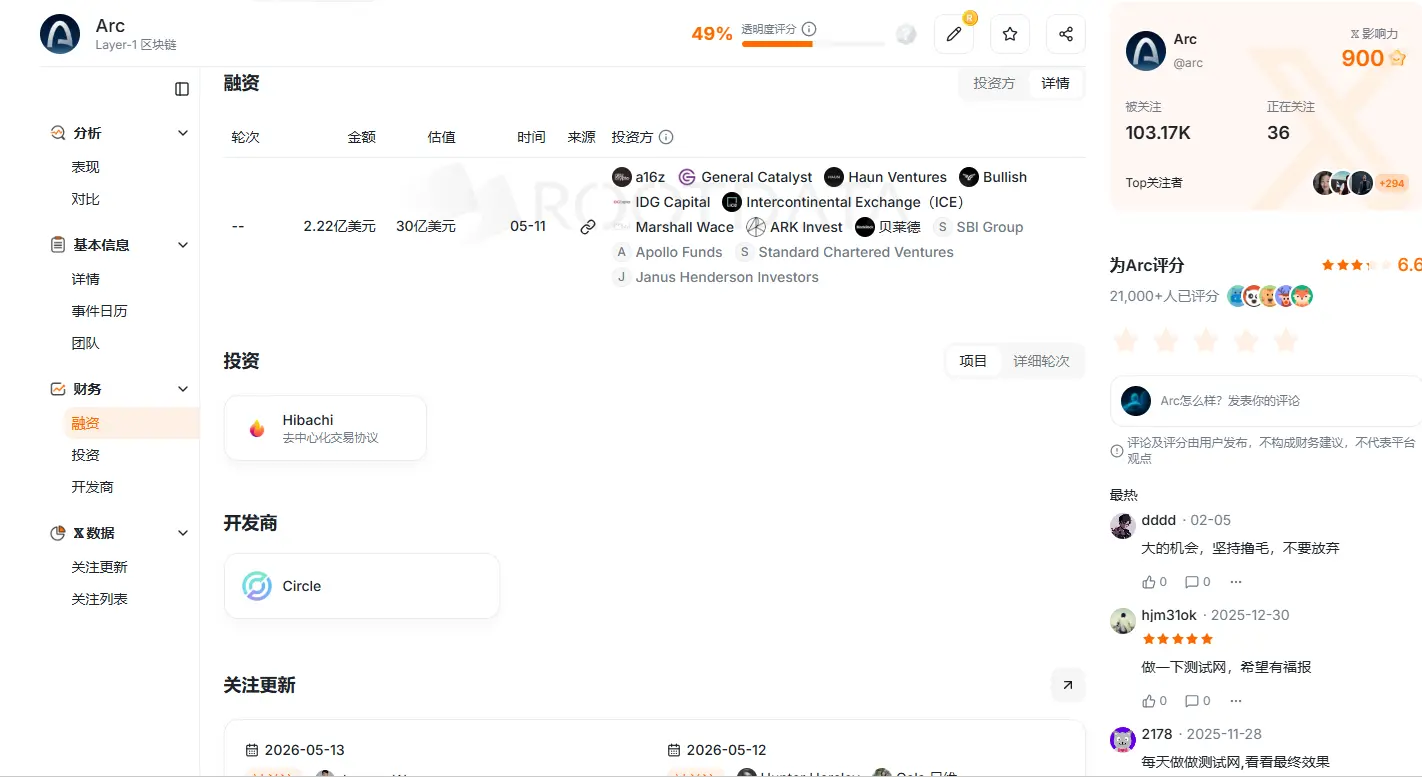
Sumber Gambar:RootData

Pasar kemudian muncul dengan pertanyaan inti: Circle sudah menjadi perusahaan publik, jika optimis tentang masa depannya, cukup beli saham CRCL saja, mengapa harus mengeluarkan token ARC? Keduanya menangkap nilai dari jaringan Arc, apa nilai masing-masing?

一、Mengapa Circle Membangun Arc Sendiri

Mengapa Circle tidak melanjutkan penerbitan dan penggunaan USDC di Ethereum atau Solana, tetapi harus menghabiskan sumber daya besar untuk membangun blockchain publik sendiri?

a16z Crypto menjelaskan hal ini, dengan semakin banyaknya keuangan global yang terhubung ke blockchain, di masa depan hanya akan ada sedikit blockchain publik yang dapat menjadi "landasan sistem ekonomi terhubung".

Volume transaksi stablecoin tahun lalu mendekati $9 triliun, berada pada tingkat yang sama dengan jaringan pembayaran global seperti Visa dan PayPal,pembayaran lintas batas, penyelesaian B2B, dan transaksi valas menjadi inti dari penggunaan stablecoin, stablecoin telah meningkat menjadi lapisan inti infrastruktur keuangan global.

Namun, infrastruktur blockchain yang ada masih terutama ditujukan untuk pengguna kripto asli dan pengembang individu, dan kurang memiliki dukungan asli untuk kebutuhan institusional skala besar.

Orang dalam industri mencatat bahwa institusi menghadapi beberapa tantangan inti saat menjalankan bisnis di blockchain, termasuk penerbitan dan penukaran aset yang memerlukan konfirmasi hak milik tertutup lengkap antara on-chain dan off-chain, pembayaran yang memerlukan finalitas pasti, kemampuan kepatuhan yang perlu dimasukkan ke dalam lapisan dasar, perlindungan privasi yang dapat dikonfigurasi, serta penggunaan USDC untuk mencapai biaya Gas yang dapat diprediksi, dll.

Kebutuhan-kebutuhan ini sulit dipenuhi secara asli oleh blockchain publik yang ada seperti Ethereum dan Solana.

BagiCircle ,di masa lalu perusahaan terutama bergantung pada bunga cadangan USDC untuk menghasilkan laba,volume sirkulasi USDC pada kuartal pertama mencapai $77 miliar, meningkat 28% dibandingkan tahun sebelumnya.Seiring dengan perluasan skala bisnis yang berkelanjutan, hanya bergantung pada blockchain publik yang ada sudah tidak dapat sepenuhnya memenuhi kebutuhan mendalam klien institusional.

Oleh karena itu,Circle meluncurkan Arc, salah satu tujuan intinya adalah untuk mengisi kekosongan ini. Sirkulasi stablecoin di blockchain orang lain tidak berarti keuangan stablecoin milik mereka sendiri — inilah logika mendasar di balik keputusan Circle untuk membangun L1 sendiri.
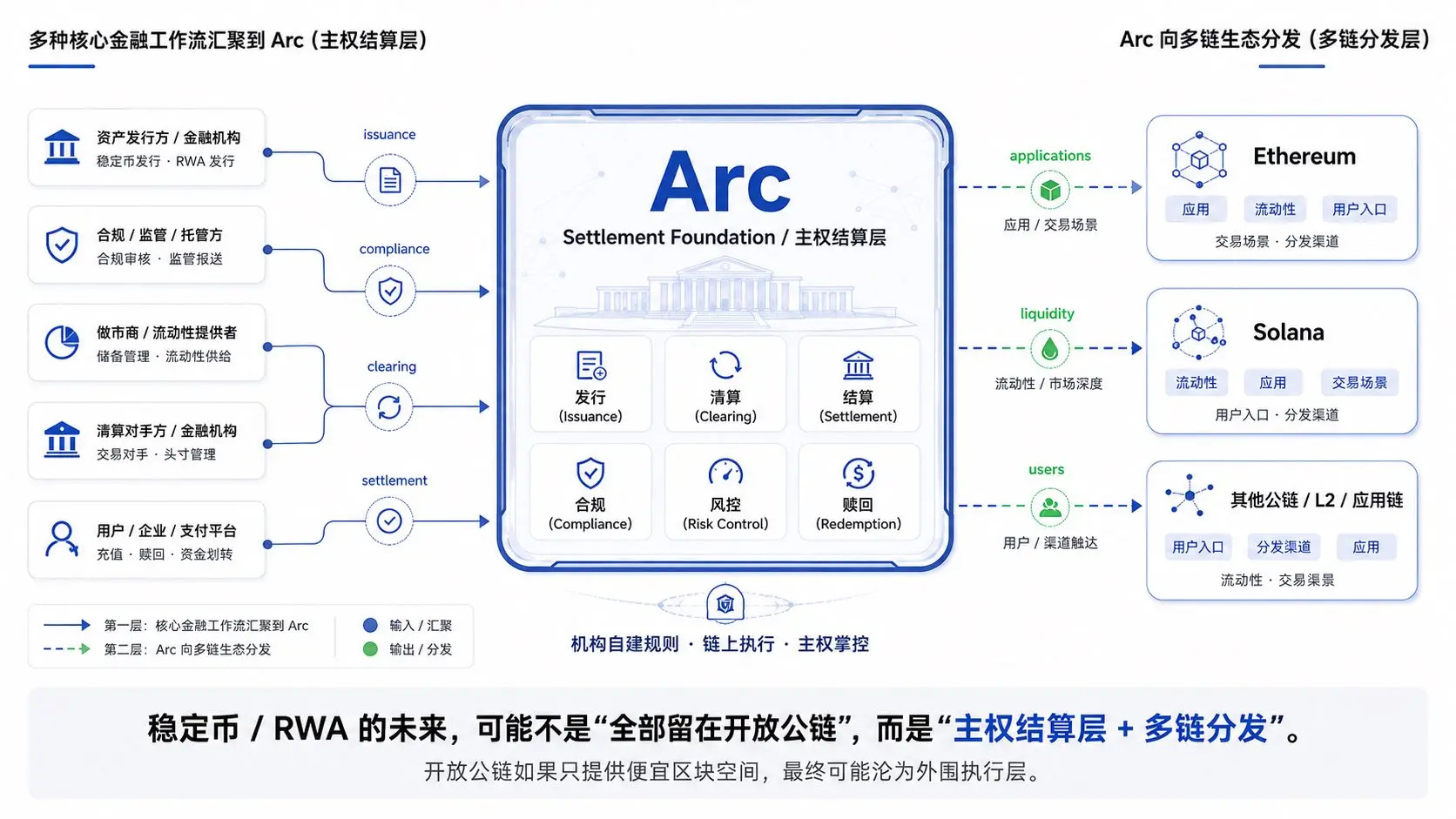
Sumber Gambar:Pengguna X @vanisaxxm

二、USDC Menyelesaikan Masalah Transaksi, ARC Menyelesaikan Masalah Koordinasi

Mengingat USDC sudah menjadi token Gas Arc, mengapa harus mengeluarkan token ARC?

USDC sudah menyelesaikan masalah stabilitas pada tingkat transaksi dengan baik. Institusi dapat menggunakan dolar AS untuk membayar biaya secara langsung, biaya dapat diprediksi dan dapat dicatat, menghindari masalah yang disebabkan oleh fluktuasi harga aset kripto bagi departemen keuangan.

Namun, agar jaringan dapat berjalan sehat dalam jangka panjang, hanya menyelesaikan masalah transaksi tidak cukup, perlu juga menangani masalah koordinasi.

Menurut whitepaper resmi, Arc akan bertransisi secara bertahap dari PoA saat ini ke PoS. Node validator perlu mempertaruhkan aset untuk menjamin keamanan jaringan, inti dari staking adalah mengikat perilaku node dengan insentif ekonomi, jika berbuat curang akan menghadapi sanksi pemotongan. Nilai USDC konstan pada $1, tidak dapat benar-benar mengikat node dengan keberhasilan atau kegagalan jaringan,hanya token asli ARC yang dapat menyediakan insentif ekonomi dinamis ini.
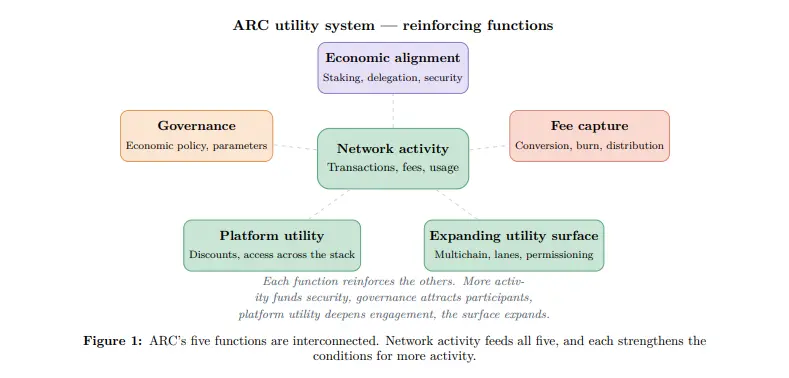
Pada tingkat tata kelola juga memerlukan pengikatan kepentingan. Keputusan kunci seperti tingkat biaya, parameter inflasi, rasio pembakaran, memerlukan partisipan untuk memiliki perspektif jangka panjang. Jika hanya menggunakan USDC untuk memilih, pemegang mudah kehilangan motivasi berkelanjutan, setelah memilih bisa pergi. Nilai aset pemegang ARC langsung terkait dengan kinerja jaringan, lebih memiliki motivasi untuk membuat pilihan yang menguntungkan perkembangan jangka panjang jaringan.

Whitepaper juga menjelaskan dengan jelas bahwa hak tata kelola ARC memiliki batasan bertahap. Parameter ekonomi diputuskan melalui pemungutan suara oleh pemegang token, tetapi hal-hal penting seperti peningkatan protokol, penanganan insiden keamanan, peninjauan kualifikasi node validator, pada tahap awal masih dikendalikan oleh Circle, dan akan dilimpahkan secara bertahap seiring dengan matangnya mekanisme tata kelola.

Secara sederhana, USDC adalah darah jaringan Arc, bertanggung jawab untuk aliran efisien sehari-hari; ARC adalah ekuitas jaringan, bertanggung jawab untuk mengikat kepentingan semua pihak dalam jangka panjang. Desain token ganda ini juga mengubah sebagian biaya pembangunan ekosistem dari pengeluaran tunai tetap Circle menjadi pengaturan insentif yang terkait dengan keberhasilan atau kegagalan jaringan.

三、CRCL dan ARC, Masing-masing Mendapatkan Bagian Kue Mana

Dengan demikian, Circle secara bersamaan memiliki ekuitas perusahaan publik CRCL dan token asli jaringan ARC, keduanya menangkap nilai dari jaringan Arc yang sama. Jadi, masing-masing sebenarnya mendapatkan bagian kue mana?

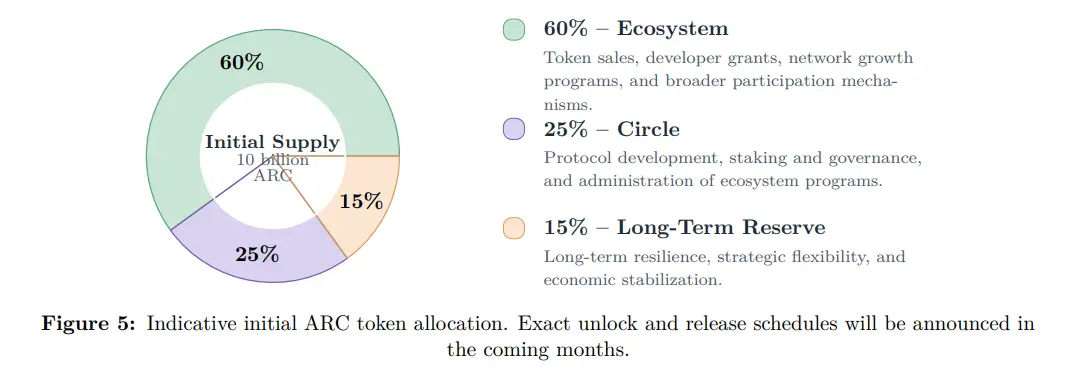
Menurut whitepaper, total pasokan Arc adalah 10 miliar token ARC, dengan proporsi alokasi yang jelas: 60% digunakan untuk ekosistem, termasuk insentif pengembang, rencana pertumbuhan jaringan, dan penghargaan partisipasi pengguna; 25% milik perusahaan Circle, digunakan untuk operasi node validator, staking, dan tata kelola; 15% sebagai cadangan jangka panjang, digunakan untuk stabilitas jaringan dan fleksibilitas strategis.
Dalam hal mekanisme biaya, semua biaya protokol di Arc, terlepas dari aset apa yang digunakan pengguna untuk membayar, akan sepenuhnya dikonversi ke ARC pada lapisan protokol, sebagian dibakar secara permanen, sebagian dialokasikan kepada staker dan validator. Semakin aktif aktivitas jaringan, semakin kuat penangkapan nilai ARC.

Pemegang saham CRCL terutama mendapat keuntungan melalui tingkat perusahaan Circle. Perusahaan terus menikmati bunga cadangan USDC sebagai pendapatan inti, serta pertumbuhan dari bisnis lain seperti jaringan pembayaran CPN. Pada saat yang sama, Circle memegang 25% ARC, juga dapat berbagi penghargaan pada tingkat jaringan secara tidak langsung.

Analis kripto BTCdayu mengajukan kerangka valuasi tiga dimensi untuk memahami CRCL: Dimensi pertama adalah pendapatan bunga cadangan, ini adalah arus kas paling stabil saat ini, membentuk dasar valuasi; Dimensi kedua adalah pendapatan jaringan pembayaran, seiring dengan perluasan skala CPN, bagian ini diharapkan mendekati model biaya jaringan seperti Visa; Dimensi ketiga adalah nilai opsi jaringan yang dibawa oleh Arc, ini adalah ekspektasi pasar terhadap transformasi Circle dari penerbit stablecoin menjadi platform infrastruktur keuangan.

Secara sederhana, CRCL menangkap arus kas stabil secara keseluruhan perusahaan dan pertumbuhan bisnis yang ada, sedangkan ARC menangkap elastisitas pertumbuhan pada tingkat jaringan, termasuk konversi biaya Gas, ekspansi ekosistem, dan efek jaringan jangka panjang.

Keduanya membentuk struktur jalur ganda yang jelas. Semakin sukses jaringan Arc, semakin besar penggunaan USDC, semakin kuat sinergi bisnis, perusahaan Circle mendapat manfaat; pada saat yang sama nilai token ARC naik, porsi 25% yang dipegang Circle juga akan meningkat nilainya, akhirnya diteruskan kepada pemegang saham CRCL.

Namun, keduanya sepenuhnya independen secara hukum.Pihak resmi menyebutkan, ARC tidak mewakili ekuitas Circle, juga tidak mengajukan klaim apa pun atas pendapatan, laba, aset, atau saham CRCL Circle. Ini berarti pemegang ARC tidak memiliki perlindungan tanggung jawab kepercayaan seperti pemegang saham perusahaan publik, keuntungan mereka sepenuhnya tergantung pada adopsi jaringan yang sebenarnya dan desain ekonomi token.

四、Bagaimana Pengguna Biasa Dapat Berpartisipasi untuk "Mengumpulkan"

Setelah memahami alokasi nilai CRCL dan ARC, masalah praktisnya adalah: kepada siapa token ARC sebenarnya dijual? Bagaimana pengguna biasa dapat berpartisipasi dengan biaya rendah?

Pembeli tipe pertama adalah investor strategis institusional. Mereka masuk melalui pra-penjualan $2,22 miliar, harga satuan $0,3, periode penguncian bervariasi dari 1 hingga 4 tahun. Institusi-institusi ini tidak hanya menyediakan dana, tetapi juga kebanyakan adalah pengguna dan pembangun potensial Arc. Misalnya, BlackRock telah menguji penyelesaian aset tokenisasi di jaringan tes, ICE sebagai perusahaan induk NYSE, SBI Group sebagai grup keuangan terbesar di Jepang, semuanya mempersiapkan bisnis di Arc di masa depan.

Tipe kedua adalah pembangun ekosistem dan pemegang jangka panjang. Pengembang, penyedia likuiditas mendapatkan insentif ARC melalui kontribusi, 60% alokasi ekosistem disiapkan untuk ini. Mereka lebih memperhatikan pertumbuhan jaringan jangka panjang, mirip dengan karyawan awal yang memegang ekuitas perusahaan.

Tipe ketiga adalah spekulan ritel dan partisipan. Mereka fokus pada peluang narasi awal dan insentif ekosistem, berharap adanya elastisitas harga setelah peluncuran mainnet.

Bagi pengguna biasa yang tidak memiliki kualifikasi pra-penjualan, Arc menyediakan beberapa jalur partisipasi biaya rendah.

Arc Testnet telah diluncurkan pada Oktober 2025, hingga saat ini telah memproses lebih dari 244 juta transaksi tes, mainnet diharapkan diluncurkan pada musim panas 2026. Pengguna dapat secara gratis mengklaim token tes, melakukan operasi seperti Swap, Bridge, penyebaran kontrak, untuk mengenal interaksi jaringan.

Komunitas Arc House adalah pintu masuk utama bagi pengguna biasa. Pengguna dapat mengumpulkan poin dengan mendaftar ke komunitas, tetap aktif, memposting, membaca konten, berpartisipasi dalam tanya jawab, dll. Jawaban yang diterima juga akan mendapat poin ekstra.

Cara lanjutan termasuk kontribusi konten, berbagi video, penyelenggara acara, bahkan menjadi tuan rumah Meetup offline. Selain itu, pengguna yang memiliki tim atau produk juga dapat mengajukan Circle Developer Grants.

Perlu dijelaskan bahwa poin Arc House hanya sebagai pengakuan kontribusi komunitas, tidak memiliki nilai moneter, juga tidak menjamin alokasi hak tertentu apa pun, aturan spesifik mengikuti pengumuman terbaru resmi.

Kesimpulan

Saat ini persaingan di sektor institusi on-chain sangat ketat, bukan hanya Arc yang unggul.

Digital Asset, yang memiliki Canton Network, sedang menyelesaikan putaran pendanaan baru dengan valuasi sekitar $20 miliar, dipimpin oleh a16z crypto; Plasma memposisikan diri sebagai penyelesaian asli stablecoin, valuasinya relatif lebih menarik; Visa telah memasukkan proyek-proyek seperti Arc, Canton, Plasma, Base, Tempo sebagai titik uji penyelesaian stablecoin pada bulan April. Ini menunjukkan bahwa sektor ini masih berada dalam tahap beberapa pihak berjalan paralel dan berkembang secara kompetitif.

Dalam konteks ini, FDV pra-penjualan Arc sebesar $30 miliar berada pada posisi yang relatif tinggi. Jika investor ritel berpartisipasi di pasar sekunder, perlu mengevaluasi potensi narasi proyek dan lanskap persaingan internal sektor secara penuh.

Dalam jangka panjang, memegang ARC dengan inflasi 2% hingga 3% per tahun memerlukan jaringan menghasilkan biaya riil yang cukup untuk mengimbangi tekanan penerbitan, agar dapat mencapai pertumbuhan nilai. Sedangkan CRCL bergantung pada bunga cadangan USDC dan pendapatan jaringan pembayaran, memiliki dukungan arus kas yang relatif jelas. Keduanya menghadapi struktur risiko dan imbalan yang berbeda.

Dalam jangka pendek, sentimen pasar sering kali memiliki logikanya sendiri. Sekitar waktu peluncuran mainnet, periode ledakan narasi terkonsentrasi dapat membawa peluang sementara, saat itu peningkatan nilai 25% ARC yang dipegang Circle juga akan menguntungkan pemegang saham CRCL.

Pada tingkat regulasi, implementasi GENIUS Act mengukuhkan parit pertahanan Circle, sedangkan draf baru CLARITY Act telah dipublikasikan, saat ini sedang berjalan di Kongres, diharapkan dapat memberikan kepastian regulasi yang lebih jelas bagi ekosistem aset digital, yang merupakan kabar baik penting bagi Circle.

Secara keseluruhan, Arc adalah salah satu langkah strategis penting Circle saat ini, whitepaper menunjukkan, "Sebuah sistem operasi ekonomi global tidak dapat dikoordinasikan oleh satu entitas tunggal, ia akan mengubah partisipan yang menggunakan Arc menjadi partisipan yang mempertahankan Arc." Visi ini pada akhirnya dapat terwujud atau tidak, masih tergantung pada apakah setelah peluncuran mainnet dapat menarik transaksi institusional nyata dan aktivitas ekonomi yang cukup skala.

Sebelum semua data benar-benar terwujud, semua narasi masih hanya narasi.

Related Questions

QMengapa Circle memutuskan untuk membangun blockchain sendiri yang bernama Arc, alih-alih terus menggunakan Ethereum atau Solana untuk USDC?

ACircle membangun Arc karena blockchain yang ada seperti Ethereum dan Solana kurang memenuhi kebutuhan institusional seperti penyelesaian akhir yang pasti, kepatuhan regulasi yang terintegrasi, privasi yang dapat dikonfigurasi, dan biaya gas yang dapat diprediksi dalam USDC. Arc dirancang sebagai infrastruktur kelas institusi untuk menangkap nilai ekonomi yang lebih luas di sekitar USDC, tidak hanya bergantung pada pendapatan bunga cadangan.

QApa peran dan fungsi berbeda dari USDC dan ARC di jaringan Arc? Mengapa keduanya diperlukan?

AUSDC berfungsi sebagai 'darah' jaringan, yaitu aset stable untuk transaksi dan pembayaran biaya gas, memberikan stabilitas dan prediktabilitas biaya. ARC berfungsi sebagai 'ekuitas' jaringan, yaitu token asli untuk staking (mengamankan jaringan dalam model PoS), tata kelola, dan insentif ekonomi jangka panjang, mengikat kepentingan semua pihak dengan keberhasilan jaringan.

QBagaimana nilai ditangkap (value capture) oleh saham CRCL dan token ARC? Apa perbedaannya?

ACRCL (saham Circle) menangkap nilai pada tingkat perusahaan, terutama dari pendapatan bunga cadangan USDC, jaringan pembayaran CPN, dan apresiasi nilai 25% kepemilikan ARC oleh Circle. ARC menangkap nilai pada tingkat jaringan itu sendiri, melalui pembakaran token dari biaya transaksi, ekspansi ekosistem, dan efek jaringan jangka panjang. CRCL memiliki aliran pendapatan yang lebih stabil, sementara ARC menawarkan potensi pertumbuhan elastis dari adopsi jaringan.

QSiapa saja pembeli utama token ARC dalam penjualan privat senilai $222 juta, dan bagaimana pengguna biasa dapat berpartisipasi di ekosistem Arc?

APembeli utama adalah investor institusional strategis seperti a16z crypto, BlackRock, Apollo, dan ICE. Mereka juga calon pengguna dan pembangun jaringan. Pengguna biasa dapat berpartisipasi dengan bergabung di komunitas Arc House untuk mendapatkan poin kontribusi, berinteraksi di testnet Arc, membuat konten, mengadakan acara, atau mengajukan permohonan Circle Developer Grants. Poin Arc House adalah pengakuan kontribusi dan tidak dijamin akan mendapat distribusi token.

QApa saja tantangan dan persaingan yang dihadapi Arc dalam upayanya menjadi infrastruktur blockchain untuk keuangan institusional?

AArc menghadapi persaingan ketat dari jaringan lain yang juga menargetkan segmen institusional, seperti Canton Network, Plasma, Base, dan Tempo. Visa sedang menguji beberapa jaringan ini secara bersamaan. FDV (Fully Diluted Valuation) Arc sebesar $3 miliar dari penjualan privat dianggap relatif tinggi. Keberhasilan jangka panjang bergantung pada kemampuan menarik transaksi institusional yang nyata dan menghasilkan pendapatan biaya yang cukup untuk menopang nilai token melawan inflasi tahunan 2-3%.

Related Reads

Warsh's Debut: Will the FED Chair Who Knows Crypto Best Bring Surprises or Shocks to the Market?

Kevin Warsh, the new Federal Reserve Chairman, prepares for his inaugural press conference amidst a challenging macroeconomic landscape: resurgent inflation, a bond market sell-off, and political pressure from President Trump for rate cuts. Uniquely, Warsh holds indirect investments in over 20 crypto and Web3 entities (e.g., Solana, dYdX), making him the first Fed Chair with disclosed crypto exposure. His stance may combine a hawkish, inflation-focused monetary policy with a crypto-friendly regulatory philosophy that shifts from Powell’s “same risk, same rule” approach toward a framework acknowledging blockchain’s productivity value. Warsh’s leadership could impact crypto markets across three dimensions: a paradigm shift in regulation (potentially accelerating pro-innovation legislation and stable币 rules), a re-pricing of risk premiums based on clearer communication and his view of AI as a structural disinflationary force, and a long-term reallocation of global institutional capital driven by increased legitimacy. Two potential scenarios for the press conference are outlined. A “positive surprise” would involve a dovish-leaning tone on rates coupled with signals of regulatory openness, potentially boosting crypto asset valuations. Conversely, a “negative shock” would see a more hawkish-than-expected stance on inflation and rates, triggering a broad risk-asset selloff that crypto markets would not escape. While ethics rules required Warsh to divest his crypto holdings upon confirmation, his deep understanding of the technology may fundamentally lower policy uncertainty and build a more receptive long-term foundation for digital assets’ integration into the mainstream financial system.

marsbit7h ago

Warsh's Debut: Will the FED Chair Who Knows Crypto Best Bring Surprises or Shocks to the Market?

marsbit7h ago

Trading

Spot
Futures

Hot Articles

What is LINON

Linde plc Tokenized Stock (Ondo): Revolutionizing Traditional Equity Access Through Blockchain Innovation The emergence of Linde plc Tokenized Stock (Ondo), represented by the ticker $LINON, signifies a monumental shift in the fusion of traditional financial structures and decentralized finance (DeFi). This innovative financial instrument showcases the tremendous potential of blockchain technology to democratize access to traditional equity markets while ensuring the security and regulatory compliance necessary for institutional-grade financial products. Through Ondo Finance's pioneering tokenization platform, $LINON provides a seamless pathway for global investors to engage with one of the world's leading industrial gas companies, Linde plc, creating a blockchain-native representation of the underlying equity. Introduction to Linde plc Tokenized Stock The landscape of financial markets is witnessing a groundbreaking transformation through the tokenization of real-world assets. Linde plc Tokenized Stock (Ondo) epitomizes this revolutionary approach by bridging the gap between conventional stock ownership and blockchain-enabled financial infrastructure. The $LINON token allows investors to gain exposure to one of the prominent industrial companies worldwide through decentralized technology. Operating within Ondo Finance's comprehensive ecosystem, $LINON symbolizes a practical application of tokenization technology that enhances accessibility, efficiency, and global connectivity in traditional financial markets. By leveraging blockchain infrastructure, this tokenized stock enables international investors to participate in U.S. equity markets, overcoming traditional barriers associated with cross-border investing. The significance of $LINON goes beyond technological innovation; it represents a fundamental shift in asset structuring, distribution, and trading in the digital age. This tokenized stock maintains all the economic benefits associated with traditional Linde plc shares while offering improved liquidity, programmable compliance features, and seamless integration with decentralized finance protocols. The development of $LINON indicates a growing acceptance of blockchain technology as a viable means for traditional finance, exemplifying how even well-established assets like Linde plc can integrate into blockchain systems. This approach preserves the core attributes that appeal to investors while introducing advanced capabilities that enhance the overall investment proposition. Project Overview and Objectives Linde plc Tokenized Stock (Ondo) encapsulates a strategic effort to democratize access to traditional equity markets through advanced blockchain technologies. The primary objective of $LINON is to provide approved global investors seamless access to the economic exposure associated with Linde plc shares, furthering an effort to create a more inclusive financial ecosystem. Beyond the digital representation of traditional assets, $LINON endeavors to eliminate barriers of geography and time zones that limit investor participation. Its design ensures that blockchain technology can elevate traditional investment vehicles without undermining the security or compliance requirements expected by investors. Key goals of the project include enhanced liquidity provision, programmable compliance mechanisms, and interoperability with other blockchain networks. Each $LINON token is fortified by actual Linde plc securities housed at U.S.-registered broker-dealers, allowing holders to reap economic advantages akin to traditional stockholders, such as dividend reinvestment. Furthermore, $LINON aims to establish new industry standards for institutional-grade tokenized securities, paving the way for traditional assets to embrace blockchain technology while remaining compliant with regulatory frameworks. By associating itself with a company as reputable as Linde plc, the project opens avenues for exploring tokenized equities catering to both conservative institutional players and daring retail investors. Project Creator and Development Team The vision for Linde plc Tokenized Stock (Ondo) comes from Nathan Allman, founder and CEO of Ondo Finance. His background in traditional finance coupled with expertise in blockchain technology positions him uniquely to navigate the complexities of asset tokenization. Allman's academic journey began at Brown University, focusing on Economics and Biology, equipping him with valuable analytical skills. His time at Goldman Sachs in the Digital Assets division strengthened his understanding of the interplay between financial institutions and emerging technologies, laying the groundwork for his later endeavors in alternative investment strategies. Under Allman's guidance, Ondo Finance has emerged as a leader in asset tokenization, launching $LINON as a flagship example of the company's larger mission towards revolutionizing traditional financial systems using blockchain technology. His commitment to leveraging blockchain for creating institutional-grade financial products has shaped the landscape of real-world asset tokenization. Investment and Funding Structure The growth of Ondo Finance, the platform powering Linde plc Tokenized Stock (Ondo), is bolstered by robust financial backing from prestigious venture capital firms and strategic investors. This strong investment foundation underpins the development of the key infrastructure essential for compliant tokenized securities like $LINON. In August 2021, Ondo Finance secured $4 million in seed funding led by a major venture capital firm, which enabled the company to commence platform development and establish the necessary regulatory processes for tokenizing real-world assets. This early investment cemented Ondo Finance's credibility within the industry. The Series A funding round followed, garnering $20 million with participation from renowned firms committed to transformative technology companies. This backing demonstrated substantial institutional confidence in Ondo Finance's vision, allowing it to hone its approach to asset tokenization through mechanisms that ensure compliance and accessibility. Noteworthy contributors, including institutional investors and experienced partners, have added significant value to Ondo Finance’s development efforts. Their involvement underscores the confidence across sectors in Ondo Finance's approach to bridging traditional finance with blockchain innovations. Technical Infrastructure and Innovation The technical architecture that underpins Linde plc Tokenized Stock (Ondo) represents a sophisticated melding of traditional finance systems and cutting-edge blockchain technology. The architecture's foundation is built on the Ethereum network, renowned for its security and programmability—both critical for intricate financial instruments. The $LINON tokenization process comprises creating a blockchain-native representation of Linde plc shares that preserves economic benefits while augmenting investor capabilities. Each token corresponds to actual shares held at U.S.-registered broker-dealers, creating a compliant custody structure that legitimizes the asset's existence and value. Automated compliance systems are integrated into the tokenization process, managing critical components such as know-your-customer (KYC) verification and anti-money laundering (AML) protocols. This incorporation of programmable compliance empowers $LINON to uphold regulatory standards essential for institutional proliferation. Cross-chain interoperability characterizes the advanced technical features of $LINON. While initially deployed on Ethereum, the framework is designed for expansion to other networks such as Solana and BNB Chain. This adaptability enhances liquidity and accessibility, allowing investors to select their preferred blockchain ecosystems. Historical Timeline and Development Crafting the history of Linde plc Tokenized Stock (Ondo) unfolds in parallel with the evolution of Ondo Finance's tokenization platform. The timeline's inception dates back to March 2021 when Nathan Allman laid the foundations for creating institutional-grade financial products on blockchain infrastructure. The initial funding round in August 2021 provided crucial resources for developing the platform and establishing partnerships necessary for effective tokenization. By January 2023, Ondo Finance launched its tokenized treasury products, establishing mechanisms that would facilitate future tokenized equities such as $LINON. A pivotal milestone arose in February 2025 when Ondo Chain—a Layer 1 blockchain designed specifically for asset tokenization—was introduced. This infrastructure enhances capabilities vital for institutional markets, demonstrating Ondo Finance's long-term commitment to tokenization. Subsequently, the launch of Ondo Global Markets in September 2025 marked the official debut of $LINON. This milestone showcased the successful transition from development to active trading, enabling investors around the world to access American financial markets seamlessly. Ongoing development plans include a targeted expansion of available tokenized assets to over 1,000 by the end of 2025, pointing to a bright future for Ondo Finance's ecosystem and its mission to broaden tokenized equity accessibility. Regulatory Compliance and Legal Framework The legal architecture governing Linde plc Tokenized Stock (Ondo) emphasizes a sophisticated approach to regulatory compliance, allowing tokenized securities to be implemented within a blockchain-based framework. The legal structure governing $LINON spans multiple jurisdictions while maintaining a robust legal footing. Compliance systems ensure that only eligible investors can access the token, enforced through automated verification that aligns with international regulations. This innovative regulatory technology promises real-time enforcement of complex requirements, considerably enhancing efficiency in operating within the regulatory landscape. The custody framework undergirding $LINON ensures that the underlying shares are securely held at U.S.-registered broker-dealers, complying with necessary regulations while delivering blockchain-driven access to investors. The token maintains its economic equivalency and security through this carefully structured custody arrangement. KYC and AML compliance systems are embedded within the smart contract architecture, ensuring integrity and adherence to regulatory practices while fostering transparency for investors. The jurisdictional restrictions mark a commitment to navigating the evolving landscape of international securities laws. Market Impact and Industry Significance The advent of Linde plc Tokenized Stock (Ondo) holds profound implications for the broader financial landscape, symbolizing a clear shift towards blockchain-enabled markets. $LINON serves as a proof-of-concept for integrating traditional companies into blockchain ecosystems, showcasing the potential benefits such as broader accessibility and improved efficiency. The market's response to $LINON indicates a growing acceptance of tokenization among institutional investors, contributing to the emergence of an expanding sector wherein traditional assets can be interconnected with blockchain innovations. The success of $LINON further solidifies market confidence, indicating an overarching shift towards recognizing asset tokenization as a transformative force in finance. Future Development and Expansion Plans The future trajectory for Linde plc Tokenized Stock (Ondo) centers around the expansion of the tokenization ecosystem and enhanced infrastructure supporting blockchain-enabled financial services. Plans for cross-chain integration usher in new opportunities for liquidity and flexibility within the investment framework, with existing capabilities poised for continuous enhancement. With the introduction of Ondo Chain, Ondo Finance aims to transition $LINON to an optimized blockchain environment specifically designed for asset tokenization. This new infrastructure heralds exciting prospects for the development of institutional-grade financial products, ensuring ongoing compatibility with contemporary investment strategies. Further integration with decentralized finance protocols signifies a commitment to empowering $LINON holders through advanced financial strategies. The anticipated expansion of available tokenized assets promises to broaden investor access, enhancing the utility and appeal of the platform. In alignment with ambitions for regulatory expansion, ongoing efforts to secure approvals for new jurisdictions will enhance investor access, further positioning $LINON at the forefront of the burgeoning tokenization market. Conclusion Linde plc Tokenized Stock (Ondo), as represented by the $LINON token, stands at the intersection of traditional finance and blockchain innovation. It embodies a transformative milestone in how financial assets are structured, distributed, and engaged within modern investment ecosystems. The technical sophistication behind $LINON, combined with its regulatory compliance framework, illustrates that asset tokenization can improve financial infrastructure rather than simply digitizing existing products. This pioneering effort not only enhances investor access to U.S. equity markets but also signifies an evolution of how traditional financial services can integrate blockchain technology. As the asset tokenization market grows exponentially, with prospects suggesting significant valuation increases, $LINON paves the way for a future where tokenized securities become standard fixtures in the financial landscape. The trajectory of $LINON will undoubtedly influence how traditional finance adapts to a transformed, blockchain-powered world.

3.2k Total ViewsPublished 2025.12.05Updated 2025.12.05

What is LINON

What is CRMON

Salesforce Tokenized Stock (Ondo): Revolutionising Traditional Equity Access Through Blockchain Innovation The emergence of Salesforce Tokenized Stock (CRMON) marks a pivotal advancement in integrating traditional financial markets with blockchain technology. This innovative approach offers investors unprecedented access to equity exposure through tokenisation. Developed by Ondo Finance, CRMON provides tokenholders with economic exposure equivalent to holding Salesforce stock (CRM) while automatically reinvesting dividends. This effectively bridges the gap between conventional equity markets and decentralised finance (DeFi). Introduction and Comprehensive Overview of Salesforce Tokenized Stock In recent years, the financial landscape has dramatically transformed due to blockchain technology, fundamentally altering how investors access and interact with traditional assets. The development of Salesforce Tokenized Stock (CRMON) is a prime example of this evolution, representing a sophisticated fusion of conventional equity markets with cutting-edge distributed ledger technology. CRMON is a tokenised version of Salesforce stock, emerging from the innovative work of Ondo Finance, a leading platform in the real-world asset tokenisation sector that positions itself as a bridge between traditional finance and decentralised systems. Designed to provide tokenholders with economic exposure that mirrors the performance of the underlying Salesforce stock, CRMON incorporates automatic dividend reinvestment mechanisms. This eliminates many traditional barriers associated with international equity investment, such as complex brokerage relationships, currency conversion challenges, and restricted trading hours. The tokenisation process reimagines stock ownership as a blockchain-native asset while maintaining its economic equivalence with the underlying security, offering enhanced portability and integration capabilities within decentralised finance ecosystems. CRMON transcends its individual utility as an investment instrument to represent a fundamental shift in how financial markets can operate in an increasingly digital world. By maintaining full backing through U.S.-registered broker-dealers and implementing robust compliance frameworks, CRMON demonstrates that tokenised securities can achieve the regulatory standards necessary for institutional adoption while delivering the technological advantages of blockchain infrastructure. Understanding Tokenized Real-World Assets and CRMON's Strategic Position Tokenised real-world assets signify one of the most significant innovations in modern finance, fundamentally reimagining how traditional securities are represented, traded, and utilised within digital ecosystems. CRMON operates as a tokenised equity instrument correlating directly with Salesforce stock while optimising accessibility and efficiency. This aligns with Ondo Finance's broader mission to democratise access to institutional-grade financial products through innovative tokenisation strategies. The tokenisation process guarantees complete economic equivalence with the underlying Salesforce equity. Each CRMON token represents a proportional claim on Salesforce stock held by qualified custodians, with dividend payments automatically reinvested to maintain continuous exposure to total return performance. This structure simplifies dividend management and ensures that tokenholders receive the full economic benefit of their equity exposure, encompassing both capital appreciation and income generation. Ondo Finance's strategy in tokenising Salesforce stock demonstrates its expertise in creating compliant, institutional-grade products that meet traditional financial markets' stringent requirements. The platform’s focus on merging regulatory compliance with blockchain benefits positions it at the forefront of decentralised finance, captivating both institutional and retail investors seeking blockchain-native solutions. The Technology and Innovation Framework Behind CRMON The technological infrastructure supporting CRMON integrates blockchain technology with traditional financial mechanisms, delivering institutional-grade security and compliance while maintaining the operational advantages of decentralised systems. Built on the Ethereum blockchain, CRMON utilises robust smart contract capabilities to ensure transparent, secure operations. The smart contract architecture incorporates layered security and compliance mechanisms, enabling automated compliance checks and real-time asset backing verification. Integration with oracle services maintains accurate pricing and dividend information, ensuring CRMON reflects the underlying Salesforce stock's accurate performance. This architecture delivers automated dividend reinvestments and other corporate actions, eliminating manual processing requirements and directly enhancing tokenholder benefits. Ondo Finance ensures CRMON's security structure includes daily third-party verification of holdings, independent collateral agents, and a multiple-layer custody system through partnerships with established financial institutions. This framework safeguards tokenholder interests against operational risks while providing robust asset backing. The user interface enhances integration capabilities, allowing seamless interaction between CRMON and various decentralised finance protocols, as well as cryptocurrency exchanges. This interoperability enables users to leverage their tokenised equity across multiple platforms, creating sophisticated investment strategies that marry traditional equity characteristics with blockchain-native innovation. Leadership and Corporate Structure of Ondo Finance The leadership team behind CRMON and Ondo Finance blends expertise from traditional finance and blockchain technology, presenting a robust combination of skills essential for successfully bridging conventional markets with decentralised finance. Nathan Allman, the founder and CEO, emerged from a distinguished financial background before establishing Ondo Finance in 2021. Allman's experience includes notable roles at major financial institutions, including significant contributions to developing cryptocurrency market services. His insights into regulatory compliance were paramount in developing products like CRMON that successfully unify traditional securities with blockchain technology. With a team of professionals boasting substantial experience in both conventional finance and blockchain sectors, Ondo Finance's leadership comprises diverse expertise that covers every aspect of tokenised asset development. Justin Schmidt serves as President and COO, contributing unique operational expertise, while Chris Tyrell brings essential compliance knowledge. Investment Landscape and Funding History The investment landscape surrounding Ondo Finance reflects significant institutional confidence in its mission to tokenise real-world assets. The company has raised substantial funds through various investment rounds, attracting leading venture capital firms and strategic investors that recognise the transformative potential of tokenised securities like CRMON. Notably, Ondo Finance completed a successful Series A funding round in 2022, led by well-known venture capital firms. This funding success validates Ondo Finance's innovative approach to creating compliant, institutional-grade tokenised products. In total, Ondo Finance has successfully secured substantial funding, raising significant capital for product development and market expansion, including a noteworthy token sale that reinforced its governance structure through the establishment of the ONDO token. The diverse composition of investors reflects broad market confidence in Ondo Finance's business model, demonstrating support from both traditional and blockchain-native organisations. Operational Mechanics and Technical Implementation The operational framework supporting CRMON exemplifies sophisticated integration of traditional financial mechanisms with blockchain technology. The technical implementation introduces multiple layers of security, compliance, and operational efficiency to meet institutional standards while enhancing accessibility. The tokenisation process begins by acquiring actual Salesforce stock through U.S.-registered broker-dealers, ensuring each CRMON token maintains direct correlation with the underlying equity performance. Smart contracts automate operational processes, including dividend reinvestment and corporate action processing, facilitating a streamlined user experience. The Minting and redemption processes allow authorised participants to manage CRMON tokens effectively. During U.S. trading hours, institutions can mint new tokens by depositing stablecoins that are used to purchase corresponding Salesforce equity. This structure maintains a tight correlation with underlying assets, enhancing liquidity and price discovery. Additionally, the infrastructure supports twenty-four-hour token transfer capabilities, providing CRMON holders with operations outside traditional market hours. This represents a significant advantage over conventional securities ownership, thus promoting integration with decentralised finance applications. Plans for cross-chain compatibility through partnerships signal further ambitions for CRMON's market reach. By expanding to other blockchain networks, Ondo Finance aims to enhance accessibility and user engagement with tokenised equity products. Timeline and Historical Development of Tokenized Equity Innovation The timeline of CRMON's development and Ondo Finance's broader tokenised capabilities demonstrates a systematic innovation process beginning with the company's founding in 2021. 2021: Ondo Finance is founded by Nathan Allman and co-founders, launching initial products focused on structured vault offerings on the Ethereum blockchain. 2022: The company completes substantial funding rounds—both equity and token sales—totaling significant capital and launching initial tokenised U.S. Treasury products. 2023-2024: Ondo Finance experiences substantial growth, establishing partnerships with major financial institutions while expanding its product offerings beyond fixed-income securities. February 2025: Ondo Global Markets is announced, marking the transition into equity tokenisation with plans for accessing over one hundred U.S. stocks and ETFs. September 2025: The official launch of Ondo Global Markets includes CRMON alongside other tokenised equity offerings, marking a significant evolution in Ondo Finance's product ecosystem. This timeline highlights the organisation's rapid growth and its capability to adapt its technological and compliance frameworks to accommodate different asset classes effectively while maintaining security and regulatory integrity. Regulatory Framework and Compliance Approach Ondo Finance's regulatory framework showcases a sophisticated compliance strategy, essential for achieving institutional adoption in the tokenised securities market. The company's strong partnerships with U.S.-registered broker-dealers promote adherence to Securities and Exchange Commission regulations and apply robust investor protections. Acquisitions, such as Oasis Pro—a registered broker-dealer—significantly enhance Ondo Finance's compliance capabilities, ensuring thorough alignment with existing regulatory structures. The company employs independent verification procedures that foster transparency, aiming for a solid performance standards reputation. Furthermore, Ondo Finance's commitment extends to international regulatory compliance, ensuring token access remains restricted to eligible investors while adhering to pertinent cross-border securities regulations. Comprehensive attention to tax implications and reporting requirements fortifies the security and compliance landscape of CRMON, ensuring that investor obligations remain manageable. Future Prospects and Market Positioning The forward-looking landscape for CRMON and Ondo Finance illustrates substantial growth opportunities driven by institutional adoption of blockchain technology and escalating demand for efficient alternatives to conventional securities ownership. Market projections indicate the tokenised asset sector could value multiple trillion dollars by 2030. With plans to scale CRMON offerings significantly and integrate it with a dedicated blockchain infrastructure—Ondo Chain—Ondo Finance aims to elevate its institutional-grade tokenised asset operations. Additionally, the development of strategic partnerships enhances distribution capabilities while establishing the company's credibility in the financial market. Furthermore, the integration of tokenised equity with decentralised finance protocols offers new potential for innovative financial products and strategies previously impossible with traditional securities. These factors underscore CRMON's positioning to effectively capture increased market share and deliver innovative solutions for international investment exposure. Conclusion Salesforce Tokenized Stock (CRMON) symbolises a transformative development within financial markets, successfully bridging traditional equity ownership with blockchain technology to create unprecedented accessibility for global investors. Through Ondo Finance's sophisticated tokenisation framework, CRMON provides complete economic exposure to Salesforce equity performance while enhancing operational advantages that exceed traditional ownership. The launch of CRMON reflects the broader evolution of financial markets towards blockchain infrastructures that maintain regulatory compliance while delivering increased efficiency. Ondo Finance's extensive approach to regulatory adherence, institutional-grade security, and technological innovation solidifies CRMON as a model for future tokenised securities, delivering access previously unattainable in conventional brokerage structures. As the tokenised asset sector continues to develop, CRMON is well-positioned to address historical inefficiencies in capital markets while providing investors with innovative solutions for accessing traditional securities. The outlook for CRMON looks exceptionally promising, supported by ambitious expansion plans, technological innovations, and strategic partnerships, thereby representing a pioneering model of modern financial infrastructure evolving through blockchain integration.

3.3k Total ViewsPublished 2025.12.05Updated 2025.12.05

What is CRMON

What is SHOPON

Shopify Tokenized Stock (Ondo): A Comprehensive Analysis of Real-World Asset Tokenization in Web3 This article delves into the Shopify Tokenized Stock (Ondo), recognised by its ticker symbol $SHOPON, exploring its implications at the intersection of traditional finance and blockchain technology. As a part of Ondo Finance's tokenized securities platform, Shopify’s tokenized stock exemplifies advancements in democratizing access to global capital markets through innovative digital assets. Introduction and Overview of Shopify Tokenized Stock (Ondo) Shopify Tokenized Stock (Ondo), or $SHOPON, portrays a pivotal innovation in the realm of tokenized securities, allowing investors to gain economic exposure akin to directly owning shares of Shopify Inc. This token, developed under the umbrella of Ondo Finance, not only provides investors with the ability to hold digital representations of the company’s stock but also integrates features such as automatic reinvestment of dividends. This advancement represents a substantial shift in the landscape of decentralized finance (DeFi), linking conventional equity markets with blockchain solutions designed to enhance accessibility, transparency, and liquidity. By eliminating geographical barriers and enabling 24/7 trading capabilities, $SHOPON is positioned as a bridge connecting traditional financial instruments and the emerging Web3 ecosystem. What is Shopify Tokenized Stock (Ondo), $SHOPON? The $SHOPON token serves as a digital manifestation of Shopify Inc.'s shares, engineered to provide a direct correlation to the underlying asset's performance. Through the utilization of blockchain technology, the token gives holders a mechanism to participate in the economic benefits associated with equity ownership, including capital appreciation and dividend distribution. The unique aspect of $SHOPON lies in its automatic dividend reinvestment mechanism, which allows returns to compound without necessitating active management by the investor. This feature inherently enhances its attractiveness as an investment vehicle, particularly for individuals seeking passive income growth alongside exposure to high-performing equities. The tokenization process is facilitated by the custody of actual Shopify shares through regulated intermediaries, ensuring that every $SHOPON token is verifiably backed by real equity. This structure empowers investors with the dual advantages of both traditional financial characteristics and the innovative benefits tied to blockchain technology. Who is the Creator of Shopify Tokenized Stock (Ondo)? The creator of Shopify Tokenized Stock (Ondo), Nathan Allman, is an experienced figure in the finance sector, formerly associated with Goldman Sachs. His rich background includes significant expertise in digital asset development, bridging the gap between traditional finance and cryptocurrencies. Allman’s educational journey, marked by studies at Brown University, provided him with a deep understanding of economics and biology, equipping him with analytical skills that inform his strategic vision. In 2021, he founded Ondo Finance, committing to developing tokenized securities that meet institutional-grade standards while leveraging blockchain's transformative capabilities. Under Allman's leadership, Ondo Finance has focused on creating compliant and innovative financial products that empower a diverse investor base. Who are the Investors of Shopify Tokenized Stock (Ondo)? The investment landscape surrounding Shopify Tokenized Stock (Ondo) is notably robust, underpinned by significant institutional support. Primarily, Pantera Capital stands out as a strategic partner through the Ondo Catalyst initiative, a $250 million commitment aimed at accelerating the development of on-chain capital markets. This partnership not only signifies institutional confidence in the potential of tokenized assets but also reinforces Ondo Finance's operational capabilities and market positioning. The funding pathways have included earlier rounds that amassed millions in seed funding and further structural investments, solidifying relationships with both venture capital firms and private investors. Moreover, the financial framework is complemented by strategic partnerships with established financial institutions and technology companies, enhancing Ondo’s infrastructure and operational expertise. How Does Shopify Tokenized Stock (Ondo), $SHOPON Work? At the core of $SHOPON's operational framework is a sophisticated system integrating traditional finance mechanisms with blockchain technology. The custody of actual Shopify shares ensures that token holders retain authentic economic exposure, safeguarding their investments in line with recognized legal structures. The smart contracts employed in managing $SHOPON handle various functions, including automatic dividend reinvestment and ownership transfer, offering instant settlement and increased liquidity, marking a significant departure from conventional trading systems plagued by multi-day settlement delays. By providing interoperability with other decentralized finance applications, $SHOPON empowers holders with potentially lucrative opportunities for advanced investment strategies, including lending and automated market making. This complex integration presents a unique value proposition, catering to both traditional and crypto-native investors. The innovative structure of $SHOPON also allows for real-time settlements and transactions documented on the blockchain, delivering unparalleled transparency and security—a major advancement over standard equity trading practices. Timeline of Shopify Tokenized Stock (Ondo) March 2021: Nathan Allman establishes Ondo Finance, initially focusing on decentralized finance yield optimization. August 2021: Completion of a $4 million seed funding round led by Pantera Capital. January 2023: Launch of initial tokenized treasury security products, laying the groundwork for future equity tokenization. July 2025: Announcement of the Ondo Catalyst initiative, a strategic investment program valued at $250 million, aimed at propelling the development of tokenization in capital markets. September 3, 2025: Launch of Ondo Global Markets featuring over 100 tokenized U.S. stocks and ETFs, including $SHOPON. Technical Implementation and Blockchain Infrastructure Shopify Tokenized Stock (Ondo) operates on a technical architectural framework that marries blockchain protocols with traditional financial custody arrangements. The ecosystem leverages Ethereum's smart contract capabilities, providing seamless transaction management while ensuring compliance with regulatory standards through established financial custodians. Central to this architecture are security measures and transparent transaction records that affirm the legitimacy of each tokenholder's economic stake. With automated features managed by intricate smart contracts, $SHOPON not only streamlines ownership transfers but also allows for the tactical reinvestment of dividends—a hallmark of modern investment strategies. Moreover, the incorporation of LayerZero technology facilitates cross-chain interoperability, making $SHOPON accessible across multiple blockchain environments while preserving its functional robustness. This forward-thinking technical design positions $SHOPON as an adaptable asset within the larger DeFi milieu. Regulatory Framework and Compliance Architecture $SHOPON's regulatory framework is built upon the meticulous navigation of existing financial regulations that govern securities. The custody arrangements for the underlying Shopify shares are managed by U.S.-regulated broker-dealers, ensuring compliance and protection for investors. By maintaining a separation between the blockchain tokenization process and traditional custody, $SHOPON adheres to legal requirements while offering innovative functionalities that challenge conventional constraints. This dual-layered compliance approach enhances investor confidence and underscores Ondo Finance's commitment to regulatory integrity. Notably, the availability of $SHOPON is tailored to international investors from regions such as Asia-Pacific, Europe, and Africa, as regulatory parameters in the U.S. and U.K. present challenges in accessing tokenized securities. Market Access and Global Distribution Strategy The distribution strategy of $SHOPON is keenly designed to optimize global access while conforming to regulatory standards. The platform aims to establish comprehensive coverage for eligible investors across multiple regions, effectively dismantling traditional barriers through the implementation of blockchain technology. Integration with various cryptocurrency wallets and exchanges also promotes user-friendliness and accessibility, establishing a streamlined experience for investors to manage their holdings. Moreover, the 24/7 trading capabilities afforded by the tokenized model allow participants to react promptly to market shifts, fundamentally transforming how global equities are accessed and traded. Technology Integration and Cross-Chain Functionality The remarkable technological underpinnings of $SHOPON propagate its multi-chain functionality, set to expand its reach beyond Ethereum to networks such as Solana and BNB Chain. Such cross-chain capabilities allow users flexibility when navigating between blockchains, concurrently leveraging distinct network attributes to optimize their trading experience. LayerZero serves as the backbone for ensuring decentralized transfers between networks while providing the requisite security and speed, quintessential for maintaining investor trust. This comprehensive interoperability illustrates $SHOPON's commitment to being a versatile, user-centric asset in the evolving investment landscape. Ecosystem Integration and DeFi Compatibility Incorporating $SHOPON into broader DeFi protocols signifies its potential beyond traditional stock ownership. Token holders can leverage their holdings for various sophisticated strategies and applications, enhancing investment returns and liquidity management. By establishing a presence in lending protocols and automated trading systems, $SHOPON effectively democratizes access to advanced financial strategies previously limited to institutional investors. Such integration contributes to a more competitive and dynamic financial landscape, where individual investors can capitalize on tools typically reserved for larger entities. Risk Management and Security Framework Security remains paramount in the operational infrastructure of $SHOPON. The tokenization framework employs multiple layers of protection—beginning with regulated custody of the underlying Shopify shares. The operational protocols establish rigorous auditing, key management, and transaction monitoring standards, thus safeguarding against potential vulnerabilities. Moreover, meticulous adherence to evolving regulatory requirements provides an extra layer of security, fortifying investor protections and institutional compliance. Market Impact and Industry Implications The introduction of Shopify Tokenized Stock (Ondo) heralds a transformative shift in how financial markets operate, emphasizing the potential of tokenized securities to reshape traditional investment paradigms. The successful integration of $SHOPON encapsulates the efficiencies inherent in blockchain technology and opens avenues for new user demographics previously barred from extensive market participation. The impact extends beyond the immediate benefits to token holders, indicating broader trends that may challenge the status quo of investment services, particularly in addressing geographic restrictions and operational costs typically associated with traditional brokerage platforms. Undeniably, $SHOPON encapsulates the potential for traditional institutions to innovate further, leveraging the increasing demand for seamless blockchain access to complement existing financial infrastructure. Future Development Roadmap and Strategic Vision As Ondo Finance looks forward, the trajectory of $SHOPON rests on ambitious goals aimed at broadening the spectrum of available tokenized assets significantly. Over the next few years, plans are in place to expand to more than 1,000 tokenized securities, further enhancing market participation and investment options for individuals worldwide. Continued integration with traditional financial actors, development of specialized institutional products, and enhancements in automated trading capabilities will ensure that $SHOPON maintains its position at the forefront of financial innovation. Regulatory collaboration will also remain a focal point, establishing a framework that not only supports the compliance requirements but also promotes a healthy environment for tokenized asset proliferation. Conclusion and Market Significance In summary, Shopify Tokenized Stock (Ondo), represented by the ticker $SHOPON, is more than merely a tokenized equity offering; it embodies the innovation possible when traditional finance collides with modern blockchain applications. With a robust technical architecture, a commitment to compliance, and a clear strategic vision, $SHOPON exemplifies the potential for tokenized assets to enhance liquidity, accessibility, and functionality in capital markets. As the global investment landscape evolves, the transformative implications of $SHOPON extend beyond individual investors to revolutionize how financial instruments are perceived, traded, and utilized within both traditional and decentralized frameworks.

3.2k Total ViewsPublished 2025.12.05Updated 2025.12.05

What is SHOPON

Discussions

Welcome to the HTX Community. Here, you can stay informed about the latest platform developments and gain access to professional market insights. Users' opinions on the price of ARC (ARC) are presented below.

活动图片













