De Gas Limit à Keyed Nonces : Comment comprendre la prochaine étape de l'évolutivité d'Ethereum ?

marsbitPublished on 2026-05-14Last updated on 2026-05-14

Abstract

**Résumé :** L'évolutivité d'Ethereum entre dans une nouvelle phase, se concentrant désormais sur l'amélioration concrète de l'expérience utilisateur en déplaçant la complexité vers la couche protocolaire. Deux développements clés illustrent cette tendance. Premièrement, l'augmentation significative de la **Gas Limit** (plafond de gaz par bloc) est en discussion, visant potentiellement 200 millions dans la future mise à jour Glamsterdam, contre ~60 millions actuellement. Cette expansion n'est pas brute ; elle s'accompagne de mécanismes comme l'ePBS (séparation intégrée du proposeur et du constructeur) et les Block-Level Access Lists pour maintenir la décentralisation et la viabilité des nœuds. Deuxièmement, la proposition **Keyed Nonces** (EIP-8250) vise à révolutionner le modèle de compte. Au lieu d'une file d'attente unique (nonce linéaire) pour toutes les transactions d'une adresse, elle permet plusieurs files indépendantes (nonce_key). Cela réduit les blocages entre transactions, bénéficiant particulièrement aux portefeuilles intelligents, aux transactions par lots et aux protocoles de confidentialité. Ces évolutions, combinées aux avancées sur l'abstraction de compte native et l'interopérabilité entre L2, montrent qu'Ethereum ne cherche pas seulement des transactions moins chères, mais une expérience utilisateur plus fluide, plus sûre et unifiée. Le portefeuille devient l'interface cruciale pour traduire ces complexités techniques en simplicité pour l'utilisateur fin...

Rédigé par : imToken

Objectivement, ces derniers temps, les impressions directes de nombreux utilisateurs sur Ethereum ne viennent souvent pas de la feuille de route ou des réunions de développeurs, mais plutôt d'opérations spécifiques sur la chaîne.

Par exemple, ces deux dernières années, tout le monde a pu constater que les frais Gas pour les transferts sont de plus en plus bas, que l'expérience d'interopérabilité cross-chain s'est améliorée, etc. C'est pourquoi l'augmentation de capacité d'Ethereum n'a jamais été un simple problème de « course aux performances » — pour l'utilisateur ordinaire, un TPS plus élevé, des blocs plus grands, une architecture sous-jacente plus complexe, n'ont de sens que lorsqu'ils se traduisent réellement par des coûts plus bas, des opérations plus fluides et une expérience de portefeuille plus sûre.

Et récemment, une série de nouvelles évolutions d'Ethereum pointent précisément vers sa tentative de systématiquement repousser vers la couche protocolaire la complexité qui était autrefois supportée par les portefeuilles, les DApps, les relais tiers et les utilisateurs eux-mêmes.

Cela inclut notamment les Keyed Nonces, auxquels Vitalik a participé, le consensus directionnel autour du « plancher de 200 millions de Gas Limit » lors de la mise à niveau Glamsterdam, ainsi qu'une série de pistes filigranes dans la feuille de route 2026, soulignant continuellement l'abstraction de compte native, l'interopérabilité cross-L2 et le renforcement de la sécurité de la L1.
I. Augmenter la limite de Gas à 200 millions ?

Commençons par l'aspect le plus directement perceptible pour l'utilisateur : la limite de Gas.

Comme chacun sait, sur le réseau Ethereum, chaque transaction (qu'il s'agisse d'un transfert ou d'une interaction avec un contrat) consomme une certaine quantité de Gas, et la capacité de Gas Limit de chaque bloc Ethereum est fixe, c'est-à-dire que les places sont limitées : plus il y a de places, plus on peut transporter de passagers simultanément ; plus les places sont rares, plus il faut enchérir pour la même place, et les frais de Gas montent en flèche.

Théoriquement, l'augmentation de la limite de Gas par bloc augmenterait directement et massivement les performances du mainnet Ethereum. Cependant, par le passé, dans le contexte du fort développement de la feuille de route L2, Ethereum a été plutôt prudent et retenu sur ce point, poussant intentionnellement la plupart des pressions de scalabilité vers la piste L2.

En regardant la courbe d'augmentation du Gas Limit d'Ethereum, on constate qu'après que le Gas Limit du réseau soit passé de 8 millions à 10 millions pour la première fois en septembre 2019, il a fallu attendre cette année, soit 7 ans, pour qu'il passe de 8 millions à 60 millions. Notamment, ce n'est qu'en 2025 qu'il est vraiment entré dans une phase d'accélération — de 30 millions à 36 millions en février, puis à 45 millions en juillet, et enfin à 60 millions après la mise à niveau Fusaka en décembre.

On peut dire que la plupart de l'augmentation de capacité s'est concentrée sur cette seule année 2025. Bien sûr, nous l'avons déjà mentionné, 2025 est aussi une année cruciale dans l'histoire du développement d'Ethereum. La mise à niveau Fusaka, seulement 7 mois après la mise à niveau Pectra de mai, a prouvé que l'EF, après un changement majeur de leadership, conservait la capacité de pousser des mises à jour importantes, marquant également l'entrée officielle d'Ethereum dans le rythme de développement accéléré de « deux hard forks par an » (lecture complémentaire : « Ethereum 2026 : Décrypter la dernière feuille de route protocolaire de l'EF, entrée dans l'ère des « mises à niveau d'ingénierie » ? »).
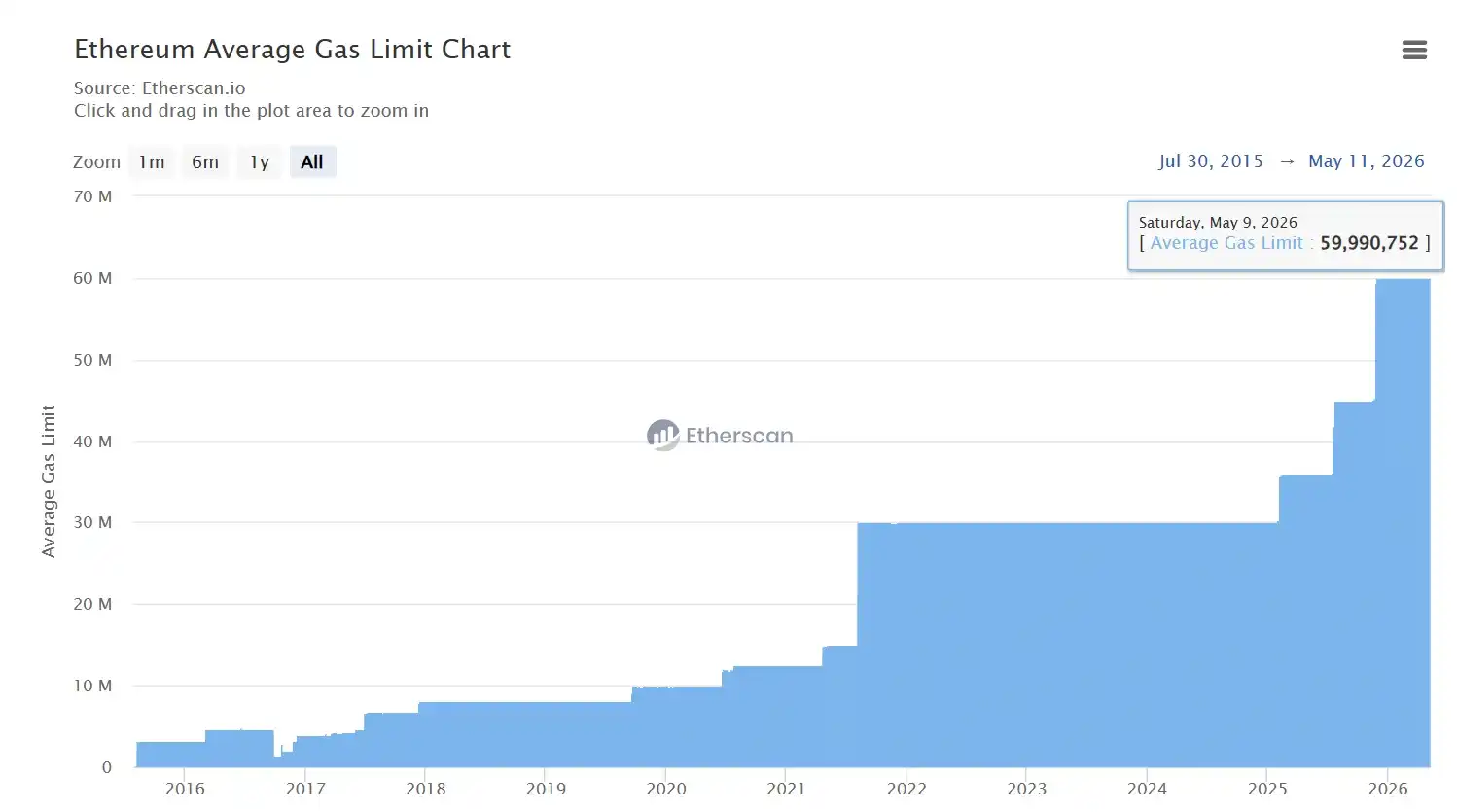
Source : Etherscan

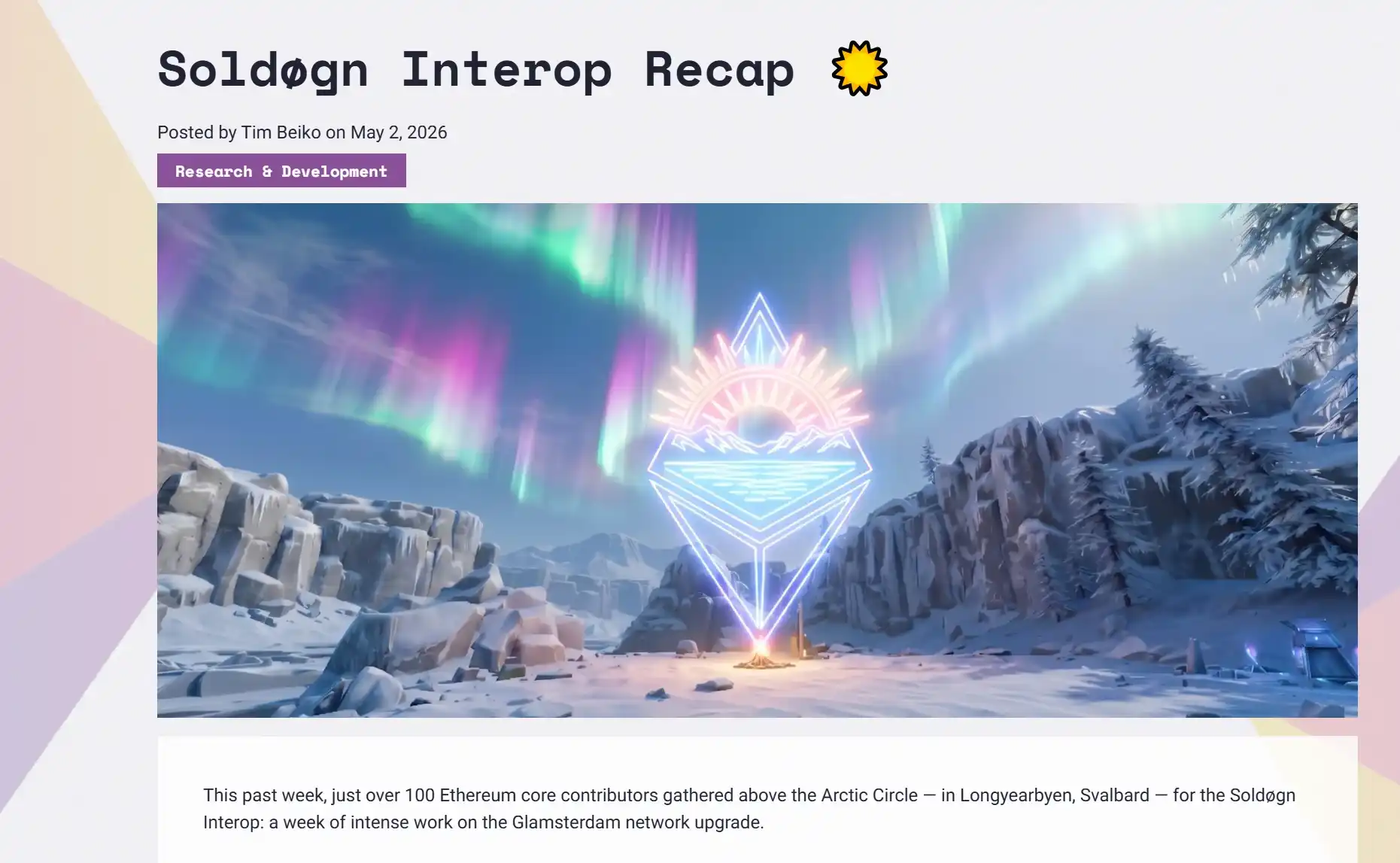
Et selon le Soldøgn Interop Recap publié par l'Ethereum Foundation le 2 mai, plus de 100 contributeurs clés d'Ethereum ont participé à une réunion d'interopérabilité sur la mise à niveau Glamsterdam dans l'archipel du Svalbard en Norvège. L'objectif principal était d'avancer l'implémentation multi-client, les tests et l'alignement des paramètres pour Glamsterdam. À la fin de la réunion, les développeurs avaient déjà formé un consensus directionnel autour d'un Gas Limit de 200 millions après Glamsterdam.

Cela signifie que, si les prochaines étapes se déroulent bien, la capacité d'exécution de la L1 d'Ethereum pourrait passer du Gas Limit actuel d'environ 60 millions à un niveau de l'ordre de 200 millions. Sur une échelle de temps plus longue, l'attitude de l'écosystème Ethereum envers la discussion publique sur le Gas Limit est clairement devenue beaucoup plus « agressive ». La proposition EIP-9698 suggère même une « multiplication par dix tous les deux ans », visant à porter le Gas Limit à 3,6 milliards d'ici 2029, soit 50 fois le niveau actuel.

Mais il est important de souligner ici qu'augmenter le Gas Limit ne se résume pas à simplement agrandir les blocs.

Si l'on augmentait brutalement la quantité de calcul que chaque bloc peut contenir, à court terme, cela pourrait réduire les frais, mais à long terme, cela entraînerait une charge plus lourde pour les nœuds, une inflation des données d'état, et signifierait que les utilisateurs ordinaires auraient plus de difficultés à exécuter un nœud, affaiblissant finalement le fondement le plus central d'Ethereum : la décentralisation.

L'approche de scalabilité de Glamsterdam est donc une combinaison de mesures :

  • L'ePBS (enshrined Proposer-Builder Separation) intègre plus clairement les processus de construction et de validation des blocs dans les règles du protocole, permettant aux validateurs de traiter plus sûrement des blocs plus grands ;
  • Les Block-Level Access Lists (BAL) enregistrent à l'avance les comptes et emplacements de stockage qui seront consultés lors de l'exécution d'un bloc, permettant ainsi des lectures disque parallèles, des validations de transactions parallèles et des calculs de racine d'état parallèles ;
  • Et l'EIP-8037, en augmentant le coût des opérations liées à la création d'état, évite une croissance trop rapide de l'état après l'augmentation du Gas Limit.

En fin de compte, Ethereum ne cherche pas seulement à « contenir plus de transactions », il réfléchit aussi à comment, tout en contenant plus de transactions, ne pas rendre le seuil d'exécution d'un nœud de plus en plus élevé.

C'est la différence fondamentale entre la feuille de route de scalabilité d'Ethereum et le récit de nombreuses chaînes hautes performances. Elle n'a jamais cherché à sacrifier le coût de la validation pour obtenir un débit de surface, mais plutôt, dans la mesure du possible, à maintenir la participation des nœuds ordinaires et la vérifiabilité du système, tout en augmentant la capacité de charge du mainnet lui-même.

II. Keyed Nonces : Transformer « une file d'attente » en « plusieurs canaux »

Si le Gas Limit résout la question de « combien un bloc peut contenir », les Keyed Nonces s'intéressent à un autre problème plus détaillé mais crucial : comment les transactions doivent-elles être mises en file d'attente ?

Comme chacun sait, dans Ethereum, le nonce peut être simplement compris comme le « numéro de série » des transactions d'un compte. Son rôle est d'empêcher l'exécution répétée d'une même transaction et de garantir que les transactions envoyées par un même compte sont traitées dans l'ordre.

Ce mécanisme est facile à comprendre dans le scénario d'un simple transfert : première transaction, deuxième transaction, troisième transaction, etc., dans l'ordre.

Mais le problème est que lorsque les capacités d'un compte deviennent plus complexes, impliquant par exemple des transactions privées, des portefeuilles intelligents, des clés de session, des opérations par lots, des paiements par des tiers, le nonce linéaire unique peut devenir un goulot d'étranglement. Ainsi, les Keyed Nonces proposés par l'EIP-8250 ont pour idée centrale de transformer le fait qu'un compte n'avait qu'une seule file d'attente de nonce, en la possibilité d'avoir plusieurs domaines de nonce.

Plus précisément, ils remplacent le sender nonce unique des Frame Transactions de l'EIP-8141 par une structure (nonce_key, nonce_seq), où nonce_key == 0 correspond au nonce de compte traditionnel, tandis que les clés non nulles peuvent choisir des séquences de nonce gérées indépendamment par le protocole. Les transactions sous des clés différentes sont indépendantes les unes des autres et ne s'affectent pas mutuellement en termes de protection contre la relecture.

Cela peut sembler technique, mais on peut le comprendre par une analogie de la vie quotidienne : auparavant, un compte était comme une banque avec un seul guichet, toutes les opérations devaient faire la même queue ; les Keyed Nonces, c'est comme attribuer différentes opérations à différents guichets : transfert, retrait privé, autorisation de session, exécution par lots peuvent chacun emprunter leur propre canal.
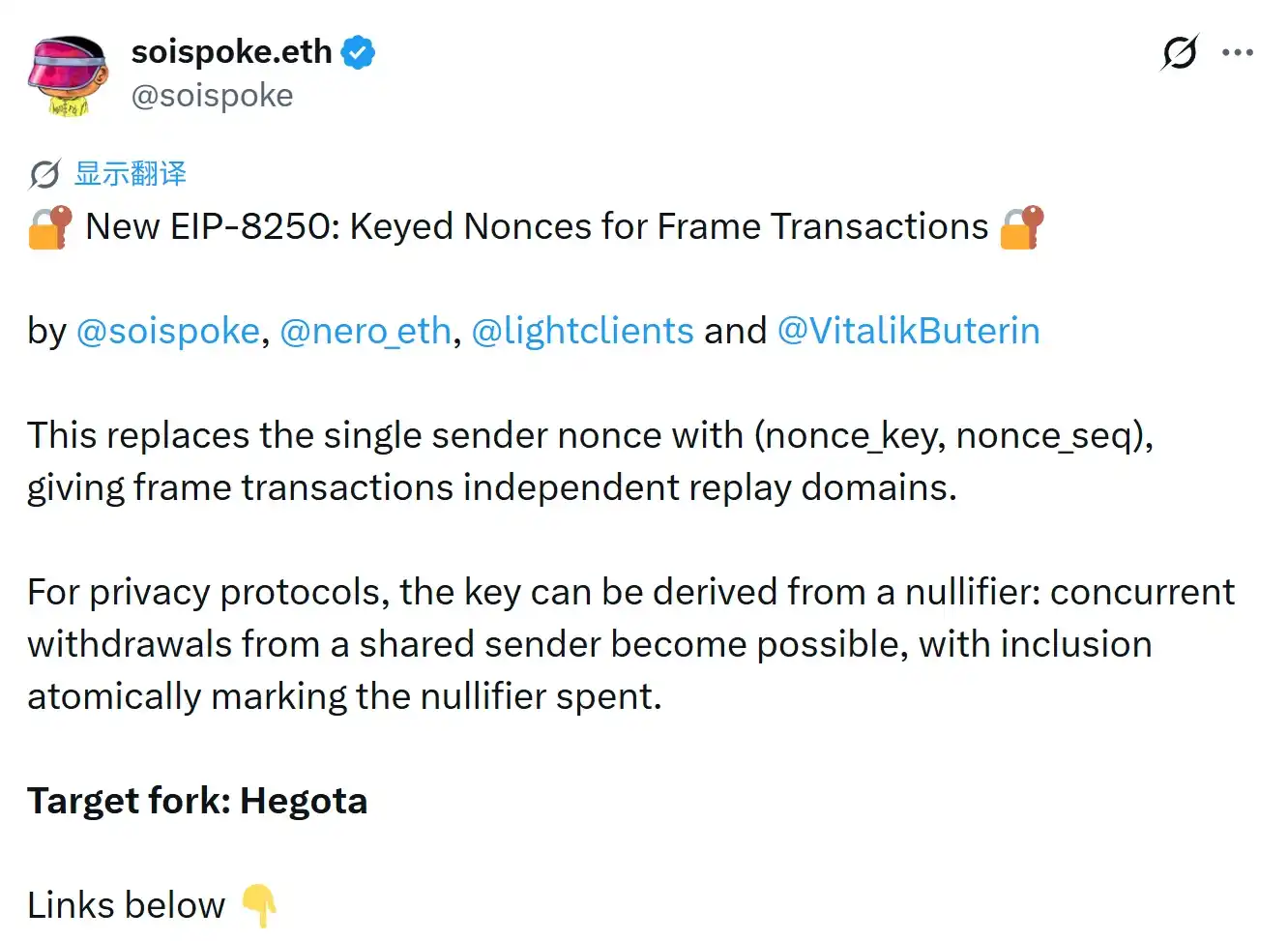
Ceci est particulièrement important pour les protocoles de confidentialité. En effet, pour éviter de lier directement les activités on-chain d'un utilisateur à une adresse publique, un protocole de confidentialité pourrait faire en sorte que plusieurs utilisateurs initient des transactions via une même adresse d'expéditeur partagée. Mais avec un mécanisme de nonce unique, une fois la transaction d'un utilisateur intégrée dans un bloc, cela peut invalider ou bloquer les transactions d'autres utilisateurs encore en attente.

Et les Keyed Nonces permettent à chaque dépense de choisir son propre domaine de nonce, par exemple dérivé d'un nullifier de confidentialité, réduisant ainsi ce type de conflit de file d'attente au niveau du protocole.

La vision de Vitalik lui-même à ce sujet est encore plus large. En présentant l'EIP-8250, il a clairement déclaré que les Keyed Nonces « ne sont pas seulement un soutien plus fort aux solutions de confidentialité au niveau du protocole, mais pourraient aussi être la première étape d'une nouvelle stratégie de scalabilité de l'état pour Ethereum — en créant des types de stockage spécialement optimisés pour différents cas d'usage, afin d'atteindre une scalabilité extrême tout en préservant la décentralisation du protocole. »

En d'autres termes, on peut simplement comprendre que le Gas Limit résout la « taille des blocs », tandis que les Keyed Nonces explorent la « forme de l'état » — ce qu'Ethereum devra supporter à l'avenir, ce n'est pas seulement plus de transactions, mais plus de types de transactions.

III. Comment cela affectera-t-il l'utilisateur ordinaire ?

Pour l'écosystème Ethereum, de nombreuses mises à niveau protocolaires semblent éloignées de l'utilisateur ordinaire, mais finissent toutes par se traduire dans l'expérience du portefeuille.

Parce que le véritable point d'entrée des utilisateurs vers Ethereum n'est pas les EIP, les clients ou les réunions de développeurs, mais chaque transfert, autorisation, signature, interaction cross-chain et avec les DApps dans le portefeuille. Autrement dit, les changements au niveau du protocole ne réalisent véritablement la transformation d'une mise à niveau technique en une mise à niveau de l'expérience utilisateur que lorsqu'ils sont traduits, au niveau du portefeuille, en une expérience d'utilisation plus claire, plus fluide et plus sûre.

Par exemple, l'abstraction de compte, dont tout le monde parle aujourd'hui, n'existe pas pour que l'utilisateur comprenne plus de termes techniques, mais pour qu'à l'avenir, il puisse utiliser son compte on-chain de manière plus naturelle. C'est pourquoi ces dernières années, les transactions par lots, le paiement du Gas par des jetons, les mécanismes de récupération, les différentes méthodes de signature, les autorisations de session ainsi que des stratégies de sécurité plus flexibles deviennent progressivement des capacités de base dans les portefeuilles.

Prenons également l'exemple des Keyed Nonces. Cela ressemble à une optimisation très bas niveau du mécanisme de file d'attente des comptes, mais du côté utilisateur, son impact potentiel n'est pas abstrait. Car aujourd'hui, de nombreux utilisateurs ont probablement rencontré des situations similaires lors d'opérations on-chain : une transaction qui met du temps à être confirmée, bloquant les transactions suivantes ; vouloir annuler ou accélérer une transaction sans comprendre les relations entre nonce, Gas et remplacement de transaction ; surtout lors d'opérations multiples parallèles, une étape en échec peut affecter tous les processus suivants.

Pour l'utilisateur ordinaire, ces problèmes semblent être du « portefeuille peu pratique » ou de la « chaîne peu pratique », mais ils sont en réalité liés à la conception du nonce linéaire unique dans le modèle de compte d'Ethereum. La direction représentée par les Keyed Nonces consiste à permettre aux comptes de ne plus devoir exécuter toutes les opérations dans une seule file d'attente séquentielle, mais de pouvoir diviser cette file en plusieurs canaux parallèles selon différents scénarios d'utilisation.

Ainsi, à l'avenir, les opérations courantes de transfert, d'autorisation DApp, de transaction privée, de transaction par lots, de paiement de Gas par des tiers pourraient théoriquement avoir des espaces d'exécution plus indépendants, réduisant la probabilité de blocages et de conflits mutuels.

Cela ouvrira sans aucun doute davantage l'espace de conception des portefeuilles intelligents.

Plus important encore, par le passé, ces capacités nécessitaient souvent que le portefeuille, la DApp, les services de relais et l'utilisateur partagent la complexité. L'utilisateur devait comprendre la portée des autorisations, juger si le Gas était raisonnable, savoir exactement ce qu'il signait, et reconfirmiter à chaque étape dans les opérations multi-étapes comme le cross-chain, l'échange, le staking, la récupération de récompenses, etc. Toute mécompréhension à une étape pouvait entraîner un échec de l'opération et un risque de perte d'actifs.

Ce qu'Ethereum essaie de faire maintenant, c'est précisément de repousser une partie de cette complexité vers la couche protocolaire, permettant aux portefeuilles de fournir une meilleure abstraction d'interaction à l'utilisateur, basée sur des capacités sous-jacentes plus standardisées et plus natives.

C'est aussi pourquoi le Gas Limit, les BAL, l'ePBS, les Keyed Nonces, les Frame Transactions, l'abstraction de compte native et l'interopérabilité cross-L2, qui semblent appartenir à différents modules techniques, servent en réalité tous la même chose : permettre à Ethereum de supporter des scénarios d'utilisation on-chain plus complexes sans sacrifier la décentralisation et la sécurité.

Concrètement, en considérant ces dynamiques ensemble, on constate que les priorités récentes d'Ethereum ne sont pas dispersées :

  • L'augmentation du Gas Limit résout la capacité d'exécution du mainnet et la pression sur les frais ;
  • Les BAL, l'ePBS, l'EIP-8037 résolvent comment maintenir la vérifiabilité des nœuds et une croissance contrôlée de l'état pendant le processus de scalabilité ;
  • Les Keyed Nonces et les Frame Transactions résolvent les goulots d'étranglement au niveau du protocole pour le modèle de compte, les protocoles de confidentialité et les portefeuilles intelligents ;
  • L'abstraction de compte native et l'interopérabilité cross-L2 visent davantage l'amélioration de l'expérience que l'utilisateur ordinaire peut réellement ressentir.

Cela signifie aussi qu'Ethereum entre dans une nouvelle phase.

Après tout, ces dernières années, le marché s'est davantage concentré sur la scalabilité L2, la réduction des frais par les Blobs et le récit de la modularité. Les utilisateurs se sont aussi habitués à transférer des actifs entre différentes L2 et à rechercher des environnements d'interaction à moindre coût. Mais avec la poursuite de l'augmentation du Gas Limit du mainnet, l'avancement des mises à niveau comme Glamsterdam, et l'évolution continue des solutions d'abstraction de compte et d'interopérabilité, la question à laquelle Ethereum répond n'est plus seulement « comment rendre les transactions moins chères », mais « comment faire en sorte que l'expérience on-chain ressemble davantage à un tout cohérent ».

Dans ce processus, l'importance du portefeuille sera sans aucun doute encore amplifiée.

Car le portefeuille n'est pas seulement le point d'entrée de l'utilisateur dans Ethereum, c'est aussi l'interface par laquelle les capacités du protocole sont réellement comprises et utilisées par l'utilisateur. À l'avenir, plus les mises à niveau sous-jacentes seront complexes, plus elles devront être traduites par le portefeuille en invitations de signature plus claires, des chemins de transaction plus compréhensibles, une identification des risques plus en amont, et une expérience d'interaction on-chain plus fluide.

À méditer ensemble.

Trending Cryptos

Related Questions

QQuels sont les principaux développements récents d'Ethereum pour améliorer l'expérience utilisateur ?

ALes développements récents d'Ethereum incluent l'augmentation de la limite de Gas jusqu'à 2 milliards lors de la mise à niveau Glamsterdam, l'implémentation de Keyed Nonces (EIP-8250) pour améliorer la gestion des transactions, et l'accent mis sur l'abstraction de compte native et l'interopérabilité inter-L2 pour simplifier l'expérience des utilisateurs.

QComment Keyed Nonces améliore-t-il la gestion des transactions sur Ethereum ?

AKeyed Nonces (EIP-8250) remplace le mécanisme nonce linéaire unique par des domaines nonce multiples, permettant à différentes transactions (comme les transferts, les opérations de confidentialité ou les autorisations de session) d'être traitées en parallèle sans se bloquer mutuellement, ce qui améliore l'efficacité et réduit les conflits.

QPourquoi l'augmentation de la limite de Gas à 2 milliards est-elle importante pour Ethereum ?

AL'augmentation de la limite de Gas à 2 milliards augmente la capacité d'exécution d'Ethereum, réduisant potentiellement les frais de transaction et améliorant le débit. Cependant, cette approche est combinée à des mesures comme ePBS et BAL pour maintenir la décentralisation et éviter une charge excessive sur les nœuds.

QQuel est le rôle du portefeuille dans l'amélioration de l'expérience utilisateur sur Ethereum ?

ALe portefeuille sert d'interface essentielle pour traduire les mises à niveau protocolaires complexes en expériences utilisateur fluides. Il simplifie les signatures, les autorisations, les transactions par lots et la gestion des risques, permettant aux utilisateurs d'interagir plus facilement avec Ethereum sans comprendre les détails techniques sous-jacents.

QQuelles mesures Ethereum prend-il pour maintenir la décentralisation lors de l'augmentation de la limite de Gas ?

APour maintenir la décentralisation lors de l'augmentation de la limite de Gas, Ethereum utilise des mécanismes comme ePBS (séparation intégrée du proposant et du constructeur), les Block-Level Access Lists (BAL) pour une lecture parallèle des données, et l'EIP-8037 pour contrôler la croissance de l'état, garantissant que les nœuds restent accessibles et gérables.

Related Reads

Why Is the World Nervous About Japan Raising Interest Rates?

In June 2026, the Bank of Japan raised its policy rate to 1%, marking its first hike to this level since 1995. While this rate remains low compared to global peers like the US and Europe, the move signals a profound shift for a nation that has been a global source of ultra-cheap funding for decades. Japan's long-standing near-zero or negative interest rates had facilitated massive "yen carry trades," where international investors borrowed low-cost yen to invest in higher-yielding assets worldwide, such as US tech stocks and emerging market bonds. This made Japan a critical, often overlooked, source of global liquidity. Japan's ultra-loose policy stemmed from structural challenges post-1990s asset bubble: aging demographics, chronic low inflation/deflation, and high public debt. Recent shifts, including sustained wage growth (exceeding 5% in recent years) and inflation consistently above the 2% target, have created a "wage-price spiral" possibility, prompting the policy normalization. The global market's concern lies not in the absolute rate but in the potential unwinding of the yen carry trade. As Japanese borrowing costs rise, the economics of these leveraged global investments change, potentially triggering deleveraging and capital outflows from risk assets. Market anxiety focuses on the end of a thirty-year consensus that Japan would perpetually provide cheap funding. Ultimately, the global impact will depend on the interplay with US monetary policy. While Japan is tightening, the significant interest rate differential with the US remains. The key future dynamic is whether simultaneous Japanese hikes and eventual US rate cuts will narrow this gap, forcing a major recalibration of global capital flows and asset pricing built on an era of abundant, cheap yen liquidity.

marsbit1h ago

Why Is the World Nervous About Japan Raising Interest Rates?

marsbit1h ago

Research Report Analysis: MRVL's Optical AI Booming, Why High Valuation Keeps Morgan Stanley's Star Analyst Sidelined?

Report Recap: MRVL Optical AI Boom - Why High Valuation Led Morgan Stanley's Star Analyst to Stay Neutral? Morgan Stanley analyst Joseph Moore maintained an "Equal-weight" (Neutral) rating on Marvell Technology (MRVL) on May 28, raising the price target from $172 to $195, below the trading price. This stance comes despite Marvell reporting a record quarter and significantly raising its full-year outlook (FY27 revenue ~$11.5B, up ~40%). Moore's neutral view is based on valuation. The $195 target implies ~40x CY2027 P/E. He contrasts MRVL with NVDA: both trade near ~$200, but Nvidia's forward EPS is more than double Marvell's. For MRVL's valuation to hold, it needs consistent earnings upgrades, proof of networking market share gains, or certainty on large-scale custom AI chip shipments—none of which are confirmed yet. Growth is driven by two pillars: **1) Optical Interconnect** (the faster runner): Moore raised FY27 growth expectations to >70%, with the optical module product line nearing a $1B annualized run rate. **2) Custom AI Chips** (the climber): Confidence in FY28 is growing, but a major new customer project only ramps in FY28, with no current revenue visibility. Key risks are the underperforming Storage, Enterprise, and legacy Networking segments. Moore acknowledges the real AI opportunity but believes the current price already reflects it. For the stock to work from here, investors need to see the optical business hit its targets, custom chips ramp as planned, and a recovery in the weaker business units.

marsbit2h ago

Research Report Analysis: MRVL's Optical AI Booming, Why High Valuation Keeps Morgan Stanley's Star Analyst Sidelined?

marsbit2h ago

qinbaFrank: Review and Outlook of the AI Computing Power Wave — From the Three Debates on NVIDIA to Optical Interconnect and SpaceX IPO, How is Capital Rotating?

**Summary: Retrospective and Outlook on the AI Computing Wave - A Framework for Capital Rotation** Based on a presentation by investor qinbaFrank, this analysis reviews the AI computing market trajectory since 2023 and outlines a forward-looking framework. **Key Phases and Market Debates:** The AI bull market progressed through three major debates: 1) The necessity of massive capital expenditure (late 2023). 2) The sustainability of tech giants' spending (early 2024-early 2025). 3) Potential overestimation of compute needs (early 2025). Consensus solidified in late 2025 as model capabilities and utility demonstrably improved. **Core Thesis: Penetration Rate Drives Commercialization.** Unlike the 2000 dot-com bubble, the current AI wave benefits from mature digital infrastructure, enabling faster adoption. The critical threshold is 10% penetration; surpassing it (with recent enterprise intent surveys showing ~18%) indicates entry into a rapid growth "golden period" where user scale and willingness to pay increase simultaneously. **AI vs. Internet: A Fundamental Difference.** While the internet enhanced connection efficiency, AI directly substitutes human cognition and labor. Once AI performance exceeds the "societal average" human level, its commercial value scales exponentially as payment shifts from human labor costs to AI service fees. **Investment Logic Evolution in the Compute Chain.** The focus has expanded from GPUs to a systemic re-rating of the entire hardware stack: storage/HBM, CPUs, interconnects, power, and advanced packaging. The framework is: **short-term "scarcity pricing," mid-term "upgrade pricing" (e.g., optical interconnects, power networks), and long-term "Physical AI" pricing** (edge computing, robotics). **Market Focus Shift and Adjustment Framework.** The market is transitioning from "hardware scarcity" to "commercialization validation." The ultimate anchor for the narrative is sustained high growth in model providers' Annual Recurring Revenue (ARR) and cloud business revenue, which justifies continued capital expenditure. Adjustments are categorized into three levels: * **L1 (Minor):** Driven by valuation compression or macro noise (e.g., single CPI print). Fundamentals intact. * **L2 (Moderate):** Triggered by significant macro events requiring risk repricing. Requires new data for confidence restoration. * **L3 (Major):** Involves a reset of the core industrial narrative or macro regime (e.g., AI commercialization growth stalling). The **crucial dividing line** is whether AI commercialization growth slows. Without a slowdown, pullbacks are likely L1/L2 "repricing" events. A genuine growth deceleration would signal an L2/L3 narrative reset. **Conclusion: A Foundational Civilizational Leap.** AI represents a foundational upgrade to "intelligence" itself—akin to humanity mastering fire—rather than a single-point industrial revolution. This底层能力跃迁 (underlying capability leap) will spawn successive waves of innovation (Agent, robotics, industry workflow重构). The journey will be波浪式的 (wavelike), driven by cycles of scarcity, technological upgrades, and远期兑现 (long-term realization).

marsbit2h ago

qinbaFrank: Review and Outlook of the AI Computing Power Wave — From the Three Debates on NVIDIA to Optical Interconnect and SpaceX IPO, How is Capital Rotating?

marsbit2h ago

Trading

Spot
Futures

Hot Articles

What is SONIC

Sonic: Pioneering the Future of Gaming in Web3 Introduction to Sonic In the ever-evolving landscape of Web3, the gaming industry stands out as one of the most dynamic and promising sectors. At the forefront of this revolution is Sonic, a project designed to amplify the gaming ecosystem on the Solana blockchain. Leveraging cutting-edge technology, Sonic aims to deliver an unparalleled gaming experience by efficiently processing millions of requests per second, ensuring that players enjoy seamless gameplay while maintaining low transaction costs. This article delves into the intricate details of Sonic, exploring its creators, funding sources, operational mechanics, and the timeline of significant events that have shaped its journey. What is Sonic? Sonic is an innovative layer-2 network that operates atop the Solana blockchain, specifically tailored to enhance the existing Solana gaming ecosystem. It accomplishes this through a customised, VM-agnostic game engine paired with a HyperGrid interpreter, facilitating sovereign game economies that roll up back to the Solana platform. The primary goals of Sonic include: Enhanced Gaming Experiences: Sonic is committed to offering lightning-fast on-chain gameplay, allowing players and developers to engage with games at previously unattainable speeds. Atomic Interoperability: This feature enables transactions to be executed within Sonic without the need to redeploy Solana programmes and accounts. This makes the process more efficient and directly benefits from Solana Layer1 services and liquidity. Seamless Deployment: Sonic allows developers to write for Ethereum Virtual Machine (EVM) based systems and execute them on Solana’s SVM infrastructure. This interoperability is crucial for attracting a broader range of dApps and decentralised applications to the platform. Support for Developers: By offering native composable gaming primitives and extensible data types - dining within the Entity-Component-System (ECS) framework - game creators can craft intricate business logic with ease. Overall, Sonic's unique approach not only caters to players but also provides an accessible and low-cost environment for developers to innovate and thrive. Creator of Sonic The information regarding the creator of Sonic is somewhat ambiguous. However, it is known that Sonic's SVM is owned by the company Mirror World. The absence of detailed information about the individuals behind Sonic reflects a common trend in several Web3 projects, where collective efforts and partnerships often overshadow individual contributions. Investors of Sonic Sonic has garnered considerable attention and support from various investors within the crypto and gaming sectors. Notably, the project raised an impressive $12 million during its Series A funding round. The round was led by BITKRAFT Ventures, with other notable investors including Galaxy, Okx Ventures, Interactive, Big Brain Holdings, and Mirana. This financial backing signifies the confidence that investment foundations have in Sonic’s potential to revolutionise the Web3 gaming landscape, further validating its innovative approaches and technologies. How Does Sonic Work? Sonic utilises the HyperGrid framework, a sophisticated parallel processing mechanism that enhances its scalability and customisability. Here are the core features that set Sonic apart: Lightning Speed at Low Costs: Sonic offers one of the fastest on-chain gaming experiences compared to other Layer-1 solutions, powered by the scalability of Solana’s virtual machine (SVM). Atomic Interoperability: Sonic enables transaction execution without redeployment of Solana programmes and accounts, effectively streamlining the interaction between users and the blockchain. EVM Compatibility: Developers can effortlessly migrate decentralised applications from EVM chains to the Solana environment using Sonic’s HyperGrid interpreter, increasing the accessibility and integration of various dApps. Ecosystem Support for Developers: By exposing native composable gaming primitives, Sonic facilitates a sandbox-like environment where developers can experiment and implement business logic, greatly enhancing the overall development experience. Monetisation Infrastructure: Sonic natively supports growth and monetisation efforts, providing frameworks for traffic generation, payments, and settlements, thereby ensuring that gaming projects are not only viable but also sustainable financially. Timeline of Sonic The evolution of Sonic has been marked by several key milestones. Below is a brief timeline highlighting critical events in the project's history: 2022: The Sonic cryptocurrency was officially launched, marking the beginning of its journey in the Web3 gaming arena. 2024: June: Sonic SVM successfully raised $12 million in a Series A funding round. This investment allowed Sonic to further develop its platform and expand its offerings. August: The launch of the Sonic Odyssey testnet provided users with the first opportunity to engage with the platform, offering interactive activities such as collecting rings—a nod to gaming nostalgia. October: SonicX, an innovative crypto game integrated with Solana, made its debut on TikTok, capturing the attention of over 120,000 users within a short span. This integration illustrated Sonic’s commitment to reaching a broader, global audience and showcased the potential of blockchain gaming. Key Points Sonic SVM is a revolutionary layer-2 network on Solana explicitly designed to enhance the GameFi landscape, demonstrating great potential for future development. HyperGrid Framework empowers Sonic by introducing horizontal scaling capabilities, ensuring that the network can handle the demands of Web3 gaming. Integration with Social Platforms: The successful launch of SonicX on TikTok displays Sonic’s strategy to leverage social media platforms to engage users, exponentially increasing the exposure and reach of its projects. Investment Confidence: The substantial funding from BITKRAFT Ventures, among others, emphasizes the robust backing Sonic has, paving the way for its ambitious future. In conclusion, Sonic encapsulates the essence of Web3 gaming innovation, striking a balance between cutting-edge technology, developer-centric tools, and community engagement. As the project continues to evolve, it is poised to redefine the gaming landscape, making it a notable entity for gamers and developers alike. As Sonic moves forward, it will undoubtedly attract greater interest and participation, solidifying its place within the broader narrative of blockchain gaming.

1.7k Total ViewsPublished 2024.04.04Updated 2024.12.03

What is SONIC

What is $S$

Understanding SPERO: A Comprehensive Overview Introduction to SPERO As the landscape of innovation continues to evolve, the emergence of web3 technologies and cryptocurrency projects plays a pivotal role in shaping the digital future. One project that has garnered attention in this dynamic field is SPERO, denoted as SPERO,$$s$. This article aims to gather and present detailed information about SPERO, to help enthusiasts and investors understand its foundations, objectives, and innovations within the web3 and crypto domains. What is SPERO,$$s$? SPERO,$$s$ is a unique project within the crypto space that seeks to leverage the principles of decentralisation and blockchain technology to create an ecosystem that promotes engagement, utility, and financial inclusion. The project is tailored to facilitate peer-to-peer interactions in new ways, providing users with innovative financial solutions and services. At its core, SPERO,$$s$ aims to empower individuals by providing tools and platforms that enhance user experience in the cryptocurrency space. This includes enabling more flexible transaction methods, fostering community-driven initiatives, and creating pathways for financial opportunities through decentralised applications (dApps). The underlying vision of SPERO,$$s$ revolves around inclusiveness, aiming to bridge gaps within traditional finance while harnessing the benefits of blockchain technology. Who is the Creator of SPERO,$$s$? The identity of the creator of SPERO,$$s$ remains somewhat obscure, as there are limited publicly available resources providing detailed background information on its founder(s). This lack of transparency can stem from the project's commitment to decentralisation—an ethos that many web3 projects share, prioritising collective contributions over individual recognition. By centring discussions around the community and its collective goals, SPERO,$$s$ embodies the essence of empowerment without singling out specific individuals. As such, understanding the ethos and mission of SPERO remains more important than identifying a singular creator. Who are the Investors of SPERO,$$s$? SPERO,$$s$ is supported by a diverse array of investors ranging from venture capitalists to angel investors dedicated to fostering innovation in the crypto sector. The focus of these investors generally aligns with SPERO's mission—prioritising projects that promise societal technological advancement, financial inclusivity, and decentralised governance. These investor foundations are typically interested in projects that not only offer innovative products but also contribute positively to the blockchain community and its ecosystems. The backing from these investors reinforces SPERO,$$s$ as a noteworthy contender in the rapidly evolving domain of crypto projects. How Does SPERO,$$s$ Work? SPERO,$$s$ employs a multi-faceted framework that distinguishes it from conventional cryptocurrency projects. Here are some of the key features that underline its uniqueness and innovation: Decentralised Governance: SPERO,$$s$ integrates decentralised governance models, empowering users to participate actively in decision-making processes regarding the project’s future. This approach fosters a sense of ownership and accountability among community members. Token Utility: SPERO,$$s$ utilises its own cryptocurrency token, designed to serve various functions within the ecosystem. These tokens enable transactions, rewards, and the facilitation of services offered on the platform, enhancing overall engagement and utility. Layered Architecture: The technical architecture of SPERO,$$s$ supports modularity and scalability, allowing for seamless integration of additional features and applications as the project evolves. This adaptability is paramount for sustaining relevance in the ever-changing crypto landscape. Community Engagement: The project emphasises community-driven initiatives, employing mechanisms that incentivise collaboration and feedback. By nurturing a strong community, SPERO,$$s$ can better address user needs and adapt to market trends. Focus on Inclusion: By offering low transaction fees and user-friendly interfaces, SPERO,$$s$ aims to attract a diverse user base, including individuals who may not previously have engaged in the crypto space. This commitment to inclusion aligns with its overarching mission of empowerment through accessibility. Timeline of SPERO,$$s$ Understanding a project's history provides crucial insights into its development trajectory and milestones. Below is a suggested timeline mapping significant events in the evolution of SPERO,$$s$: Conceptualisation and Ideation Phase: The initial ideas forming the basis of SPERO,$$s$ were conceived, aligning closely with the principles of decentralisation and community focus within the blockchain industry. Launch of Project Whitepaper: Following the conceptual phase, a comprehensive whitepaper detailing the vision, goals, and technological infrastructure of SPERO,$$s$ was released to garner community interest and feedback. Community Building and Early Engagements: Active outreach efforts were made to build a community of early adopters and potential investors, facilitating discussions around the project’s goals and garnering support. Token Generation Event: SPERO,$$s$ conducted a token generation event (TGE) to distribute its native tokens to early supporters and establish initial liquidity within the ecosystem. Launch of Initial dApp: The first decentralised application (dApp) associated with SPERO,$$s$ went live, allowing users to engage with the platform's core functionalities. Ongoing Development and Partnerships: Continuous updates and enhancements to the project's offerings, including strategic partnerships with other players in the blockchain space, have shaped SPERO,$$s$ into a competitive and evolving player in the crypto market. Conclusion SPERO,$$s$ stands as a testament to the potential of web3 and cryptocurrency to revolutionise financial systems and empower individuals. With a commitment to decentralised governance, community engagement, and innovatively designed functionalities, it paves the way toward a more inclusive financial landscape. As with any investment in the rapidly evolving crypto space, potential investors and users are encouraged to research thoroughly and engage thoughtfully with the ongoing developments within SPERO,$$s$. The project showcases the innovative spirit of the crypto industry, inviting further exploration into its myriad possibilities. While the journey of SPERO,$$s$ is still unfolding, its foundational principles may indeed influence the future of how we interact with technology, finance, and each other in interconnected digital ecosystems.

58 Total ViewsPublished 2024.12.17Updated 2024.12.17

What is $S$

What is AGENT S

Agent S: The Future of Autonomous Interaction in Web3 Introduction In the ever-evolving landscape of Web3 and cryptocurrency, innovations are constantly redefining how individuals interact with digital platforms. One such pioneering project, Agent S, promises to revolutionise human-computer interaction through its open agentic framework. By paving the way for autonomous interactions, Agent S aims to simplify complex tasks, offering transformative applications in artificial intelligence (AI). This detailed exploration will delve into the project's intricacies, its unique features, and the implications for the cryptocurrency domain. What is Agent S? Agent S stands as a groundbreaking open agentic framework, specifically designed to tackle three fundamental challenges in the automation of computer tasks: Acquiring Domain-Specific Knowledge: The framework intelligently learns from various external knowledge sources and internal experiences. This dual approach empowers it to build a rich repository of domain-specific knowledge, enhancing its performance in task execution. Planning Over Long Task Horizons: Agent S employs experience-augmented hierarchical planning, a strategic approach that facilitates efficient breakdown and execution of intricate tasks. This feature significantly enhances its ability to manage multiple subtasks efficiently and effectively. Handling Dynamic, Non-Uniform Interfaces: The project introduces the Agent-Computer Interface (ACI), an innovative solution that enhances the interaction between agents and users. Utilizing Multimodal Large Language Models (MLLMs), Agent S can navigate and manipulate diverse graphical user interfaces seamlessly. Through these pioneering features, Agent S provides a robust framework that addresses the complexities involved in automating human interaction with machines, setting the stage for myriad applications in AI and beyond. Who is the Creator of Agent S? While the concept of Agent S is fundamentally innovative, specific information about its creator remains elusive. The creator is currently unknown, which highlights either the nascent stage of the project or the strategic choice to keep founding members under wraps. Regardless of anonymity, the focus remains on the framework's capabilities and potential. Who are the Investors of Agent S? As Agent S is relatively new in the cryptographic ecosystem, detailed information regarding its investors and financial backers is not explicitly documented. The lack of publicly available insights into the investment foundations or organisations supporting the project raises questions about its funding structure and development roadmap. Understanding the backing is crucial for gauging the project's sustainability and potential market impact. How Does Agent S Work? At the core of Agent S lies cutting-edge technology that enables it to function effectively in diverse settings. Its operational model is built around several key features: Human-like Computer Interaction: The framework offers advanced AI planning, striving to make interactions with computers more intuitive. By mimicking human behaviour in tasks execution, it promises to elevate user experiences. Narrative Memory: Employed to leverage high-level experiences, Agent S utilises narrative memory to keep track of task histories, thereby enhancing its decision-making processes. Episodic Memory: This feature provides users with step-by-step guidance, allowing the framework to offer contextual support as tasks unfold. Support for OpenACI: With the ability to run locally, Agent S allows users to maintain control over their interactions and workflows, aligning with the decentralised ethos of Web3. Easy Integration with External APIs: Its versatility and compatibility with various AI platforms ensure that Agent S can fit seamlessly into existing technological ecosystems, making it an appealing choice for developers and organisations. These functionalities collectively contribute to Agent S's unique position within the crypto space, as it automates complex, multi-step tasks with minimal human intervention. As the project evolves, its potential applications in Web3 could redefine how digital interactions unfold. Timeline of Agent S The development and milestones of Agent S can be encapsulated in a timeline that highlights its significant events: September 27, 2024: The concept of Agent S was launched in a comprehensive research paper titled “An Open Agentic Framework that Uses Computers Like a Human,” showcasing the groundwork for the project. October 10, 2024: The research paper was made publicly available on arXiv, offering an in-depth exploration of the framework and its performance evaluation based on the OSWorld benchmark. October 12, 2024: A video presentation was released, providing a visual insight into the capabilities and features of Agent S, further engaging potential users and investors. These markers in the timeline not only illustrate the progress of Agent S but also indicate its commitment to transparency and community engagement. Key Points About Agent S As the Agent S framework continues to evolve, several key attributes stand out, underscoring its innovative nature and potential: Innovative Framework: Designed to provide an intuitive use of computers akin to human interaction, Agent S brings a novel approach to task automation. Autonomous Interaction: The ability to interact autonomously with computers through GUI signifies a leap towards more intelligent and efficient computing solutions. Complex Task Automation: With its robust methodology, it can automate complex, multi-step tasks, making processes faster and less error-prone. Continuous Improvement: The learning mechanisms enable Agent S to improve from past experiences, continually enhancing its performance and efficacy. Versatility: Its adaptability across different operating environments like OSWorld and WindowsAgentArena ensures that it can serve a broad range of applications. As Agent S positions itself in the Web3 and crypto landscape, its potential to enhance interaction capabilities and automate processes signifies a significant advancement in AI technologies. Through its innovative framework, Agent S exemplifies the future of digital interactions, promising a more seamless and efficient experience for users across various industries. Conclusion Agent S represents a bold leap forward in the marriage of AI and Web3, with the capacity to redefine how we interact with technology. While still in its early stages, the possibilities for its application are vast and compelling. Through its comprehensive framework addressing critical challenges, Agent S aims to bring autonomous interactions to the forefront of the digital experience. As we move deeper into the realms of cryptocurrency and decentralisation, projects like Agent S will undoubtedly play a crucial role in shaping the future of technology and human-computer collaboration.

732 Total ViewsPublished 2025.01.14Updated 2025.01.14

What is AGENT S

Discussions

Welcome to the HTX Community. Here, you can stay informed about the latest platform developments and gain access to professional market insights. Users' opinions on the price of S (S) are presented below.

活动图片