¿Los bajistas han sido exprimidos? ¿La próxima etapa del mercado de la IA en EE.UU. se desarrollará en Seúl?

marsbitPublished on 2026-05-12Last updated on 2026-05-12

Abstract

**Resumen: ¿Se trasladará el rally de la IA de Wall Street a Seúl?** Un informe de Nomura señala que la fase actual del rally de la IA en EE.UU., impulsada principalmente por el cierre de posiciones cortas (short squeezing) y la recomposición de carteras institucionales, está llegando a su límite. Para que continúe la tendencia alcista, se necesita una nueva ola de capital, probablemente de inversores minoristas movidos por el FOMO (miedo a perderse algo). El mercado surcoreano parece estar dando la respuesta. El mismo día del informe, el índice KOSPI subió un 4,32%, impulsado por fuertes ganancias en gigantes de semiconductores como SK Hynix (+11,98%). Esto refleja un claro patrón de FOMO entre los inversores minoristas locales, mientras que el capital extranjero se redirige hacia ETFs específicos de chips de memoria (DRAM), en lugar de fondos de cobertura amplios sobre Corea. Este movimiento en Seúl no es aislado; es una extensión de alta beta de la historia del gasto en IA. Grandes tecnológicas estadounidenses están destinando cientos de miles de millones a infraestructura, lo que beneficia directamente a los proveedores clave de memoria como SK Hynix y Samsung. Sin embargo, la sostenibilidad de este "relevo" coreano depende de varios factores: que no haya una corrección significativa en las acciones tecnológicas de EE.UU., que los datos de inflación estadounidenses no sorprendan al alza, y que la tensión geopolítica en el Estrecho de Ormuz no se intensifique. Por ahor...

Autor: Claude, Deep Tide TechFlow

Guía de Deep Tide: Un informe de investigación de Nomura publicado el 11 de mayo lanzó un juicio clave: "Al menos para las acciones estadounidenses, el mercado de la IA podría estar tomando un respiro." Justo el mismo día, el KOSPI se disparó un 4,32% en un solo día hasta 7822,24 puntos, desencadenando un *buy-sidecar* durante la sesión. SK Hynix subió un 11,98% en un día y su capitalización de mercado superó por primera vez a la de Eli Lilly, ocupando el puesto 14 a nivel mundial. El juicio del informe "la próxima etapa depende del FOMO en Corea del Sur" ocurrió casi simultáneamente con el fuerte repunte de las acciones coreanas. La fuerza impulsora de las operaciones con IA en EE.UU. está cambiando de "exprimir a los bajistas" a "FOMO de los minoristas".

El mercado de la IA en acciones estadounidenses no ha terminado. El S&P 500 acumuló un aumento de aproximadamente el 16,6% en 28 sesiones, pero el origen del dinero que elevó el índice y cuánto combustible de impulso queda están experimentando cambios sutiles. El juicio de Nomura es: la fase impulsada por el cierre de posiciones cortas y la reposición de posiciones por parte de las instituciones está llegando a su fin; si las operaciones con IA van a continuar, se necesita una nueva ronda de fondos para tomar el relevo. El mercado coreano proporcionó precisamente una muestra el mismo día que se publicó el informe. El KOSPI superó tres barreras (7000, 7400, 7800) en una semana, los minoristas cayeron en el "hynix FOMO" y los fondos extranjeros aumentaron fuertemente sus posiciones en acciones de chips a través de ETF de DRAM. La narrativa está cambiando del Nasdaq al KOSPI.

Las acciones de EE.UU. parecen normales, pero la combinación anómala de "subida del contado/subida de la volatilidad" ya está encendiendo señales

Los indicadores superficiales de las operaciones con IA en acciones de EE.UU. siguen siendo intensos. El informe de opciones de Saxo del 11 de mayo muestra que el VIX cerró en 17,19, subiendo 0,64% en un día. Esta lectura en sí misma está por debajo de la media histórica, pero el hecho de que el VIX aún suba cuando el índice alcanza máximos históricos es en sí una señal anómala. El índice CBOE SKEW subió a 138,21 (+1,54%), el VVIX (que mide la volatilidad del VIX) subió a 96,78 (+3,39%). El ascenso simultáneo de los tres indicadores indica que los inversores institucionales no han relajado sus coberturas a pesar de que el índice marca nuevos máximos.

Nomura describió esta combinación en su informe del 11 de mayo como una "situación atípica" para las acciones tecnológicas estadounidenses. El informe señala que el Nasdaq muestra una combinación de "subida del contado y subida de la volatilidad", con el VIX bajando continuamente mientras el VXN (volatilidad del Nasdaq) rebota claramente; el *skew* de las opciones sobre acciones tecnológicas estadounidenses (la diferencia entre la volatilidad implícita de las opciones de venta *25-delta* a un mes y la de las opciones de compra *25-delta*) ha caído rápidamente a niveles cercanos a mínimos históricos, volviendo a niveles de octubre de 2025. Una caída en el *skew* significa que la prima de protección de venta frente a las opciones de compra se reduce, y el mercado está más saturado en la fijación de precios al alza de las acciones tecnológicas.

Lo que es más importante es la estructura de esta subida. Según un gráfico de atribución de rentabilidad del equipo Vol de Nomura citado por TECHi, de aproximadamente el 16% de la subida del S&P 500 desde el 30 de marzo, 10 acciones contribuyeron un 69% (Alphabet, Nvidia, Amazon, Broadcom, Intel, Micron, Apple, AMD, Microsoft, SanDisk), mientras que las otras 490 acciones del índice solo contribuyeron un 31%. Ben Snider, estratega jefe de acciones estadounidenses de Goldman Sachs, también señaló que la amplitud del mercado actual se ha reducido a uno de los niveles más estrechos desde la burbuja de Internet. Goldman Sachs enumera la "Gran Construcción de la IA" y el "conflicto con Irán" como los dos riesgos más claros para el mercado de valores en las próximas semanas.
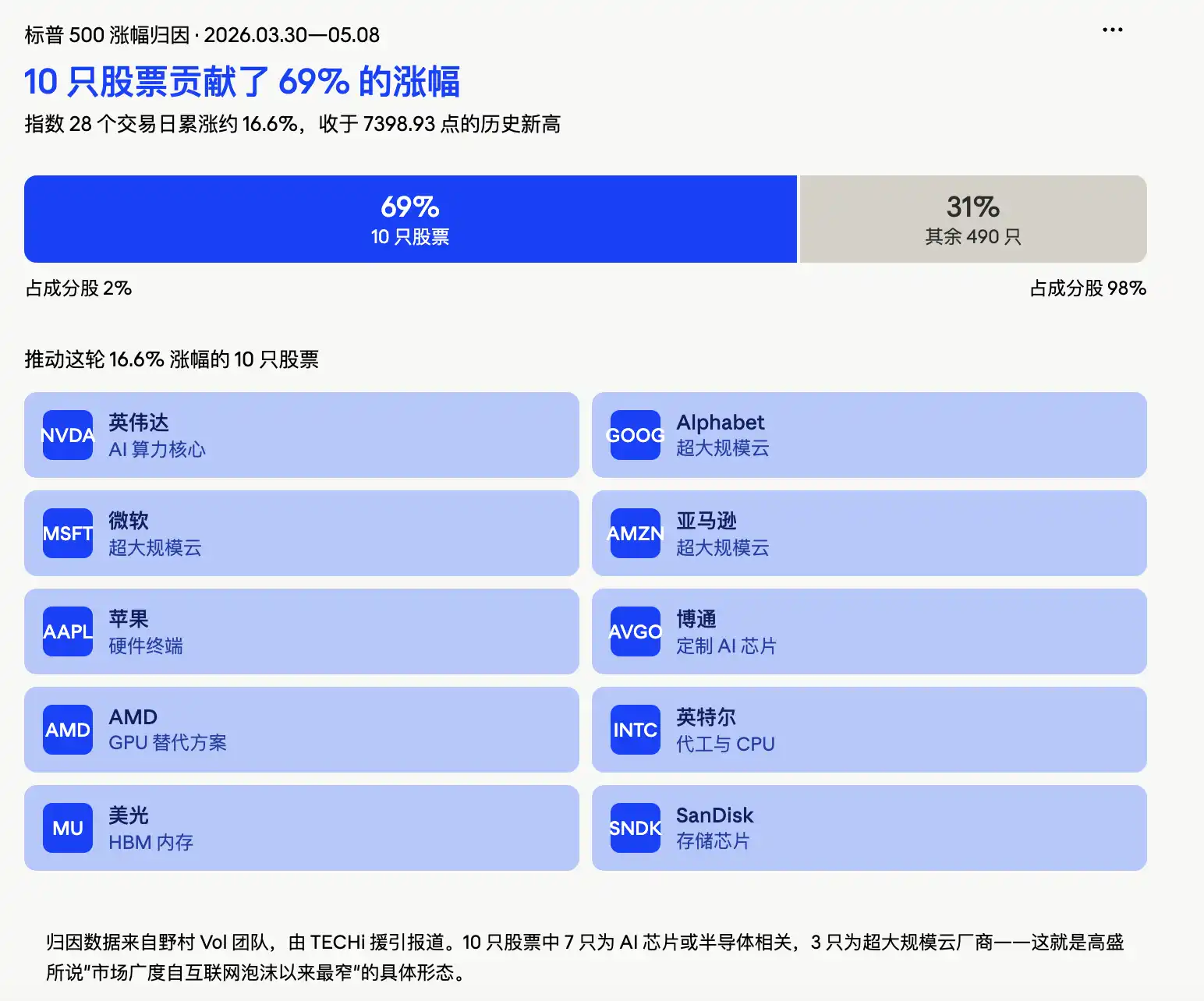
Los bajistas ya han sido exprimidos, ¿quién empujará la siguiente etapa?

El verdadero juicio contundente del informe de Nomura no está en la "combinación anómala" en sí, sino en el análisis de los flujos de capital: la exposición a acciones de los fondos cuantitativos se ha recuperado a niveles cercanos a la neutralidad, y el proceso de compras forzadas y cierre de posiciones cortas previo está básicamente completado. Los fondos CTA (*Commodity Trading Advisors*) han regresado casi por completo a posiciones largas totales, y la demanda incremental marginal de las estrategias de control de volatilidad también se está debilitando.

En otras palabras, las tres fuentes principales de demanda de compra que impulsaron las acciones de IA en las últimas semanas (exprimir a los bajistas, aumento de posiciones de los CTA, y el aumento de apalancamiento impulsado por la caída de la volatilidad en las estrategias *vol-control*) están cerca de su límite. Si las acciones de IA van a seguir subiendo, ya no se puede contar principalmente con la fuerza del "cierre de posiciones cortas".

Cabe señalar que las estimaciones de Nomura sobre las posiciones de fondos cuantitativos, CTA, fondos macro, etc., se basan en cálculos de modelos, no en carteras medidas directamente. Esto determina que es más adecuado como termómetro de cambios marginales, no como una tabla de posiciones precisa. Pero incluso así, la dirección es clara: la demanda de compra programática del lado institucional está cerca de su límite, y el ímpetu alcista posterior debe depender más de los fondos impulsados por minoristas y el sentimiento.

La mesa de operaciones de Goldman Sachs coincide en gran medida con el juicio de Nomura. Rich Privorotsky, responsable de la mesa de operaciones One-Delta de Goldman Sachs, describió anteriormente el ritmo actual como una "persecución medio irracional", citando 1999 como analogía, cuando los pedidos saturados de equipos de telecomunicaciones proporcionaron una "narrativa de cuellos de botella reales", similar a la lógica actual de la escasez de potencia de cálculo para la IA. La mesa de operaciones de volatilidad de Goldman Sachs calificó el período reciente como una dinámica de "subida del contado y subida de la volatilidad" que ya limita el espacio para que las estrategias sistemáticas aumenten aún más sus posiciones.

Este juicio significa que las operaciones con IA en acciones estadounidenses no se han roto, pero el guión de "seguir impulsando exprimiendo a los bajistas" está llegando a su fin.

Las acciones coreanas dan la respuesta: El mismo día que se publicó el informe de Nomura, el KOSPI subió un 4,32% en un día, desencadenando *buy-sidecar*

Otro juicio en el informe de Nomura fue: si las operaciones con IA van a tener otra etapa, la verdadera señal de continuación del rally debe verse en si Corea del Sur vuelve a mostrar FOMO.

El mismo día de la publicación del informe, el mercado coreano respondió con un estallido extremo. El KOSPI cerró ese día en 7822,24 puntos, subiendo un 4,32% en un día, tocando 7899,32 puntos durante la sesión y desencadenando un *buy-side sidecar*. SK Hynix subió un 11,98% en un día a 1,888 millones de wones, y su capitalización de mercado superó por primera vez a la de Eli Lilly, ocupando el puesto 14 a nivel mundial; Samsung Electronics subió un 6,33% a 285.500 wones. La capitalización combinada de ambas empresas superó los 3000 billones de wones, representando casi la mitad de la capitalización total del KOSPI. La capitalización combinada del mercado de valores coreano y el KOSDAQ superó por primera vez los 7000 billones de wones, apenas 8 sesiones después de superar los 6000 billones el 27 de octubre.

Durante la sesión del 12 de mayo, el KOSPI superó aún más el nivel de 3900 puntos (es decir, el nivel de 7900 puntos), marcando otro máximo histórico. Pero los datos del mismo día revelaron la otra cara del FOMO: de las 948 acciones del mercado total del KOSPI, solo 186 subieron y 696 bajaron; aproximadamente el 30% de las acciones del índice acumulan pérdidas en lo que va de año. Las ganancias se concentraron completamente en las dos acciones semiconductores de gran peso, Samsung y SK Hynix.

El FOMO minorista ya ha formado un nuevo vocabulario de mercado. Los medios financieros coreanos utilizan "hynix FOMO" para describir la división psicológica del público minorista: por un lado, el arrepentimiento de no haber comprado a 800.000 wones, y por otro, la ansiedad entre "¿debería entrar ahora?" y "el ajuste llegará pronto". En las comunidades de minoristas han surgido numerosas discusiones sobre "Samjeon-nix" (término que combina Samsung + Hynix). Esta es una forma típica de persecución alcista dominada por minoristas, que coincide altamente con la "señal de FOMO" definida por Nomura.

La dirección de los flujos de capital extranjero es aún más ilustrativa. Según informó *Seoul Economic Daily* el 10 de mayo, el iShares MSCI Korea ETF (EWY) experimentó una salida neta de 1014,5 millones de dólares entre el 1 y el 7 de mayo, una señal de que los fondos pasivos están retirándose del mercado coreano. Pero simultáneamente, el Roundhill Active DRAM ETF recibió una entrada neta de 1953,8 millones de dólares en el mismo período. Este ETF tiene una ponderación del 25,94% en SK Hynix y del 21,62% en Samsung Electronics, sumando aproximadamente el 48%. El capital extranjero no está vendiendo Corea en general, sino vendiendo índices amplios y comprando chips. Esta es una compra precisa centrada en el tema de la IA.

Solo hay un detalle que merece mantener la alerta. Nomura señaló en su informe del 11 de mayo que el KOSPI 200 también mostró "subida del contado/subida de la volatilidad", pero el *skew* de las opciones de compra no aumentó junto con ello, lo que no se parece a una expansión de volatilidad impulsada por la demanda de opciones de compra. Es decir, hasta el momento de publicación del informe, el mercado coreano aún no había entrado en el estado típico de "miedo a perderse la subida, comprar opciones de compra". Si esta señal se revierte rápidamente después del fuerte repunte del KOSPI ese día, será clave para juzgar la persistencia del FOMO en el siguiente paso.
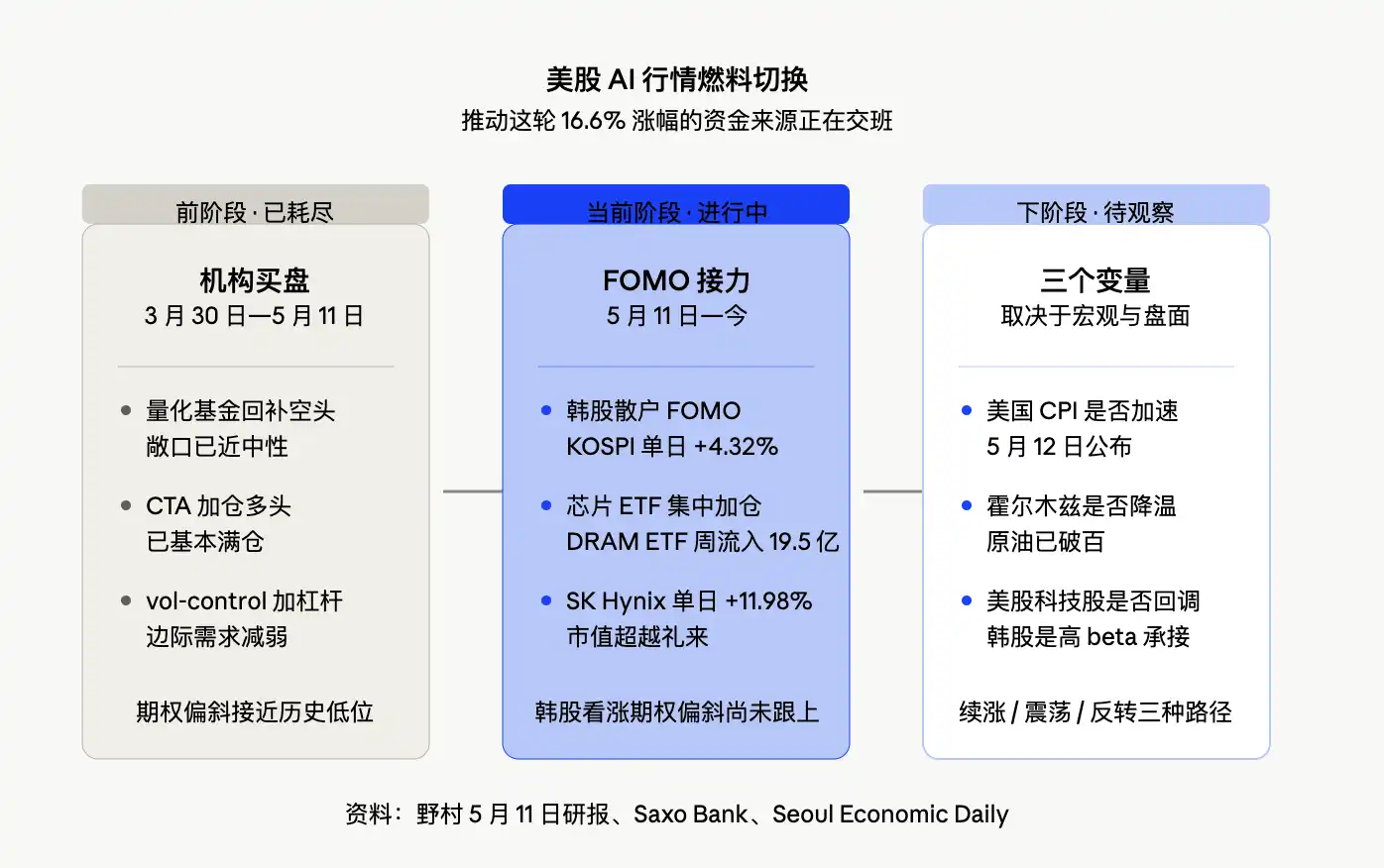
Las acciones coreanas son una extensión de la cadena de gasto de capital en IA de EE.UU.; cuánto durará la próxima etapa depende de la "cima de la pirámide"

El FOMO en las acciones coreanas no es un evento aislado; es esencialmente una extensión de alta beta de la historia del gasto de capital en IA en acciones estadounidenses.

Los datos pueden anclar directamente esta cadena de transmisión. Según estimaciones de Bridgewater, Alphabet, Amazon, Meta y Microsoft invertirán conjuntamente alrededor de 650.000 millones de dólares en infraestructura relacionada con la IA en 2026. Goldman Sachs, citando datos, señala que las estimaciones de consenso sobre el gasto de capital de las mayores empresas de infraestructura en la nube para 2026 aumentaron en 130.000 millones de dólares en el último trimestre, alcanzando los 670.000 millones de dólares, equivalentes a más del 90% del flujo de caja operativo esperado de estas empresas. El gasto de capital de Microsoft en el tercer trimestre fiscal ya fue de 31.900 millones de dólares; Alphabet, en sus resultados del Q1, reveló compras de propiedades y equipos por 35.700 millones de dólares; Meta elevó su guía de gasto de capital para 2026 a un rango de 125.000 a 145.000 millones de dólares.

Este flujo de dinero se dirige a centros de datos, GPU, memoria, redes, sistemas de energía y capacidad en la nube. SK Hynix y Samsung están precisamente en el núcleo de este flujo de dinero; la memoria HBM4 y el almacenamiento de alta velocidad HBM están siendo acaparados por los grandes proveedores de servicios en la nube. Según un informe de Reuters, SK Hynix recibió recientemente propuestas de pedidos "sin precedentes" de grandes empresas tecnológicas, y algunos clientes se ofrecieron activamente a financiar nuevas líneas de producción y máquinas litográficas de ASML. La capacidad de producción de chips está básicamente agotada. Por eso el fuerte repuesto del 4,32% en un día del KOSPI es completamente coherente en términos de narrativa; las acciones coreanas son esencialmente la "segunda derivada" de la historia de la IA en acciones estadounidenses.

Pero esta interconexión también implica fragilidad. Una vez que las acciones tecnológicas estadounidenses sufran una reversión total, las acciones coreanas serán el activo de alta beta que reciba directamente la presión de venta. Otra vía de riesgo mencionada por Nomura es que un repunte de la inflación obligue a los bancos centrales globales a adoptar posturas más agresivas. El IPC de EE.UU. de esta semana (12 de mayo) es un evento clave, y el mercado de opciones aún valora poco este evento, ya que el mercado no ha pagado una prima alta por este riesgo.

En el fondo macroeconómico hay otra variable: el Estrecho de Ormuz. El crudo WTI cerró el 8 de mayo en 100,09 dólares (+4,89%) y el Brent en 105,66 dólares (+4,31%); los conflictos cerca del Estrecho de Ormuz siguen intensificándose. El juicio de Nomura es: mientras el estrecho siga obstruido y persistan las diferencias entre EE.UU. e Irán sobre las condiciones del alto el fuego, el entorno de mercado dominado por la IA podría ser más persistente de lo esperado. La perturbación de los precios de la energía elevaría las expectativas de inflación, pero también haría que el mercado fuera aún más reacio a abandonar "la historia de la IA, donde se puede ganar dinero".

Superponiendo las pistas anteriores, la fase de impulso del mercado de la IA en acciones estadounidenses mediante "exprimir a los bajistas" está llegando a su fin; el FOMO en acciones coreanas ya se ha encendido, con minoristas y ETF de chips extranjeros aumentando posiciones simultáneamente, pero el *skew* de opciones aún no sigue el ritmo; cuánto durará la próxima etapa dependerá de si las acciones tecnológicas estadounidenses se corrigen, si el IPC de EE.UU. muestra una aceleración inflacionaria y si la situación en el Estrecho de Ormuz finalmente se calma. El marco de juicio del informe de Nomura ya ha sido verificado paso a paso por la acción del mercado. Seúl se está convirtiendo en el nuevo epicentro de estas operaciones con IA.


Related Questions

Q¿Qué señal anómala en el mercado de valores estadounidense indica una posible pausa en el rally de la IA, según el informe de Nomura?

ASegún el informe de Nomura, la señal anómala es la combinación de 'subida del precio al contado/subida de la volatilidad' (spot up/vol up). Específicamente, mientras el Nasdaq alcanza máximos históricos, el VXN (índice de volatilidad del Nasdaq) también sube, y el sesgo de las opciones (skew) de las acciones tecnológicas cae rápidamente a niveles cercanos a los mínimos históricos, lo que indica un posicionamiento muy concentrado en la subida.

Q¿Qué tres fuentes principales de demanda de compra institucional parecen haber alcanzado su límite para seguir impulsando las acciones de IA en Estados Unidos, según el análisis?

ALas tres fuentes principales de demanda de compra institucional que parecen estar cerca de su límite son: 1) La cobertura de posiciones cortas (short covering). 2) La adición de posiciones por parte de los fondos CTA (Commodity Trading Advisors). 3) El aumento del apalancamiento impulsado por estrategias de control de volatilidad (vol-control strategies) debido a la disminución de la volatilidad.

Q¿Cómo demostró el mercado surcoreano (KOSPI) el concepto de 'FOMO' descrito por Nomura el mismo día de la publicación de su informe?

AEl mismo día de la publicación del informe de Nomura, el KOSPI subió un 4.32%, activando el mecanismo de seguridad 'buy-sidecar'. SK Hynix subió un 11.98% y Samsung Electronics un 6.33%, con sus valores combinados superando la mitad de la capitalización del KOSPI. Este rally extremadamente concentrado en acciones de semiconductores, impulsado por inversores minoristas (ejemplificado por el término 'hynix FOMO') y por flujos de capital extranjero hacia ETFs específicos de chips (como el Roundhill Active DRAM ETF), fue una demostración clara de un comportamiento de compra por miedo a perderse algo (FOMO).

QSegún el artículo, ¿por qué el rally del mercado surcoreano es una extensión natural de la narrativa de la IA en Estados Unidos?

AEl rally surcoreano es una extensión de alta beta (mayor volatilidad) de la narrativa de la IA estadounidense porque está directamente vinculado a la cadena de gasto de capital en IA. Grandes tecnológicas estadounidenses (como Alphabet, Amazon, Meta, Microsoft) están realizando enormes inversiones en infraestructura de IA, lo que genera una demanda masiva de componentes como memoria de alta gama (HBM). SK Hynix y Samsung, pesos pesados del KOSPI, son proveedores clave en esta cadena, beneficiándose directamente de estos flujos de capital. Por lo tanto, la subida del KOSPI refleja y amplifica la historia de la IA de EE.UU.

Q¿Qué factores macroeconómicos y geopolíticos menciona el artículo que podrían influir en la duración de la fase actual del comercio de IA, especialmente en Corea del Sur?

AEl artículo menciona tres factores clave que podrían influir en la duración del comercio de IA: 1) Una posible corrección en las acciones tecnológicas estadounidenses, que afectaría fuertemente a los mercados de alta beta como Corea del Sur. 2) Los datos de inflación de EE.UU. (como el IPC), ya que un repunte podría llevar a los bancos centrales a ser más restrictivos. 3) La situación geopolítica en el Estrecho de Ormuz, donde las tensiones están elevando los precios del petróleo. Una inflación energética persistente podría, paradójicamente, hacer que los inversores se aferren más a la narrativa rentable de la IA, pero también supone un riesgo de inestabilidad macroeconómica.

Related Reads

Focus: Five Leading AI Stocks on Nasdaq

The report analyzes five Nasdaq-listed AI infrastructure stocks—Micron (MU), MaxLinear (MXL), AMD, Lumentum (LITE), and Vicor (VICR)—as distinct plays within the AI capital expenditure chain, rather than a single "AI trade." While all benefit from AI data center spending, they differ in their specific roles (e.g., memory, computing, optics, power, connectivity), financial resilience, and risk profiles. The author argues that the key question is not whether the AI narrative remains intact, but whether capital expenditure translates into real orders, earnings justify valuations, and portfolios can withstand high volatility. Historical data shows these stocks have significantly outperformed benchmarks but also experienced deeper drawdowns (~28% to -32%), highlighting their high-beta, high-volatility nature. An investment framework is proposed: core positions (e.g., MU, AMD) for stocks with stronger fundamental evidence; satellite positions (e.g., LITE, VICR) for high-potential, high-volatility names; and cautious observation (e.g., MXL) for smaller-cap ideas with unproven financials. The emphasis is on disciplined, phased buying during pullbacks—only when price corrections align with intact fundamentals and available risk budget—rather than emotional "buy-the-dip" strategies. Overall, AI infrastructure offers long-term potential, but success requires strict position sizing, role definition for each holding, and preparedness for significant volatility.

marsbit10m ago

Focus: Five Leading AI Stocks on Nasdaq

marsbit10m ago

Will UNI Reach $100 in Four Years? Will Standard Chartered's Prediction Come True?

TL;DR: - According to reports, Standard Chartered Bank has published a research report on Uniswap, setting a 2030 price target of $100 for the UNI token. - The bank's core logic is that the tokenization of assets will drive demand for open DeFi liquidity, and Uniswap could capture significant trading volume and fee revenue. - However, most institutional-grade tokenized products are permissioned, and the example of BlackRock's BUIDL shows that DeFi still faces significant access barriers. Standard Chartered's $100 target for UNI by 2030 is based on the hypothesis that tokenized assets will grow massively and a significant portion will flow into open DeFi markets, requiring decentralized exchange platforms like Uniswap for liquidity. The bank forecasts tokenized assets could reach $4 trillion by 2028, with up to 30% in DeFi by 2030. The key question is whether tokenized assets like treasuries and funds will trade in open, decentralized markets or remain within closed, permissioned institutional systems. This directly impacts Uniswap's potential growth. A real-world example is BlackRock's BUIDL fund, which, while using UniswapX for trading, is strictly limited to pre-approved, whitelisted institutional participants. This highlights the current trend: institutions may leverage DeFi infrastructure but maintain strict control over access and transfers. Furthermore, for UNI's value to rise significantly, Uniswap must establish a clear value-capture mechanism, such as the approved fee switch and token burn proposal. Regulatory and interoperability hurdles also persist, as noted by bodies like the Financial Stability Board. In summary, Standard Chartered's bold prediction hinges on the future flow of tokenized asset liquidity. While it signals institutional recognition of DeFi's potential, the path to $100 depends on overcoming current permissioned models and enabling truly open, cross-asset liquidity pools on platforms like Uniswap.

Foresight News14m ago

Will UNI Reach $100 in Four Years? Will Standard Chartered's Prediction Come True?

Foresight News14m ago

Odaily Editorial Team Tea Talk (June 17)

Odaily Editorial Team Casual Chat (June 17) This is an informal column sharing real-time thoughts from Odaily's editorial team on industry news, data, and events. The content is based on actual investment and observations, does not constitute investment advice, and aims to expand perspectives. Azuma shared recent operations: small-scale buys in crypto (mainly BTC) at relatively high levels, a small addition to HOOD stock, and participation in World Cup prediction markets. He also discussed Hyperliquid, noting that while its token HYPE has performed well, its high price may hinder the expansion of its HIP-3 ecosystem by making market creation cost-prohibitive, potentially limiting the platform to just one major market (trade.xyz). Suzz emphasized the importance of a calm mindset in investing, stating that markets offer perpetual opportunities. He warned against "hindsight bias," where past opportunities seem obvious, and stressed that the present always holds new chances for those with the right knowledge and temperament. Golem analyzed SpaceX's acquisition of AI tool Cursor's parent company, Anysphere, for $60 billion paid entirely in SpaceX stock. He speculated whether Musk's interests might work to keep SpaceX's trading volume and market cap high in the short term to reduce the actual equity cost of the deal, noting current high retail investor enthusiasm. Wenser shared a market outlook: cautiously bullish on BTC, monitoring SpaceX stock post-IPO for a potential rise, observing World Cup trends favoring strong teams, and noting the continued strength of Japanese and Korean stocks. He highlighted Anthropic's potential for a massive future IPO and the defensive investment logic in "picks and shovels" AI infrastructure. Qin Xiaofeng discussed trading HYPE around $56-$70, viewing the $50-$60 range as long-term support due to Hyperliquid's dominance in on-chain traditional asset trading and its substantial fee revenue used to buy back HYPE. On ETH, he noted a divide between disappointed crypto natives and bullish traditional investors like Tom Lee, personally viewing current ETH prices as undervalued.

Odaily星球日报25m ago

Odaily Editorial Team Tea Talk (June 17)

Odaily星球日报25m ago

Under the Shock of Oil Prices and Inflation, Which Country Will Be the First to Sell Off Its Gold Reserves?

The article draws a parallel between the 2003 North American blackout and the potential collapse of the global financial system, framing the US dollar and Treasury market as the world's economic "power grid." It argues that the closure of the Strait of Hormuz is creating a shockwave, starting with oil-importing emerging markets like Turkey, India, and Indonesia. As oil prices rise, these nations are forced to sell dollar-denominated assets—first US Treasuries, then potentially their gold reserves—to afford fuel. Turkey is highlighted as a key case, having sold nearly 90% of its Treasuries and begun tapping gold reserves when oil was between $70-$105/barrel. The article warns that if prices spike to $150-$160/barrel, global buffers like oil inventories and strategic reserves will be depleted. This could trigger a cascade: vulnerable nations, having exhausted assets, could face economic and political collapse (like Sri Lanka in 2022). Their forced asset sales would drive US Treasury yields higher, potentially past a critical threshold (around 5%), forcing the US to choose between a bond market crash or hyperinflation through massive money printing. Ultimately, the piece posits that the dollar's long-term decline is inevitable. The first domino to fall will likely be a fragile emerging market, signaling the start of a chain reaction that eventually threatens the core of the dollar system. The conclusion advises holding tangible assets like gold and energy, which cannot be printed, as a hedge against currency devaluation.

marsbit50m ago

Under the Shock of Oil Prices and Inflation, Which Country Will Be the First to Sell Off Its Gold Reserves?

marsbit50m ago

Trading

Spot
Futures

Hot Articles

What is LINON

Linde plc Tokenized Stock (Ondo): Revolutionizing Traditional Equity Access Through Blockchain Innovation The emergence of Linde plc Tokenized Stock (Ondo), represented by the ticker $LINON, signifies a monumental shift in the fusion of traditional financial structures and decentralized finance (DeFi). This innovative financial instrument showcases the tremendous potential of blockchain technology to democratize access to traditional equity markets while ensuring the security and regulatory compliance necessary for institutional-grade financial products. Through Ondo Finance's pioneering tokenization platform, $LINON provides a seamless pathway for global investors to engage with one of the world's leading industrial gas companies, Linde plc, creating a blockchain-native representation of the underlying equity. Introduction to Linde plc Tokenized Stock The landscape of financial markets is witnessing a groundbreaking transformation through the tokenization of real-world assets. Linde plc Tokenized Stock (Ondo) epitomizes this revolutionary approach by bridging the gap between conventional stock ownership and blockchain-enabled financial infrastructure. The $LINON token allows investors to gain exposure to one of the prominent industrial companies worldwide through decentralized technology. Operating within Ondo Finance's comprehensive ecosystem, $LINON symbolizes a practical application of tokenization technology that enhances accessibility, efficiency, and global connectivity in traditional financial markets. By leveraging blockchain infrastructure, this tokenized stock enables international investors to participate in U.S. equity markets, overcoming traditional barriers associated with cross-border investing. The significance of $LINON goes beyond technological innovation; it represents a fundamental shift in asset structuring, distribution, and trading in the digital age. This tokenized stock maintains all the economic benefits associated with traditional Linde plc shares while offering improved liquidity, programmable compliance features, and seamless integration with decentralized finance protocols. The development of $LINON indicates a growing acceptance of blockchain technology as a viable means for traditional finance, exemplifying how even well-established assets like Linde plc can integrate into blockchain systems. This approach preserves the core attributes that appeal to investors while introducing advanced capabilities that enhance the overall investment proposition. Project Overview and Objectives Linde plc Tokenized Stock (Ondo) encapsulates a strategic effort to democratize access to traditional equity markets through advanced blockchain technologies. The primary objective of $LINON is to provide approved global investors seamless access to the economic exposure associated with Linde plc shares, furthering an effort to create a more inclusive financial ecosystem. Beyond the digital representation of traditional assets, $LINON endeavors to eliminate barriers of geography and time zones that limit investor participation. Its design ensures that blockchain technology can elevate traditional investment vehicles without undermining the security or compliance requirements expected by investors. Key goals of the project include enhanced liquidity provision, programmable compliance mechanisms, and interoperability with other blockchain networks. Each $LINON token is fortified by actual Linde plc securities housed at U.S.-registered broker-dealers, allowing holders to reap economic advantages akin to traditional stockholders, such as dividend reinvestment. Furthermore, $LINON aims to establish new industry standards for institutional-grade tokenized securities, paving the way for traditional assets to embrace blockchain technology while remaining compliant with regulatory frameworks. By associating itself with a company as reputable as Linde plc, the project opens avenues for exploring tokenized equities catering to both conservative institutional players and daring retail investors. Project Creator and Development Team The vision for Linde plc Tokenized Stock (Ondo) comes from Nathan Allman, founder and CEO of Ondo Finance. His background in traditional finance coupled with expertise in blockchain technology positions him uniquely to navigate the complexities of asset tokenization. Allman's academic journey began at Brown University, focusing on Economics and Biology, equipping him with valuable analytical skills. His time at Goldman Sachs in the Digital Assets division strengthened his understanding of the interplay between financial institutions and emerging technologies, laying the groundwork for his later endeavors in alternative investment strategies. Under Allman's guidance, Ondo Finance has emerged as a leader in asset tokenization, launching $LINON as a flagship example of the company's larger mission towards revolutionizing traditional financial systems using blockchain technology. His commitment to leveraging blockchain for creating institutional-grade financial products has shaped the landscape of real-world asset tokenization. Investment and Funding Structure The growth of Ondo Finance, the platform powering Linde plc Tokenized Stock (Ondo), is bolstered by robust financial backing from prestigious venture capital firms and strategic investors. This strong investment foundation underpins the development of the key infrastructure essential for compliant tokenized securities like $LINON. In August 2021, Ondo Finance secured $4 million in seed funding led by a major venture capital firm, which enabled the company to commence platform development and establish the necessary regulatory processes for tokenizing real-world assets. This early investment cemented Ondo Finance's credibility within the industry. The Series A funding round followed, garnering $20 million with participation from renowned firms committed to transformative technology companies. This backing demonstrated substantial institutional confidence in Ondo Finance's vision, allowing it to hone its approach to asset tokenization through mechanisms that ensure compliance and accessibility. Noteworthy contributors, including institutional investors and experienced partners, have added significant value to Ondo Finance’s development efforts. Their involvement underscores the confidence across sectors in Ondo Finance's approach to bridging traditional finance with blockchain innovations. Technical Infrastructure and Innovation The technical architecture that underpins Linde plc Tokenized Stock (Ondo) represents a sophisticated melding of traditional finance systems and cutting-edge blockchain technology. The architecture's foundation is built on the Ethereum network, renowned for its security and programmability—both critical for intricate financial instruments. The $LINON tokenization process comprises creating a blockchain-native representation of Linde plc shares that preserves economic benefits while augmenting investor capabilities. Each token corresponds to actual shares held at U.S.-registered broker-dealers, creating a compliant custody structure that legitimizes the asset's existence and value. Automated compliance systems are integrated into the tokenization process, managing critical components such as know-your-customer (KYC) verification and anti-money laundering (AML) protocols. This incorporation of programmable compliance empowers $LINON to uphold regulatory standards essential for institutional proliferation. Cross-chain interoperability characterizes the advanced technical features of $LINON. While initially deployed on Ethereum, the framework is designed for expansion to other networks such as Solana and BNB Chain. This adaptability enhances liquidity and accessibility, allowing investors to select their preferred blockchain ecosystems. Historical Timeline and Development Crafting the history of Linde plc Tokenized Stock (Ondo) unfolds in parallel with the evolution of Ondo Finance's tokenization platform. The timeline's inception dates back to March 2021 when Nathan Allman laid the foundations for creating institutional-grade financial products on blockchain infrastructure. The initial funding round in August 2021 provided crucial resources for developing the platform and establishing partnerships necessary for effective tokenization. By January 2023, Ondo Finance launched its tokenized treasury products, establishing mechanisms that would facilitate future tokenized equities such as $LINON. A pivotal milestone arose in February 2025 when Ondo Chain—a Layer 1 blockchain designed specifically for asset tokenization—was introduced. This infrastructure enhances capabilities vital for institutional markets, demonstrating Ondo Finance's long-term commitment to tokenization. Subsequently, the launch of Ondo Global Markets in September 2025 marked the official debut of $LINON. This milestone showcased the successful transition from development to active trading, enabling investors around the world to access American financial markets seamlessly. Ongoing development plans include a targeted expansion of available tokenized assets to over 1,000 by the end of 2025, pointing to a bright future for Ondo Finance's ecosystem and its mission to broaden tokenized equity accessibility. Regulatory Compliance and Legal Framework The legal architecture governing Linde plc Tokenized Stock (Ondo) emphasizes a sophisticated approach to regulatory compliance, allowing tokenized securities to be implemented within a blockchain-based framework. The legal structure governing $LINON spans multiple jurisdictions while maintaining a robust legal footing. Compliance systems ensure that only eligible investors can access the token, enforced through automated verification that aligns with international regulations. This innovative regulatory technology promises real-time enforcement of complex requirements, considerably enhancing efficiency in operating within the regulatory landscape. The custody framework undergirding $LINON ensures that the underlying shares are securely held at U.S.-registered broker-dealers, complying with necessary regulations while delivering blockchain-driven access to investors. The token maintains its economic equivalency and security through this carefully structured custody arrangement. KYC and AML compliance systems are embedded within the smart contract architecture, ensuring integrity and adherence to regulatory practices while fostering transparency for investors. The jurisdictional restrictions mark a commitment to navigating the evolving landscape of international securities laws. Market Impact and Industry Significance The advent of Linde plc Tokenized Stock (Ondo) holds profound implications for the broader financial landscape, symbolizing a clear shift towards blockchain-enabled markets. $LINON serves as a proof-of-concept for integrating traditional companies into blockchain ecosystems, showcasing the potential benefits such as broader accessibility and improved efficiency. The market's response to $LINON indicates a growing acceptance of tokenization among institutional investors, contributing to the emergence of an expanding sector wherein traditional assets can be interconnected with blockchain innovations. The success of $LINON further solidifies market confidence, indicating an overarching shift towards recognizing asset tokenization as a transformative force in finance. Future Development and Expansion Plans The future trajectory for Linde plc Tokenized Stock (Ondo) centers around the expansion of the tokenization ecosystem and enhanced infrastructure supporting blockchain-enabled financial services. Plans for cross-chain integration usher in new opportunities for liquidity and flexibility within the investment framework, with existing capabilities poised for continuous enhancement. With the introduction of Ondo Chain, Ondo Finance aims to transition $LINON to an optimized blockchain environment specifically designed for asset tokenization. This new infrastructure heralds exciting prospects for the development of institutional-grade financial products, ensuring ongoing compatibility with contemporary investment strategies. Further integration with decentralized finance protocols signifies a commitment to empowering $LINON holders through advanced financial strategies. The anticipated expansion of available tokenized assets promises to broaden investor access, enhancing the utility and appeal of the platform. In alignment with ambitions for regulatory expansion, ongoing efforts to secure approvals for new jurisdictions will enhance investor access, further positioning $LINON at the forefront of the burgeoning tokenization market. Conclusion Linde plc Tokenized Stock (Ondo), as represented by the $LINON token, stands at the intersection of traditional finance and blockchain innovation. It embodies a transformative milestone in how financial assets are structured, distributed, and engaged within modern investment ecosystems. The technical sophistication behind $LINON, combined with its regulatory compliance framework, illustrates that asset tokenization can improve financial infrastructure rather than simply digitizing existing products. This pioneering effort not only enhances investor access to U.S. equity markets but also signifies an evolution of how traditional financial services can integrate blockchain technology. As the asset tokenization market grows exponentially, with prospects suggesting significant valuation increases, $LINON paves the way for a future where tokenized securities become standard fixtures in the financial landscape. The trajectory of $LINON will undoubtedly influence how traditional finance adapts to a transformed, blockchain-powered world.

3.2k Total ViewsPublished 2025.12.05Updated 2025.12.05

What is LINON

What is CRMON

Salesforce Tokenized Stock (Ondo): Revolutionising Traditional Equity Access Through Blockchain Innovation The emergence of Salesforce Tokenized Stock (CRMON) marks a pivotal advancement in integrating traditional financial markets with blockchain technology. This innovative approach offers investors unprecedented access to equity exposure through tokenisation. Developed by Ondo Finance, CRMON provides tokenholders with economic exposure equivalent to holding Salesforce stock (CRM) while automatically reinvesting dividends. This effectively bridges the gap between conventional equity markets and decentralised finance (DeFi). Introduction and Comprehensive Overview of Salesforce Tokenized Stock In recent years, the financial landscape has dramatically transformed due to blockchain technology, fundamentally altering how investors access and interact with traditional assets. The development of Salesforce Tokenized Stock (CRMON) is a prime example of this evolution, representing a sophisticated fusion of conventional equity markets with cutting-edge distributed ledger technology. CRMON is a tokenised version of Salesforce stock, emerging from the innovative work of Ondo Finance, a leading platform in the real-world asset tokenisation sector that positions itself as a bridge between traditional finance and decentralised systems. Designed to provide tokenholders with economic exposure that mirrors the performance of the underlying Salesforce stock, CRMON incorporates automatic dividend reinvestment mechanisms. This eliminates many traditional barriers associated with international equity investment, such as complex brokerage relationships, currency conversion challenges, and restricted trading hours. The tokenisation process reimagines stock ownership as a blockchain-native asset while maintaining its economic equivalence with the underlying security, offering enhanced portability and integration capabilities within decentralised finance ecosystems. CRMON transcends its individual utility as an investment instrument to represent a fundamental shift in how financial markets can operate in an increasingly digital world. By maintaining full backing through U.S.-registered broker-dealers and implementing robust compliance frameworks, CRMON demonstrates that tokenised securities can achieve the regulatory standards necessary for institutional adoption while delivering the technological advantages of blockchain infrastructure. Understanding Tokenized Real-World Assets and CRMON's Strategic Position Tokenised real-world assets signify one of the most significant innovations in modern finance, fundamentally reimagining how traditional securities are represented, traded, and utilised within digital ecosystems. CRMON operates as a tokenised equity instrument correlating directly with Salesforce stock while optimising accessibility and efficiency. This aligns with Ondo Finance's broader mission to democratise access to institutional-grade financial products through innovative tokenisation strategies. The tokenisation process guarantees complete economic equivalence with the underlying Salesforce equity. Each CRMON token represents a proportional claim on Salesforce stock held by qualified custodians, with dividend payments automatically reinvested to maintain continuous exposure to total return performance. This structure simplifies dividend management and ensures that tokenholders receive the full economic benefit of their equity exposure, encompassing both capital appreciation and income generation. Ondo Finance's strategy in tokenising Salesforce stock demonstrates its expertise in creating compliant, institutional-grade products that meet traditional financial markets' stringent requirements. The platform’s focus on merging regulatory compliance with blockchain benefits positions it at the forefront of decentralised finance, captivating both institutional and retail investors seeking blockchain-native solutions. The Technology and Innovation Framework Behind CRMON The technological infrastructure supporting CRMON integrates blockchain technology with traditional financial mechanisms, delivering institutional-grade security and compliance while maintaining the operational advantages of decentralised systems. Built on the Ethereum blockchain, CRMON utilises robust smart contract capabilities to ensure transparent, secure operations. The smart contract architecture incorporates layered security and compliance mechanisms, enabling automated compliance checks and real-time asset backing verification. Integration with oracle services maintains accurate pricing and dividend information, ensuring CRMON reflects the underlying Salesforce stock's accurate performance. This architecture delivers automated dividend reinvestments and other corporate actions, eliminating manual processing requirements and directly enhancing tokenholder benefits. Ondo Finance ensures CRMON's security structure includes daily third-party verification of holdings, independent collateral agents, and a multiple-layer custody system through partnerships with established financial institutions. This framework safeguards tokenholder interests against operational risks while providing robust asset backing. The user interface enhances integration capabilities, allowing seamless interaction between CRMON and various decentralised finance protocols, as well as cryptocurrency exchanges. This interoperability enables users to leverage their tokenised equity across multiple platforms, creating sophisticated investment strategies that marry traditional equity characteristics with blockchain-native innovation. Leadership and Corporate Structure of Ondo Finance The leadership team behind CRMON and Ondo Finance blends expertise from traditional finance and blockchain technology, presenting a robust combination of skills essential for successfully bridging conventional markets with decentralised finance. Nathan Allman, the founder and CEO, emerged from a distinguished financial background before establishing Ondo Finance in 2021. Allman's experience includes notable roles at major financial institutions, including significant contributions to developing cryptocurrency market services. His insights into regulatory compliance were paramount in developing products like CRMON that successfully unify traditional securities with blockchain technology. With a team of professionals boasting substantial experience in both conventional finance and blockchain sectors, Ondo Finance's leadership comprises diverse expertise that covers every aspect of tokenised asset development. Justin Schmidt serves as President and COO, contributing unique operational expertise, while Chris Tyrell brings essential compliance knowledge. Investment Landscape and Funding History The investment landscape surrounding Ondo Finance reflects significant institutional confidence in its mission to tokenise real-world assets. The company has raised substantial funds through various investment rounds, attracting leading venture capital firms and strategic investors that recognise the transformative potential of tokenised securities like CRMON. Notably, Ondo Finance completed a successful Series A funding round in 2022, led by well-known venture capital firms. This funding success validates Ondo Finance's innovative approach to creating compliant, institutional-grade tokenised products. In total, Ondo Finance has successfully secured substantial funding, raising significant capital for product development and market expansion, including a noteworthy token sale that reinforced its governance structure through the establishment of the ONDO token. The diverse composition of investors reflects broad market confidence in Ondo Finance's business model, demonstrating support from both traditional and blockchain-native organisations. Operational Mechanics and Technical Implementation The operational framework supporting CRMON exemplifies sophisticated integration of traditional financial mechanisms with blockchain technology. The technical implementation introduces multiple layers of security, compliance, and operational efficiency to meet institutional standards while enhancing accessibility. The tokenisation process begins by acquiring actual Salesforce stock through U.S.-registered broker-dealers, ensuring each CRMON token maintains direct correlation with the underlying equity performance. Smart contracts automate operational processes, including dividend reinvestment and corporate action processing, facilitating a streamlined user experience. The Minting and redemption processes allow authorised participants to manage CRMON tokens effectively. During U.S. trading hours, institutions can mint new tokens by depositing stablecoins that are used to purchase corresponding Salesforce equity. This structure maintains a tight correlation with underlying assets, enhancing liquidity and price discovery. Additionally, the infrastructure supports twenty-four-hour token transfer capabilities, providing CRMON holders with operations outside traditional market hours. This represents a significant advantage over conventional securities ownership, thus promoting integration with decentralised finance applications. Plans for cross-chain compatibility through partnerships signal further ambitions for CRMON's market reach. By expanding to other blockchain networks, Ondo Finance aims to enhance accessibility and user engagement with tokenised equity products. Timeline and Historical Development of Tokenized Equity Innovation The timeline of CRMON's development and Ondo Finance's broader tokenised capabilities demonstrates a systematic innovation process beginning with the company's founding in 2021. 2021: Ondo Finance is founded by Nathan Allman and co-founders, launching initial products focused on structured vault offerings on the Ethereum blockchain. 2022: The company completes substantial funding rounds—both equity and token sales—totaling significant capital and launching initial tokenised U.S. Treasury products. 2023-2024: Ondo Finance experiences substantial growth, establishing partnerships with major financial institutions while expanding its product offerings beyond fixed-income securities. February 2025: Ondo Global Markets is announced, marking the transition into equity tokenisation with plans for accessing over one hundred U.S. stocks and ETFs. September 2025: The official launch of Ondo Global Markets includes CRMON alongside other tokenised equity offerings, marking a significant evolution in Ondo Finance's product ecosystem. This timeline highlights the organisation's rapid growth and its capability to adapt its technological and compliance frameworks to accommodate different asset classes effectively while maintaining security and regulatory integrity. Regulatory Framework and Compliance Approach Ondo Finance's regulatory framework showcases a sophisticated compliance strategy, essential for achieving institutional adoption in the tokenised securities market. The company's strong partnerships with U.S.-registered broker-dealers promote adherence to Securities and Exchange Commission regulations and apply robust investor protections. Acquisitions, such as Oasis Pro—a registered broker-dealer—significantly enhance Ondo Finance's compliance capabilities, ensuring thorough alignment with existing regulatory structures. The company employs independent verification procedures that foster transparency, aiming for a solid performance standards reputation. Furthermore, Ondo Finance's commitment extends to international regulatory compliance, ensuring token access remains restricted to eligible investors while adhering to pertinent cross-border securities regulations. Comprehensive attention to tax implications and reporting requirements fortifies the security and compliance landscape of CRMON, ensuring that investor obligations remain manageable. Future Prospects and Market Positioning The forward-looking landscape for CRMON and Ondo Finance illustrates substantial growth opportunities driven by institutional adoption of blockchain technology and escalating demand for efficient alternatives to conventional securities ownership. Market projections indicate the tokenised asset sector could value multiple trillion dollars by 2030. With plans to scale CRMON offerings significantly and integrate it with a dedicated blockchain infrastructure—Ondo Chain—Ondo Finance aims to elevate its institutional-grade tokenised asset operations. Additionally, the development of strategic partnerships enhances distribution capabilities while establishing the company's credibility in the financial market. Furthermore, the integration of tokenised equity with decentralised finance protocols offers new potential for innovative financial products and strategies previously impossible with traditional securities. These factors underscore CRMON's positioning to effectively capture increased market share and deliver innovative solutions for international investment exposure. Conclusion Salesforce Tokenized Stock (CRMON) symbolises a transformative development within financial markets, successfully bridging traditional equity ownership with blockchain technology to create unprecedented accessibility for global investors. Through Ondo Finance's sophisticated tokenisation framework, CRMON provides complete economic exposure to Salesforce equity performance while enhancing operational advantages that exceed traditional ownership. The launch of CRMON reflects the broader evolution of financial markets towards blockchain infrastructures that maintain regulatory compliance while delivering increased efficiency. Ondo Finance's extensive approach to regulatory adherence, institutional-grade security, and technological innovation solidifies CRMON as a model for future tokenised securities, delivering access previously unattainable in conventional brokerage structures. As the tokenised asset sector continues to develop, CRMON is well-positioned to address historical inefficiencies in capital markets while providing investors with innovative solutions for accessing traditional securities. The outlook for CRMON looks exceptionally promising, supported by ambitious expansion plans, technological innovations, and strategic partnerships, thereby representing a pioneering model of modern financial infrastructure evolving through blockchain integration.

3.3k Total ViewsPublished 2025.12.05Updated 2025.12.05

What is CRMON

What is SHOPON

Shopify Tokenized Stock (Ondo): A Comprehensive Analysis of Real-World Asset Tokenization in Web3 This article delves into the Shopify Tokenized Stock (Ondo), recognised by its ticker symbol $SHOPON, exploring its implications at the intersection of traditional finance and blockchain technology. As a part of Ondo Finance's tokenized securities platform, Shopify’s tokenized stock exemplifies advancements in democratizing access to global capital markets through innovative digital assets. Introduction and Overview of Shopify Tokenized Stock (Ondo) Shopify Tokenized Stock (Ondo), or $SHOPON, portrays a pivotal innovation in the realm of tokenized securities, allowing investors to gain economic exposure akin to directly owning shares of Shopify Inc. This token, developed under the umbrella of Ondo Finance, not only provides investors with the ability to hold digital representations of the company’s stock but also integrates features such as automatic reinvestment of dividends. This advancement represents a substantial shift in the landscape of decentralized finance (DeFi), linking conventional equity markets with blockchain solutions designed to enhance accessibility, transparency, and liquidity. By eliminating geographical barriers and enabling 24/7 trading capabilities, $SHOPON is positioned as a bridge connecting traditional financial instruments and the emerging Web3 ecosystem. What is Shopify Tokenized Stock (Ondo), $SHOPON? The $SHOPON token serves as a digital manifestation of Shopify Inc.'s shares, engineered to provide a direct correlation to the underlying asset's performance. Through the utilization of blockchain technology, the token gives holders a mechanism to participate in the economic benefits associated with equity ownership, including capital appreciation and dividend distribution. The unique aspect of $SHOPON lies in its automatic dividend reinvestment mechanism, which allows returns to compound without necessitating active management by the investor. This feature inherently enhances its attractiveness as an investment vehicle, particularly for individuals seeking passive income growth alongside exposure to high-performing equities. The tokenization process is facilitated by the custody of actual Shopify shares through regulated intermediaries, ensuring that every $SHOPON token is verifiably backed by real equity. This structure empowers investors with the dual advantages of both traditional financial characteristics and the innovative benefits tied to blockchain technology. Who is the Creator of Shopify Tokenized Stock (Ondo)? The creator of Shopify Tokenized Stock (Ondo), Nathan Allman, is an experienced figure in the finance sector, formerly associated with Goldman Sachs. His rich background includes significant expertise in digital asset development, bridging the gap between traditional finance and cryptocurrencies. Allman’s educational journey, marked by studies at Brown University, provided him with a deep understanding of economics and biology, equipping him with analytical skills that inform his strategic vision. In 2021, he founded Ondo Finance, committing to developing tokenized securities that meet institutional-grade standards while leveraging blockchain's transformative capabilities. Under Allman's leadership, Ondo Finance has focused on creating compliant and innovative financial products that empower a diverse investor base. Who are the Investors of Shopify Tokenized Stock (Ondo)? The investment landscape surrounding Shopify Tokenized Stock (Ondo) is notably robust, underpinned by significant institutional support. Primarily, Pantera Capital stands out as a strategic partner through the Ondo Catalyst initiative, a $250 million commitment aimed at accelerating the development of on-chain capital markets. This partnership not only signifies institutional confidence in the potential of tokenized assets but also reinforces Ondo Finance's operational capabilities and market positioning. The funding pathways have included earlier rounds that amassed millions in seed funding and further structural investments, solidifying relationships with both venture capital firms and private investors. Moreover, the financial framework is complemented by strategic partnerships with established financial institutions and technology companies, enhancing Ondo’s infrastructure and operational expertise. How Does Shopify Tokenized Stock (Ondo), $SHOPON Work? At the core of $SHOPON's operational framework is a sophisticated system integrating traditional finance mechanisms with blockchain technology. The custody of actual Shopify shares ensures that token holders retain authentic economic exposure, safeguarding their investments in line with recognized legal structures. The smart contracts employed in managing $SHOPON handle various functions, including automatic dividend reinvestment and ownership transfer, offering instant settlement and increased liquidity, marking a significant departure from conventional trading systems plagued by multi-day settlement delays. By providing interoperability with other decentralized finance applications, $SHOPON empowers holders with potentially lucrative opportunities for advanced investment strategies, including lending and automated market making. This complex integration presents a unique value proposition, catering to both traditional and crypto-native investors. The innovative structure of $SHOPON also allows for real-time settlements and transactions documented on the blockchain, delivering unparalleled transparency and security—a major advancement over standard equity trading practices. Timeline of Shopify Tokenized Stock (Ondo) March 2021: Nathan Allman establishes Ondo Finance, initially focusing on decentralized finance yield optimization. August 2021: Completion of a $4 million seed funding round led by Pantera Capital. January 2023: Launch of initial tokenized treasury security products, laying the groundwork for future equity tokenization. July 2025: Announcement of the Ondo Catalyst initiative, a strategic investment program valued at $250 million, aimed at propelling the development of tokenization in capital markets. September 3, 2025: Launch of Ondo Global Markets featuring over 100 tokenized U.S. stocks and ETFs, including $SHOPON. Technical Implementation and Blockchain Infrastructure Shopify Tokenized Stock (Ondo) operates on a technical architectural framework that marries blockchain protocols with traditional financial custody arrangements. The ecosystem leverages Ethereum's smart contract capabilities, providing seamless transaction management while ensuring compliance with regulatory standards through established financial custodians. Central to this architecture are security measures and transparent transaction records that affirm the legitimacy of each tokenholder's economic stake. With automated features managed by intricate smart contracts, $SHOPON not only streamlines ownership transfers but also allows for the tactical reinvestment of dividends—a hallmark of modern investment strategies. Moreover, the incorporation of LayerZero technology facilitates cross-chain interoperability, making $SHOPON accessible across multiple blockchain environments while preserving its functional robustness. This forward-thinking technical design positions $SHOPON as an adaptable asset within the larger DeFi milieu. Regulatory Framework and Compliance Architecture $SHOPON's regulatory framework is built upon the meticulous navigation of existing financial regulations that govern securities. The custody arrangements for the underlying Shopify shares are managed by U.S.-regulated broker-dealers, ensuring compliance and protection for investors. By maintaining a separation between the blockchain tokenization process and traditional custody, $SHOPON adheres to legal requirements while offering innovative functionalities that challenge conventional constraints. This dual-layered compliance approach enhances investor confidence and underscores Ondo Finance's commitment to regulatory integrity. Notably, the availability of $SHOPON is tailored to international investors from regions such as Asia-Pacific, Europe, and Africa, as regulatory parameters in the U.S. and U.K. present challenges in accessing tokenized securities. Market Access and Global Distribution Strategy The distribution strategy of $SHOPON is keenly designed to optimize global access while conforming to regulatory standards. The platform aims to establish comprehensive coverage for eligible investors across multiple regions, effectively dismantling traditional barriers through the implementation of blockchain technology. Integration with various cryptocurrency wallets and exchanges also promotes user-friendliness and accessibility, establishing a streamlined experience for investors to manage their holdings. Moreover, the 24/7 trading capabilities afforded by the tokenized model allow participants to react promptly to market shifts, fundamentally transforming how global equities are accessed and traded. Technology Integration and Cross-Chain Functionality The remarkable technological underpinnings of $SHOPON propagate its multi-chain functionality, set to expand its reach beyond Ethereum to networks such as Solana and BNB Chain. Such cross-chain capabilities allow users flexibility when navigating between blockchains, concurrently leveraging distinct network attributes to optimize their trading experience. LayerZero serves as the backbone for ensuring decentralized transfers between networks while providing the requisite security and speed, quintessential for maintaining investor trust. This comprehensive interoperability illustrates $SHOPON's commitment to being a versatile, user-centric asset in the evolving investment landscape. Ecosystem Integration and DeFi Compatibility Incorporating $SHOPON into broader DeFi protocols signifies its potential beyond traditional stock ownership. Token holders can leverage their holdings for various sophisticated strategies and applications, enhancing investment returns and liquidity management. By establishing a presence in lending protocols and automated trading systems, $SHOPON effectively democratizes access to advanced financial strategies previously limited to institutional investors. Such integration contributes to a more competitive and dynamic financial landscape, where individual investors can capitalize on tools typically reserved for larger entities. Risk Management and Security Framework Security remains paramount in the operational infrastructure of $SHOPON. The tokenization framework employs multiple layers of protection—beginning with regulated custody of the underlying Shopify shares. The operational protocols establish rigorous auditing, key management, and transaction monitoring standards, thus safeguarding against potential vulnerabilities. Moreover, meticulous adherence to evolving regulatory requirements provides an extra layer of security, fortifying investor protections and institutional compliance. Market Impact and Industry Implications The introduction of Shopify Tokenized Stock (Ondo) heralds a transformative shift in how financial markets operate, emphasizing the potential of tokenized securities to reshape traditional investment paradigms. The successful integration of $SHOPON encapsulates the efficiencies inherent in blockchain technology and opens avenues for new user demographics previously barred from extensive market participation. The impact extends beyond the immediate benefits to token holders, indicating broader trends that may challenge the status quo of investment services, particularly in addressing geographic restrictions and operational costs typically associated with traditional brokerage platforms. Undeniably, $SHOPON encapsulates the potential for traditional institutions to innovate further, leveraging the increasing demand for seamless blockchain access to complement existing financial infrastructure. Future Development Roadmap and Strategic Vision As Ondo Finance looks forward, the trajectory of $SHOPON rests on ambitious goals aimed at broadening the spectrum of available tokenized assets significantly. Over the next few years, plans are in place to expand to more than 1,000 tokenized securities, further enhancing market participation and investment options for individuals worldwide. Continued integration with traditional financial actors, development of specialized institutional products, and enhancements in automated trading capabilities will ensure that $SHOPON maintains its position at the forefront of financial innovation. Regulatory collaboration will also remain a focal point, establishing a framework that not only supports the compliance requirements but also promotes a healthy environment for tokenized asset proliferation. Conclusion and Market Significance In summary, Shopify Tokenized Stock (Ondo), represented by the ticker $SHOPON, is more than merely a tokenized equity offering; it embodies the innovation possible when traditional finance collides with modern blockchain applications. With a robust technical architecture, a commitment to compliance, and a clear strategic vision, $SHOPON exemplifies the potential for tokenized assets to enhance liquidity, accessibility, and functionality in capital markets. As the global investment landscape evolves, the transformative implications of $SHOPON extend beyond individual investors to revolutionize how financial instruments are perceived, traded, and utilized within both traditional and decentralized frameworks.

3.3k Total ViewsPublished 2025.12.05Updated 2025.12.05

What is SHOPON

Discussions

Welcome to the HTX Community. Here, you can stay informed about the latest platform developments and gain access to professional market insights. Users' opinions on the price of NOM (NOM) are presented below.

活动图片












