Qubic Lanza la Fase 3 de Minería de Dogecoin: Qué Significa Para DOGE

bitcoinistPublished on 2026-04-24Last updated on 2026-04-24

Abstract

Qubic ha completado su transición a una arquitectura de minería centrada en Dogecoin, iniciando así la "Fase 3" y eliminando por completo a Monero (XMR) de sus operaciones. El nuevo sistema utiliza ASICs al 100% para minar DOGE, mientras que CPUs y GPUs se dedican exclusivamente a entrenar su marco de inteligencia artificial, Aigarth. Según Qubic, este modelo elimina la necesidad de alternar entre tareas, permitiendo que ambos flujos de trabajo funcionen simultáneamente a máxima capacidad. El mecanismo convierte las ganancias de la minería de DOGE en compras de QU, su token nativo, creando un ciclo de capital continuo. Datos iniciales muestran que minar DOGE a través de Qubic generó aproximadamente un 32% más de ganancias en comparación con los grupos de minería tradicionales, utilizando el mismo hardware. Aunque su participación en la tasa de hash de Dogecoin es aún pequeña (alrededor del 0,086%), la migración demuestra que el modelo es operativo. Si Qubic escala su capacidad minera, podría llegar a tener un impacto material en el panorama de minería de DOGE.

Qubic afirma que ha completado la transición a su arquitectura de minería centrada en Dogecoin, marcando el inicio de la "Fase 3" y eliminando a Monero (XMR) de su pila operativa. Este cambio consolida los recursos en un sistema de doble vía que mina Dogecoin (DOGE) y entrena su marco de IA interno, Aigarth, de manera simultánea.

Qubic Cambia Completamente de Monero a Dogecoin

El cambio, anunciado a través de X, representa un giro estructural en lugar de una actualización incremental. "La Fase 3 está en vivo. Qubic ha completado la migración de minería de Dogecoin. XMR está fuera. La nueva arquitectura está en pleno efecto", escribió el equipo, describiendo un sistema donde los ASIC se dedican completamente a la minería de DOGE, mientras que las CPU y GPU se asignan totalmente al entrenamiento de IA.

Anteriormente, la arquitectura de Qubic requería alternar los recursos de computación entre las cargas de trabajo de minería y IA. Esa restricción ahora ha sido eliminada. "No más alternancia. No más compromisos. Ambos flujos de trabajo funcionando simultáneamente a plena capacidad, por primera vez", dijo el equipo, enmarcando la actualización como un paso hacia la utilización total de recursos.

Central a este modelo es un mecanismo de capital circular. Según Qubic, "DOGE minado → vendido → QU readquirido → distribuido a los computadores. El volante de inercia está girando". El diseño dirige efectivamente la producción minera hacia una presión de compra continua para QU, la unidad nativa de Qubic, mientras mantiene una producción continua de DOGE.

Junto con el lanzamiento arquitectónico, Qubic publicó datos de rendimiento iniciales del Día 1 de la Fase 3. Usando una muestra basada en el ASIC DG1+ a 13 GH/s, el equipo comparó los rendimientos entre su sistema y los grupos de minería tradicionales.

"Minando DOGE a través de Qubic → 10,314,425 Qu’s → $7.94/día. Minando DOGE en grupos tradicionales → 62.31 DOGE → $6.02/día. Eso es +$1.92/día. ~32% más de ganancia. Mismo hardware. Mismo esfuerzo. Resultado completamente diferente."

Para el propio Dogecoin, la lectura más clara es que Qubic se ha convertido en un participante minero real, aunque todavía relativamente pequeño. Una participación de aproximadamente el 0.086% en la tasa de hash (2.1 TH/s vs. 2.44 PH/s) no es suficiente para remodelar por sí sola la seguridad de la red, la producción de bloques o la presión de venta de DOGE. Lo que sí muestra es que la migración ya no es teórica: Qubic tiene hash Scrypt en vivo en la red, y su modelo ahora está expuesto a la misma prueba que importa para cada minero: si puede escalar.

Eso hace que la próxima fase sea menos sobre la retórica de lanzamiento y más sobre la trayectoria. Si la tasa de hash de DOGE de Qubic sigue aumentando desde aquí, la historia cambiará de si la red entró en la minería de Dogecoin a qué tan rápido puede convertir una posición inicial en algo material para el panorama minero de DOGE.

Antes del giro hacia Dogecoin, Qubic utilizó la minería de XMR como una prueba de concepto en vivo para su modelo de Prueba de Trabajo Útil, mostrando que la computación de la red podía redirigirse a la minería externa y luego reciclarse de vuelta a la economía de Qubic. Durante ese período, el proyecto dijo que escaló hasta el 45% de la tasa de hash global de Monero en una época, encontró 3,496 bloques de Monero, y en una etapa incluso llevó a cabo una demostración pública de una toma de control del 51%.

Al cierre de esta edición, DOGE cotizaba a $0.09791.
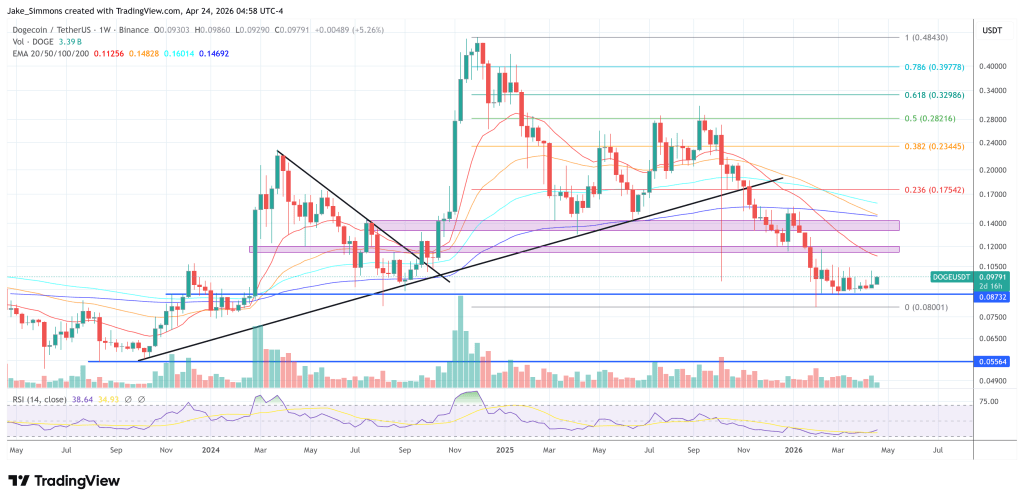
DOGE se mantiene por encima del soporte clave, gráfico semanal | Fuente: DOGEUSDT en TradingView.com

Related Questions

Q¿Qué anuncia Qubic con el inicio de la Fase 3?

AQubic anuncia que ha completado la transición completa a una arquitectura de minería centrada en Dogecoin, eliminando Monero (XMR) de su stack operativo.

Q¿Cómo se distribuyen ahora los recursos de hardware en el nuevo sistema?

ALos ASICs se dedican al 100% a la minería de DOGE, mientras que las CPUs y GPUs se asignan completamente al entrenamiento de su framework de IA, Aigarth.

Q¿Qué ventaja económica afirma tener Qubic sobre los pools de minería tradicionales?

ASegún Qubic, su sistema genera aproximadamente un 32% más de beneficio, con una ganancia de +$1.92 por día usando el mismo hardware en comparación con los pools tradicionales.

Q¿Qué mecanismo utiliza Qubic para crear presión de compra sobre su token nativo QU?

AUtiliza un mecanismo circular donde el DOGE minado se vende, luego se recompra QU con esos fondos, y finalmente se distribuye QU a los 'computors'.

Q¿Cuál fue el papel de Monero en el desarrollo anterior de Qubic?

AMonero se utilizó como prueba de concepto para su modelo Useful Proof of Work, llegando a representar hasta el 45% del hashrate global de Monero en una época y demostrando incluso una toma de control del 51%.

Related Reads

Warsh's Debut: Will the FED Chair Who Knows Crypto Best Bring Surprises or Shocks to the Market?

Kevin Warsh, the new Federal Reserve Chairman, prepares for his inaugural press conference amidst a challenging macroeconomic landscape: resurgent inflation, a bond market sell-off, and political pressure from President Trump for rate cuts. Uniquely, Warsh holds indirect investments in over 20 crypto and Web3 entities (e.g., Solana, dYdX), making him the first Fed Chair with disclosed crypto exposure. His stance may combine a hawkish, inflation-focused monetary policy with a crypto-friendly regulatory philosophy that shifts from Powell’s “same risk, same rule” approach toward a framework acknowledging blockchain’s productivity value. Warsh’s leadership could impact crypto markets across three dimensions: a paradigm shift in regulation (potentially accelerating pro-innovation legislation and stable币 rules), a re-pricing of risk premiums based on clearer communication and his view of AI as a structural disinflationary force, and a long-term reallocation of global institutional capital driven by increased legitimacy. Two potential scenarios for the press conference are outlined. A “positive surprise” would involve a dovish-leaning tone on rates coupled with signals of regulatory openness, potentially boosting crypto asset valuations. Conversely, a “negative shock” would see a more hawkish-than-expected stance on inflation and rates, triggering a broad risk-asset selloff that crypto markets would not escape. While ethics rules required Warsh to divest his crypto holdings upon confirmation, his deep understanding of the technology may fundamentally lower policy uncertainty and build a more receptive long-term foundation for digital assets’ integration into the mainstream financial system.

marsbit2h ago

Warsh's Debut: Will the FED Chair Who Knows Crypto Best Bring Surprises or Shocks to the Market?

marsbit2h ago

Trading

Spot
Futures

Hot Articles

What is DOGE M

Doge Matrix ($doge m): The New Breed of Community-Driven Cryptocurrency Introduction In the ever-evolving landscape of cryptocurrency, new projects constantly emerge, each aiming to capture the interest of investors and enthusiasts alike. One of the latest entrants to this domain is Doge Matrix, represented by the ticker symbol $doge m. This project has attracted attention thanks to its roots in the popular meme culture surrounding Dogecoin, establishing its place within the web3 space. This article aims to provide a comprehensive analysis of Doge Matrix, covering its overview, creator, investors, functionality, timeline, and notable aspects. What is Doge Matrix ($doge m)? Doge Matrix is a community-driven cryptocurrency project that seemingly builds upon the widespread appeal of Dogecoin, a digital currency known for its Shiba Inu mascot and its meme origins. While the overarching objectives of Doge Matrix are not extensively defined, it is characterized by a commitment to harnessing community involvement and support. Unlike traditional cryptocurrencies that often emphasize utility or intrinsic value through underlying technologies, Doge Matrix positions itself within a space that embraces the cultural phenomenon of cryptocurrencies, particularly appealing to those who resonate with the ethos of meme-based assets. Drawing on the strengths of the Dogecoin community, Doge Matrix operates as part of a broader ecosystem, inviting participation and engagement from users who share an interest in cryptocurrency and the digital landscape. Who is the Creator of Doge Matrix ($doge m)? The identity of the creator of Doge Matrix remains unknown. This lack of transparency is not an uncommon occurrence in the cryptocurrency space, where some projects are launched without revealing the identities of their founders. The absence of information regarding the founding team can raise questions among potential investors about the project’s accountability and direction. Who are the Investors of Doge Matrix ($doge m)? As it stands, there is no publicly available information detailing the investors or investment foundations that back Doge Matrix. The project appears to rely primarily on community support rather than institutional investment. This model aligns with the community-driven nature of the initiative, fostering an environment where the direction of the project is shaped by its participants rather than being dictated by a select few financial backers. How Does Doge Matrix ($doge m) Work? The specifics regarding the operational mechanisms of Doge Matrix are somewhat vague, reflecting a broader trend of projects in the meme coin space where innovative functionalities are not always clearly articulated. Nonetheless, Doge Matrix seems designed to tap into the existing cryptocurrency ecosystem by encouraging user participation while tapping into the familiar cultural references associated with Dogecoin. Its potentially unique characteristics derive from community interactions rather than technological advancements, emphasizing shared experiences and collaboration among token holders. While the exact innovations have not been explicitly outlined, the project appears to create a space where community members can engage, share ideas, and propel the project's potential forward. Timeline of Doge Matrix ($doge m) Reflecting on the project’s timeline reveals notable events that have defined its journey thus far: November 25, 2024: Doge Matrix reached its all-time high value, marking a significant milestone in its early history. January 1, 2025: Conversely, Doge Matrix hit its all-time low value, illustrating the volatility often associated with cryptocurrencies, especially in the early stages of a project's lifecycle. Ongoing: The project continues to be actively traded and supported by its community, although specific future milestones or objectives have yet to be disclosed. Key Points About Doge Matrix ($doge m) Community Focus At the heart of Doge Matrix is a commitment to community engagement. The project thrives on the premise of collaboration and shared objectives among its members, emphasizing the importance of collective effort. Unlike centralized projects that often have a defined leadership structure, Doge Matrix at present showcases a more fluid approach to governance, where every community member's voice matters. Volatility The cryptocurrency market is notorious for its volatility, and Doge Matrix is no exception. Its price history reflects significant fluctuations between high and low values, which is typical of many new cryptocurrencies but underscores the risks associated with investment in emerging tokens. Lack of Detailed Information One of the most striking features about Doge Matrix is the scarcity of detailed information regarding its technological underpinnings and operational mechanisms. This ambiguity necessitates that potential investors conduct thorough due diligence before engaging with the project. Conclusion In summary, Doge Matrix ($doge m) illustrates a new wave of cryptocurrency projects that lean heavily on community engagement and cultural relevance. While lacking in certain specifics—such as clear leadership, defined objectives, and detailed functionality—the project has managed to generate interest within the crypto community, leveraging the established appeal of meme culture. As with any investment in the cryptocurrency space, understanding the inherent risks and conducting comprehensive research is essential for potential participants. Doge Matrix stands as a reminder of the dynamic, sometimes unpredictable nature of the crypto industry, marked by constant evolution and enthusiasm for community-driven initiatives.

3.8k Total ViewsPublished 2025.02.03Updated 2025.02.03

What is DOGE M

Discussions

Welcome to the HTX Community. Here, you can stay informed about the latest platform developments and gain access to professional market insights. Users' opinions on the price of DOGE (DOGE) are presented below.

活动图片