Cada vez más 'supermercados de modelos': ByteDance, Alibaba y Tencent compiten por integrar

marsbitPublished on 2026-04-24Last updated on 2026-04-24

Abstract

Resumen: Las principales plataformas en la nube de China, como ByteDance Volcano Engine, Alibaba Cloud y Tencent Cloud, están compitiendo por integrar múltiples modelos de IA en sus servicios de suscripción tipo "supermercado de modelos". Recientemente, Volcano Engine actualizó su plan "Coding Plan" con nuevos modelos como GLM-5.1, Minimax M2.7, Kimi k2.6 y DeepSeek-V3.2, permitiendo a los desarrolladores acceder a varios modelos con una sola suscripción a precios desde 40 CNY/mes. Sin embargo, usuarios reportan problemas como límites de uso demasiado estrictos (5 horas que se agotan rápidamente), errores 429 por sobrecarga del sistema, alta latencia y coeficientes de deducción variables según el modelo utilizado. La tendencia hacia la agregación de modelos está llevando a preocupaciones sobre la "canalización" de los proveedores de modelos independientes, aunque empresas como Zhipu AI, Moonlight (Kimi) y MiniMax están desarrollando estrategias para diferenciarse mediante agentes autónomos, capacidades de texto largo y especialización vertical. Los analistas sugieren que, aunque a corto plazo las plataformas pueden ganar poder de negociación, a largo plazo los modelos especializados mantendrán su valor en nichos específicos.

ByteDance Volcano Engine Ark Coding Plan lanzó oficialmente recientemente GLM-5.1, indicando oficialmente que "se alinea con las capacidades completas del fabricante original, sin límites de compra". Antes de esto, el Coding Plan de Volcano durante mucho tiempo solo tenía modelos más antiguos como GLM-4.7. Esta actualización no solo introdujo GLM-5.1, sino que también integró múltiples modelos de inteligencia artificial nacionales de última generación como Minimax M2.7, Kimi k2.6 y DeepSeek-V3.2.
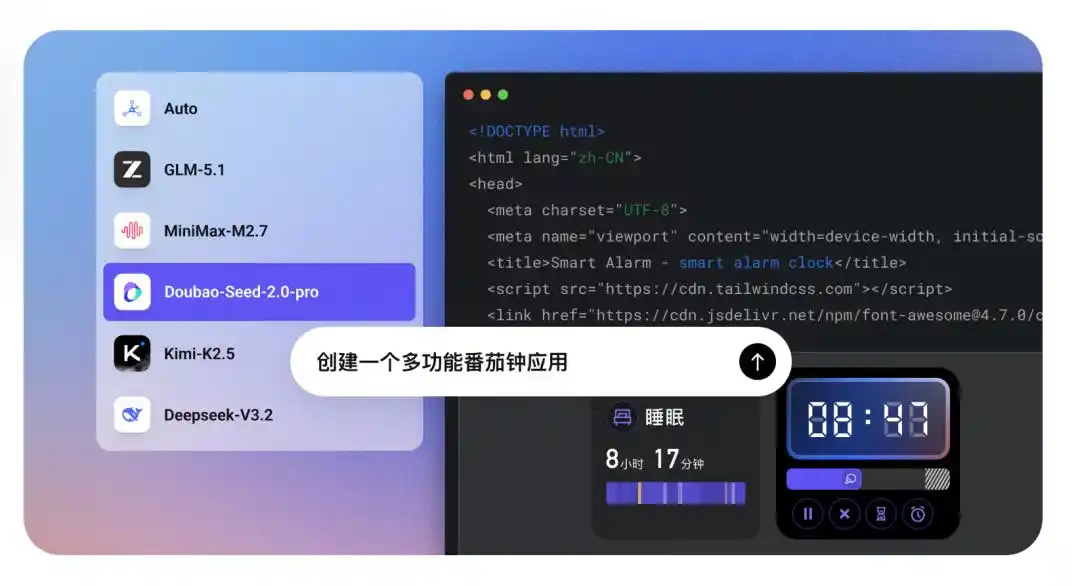
Esto significa que los desarrolladores, con una sola suscripción, pueden acceder simultáneamente a múltiples modelos líderes. Según la retroalimentación del mercado, este "modelo de paquete" reduce enormemente los costos de prueba y error para los desarrolladores. Actualmente, el precio del paquete Lite es de 40 yuanes mensuales y el paquete Pro de 200 yuanes mensuales, lo que hace que muchos desarrolladores estén dispuestos a "comprar uno para asegurar su lugar".

El propio GLM-5.1 de Zhipu AI, en una actualización a principios de abril de 2026, ya mostró capacidades de ingeniería impresionantes. En dos videos oficiales publicados por Zhipu, "construir un escritorio de Linux desde cero en 8 horas" y "655 iteraciones, aumentando el rendimiento de consulta de la base de datos vectorial a 6.9 veces la versión inicial", renovaron la imaginación del público sobre la "ejecución efectiva en 8 horas" de los grandes modelos.

Periodista explora comunidad de desarrolladores: la mayoría de los usuarios indican que "no es duradero"

Al entrar en un grupo de comunicación de desarrolladores de Ark Coding, el periodista descubrió que, además de publicaciones compartiendo experiencias, muchos usuarios reportaron una brecha en la experiencia real. Al revisar unas páginas de la comunidad de intercambio, se encuentran numerosas publicaciones de quejas y solicitudes de reembolso, con muchos netizens exclamando directamente "me siento estafado".
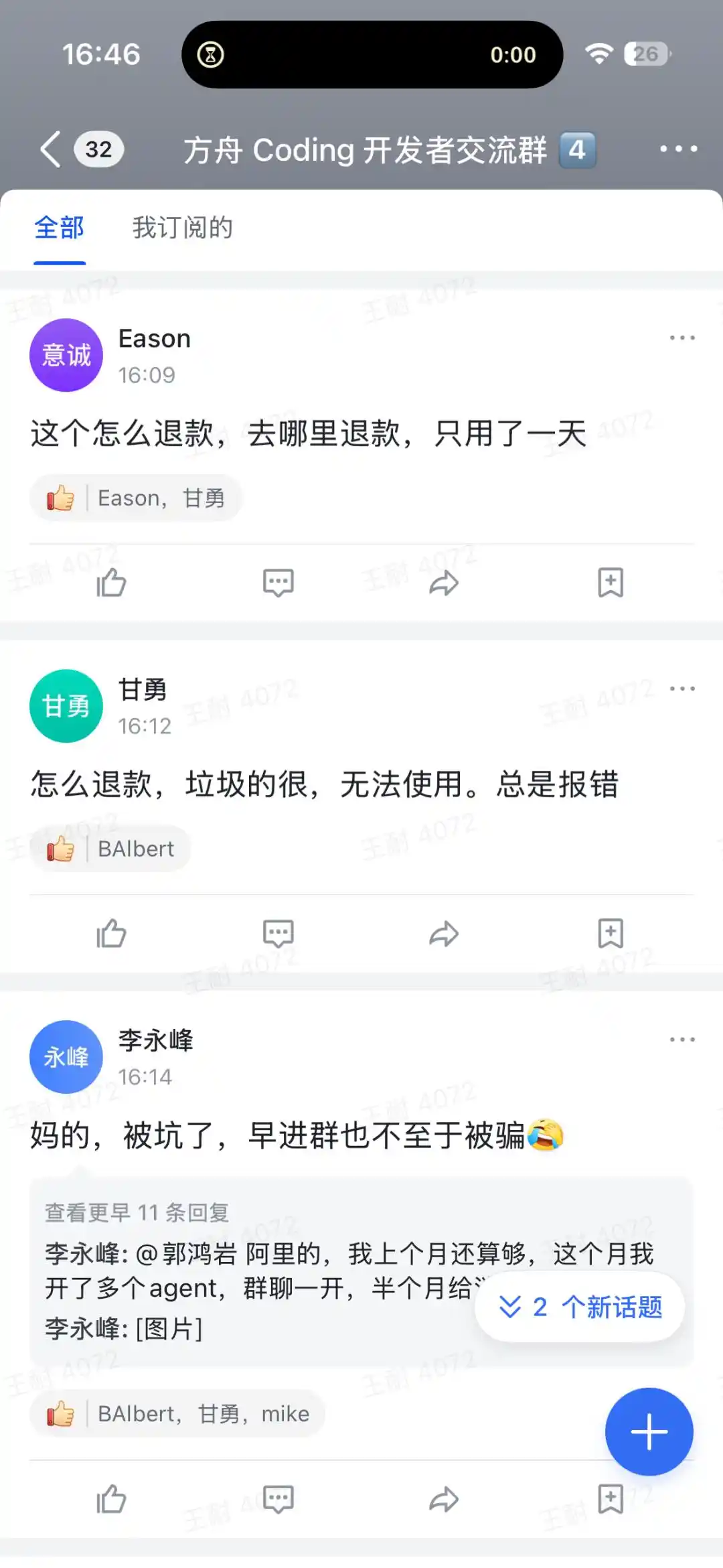
Las controversias son principalmente dos:

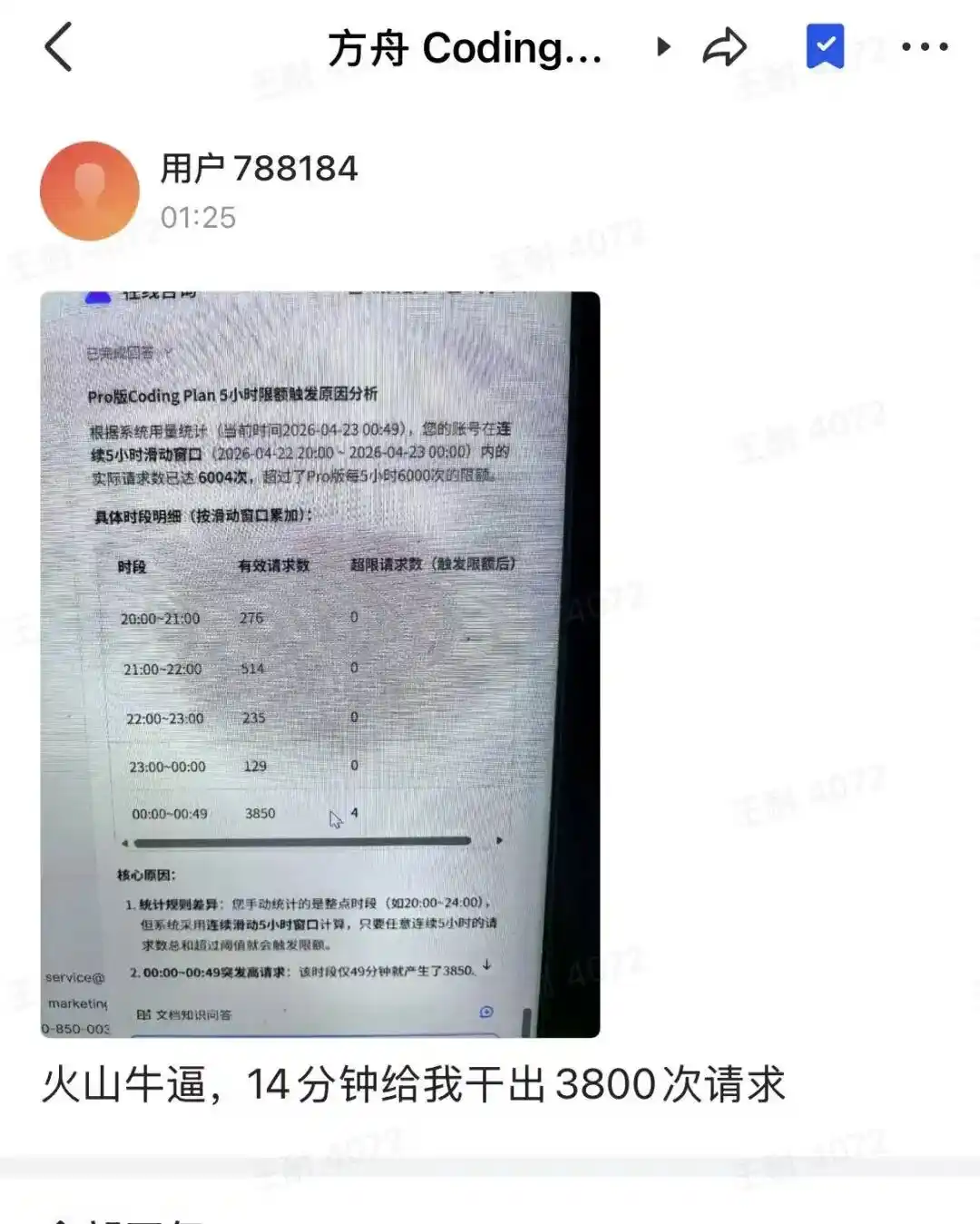
Una es sobre el agotamiento rápido de la cuota. Un usuario llamado "Hakimi" publicó: "unas pocas rondas de diálogo en una tarea y la limitación de 5 horas casi se agota". Otro netizen publicó que la "razón para activar la limitación de 5 horas" fue porque la cuenta tuvo una ventana deslizante continua durante 5 horas, con un número real de solicitudes que excedió las 6004, superando el límite del sistema.
La segunda es la degradación de la experiencia debido a la presión en la programación de la capacidad de cálculo. Muchos usuarios informaron encontrar el error 429 (demasiadas solicitudes) y, en horas pico, "un retraso del primer carácter de más de un minuto es normal". Un usuario直言: "La activación de la limitación de 5 horas es demasiado frecuente, no se puede usar para un desarrollo serio."

Al mismo tiempo, detrás del bajo precio mensual de 40 yuanes del Coding Plan, también se esconde una "corriente oculta" sobre "una solicitud de llamada" que conduce a diferentes coeficientes de deducción en el paquete. Por ejemplo, un usuario publicó en el grupo de intercambio de desarrolladores una imagen de las "diferencias en los coeficientes de deducción al llamar a diferentes modelos". Por ejemplo, la serie completa de Doubao y la serie Qwen tienen un coeficiente de deducción de 1 vez, la serie DeepSeek de 2 veces, y las series MiniMax-M2.7, Kimi-K2.6 y GLM-5.1 de 5 veces.
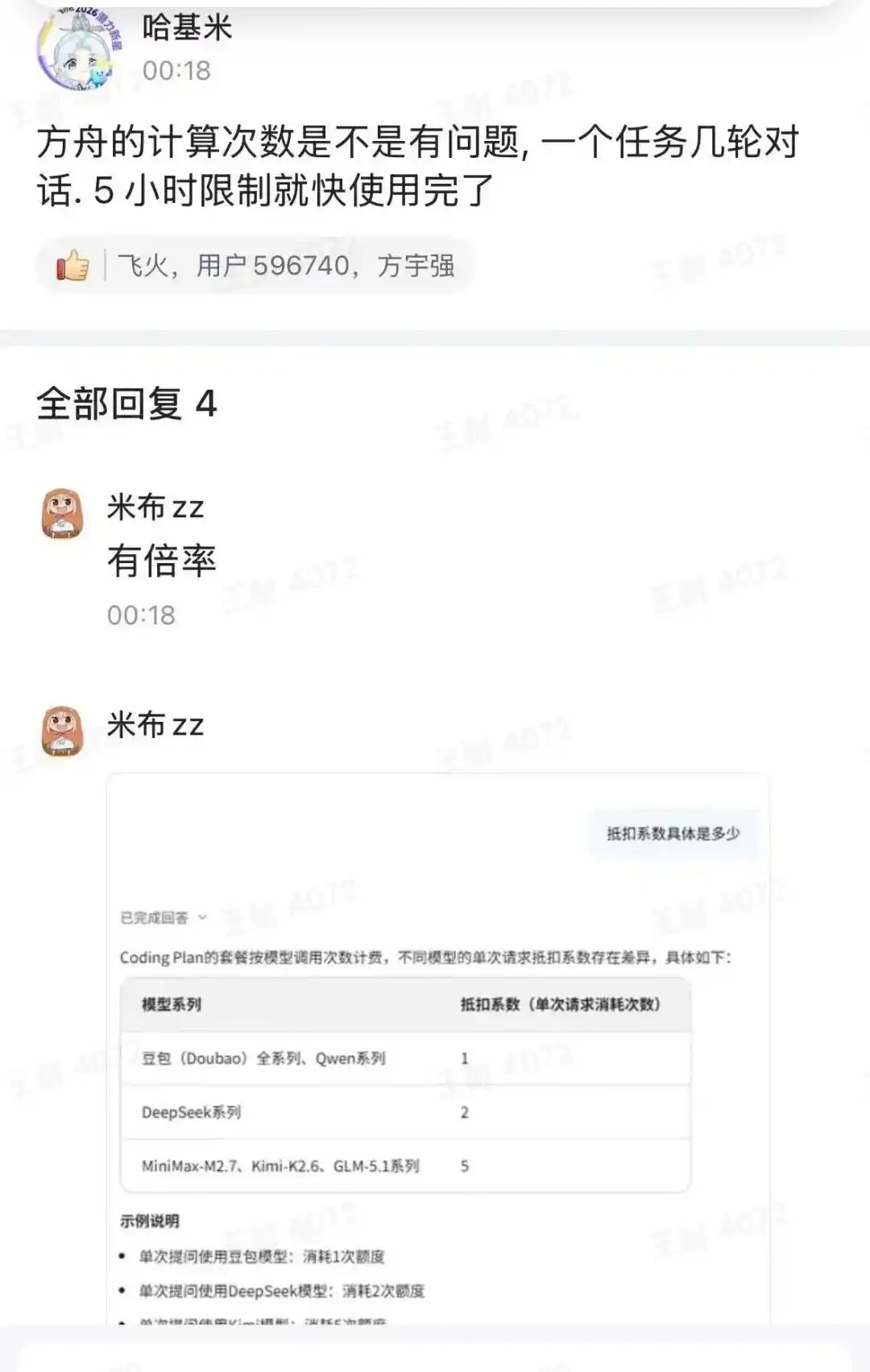
Esto también refleja que la construcción de un "supermercado de modelos" no es tan fácil como se imaginaba. Los desarrolladores son atraídos por la "relación costo-beneficio", pero las deficiencias expuestas inicialmente en áreas como la programación de capacidad de cálculo hacen que muchos desarrolladores, después de probarlo, opten por detenerse. Esto también expone los dolores de crecimiento iniciales del "modelo de paquete". Con la afluencia de usuarios, la capacidad de carga de la plataforma de computación enfrenta desafíos. Cómo encontrar un punto de equilibrio sostenible entre la atracción de precios bajos y la calidad del servicio será una propuesta a largo plazo que Volcano Engine y sus seguidores necesitarán resolver.

Proveedores de nube se vuelven colectivamente hacia "supermercados de modelos": comienza a aparecer una estratificación sólida

Esta actualización "integrativa" del Coding Plan de Volcano Engine tampoco es un evento aislado.

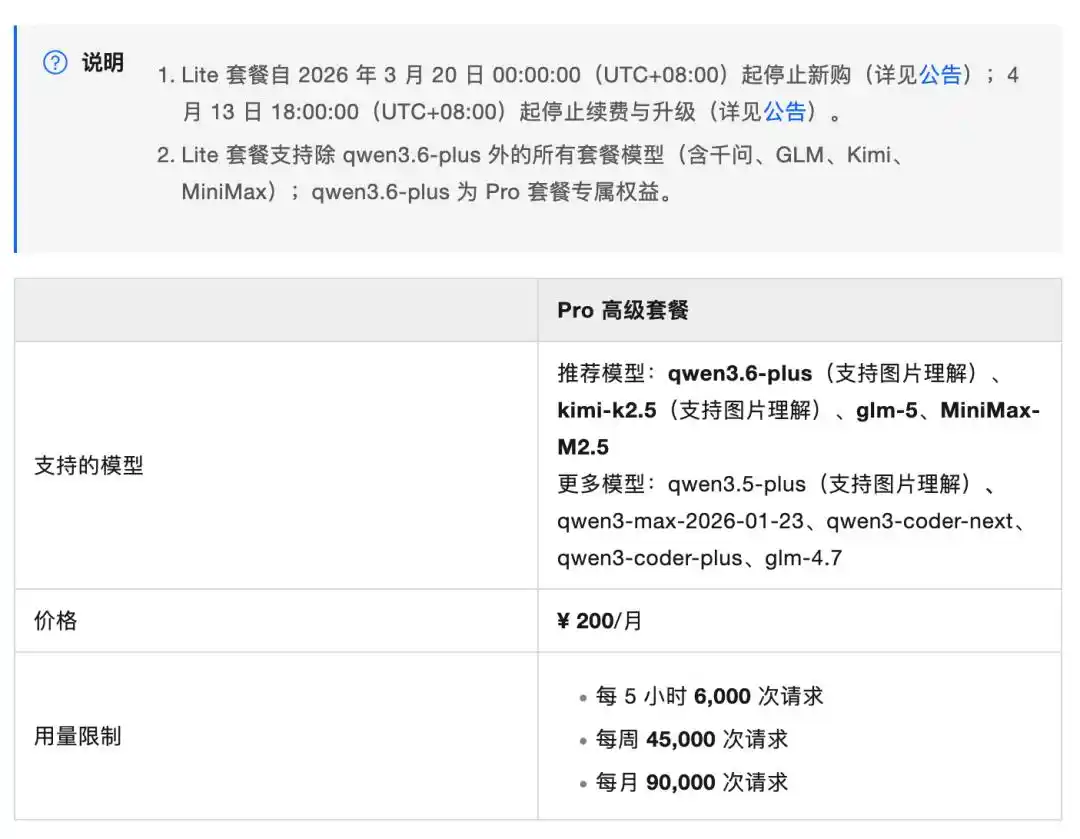
Desde principios de 2026, los principales proveedores de nube como Alibaba Cloud, Baidu Intelligent Cloud y Tencent Cloud han estado avanzando en layouts de integración de múltiples modelos. Por ejemplo, Alibaba Cloud, como pionero en la industria, lanzó antes el paquete de suscripción multi-modelo "Bailian Coding Plan". Actualmente admite series como Qianwen, kimi-k2.5, glm-5, MiniMax-M2.5, etc. Actualmente, el precio Pro es de 200 yuanes mensuales, y el paquete Lite dejó de estar disponible para nuevas compras a partir del 20 de marzo, y dejará de renovarse y actualizarse a partir del 13 de abril.
El servicio de suscripción Tencent Cloud Large Model Coding Plan se lanzó completamente en marzo de 2026, admitiendo múltiples modelos最新 como Tencent HY 2.0 Instruct, GLM-5, Kimi-K2.5, MiniMax-M2.5. Baidu Qianfan lanzó oficialmente el servicio de suscripción de codificación AI Coding Plan en febrero de 2026, siendo también uno de los primeros proveedores de nube en lanzar este tipo de servicio en China.

El modelo de "supermercado de modelos" no es una elección de una sola empresa, sino que se está convirtiendo en una pista en la que compiten los proveedores de nube. Pero al desgarrar la estrategia de agregación de los proveedores de nube, quién puede proporcionar un servicio más estable, reglas de cuota más transparentes, mecanismos de tolerancia a fallos más flexibles, quién puede extender más capacidades de servicio a nivel empresarial más allá de la programación, y si la tasa de renovación puede seguir el ritmo, se convierten en nuevos núcleos de competencia.

A nivel internacional, las plataformas de servicio de agregación de modelos Amazon Bedrock y Microsoft Azure, aunque difieren en escenarios del modo de suscripción Coding nacional, pertenecen a la misma tendencia de integración.

En general, la competencia de la industria también está pasando de la "comparación de capacidades de un solo modelo" a la "capacidad de integración de plataformas + capacidad de servicio ecológico", y la concentración de la industria aumentará rápidamente.

Wang Kai, analista jefe de asignación de activos de Guoxin Securities, dijo al periodista que, aunque la diferenciación de la industria se está acelerando, puede ser un poco pronto juzgar el período de integración. "Más precisamente, esto es una refinación e iteración de la división laboral de la cadena industrial. Los fabricantes de modelos se enfocan en algoritmos, los proveedores de nube se enfocan en la entrega de ingeniería, cada uno aprovechando sus ventajas principales". Considera que, independientemente de si otros proveedores de nube siguen el ejemplo, el panorama competitivo evolucionará de luchas individuales a una diferenciación de nicho ecológico.

¿Se intensifica la presión de "canalización" para las empresas de grandes modelos?

La llamada "canalización" no se refiere a la desaparición de las empresas de modelos, sino a la pérdida de su prima de producto, derecho de conexión con el usuario y poder de discourse, transfiriéndose las ganancias a la parte de la plataforma de computación, convirtiéndose en un papel "dominado".

Bajo la ola de agregación de los proveedores de nube, la "canalización" también se está convirtiendo en la espada de Damocles que pende sobre la cabeza de las empresas independientes de grandes modelos. En este juego silencioso, jugadores líderes como Zhipu AI, Moonlight (Kimi), MiniMax, etc., no han optado por comprometerse pasivamente, sino que han crecido desde sus genes, dando diferentes caminos de突围.

Zhang Peng, CEO de Zhipu AI, en un diálogo público el 8 de abril, dejó claro que el objetivo final de Zhipu nunca es convertirse en una "herramienta de llamada reemplazable a voluntad", sino construir un agente inteligente totalmente autónomo (Autonomous Agent). Este posicionamiento intenta hacer que Zhipu actualice de "proveedor de modelos" a "ejecutor de tareas", evitando así la trampa de precios bajos de la API pura.

Moonlight (Kimi) adopta una estrategia de "disposición dispersa + profundización en texto largo". Se conecta simultáneamente a múltiples plataformas principales en la nube como Volcano Engine y Alibaba Cloud, logrando un suministro de capacidad de cálculo multi-fuente, sin estar vinculado a un solo canal, garantizando la estabilidad del servicio y el control de costos. Kimi K2.6, lanzado en abril de 2026, adopta una arquitectura Mixture of Experts (MoE), con una ventana de contexto estándar de 256K tokens.

MiniMax concentra sus recursos centrales en campos verticales como la creación de contenido, servicio al cliente inteligente, educación, servicios empresariales, entretenimiento social, etc., especialmente en escenarios como IA para juegos, humanos digitales, interacción multimodal, etc., creando "capacidades personalizadas difíciles de reemplazar por la plataforma en la nube".

¿La integración de plataformas de los grandes fabricantes acelerará la "canalización" de las empresas de modelos? Wang Kai, analista jefe de asignación de activos de Guoxin Securities, cree que es necesario distinguir entre perspectivas a corto y largo plazo.

"A corto plazo, es una ley comercial que los canales de distribución estén controlados por la plataforma, se ceda parcialmente el poder de fijación de precios y las ganancias de los fabricantes de modelos se transfieran a la parte de entrada. Pero a largo plazo, los modelos generales son fáciles de homogeneizar, y los modelos de aprendizaje profundo en escenarios verticales como finanzas, atención médica, derecho, etc., tienen barreras profesionales que la agregación centralizada no puede eliminar." Considera.

Para hacer frente al riesgo de ser platformizado, también se puede hacer referencia a las estrategias de OpenAI y Anthropic. Por un lado, fortalecer los canales que se enfrentan directamente a los usuarios finales, por ejemplo, la operación independiente de ChatGPT y Claude esencialmente establece una conexión de usuario que evita la plataforma. Por otro lado, la velocidad de iteración tecnológica y el reconocimiento de la marca del usuario son dos barreras efectivas, por lo que las empresas de modelos necesitan equilibrar la inversión en I+D y el layout de productización.

El final del juego de esta "canalización versus platformización" podría no ser quién se come a quién, sino una mayor clarificación de la división laboral. Los proveedores de nube hacen la canalización, las empresas de modelos hacen la tecnología, y ambas partes encuentran gradualmente sus límites de supervivencia en el juego.

En cuanto a quién se come a quién, en esta etapa, aún está lejos del final de la historia.

Este artículo proviene del WeChat public account "科创板日报", autor: Wang Nai

Trending Cryptos

Related Questions

Q¿Qué es el 'Coding Plan' de ByteDance Volcano Engine y qué nuevos modelos ha integrado recientemente?

AEl 'Coding Plan' de ByteDance Volcano Engine es un servicio de suscripción que permite a los desarrolladores acceder a múltiples modelos de inteligencia artificial. Recientemente, ha integrado modelos como GLM-5.1, Minimax M2.7, Kimi k2.6 y DeepSeek-V3.2, ofreciendo 'capacidades completas alineadas con el fabricante original sin límites de compra'.

Q¿Cuáles son las principales quejas de los desarrolladores sobre el servicio 'Coding Plan' de Volcano Engine?

ALos desarrolladores se quejan principalmente de dos problemas: 1) Límites de uso que se agotan rápidamente, con usuarios reportando que unas pocas conversaciones agotan el límite de 5 horas; y 2) Problemas de rendimiento como errores 429 (demasiadas solicitudes) y retrasos de más de un minuto para la primera respuesta durante horas pico, lo que dificulta el desarrollo serio.

Q¿Cómo están respondiendo los principales proveedores de nube en China a la tendencia de 'supermercado de modelos'?

AProveedores principales como Alibaba Cloud, Tencent Cloud y Baidu Intelligent Cloud están avanzando en la integración de múltiples modelos. Por ejemplo, Alibaba Cloud ofrece 'Bailian Coding Plan', Tencent Cloud lanzó su servicio de suscripción en marzo de 2026, y Baidu Qianfan introdujo su servicio de suscripción AI Coding en febrero de 2026, todos apoyando varios modelos líderes.

Q¿Qué estrategias están adoptando las empresas de modelos independientes como Zhipu AI, Moonlight (Kimi) y MiniMax para evitar la 'canalización'?

AZhipu AI busca construir agentes autónomos completos para ser 'ejecutores de tareas' en lugar de simples proveedores de API. Moonlight (Kimi) adopta una estrategia de distribución diversificada y se especializa en texto largo, integrando múltiples plataformas en la nube. MiniMax se enfoca en verticales como creación de contenido, servicio al cliente, educación y entretenimiento, desarrollando capacidades personalizadas difíciles de reemplazar.

QSegún el analista Wang Kai, ¿cómo evolucionará la competencia entre los proveedores de nube y las empresas de modelos?

AWang Kai, analista jefe de configuración de activos de Guoxin Securities, cree que a corto plazo, la ganancia puede transferirse a las plataformas dueñas de los canales de distribución, pero a largo plazo, los modelos especializados en verticales como finanzas, atención médica y derecho mantendrán barreras profesionales. La competencia evolucionará hacia una división del trabajo más clara, donde los proveedores de nube gestionen la canalización y las empresas de modelos se centren en la tecnología, encontrando cada uno su límite de supervivencia.

Related Reads

With Labour Changing Leaders, Is the Long-Suppressed UK Crypto Market About to Turn Around?

Labour leader change: Hope for UK crypto market? With Keir Starmer's resignation as Prime Minister and Labour leader, a leadership contest has begun. Andy Burnham, the former Mayor of Greater Manchester and now the overwhelming favourite to succeed, has sparked cautious optimism within the UK cryptocurrency industry. Industry figures hope Burnham, seen as more receptive to digital assets than much of the Labour establishment, could shift the party's traditionally harder line. The leadership transition is expected to be swift, with prediction markets like Polymarket assigning a 97% probability to Burnham becoming the next Prime Minister. However, this political shift comes as a comprehensive regulatory framework for crypto, established by law earlier this year, is in its final implementation phase. The Financial Conduct Authority (FCA) is finalizing detailed rules covering trading, custody, stablecoins, and market abuse, with the full regime set to go live in October 2027. While a new Prime Minister can reshuffle ministers and adjust policy priorities, the core regulatory architecture is now law and unlikely to be fundamentally overturned without significant, deliberate government intervention. The main industry hope is that a Burnham government, focusing on economic growth, will ensure the FCA's implementation is pragmatic and growth-oriented. Industry advocates seek proportionate capital requirements, a streamlined licensing process, and clear rules for staking and stablecoins. They argue that embracing the crypto sector could attract investment and listings to London's struggling markets. Despite the optimism, concerns remain that regulatory implementation may still be influenced by more sceptical factions within the Labour party.

Foresight News10m ago

With Labour Changing Leaders, Is the Long-Suppressed UK Crypto Market About to Turn Around?

Foresight News10m ago

A 60-Day Window Depresses Oil Prices, So Why Is the Market Falling Instead?

International oil prices continued to decline on June 23, extending significant losses from the previous session. The market shifted focus from Middle East military risks to actual supply changes following a temporary U.S.-Iran arrangement. The immediate trigger was the resumption of traffic through the Strait of Hormuz, a critical oil shipping chokepoint, with two tankers passing through, signaling eased near-term supply disruption fears. Prices retreated as the "worst-case scenario" was temporarily averted. A reported 60-day window in a U.S.-Iran understanding allows Iran to sell oil during this period, further dampening supply concerns. However, this arrangement is temporary, linked to nuclear talks, and does not guarantee a long-term solution. Market sentiment remains cautious because the deal could still unravel, potentially reinstating sanctions or disrupting shipping. While these developments have lowered immediate risk premiums, prices have not fully returned to pre-conflict levels. Geopolitical news, particularly regarding the stability of the Strait of Hormuz or the progress of negotiations, could quickly reverse the price drop. Additionally, low U.S. strategic petroleum reserves limit the emergency buffer available if supply shocks reemerge. Therefore, the current price decline reflects a reduction in near-term panic, not a complete elimination of Middle East supply risks.

marsbit25m ago

A 60-Day Window Depresses Oil Prices, So Why Is the Market Falling Instead?

marsbit25m ago

SK Hynix Market Cap Exceeds Samsung for First Time in 26 Years, Korean Broker Calls for 50% More Upside

SK Hynix's market capitalization surpassed Samsung Electronics for the first time in 26 years on June 22, reaching 208.1 trillion won. The shift reflects a market trend where companies directly benefiting from AI infrastructure, like SK Hynix, are receiving higher valuation premiums than diversified giants. The surge is driven by AI-driven demand for High Bandwidth Memory (HBM), where SK Hynix holds a dominant 70-80% market share. Its Q1 2026 revenue exceeded 50 trillion won for the first time, with an operating profit margin of 72%. Hanwha Investment & Securities significantly raised its price target for SK Hynix to 430,000 won, the highest among Korean brokerages. The key rationale is that Long-Term Supply Agreements (LTAs) and robust HBM demand have fundamentally reduced the company's historical profit volatility. Several other brokers have also raised targets, arguing the valuation framework for memory semiconductors is being rewritten, moving away from a cyclical model. Despite the bullish outlook, the stock experienced a pullback of over 5% in regular trading on June 23 after briefly surpassing 3 million won pre-market, amid broader tech sector weakness. Some analysts caution that the市值 overtaking Samsung, whose profit scale and growth forecasts remain higher, could signal short-term overheating. However, high-return investors viewed the dip as a buying opportunity.

marsbit44m ago

SK Hynix Market Cap Exceeds Samsung for First Time in 26 Years, Korean Broker Calls for 50% More Upside

marsbit44m ago

GPU Rental Prices Drop 30% in Three Weeks: AI Value Chain Migrating from Nvidia to Memory Chips

GPU rental prices for Nvidia's flagship B200 chip have fallen by approximately 30% over three weeks, dropping from a high of $6.11/hour to $4.22/hour. This decline signals a potential easing of the "compute scarcity" narrative that has long supported AI hardware valuations. Concurrently, the semiconductor market is witnessing a significant divergence: while the VanEck Semiconductor ETF (SMH) has risen 15% in the past month, with memory giants Micron and SanDisk each surging nearly 60%, Nvidia's stock has declined about 3% over the same period. Analysts suggest this shift indicates that the AI value chain's bottleneck and profits are migrating from compute (GPUs) to memory. Demand for high-bandwidth memory (HBM) remains intensely strong, with contract prices soaring over 100% in H1 2026, granting memory manufacturers significant pricing power. In contrast, increased B200 supply from improved manufacturing yields and competitive pressure from new cloud providers are softening GPU rental rates. While long-term contracts, like SpaceX's $30 billion deal with Google, show sustained large-scale demand for Nvidia hardware, the softening spot prices pressure the margins of cloud providers and could eventually impact Nvidia's order flow if chip prices don't adjust. The key takeaway for investors is not a weakening AI thesis, but a recalibration within the sector: pricing power appears to be strengthening for memory chipmakers while showing signs of strain for leading GPU suppliers.

marsbit53m ago

GPU Rental Prices Drop 30% in Three Weeks: AI Value Chain Migrating from Nvidia to Memory Chips

marsbit53m ago

Trading

Spot
Futures

Hot Articles

What is SONIC

Sonic: Pioneering the Future of Gaming in Web3 Introduction to Sonic In the ever-evolving landscape of Web3, the gaming industry stands out as one of the most dynamic and promising sectors. At the forefront of this revolution is Sonic, a project designed to amplify the gaming ecosystem on the Solana blockchain. Leveraging cutting-edge technology, Sonic aims to deliver an unparalleled gaming experience by efficiently processing millions of requests per second, ensuring that players enjoy seamless gameplay while maintaining low transaction costs. This article delves into the intricate details of Sonic, exploring its creators, funding sources, operational mechanics, and the timeline of significant events that have shaped its journey. What is Sonic? Sonic is an innovative layer-2 network that operates atop the Solana blockchain, specifically tailored to enhance the existing Solana gaming ecosystem. It accomplishes this through a customised, VM-agnostic game engine paired with a HyperGrid interpreter, facilitating sovereign game economies that roll up back to the Solana platform. The primary goals of Sonic include: Enhanced Gaming Experiences: Sonic is committed to offering lightning-fast on-chain gameplay, allowing players and developers to engage with games at previously unattainable speeds. Atomic Interoperability: This feature enables transactions to be executed within Sonic without the need to redeploy Solana programmes and accounts. This makes the process more efficient and directly benefits from Solana Layer1 services and liquidity. Seamless Deployment: Sonic allows developers to write for Ethereum Virtual Machine (EVM) based systems and execute them on Solana’s SVM infrastructure. This interoperability is crucial for attracting a broader range of dApps and decentralised applications to the platform. Support for Developers: By offering native composable gaming primitives and extensible data types - dining within the Entity-Component-System (ECS) framework - game creators can craft intricate business logic with ease. Overall, Sonic's unique approach not only caters to players but also provides an accessible and low-cost environment for developers to innovate and thrive. Creator of Sonic The information regarding the creator of Sonic is somewhat ambiguous. However, it is known that Sonic's SVM is owned by the company Mirror World. The absence of detailed information about the individuals behind Sonic reflects a common trend in several Web3 projects, where collective efforts and partnerships often overshadow individual contributions. Investors of Sonic Sonic has garnered considerable attention and support from various investors within the crypto and gaming sectors. Notably, the project raised an impressive $12 million during its Series A funding round. The round was led by BITKRAFT Ventures, with other notable investors including Galaxy, Okx Ventures, Interactive, Big Brain Holdings, and Mirana. This financial backing signifies the confidence that investment foundations have in Sonic’s potential to revolutionise the Web3 gaming landscape, further validating its innovative approaches and technologies. How Does Sonic Work? Sonic utilises the HyperGrid framework, a sophisticated parallel processing mechanism that enhances its scalability and customisability. Here are the core features that set Sonic apart: Lightning Speed at Low Costs: Sonic offers one of the fastest on-chain gaming experiences compared to other Layer-1 solutions, powered by the scalability of Solana’s virtual machine (SVM). Atomic Interoperability: Sonic enables transaction execution without redeployment of Solana programmes and accounts, effectively streamlining the interaction between users and the blockchain. EVM Compatibility: Developers can effortlessly migrate decentralised applications from EVM chains to the Solana environment using Sonic’s HyperGrid interpreter, increasing the accessibility and integration of various dApps. Ecosystem Support for Developers: By exposing native composable gaming primitives, Sonic facilitates a sandbox-like environment where developers can experiment and implement business logic, greatly enhancing the overall development experience. Monetisation Infrastructure: Sonic natively supports growth and monetisation efforts, providing frameworks for traffic generation, payments, and settlements, thereby ensuring that gaming projects are not only viable but also sustainable financially. Timeline of Sonic The evolution of Sonic has been marked by several key milestones. Below is a brief timeline highlighting critical events in the project's history: 2022: The Sonic cryptocurrency was officially launched, marking the beginning of its journey in the Web3 gaming arena. 2024: June: Sonic SVM successfully raised $12 million in a Series A funding round. This investment allowed Sonic to further develop its platform and expand its offerings. August: The launch of the Sonic Odyssey testnet provided users with the first opportunity to engage with the platform, offering interactive activities such as collecting rings—a nod to gaming nostalgia. October: SonicX, an innovative crypto game integrated with Solana, made its debut on TikTok, capturing the attention of over 120,000 users within a short span. This integration illustrated Sonic’s commitment to reaching a broader, global audience and showcased the potential of blockchain gaming. Key Points Sonic SVM is a revolutionary layer-2 network on Solana explicitly designed to enhance the GameFi landscape, demonstrating great potential for future development. HyperGrid Framework empowers Sonic by introducing horizontal scaling capabilities, ensuring that the network can handle the demands of Web3 gaming. Integration with Social Platforms: The successful launch of SonicX on TikTok displays Sonic’s strategy to leverage social media platforms to engage users, exponentially increasing the exposure and reach of its projects. Investment Confidence: The substantial funding from BITKRAFT Ventures, among others, emphasizes the robust backing Sonic has, paving the way for its ambitious future. In conclusion, Sonic encapsulates the essence of Web3 gaming innovation, striking a balance between cutting-edge technology, developer-centric tools, and community engagement. As the project continues to evolve, it is poised to redefine the gaming landscape, making it a notable entity for gamers and developers alike. As Sonic moves forward, it will undoubtedly attract greater interest and participation, solidifying its place within the broader narrative of blockchain gaming.

1.7k Total ViewsPublished 2024.04.04Updated 2024.12.03

What is SONIC

What is $S$

Understanding SPERO: A Comprehensive Overview Introduction to SPERO As the landscape of innovation continues to evolve, the emergence of web3 technologies and cryptocurrency projects plays a pivotal role in shaping the digital future. One project that has garnered attention in this dynamic field is SPERO, denoted as SPERO,$$s$. This article aims to gather and present detailed information about SPERO, to help enthusiasts and investors understand its foundations, objectives, and innovations within the web3 and crypto domains. What is SPERO,$$s$? SPERO,$$s$ is a unique project within the crypto space that seeks to leverage the principles of decentralisation and blockchain technology to create an ecosystem that promotes engagement, utility, and financial inclusion. The project is tailored to facilitate peer-to-peer interactions in new ways, providing users with innovative financial solutions and services. At its core, SPERO,$$s$ aims to empower individuals by providing tools and platforms that enhance user experience in the cryptocurrency space. This includes enabling more flexible transaction methods, fostering community-driven initiatives, and creating pathways for financial opportunities through decentralised applications (dApps). The underlying vision of SPERO,$$s$ revolves around inclusiveness, aiming to bridge gaps within traditional finance while harnessing the benefits of blockchain technology. Who is the Creator of SPERO,$$s$? The identity of the creator of SPERO,$$s$ remains somewhat obscure, as there are limited publicly available resources providing detailed background information on its founder(s). This lack of transparency can stem from the project's commitment to decentralisation—an ethos that many web3 projects share, prioritising collective contributions over individual recognition. By centring discussions around the community and its collective goals, SPERO,$$s$ embodies the essence of empowerment without singling out specific individuals. As such, understanding the ethos and mission of SPERO remains more important than identifying a singular creator. Who are the Investors of SPERO,$$s$? SPERO,$$s$ is supported by a diverse array of investors ranging from venture capitalists to angel investors dedicated to fostering innovation in the crypto sector. The focus of these investors generally aligns with SPERO's mission—prioritising projects that promise societal technological advancement, financial inclusivity, and decentralised governance. These investor foundations are typically interested in projects that not only offer innovative products but also contribute positively to the blockchain community and its ecosystems. The backing from these investors reinforces SPERO,$$s$ as a noteworthy contender in the rapidly evolving domain of crypto projects. How Does SPERO,$$s$ Work? SPERO,$$s$ employs a multi-faceted framework that distinguishes it from conventional cryptocurrency projects. Here are some of the key features that underline its uniqueness and innovation: Decentralised Governance: SPERO,$$s$ integrates decentralised governance models, empowering users to participate actively in decision-making processes regarding the project’s future. This approach fosters a sense of ownership and accountability among community members. Token Utility: SPERO,$$s$ utilises its own cryptocurrency token, designed to serve various functions within the ecosystem. These tokens enable transactions, rewards, and the facilitation of services offered on the platform, enhancing overall engagement and utility. Layered Architecture: The technical architecture of SPERO,$$s$ supports modularity and scalability, allowing for seamless integration of additional features and applications as the project evolves. This adaptability is paramount for sustaining relevance in the ever-changing crypto landscape. Community Engagement: The project emphasises community-driven initiatives, employing mechanisms that incentivise collaboration and feedback. By nurturing a strong community, SPERO,$$s$ can better address user needs and adapt to market trends. Focus on Inclusion: By offering low transaction fees and user-friendly interfaces, SPERO,$$s$ aims to attract a diverse user base, including individuals who may not previously have engaged in the crypto space. This commitment to inclusion aligns with its overarching mission of empowerment through accessibility. Timeline of SPERO,$$s$ Understanding a project's history provides crucial insights into its development trajectory and milestones. Below is a suggested timeline mapping significant events in the evolution of SPERO,$$s$: Conceptualisation and Ideation Phase: The initial ideas forming the basis of SPERO,$$s$ were conceived, aligning closely with the principles of decentralisation and community focus within the blockchain industry. Launch of Project Whitepaper: Following the conceptual phase, a comprehensive whitepaper detailing the vision, goals, and technological infrastructure of SPERO,$$s$ was released to garner community interest and feedback. Community Building and Early Engagements: Active outreach efforts were made to build a community of early adopters and potential investors, facilitating discussions around the project’s goals and garnering support. Token Generation Event: SPERO,$$s$ conducted a token generation event (TGE) to distribute its native tokens to early supporters and establish initial liquidity within the ecosystem. Launch of Initial dApp: The first decentralised application (dApp) associated with SPERO,$$s$ went live, allowing users to engage with the platform's core functionalities. Ongoing Development and Partnerships: Continuous updates and enhancements to the project's offerings, including strategic partnerships with other players in the blockchain space, have shaped SPERO,$$s$ into a competitive and evolving player in the crypto market. Conclusion SPERO,$$s$ stands as a testament to the potential of web3 and cryptocurrency to revolutionise financial systems and empower individuals. With a commitment to decentralised governance, community engagement, and innovatively designed functionalities, it paves the way toward a more inclusive financial landscape. As with any investment in the rapidly evolving crypto space, potential investors and users are encouraged to research thoroughly and engage thoughtfully with the ongoing developments within SPERO,$$s$. The project showcases the innovative spirit of the crypto industry, inviting further exploration into its myriad possibilities. While the journey of SPERO,$$s$ is still unfolding, its foundational principles may indeed influence the future of how we interact with technology, finance, and each other in interconnected digital ecosystems.

63 Total ViewsPublished 2024.12.17Updated 2024.12.17

What is $S$

What is AGENT S

Agent S: The Future of Autonomous Interaction in Web3 Introduction In the ever-evolving landscape of Web3 and cryptocurrency, innovations are constantly redefining how individuals interact with digital platforms. One such pioneering project, Agent S, promises to revolutionise human-computer interaction through its open agentic framework. By paving the way for autonomous interactions, Agent S aims to simplify complex tasks, offering transformative applications in artificial intelligence (AI). This detailed exploration will delve into the project's intricacies, its unique features, and the implications for the cryptocurrency domain. What is Agent S? Agent S stands as a groundbreaking open agentic framework, specifically designed to tackle three fundamental challenges in the automation of computer tasks: Acquiring Domain-Specific Knowledge: The framework intelligently learns from various external knowledge sources and internal experiences. This dual approach empowers it to build a rich repository of domain-specific knowledge, enhancing its performance in task execution. Planning Over Long Task Horizons: Agent S employs experience-augmented hierarchical planning, a strategic approach that facilitates efficient breakdown and execution of intricate tasks. This feature significantly enhances its ability to manage multiple subtasks efficiently and effectively. Handling Dynamic, Non-Uniform Interfaces: The project introduces the Agent-Computer Interface (ACI), an innovative solution that enhances the interaction between agents and users. Utilizing Multimodal Large Language Models (MLLMs), Agent S can navigate and manipulate diverse graphical user interfaces seamlessly. Through these pioneering features, Agent S provides a robust framework that addresses the complexities involved in automating human interaction with machines, setting the stage for myriad applications in AI and beyond. Who is the Creator of Agent S? While the concept of Agent S is fundamentally innovative, specific information about its creator remains elusive. The creator is currently unknown, which highlights either the nascent stage of the project or the strategic choice to keep founding members under wraps. Regardless of anonymity, the focus remains on the framework's capabilities and potential. Who are the Investors of Agent S? As Agent S is relatively new in the cryptographic ecosystem, detailed information regarding its investors and financial backers is not explicitly documented. The lack of publicly available insights into the investment foundations or organisations supporting the project raises questions about its funding structure and development roadmap. Understanding the backing is crucial for gauging the project's sustainability and potential market impact. How Does Agent S Work? At the core of Agent S lies cutting-edge technology that enables it to function effectively in diverse settings. Its operational model is built around several key features: Human-like Computer Interaction: The framework offers advanced AI planning, striving to make interactions with computers more intuitive. By mimicking human behaviour in tasks execution, it promises to elevate user experiences. Narrative Memory: Employed to leverage high-level experiences, Agent S utilises narrative memory to keep track of task histories, thereby enhancing its decision-making processes. Episodic Memory: This feature provides users with step-by-step guidance, allowing the framework to offer contextual support as tasks unfold. Support for OpenACI: With the ability to run locally, Agent S allows users to maintain control over their interactions and workflows, aligning with the decentralised ethos of Web3. Easy Integration with External APIs: Its versatility and compatibility with various AI platforms ensure that Agent S can fit seamlessly into existing technological ecosystems, making it an appealing choice for developers and organisations. These functionalities collectively contribute to Agent S's unique position within the crypto space, as it automates complex, multi-step tasks with minimal human intervention. As the project evolves, its potential applications in Web3 could redefine how digital interactions unfold. Timeline of Agent S The development and milestones of Agent S can be encapsulated in a timeline that highlights its significant events: September 27, 2024: The concept of Agent S was launched in a comprehensive research paper titled “An Open Agentic Framework that Uses Computers Like a Human,” showcasing the groundwork for the project. October 10, 2024: The research paper was made publicly available on arXiv, offering an in-depth exploration of the framework and its performance evaluation based on the OSWorld benchmark. October 12, 2024: A video presentation was released, providing a visual insight into the capabilities and features of Agent S, further engaging potential users and investors. These markers in the timeline not only illustrate the progress of Agent S but also indicate its commitment to transparency and community engagement. Key Points About Agent S As the Agent S framework continues to evolve, several key attributes stand out, underscoring its innovative nature and potential: Innovative Framework: Designed to provide an intuitive use of computers akin to human interaction, Agent S brings a novel approach to task automation. Autonomous Interaction: The ability to interact autonomously with computers through GUI signifies a leap towards more intelligent and efficient computing solutions. Complex Task Automation: With its robust methodology, it can automate complex, multi-step tasks, making processes faster and less error-prone. Continuous Improvement: The learning mechanisms enable Agent S to improve from past experiences, continually enhancing its performance and efficacy. Versatility: Its adaptability across different operating environments like OSWorld and WindowsAgentArena ensures that it can serve a broad range of applications. As Agent S positions itself in the Web3 and crypto landscape, its potential to enhance interaction capabilities and automate processes signifies a significant advancement in AI technologies. Through its innovative framework, Agent S exemplifies the future of digital interactions, promising a more seamless and efficient experience for users across various industries. Conclusion Agent S represents a bold leap forward in the marriage of AI and Web3, with the capacity to redefine how we interact with technology. While still in its early stages, the possibilities for its application are vast and compelling. Through its comprehensive framework addressing critical challenges, Agent S aims to bring autonomous interactions to the forefront of the digital experience. As we move deeper into the realms of cryptocurrency and decentralisation, projects like Agent S will undoubtedly play a crucial role in shaping the future of technology and human-computer collaboration.

738 Total ViewsPublished 2025.01.14Updated 2025.01.14

What is AGENT S

Discussions

Welcome to the HTX Community. Here, you can stay informed about the latest platform developments and gain access to professional market insights. Users' opinions on the price of S (S) are presented below.

活动图片