"Supermarket Model" Semakin Banyak: ByteDance, Alibaba, dan Tencent Bersaing dalam Integrasi

marsbitPublished on 2026-04-24Last updated on 2026-04-24

Abstract

Ringkasan: "Toko Model" Semakin Banyak: ByteDance, Alibaba, dan Tencent Berkompetisi dalam Integrasi ByteDance's Volcano Engine baru saja meluncurkan GLM-5.1 dalam "Coding Plan", menawarkan akses ke berbagai model AI terbaru seperti Minimax M2.7, Kimi k2.6, dan DeepSeek-V3.2. Dengan biaya berlangganan mulai dari 40 yuan per bulan, skema "paket bundel" ini bertujuan mengurangi biaya eksperimen bagi pengembang. Namun, banyak pengguna melaporkan masalah seperti batas penggunaan yang terlalu cepat habis (contohnya, 5 jam untuk 6000+ permintaan) dan penurunan kinerja selama jam sibuk, termasuk error 429 dan delay respons. Selain itu, terdapat perbedaan "koefisien pemotongan" untuk setiap model, yang memengaruhi nilai paket. Peristiwa ini mencerminkan tren industri di mana penyedia cloud seperti Alibaba Cloud, Tencent Cloud, dan Baidu Intelligent Cloud juga beralih ke model "toko model" serupa. Persaingan bergeser dari kemampuan model tunggal ke kemampuan integrasi platform dan layanan ekosistem. Analis memperdebatkan apakah perusahaan model AI independen seperti Zhipu AI, Moonlight (Kimi), dan MiniMax akan menghadapi "pipa-isasi" (kehilangan kendali atas harga dan koneksi pengguna). Namun, perusahaan-perusahaan ini merespons dengan strategi seperti pengembangan agen otonom, fokus pada teks panjang, atau pendalaman di vertical tertentu. Masa depan akan ditentukan oleh keseimbangan antara platform cloud dan spesialisasi model.

ByteDance Volcano Engine Ark Coding Plan baru-baru ini secara resmi meluncurkan GLM-5.1, dengan pernyataan resmi "selaras dengan kemampuan penuh pabrik asli, tanpa batas pembelian". Sebelumnya, Coding Plan Volcano hanya memiliki model yang lebih lama seperti GLM-4.7. Pembaruan ini tidak hanya memperkenalkan GLM-5.1, tetapi juga mengintegrasikan berbagai model besar domestik terbaru seperti Minimax M2.7, Kimi k2.6, DeepSeek-V3.2, dan lainnya.
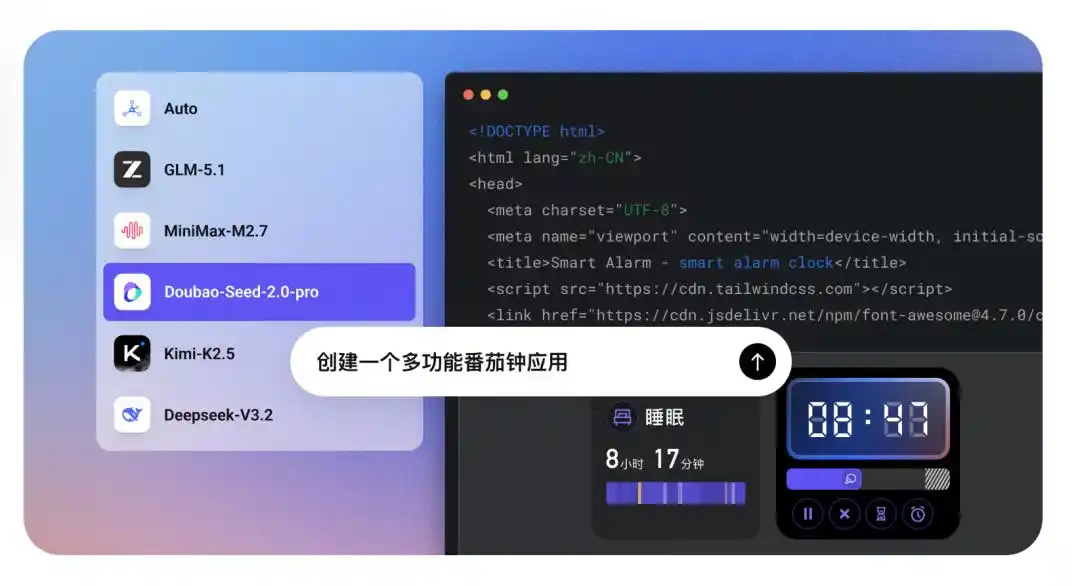
Ini berarti, pengembang hanya perlu satu biaya langganan untuk dapat memanggil beberapa model utama sekaligus. Dari umpan balik pasar, "mode paket" ini sangat mengurangi biaya percobaan dan kesalahan bagi pengembang. Saat ini, harga paket Lite adalah sekitar 40 yuan per bulan, dan harga paket Pro adalah 200 yuan per bulan, membuat banyak pengembang bersedia "membeli dulu untuk mengamankan tempat".

GLM-5.1 dari Zhipu AI sendiri, dalam pembaruan awal April 2026, telah menunjukkan kemampuan rekayasa yang mengesankan. Dalam dua video resmi yang dirilis oleh Zhipu, "Membangun Desktop Linux dari Nol dalam 8 Jam" dan "655 iterasi, meningkatkan throughput kueri database vektor menjadi 6,9 kali lipat dari versi resmi awal", telah memperbarui imajinasi publik tentang "eksekusi efektif 8 jam" dari model besar.

Wartawan Menyelidiki Komunitas Pengembang, Mayoritas Pengguna Menyatakan "Tidak Tahan Lama"

Wartawan memasuki grup komunikasi pengembang Ark Coding dan menemukan bahwa selain postingan yang berbagi pengalaman, banyak pengguna yang memberikan umpan balik tentang kenyataan yang tidak sesuai. Dengan melihat beberapa halaman komunitas komunikasi, sangat banyak postingan yang mengeluh dan meminta pengembalian dana, dengan banyak netizen berteriak "merasa ditipu".
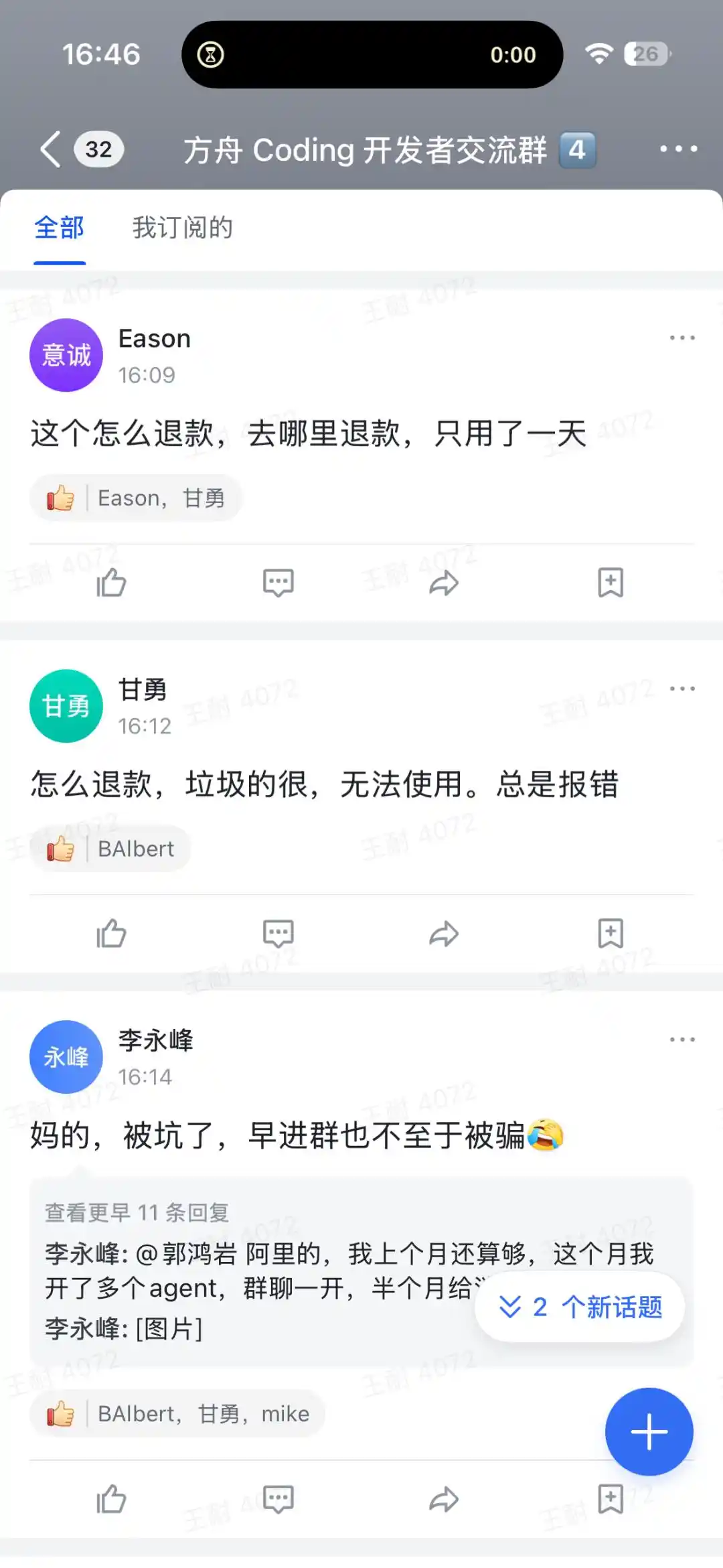
Kontroversi utamanya ada dua:

Pertama adalah tentang penggunaan batas yang terlalu cepat. Seorang pengguna bernama "Hakimi" memposting bahwa "hanya beberapa putaran percakapan untuk satu tugas, batas 5 jam hampir habis". Ada juga pengguna lain yang mempublikasikan "alasan pemicu batas 5 jam" karena akunnya terus-menerus menggunakan window geser dalam 5 jam berturut-turut, dengan jumlah permintaan aktual melebihi 6004 kali, melebihi batas sistem.
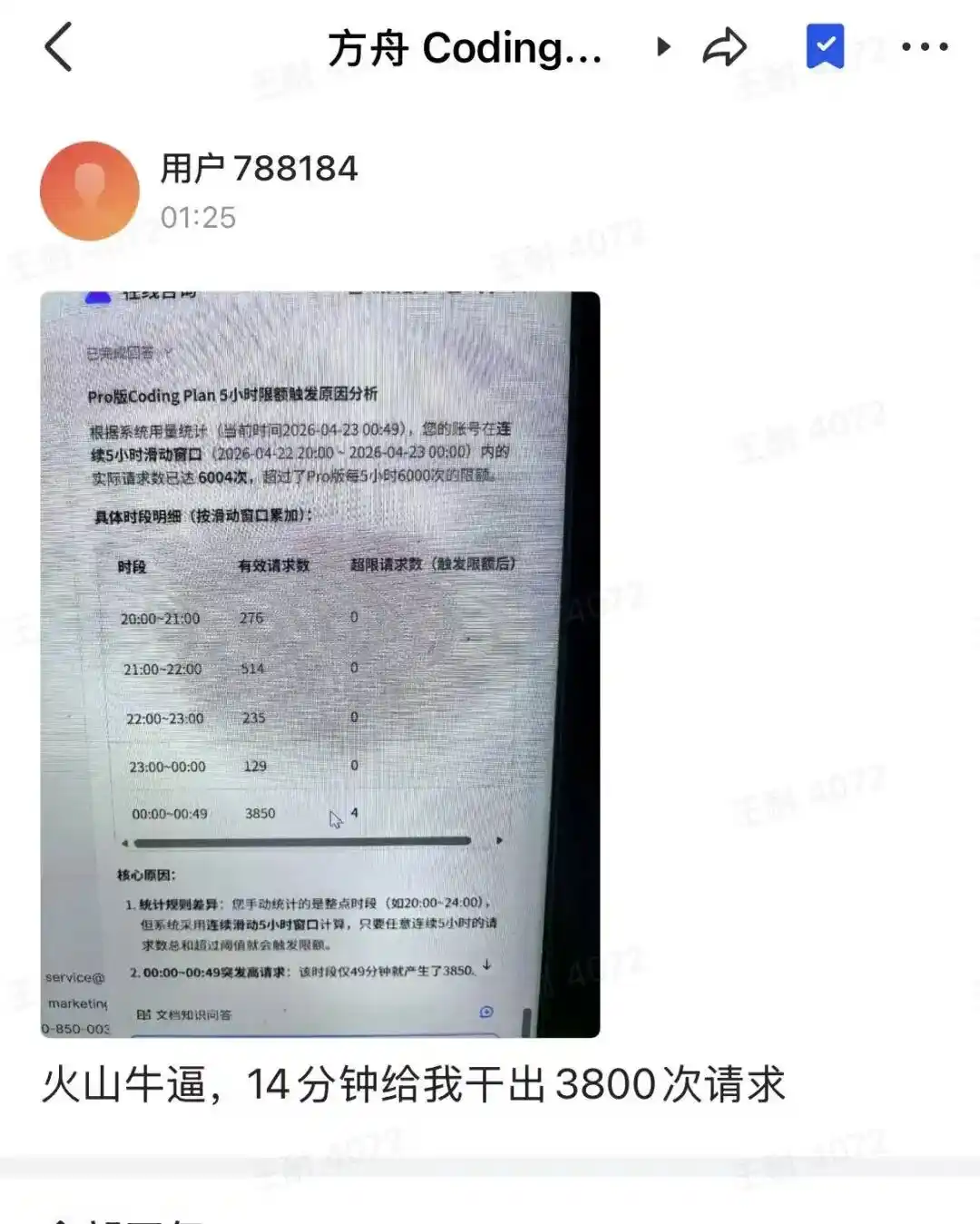
Kedua adalah penurunan pengalaman karena tekanan penjadwalan daya komputasi. Banyak pengguna melaporkan mengalami error 429 (terlalu banyak permintaan), serta "penundaan karakter pertama lebih dari 1 menit adalah hal biasa" pada jam sibuk. Seorang pengguna直言: "Pemicu batas 5 jam terlalu sering, tidak bisa digunakan untuk pengembangan yang serius."

Pada saat yang sama, di balik harga rendah Coding Plan 40 yuan per bulan, juga tersembunyi "arus bawah" tentang "satu permintaan panggilan" yang mengarah ke koefisien pengurangan yang berbeda dalam paket. Misalnya, seorang pengguna memposting gambar "perbedaan koefisien pengurangan panggilan model yang berbeda" di grup komunikasi pengembang. Misalnya, koefisien pengurangan untuk seri Doubao dan seri Qwen adalah 1 kali, seri DeepSeek adalah 2 kali, sedangkan seri MiniMax-M2.7, Kimi-K2.6, dan GLM-5.1 adalah 5 kali.
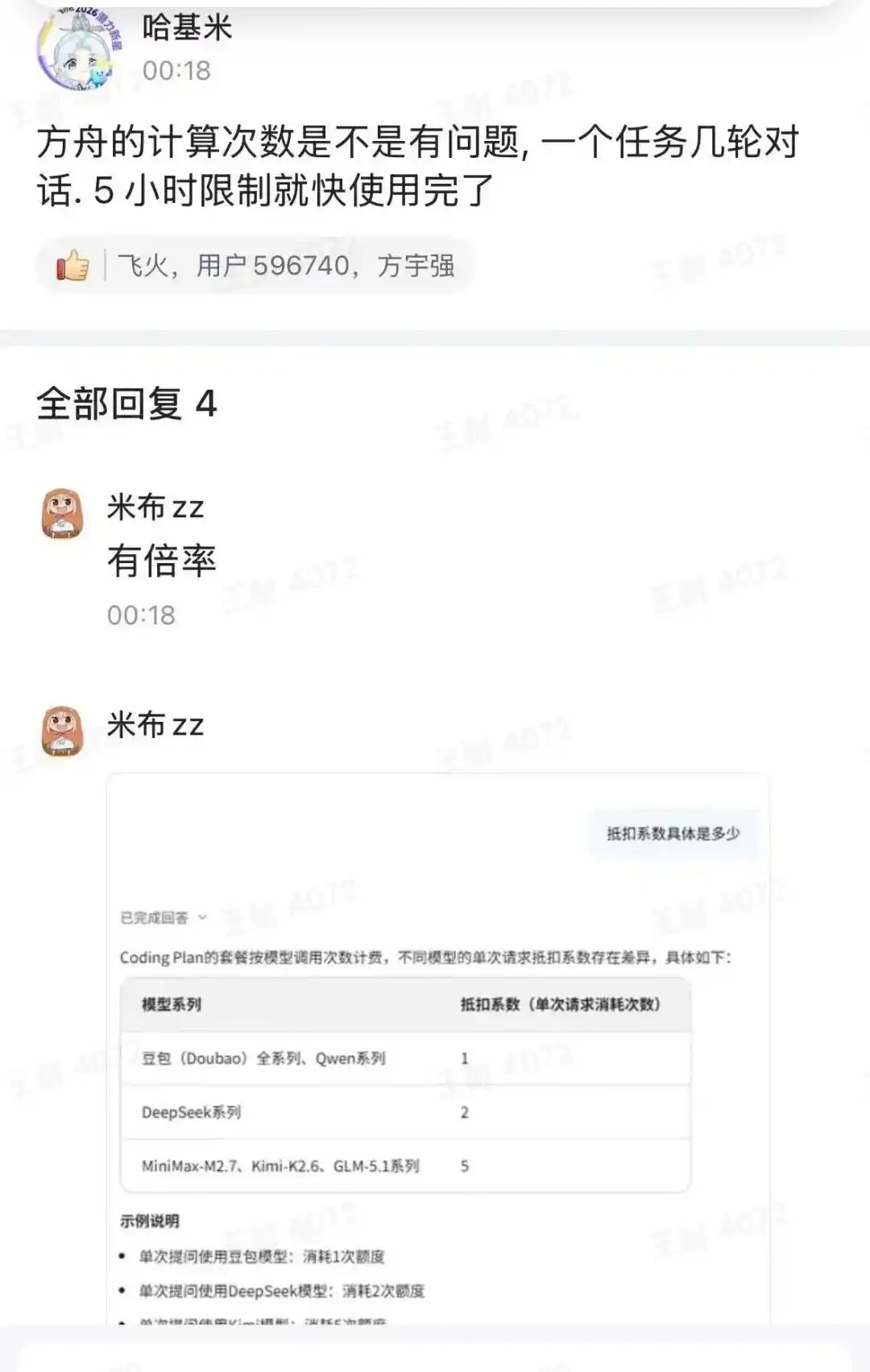
Ini juga mencerminkan bahwa membangun "supermarket model" tidak semudah yang dibayangkan. Pengembang tertarik oleh "nilai untuk uang", tetapi kekurangan yang terlihat di awal dalam hal penjadwalan daya komputasi juga membuat banyak pengembang memilih untuk mundur setelah mencoba. Ini juga mengungkapkan masa-masa sulit awal dari "mode paket". Dengan membanjirnya pengguna, kapasitas dukungan platform komputasi menghadapi tantangan. Bagaimana menemukan titik keseimbangan yang berkelanjutan antara daya tarik harga rendah dan kualitas layanan akan menjadi proposisi jangka panjang yang perlu dipecahkan oleh Volcano Engine dan para pengikutnya.

Vendor Cloud Beralih Kolektif ke "Supermarket Model", Stratifikasi Mulai Terlihat

Pembaruan "integratif" dari Volcano Engine Coding Plan ini juga bukan peristiwa yang terisolasi.

Sejak awal 2026, vendor cloud utama seperti Alibaba Cloud, Baidu Intelligent Cloud, dan Tencent Cloud telah mempromosikan tata letak integrasi multi-model. Misalnya, Alibaba Cloud sebagai pelopor industri, lebih awal meluncurkan paket langganan multi-model "Bailian Coding Plan". Saat ini mendukung seri Qwen serta model seperti kimi-k2.5, glm-5, MiniMax-M2.5. Saat ini harga Pro adalah 200 yuan per bulan, paket Lite telah berhenti dijual baru sejak 20 Maret, dan akan berhenti memperpanjang dan meningkatkan mulai 13 April.
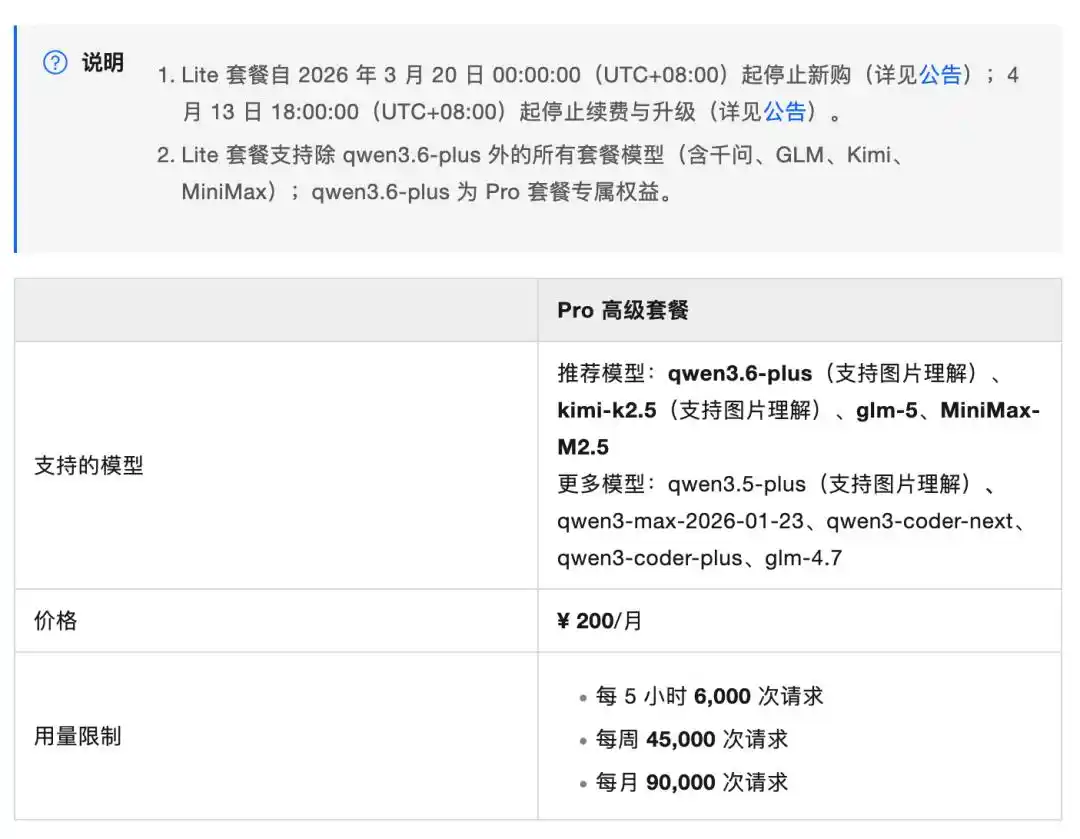
Layanan langganan Tencent Cloud Big Model Coding Plan diperbarui secara keseluruhan pada Maret 2026, mendukung berbagai model terbaru seperti Tencent HY 2.0 Instruct, GLM-5, Kimi-K2.5, MiniMax-M2.5. Baidu Qianfan secara resmi meluncurkan layanan langganan pengkodean AI Coding Plan pada Februari 2026, juga merupakan salah satu vendor cloud yang lebih awal meluncurkan layanan semacam ini di dalam negeri.

Mode "supermarket model" bukanlah pilihan satu perusahaan, tetapi sedang menjadi jalur yang diperebutkan oleh vendor cloud. Namun, menyobek kulit luar strategi agregasi vendor cloud, siapa yang dapat menyediakan layanan yang lebih stabil, aturan kuota yang lebih transparan, mekanisme toleransi kesalahan yang lebih fleksibel, siapa yang dapat memperluas lebih banyak kemampuan layanan tingkat perusahaan di luar pemrograman, dan apakah tingkat perpanjangan dapat mengikuti, semuanya menjadi inti persaingan baru.

Secara internasional, platform layanan agregasi model Amazon Bedrock dan Microsoft Azure, meskipun berbeda skenario dengan mode langganan Coding domestik, termasuk dalam tren integrasi yang sama.

Secara keseluruhan, persaingan industri juga beralih dari "perbandingan kemampuan model tunggal" ke "kemampuan integrasi platform + kemampuan layanan ekosistem", dan konsentrasi industri akan meningkat dengan cepat.

Kepala Analis Konfigurasi Aset Guoxin Securities, Wang Kai, mengatakan kepada reporter bahwa meskipun diferensiasi industri sedang berakselerasi, penilaian periode integrasi mungkin agak prematur. "Lebih tepatnya, ini adalah penyempurnaan dan iterasi dari divisi kerja rantai industri. Perusahaan model fokus pada algoritma, vendor cloud fokus pada pengiriman rekayasa, masing-masing memanfaatkan keunggulan utama mereka." Dia percaya, terlepas dari apakah vendor cloud lain mengikuti, pola persaingan akan berevolusi dari bertarung sendiri ke diferensiasi niche ekologis.

Tekanan "Pipelinisasi" Perusahaan Model Besar Semakin Meningkat?

Yang dimaksud dengan "pipelinisasi" bukan berarti perusahaan model menghilang, tetapi kehilangan harga premium produk, hak koneksi pengguna, dan hak suara, dengan keuntungan berpindah ke pihak platform komputasi, menjadi peran "yang didominasi".

Di bawah gelombang agregasi vendor cloud, "pipelinisasi" juga sedang menjadi pedang Damocles yang menggantung di atas kepala perusahaan model besar independen. Dalam permainan tanpa suara ini, pemain utama seperti Zhipu AI, Moonlight (Kimi), MiniMax, dll., tidak memilih untuk berkompromi secara pasif, tetapi tumbuh dari gen mereka masing-masing, memberikan jalur terobosan yang berbeda.

CEO Zhipu AI Zhang Peng dalam dialog terbuka pada 8 April, dengan jelas menyatakan bahwa tujuan akhir Zhipu bukanlah menjadi "alat panggilan yang dapat diganti sembarangan", tetapi membangun agen otonom penuh (Autonomous Agent). Posisi ini mencoba untuk meningkatkan Zhipu dari "pemasok model" menjadi "pelaksana tugas", sehingga melewati perangkap harga rendah pipa API murni.

Moonlight (Kimi) mengadopsi strategi "tata letak terdesentralisasi + mendalami teks panjang". Secara bersamaan terhubung ke beberapa platform cloud utama seperti Volcano Engine, Alibaba Cloud, dll., mencapai pasokan daya komputasi multi-sumber, tidak terikat oleh saluran tunggal, menjamin stabilitas layanan dan pengendalian biaya. Kimi K2.6 yang diluncurkan pada April 2026 mengadopsi arsitektur Mixed Expert (MoE), dengan window konteks standar mencapai 256K token.

MiniMax memusatkan sumber daya inti pada bidang vertikal seperti penciptaan konten, layanan pelanggan cerdas, pendidikan, layanan perusahaan, hiburan sosial, terutama fokus pada skenario seperti AI game, digital human, interaksi multimodal, menciptakan "kemampuan kustomisasi yang sulit digantikan oleh platform cloud".

Akankah integrasi platform oleh raksasa teknologi mempercepat "pipelinisasi" perusahaan model? Kepala Analis Konfigurasi Aset Guoxin Securities, Wang Kai, percaya bahwa perlu membedakan perspektif jangka panjang dan pendek.

"Dalam jangka pendek, saluran distribusi dikuasai oleh platform, hak penentuan harga sebagian diserahkan, transfer keuntungan perusahaan model ke pihak pintu masuk adalah hukum bisnis. Tetapi dalam jangka panjang, model umum mudah menjadi homogen, model pembelajaran mendalam untuk skenario vertikal seperti keuangan, perawatan kesehatan, hukum, hambatan profesional bukanlah sesuatu yang dapat dihapus hanya dengan agregasi terpusat." Katanya.

Dalam menanggapi risiko platformisasi, juga dapat merujuk pada strategi OpenAI dan Anthropic, di satu sisi memperkuat saluran yang langsung menghadapi pengguna akhir, seperti operasi independen ChatGPT dan Claude pada dasarnya adalah membangun koneksi pengguna yang melewati platform. Di sisi lain, kecepatan iterasi teknologi dan kesadaran merek pengguna adalah dua parit efektif, sehingga perusahaan model perlu mempertimbangkan investasi penelitian dan pengembangan serta tata letak produk.

Akhir dari permainan "pipelinisasi dan platformisasi" ini mungkin bukan tentang siapa yang memakan siapa, tetapi kejelasan divisi kerja lebih lanjut. Vendor cloud menjadi pipa, perusahaan model melakukan teknologi, kedua belah pihak secara bertahap menemukan batas survival mereka masing-masing dalam permainan.

Siapa yang memakan siapa, pada tahap ini, masih jauh dari akhir cerita.

Artikel ini dari akun resmi WeChat "Science and Technology Innovation Board Daily", penulis: Wang Nai

Trending Cryptos

Related Questions

QApa yang ditawarkan oleh ByteDance Volcano Engine Ark Coding Plan dengan peluncuran GLM-5.1?

AByteDance Volcano Engine Ark Coding Plan menawarkan akses ke model GLM-5.1 dengan kemampuan yang setara dengan versi asli, tanpa batasan pembelian. Layanan ini juga mengintegrasikan model AI terbaru lainnya seperti Minimax M2.7, Kimi k2.6, dan DeepSeek-V3.2, memungkinkan pengembang menggunakannya dengan satu langganan.

QApa keluhan utama pengguna terhadap layanan Coding Plan berdasarkan artikel?

APengguna melaporkan dua keluhan utama: batas penggunaan 5 jam yang terlalu cepat habis (beberapa tugas menghabiskan kuota dalam beberapa putaran percakapan) dan penurunan pengalaman akibat tekanan pada penjadwalan komputasi, seperti error 429 (terlalu banyak permintaan) dan penundaan respons hingga lebih dari 1 menit selama jam sibuk.

QBagaimana perusahaan cloud besar seperti Alibaba dan Tencent merespons tren 'model supermarket'?

APerusahaan cloud besar seperti Alibaba Cloud, Tencent Cloud, dan Baidu Intelligent Cloud juga mengadopsi model integrasi multi-model. Misalnya, Alibaba meluncurkan 'Bailian Coding Plan', Tencent menghadirkan layanan langganan model AI, dan Baidu meluncurkan 'Qianfan AI Coding Plan', semua menawarkan akses ke berbagai model AI dalam satu paket.

QApa strategi yang digunakan perusahaan model AI independen seperti Zhipu AI untuk menghindari 'pipa-isasi'?

AZhipu AI berfokus pada pengembangan agen otonom penuh (Autonomous Agent) untuk menjadi pelaksana tugas, bukan sekadar penyedia model. Moonlight (Kimi) menggunakan strategi distribusi multi-platform dan pendalaman teks panjang, sementara MiniMax mengkhususkan diri pada layanan tersier seperti konten kreatif dan interaksi multimodal.

QApa pandangan analis tentang dampak jangka panjang integrasi platform cloud pada perusahaan model AI?

AAnalis percaya bahwa dalam jangka pendek, integrasi platform dapat mengurangi margin keuntungan perusahaan model AI karena kehilangan kendali atas distribusi dan penetapan harga. Namun, dalam jangka panjang, model khusus untuk sektor vertikal (seperti keuangan atau kesehatan) akan tetap memiliki nilai karena keahlian mendalam yang tidak mudah digantikan oleh platform umum.

Related Reads

A 60-Day Window Depresses Oil Prices, So Why Is the Market Falling Instead?

International oil prices continued to decline on June 23, extending significant losses from the previous session. The market shifted focus from Middle East military risks to actual supply changes following a temporary U.S.-Iran arrangement. The immediate trigger was the resumption of traffic through the Strait of Hormuz, a critical oil shipping chokepoint, with two tankers passing through, signaling eased near-term supply disruption fears. Prices retreated as the "worst-case scenario" was temporarily averted. A reported 60-day window in a U.S.-Iran understanding allows Iran to sell oil during this period, further dampening supply concerns. However, this arrangement is temporary, linked to nuclear talks, and does not guarantee a long-term solution. Market sentiment remains cautious because the deal could still unravel, potentially reinstating sanctions or disrupting shipping. While these developments have lowered immediate risk premiums, prices have not fully returned to pre-conflict levels. Geopolitical news, particularly regarding the stability of the Strait of Hormuz or the progress of negotiations, could quickly reverse the price drop. Additionally, low U.S. strategic petroleum reserves limit the emergency buffer available if supply shocks reemerge. Therefore, the current price decline reflects a reduction in near-term panic, not a complete elimination of Middle East supply risks.

marsbit3m ago

A 60-Day Window Depresses Oil Prices, So Why Is the Market Falling Instead?

marsbit3m ago

SK Hynix Market Cap Exceeds Samsung for First Time in 26 Years, Korean Broker Calls for 50% More Upside

SK Hynix's market capitalization surpassed Samsung Electronics for the first time in 26 years on June 22, reaching 208.1 trillion won. The shift reflects a market trend where companies directly benefiting from AI infrastructure, like SK Hynix, are receiving higher valuation premiums than diversified giants. The surge is driven by AI-driven demand for High Bandwidth Memory (HBM), where SK Hynix holds a dominant 70-80% market share. Its Q1 2026 revenue exceeded 50 trillion won for the first time, with an operating profit margin of 72%. Hanwha Investment & Securities significantly raised its price target for SK Hynix to 430,000 won, the highest among Korean brokerages. The key rationale is that Long-Term Supply Agreements (LTAs) and robust HBM demand have fundamentally reduced the company's historical profit volatility. Several other brokers have also raised targets, arguing the valuation framework for memory semiconductors is being rewritten, moving away from a cyclical model. Despite the bullish outlook, the stock experienced a pullback of over 5% in regular trading on June 23 after briefly surpassing 3 million won pre-market, amid broader tech sector weakness. Some analysts caution that the市值 overtaking Samsung, whose profit scale and growth forecasts remain higher, could signal short-term overheating. However, high-return investors viewed the dip as a buying opportunity.

marsbit21m ago

SK Hynix Market Cap Exceeds Samsung for First Time in 26 Years, Korean Broker Calls for 50% More Upside

marsbit21m ago

GPU Rental Prices Drop 30% in Three Weeks: AI Value Chain Migrating from Nvidia to Memory Chips

GPU rental prices for Nvidia's flagship B200 chip have fallen by approximately 30% over three weeks, dropping from a high of $6.11/hour to $4.22/hour. This decline signals a potential easing of the "compute scarcity" narrative that has long supported AI hardware valuations. Concurrently, the semiconductor market is witnessing a significant divergence: while the VanEck Semiconductor ETF (SMH) has risen 15% in the past month, with memory giants Micron and SanDisk each surging nearly 60%, Nvidia's stock has declined about 3% over the same period. Analysts suggest this shift indicates that the AI value chain's bottleneck and profits are migrating from compute (GPUs) to memory. Demand for high-bandwidth memory (HBM) remains intensely strong, with contract prices soaring over 100% in H1 2026, granting memory manufacturers significant pricing power. In contrast, increased B200 supply from improved manufacturing yields and competitive pressure from new cloud providers are softening GPU rental rates. While long-term contracts, like SpaceX's $30 billion deal with Google, show sustained large-scale demand for Nvidia hardware, the softening spot prices pressure the margins of cloud providers and could eventually impact Nvidia's order flow if chip prices don't adjust. The key takeaway for investors is not a weakening AI thesis, but a recalibration within the sector: pricing power appears to be strengthening for memory chipmakers while showing signs of strain for leading GPU suppliers.

marsbit31m ago

GPU Rental Prices Drop 30% in Three Weeks: AI Value Chain Migrating from Nvidia to Memory Chips

marsbit31m ago

From Corning to Ciena: The 10X Stock Opportunities in the AI Optical Communication Chain

From Copper to Light: The AI-Driven Optical Communication Supply Chain and Investment Opportunities The exponential data demands of AI are pushing data centers beyond the physical limits of copper cables, forcing a critical transition to optical communication. This shift from electrical to photonic signals over distances greater than ~3 feet solves heat, power, and bandwidth constraints. The real investment opportunity lies not just in headline chipmakers, but across the entire essential photonics supply chain. **Key Investment Layers & Companies:** * **Glass & Fiber:** **Corning** is a dominant, irreplaceable supplier of advanced fiber to all major cloud/AI players (Meta, Amazon, Google, MSFT, OpenAI, NVIDIA), with multi-billion-dollar, multi-year contracts locked in years ahead of delivery. Its profit growth (93%) far outpaces revenue growth (36%), showing pricing power. * **Interconnects:** **Amphenol**, a consolidating giant in high-speed connectors (both copper and optical), shows robust growth (>80% in AI data centers) and expanding margins post-acquisition. **Credo Technology** bridges old and new worlds, extending copper's life in racks while moving into optics. It has hyper-growth but carries high customer concentration risk. * **Systems:** **Ciena** is a leader in coherent optics, enabling massive data capacity upgrades on existing fiber. It has a massive, growing order backlog ($~7B) and strong ties with cloud providers. * **Upstream & Enablers:** **AXT** produces mission-critical indium phosphide wafers for lasers, creating a supply bottleneck, but faces significant geopolitical/export license risk from its China-based manufacturing. **VEO Solutions** is the essential "picks and shovels" play, providing test equipment needed by every component in the optical chain, regardless of the eventual winner. A new pure-play photonics ETF (**FOTO**) offers a consolidated investment vehicle for this theme, though it is new and small. The core thesis is clear: the move from copper to light is inevitable and accelerating, with wealth creation spreading across this critical, multi-layered supply chain.

marsbit50m ago

From Corning to Ciena: The 10X Stock Opportunities in the AI Optical Communication Chain

marsbit50m ago

A Chip Company Releases AIDC Energy Storage Certification Standards. Why NVIDIA? Computing Power Reshapes Power Supply Logic. Who's in the Lead and Who's Left Out?

NVIDIA has released a "Battery Energy Storage System Self-Certification Guide," setting strict technical standards for energy storage systems specifically for AI data centers (AIDC). The guide focuses solely on certifying the Power Conversion System (PCS), not the batteries, with 10 mandatory performance metrics and 12 validation tests requiring real-world and simulation comparisons. Key requirements include rapid dynamic response to AI workloads, high-frequency system telemetry, and detailed electromagnetic transient models. The move is driven by the extreme and fluctuating power demands of next-generation AI hardware. Modern AIDCs require energy storage systems to act as intelligent, controllable grid assets, not just passive backup, to manage instantaneous, massive power load shifts that traditional UPS systems cannot handle. This redefines the competitive landscape for energy storage providers, shifting focus from capacity and cost to advanced control capabilities and system integration. While the market potential is significant—with forecasts of hundreds of GWh in new demand by 2030—the certification creates a high barrier to entry. It requires proven PCS delivery volumes and credible plans for rapid capacity scaling, favoring established, well-resourced players. Early movers like Fluence (partnering with Siemens) and several Chinese companies have secured projects ahead of the standard, but new entrants must now navigate this rigorous, costly, and time-intensive certification process to compete in the AIDC energy storage market.

marsbit1h ago

A Chip Company Releases AIDC Energy Storage Certification Standards. Why NVIDIA? Computing Power Reshapes Power Supply Logic. Who's in the Lead and Who's Left Out?

marsbit1h ago

Trading

Spot
Futures

Hot Articles

What is SONIC

Sonic: Pioneering the Future of Gaming in Web3 Introduction to Sonic In the ever-evolving landscape of Web3, the gaming industry stands out as one of the most dynamic and promising sectors. At the forefront of this revolution is Sonic, a project designed to amplify the gaming ecosystem on the Solana blockchain. Leveraging cutting-edge technology, Sonic aims to deliver an unparalleled gaming experience by efficiently processing millions of requests per second, ensuring that players enjoy seamless gameplay while maintaining low transaction costs. This article delves into the intricate details of Sonic, exploring its creators, funding sources, operational mechanics, and the timeline of significant events that have shaped its journey. What is Sonic? Sonic is an innovative layer-2 network that operates atop the Solana blockchain, specifically tailored to enhance the existing Solana gaming ecosystem. It accomplishes this through a customised, VM-agnostic game engine paired with a HyperGrid interpreter, facilitating sovereign game economies that roll up back to the Solana platform. The primary goals of Sonic include: Enhanced Gaming Experiences: Sonic is committed to offering lightning-fast on-chain gameplay, allowing players and developers to engage with games at previously unattainable speeds. Atomic Interoperability: This feature enables transactions to be executed within Sonic without the need to redeploy Solana programmes and accounts. This makes the process more efficient and directly benefits from Solana Layer1 services and liquidity. Seamless Deployment: Sonic allows developers to write for Ethereum Virtual Machine (EVM) based systems and execute them on Solana’s SVM infrastructure. This interoperability is crucial for attracting a broader range of dApps and decentralised applications to the platform. Support for Developers: By offering native composable gaming primitives and extensible data types - dining within the Entity-Component-System (ECS) framework - game creators can craft intricate business logic with ease. Overall, Sonic's unique approach not only caters to players but also provides an accessible and low-cost environment for developers to innovate and thrive. Creator of Sonic The information regarding the creator of Sonic is somewhat ambiguous. However, it is known that Sonic's SVM is owned by the company Mirror World. The absence of detailed information about the individuals behind Sonic reflects a common trend in several Web3 projects, where collective efforts and partnerships often overshadow individual contributions. Investors of Sonic Sonic has garnered considerable attention and support from various investors within the crypto and gaming sectors. Notably, the project raised an impressive $12 million during its Series A funding round. The round was led by BITKRAFT Ventures, with other notable investors including Galaxy, Okx Ventures, Interactive, Big Brain Holdings, and Mirana. This financial backing signifies the confidence that investment foundations have in Sonic’s potential to revolutionise the Web3 gaming landscape, further validating its innovative approaches and technologies. How Does Sonic Work? Sonic utilises the HyperGrid framework, a sophisticated parallel processing mechanism that enhances its scalability and customisability. Here are the core features that set Sonic apart: Lightning Speed at Low Costs: Sonic offers one of the fastest on-chain gaming experiences compared to other Layer-1 solutions, powered by the scalability of Solana’s virtual machine (SVM). Atomic Interoperability: Sonic enables transaction execution without redeployment of Solana programmes and accounts, effectively streamlining the interaction between users and the blockchain. EVM Compatibility: Developers can effortlessly migrate decentralised applications from EVM chains to the Solana environment using Sonic’s HyperGrid interpreter, increasing the accessibility and integration of various dApps. Ecosystem Support for Developers: By exposing native composable gaming primitives, Sonic facilitates a sandbox-like environment where developers can experiment and implement business logic, greatly enhancing the overall development experience. Monetisation Infrastructure: Sonic natively supports growth and monetisation efforts, providing frameworks for traffic generation, payments, and settlements, thereby ensuring that gaming projects are not only viable but also sustainable financially. Timeline of Sonic The evolution of Sonic has been marked by several key milestones. Below is a brief timeline highlighting critical events in the project's history: 2022: The Sonic cryptocurrency was officially launched, marking the beginning of its journey in the Web3 gaming arena. 2024: June: Sonic SVM successfully raised $12 million in a Series A funding round. This investment allowed Sonic to further develop its platform and expand its offerings. August: The launch of the Sonic Odyssey testnet provided users with the first opportunity to engage with the platform, offering interactive activities such as collecting rings—a nod to gaming nostalgia. October: SonicX, an innovative crypto game integrated with Solana, made its debut on TikTok, capturing the attention of over 120,000 users within a short span. This integration illustrated Sonic’s commitment to reaching a broader, global audience and showcased the potential of blockchain gaming. Key Points Sonic SVM is a revolutionary layer-2 network on Solana explicitly designed to enhance the GameFi landscape, demonstrating great potential for future development. HyperGrid Framework empowers Sonic by introducing horizontal scaling capabilities, ensuring that the network can handle the demands of Web3 gaming. Integration with Social Platforms: The successful launch of SonicX on TikTok displays Sonic’s strategy to leverage social media platforms to engage users, exponentially increasing the exposure and reach of its projects. Investment Confidence: The substantial funding from BITKRAFT Ventures, among others, emphasizes the robust backing Sonic has, paving the way for its ambitious future. In conclusion, Sonic encapsulates the essence of Web3 gaming innovation, striking a balance between cutting-edge technology, developer-centric tools, and community engagement. As the project continues to evolve, it is poised to redefine the gaming landscape, making it a notable entity for gamers and developers alike. As Sonic moves forward, it will undoubtedly attract greater interest and participation, solidifying its place within the broader narrative of blockchain gaming.

1.7k Total ViewsPublished 2024.04.04Updated 2024.12.03

What is SONIC

What is $S$

Understanding SPERO: A Comprehensive Overview Introduction to SPERO As the landscape of innovation continues to evolve, the emergence of web3 technologies and cryptocurrency projects plays a pivotal role in shaping the digital future. One project that has garnered attention in this dynamic field is SPERO, denoted as SPERO,$$s$. This article aims to gather and present detailed information about SPERO, to help enthusiasts and investors understand its foundations, objectives, and innovations within the web3 and crypto domains. What is SPERO,$$s$? SPERO,$$s$ is a unique project within the crypto space that seeks to leverage the principles of decentralisation and blockchain technology to create an ecosystem that promotes engagement, utility, and financial inclusion. The project is tailored to facilitate peer-to-peer interactions in new ways, providing users with innovative financial solutions and services. At its core, SPERO,$$s$ aims to empower individuals by providing tools and platforms that enhance user experience in the cryptocurrency space. This includes enabling more flexible transaction methods, fostering community-driven initiatives, and creating pathways for financial opportunities through decentralised applications (dApps). The underlying vision of SPERO,$$s$ revolves around inclusiveness, aiming to bridge gaps within traditional finance while harnessing the benefits of blockchain technology. Who is the Creator of SPERO,$$s$? The identity of the creator of SPERO,$$s$ remains somewhat obscure, as there are limited publicly available resources providing detailed background information on its founder(s). This lack of transparency can stem from the project's commitment to decentralisation—an ethos that many web3 projects share, prioritising collective contributions over individual recognition. By centring discussions around the community and its collective goals, SPERO,$$s$ embodies the essence of empowerment without singling out specific individuals. As such, understanding the ethos and mission of SPERO remains more important than identifying a singular creator. Who are the Investors of SPERO,$$s$? SPERO,$$s$ is supported by a diverse array of investors ranging from venture capitalists to angel investors dedicated to fostering innovation in the crypto sector. The focus of these investors generally aligns with SPERO's mission—prioritising projects that promise societal technological advancement, financial inclusivity, and decentralised governance. These investor foundations are typically interested in projects that not only offer innovative products but also contribute positively to the blockchain community and its ecosystems. The backing from these investors reinforces SPERO,$$s$ as a noteworthy contender in the rapidly evolving domain of crypto projects. How Does SPERO,$$s$ Work? SPERO,$$s$ employs a multi-faceted framework that distinguishes it from conventional cryptocurrency projects. Here are some of the key features that underline its uniqueness and innovation: Decentralised Governance: SPERO,$$s$ integrates decentralised governance models, empowering users to participate actively in decision-making processes regarding the project’s future. This approach fosters a sense of ownership and accountability among community members. Token Utility: SPERO,$$s$ utilises its own cryptocurrency token, designed to serve various functions within the ecosystem. These tokens enable transactions, rewards, and the facilitation of services offered on the platform, enhancing overall engagement and utility. Layered Architecture: The technical architecture of SPERO,$$s$ supports modularity and scalability, allowing for seamless integration of additional features and applications as the project evolves. This adaptability is paramount for sustaining relevance in the ever-changing crypto landscape. Community Engagement: The project emphasises community-driven initiatives, employing mechanisms that incentivise collaboration and feedback. By nurturing a strong community, SPERO,$$s$ can better address user needs and adapt to market trends. Focus on Inclusion: By offering low transaction fees and user-friendly interfaces, SPERO,$$s$ aims to attract a diverse user base, including individuals who may not previously have engaged in the crypto space. This commitment to inclusion aligns with its overarching mission of empowerment through accessibility. Timeline of SPERO,$$s$ Understanding a project's history provides crucial insights into its development trajectory and milestones. Below is a suggested timeline mapping significant events in the evolution of SPERO,$$s$: Conceptualisation and Ideation Phase: The initial ideas forming the basis of SPERO,$$s$ were conceived, aligning closely with the principles of decentralisation and community focus within the blockchain industry. Launch of Project Whitepaper: Following the conceptual phase, a comprehensive whitepaper detailing the vision, goals, and technological infrastructure of SPERO,$$s$ was released to garner community interest and feedback. Community Building and Early Engagements: Active outreach efforts were made to build a community of early adopters and potential investors, facilitating discussions around the project’s goals and garnering support. Token Generation Event: SPERO,$$s$ conducted a token generation event (TGE) to distribute its native tokens to early supporters and establish initial liquidity within the ecosystem. Launch of Initial dApp: The first decentralised application (dApp) associated with SPERO,$$s$ went live, allowing users to engage with the platform's core functionalities. Ongoing Development and Partnerships: Continuous updates and enhancements to the project's offerings, including strategic partnerships with other players in the blockchain space, have shaped SPERO,$$s$ into a competitive and evolving player in the crypto market. Conclusion SPERO,$$s$ stands as a testament to the potential of web3 and cryptocurrency to revolutionise financial systems and empower individuals. With a commitment to decentralised governance, community engagement, and innovatively designed functionalities, it paves the way toward a more inclusive financial landscape. As with any investment in the rapidly evolving crypto space, potential investors and users are encouraged to research thoroughly and engage thoughtfully with the ongoing developments within SPERO,$$s$. The project showcases the innovative spirit of the crypto industry, inviting further exploration into its myriad possibilities. While the journey of SPERO,$$s$ is still unfolding, its foundational principles may indeed influence the future of how we interact with technology, finance, and each other in interconnected digital ecosystems.

63 Total ViewsPublished 2024.12.17Updated 2024.12.17

What is $S$

What is AGENT S

Agent S: The Future of Autonomous Interaction in Web3 Introduction In the ever-evolving landscape of Web3 and cryptocurrency, innovations are constantly redefining how individuals interact with digital platforms. One such pioneering project, Agent S, promises to revolutionise human-computer interaction through its open agentic framework. By paving the way for autonomous interactions, Agent S aims to simplify complex tasks, offering transformative applications in artificial intelligence (AI). This detailed exploration will delve into the project's intricacies, its unique features, and the implications for the cryptocurrency domain. What is Agent S? Agent S stands as a groundbreaking open agentic framework, specifically designed to tackle three fundamental challenges in the automation of computer tasks: Acquiring Domain-Specific Knowledge: The framework intelligently learns from various external knowledge sources and internal experiences. This dual approach empowers it to build a rich repository of domain-specific knowledge, enhancing its performance in task execution. Planning Over Long Task Horizons: Agent S employs experience-augmented hierarchical planning, a strategic approach that facilitates efficient breakdown and execution of intricate tasks. This feature significantly enhances its ability to manage multiple subtasks efficiently and effectively. Handling Dynamic, Non-Uniform Interfaces: The project introduces the Agent-Computer Interface (ACI), an innovative solution that enhances the interaction between agents and users. Utilizing Multimodal Large Language Models (MLLMs), Agent S can navigate and manipulate diverse graphical user interfaces seamlessly. Through these pioneering features, Agent S provides a robust framework that addresses the complexities involved in automating human interaction with machines, setting the stage for myriad applications in AI and beyond. Who is the Creator of Agent S? While the concept of Agent S is fundamentally innovative, specific information about its creator remains elusive. The creator is currently unknown, which highlights either the nascent stage of the project or the strategic choice to keep founding members under wraps. Regardless of anonymity, the focus remains on the framework's capabilities and potential. Who are the Investors of Agent S? As Agent S is relatively new in the cryptographic ecosystem, detailed information regarding its investors and financial backers is not explicitly documented. The lack of publicly available insights into the investment foundations or organisations supporting the project raises questions about its funding structure and development roadmap. Understanding the backing is crucial for gauging the project's sustainability and potential market impact. How Does Agent S Work? At the core of Agent S lies cutting-edge technology that enables it to function effectively in diverse settings. Its operational model is built around several key features: Human-like Computer Interaction: The framework offers advanced AI planning, striving to make interactions with computers more intuitive. By mimicking human behaviour in tasks execution, it promises to elevate user experiences. Narrative Memory: Employed to leverage high-level experiences, Agent S utilises narrative memory to keep track of task histories, thereby enhancing its decision-making processes. Episodic Memory: This feature provides users with step-by-step guidance, allowing the framework to offer contextual support as tasks unfold. Support for OpenACI: With the ability to run locally, Agent S allows users to maintain control over their interactions and workflows, aligning with the decentralised ethos of Web3. Easy Integration with External APIs: Its versatility and compatibility with various AI platforms ensure that Agent S can fit seamlessly into existing technological ecosystems, making it an appealing choice for developers and organisations. These functionalities collectively contribute to Agent S's unique position within the crypto space, as it automates complex, multi-step tasks with minimal human intervention. As the project evolves, its potential applications in Web3 could redefine how digital interactions unfold. Timeline of Agent S The development and milestones of Agent S can be encapsulated in a timeline that highlights its significant events: September 27, 2024: The concept of Agent S was launched in a comprehensive research paper titled “An Open Agentic Framework that Uses Computers Like a Human,” showcasing the groundwork for the project. October 10, 2024: The research paper was made publicly available on arXiv, offering an in-depth exploration of the framework and its performance evaluation based on the OSWorld benchmark. October 12, 2024: A video presentation was released, providing a visual insight into the capabilities and features of Agent S, further engaging potential users and investors. These markers in the timeline not only illustrate the progress of Agent S but also indicate its commitment to transparency and community engagement. Key Points About Agent S As the Agent S framework continues to evolve, several key attributes stand out, underscoring its innovative nature and potential: Innovative Framework: Designed to provide an intuitive use of computers akin to human interaction, Agent S brings a novel approach to task automation. Autonomous Interaction: The ability to interact autonomously with computers through GUI signifies a leap towards more intelligent and efficient computing solutions. Complex Task Automation: With its robust methodology, it can automate complex, multi-step tasks, making processes faster and less error-prone. Continuous Improvement: The learning mechanisms enable Agent S to improve from past experiences, continually enhancing its performance and efficacy. Versatility: Its adaptability across different operating environments like OSWorld and WindowsAgentArena ensures that it can serve a broad range of applications. As Agent S positions itself in the Web3 and crypto landscape, its potential to enhance interaction capabilities and automate processes signifies a significant advancement in AI technologies. Through its innovative framework, Agent S exemplifies the future of digital interactions, promising a more seamless and efficient experience for users across various industries. Conclusion Agent S represents a bold leap forward in the marriage of AI and Web3, with the capacity to redefine how we interact with technology. While still in its early stages, the possibilities for its application are vast and compelling. Through its comprehensive framework addressing critical challenges, Agent S aims to bring autonomous interactions to the forefront of the digital experience. As we move deeper into the realms of cryptocurrency and decentralisation, projects like Agent S will undoubtedly play a crucial role in shaping the future of technology and human-computer collaboration.

738 Total ViewsPublished 2025.01.14Updated 2025.01.14

What is AGENT S

Discussions

Welcome to the HTX Community. Here, you can stay informed about the latest platform developments and gain access to professional market insights. Users' opinions on the price of S (S) are presented below.

活动图片