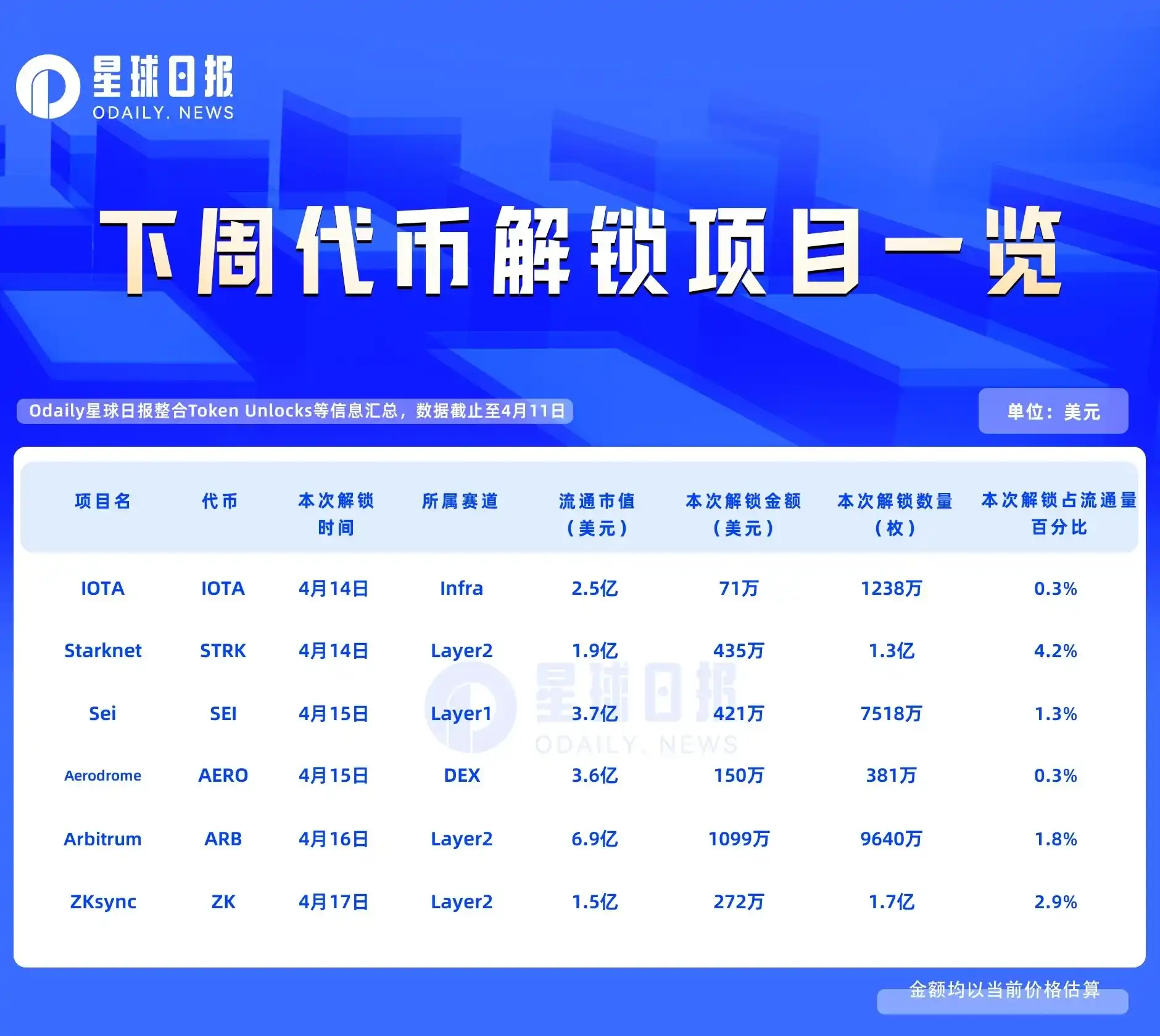
Déblocage hebdomadaire des jetons : STRK débloque 4,2 % de l'offre en circulation

marsbitPublished on 2026-04-11Last updated on 2026-04-11

Abstract

Cette semaine, deux projets majeurs de Layer 2 Ethereum procèdent à des déverrouillages importants de tokens. Starknet (STRK) débloque 130 millions de tokens, d'une valeur d'environ 4,35 millions de dollars, ce qui représente environ 4,2% de son offre en circulation. Starknet, développé par StarkWare, utilise la technologie zk-STARKs pour accélérer les transactions et réduire les frais sur Ethereum. Parallèlement, ZKsync déverrouille 170 millions de tokens, d'une valeur d'environ 2,72 millions de dollars. Développé par Matter Labs, zkSync est une solution d'échelle de Layer 2 qui utilise des preuves à connaissance nulle (ZK) pour garantir la sécurité tout en effectuant les calculs hors chaîne. Les deux projets ont publié leurs courbes de déverrouillage respectives, détaillant le calendrier de mise en circulation de ces tokens.

Starknet

Twitter du projet : https://twitter.com/Starknet

Site officiel du projet : https://starknet.io/

Quantité débloquée cette fois : 130 millions de jetons

Montant débloqué cette fois : environ 4,35 millions de dollars

Starknet est une solution de Layer 2 pour Ethereum, utilisant la technologie zk-STARKs pour rendre les transactions Ethereum plus rapides et moins coûteuses. La société mère de StarkNet, StarkWare, a été fondée en 2018 et est basée en Israël. Ses principaux produits développés sont Starknet et StarkEx. En utilisant STARK, Starknet vérifie les transactions et les calculs sans que tous les nœuds du réseau aient à vérifier chaque opération. Cela réduit considérablement la charge de calcul et augmente le débit du réseau blockchain.

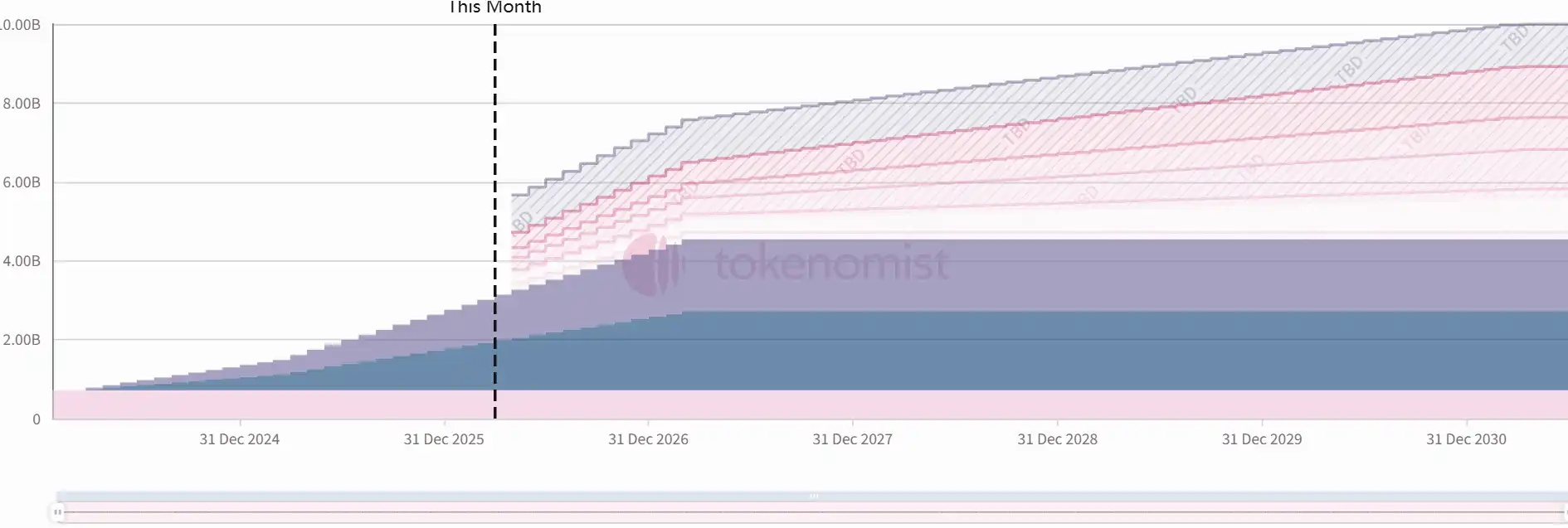
La courbe de libération spécifique est la suivante :
ZKsync

Twitter du projet : https://x.com/zksync

Site officiel du projet : https://zksync.io/

Quantité débloquée cette fois : 170 millions de jetons

Montant débloqué cette fois : environ 2,72 millions de dollars

zkSync est une solution d'extension de Layer 2 développée par Matter Labs, qui préserve les propriétés de sécurité de la blockchain sous-jacente en exploitant la dernière génération de preuves à connaissance nulle succinctes. Dans zkSync, tous les fonds sont détenus par des contrats intelligents sur la chaîne principale, tandis que le calcul et le stockage sont exécutés hors chaîne.

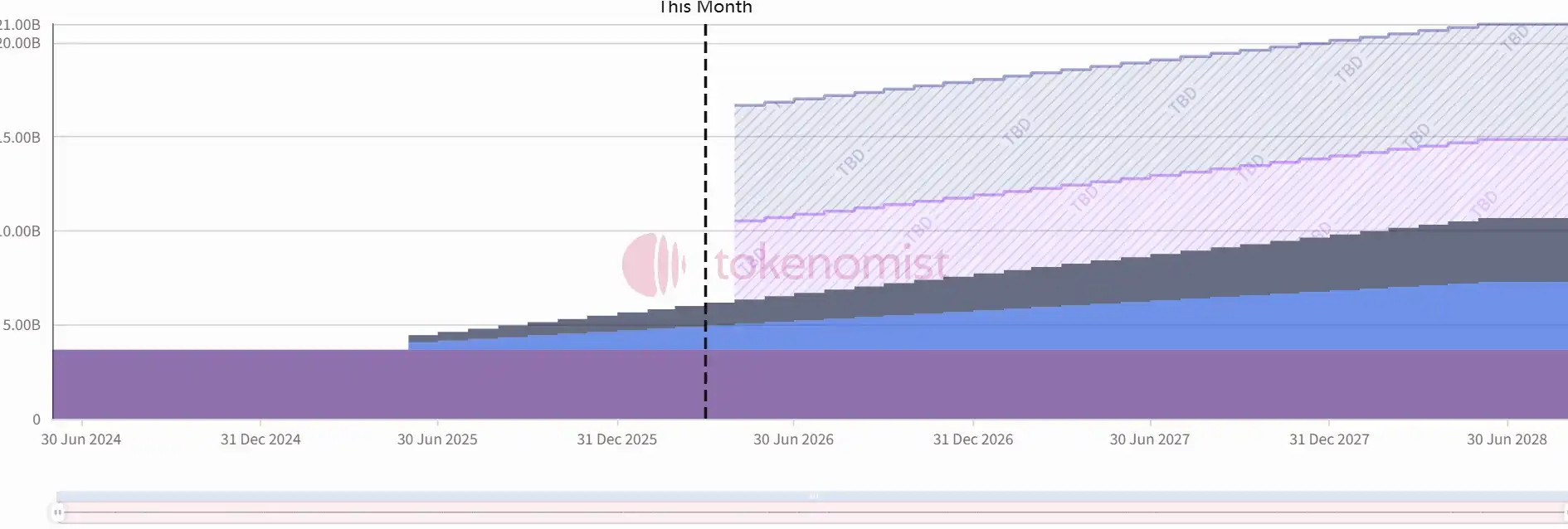
La courbe de libération spécifique est la suivante :
Related Questions

QQuel est la quantité de jetons STRK déverrouillés cette semaine et quel pourcentage cela représente-t-il par rapport à l'offre en circulation ?

A1,3 million de jetons STRK sont déverrouillés cette semaine, ce qui représente 4,2% de l'offre en circulation.

QQuelle est la valeur approximative en dollars du déverrouillage des jetons STRK ?

ALa valeur approximative du déverrouillage des jetons STRK est d'environ 4,35 millions de dollars.

QQuelle technologie Starknet utilise-t-il pour améliorer les transactions Ethereum ?

AStarknet utilise la technologie zk-STARKs pour rendre les transactions Ethereum plus rapides et moins chères.

QCombien de jetons ZKsync sont déverrouillés cette semaine et quelle est leur valeur estimée ?

A1,7 million de jetons ZKsync sont déverrouillés cette semaine, d'une valeur estimée à environ 2,72 millions de dollars.

QQuelle est la principale caractéristique de zkSync en tant que solution d'échelle de couche 2 ?

ALa principale caractéristique de zkSync est qu'il utilise des preuves à connaissance nulle (ZK) pour préserver les propriétés de sécurité de la blockchain tout en effectuant les calculs et le stockage hors chaîne.

Related Reads

Fed's Internal Doves Flock to Hawkish Stance, Warsh's Debut "Between a Rock and a Hard Place"

U.S. Federal Reserve officials who previously advocated for rate cuts, including Governor Christopher Waller, have recently shifted their stance, with many now not ruling out the possibility of future rate hikes. This sets a challenging stage for new Fed Chair Kevin Warsh's first policy meeting. Appointed by President Trump based on his dovish views, Warsh now faces a committee where the debate has pivoted from "when to cut" to "whether to hike," driven by persistent inflation above 3%, a strong labor market, and supply-side pressures from AI infrastructure demands and geopolitical tensions. Key figures illustrate the shift. Governor Waller, once concerned about employment, now says data has pushed him toward considering rate increases. Even moderate voices like Governor Lisa Cook, while expecting inflation to ease, have indicated readiness to hike if it fails to do so. Long-time hawks such as regional Fed presidents Beth Hammack, Lorie Logan, and Neel Kashkari have grown more vocal, arguing that the real policy rate is effectively falling and that action may soon be needed. The upcoming Fed meeting is expected to keep rates steady but will likely remove the "easing bias" from its statement, signaling a neutral stance between cuts and hikes. The quarterly "dot plot" is anticipated to show most officials projecting no cuts this year, with some potentially indicating hikes. Chair Warsh, a critic of the Fed's reliance on forward guidance like the dot plot, must navigate communicating this pivot using tools he has questioned, all while steering policy in a direction counter to the preferences of the president who appointed him. The consensus suggests the Fed's next move could well be a rate increase.

marsbit36m ago

Fed's Internal Doves Flock to Hawkish Stance, Warsh's Debut "Between a Rock and a Hard Place"

marsbit36m ago

The Trillion-Yuan Market Cap 'Yi Zhong Tian': Who is the True Value King?

The article analyzes the three leading Chinese optical module companies, collectively nicknamed "Yi Zhong Tian": Xinyisheng, Zhongji Innolight, and TFC Optical Communication. It evaluates their "cost-performance" not by current stock price, but through three lenses: PEG ratio (growth vs. valuation), earnings quality, and premium/discount for certainty. Xinyisheng shows the most attractive PEG ratio and high profitability, but its valuation reflects discounts for risks like high customer concentration and reliance on overseas markets. Zhongji Innolight, the most expensive, commands a premium for its market leadership, dominant share in key products like 800G/1.6T modules, and higher earnings certainty, though it faces geopolitical risks. TFC Optical, as an upstream component supplier ("water seller"), has the highest gross margin and bets on the long-term CPO/NPO architecture trend, but trades at a high valuation with more stable, less explosive growth. The core argument is that while these companies dominate module assembly, the true profit pool and technological moat lie upstream in laser and switch chips, currently controlled by U.S. firms like Lumentum and Coherent. The long-term "cost-performance" for these Chinese leaders hinges on whether the domestic industry, exemplified by companies like Yuanjie Technology, can successfully move up the value chain into high-power laser chips. Otherwise, their high growth may remain confined to the lower-margin assembly segment.

marsbit46m ago

The Trillion-Yuan Market Cap 'Yi Zhong Tian': Who is the True Value King?

marsbit46m ago

Has the Crypto Market Bottomed? Here's What Institutions Think

The crypto market is in a period of significant debate, with leading institutions offering differing views on whether a bottom has been reached. Three prominent firms have published detailed analyses: * **Galaxy Digital** argues Bitcoin has **not yet bottomed**. Their analysis of 13 historical indicators across six dimensions (valuation, profit-taking, miner pressure, etc.) shows only four are fully met. They project a potential bottom range between $30k and $54k. * **NYDIG** states a bottom is **possible but not likely**. While metrics are close to historic bear market extremes, they note the absence of a classic panic-selling event. They also suggest increased institutional adoption may have structurally altered the market cycle, potentially leading to a shallower downturn. * **Standard Chartered Bank** asserts the **bottom has already occurred** at around $59k. They cite two key factors: potential US-Iran diplomatic progress and the anticipated SpaceX IPO, which they believe absorbed capital and caused ETF selling pressure that is now subsiding. They forecast a year-end price target of $100k. Despite the surface-level disagreement, the reports share critical common ground more valuable for long-term investors: 1. All three believe the market bottom will form **within this year**. 2. All agree the current price is **closer to the bottom than to previous highs**. 3. All maintain a **bullish long-term outlook** for Bitcoin and a new cycle. The core takeaway is that while the exact bottom price ($40k, $50k, or $60k) is debated, the consensus is that a bottom is imminent. For long-term holders, the primary focus should not be pinpointing the absolute low, but on the future potential for prices to reach $100k, $200k, or higher. The fundamental thesis for Bitcoin—sovereign debt accumulation, inflation, declining trust in centralized institutions, global digitization, and improved accessibility—remains intact and is arguably strengthening. The overall landscape is viewed as more favorable than in previous crypto winters.

marsbit56m ago

Has the Crypto Market Bottomed? Here's What Institutions Think

marsbit56m ago

The 'Chip' Challenge and Breakthroughs in China's Optical Industry Chain

China's Photonics Industry: Bottlenecks and Breakthroughs In the global AI race, computing chips dominate the narrative, but the underlying bottleneck increasingly defining the scale of AI clusters is light—or more specifically, optical connectivity. Optical modules, which translate electrical signals to light and vice versa, are crucial for connecting thousands of GPUs in AI data centers, preventing data congestion and ensuring efficient model training. High-speed modules (800G, 1.6T) are now standard, with performance hinging on advanced DSP (Digital Signal Processor) chips. This is where a critical dependency lies. Two US giants—Marvell and Broadcom—collectively dominate over 90% of the high-end DSP chip market. Chinese optical module leaders like Zhongji Innolight and Eoptolink rely on these chips to manufacture modules for overseas AI customers, primarily in North America. While this creates a supply chain vulnerability, complete decoupling is difficult. Marvell derives over half its revenue from Greater China, and the US firms depend on Chinese partners for chip packaging and optical components. The risk from laser chips (e.g., from Lumentum), another key component, is considered more manageable due to multiple global suppliers and faster progress in domestic alternatives from companies like YOFC and Accelink. To mitigate risks, China's industry is pursuing a multi-pronged strategy: diversifying supply chains and locking in long-term orders; fostering a domestic market ecosystem to adopt homegrown DSPs from firms like Huawei HiSilicon and CETC; accelerating R&D in high-speed DSPs and advanced packaging; and investing in next-gen technologies like silicon photonics and Co-Packaged Optics (CPO) to reduce reliance on discrete DSPs. The ultimate solution lies not in short-term博弈 but in persistent advancement of domestic high-end chip R&D and manufacturing. While challenges remain in performance, certification, and ecosystem building, China's vast domestic market and manufacturing base provide a crucial buffer, buying time for the industry to achieve greater technological independence.

marsbit1h ago

The 'Chip' Challenge and Breakthroughs in China's Optical Industry Chain

marsbit1h ago

Trading

Spot
Futures

Hot Articles

How to Buy STRK

Welcome to HTX.com! We've made purchasing Starknet (STRK) simple and convenient. Follow our step-by-step guide to embark on your crypto journey.Step 1: Create Your HTX AccountUse your email or phone number to sign up for a free account on HTX. Experience a hassle-free registration journey and unlock all features.Get My AccountStep 2: Go to Buy Crypto and Choose Your Payment MethodCredit/Debit Card: Use your Visa or Mastercard to buy Starknet (STRK) instantly.Balance: Use funds from your HTX account balance to trade seamlessly.Third Parties: We've added popular payment methods such as Google Pay and Apple Pay to enhance convenience.P2P: Trade directly with other users on HTX.Over-the-Counter (OTC): We offer tailor-made services and competitive exchange rates for traders.Step 3: Store Your Starknet (STRK)After purchasing your Starknet (STRK), store it in your HTX account. Alternatively, you can send it elsewhere via blockchain transfer or use it to trade other cryptocurrencies.Step 4: Trade Starknet (STRK)Easily trade Starknet (STRK) on HTX's spot market. Simply access your account, select your trading pair, execute your trades, and monitor in real-time. We offer a user-friendly experience for both beginners and seasoned traders.

2.9k Total ViewsPublished 2024.03.29Updated 2026.06.02

How to Buy STRK

Discussions

Welcome to the HTX Community. Here, you can stay informed about the latest platform developments and gain access to professional market insights. Users' opinions on the price of STRK (STRK) are presented below.

活动图片













