Algorand: Why THIS signal points to another 10% ALGO drop

ambcryptoPublished on 2026-04-09Last updated on 2026-04-09

Abstract

Algorand (ALGO) has declined by 10% in the past day, with technical analysis suggesting further downside. The price was rejected at the upper Bollinger Band, indicating overvaluation, and is now expected to move toward the middle band, implying a potential additional 10% drop. The strengthening downtrend is supported by a rising Average Directional Index (ADX). Futures market activity reinforces the bearish outlook, with over $6.5 million exiting ALGO perpetual contracts and a sharp drop in the Open Interest Weighted Funding Rate, signaling increased short positioning. However, spot investors are accumulating ALGO, with nearly $496,000 in inflows in the past day and $1.98 million over the week, which may cushion further declines or prompt a reversal if sustained.

Algorand [ALGO] recorded a 10% drop over the past day, at press time, as the market adjusted. This move may mark the start of a broader decline, based on technical patterns observed on the chart.

Other factors, particularly activity in the perpetual futures market, are likely to play a major role in adding pressure and extending the current downside.

Bollinger Bands signal further downside

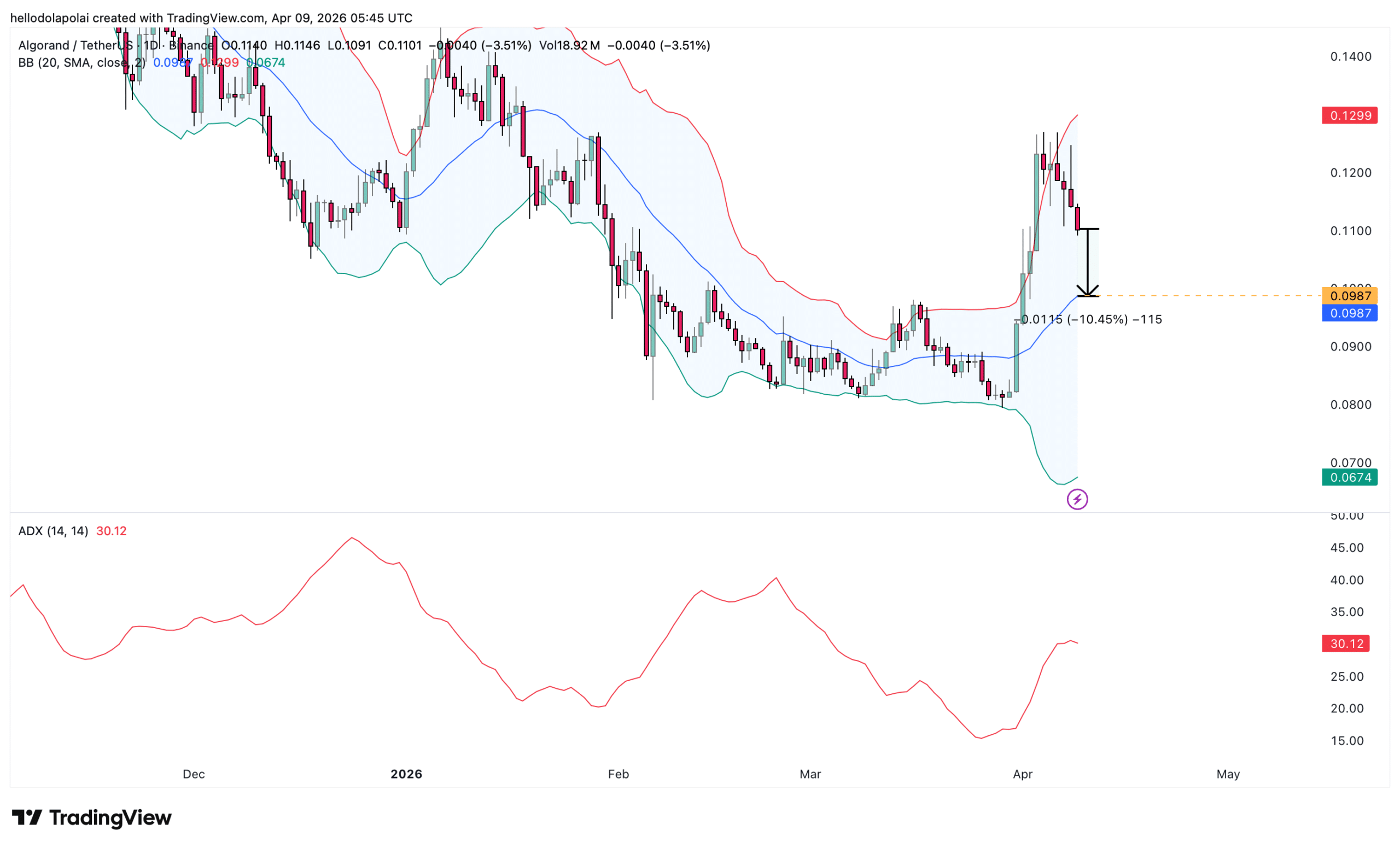
Bollinger Bands, an indicator used to assess whether an asset is overvalued or undervalued while identifying potential support and resistance levels, suggest that further downside may be imminent.

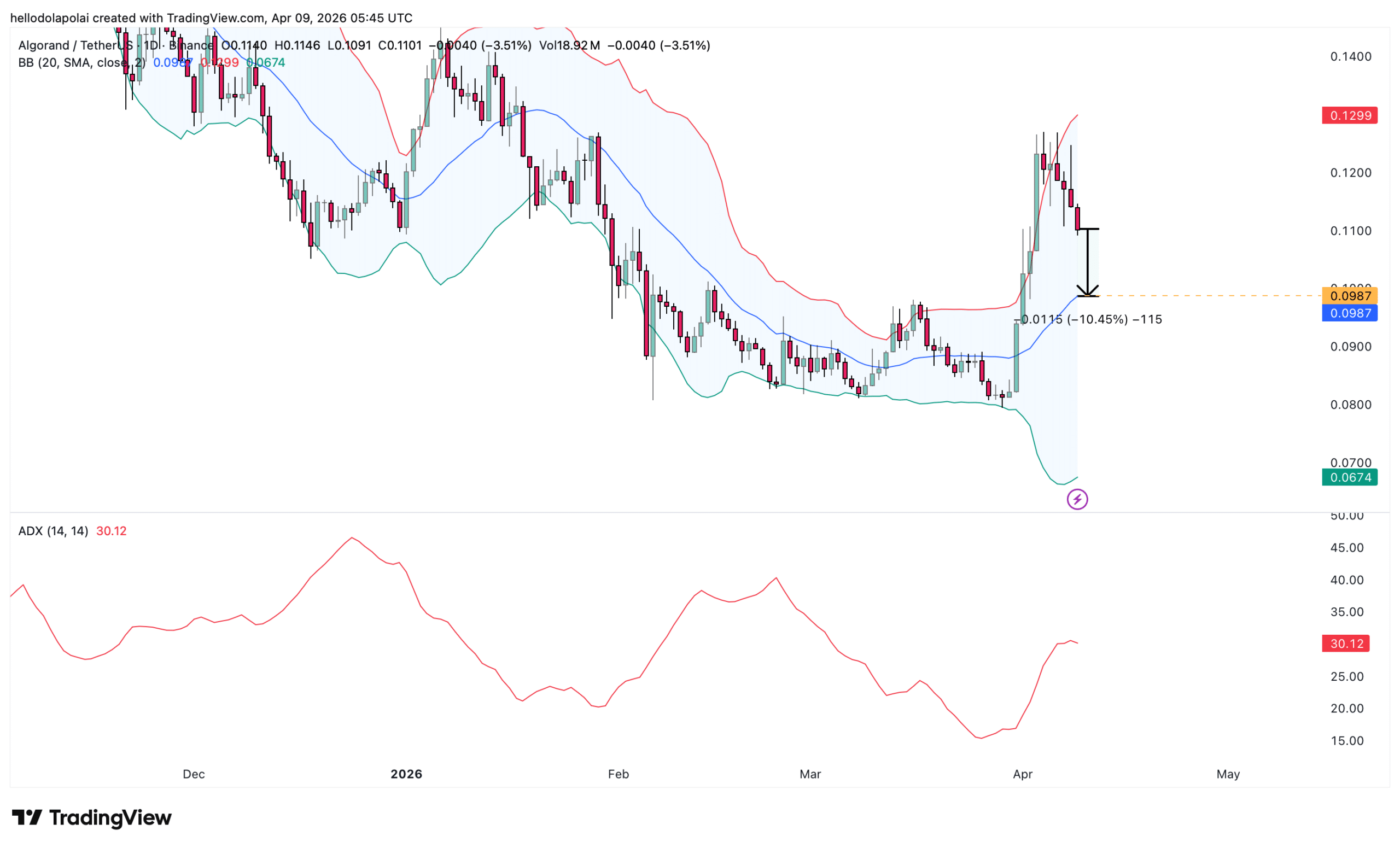
This outlook follows ALGO’s rejection at the upper band (red), which acted as resistance and signaled an overvaluation zone, pushing price lower. Such rejections typically drive price toward the middle band, or neutral zone, marked in blue, as seen on several occasions in the past.
Source: TradingView

Notably, price has yet to approach this middle region. The gap between the current price of $0.677 and the middle band implies a potential additional decline of roughly 10%. The likelihood of continued downside is further supported by the trend-based indicator, the Average Directional Index (ADX), which is trending upward as price moves lower.

ADX measures trend strength. When it rises while price declines, it indicates that the prevailing downtrend is strengthening and may persist.

Futures market adds pressure

Activity in the Futures market has not supported price stability and instead points to an acceleration of the decline.

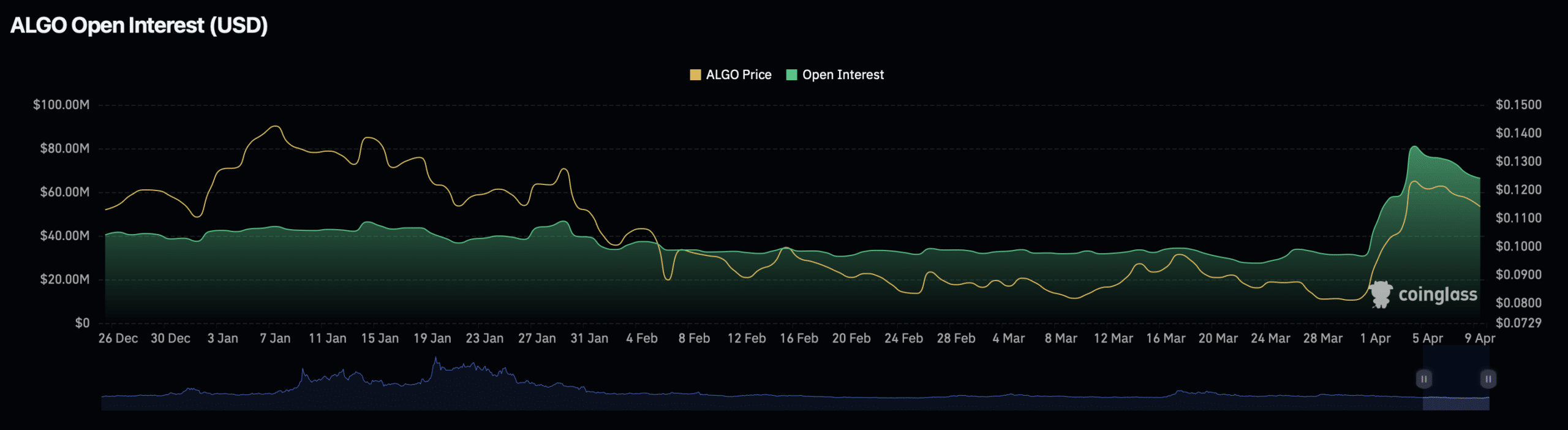
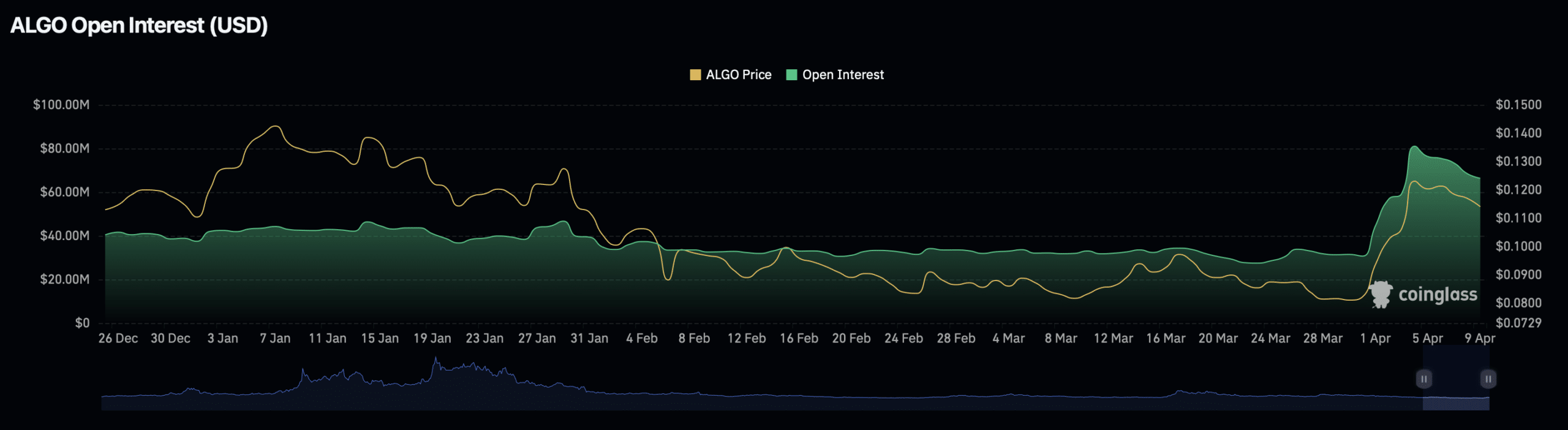
Over the past day, the market has seen a significant capital outflow, with more than $6.5 million exiting ALGO’s perpetual contracts as the broader cycle weakens.
Source: CoinGlass

This outflow aligns with a sharp shift in positioning. At press time, the Open Interest Weighted Funding Rate dropped from 0.0073% to 0.0027% over the past 24 hours, reflecting a decline in long positions. This trend suggests a rise in short positions on ALGO, a typical signal when traders anticipate further downside.

For context, between the 7th and 8th of April, ALGO maintained a bullish outlook. However, short sellers have been proven correct, and the price has fallen over the last 24 hours. Spot investors appear to be the key group mitigating further downside, even as short positions continue to build in the derivatives market.

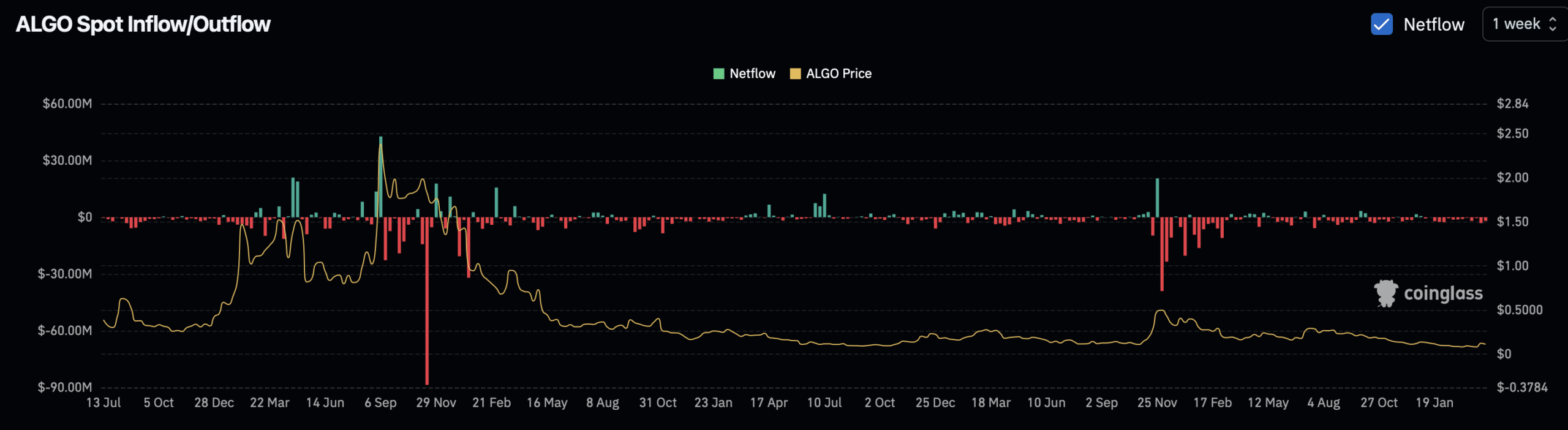
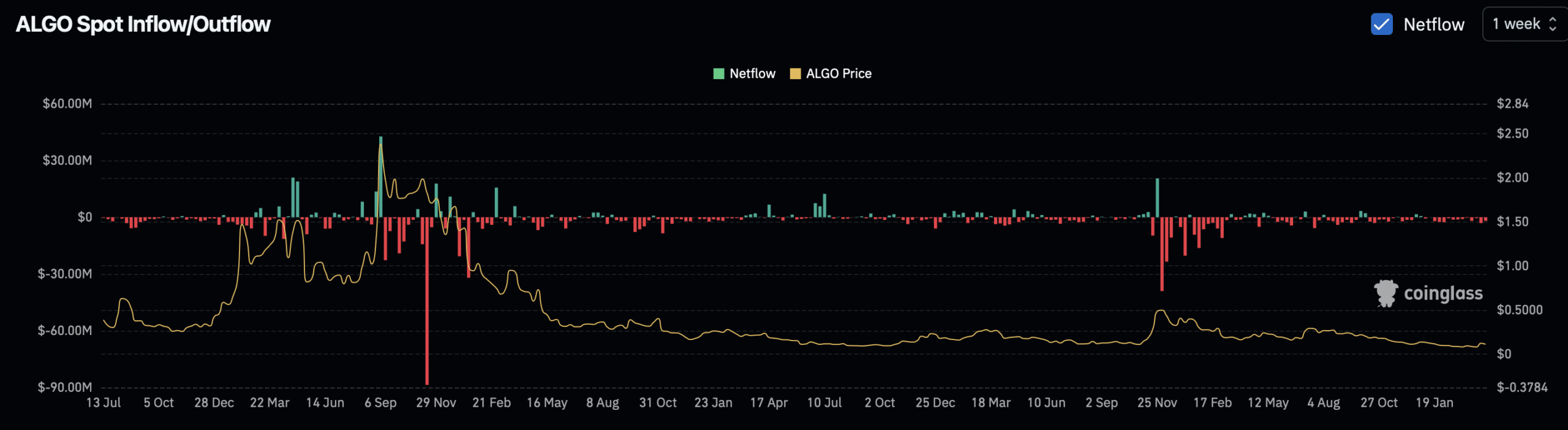
In the past day alone, the spot market recorded nearly $496,000 in inflows into ALGO despite the price decline, signaling accumulation at lower levels. This forms part of a broader trend. Over the past week, spot investors have consistently accumulated ALGO, with total purchases reaching $1.98 million.
Source: CoinGlass

This places the average daily net inflow as of writing, at approximately $396,000.

Sustained accumulation in the spot market could help cushion ALGO’s downside. If buying pressure remains strong, it may limit losses or even trigger a reversal before the projected decline fully plays out.


Final Summary

  • ALGO may witness an additional 10% decline as indicators point to a move toward fair value.
  • Perpetual traders may intensify the ongoing sell-off, while spot investors appear to view the dip as a discount and continue accumulating ALGO.


Trending Cryptos

Related Questions

QWhat technical indicator suggests that Algorand (ALGO) may experience a further 10% decline in price?

AThe Bollinger Bands indicator suggests a further downside. The price was rejected at the upper band, signaling an overvaluation, and the gap between the current price and the middle band implies a potential additional decline of roughly 10%.

QHow did the activity in the perpetual futures market contribute to the downward pressure on ALGO's price?

AActivity in the perpetual futures market added downward pressure with a significant capital outflow of over $6.5 million from ALGO's contracts. The Open Interest Weighted Funding Rate also dropped, reflecting a decline in long positions and a rise in short positions as traders anticipated further downside.

QWhat does a rising Average Directional Index (ADX) indicate when the price is declining?

AA rising Average Directional Index (ADX) while the price is declining indicates that the prevailing downtrend is strengthening and is likely to persist.

QDespite the price decline, what activity did spot investors engage in regarding ALGO?

ADespite the price decline, spot investors were accumulating ALGO. In the past day alone, the spot market recorded nearly $496,000 in inflows, and over the past week, total purchases reached $1.98 million.

QWhat could potentially limit the losses or trigger a reversal in ALGO's price according to the article?

ASustained accumulation and strong buying pressure from spot investors in the market could help cushion ALGO's downside, potentially limiting losses or even triggering a reversal before the full projected decline plays out.

Related Reads

Upbit is Anxious: A Hasty Counterattack Aimed at Regaining Stablecoin Market Share

Title: Upbit's Rushed Counterattack to Reclaim Stablecoin Market Share Facing a dramatic shift in South Korea's stablecoin market, leading exchange Upbit launched a promotional campaign from July 26 to August 9, waiving the 0.05% trading fee for stablecoins paired with the Korean Won (KRW) and rapidly listing new stablecoins like RLUSD and USDG. This move is a direct response to its plummeting market share in this sector. Historically a duopoly with Bithumb, the market has been reshaped since October 2025 when Coinone permanently removed fees for USDC trading. By June 2026, Coinone led with 34.8% of stablecoin volume, followed by Bithumb (31.1%) and Upbit (30.1%). This contrasts sharply with the overall crypto market, where Upbit commands 60%. The data shows stablecoin demand is highly sensitive to fees, as users primarily buy them to transfer capital overseas for derivatives trading or forex arbitrage. South Korean exchanges have seen a net outflow of stablecoins for 18 consecutive months, totaling approximately 14.9 trillion KRW, underscoring their role as a cross-border capital conduit. Upbit's limited-time promotion initially boosted its daily stablecoin volume by 162%, but the surge was almost entirely in USDT (98.1% of volume). The newly listed stablecoins saw negligible, fleeting interest. Furthermore, the promotional effect quickly waned in the second week, with volume dropping 33% on weekdays. A concurrent weakening of the KRW also contributed to the trading spike, independent of the fee waiver. The analysis suggests that once the promotion ends, Upbit is unlikely to retain its temporary gains unless it matches Coinone's permanent zero-fee policy, forcing a choice between market share and fee revenue. Upbit's strategic push may be less about immediate profit and more about preparing for future regulatory shifts. With South Korea's *Digital Asset Basic Act* on the horizon, which will regulate KRW-backed stablecoins, and following Dunamu's (Upbit's parent) integration into Naver Financial to build a payment ecosystem, securing a dominant position in the dollar stablecoin distribution channel holds long-term strategic value. However, potential regulatory conflicts could prevent Upbit from listing a future Naver-issued KRW stablecoin, making the current fight for dollar stablecoin flow even more critical.

marsbit6h ago

Upbit is Anxious: A Hasty Counterattack Aimed at Regaining Stablecoin Market Share

marsbit6h ago

Trading

Spot

Hot Articles

How to Buy ALGO

Welcome to HTX.com! We've made purchasing Algorand (ALGO) simple and convenient. Follow our step-by-step guide to embark on your crypto journey.Step 1: Create Your HTX AccountUse your email or phone number to sign up for a free account on HTX. Experience a hassle-free registration journey and unlock all features.Get My AccountStep 2: Go to Buy Crypto and Choose Your Payment MethodCredit/Debit Card: Use your Visa or Mastercard to buy Algorand (ALGO) instantly.Balance: Use funds from your HTX account balance to trade seamlessly.Third Parties: We've added popular payment methods such as Google Pay and Apple Pay to enhance convenience.P2P: Trade directly with other users on HTX.Over-the-Counter (OTC): We offer tailor-made services and competitive exchange rates for traders.Step 3: Store Your Algorand (ALGO)After purchasing your Algorand (ALGO), store it in your HTX account. Alternatively, you can send it elsewhere via blockchain transfer or use it to trade other cryptocurrencies.Step 4: Trade Algorand (ALGO)Easily trade Algorand (ALGO) on HTX's spot market. Simply access your account, select your trading pair, execute your trades, and monitor in real-time. We offer a user-friendly experience for both beginners and seasoned traders.

3.8k Total ViewsPublished 2024.03.29Updated 2026.06.02

How to Buy ALGO

Discussions

Welcome to the HTX Community. Here, you can stay informed about the latest platform developments and gain access to professional market insights. Users' opinions on the price of ALGO (ALGO) are presented below.

活动图片