DEXE giảm mạnh 15% khi áp lực bán gia tăng – Dấu hiệu cảnh báo?

ambcryptoPublished on 2026-04-09Last updated on 2026-04-09

Abstract

DEXE đã giảm mạnh 15% trong ngày, giao dịch quanh mức 7,6 USD, bất chấp thị trường tiền điện tử rộng hơn phục hồi. Đồng altcoin này mất mức hỗ trợ 8 USD, đẩy nó xuống dưới chỉ báo Parabolic SAR, cho thấy áp lực giảm giá mạnh. Sự sụt giảm chủ yếu do các nhà giao dịch chốt lời sau đợt tăng giá trước đó, dẫn đến sự thống trị của phe bán tăng mạnh. Chỉ số Sức mạnh Người bán tăng lên 62, trong khi Sức mạnh Người mua giảm xuống 37. Khối lượng giao dịch tăng 109% chủ yếu từ hoạt động bán ra. Trên thị trường phái sinh, Lợi ích Mở (OI) giảm nhẹ trong khi Khối lượng Phái sinh tăng, và dòng tiền ròng ròng chuyển sang âm, cho thấy các nhà giao dịch đang đóng vị thế và giảm tiếp xúc với rủi ro, củng cố tâm lý giảm. Các chỉ báo động lượng như MACD và SMA cho thấy cấu trúc giá đang suy yếu. Để phục hồi, DEXE cần đóng cửa trên 7,9 USD để nhắm mục tiêu 9,2 USD. Nếu không, nó có thể kiểm tra lại mức 7 USD và thậm chí là 5,1 USD nếu áp lực bán tiếp tục.

DEXE đã giảm mạnh ngay cả khi thị trường tiền điện tử rộng hơn phục hồi nhờ căng thẳng toàn cầu giảm bớt và các cuộc đàm phán ngừng bắn.

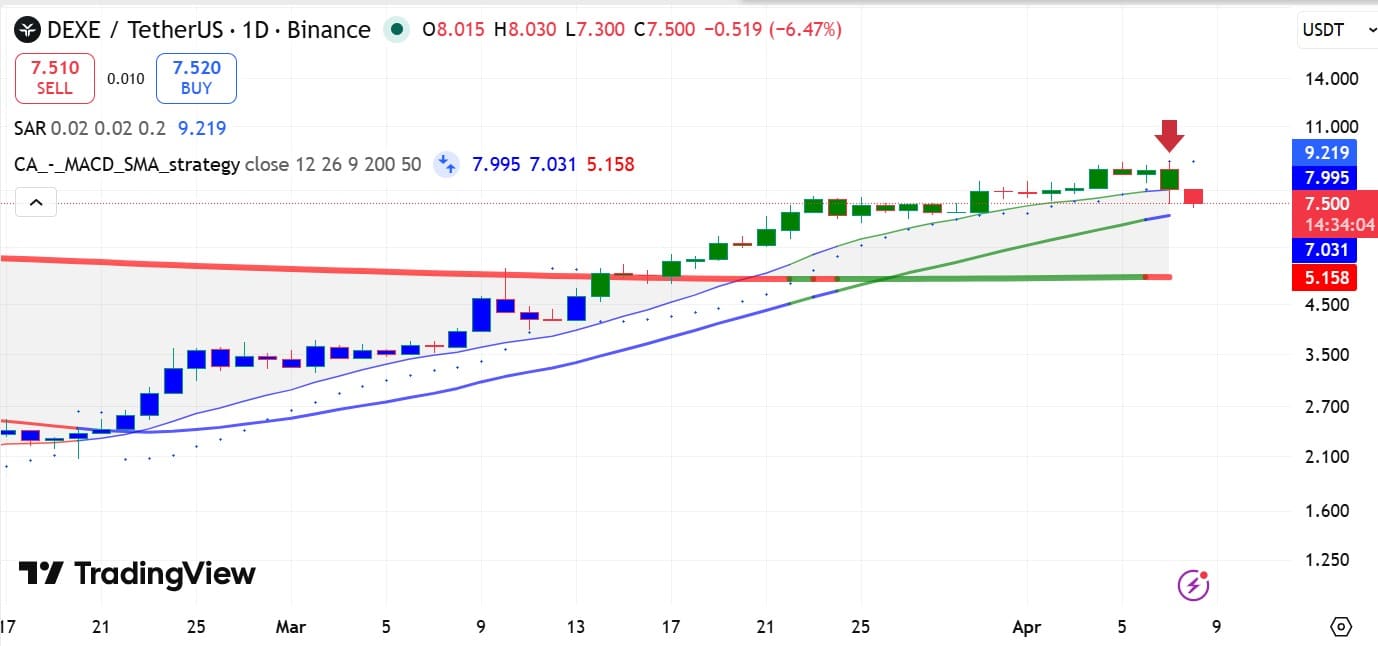
Altcoin này đã giảm từ 9,2 USD xuống 7,3 USD sau khi mất mức hỗ trợ 8 USD. Tại thời điểm báo chí đi vào hoạt động, Dexe [DEXE] được giao dịch ở mức 7,6 USD, giảm 15,27% trong ngày. Mức lỗ hàng tuần ở gần 8%.

Đợt giảm này đã đẩy altcoin xuống dưới Parabolic SAR của nó, báo hiệu áp lực giảm giá mạnh.

Tại sao DEXE chuyển sang giảm giá?

DEXE đã xóa sạch lợi nhuận hàng tuần khi các nhà giao dịch thoát vị thế và tâm lý chuyển sang giảm giá.

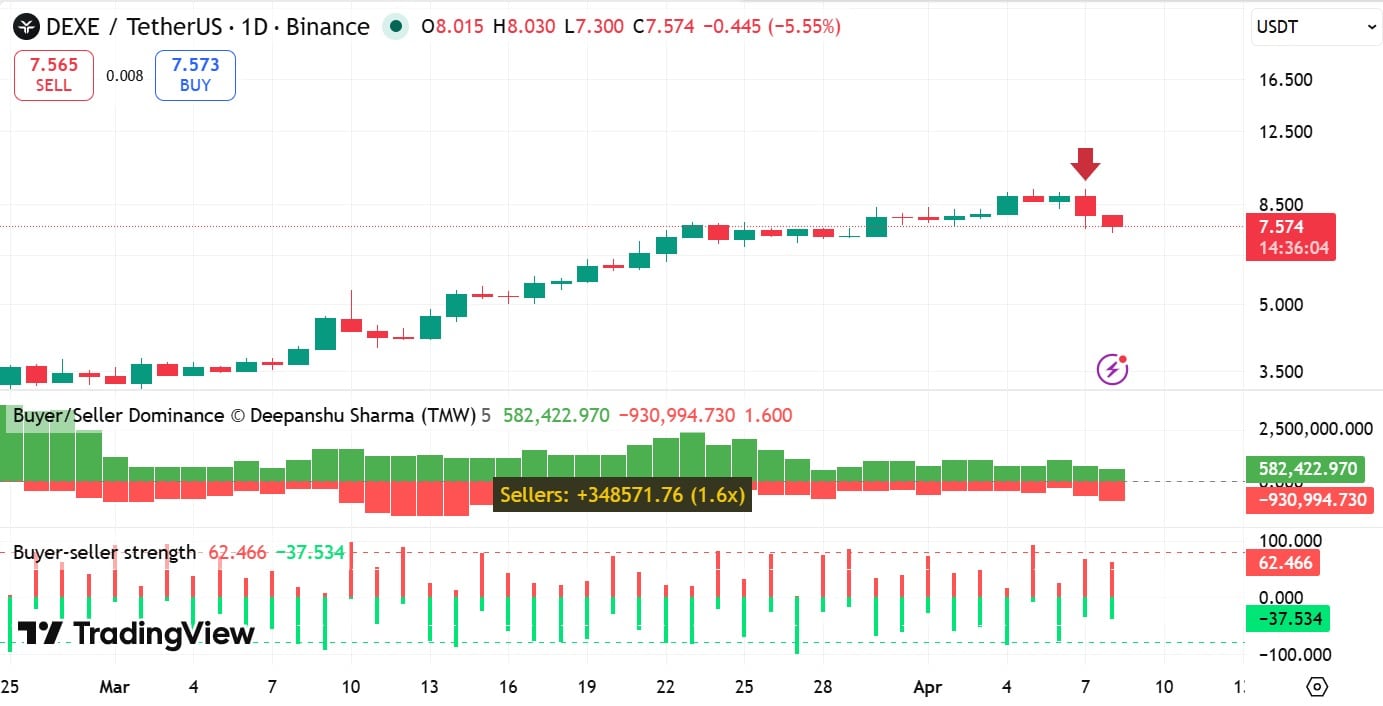
Token này đã giao dịch trong một xu hướng tăng trong suốt tháng 3 và tuần trước. Động thái đó đã thu hút hành động chốt lời gần các mức cao gần đây.
Nguồn: TradingView

Áp lực Bán (Seller Dominance) tăng lên 930k, trong khi Áp lực Mua (Buyer Dominance) giảm xuống 582k.

Đồng thời, Sức mạnh Người bán (Sellers’ Strength) tăng lên 62 trong khi Sức mạnh Người mua (Buyers’ Strength) giảm xuống 37. Sự thay đổi này xác nhận áp lực bên bán đang gia tăng.

Động thái đó trùng khớp với mức tăng 109% về khối lượng giao dịch, phần lớn được thúc đẩy bởi hoạt động bán. Áp lực bán kéo dài thường làm suyếu cấu trúc giá.

Các nhà giao dịch DEXE có đang thoát khỏi các vị thế phái sinh?

Khi thị trường bắt đầu hạ nhiệt và điều chỉnh giảm, các nhà đầu tư đã rút vốn khỏi thị trường tương lai để giảm mức độ tiếp xúc rủi ro.

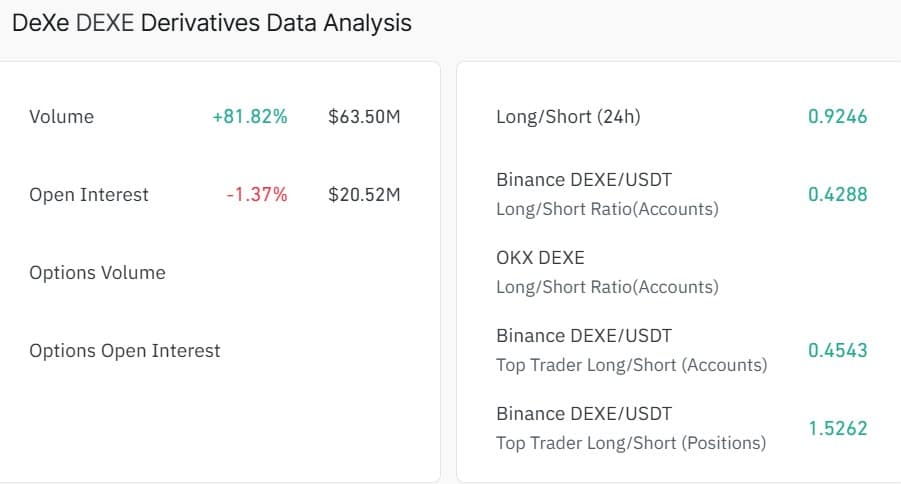
Theo dữ liệu từ CoinGlass, Open Interest [OI] giảm 1,37% xuống 20 triệu USD trong khi Khối lượng Phái sinh (Derivatives Volume) tăng 80%. Sự không trùng khớp này cho thấy hoạt động bán gia tăng trên thị trường phái sinh và việc giảm các vị thế.
Nguồn: CoinGlass

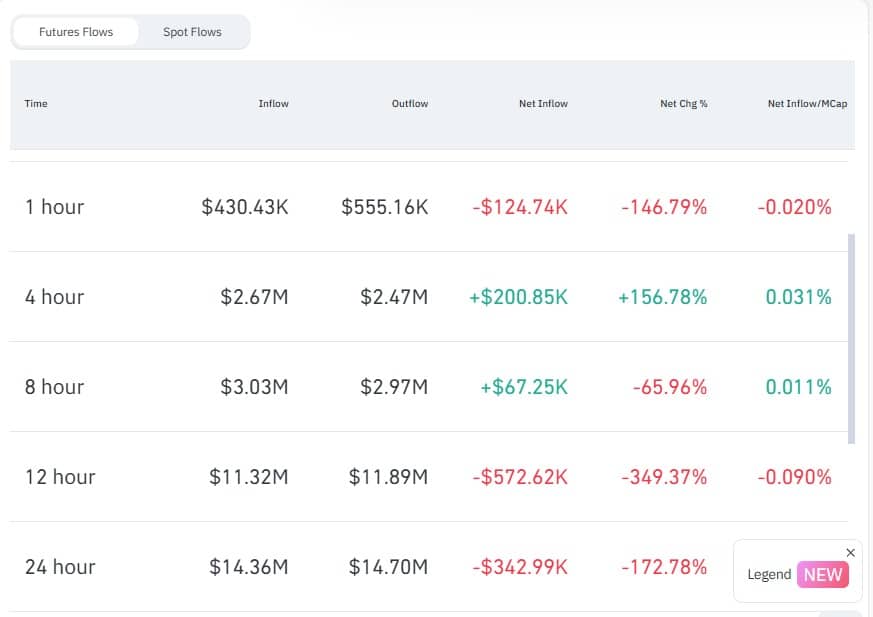
Đồng thời, dòng tiền ra thị trường Futures tăng lên, đạt 14,7 triệu USD, trong khi dòng tiền vào giảm xuống 14,36 triệu USD. Kết quả là, dòng tiền ròng (futures net flow) giảm 172% xuống -342k USD, cho thấy hoạt động bán tích cực.

Điều này cho thấy hầu hết các nhà giao dịch trên thị trường tương lai đã giảm mức độ tiếp xúc và đóng các vị thế của họ. Trong hầu hết các trường hợp, khi các nhà giao dịch đóng vị thế một cách tích cực trong một xu hướng giảm, nó cho thấy tâm lý giảm giá mạnh.
Nguồn: CoinGlass

Điều gì tiếp theo cho DEXE?

Các chỉ báo động lượng phản ánh một cấu trúc suy yếu sau đợt giảm gần đây.

MACD và SMA cho thấy giá đang kéo về phía các Đường Trung bình Động ngắn hạn. Điều này chỉ ra động lượng chậm lại sau đợt tăng giá.
Nguồn: TradingView

Dù vậy, DEXE vẫn nằm trong một xu hướng tăng tổng thể rộng hơn bất chấp đợt điều chỉnh giảm.

Việc đóng cửa hàng ngày trên mức 7,9 USD có thể hỗ trợ phục hồi về mức 9,2 USD. Nếu không thể lấy lại mức đó, giá có thể kiểm tra lại mức 7 USD. Nếu việc bán tiếp tục, mức 5,1 USD vẫn là mức hỗ trợ giảm tiếp theo.


Tóm tắt cuối cùng

  • DEXE mất mức hỗ trợ 8 USD và giảm mạnh, xác nhận một sự thay đổi rõ rệt trong xu hướng ngắn hạn.
  • Một động thái vượt trên 7,9 USD có thể hỗ trợ phục hồi, trong khi thất bại làm tăng nguy cơ kiểm tra lại mức 7 USD và các mức thấp hơn.


Trending Cryptos

Related Reads

Must-Watch Events Next Week|CLARITY Act Could Face Senate Vote; SpaceX, Circle to Report Earnings (8.3-8.9)

**Summary: Key Events and Developments to Watch (August 3-9)** The upcoming week is marked by significant financial disclosures, key legislative deadlines, and notable product updates. **Major Financial Events:** Several companies are scheduled to release their Q2 2026 earnings. American Bitcoin (ABTC) will report on August 3, followed by SpaceX and Hut 8 Mining Corp. on August 4, and Circle on August 5. Notably, a significant portion of SpaceX shares (up to 12% of total shares) will be unlocked on August 6 following their earnings release. **Key Legislative Deadline:** The U.S. Senate faces an August 7 deadline to secure 60 votes for the CLARITY Act, a bipartisan bill aiming to establish a federal regulatory framework for cryptocurrencies. The Senate may hold a full vote on the bill during the week. **Economic Data:** The U.S. July Non-Farm Payrolls report will be released on August 7, providing crucial labor market data. **Technology & Product Updates:** * **Shutdowns:** DeFi portfolio tracker Zapper and wallet app Ctrl Wallet will cease operations on August 3. * **Upgrades:** LayerZero will deprecate its v1 relayers on August 3. XRP Ledger's new version 3.3.0, featuring five new functions, is expected next week. * **AI:** Elon Musk announced that the advanced Grok 4.6 AI model is set for release around August 7. * **Bitcoin:** The BIP-110 forced signaling for a potential Bitcoin network change is scheduled to begin around August 8. **Other Notable Events:** Chinese robotics firm Unitree Tech has set its preliminary price inquiry for its IPO for August 5. South Korean exchange Upbit will delist AQT and AERGO tokens on August 3.

marsbit29m ago

Must-Watch Events Next Week|CLARITY Act Could Face Senate Vote; SpaceX, Circle to Report Earnings (8.3-8.9)

marsbit29m ago

Stocks Are Plummeting More Sharply Than Cryptocurrencies. Where Has the Money Gone?

Stock Markets Plunge Deeper Than Cryptocurrencies: Where Did the Money Go? In late July, Seoul's Kospi index triggered circuit breakers for two consecutive days, plummeting over 40% from its June high. The collapse was led by heavyweight stocks like SK Hynix, whose record profits still disappointed investors, and devastating leveraged ETFs, with one major product losing over 83% of its value. This signaled a global, forced deleveraging targeting the most crowded trades. Interestingly, while stocks exhibited extreme volatility akin to crypto markets, Bitcoin rose nearly 15% in July after a prior steep drop. Analysis shows the money fleeing equities did not flow into Bitcoin. Instead, Bitcoin had already absorbed its sell-off in May-June, when U.S. spot Bitcoin ETFs saw historic outflows. The true safe-haven beneficiary was gold, whose price rose over 20% year-on-year, highlighting a decoupling between Bitcoin and gold as "digital gold." The sell-off was a targeted unwinding of leveraged positions in tech and semiconductors, accelerated by broker-dealer risk management and shifts in the AI narrative, including new competition from Chinese memory chipmakers. The retreat path was clear: from high-valuation tech stocks to cash and U.S. Treasuries, then to gold. For Bitcoin to attract sustained institutional inflows, conditions like eased global liquidity pressure, a "soft-landing" Fed rate cut, and U.S. regulatory clarity via legislation like the stalled CLARITY Act are needed. Currently, Bitcoin is not a safe haven but an already-cleared asset. Its low correlation with tech stocks, however, makes it a potential diversification play for institutional portfolios once the storm passes. The money isn't here yet, but the positioning is underway.

marsbit29m ago

Stocks Are Plummeting More Sharply Than Cryptocurrencies. Where Has the Money Gone?

marsbit29m ago

In Conversation with Ray Dalio: We Are Currently in an AI Bubble, with 1% of My Portfolio in Bitcoin

Ray Dalio, founder of Bridgewater Associates, warns in an interview that the current AI boom shows classic bubble characteristics, which could lead to significant economic downturns as seen in past cycles like 1929 or 2000. He explains that speculative enthusiasm, fueled by debt and overvaluation, often precedes a crash when rising rates or taxation force asset sales, causing widespread losses and recession. Dalio also outlines his "Big Cycle" theory, describing an approximate 80-year pattern where widening wealth gaps, massive government deficits, and shifting geopolitical power (like China's rise) create internal conflict and global instability. He emphasizes that we are in a late-cycle, transitional phase where traditional powers like the US and UK face decline. For personal wealth protection, Dalio advises diversification beyond cash into assets like stocks, bonds, real estate, and particularly gold, which he prefers over Bitcoin. While he holds about 1% of his portfolio in Bitcoin as a non-printable hard asset, he views gold as more secure from technological or governmental threats. Regarding AI's impact, Dalio believes it will disproportionately benefit capital owners, worsening inequality by replacing both physical and cognitive labor. He suggests that human intuition and emotional intelligence, combined with AI, will be key for future workers. On taxation, Dalio argues that wealth taxes are impractical and risk triggering asset sell-offs, reducing productive investment. He points to the UK as a cautionary example of debt, low productivity, and political strife. Geopolitically, Dalio foresees a more regionalized world, with the US showing weakness in prolonged conflicts like with Iran, akin to past imperial declines. The ideal outcome, he suggests, is coexisting powerful blocs (e.g., Americas, China-Asia Pacific) without major war.

marsbit4h ago

In Conversation with Ray Dalio: We Are Currently in an AI Bubble, with 1% of My Portfolio in Bitcoin

marsbit4h ago

Daily 7.2 Trillion KRW: Foreign Capital's Record Net Buying on Friday! Wall Street Says Headwinds for Korean Stock Fund Flows Have Subsided

South Korean stock market sees a dramatic shift in fund flows. On July 31, foreign investors made a record net purchase of approximately KRW 7.2 trillion in KOSPI stocks, marking a fundamental reversal from the persistent large-scale net outflows seen in previous months. This contributed to a significant narrowing of foreign net selling in July to KRW 9.8 trillion, down sharply from KRW 48.4 trillion in June and KRW 44.5 trillion in May. Simultaneously, domestic institutional pressure eased. South Korean pension funds and asset managers turned to a net buying position in July, purchasing KRW 1.0 trillion worth of KOSPI shares, contrasting with net sales in May and June. Market volatility is expected to be dampened by new financial regulations. Effective July 31, the Financial Services Commission tightened access for retail investors to single-stock leveraged ETFs by raising the minimum cash deposit requirement. Trading volumes for these products subsequently dropped to about 50% of their monthly average. Citigroup Research maintains its year-end KOSPI target of 10,000 points. The firm cites several supportive factors: the substantial easing of headwinds from capital outflows, a robust fundamental outlook for the semiconductor sector, historically low market valuations, strong economic fundamentals, and the potential for policy support from financial authorities if needed.

marsbit4h ago

Daily 7.2 Trillion KRW: Foreign Capital's Record Net Buying on Friday! Wall Street Says Headwinds for Korean Stock Fund Flows Have Subsided

marsbit4h ago

Trading

Spot

Hot Articles

How to Buy DEXE

Welcome to HTX.com! We've made purchasing DeXe (DEXE) simple and convenient. Follow our step-by-step guide to embark on your crypto journey.Step 1: Create Your HTX AccountUse your email or phone number to sign up for a free account on HTX. Experience a hassle-free registration journey and unlock all features.Get My AccountStep 2: Go to Buy Crypto and Choose Your Payment MethodCredit/Debit Card: Use your Visa or Mastercard to buy DeXe (DEXE) instantly.Balance: Use funds from your HTX account balance to trade seamlessly.Third Parties: We've added popular payment methods such as Google Pay and Apple Pay to enhance convenience.P2P: Trade directly with other users on HTX.Over-the-Counter (OTC): We offer tailor-made services and competitive exchange rates for traders.Step 3: Store Your DeXe (DEXE)After purchasing your DeXe (DEXE), store it in your HTX account. Alternatively, you can send it elsewhere via blockchain transfer or use it to trade other cryptocurrencies.Step 4: Trade DeXe (DEXE)Easily trade DeXe (DEXE) on HTX's spot market. Simply access your account, select your trading pair, execute your trades, and monitor in real-time. We offer a user-friendly experience for both beginners and seasoned traders.

4.3k Total ViewsPublished 2024.03.29Updated 2026.06.02

How to Buy DEXE

Discussions

Welcome to the HTX Community. Here, you can stay informed about the latest platform developments and gain access to professional market insights. Users' opinions on the price of DEXE (DEXE) are presented below.

活动图片












