从爆仓2.29亿美元到重探7万关口,比特币清明行情能否延续?

Foresight NewsPublished on 2026-04-07Last updated on 2026-06-20

Abstract

假期三天,BTC 在 7 万一线的空头被打爆,但链上数据显示新资金还没真正入场。

撰文:ChandlerZ,Foresight News

清明节假期期间,A 股和港股休市,但比特币行情永不停歇。

4 月 6 日起,BTC 从亚市早盘低点 67400 美元出发,盘中最高涨破 70300 美元,刷新 3 月 26 日以来高位,较日低涨超 4%。以太坊同期从 2050 美元附近升至 2170 美元,涨幅约 6%,美股收盘时仍维持在 2140 美元上方,24 小时涨近 4%。

CoinGlass 数据显示,过去 24 小时全网总爆仓约 2.29 亿美元,其中空单爆仓 1.27 亿美元,多单爆仓 1.02 亿美元。BTC 在涨破 69000 美元时,69863 美元附近集中了约 1.36 亿美元的空单仓位,涨势直接触发了一轮大规模空头清算。
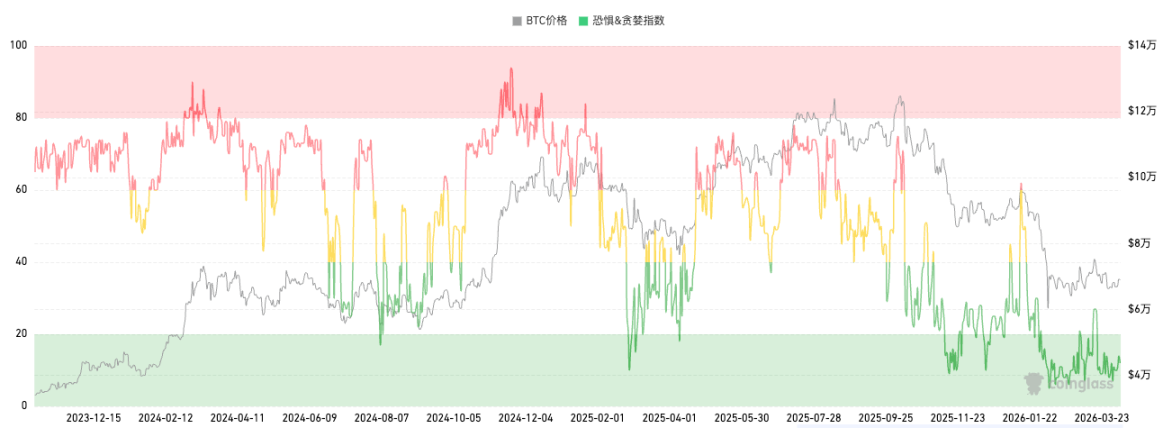
节假期行情由中东局势主导

推动这轮上涨的宏观逻辑依然是伊朗,但情节有了新变化。

3 月 21 日,特朗普曾给伊朗下过一次 48 小时期限,要求重开霍尔木兹海峡,随后却延长超过一周,转而宣布启动外交谈判。此后数周,他在「达成协议再重开海峡」和「重开海峡不需要协议」之间来回摇摆,市场跟着每一条头条涨跌。4 月 7 日晚 8 点是他设定的第二个最终期限,这次措辞升级,若届时无协议,伊朗将「生活在地狱」,并威胁将打击能源基础设施和民用目标。

与此同时,美国国防部长赫格塞思在 4 月 7 日新闻发布会上宣布当周将发动自伊朗行动开始以来最大规模的空袭。但同一场发布会上,特朗普又说伊朗有积极、有意愿的谈判参与者,并透露美伊正在讨论一份两阶段方案,先达成 45 天临时停火,再谈判全面协议。伊朗方面则公开拒绝了临时停火,坚持要求永久终战,谈判陷入僵局。

被问及是否在逐步结束战争时,特朗普的回答是:「我不知道,我说不准。这取决于他们(伊朗)的举动。」

受这一宏观环境影响,国际市场也出现往复波动。

WTI 5 月原油期货收报 112.41 美元 / 桶,连续两个交易日刷新 2022 年 6 月以来新高;布伦特期货报 109.77 美元 / 桶。原油在亚市盘中一度触及 115.48 美元后多次拉锯,反映市场对霍尔木兹海峡能否维持通航的高度分歧。

美股方面,标普 500 收涨 0.44%,纳指收涨 0.54%,均创至少两周新高,芯片股指涨逾 1%,美光、闪迪涨超 3%。VIX 报 24.15,较前日小幅上升。

这套油涨股涨币涨的组合,表面矛盾,背后逻辑一致,市场当天定价的不是战争升级,而是最坏情况被排除。45 天临时停火框架的消息让系统性崩盘的尾部风险暂时出门,风险偏好集体回升,三类资产同向反弹。油价维持高位是因为霍尔木兹海峡尚未恢复通航,但不再加速上涨,也就是市场找到了一个不会更糟但还没有好的暂时均衡点。

Interactive Brokers 首席策略师 Steve Sosnick 评论称「市场看到胡萝卜,也看到大棒,一方面是停火谈判,另一方面是继续轰炸。除特朗普讲话初期短暂波动外,投资者显然仍希望敌对行动不会迅速升级。」

值得注意的是,这个规律从伊朗战事爆发以来一直成立。自 2 月 27 日战事开始至 4 月 3 日,相对标普 500 的超额收益排名中,前四名分别是 MSCI 全球能源(+13.0%)、以太坊(+11.3%)、美国能源板块(+10.8%)和比特币(+7.0%)。
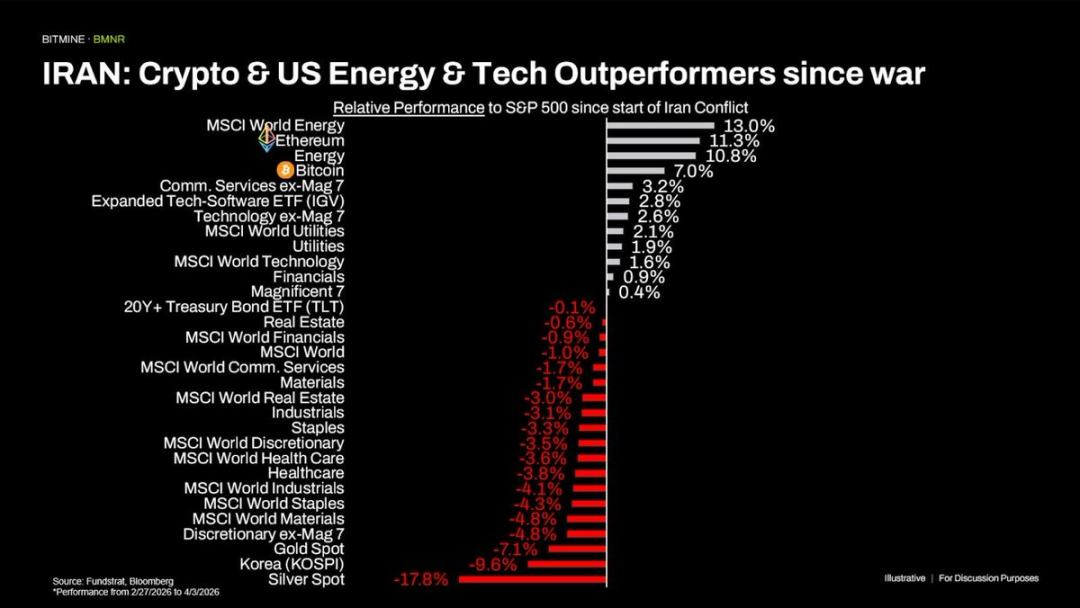
反过来,传统避险资产的表现则令人意外,黄金相对标普 500 跌了 7.1%,白银跌了 17.8%,与过去几轮地缘冲突中「买黄金避险」的市场惯性完全相反。

链上结构改善,但新资金尚未跟上

Glassnode 报告显示,本轮反弹的内部结构开始出现修复信号,动能增强,现货需求趋于稳定,市场整体亏损行为明显减少。

现货市场反映出需求回升的早期迹象,Spot CVD 从 -4780 万美元翻转至 +2790 万美元,净卖压转为净买压,相对强弱指数(RSI)强劲反弹,现货反补贴税(CVD)转为正值,表明买方积极性重振。但交易量下降表明市场参与度仍然相对较低,这预示着复苏势头良好,但尚未完全得到确认。

衍生品市场仓位调整幅度不大,未平仓合约量减少,多头资金投入降温,表明杠杆率降低,市场环境更加平衡。永续合约 CVD 从 -4.12 亿美元大幅回升至 4.61 亿美元,期货市场买方方向性明确,未平仓合约从 303 亿回落至 297 亿,杠杆未见过度堆积。
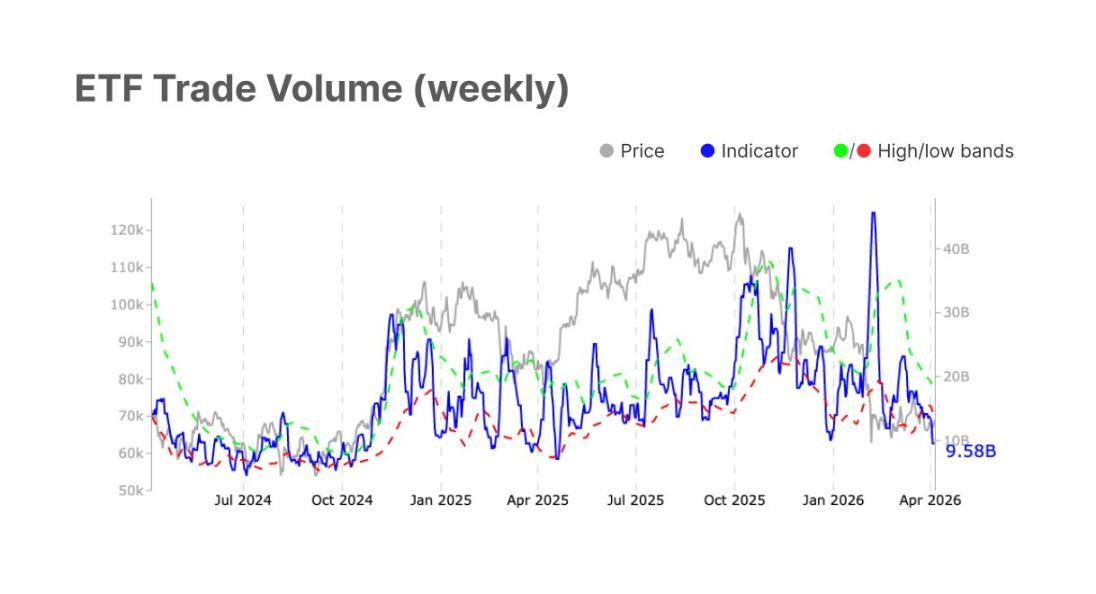
ETF 资金面出现明显改善,美国现货比特币 ETF 周净流出从 -4.05 亿美元大幅收窄至 -2200 万美元,降幅接近 95%,ETF MVRV 从 1.10 升至 1.16,机构持仓浮盈扩大。
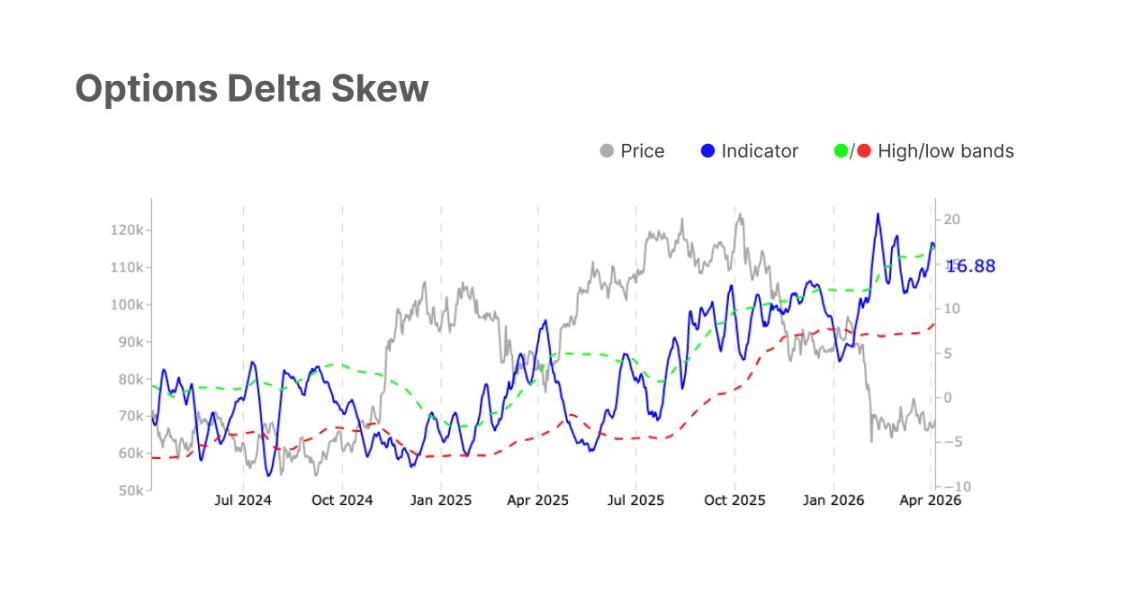
但链上基本面的恢复仍然滞后,已实现市值变化从 -0.6% 进一步降至 -0.7%,意味着新资金尚未大规模回流;Hot Capital Share 从 21.0% 降至 20.1%,短期投机性资金持续流失;25-Delta 偏斜升至 16.88%,期权市场对下行风险的定价并未因价格反弹而消退。

加密市场后续

市场上涨能否延续?机构观点出现分歧。

CoinDesk 援引分析师观点称,除非比特币能收复 75000 美元,否则跌向更低点的风险仍然存在;当前价格若无法在 7 万美元以上站稳,将面临短期持有者信心流失后的新一轮回调压力。

Glassnode 的结论相对谨慎,称反弹势头改善,现货需求趋稳,亏损卖压明显减少。但参与度在交易所、ETF 和链上各维度仍然偏软,说明市场信心尚未完全归位。要让这轮行情站稳,需要成交量、资金流入和网络活跃度的进一步跟进。

4 月 7 日是特朗普设定的最终期限。局势是否在截止日后出现实质性降级,将直接决定原油价格和风险资产的下一步走向,也将是比特币能否守住 7 万美元的关键变量。

Trending Cryptos

Related Reads

The "Impossible Triad" Is Fundamentally a Pseudo-Problem

The article argues that blockchain's fundamental limitation is not the scalability trilemma (decentralization, scalability, security), which has been largely solved, but the lack of **privacy** and, until recently, clear **legitimacy**. Blockchain is described as a slow, expensive, globally shared computer whose core value is censorship resistance and verifiability. While ideal for native digital assets like money (e.g., stablecoins), its default transparency acts as a **tax**, exposing all transactions and enabling MEV extraction, which deters serious institutional capital. Simultaneously, its permissionless nature created regulatory ambiguity. The piece contends that **privacy** is the missing critical feature. It rejects the false choice between total transparency and complete anonymity. Modern cryptography (like zero-knowledge proofs) enables **compliant privacy**: users can prove facts (solvency, KYC status, compliance) without revealing the underlying sensitive data (specific holdings, identities). This preserves auditability for regulators and eliminates the leak of financial information. With recent regulatory progress (e.g., the GENIUS Act) addressing legitimacy, adding default, provably compliant privacy becomes a pure upgrade. It transforms blockchain from a costly, public ledger into a confidential settlement layer, finally bridging the gap to mainstream institutional and individual adoption of on-chain finance.

链捕手7h ago

The "Impossible Triad" Is Fundamentally a Pseudo-Problem

链捕手7h ago

Optical Chips: Collective Capacity Expansion

The global optical chip industry is experiencing a massive wave of expansion driven by surging AI data center demand. Major players across the US, Japan, Europe, and China are aggressively investing to ramp up production capacity. In the US, Coherent is expanding its 6-inch Indium Phosphide (InP) semiconductor fab in Texas, supported by CHIPS Act funding and a $2 billion strategic investment from NVIDIA. Lumentum is building a new factory for InP optical devices, and Nokia is scaling its advanced photonic chip packaging and testing capabilities. NVIDIA's investments aim to secure future supply of critical lasers and optical interconnect products for AI infrastructure. Japan's JX Advanced Metals, a leading InP substrate supplier, plans a multi-billion yen investment to increase its capacity 7-10 times, strengthening its grip on the crucial upstream materials market. In Europe, IQE and Tower Semiconductor settled a patent dispute and signed a multi-year InP epitaxial wafer supply agreement, highlighting that next-generation silicon photonics platforms will integrate high-performance InP components. STMicroelectronics and Sivers Semiconductors are also expanding silicon photonics production and partnerships. China is rapidly building out its domestic supply chain. Dongshan Precision's subsidiary, Source Photonics, announced a $12 billion project to expand optical chip and module production. Companies like Sanan Optoelectronics and Yunnan Germanium are scaling up InP chip manufacturing and substrate production, moving towards vertical integration from materials to modules. While debate continues around the exact future architecture—whether CPO (Co-Packaged Optics), NPO, or pluggables will dominate—analysts like Morgan Stanley argue the underlying driver is unchangeable: the explosive growth in bandwidth demand. This will inevitably increase the volume of optical engines, lasers, and related content per GPU, regardless of the final technical path. The competition for "more light" in the AI era has intensified into a global, full-chain capacity race.

marsbit10h ago

Optical Chips: Collective Capacity Expansion

marsbit10h ago

Stablecoins Finally Find Real Yield: An In-Depth Look at On-Chain Reinsurance Re | A Conversation with Re Founder Karan Saroya

Stablecoin Real Yield Found: A Deep Dive into On-Chain Reinsurance with Re's Karan Saroya As stablecoin supply exceeds $170 billion, the search for sustainable, non-speculative yield intensifies. Re, an on-chain reinsurance platform, provides an answer: connecting stablecoin capital to the trillion-dollar traditional reinsurance market. Re operates as a regulated reinsurer, accepting stablecoin deposits as collateral to back US insurance companies. These insurers pay premiums, generating yield that flows back to on-chain depositors. Currently supporting 35 insurers and underwriting $500 million, Re projects scaling to over $1 billion soon. Key insights from a Bankless podcast with founder Karan Saroya and investor Avichal of Electric Capital: 1. **Uncorrelated, Real-World Yield:** Re offers stablecoin holders access to reinsurance returns (targeting 12-14%+), an asset class entirely separate from crypto or equity markets. 2. **Operational Efficiency via Smart Contracts:** Re replaces traditional, labor-intensive capital fundraising with smart contracts, allowing a ~12-person team to compete with industry giants. 3. **Regulatory Leverage:** For every $1 of collateral, regulations allow backing $5-7 in written premiums. This leverage amplifies returns from the underlying risk-free rate. 4. **DeFi Integration:** Depositors receive receipt tokens, which can be used in protocols like Morpho for "looping," potentially pushing yields to 18-20%+. 5. **The "DeFi Mullet" Model:** A compliant front-end (regulated reinsurer) paired with a decentralized back-end (smart contracts, DeFi capital markets). 6. **RE Governance Token:** Modeled on Lloyd's of London, the token governs the central capital pool's allocation, counterparty acceptance, and parameters. 7. **Real Economic Impact:** Capital funds real-world productivity (factories, clinics, businesses) via insurance, moving beyond crypto's internal loops. The discussion highlights a pivotal moment: DeFi's supply-side infrastructure is now met by real demand for productive yield, potentially kickstarting a flywheel where vast on-chain stablecoin capital seeks these real-world returns.

链捕手11h ago

Stablecoins Finally Find Real Yield: An In-Depth Look at On-Chain Reinsurance Re | A Conversation with Re Founder Karan Saroya

链捕手11h ago

1996 or 1999? Walsh's First Test is 'How to View AI'

"1996 or 1999? Wall's First Big Test Is 'How to View AI'" Federal Reserve Chairman Wall's initial challenge is not whether to raise or cut rates, but a more fundamental judgment: what kind of boom is the current AI boom? This will determine the Fed's policy path and define his legacy. Economics is split between two opposing views, according to reporter Nick Timiraos. One sees imminent productivity gains that will increase supply and cool inflation, allowing the Fed to hold steady. The other argues that while productivity benefits are distant, demand shocks are here now, and waiting for data confirmation risks missing the intervention window, forcing sharper rate hikes later. Wall has signaled a leaning toward the first view, echoing 1996-era Alan Greenspan, who embraced strong, productivity-driven growth without fear of inflation. However, Wall faces a different macro environment than Greenspan did, with tariff pressures, expanding fiscal deficits, and diminishing globalization benefits, which could force more significant inflation pressures even if AI benefits materialize. Wall's logic, expressed before taking office, is that AI-driven productivity gains won't show in official data for years. If the Fed waits for confirmation, it might mistakenly tighten policy and choke off the very growth that could suppress inflation. This argues for using forward-looking narratives over lagging data. Chicago Fed President Austan Goolsbee presents a key counter-argument. He distinguishes between expected and unexpected productivity booms. A widely anticipated boom, like the current AI wave, can cause people to spend future wealth gains in advance, overheating the economy before productivity actually rises, thus requiring preemptive rate hikes. He cites rising costs for AI data centers as evidence of such overheating. Fed Governor Christopher Waller offers a rebuttal to Goolsbee, noting the "expected spending" mechanism only works if people can borrow against future income, which many households cannot do due to borrowing constraints. Wall also faces a paradox related to his desire to reduce the Fed's use of "forward guidance" (pre-announcing policy moves). This practice was established in 1999 when Greenspan began signaling hikes to avoid market shocks. If the economy follows a less optimistic path, Wall may be forced to choose between using the guidance he wants to abolish or risking market volatility by staying silent. The ultimate question defining Wall's first major test remains: Is this 1996 or 1999?

marsbit12h ago

1996 or 1999? Walsh's First Test is 'How to View AI'

marsbit12h ago

Trading

Spot
Futures

Hot Articles

What is $BITCOIN

DIGITAL GOLD ($BITCOIN): A Comprehensive Analysis Introduction to DIGITAL GOLD ($BITCOIN) DIGITAL GOLD ($BITCOIN) is a blockchain-based project operating on the Solana network, which aims to combine the characteristics of traditional precious metals with the innovation of decentralized technologies. While it shares a name with Bitcoin, often referred to as “digital gold” due to its perception as a store of value, DIGITAL GOLD is a separate token designed to create a unique ecosystem within the Web3 landscape. Its goal is to position itself as a viable alternative digital asset, although specifics regarding its applications and functionalities are still developing. What is DIGITAL GOLD ($BITCOIN)? DIGITAL GOLD ($BITCOIN) is a cryptocurrency token explicitly designed for use on the Solana blockchain. In contrast to Bitcoin, which provides a widely recognized value storage role, this token appears to focus on broader applications and characteristics. Notable aspects include: Blockchain Infrastructure: The token is built on the Solana blockchain, known for its capacity to handle high-speed and low-cost transactions. Supply Dynamics: DIGITAL GOLD has a maximum supply capped at 100 quadrillion tokens (100P $BITCOIN), although details regarding its circulating supply are currently undisclosed. Utility: While precise functionalities are not explicitly outlined, there are indications that the token could be utilized for various applications, potentially involving decentralized applications (dApps) or asset tokenization strategies. Who is the Creator of DIGITAL GOLD ($BITCOIN)? At present, the identity of the creators and development team behind DIGITAL GOLD ($BITCOIN) remains unknown. This situation is typical among many innovative projects within the blockchain space, particularly those aligning with decentralized finance and meme coin phenomena. While such anonymity may foster a community-driven culture, it intensifies concerns about governance and accountability. Who are the Investors of DIGITAL GOLD ($BITCOIN)? The available information indicates that DIGITAL GOLD ($BITCOIN) does not have any known institutional backers or prominent venture capital investments. The project seems to operate on a peer-to-peer model focused on community support and adoption rather than traditional funding routes. Its activity and liquidity are primarily situated on decentralized exchanges (DEXs), such as PumpSwap, rather than established centralized trading platforms, further highlighting its grassroots approach. How DIGITAL GOLD ($BITCOIN) Works The operational mechanics of DIGITAL GOLD ($BITCOIN) can be elaborated on based on its blockchain design and network attributes: Consensus Mechanism: By leveraging Solana’s unique proof-of-history (PoH) combined with a proof-of-stake (PoS) model, the project ensures efficient transaction validation contributing to the network's high performance. Tokenomics: While specific deflationary mechanisms have not been extensively detailed, the vast maximum token supply implies that it may cater to microtransactions or niche use cases that are still to be defined. Interoperability: There exists the potential for integration with Solana’s broader ecosystem, including various decentralized finance (DeFi) platforms. However, the details regarding specific integrations remain unspecified. Timeline of Key Events Here is a timeline that highlights significant milestones concerning DIGITAL GOLD ($BITCOIN): 2023: The initial deployment of the token occurs on the Solana blockchain, marked by its contract address. 2024: DIGITAL GOLD gains visibility as it becomes available for trading on decentralized exchanges like PumpSwap, allowing users to trade it against SOL. 2025: The project witnesses sporadic trading activity and potential interest in community-led engagements, although no noteworthy partnerships or technical advancements have been documented as of yet. Critical Analysis Strengths Scalability: The underlying Solana infrastructure supports high transaction volumes, which could enhance the utility of $BITCOIN in various transaction scenarios. Accessibility: The potential low trading price per token could attract retail investors, facilitating wider participation due to fractional ownership opportunities. Risks Lack of Transparency: The absence of publicly known backers, developers, or an audit process may yield skepticism regarding the project's sustainability and trustworthiness. Market Volatility: The trading activity is heavily reliant on speculative behavior, which can result in significant price volatility and uncertainty for investors. Conclusion DIGITAL GOLD ($BITCOIN) emerges as an intriguing yet ambiguous project within the rapidly evolving Solana ecosystem. While it attempts to leverage the “digital gold” narrative, its departure from Bitcoin's established role as a store of value underscores the need for a clearer differentiation of its intended utility and governance structure. Future acceptance and adoption will likely depend on addressing the current opacity and defining its operational and economic strategies more explicitly. Note: This report encompasses synthesised information available as of October 2023, and developments may have transpired beyond the research period.

406 Total ViewsPublished 2025.05.13Updated 2025.05.13

What is $BITCOIN

Discussions

Welcome to the HTX Community. Here, you can stay informed about the latest platform developments and gain access to professional market insights. Users' opinions on the price of BTC (BTC) are presented below.

活动图片














