Bitcoin Price At $59,000 Is The Line In The Sand, Here’s What You Should Know

bitcoinistPublished on 2026-03-30Last updated on 2026-03-30

Abstract

Bitcoin's price is currently consolidating between $60,000 and $74,000, with a decisive breakout direction likely determining the market's next major move. Analysts highlight the critical importance of the 200-Week Moving Average, currently at $59,000, as a key support level. Historically, holding above this level has preceded significant bull runs—such as those in 2015, 2019, and 2023—leading to new all-time highs. Maintaining above $59,000 suggests long-term bullish momentum, with dips viewed as buying opportunities. However, a break below this level could signal a bear market and further declines. The macro structure remains optimistic, urging investors to avoid short-term fear.

Over the last few weeks, the Bitcoin price has ping-ponged between $60,000 and $74,000, suggesting that the direction that the price breaks out of in this range could be determinant of what direction the entire market takes next. After dropping more than 45% already, all attention has now shifted to when the pioneer cryptocurrency will make a new bottom. So far, bulls have held up surprisingly well, but there is still a ‘line in the sand’ that the price must not cross.

Bitcoin Macro Structure Is Still Bullish

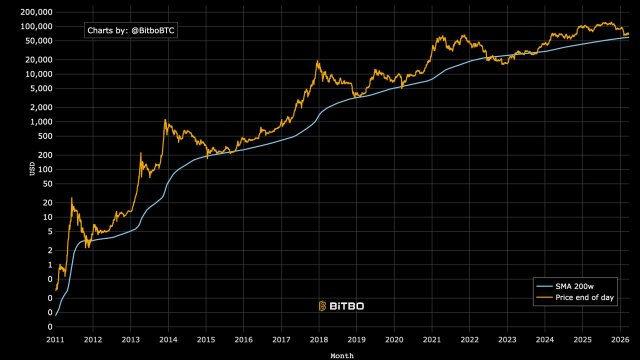
Presently, the Bitcoin price is still holding well above the 200-Week Moving Average, which is very bullish for the price, according to crypto analyst Crypto Patel. The reason for this dates back to the past market cycles, where the 200-Week Moving Average has been the major level to hold or beat.

Digging into the past cycles, Crypto Patel explained that the Bitcoin price had been able to stay above the 200-Week Moving Average back in 2015. The result of this was a major rally that saw the Bitcoin price rally toward $20,000 in the bull market that followed.

Then again, in 2019, the same 200-Week Moving Average held firm, and the resulting bull market led to the 2021 peak of $69,000. Even the third time in 2023, despite the price preciously crashing below $20,000, Bitcoin had managed to hold above the 200-Week Moving Average, and bulls were rewarded as the price would reach $126,000 in 2025.
Source: X

Given this trend, it becomes obvious that the Bitcoin price being above the 200-Week MA is bullish, and likewise, a crash below it would be bearish. This is why it is important for the bulls to maintain a hold on this level.

BTC Price Must Not Fall Below $59,000

Going by the analyst’s post, the current 200-Week Moving Average for Bitcoin lies at $59,000. This immediately makes it the level to defend for the bulls. As Crypto Patel explains, as long as the Bitcoin price stays above this level, then ‘every dip is a gift.’ This means it could be an opportunity to buy.

If historical trends are to be respected, holding the 200W MA would mean that the Bitcoin price would see new all-time highs sometime in 2028. “The Macro Structure Is Still Bullish. Don’t Let Short-Term Fear Shake You Out,” the analyst warns.

Alternatively, a break below this 200-Week Moving Average could be disastrous for Bitcoin, because it would mean that the cryptocurrency has now officially entered bear market territory. It could also bring the harbinger of more decline, sending the cryptocurrency lower before establishing a bottom.

BTC bulls begin to push upward again | Source: BTCUSD on Tradingview.com

Trending Cryptos

Related Questions

QWhat is the significance of the $59,000 level for the Bitcoin price according to the article?

AThe $59,000 level represents the current 200-Week Moving Average, which is a critical support level. Historically, Bitcoin has entered a bull market after holding above this level. A break below it could signal an official entry into a bear market.

QWhat historical evidence does the analyst, Crypto Patel, provide to support the importance of the 200-Week Moving Average?

ACrypto Patel points to three previous cycles: in 2015, holding above the 200-Week MA led to a rally to $20,000; in 2019, it led to the 2021 peak of $69,000; and in 2023, it preceded a rally to $126,000 in 2025.

QWhat is the potential consequence if the Bitcoin price breaks below the 200-Week Moving Average?

AA break below the 200-Week Moving Average would be disastrous as it would mean Bitcoin has officially entered bear market territory and could lead to further decline before a bottom is established.

QWhat is the analyst's advice for investors if the price holds above the $59,000 level?

AThe analyst advises that as long as the price stays above $59,000, 'every dip is a gift,' meaning it should be seen as a buying opportunity, and investors should not be shaken out by short-term fear.

QWhat is the projected long-term outcome if Bitcoin respects the historical trend and holds the 200-Week MA?

AIf the historical trend is respected and Bitcoin holds the 200-Week MA, the price is projected to reach new all-time highs sometime in 2028.

Related Reads

qinbaFrank: Review and Outlook of the AI Computing Power Wave — From the Three Debates on NVIDIA to Optical Interconnect and SpaceX IPO, How is Capital Rotating?

**Summary: Retrospective and Outlook on the AI Computing Wave - A Framework for Capital Rotation** Based on a presentation by investor qinbaFrank, this analysis reviews the AI computing market trajectory since 2023 and outlines a forward-looking framework. **Key Phases and Market Debates:** The AI bull market progressed through three major debates: 1) The necessity of massive capital expenditure (late 2023). 2) The sustainability of tech giants' spending (early 2024-early 2025). 3) Potential overestimation of compute needs (early 2025). Consensus solidified in late 2025 as model capabilities and utility demonstrably improved. **Core Thesis: Penetration Rate Drives Commercialization.** Unlike the 2000 dot-com bubble, the current AI wave benefits from mature digital infrastructure, enabling faster adoption. The critical threshold is 10% penetration; surpassing it (with recent enterprise intent surveys showing ~18%) indicates entry into a rapid growth "golden period" where user scale and willingness to pay increase simultaneously. **AI vs. Internet: A Fundamental Difference.** While the internet enhanced connection efficiency, AI directly substitutes human cognition and labor. Once AI performance exceeds the "societal average" human level, its commercial value scales exponentially as payment shifts from human labor costs to AI service fees. **Investment Logic Evolution in the Compute Chain.** The focus has expanded from GPUs to a systemic re-rating of the entire hardware stack: storage/HBM, CPUs, interconnects, power, and advanced packaging. The framework is: **short-term "scarcity pricing," mid-term "upgrade pricing" (e.g., optical interconnects, power networks), and long-term "Physical AI" pricing** (edge computing, robotics). **Market Focus Shift and Adjustment Framework.** The market is transitioning from "hardware scarcity" to "commercialization validation." The ultimate anchor for the narrative is sustained high growth in model providers' Annual Recurring Revenue (ARR) and cloud business revenue, which justifies continued capital expenditure. Adjustments are categorized into three levels: * **L1 (Minor):** Driven by valuation compression or macro noise (e.g., single CPI print). Fundamentals intact. * **L2 (Moderate):** Triggered by significant macro events requiring risk repricing. Requires new data for confidence restoration. * **L3 (Major):** Involves a reset of the core industrial narrative or macro regime (e.g., AI commercialization growth stalling). The **crucial dividing line** is whether AI commercialization growth slows. Without a slowdown, pullbacks are likely L1/L2 "repricing" events. A genuine growth deceleration would signal an L2/L3 narrative reset. **Conclusion: A Foundational Civilizational Leap.** AI represents a foundational upgrade to "intelligence" itself—akin to humanity mastering fire—rather than a single-point industrial revolution. This底层能力跃迁 (underlying capability leap) will spawn successive waves of innovation (Agent, robotics, industry workflow重构). The journey will be波浪式的 (wavelike), driven by cycles of scarcity, technological upgrades, and远期兑现 (long-term realization).

marsbit11m ago

qinbaFrank: Review and Outlook of the AI Computing Power Wave — From the Three Debates on NVIDIA to Optical Interconnect and SpaceX IPO, How is Capital Rotating?

marsbit11m ago

A Country That Mined Bitcoin for 8 Years Has Built Its Own Dedicated Crypto Bank

A country that has been mining Bitcoin for eight years has established its own dedicated crypto bank. DK Bank, located in Bhutan's newly developed GMC special administrative zone, aims to fill the significant banking service gap for the cryptocurrency industry. Its CEO, Zheng YD, explained that most banks avoid crypto businesses due to a lack of risk management frameworks for decentralized and anonymous protocols. Operating under a unique "one country, two systems" governance model separate from mainland Bhutan, GMC aspires to become a financial hub for South Asia. DK Bank differentiates itself by offering integrated multi-currency accounts where users can manage both fiat currencies and stablecoins like USDT and USDC in one place, alongside services like Bitcoin-backed loans. The bank faces technical challenges in merging traditional banking systems with 24/7 crypto markets and implements rigorous on-chain and off-chain transaction monitoring for risk control. GMC's regulatory framework draws from Singaporean common law and Abu Dhabi's ADGM rules, offering a fast-track licensing process for already licensed firms while maintaining high standards. The initiative is part of Bhutan's longer-term crypto strategy, which includes Bitcoin mining since 2018. The focus, however, is on building a diversified institutional-grade crypto ecosystem—including custody and asset management—rather than retail speculative tokens. Proponents argue such sovereign crypto infrastructure is necessary, and Bhutan's early, measured approach exemplifies the thoughtful integration needed in global finance.

Foresight News41m ago

A Country That Mined Bitcoin for 8 Years Has Built Its Own Dedicated Crypto Bank

Foresight News41m ago

Unveiling the Whales of the World Cup Prediction Market: Smart Money Stumbles on the Pitch, 'Buy No' Outperforms 'Buy Yes'

**Title: Unveiling the Whales of the World Cup Prediction Market: "Smart Money" Stumbles on the Pitch as "Buying No" Outperforms "Buying Yes"** An analysis of pre-match trades over $5,000 on Polymarket for 20 completed group stage matches reveals a counterintuitive finding: large "smart money" bets were not consistently accurate. Aggregated pre-match buying volume was $89.55 million, with a weighted hit rate of only 48.5%. Holding these positions would have resulted in an estimated net loss of about $1.76 million (ROI -2.0%), challenging the notion that big money reliably predicts outcomes. The data highlights several key dynamics. Draws proved to be a major risk, significantly impacting bets on favored teams, as seen in Belgium-Egypt and Spain-Cape Verde. Markets were more efficient for clear mismatches (e.g., Germany's big win) but became prone to bias when favorites were overvalued. Notably, buying "No" shares (betting against a specific outcome) significantly outperformed buying "Yes," with hit rates of 62.4% vs. 37.5%. This suggests the market often overprices popular narratives, creating value in contrarian positions. Individual trades showed extreme volatility. One wallet (mintblade) earned an estimated $6.77 million by betting against Iran, while another (LEEEROYJENKINS) lost roughly $8.39 million on a Belgium win. The market favors high-risk, high-reward information trading rather than steady arbitrage. For sustained insight, wallets with consistent performance across multiple matches (e.g., swisstony) are more telling than one-off big bets. Ultimately, the Polymarket acts less as a crystal ball and more as a mirror, reflecting crowd bias and the inherent unpredictability of football. True "smart money" may lie not in predicting the future, but in identifying and exploiting market mispricings while respecting risk.

marsbit1h ago

Unveiling the Whales of the World Cup Prediction Market: Smart Money Stumbles on the Pitch, 'Buy No' Outperforms 'Buy Yes'

marsbit1h ago

Bezos' Third Startup Still Can't Avoid Musk

Jeff Bezos Returns as CEO for Third Venture, Still Can't Avoid Musk After stepping down as Amazon CEO in 2021, Jeff Bezos has returned to the front lines as co-CEO of Prometheus, an AI startup he founded. In a recent CNBC interview, Bezos described the experience as "Type 2 fun"—exhausting but ultimately rewarding. Founded less than a year ago, Prometheus has already raised over $18 billion in two funding rounds, achieving a staggering $41 billion valuation. Prometheus aims to develop a "General Engineer AI" to accelerate the entire "invention loop"—design, simulation, testing, and manufacturing—for complex physical products like jet engines, spacecraft, and medical devices. This positions the company at the intersection of Bezos's past experiences: Amazon's platform-building scale and Blue Origin's rigorous physical engineering. This marks Bezos's third major venture, following Amazon and Blue Origin. His co-CEO is Vik Bajaj, bringing expertise from life sciences and hard tech. Bezos now dedicates most of his time to Prometheus, signaling his belief in its transformative potential. The move also comes as Bezos's space company, Blue Origin, faces challenges, including a recent test explosion delaying its New Glenn rocket. Meanwhile, Elon Musk's SpaceX achieved a record-breaking IPO, surpassing Amazon's market cap. While Musk focuses on AI for executing physical tasks (like Tesla's robots and SpaceX's engineering), Bezos is betting on AI to *invent* in the physical world. Prometheus enters a crowded industrial AI field with players like OpenAI, NVIDIA, and Tesla's Optimus. Its lofty valuation bets on the unproven but massive opportunity to become the foundational platform for engineering in the AI era—a "blue ocean" Bezos hopes to define before Musk does.

marsbit1h ago

Bezos' Third Startup Still Can't Avoid Musk

marsbit1h ago

Trading

Spot
Futures

Hot Articles

How to Buy SAND

Welcome to HTX.com! We've made purchasing The Sandbox (SAND) simple and convenient. Follow our step-by-step guide to embark on your crypto journey.Step 1: Create Your HTX AccountUse your email or phone number to sign up for a free account on HTX. Experience a hassle-free registration journey and unlock all features.Get My AccountStep 2: Go to Buy Crypto and Choose Your Payment MethodCredit/Debit Card: Use your Visa or Mastercard to buy The Sandbox (SAND) instantly.Balance: Use funds from your HTX account balance to trade seamlessly.Third Parties: We've added popular payment methods such as Google Pay and Apple Pay to enhance convenience.P2P: Trade directly with other users on HTX.Over-the-Counter (OTC): We offer tailor-made services and competitive exchange rates for traders.Step 3: Store Your The Sandbox (SAND)After purchasing your The Sandbox (SAND), store it in your HTX account. Alternatively, you can send it elsewhere via blockchain transfer or use it to trade other cryptocurrencies.Step 4: Trade The Sandbox (SAND)Easily trade The Sandbox (SAND) on HTX's spot market. Simply access your account, select your trading pair, execute your trades, and monitor in real-time. We offer a user-friendly experience for both beginners and seasoned traders.

4.9k Total ViewsPublished 2024.03.29Updated 2026.06.02

How to Buy SAND

Discussions

Welcome to the HTX Community. Here, you can stay informed about the latest platform developments and gain access to professional market insights. Users' opinions on the price of SAND (SAND) are presented below.

活动图片