Ethena lucha mientras sus ingresos caen un 32% – ¿Puede la demanda salvar a ENA en $0.089?

ambcryptoPublished on 2026-03-28Last updated on 2026-03-28

Abstract

Resumen: Ethena (ENA) enfrenta un rendimiento financiero más débil, con su precio cayendo a $0.089. Los ingresos brutos del protocolo cayeron un 32% en Q1 2026, reflejando menor actividad y recompensas de staking. El TVL también disminuido, con una salida constante de capital. Aunque la rentabilidad bruta mejoró ligeramente, sigue muy por debajo de niveles anteriores y los usuarios activos diarios han caído. Sin embargo, la demanda en el mercado spot muestra acumulación constante, con compras netas recientes, lo que podría limitar pérdidas futuras. Sin una mejora en los fundamentos, la recuperación podría ser limitada.

El precio de Ethena [ENA] ahora parece estar alineándose con su debilitamiento del rendimiento financiero. En las últimas 24 horas, el activo ha registrado una caída de dos dígitos, descendiendo a $0.089 al cierre de esta edición.

Aunque las cifras reflejan una presión creciente, es necesaria una evaluación más amplia de las condiciones del mercado para determinar si esta caída marca el inicio de una corrección más profunda o un ajuste temporal.

El impulso de Ethena se debilita en métricas clave

Los datos on-chain muestran que ENA ha tenido un rendimiento inferior en múltiples frentes desde el inicio del primer trimestre de 2026, particularmente en comparación con su desempeño en los dos trimestres anteriores.

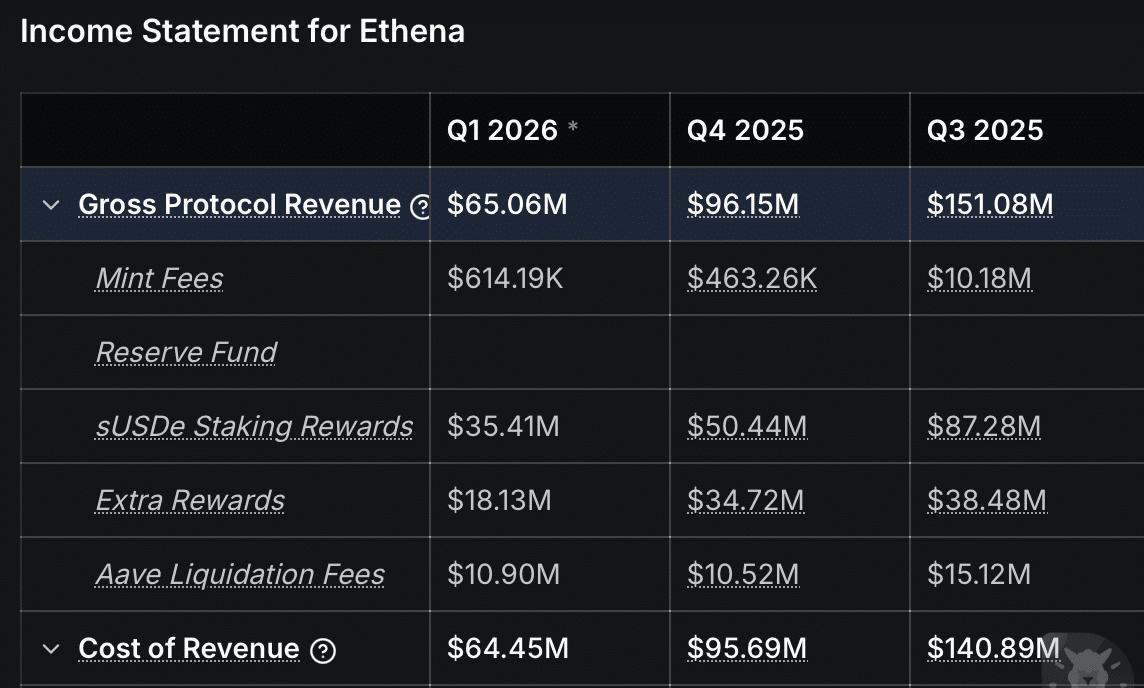
Un área clave de preocupación es la eficiencia de los ingresos. Los Ingresos Brutos del Protocolo cayeron a $65.06 millones, desde $96.15 millones en el Q4 de 2025, lo que representa un descenso del 32%. La caída se vuelve aún más pronunciada al compararla con el Q3 de 2025.

Esta contracción apunta a una actividad de acuñación más débil y a una reducción de las recompensas de staking, lo que sugiere una disminución de la participación en la cadena.
Fuente: DeFiLlama

En un mercado que se ha mantenido relativamente estable en comparación con el ciclo de octubre-diciembre de 2025, este bajo rendimiento genera preocupación sobre un debilitamiento de la demanda de los usuarios más que por una presión externa.

Las condiciones de liquidez refuerzan esta tendencia. El Valor Total Bloqueado (TVL), un indicador central de la salud del protocolo y el compromiso de los usuarios, ha continuado disminuyendo de manera constante.

Desde el inicio de marzo de 2026, el TVL ha caído aproximadamente $130 millones, situándose en alrededor de $6.66 mil millones al momento de escribir. Solo en las últimas 24 horas, se han desbloqueado aproximadamente $16 millones, lo que señala una salida sostenida de capital del protocolo.

¿Puede la ganancia por sí sola mantener el interés de los usuarios?

A pesar de la desaceleración general, Ethena ha registrado una ligera mejora en la rentabilidad bruta.

En el Q1 de 2026, el protocolo ha generado $614,190 en ganancias brutas, en comparación con $463,200 en el Q4 de 2025. Aunque esto refleja un aumento marginal, hace poco para compensar la fuerte caída de los niveles de rendimiento anteriores.

Para contextualizar, el Q3 de 2025 registró $10.18 millones en ganancias brutas, aproximadamente 16.5 veces más que las cifras actuales. Esta brecha resalta un declive estructural en el potencial de ganancias, incluso cuando la rentabilidad a corto plazo muestra una mejora menor.

La implicación es clara: un crecimiento modesto de las ganancias por sí solo puede no ser suficiente para retener usuarios, especialmente en un entorno DeFi competitivo donde el capital rota rápidamente hacia oportunidades de mayor rendimiento.

Los datos de actividad del usuario respaldan esta visión. Según Artemis, los Usuarios Activos Diarios han caído a alrededor de 1,200, el nivel más bajo registrado desde diciembre.

La demanda spot ofrece una contraseñal

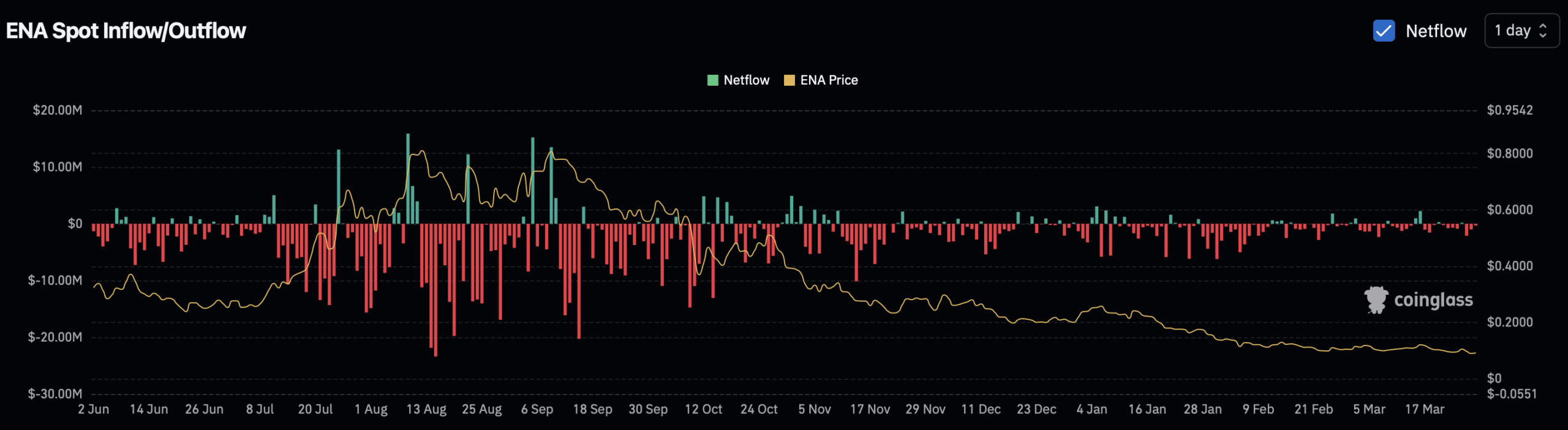
A pesar del debilitamiento de los fundamentos y la disminución de la liquidez, la actividad del mercado spot presenta una imagen más resiliente. Los datos de flujo neto de exchanges indican que la presión de compra ha aumentado recientemente. En las últimas 24 horas, las entradas netas en posiciones spot alcanzaron aproximadamente $303,000.

Más notablemente, esto no es un evento aislado. En los últimos tres días, las compras acumuladas han ascendido a alrededor de $3.41 millones, lo que sugiere una acumulación constante.
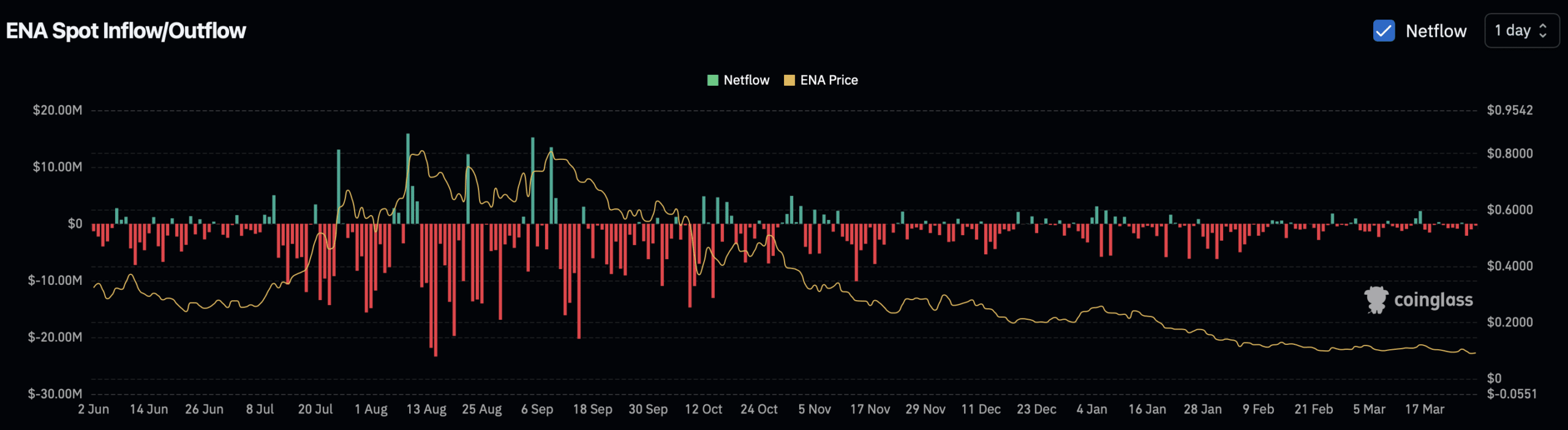
Fuente: CoinGlass

Una demanda tan sostenida indica que los inversores continúan absorbiendo la presión de venta, incluso cuando el capital sale de la capa del protocolo.

Si esta tendencia de acumulación se mantiene, podría limitar mayores caídas y apoyar la estabilización del precio. Sin embargo, sin una recuperación en los fundamentos centrales, particularmente la actividad de los usuarios y la generación de ingresos, cualquier alza puede permanecer limitada dentro de un rango estrecho.


Resumen Final

  • El rendimiento del protocolo de Ethena se deterioró en el Q1 de 2026, incluso cuando las condiciones generales del mercado se mantuvieron relativamente estables.
  • Los inversores spot continúan acumulando, a pesar del aumento de las salidas de liquidez y la disminución del TVL.


Related Questions

Q¿Por qué ha caído el precio de ENA a $0.089 y qué indica esta disminución?

AEl precio de ENA cayó a $0.089 debido a un debilitamiento en el rendimiento financiero del protocolo, incluyendo una caída del 32% en los ingresos brutos y una reducción en la actividad de acuñación y recompensas de staking, lo que sugiere una disminución en la participación en la cadena.

Q¿Cómo ha afectado la actividad de los usuarios y el TVL a Ethena en el primer trimestre de 2026?

AEl Valor Total Bloqueado (TVL) de Ethena ha disminuido constantemente, cayendo aproximadamente $130 millones desde marzo de 2026, y los usuarios activos diarios se redujeron a alrededor de 1,200, el nivel más bajo desde diciembre, indicando una salida de capital y menor participación.

Q¿Qué muestra la data de flujo neto de exchanges sobre la demanda spot de ENA?

ALos datos de flujo neto de exchanges indican que la presión compradora ha aumentado, con entradas netas de aproximadamente $303,000 en 24 horas y compras acumuladas de alrededor de $3.41 millones en tres días, sugiriendo una acumulación constante a pesar de la salida de capital del protocolo.

Q¿Por qué la mejora marginal en la rentabilidad bruta no es suficiente para Ethena?

AAunque la ganancia bruta aumentó marginalmente a $614,190 en Q1 2026, es 16.5 veces menor que los $10.18 millones de Q3 2025, lo que refleja una disminución estructural en el potencial de ganancias que no es suficiente para retener usuarios en un entorno DeFi.

Q¿Qué se necesita para que ENA estabilice su precio y limite further caídas?

APara estabilizar el precio y limitar further caídas, ENA necesita una recuperación en los fundamentos clave, como la actividad de usuarios y la generación de ingresos, ya que la acumulación en el mercado spot por sí sola puede no ser suficiente sin mejoras en la salud del protocolo.

Related Reads

Focus: Five Leading AI Stocks on Nasdaq

The report analyzes five Nasdaq-listed AI infrastructure stocks—Micron (MU), MaxLinear (MXL), AMD, Lumentum (LITE), and Vicor (VICR)—as distinct plays within the AI capital expenditure chain, rather than a single "AI trade." While all benefit from AI data center spending, they differ in their specific roles (e.g., memory, computing, optics, power, connectivity), financial resilience, and risk profiles. The author argues that the key question is not whether the AI narrative remains intact, but whether capital expenditure translates into real orders, earnings justify valuations, and portfolios can withstand high volatility. Historical data shows these stocks have significantly outperformed benchmarks but also experienced deeper drawdowns (~28% to -32%), highlighting their high-beta, high-volatility nature. An investment framework is proposed: core positions (e.g., MU, AMD) for stocks with stronger fundamental evidence; satellite positions (e.g., LITE, VICR) for high-potential, high-volatility names; and cautious observation (e.g., MXL) for smaller-cap ideas with unproven financials. The emphasis is on disciplined, phased buying during pullbacks—only when price corrections align with intact fundamentals and available risk budget—rather than emotional "buy-the-dip" strategies. Overall, AI infrastructure offers long-term potential, but success requires strict position sizing, role definition for each holding, and preparedness for significant volatility.

marsbit13m ago

Focus: Five Leading AI Stocks on Nasdaq

marsbit13m ago

Will UNI Reach $100 in Four Years? Will Standard Chartered's Prediction Come True?

TL;DR: - According to reports, Standard Chartered Bank has published a research report on Uniswap, setting a 2030 price target of $100 for the UNI token. - The bank's core logic is that the tokenization of assets will drive demand for open DeFi liquidity, and Uniswap could capture significant trading volume and fee revenue. - However, most institutional-grade tokenized products are permissioned, and the example of BlackRock's BUIDL shows that DeFi still faces significant access barriers. Standard Chartered's $100 target for UNI by 2030 is based on the hypothesis that tokenized assets will grow massively and a significant portion will flow into open DeFi markets, requiring decentralized exchange platforms like Uniswap for liquidity. The bank forecasts tokenized assets could reach $4 trillion by 2028, with up to 30% in DeFi by 2030. The key question is whether tokenized assets like treasuries and funds will trade in open, decentralized markets or remain within closed, permissioned institutional systems. This directly impacts Uniswap's potential growth. A real-world example is BlackRock's BUIDL fund, which, while using UniswapX for trading, is strictly limited to pre-approved, whitelisted institutional participants. This highlights the current trend: institutions may leverage DeFi infrastructure but maintain strict control over access and transfers. Furthermore, for UNI's value to rise significantly, Uniswap must establish a clear value-capture mechanism, such as the approved fee switch and token burn proposal. Regulatory and interoperability hurdles also persist, as noted by bodies like the Financial Stability Board. In summary, Standard Chartered's bold prediction hinges on the future flow of tokenized asset liquidity. While it signals institutional recognition of DeFi's potential, the path to $100 depends on overcoming current permissioned models and enabling truly open, cross-asset liquidity pools on platforms like Uniswap.

Foresight News16m ago

Will UNI Reach $100 in Four Years? Will Standard Chartered's Prediction Come True?

Foresight News16m ago

Odaily Editorial Team Tea Talk (June 17)

Odaily Editorial Team Casual Chat (June 17) This is an informal column sharing real-time thoughts from Odaily's editorial team on industry news, data, and events. The content is based on actual investment and observations, does not constitute investment advice, and aims to expand perspectives. Azuma shared recent operations: small-scale buys in crypto (mainly BTC) at relatively high levels, a small addition to HOOD stock, and participation in World Cup prediction markets. He also discussed Hyperliquid, noting that while its token HYPE has performed well, its high price may hinder the expansion of its HIP-3 ecosystem by making market creation cost-prohibitive, potentially limiting the platform to just one major market (trade.xyz). Suzz emphasized the importance of a calm mindset in investing, stating that markets offer perpetual opportunities. He warned against "hindsight bias," where past opportunities seem obvious, and stressed that the present always holds new chances for those with the right knowledge and temperament. Golem analyzed SpaceX's acquisition of AI tool Cursor's parent company, Anysphere, for $60 billion paid entirely in SpaceX stock. He speculated whether Musk's interests might work to keep SpaceX's trading volume and market cap high in the short term to reduce the actual equity cost of the deal, noting current high retail investor enthusiasm. Wenser shared a market outlook: cautiously bullish on BTC, monitoring SpaceX stock post-IPO for a potential rise, observing World Cup trends favoring strong teams, and noting the continued strength of Japanese and Korean stocks. He highlighted Anthropic's potential for a massive future IPO and the defensive investment logic in "picks and shovels" AI infrastructure. Qin Xiaofeng discussed trading HYPE around $56-$70, viewing the $50-$60 range as long-term support due to Hyperliquid's dominance in on-chain traditional asset trading and its substantial fee revenue used to buy back HYPE. On ETH, he noted a divide between disappointed crypto natives and bullish traditional investors like Tom Lee, personally viewing current ETH prices as undervalued.

Odaily星球日报28m ago

Odaily Editorial Team Tea Talk (June 17)

Odaily星球日报28m ago

Under the Shock of Oil Prices and Inflation, Which Country Will Be the First to Sell Off Its Gold Reserves?

The article draws a parallel between the 2003 North American blackout and the potential collapse of the global financial system, framing the US dollar and Treasury market as the world's economic "power grid." It argues that the closure of the Strait of Hormuz is creating a shockwave, starting with oil-importing emerging markets like Turkey, India, and Indonesia. As oil prices rise, these nations are forced to sell dollar-denominated assets—first US Treasuries, then potentially their gold reserves—to afford fuel. Turkey is highlighted as a key case, having sold nearly 90% of its Treasuries and begun tapping gold reserves when oil was between $70-$105/barrel. The article warns that if prices spike to $150-$160/barrel, global buffers like oil inventories and strategic reserves will be depleted. This could trigger a cascade: vulnerable nations, having exhausted assets, could face economic and political collapse (like Sri Lanka in 2022). Their forced asset sales would drive US Treasury yields higher, potentially past a critical threshold (around 5%), forcing the US to choose between a bond market crash or hyperinflation through massive money printing. Ultimately, the piece posits that the dollar's long-term decline is inevitable. The first domino to fall will likely be a fragile emerging market, signaling the start of a chain reaction that eventually threatens the core of the dollar system. The conclusion advises holding tangible assets like gold and energy, which cannot be printed, as a hedge against currency devaluation.

marsbit52m ago

Under the Shock of Oil Prices and Inflation, Which Country Will Be the First to Sell Off Its Gold Reserves?

marsbit52m ago

Trading

Spot
Futures

Hot Articles

How to Buy ENA

Welcome to HTX.com! We've made purchasing Ethena (ENA) simple and convenient. Follow our step-by-step guide to embark on your crypto journey.Step 1: Create Your HTX AccountUse your email or phone number to sign up for a free account on HTX. Experience a hassle-free registration journey and unlock all features.Get My AccountStep 2: Go to Buy Crypto and Choose Your Payment MethodCredit/Debit Card: Use your Visa or Mastercard to buy Ethena (ENA) instantly.Balance: Use funds from your HTX account balance to trade seamlessly.Third Parties: We've added popular payment methods such as Google Pay and Apple Pay to enhance convenience.P2P: Trade directly with other users on HTX.Over-the-Counter (OTC): We offer tailor-made services and competitive exchange rates for traders.Step 3: Store Your Ethena (ENA)After purchasing your Ethena (ENA), store it in your HTX account. Alternatively, you can send it elsewhere via blockchain transfer or use it to trade other cryptocurrencies.Step 4: Trade Ethena (ENA)Easily trade Ethena (ENA) on HTX's spot market. Simply access your account, select your trading pair, execute your trades, and monitor in real-time. We offer a user-friendly experience for both beginners and seasoned traders.

4.2k Total ViewsPublished 2024.04.03Updated 2026.06.02

How to Buy ENA

Ethena: Building a New Era of Web3‑Native Digital Dollars

Ethena is an Ethereum‑based synthetic dollar protocol that delivers crypto‑native monetary solutions, including USDe, a synthetic dollar, and sUSDe, a globally accessible U.S. dollar savings asset.

53.2k Total ViewsPublished 2026.03.16Updated 2026.03.16

Ethena: Building a New Era of Web3‑Native Digital Dollars

Discussions

Welcome to the HTX Community. Here, you can stay informed about the latest platform developments and gain access to professional market insights. Users' opinions on the price of ENA (ENA) are presented below.

活动图片