How Summer Is Turning Into A Short-Lived Altcoin Season

newsbtcPublished on 2022-08-03Last updated on 2022-08-03

Abstract

Ethereum Classic (ETC), Filecoin (FIL), and Lido DAO (LIDO) have been dominating the altcoin sector as they outperform Bitcoin and other large cryptocurrencies. The first crypto by market cap has been recording its best month in 2022 but is still far from the monthly average return from these tokens.

Ethereum Classic (ETC), Filecoin (FIL), and Lido DAO (LIDO) have been dominating the altcoin sector as they outperform Bitcoin and other large cryptocurrencies. The first crypto by market cap has been recording its best month in 2022 but is still far from the monthly average return from these tokens.

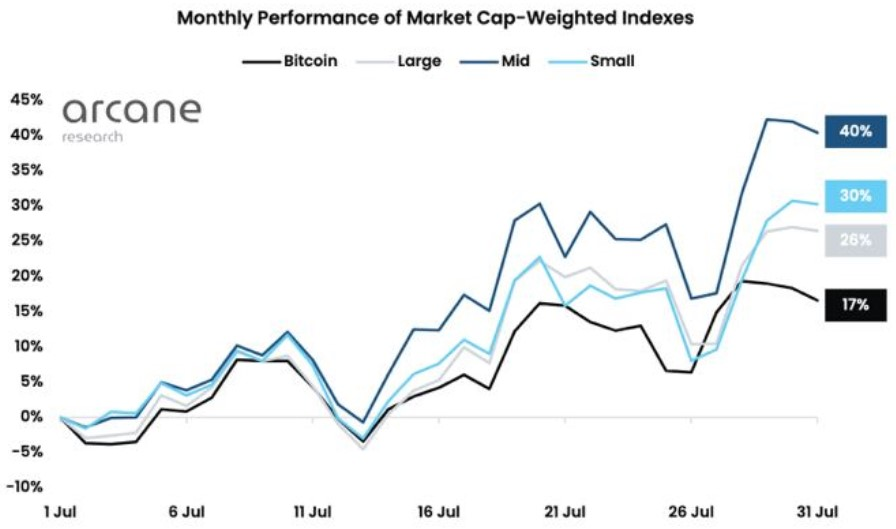
According to Arcane Research, altcoins have seen an average of 40% performance over the past month as the crypto market experienced a “classic relief rally”. July has been a historical green month for digital assets.

During this period, the nascent asset class has seen the expansion of two critical sectors, decentralized finances (DeFi) and non-fungible tokens (NFTs). As seen below, the rally has been particularly positive for mid-cap cryptocurrencies.
This market rally has translated into a reduction of Bitcoin and stablecoins market share, suggesting an increase in risk appetite for crypto investors, and more strength for Ethereum. Arcane Research noted:

Ether’s lack of strength relative to bitcoin last week has been reversed this week, as ether has increased its market share by 0.43 percentage points, while bitcoin has lost 0.22 percentage points. Notably, bitcoin and stablecoin are losing market share this week (…).

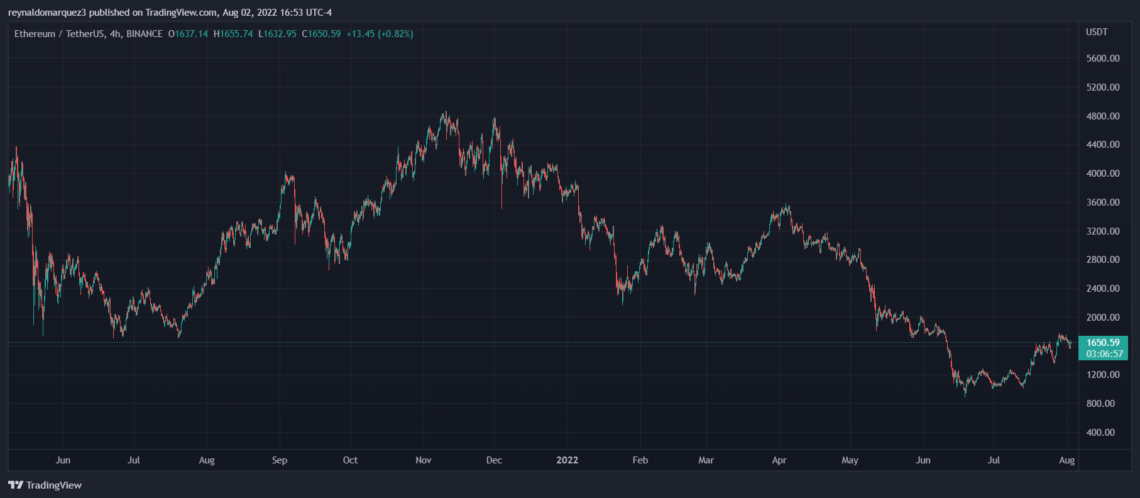
Ethereum might be critical for understanding the current price action. The cryptocurrency has a tentative deployment date for “The Merge”, the event that will combine its execution layer (Proof-of-Work) with its consensus layer (Proof-of-Stake).

Altcoins, such as Lido Dao and Ethereum Classic, might benefit from the imminent shift in this blockchain. The former cryptocurrency has rallied because more users want to stake their ETH and participate in Ethereum (2.0) consensus model to receive rewards.

Ethereum Classic has seen positive performance because it might become a safe haven for ETH miners. This sector faces inevitable destruction as ETH’s new consensus model will validate transactions with a different mechanism.
Will The Merge Provide Altcoins With Further Bullish Momentum

In that sense, and up to “The Merge” mainnet launch, altcoins might continue to extend their bullish trajectory. Data from a pseudonym user highlights the importance of this event and why it might inject fresh capital into this ecosystem further driving the price of Ethereum and the altcoin sector.

The user claims this cryptocurrency will become Environmental, Social, and Governance (ESG) friendly. This will provide new institutions with the confidence to bet on Ethereum’s long-term success. The user said:

No matter your personal thoughts on ESG, if you want mainstream cryptoasset adoption controlling the narrative around emissions and sustainability is essential. Bitcoin has decided to ignore the issue; Ethereum unlatching itself from PoW should be a positive for both assets.

Trending Cryptos

Related Reads

NVIDIA CPU Advances, China's RISC-V Responds: Semiconductor Deep Dive - Part Four

NVIDIA is set to launch its new Vera AI data center CPU in China as early as August, with high pricing. While this move offers a new option, it highlights China's continued dependence on foreign-controlled Arm architecture. In response, the Chinese semiconductor industry is increasingly turning to RISC-V as a strategic alternative for achieving high-performance computing autonomy. The article explores the concept of the "impossible triangle" in CPU development—balancing prosperity, control, and autonomy—and posits that RISC-V's open-source, modular nature offers a unique path to achieving all three. While RISC-V is already dominant in embedded systems, the focus is now shifting to data centers and AI workloads. China has become a global hotspot for RISC-V development, driven by AI-driven compute demand, supply chain concerns from export controls, cost benefits of open-source, and strong policy support. Multiple Chinese companies have reportedly crossed the key performance threshold of 15 SPECint per GHz, a benchmark for entering the high-performance CPU club. Progress extends beyond single-core benchmarks. Companies are developing complete computing subsystems, including commercial-grade coherent network-on-chip (NoC) technology and server processors with up to 40 cores that strictly adhere to the RVA23 standard to ensure software compatibility. Real-world applications are emerging in areas like video transcoding and edge AI. However, significant challenges remain. The RISC-V ecosystem faces fragmentation, immature toolchains and verification processes, and gaps in single-core performance and energy efficiency compared to mature x86 and Arm architectures. The formidable software moat, epitomized by NVIDIA's CUDA, is a long-term hurdle. In conclusion, while RISC-V cannot immediately replace offerings like NVIDIA's Vera, it represents a viable long-term path for China to develop a self-sufficient, high-performance CPU ecosystem. The journey is acknowledged to be long and arduous, requiring sustained effort to overcome technical and ecosystem challenges.

marsbit6h ago

NVIDIA CPU Advances, China's RISC-V Responds: Semiconductor Deep Dive - Part Four

marsbit6h ago

Trading

Spot
Futures

Hot Articles

Discussions

Welcome to the HTX Community. Here, you can stay informed about the latest platform developments and gain access to professional market insights. Users' opinions on the price of ETH (ETH) are presented below.

活动图片