All about Bitcoin and its final downside test before price recovery

AmbcryptoPublished on 2026-02-09Last updated on 2026-08-27

Abstract

Everyone in the Bitcoin market is hedging their bets right now.

As Bitcoin slides deeper below recent cost bases, weak hands are capitulating. However, smart money might just be repositioning, rather than retreating.

Loss realization accelerated as Bitcoin [BTC] corrected by nearly 40–50% from its $126,000 peak to the $70,000-zone in the recent days, triggering fear-driven distribution. Retail and Short-Term Holders led the capitulation, dumping into losses as long liquidations cascaded across derivatives markets.

Panic intensified as the Fear & Greed Index sank to 5–20 too. All while liquidity thinned and amplified downside volatility.

Markets reacted with compressed depth and sharp downward wicks. Still, dip accumulation and institutional absorption emerged as countermeasures, stabilizing the sentiment slightly while traders remained defensively bearish.

Short-Term holder supply contracts as new demand fades

Short-term holder dynamics have now extended the prior capitulation and whale divergence phase.

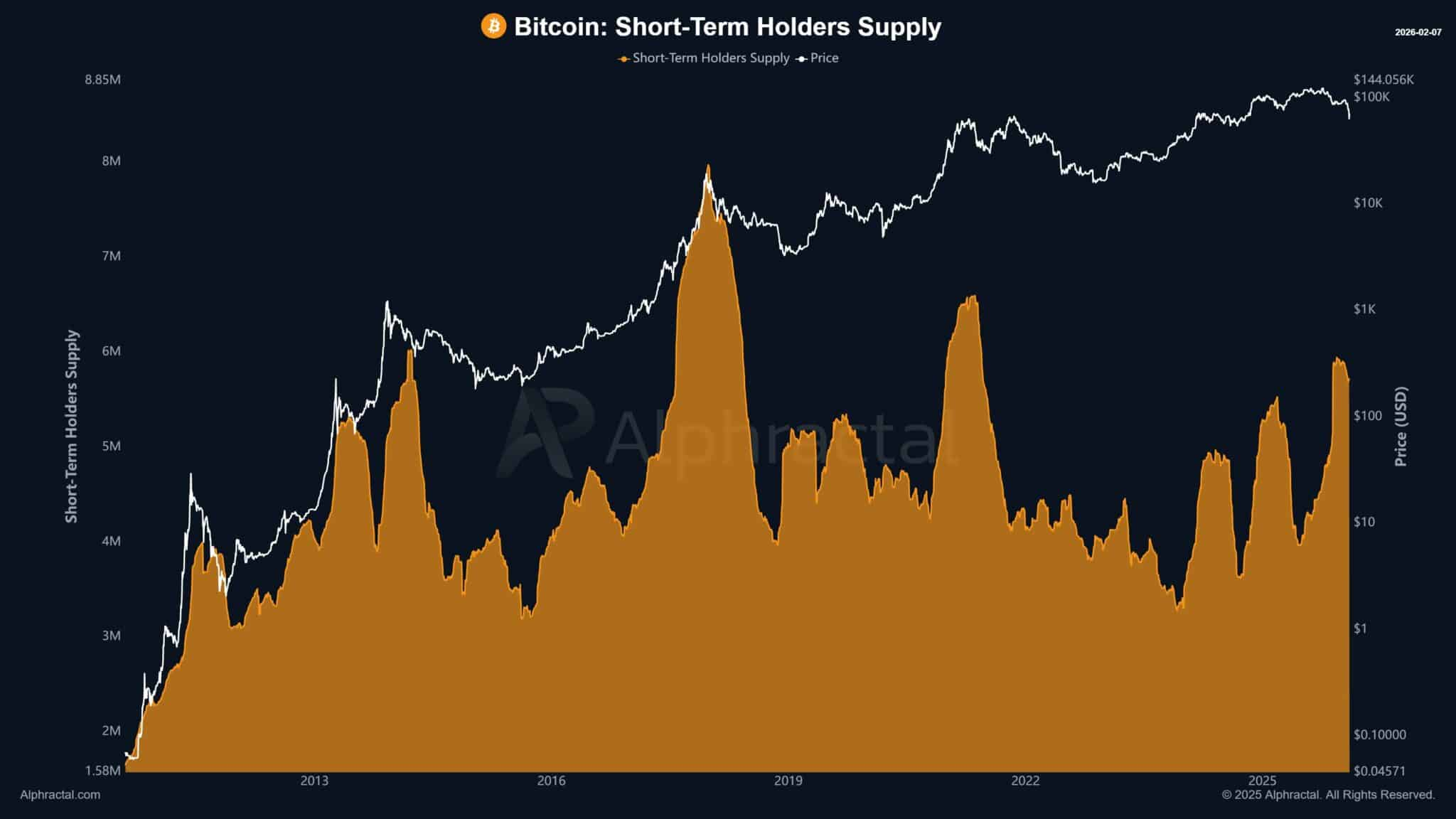
Initially, the STH supply expanded during the late-cycle rally, peaking near 8 million BTC as speculative demand surged. However, as the price corrected towards the $60,000–$70,000 band, distribution followed. The supply contracted steadily too, reflecting forced exits and loss realization.
Simultaneously, the 90-day net position change flipped deeply negative, with drawdowns nearing -1.5 million to -2 million BTC across cycles.

These developments signaled fading participation from new entrants. Retail accumulation stalled while underwater holders de-risked themselves.
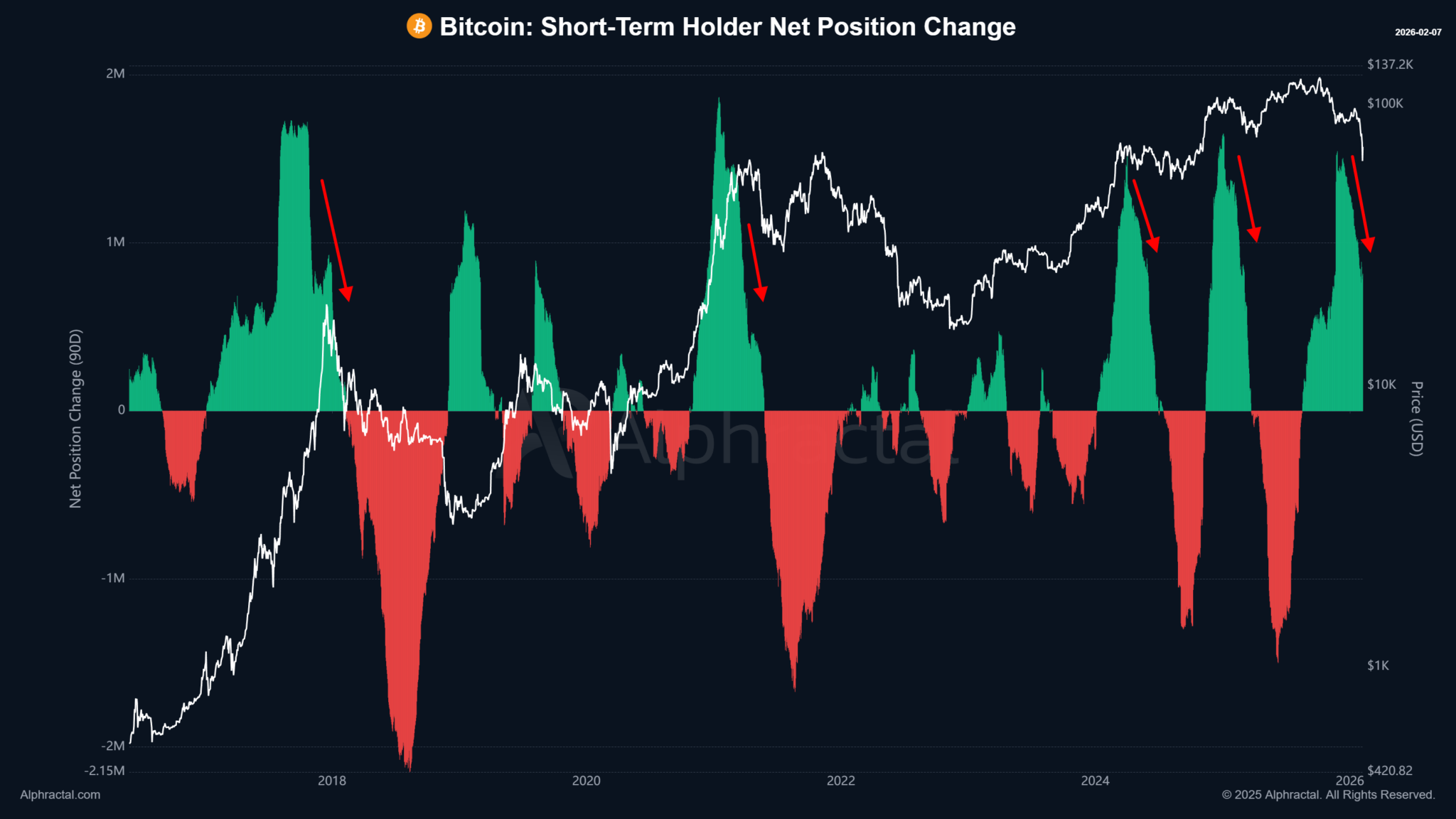
That’s not all though as market liquidity thinned alongside this withdrawal. Without fresh inflows, upside continuation lost structural support. Instead, the data seemed to point to absorption and base-building. Hence, recovery now hinges on renewed demand, improved sentiment, and sustained positive net positioning.

Building on the prior supply contraction and distress flows, cost-basis stress remains the core driver. At the time of writing, Bitcoin was valued at just above $69,000. Since the STH realized price has been holding at around $92,000–$92,500, recent buyers have been left underwater.
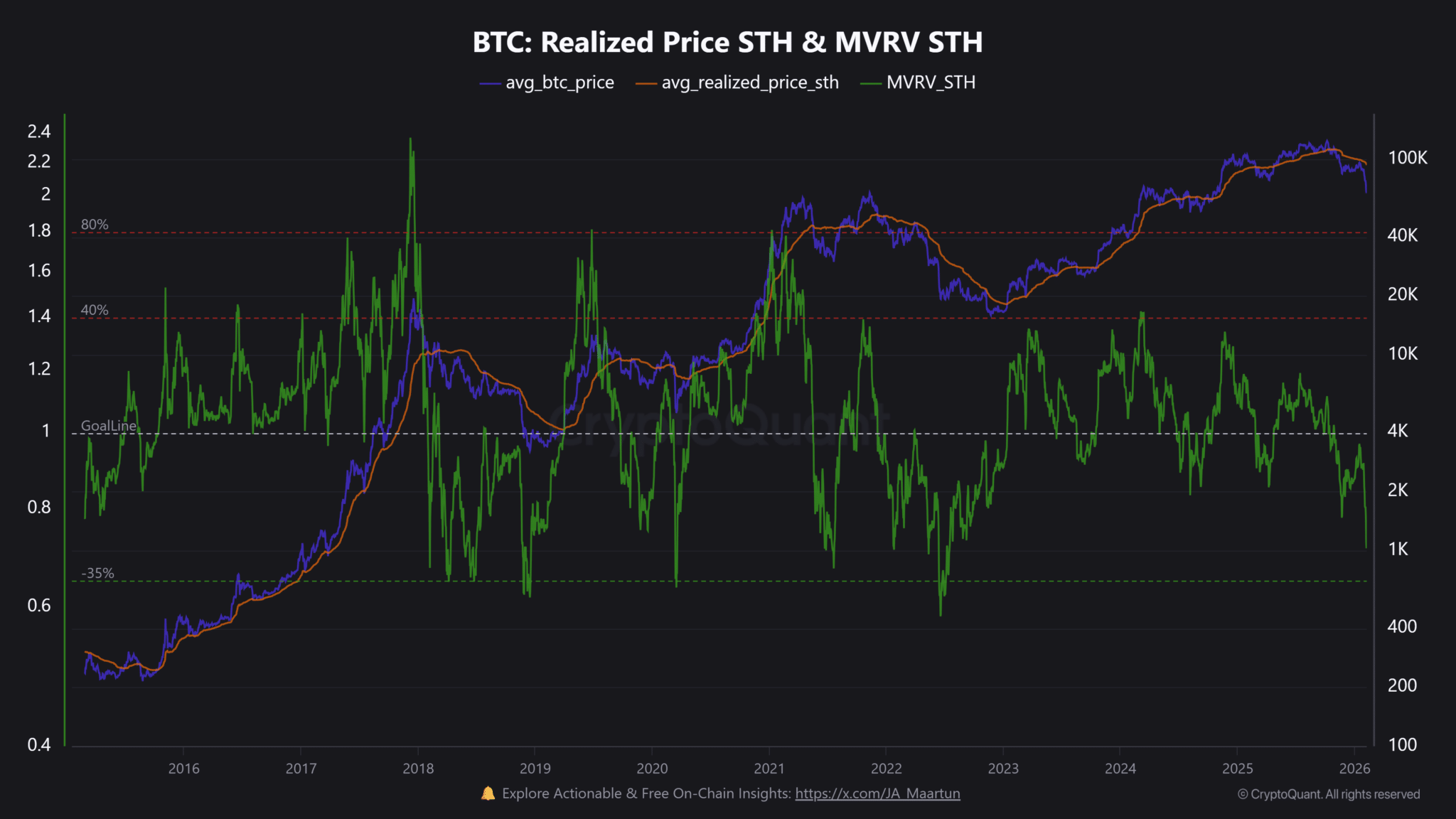
As this gap widened, the profitability compressed further. The STH-MVRV slid to about 0.75–0.78, confirming deep unrealized losses. Selling pressure followed as underwater holders de-risked themselves. Market sentiment weakened alongside this stress too.

Historically, such sub-1.0 MVRV zones mark washout phases. Thus, stabilization will now depend on the MVRV recovering towards 1.0 and the price reclaiming the cost basis. If loss flows taper while the price bases, capitulation could exhaust itself, allowing structure to rebuild gradually.

Retail optimism collides with whale caution

Whale positioning seemed to be reinforcing the structural shift too. As BTC stabilized near $69,000 after heavy loss realization, the whale vs. retail Delta spiked above 0.8 – A sign that large players have been closing longs while opening shorts.
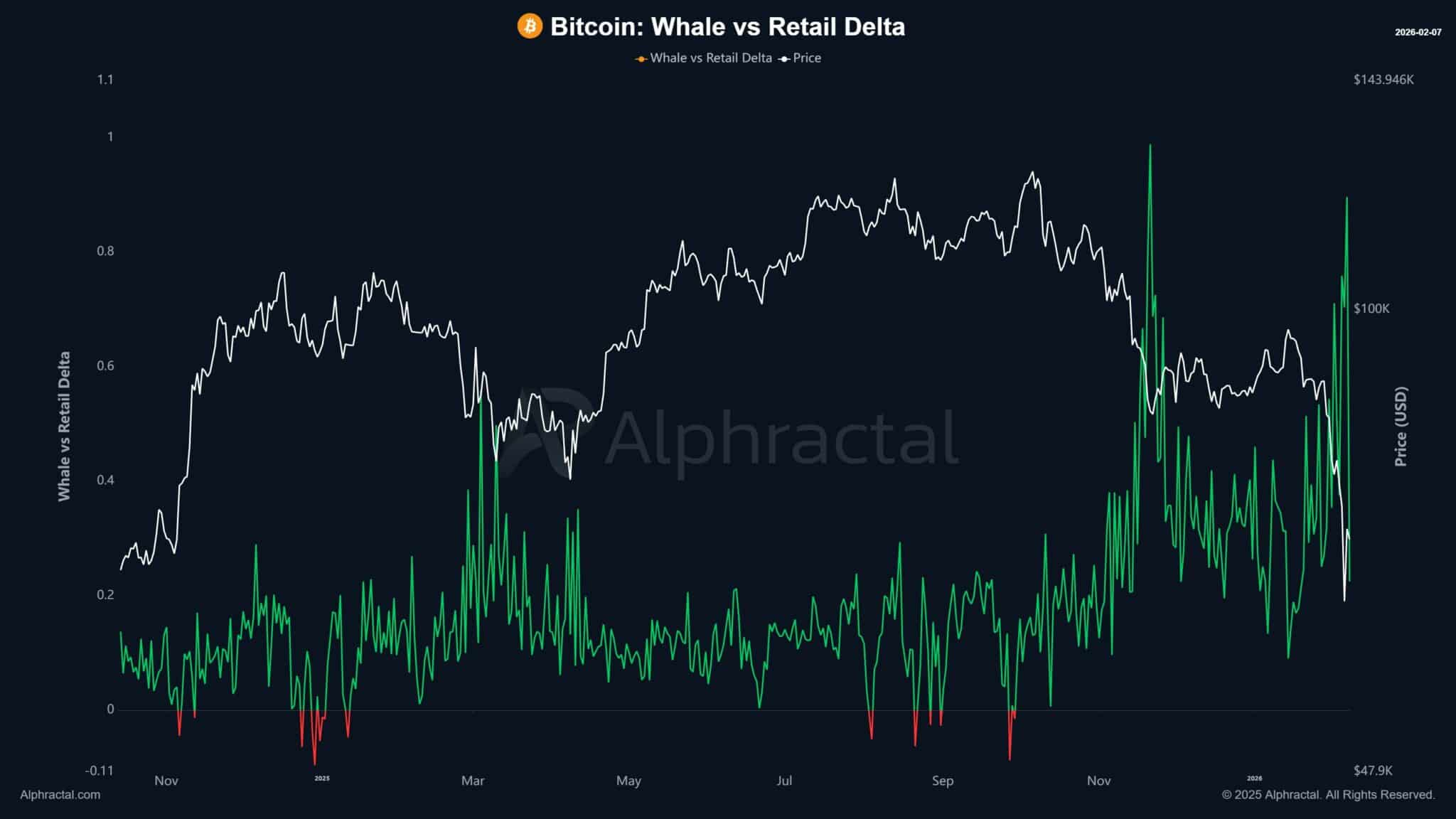
This rotation followed cost-basis compression and weakening upside momentum. Whales aimed to hedge exposure and engineer consolidation, rather than chase recovery.

Meanwhile, retail flows remained directionally long, driven by dip-buy optimism and rebound expectations. Such a divergence widened the positioning imbalance.

As smart money de-risked into strength, volatility compressed and upside follow-through weakened. Consequently, market structure tilted towards range formation, reinforcing a near-term consolidation regime.

Final Thoughts

Retail capitulation has been accelerating as STH supply contracts and cost-basis stress deepened.

Whale hedging and short positioning into weakness hinted at consolidation risk, leaving Bitcoin vulnerable to one final downside liquidity sweep.


Trending Cryptos

Related Reads

Trading

Spot

Hot Articles

What is $BITCOIN

DIGITAL GOLD ($BITCOIN): A Comprehensive Analysis Introduction to DIGITAL GOLD ($BITCOIN) DIGITAL GOLD ($BITCOIN) is a blockchain-based project operating on the Solana network, which aims to combine the characteristics of traditional precious metals with the innovation of decentralized technologies. While it shares a name with Bitcoin, often referred to as “digital gold” due to its perception as a store of value, DIGITAL GOLD is a separate token designed to create a unique ecosystem within the Web3 landscape. Its goal is to position itself as a viable alternative digital asset, although specifics regarding its applications and functionalities are still developing. What is DIGITAL GOLD ($BITCOIN)? DIGITAL GOLD ($BITCOIN) is a cryptocurrency token explicitly designed for use on the Solana blockchain. In contrast to Bitcoin, which provides a widely recognized value storage role, this token appears to focus on broader applications and characteristics. Notable aspects include: Blockchain Infrastructure: The token is built on the Solana blockchain, known for its capacity to handle high-speed and low-cost transactions. Supply Dynamics: DIGITAL GOLD has a maximum supply capped at 100 quadrillion tokens (100P $BITCOIN), although details regarding its circulating supply are currently undisclosed. Utility: While precise functionalities are not explicitly outlined, there are indications that the token could be utilized for various applications, potentially involving decentralized applications (dApps) or asset tokenization strategies. Who is the Creator of DIGITAL GOLD ($BITCOIN)? At present, the identity of the creators and development team behind DIGITAL GOLD ($BITCOIN) remains unknown. This situation is typical among many innovative projects within the blockchain space, particularly those aligning with decentralized finance and meme coin phenomena. While such anonymity may foster a community-driven culture, it intensifies concerns about governance and accountability. Who are the Investors of DIGITAL GOLD ($BITCOIN)? The available information indicates that DIGITAL GOLD ($BITCOIN) does not have any known institutional backers or prominent venture capital investments. The project seems to operate on a peer-to-peer model focused on community support and adoption rather than traditional funding routes. Its activity and liquidity are primarily situated on decentralized exchanges (DEXs), such as PumpSwap, rather than established centralized trading platforms, further highlighting its grassroots approach. How DIGITAL GOLD ($BITCOIN) Works The operational mechanics of DIGITAL GOLD ($BITCOIN) can be elaborated on based on its blockchain design and network attributes: Consensus Mechanism: By leveraging Solana’s unique proof-of-history (PoH) combined with a proof-of-stake (PoS) model, the project ensures efficient transaction validation contributing to the network's high performance. Tokenomics: While specific deflationary mechanisms have not been extensively detailed, the vast maximum token supply implies that it may cater to microtransactions or niche use cases that are still to be defined. Interoperability: There exists the potential for integration with Solana’s broader ecosystem, including various decentralized finance (DeFi) platforms. However, the details regarding specific integrations remain unspecified. Timeline of Key Events Here is a timeline that highlights significant milestones concerning DIGITAL GOLD ($BITCOIN): 2023: The initial deployment of the token occurs on the Solana blockchain, marked by its contract address. 2024: DIGITAL GOLD gains visibility as it becomes available for trading on decentralized exchanges like PumpSwap, allowing users to trade it against SOL. 2025: The project witnesses sporadic trading activity and potential interest in community-led engagements, although no noteworthy partnerships or technical advancements have been documented as of yet. Critical Analysis Strengths Scalability: The underlying Solana infrastructure supports high transaction volumes, which could enhance the utility of $BITCOIN in various transaction scenarios. Accessibility: The potential low trading price per token could attract retail investors, facilitating wider participation due to fractional ownership opportunities. Risks Lack of Transparency: The absence of publicly known backers, developers, or an audit process may yield skepticism regarding the project's sustainability and trustworthiness. Market Volatility: The trading activity is heavily reliant on speculative behavior, which can result in significant price volatility and uncertainty for investors. Conclusion DIGITAL GOLD ($BITCOIN) emerges as an intriguing yet ambiguous project within the rapidly evolving Solana ecosystem. While it attempts to leverage the “digital gold” narrative, its departure from Bitcoin's established role as a store of value underscores the need for a clearer differentiation of its intended utility and governance structure. Future acceptance and adoption will likely depend on addressing the current opacity and defining its operational and economic strategies more explicitly. Note: This report encompasses synthesised information available as of October 2023, and developments may have transpired beyond the research period.

2.4k Total ViewsPublished 2025.05.13Updated 2025.05.13

What is $BITCOIN

Discussions

Welcome to the HTX Community. Here, you can stay informed about the latest platform developments and gain access to professional market insights. Users' opinions on the price of BTC (BTC) are presented below.

活动图片