Ídolo dorado y meme que se desvanece: el absurdo drama detrás de la gigantesca estatua de Trump

比推Published on 2026-02-05Last updated on 2026-02-05

Abstract

Una estatua dorada gigante de 15 pies del expresidente Donald Trump, apodada "Don Colossus", se ha convertido en el centro de un extraño plan de criptomonedas. Un grupo de inversores gastó 300.000 dólares en la estatua para promover una meme coin llamada PATRIOT, aprovechando el apoyo de Trump a las criptomonedas. A pesar de los planes de develarla en su campo de golf en Florida, el proyecto se ha visto empañado por disputas internas, retrasos y una caída de más del 90% en el valor del token. El escultor, Alan Cottrill, alega que le deben 90.000 dólares y acusa a los promotores de usar ilegalmente su obra con derechos de autor. Aunque figuras como el pastor Mark Burns, cercano a Trump, han participado el proyecto, la familia Trump ha negado cualquier participación o respaldo oficial a la moneda.

Título original: "Don Colossus" a Golden Statue of President Trump, Waits for Its Home

Autor original: David Yaffe-Bellany, The New York Times

Compilación original: Luffy, Foresight News

Título original en chino: 镀金的偶像与归零的MEME币:特朗普巨型雕像背后的荒诞剧


Esta estatua del presidente Trump se llama «Don Colossus». Mide 15 pies de altura, descansa sobre una base de 7000 libras y su altura total es comparable a la de un edificio de dos pisos. La gigantesca estatua está fundida en bronce y su superficie está recubierta con una gruesa capa de pan de oro. (Nota: Don Colossus se traduce literalmente como «El Gigante Don», refiriéndose a Trump como un gigante).

Durante más de un año, esta estatua dorada ha sido el núcleo de uno de los planes más extraños para hacer dinero de la era Trump. Un grupo de inversores en criptomonedas gastó 300,000 dólares para encargar a un escultor la creación de esta estatua, como homenaje al Trump que apoya abiertamente las criptomonedas.

Luego, utilizaron la estatua para promocionar una moneda meme llamada PATRIOT.

Ahora, inesperadamente, este plan parece estar a punto de materializarse. El mes pasado, se completó una base de hormigón y acero inoxidable en el complejo turístico de golf de Trump en Doral, Florida. Según registros de mensajes revisados por The New York Times, Mark Burns, uno de los organizadores del plan y amigo de Trump, informó a los colaboradores que el presidente planea asistir a la ceremonia de inauguración de la estatua en el lugar.

"La estatua se ve genial.", escribió Trump en una carta a Burns en diciembre pasado.
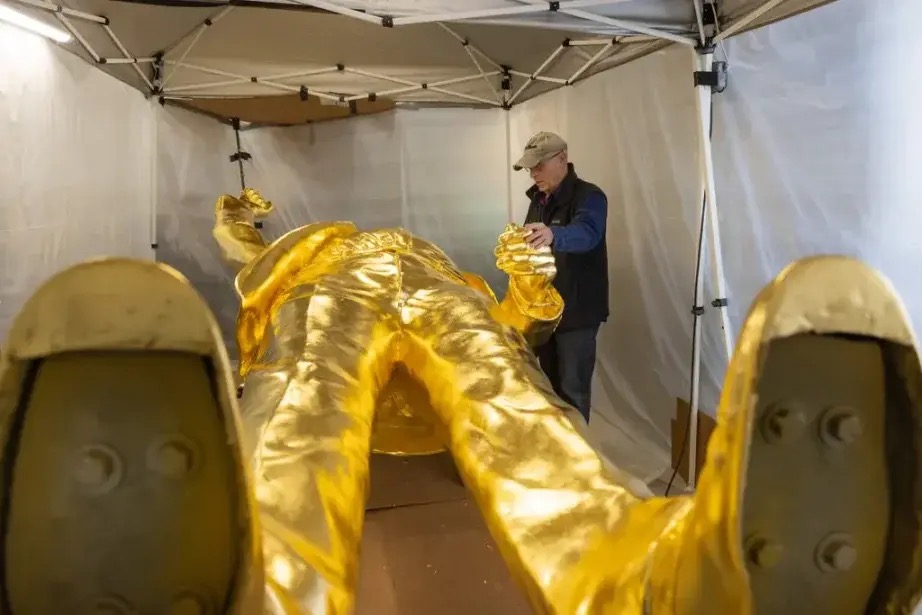
Alan Cottrill inspecciona la estatua dorada del presidente Trump que diseñó, en Zanesville, Ohio.

Casi todos en el espacio de las criptomonedas han intentado beneficiarse del mandato presidencial de Trump: ya sea cerrando acuerdos comerciales con su familia o buscando un relajamiento regulatorio de su gobierno. Pero pocos han sido tan audaces como los partidarios de PATRIOT.

Una moneda meme es una criptomoneda con casi ninguna función práctica aparte de la especulación, generalmente creada en torno a memes virales o imágenes de celebridades, y su valor depende completamente del precio que los fanáticos en línea estén dispuestos a pagar. La clave para crear una moneda meme es generar suficiente revuelo en las redes sociales para que los compradores potenciales crean que su precio seguirá subiendo.

Crear una estatua gigante es una forma costosa de generar revuelo en las redes sociales, pero también un plan potencialmente rentable. Según uno de los organizadores del plan, los inversores que financiaron la estatua recibieron grandes cantidades del token, cuyo precio a veces se disparaba. Durante meses, los partidarios de «Don Colossus» publicaron en la plataforma X imágenes del progreso de la estatua y forjaron alianzas dentro del campo «Make America Great Again», con el objetivo de lograr un gran golpe de marketing: que la estatua encontrara un hogar en una propiedad oficial de Trump.

A finales de 2024, la moneda meme PATRIOT se lanzó oficialmente, coincidiendo con la promesa de Trump de convertir a Estados Unidos en la «capital mundial de las criptomonedas», y el precio del token se disparó. Durante un evento en Washington el fin de semana de la inauguración presidencial, los partidarios del token regalaron una miniatura de bronce de la estatua a Steve Bannon, exasesor de Trump, e interactuaron con otras figuras conservadoras.

Pero los repetidos retrasos y los conflictos internos empañaron el plan de hacer dinero y ofrecieron una visión de la volatilidad del mercado de las monedas meme: un mercado plagado de estafas donde los inversores a menudo terminan perdiendo todo. El año pasado, el precio de PATRIOT se desplomó, casi llegando a cero. Para acelerar la finalización de la estatua y impulsar el token, los inversores también entraron en conflicto con el escultor Alan Cottrill, con sede en Ohio.

En los registros de mensajes de texto revisados por The New York Times, Cottrill afirmó que los inversores aún le debían 75,000 dólares por los derechos de propiedad intelectual de la estatua.

"¡Están usando la imagen de mi estatua, protegida por derechos de autor, para comercializar su token!", escribió el mes pasado en un mensaje a uno de los partidarios del token.

"Sí, jaja, planeamos hacerlo desde el primer día.", respondió Ashley Sansalone. Sansalone es un desarrollador de criptomonedas que, además de PATRIOT, participa en otro token llamado Elon GOAT.
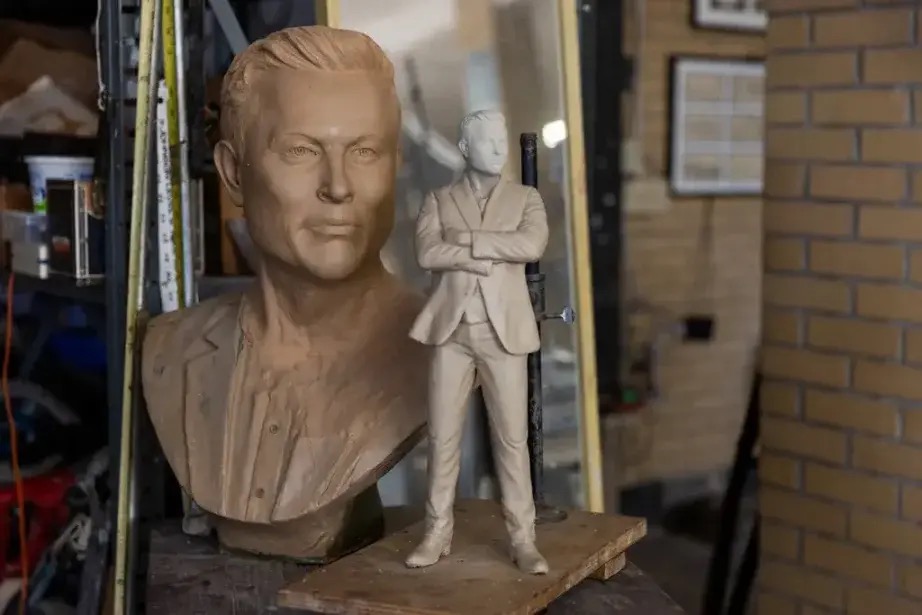
Escultura de Elon Musk diseñada por encargo de Alan Cottrill

Sansalone dijo en una declaración que Cottrill sería pagado en su totalidad antes de la inauguración de la estatua. "En cualquier acuerdo comercial, se retiene una parte del pago hasta que el producto final se entrega por completo.", dijo.

Pero aún no está claro cuándo se exhibirá oficialmente la estatua.

El lunes, después de que The New York Times preguntara a la Casa Blanca y al Trump Group sobre el token PATRIOT, el hijo del presidente, Eric Trump, publicó una declaración en X.

"Agradecemos el apoyo y el entusiasmo de todos,", dijo, "pero debe quedar claro que no participamos en ningún asunto relacionado con este token."

Creando a «Don Colossus»

El plan para crear «Don Colossus» nació en un chat grupal en la aplicación de mensajería Telegram, donde los entusiastas de las criptomonedas a menudo intercambian consejos de inversión y promueven tokens. Era julio de 2024, y Trump acababa de escapar de un intento de asesinato en Butler, Pennsylvania, donde alzó el puño con determinación.

Sansalone quería convertir esta imagen de desafío en la imagen central de una moneda meme. Colaboró con el activista de derecha Dustin Stockton, y también se unió el influyente inversor de criptomonedas Brock Pierce, quien ha estado involucrado en diversas disputas legales y financieras.

Poco después de que la bala rozara la oreja de Trump, Sansalone se puso en contacto con Cottrill, de 73 años, cuya estatua de bronce de Edison se exhibe ahora en el Capitolio de los Estados Unidos. Durante años, Cottrill ha creado estatuas de más de una docena de presidentes estadounidenses, incluidos monumentos de 10 pies de altura a George Washington y Thomas Jefferson.

Cottrill de pie en una habitación llena de esculturas

Este grupo de inversores en criptomonedas quería que la estatua de Trump fuera más grande que sus obras anteriores y propuso algunas modificaciones en su apariencia.

"Mi escultura inicial era muy realista.", dijo Cottrill el mes pasado en una entrevista. "La gente de las cripto me pidió que suavizara un poco la papada y afinara su físico."

Para la inauguración de Trump, Cottrill ya había completado la estatua; esta gigantesca figura de bronce, aún sin dorar, era la más alta que había creado. En diciembre pasado, Trump compartió en sus redes sociales un informe de Breitbart News sobre el proyecto, que decía que Stockton estaba en comunicación con el comité de inauguración presidencial para planificar una ceremonia de revelación de la estatua durante el fin de semana de la inauguración.

El momento de esta publicación fue perfecto: el token PATRIOT acababa de ser lanzado.

Su sitio web decía: "El token de cifrado de la gente, esta estatua que nadie puede borrar".

Pero luego, el proyecto sufrió dos grandes reveses. El clima frío en Washington causó una serie de problemas logísticos, obligando a posponer los planes de revelación de la estatua; y poco antes de la ceremonia de inauguración, Trump lanzó su propia moneda meme, TRUMP.

Mientras los comerciantes de criptomonedas se apresuraban a comprar este token oficial, Stockton y Pierce organizaron un evento de "Premios Patriotas" en el National Press Club de Washington, repartiendo miniaturas de la estatua.

"El ambiente se enfrió de inmediato porque el token de Trump se disparó.", dijo Cottrill.

Para finales de enero, el precio de PATRIOT había caído más del 90%.

"Un terreno precioso"

A pesar de este revés, el grupo de inversores en criptomonedas continuó con su marketing. En febrero pasado, el ex congresista de mala reputación George Santos mostró una miniatura de la estatua de Trump en Fox News, mencionando específicamente el token PATRIOT.

Una pequeña estatua dorada de Trump con el puño en alto, rodeada de varias estatuas más oscuras del mismo diseño

Stockton compartió el video en X, proclamando: "¡Esta exposición ni pagando se consigue!". En una breve entrevista telefónica, Santos dijo: "Me pagaron por hacer publicidad, siempre he sido directo sobre eso".

Los inversores también estaban buscando ganarse a otro aliado influyente: Burns. Este conocido pastor es un confidente de Trump, a veces llamado el "asesor espiritual" informal del presidente.

Después de que Pierce lo presentara al equipo del proyecto, Burns comenzó a participar en el trabajo relacionado con la estatua. Rápidamente se convirtió en una figura clave para reactivar el proyecto, sugiriendo dorar la estatua de bronce con pan de oro.

"El presidente acaba de pedirme fotos de la estatua después de ser dorada.", escribió Burns en noviembre pasado en un mensaje a los colaboradores.

El deseo de Trump finalmente se hizo realidad. Sansalone le informó al equipo que había consultado con un proveedor de pan de oro en Nueva York que había trabajado para Trump Tower. Cottrill también compartió fotos de la estatua terminada.

"Tan brillante, tan exquisita.", respondió Sansalone.

"Wow...... se lo envío al presidente.", escribió Burns.

Claramente, Trump quedó impresionado por la estatua. El mes pasado, Cottrill viajó a Florida para instalar la base de 7000 libras en el Trump National Doral Miami golf resort. Stockton alardeó en las redes sociales de que era un "terreno precioso". Burns, en un mensaje de texto a los colaboradores en enero, dijo que los planificadores de horarios de la Casa Blanca estaban "trabajando activamente" para fijar una fecha para que el presidente asistiera a la ceremonia oficial de inauguración de la estatua.

Trump National Doral Golf Club en Florida

Debería haber sido el momento cumbre para Cottrill, pero él dice que ya está harto de los inversores en criptomonedas detrás de esto.

Cottrill dijo que no fue hasta el otoño de 2024 que descubrió que estos inversores estaban usando la imagen de su obra para comercializar una moneda digital, lo que consideraba una infracción de su propiedad intelectual.

Finalmente, llegó a un acuerdo con los inversores: pagarían 150,000 dólares por los derechos de autor de la estatua. Pero afirma que aún no ha recibido el pago restante, y sumado a otros cargos pendientes, le deben aproximadamente 90,000 dólares en total.

Los inversores en criptomonedas exigieron que la estatua de Trump fuera lo suficientemente grande y propusieron modificaciones en su apariencia.

"En mi opinión, ni siquiera compraron estos derechos de propiedad intelectual, ahora los están usando ilegalmente.", dijo. "A menos que se liquide toda la deuda, esta estatua no saldrá de mi fundición."

Pero los organizadores del plan argumentaron que el proyecto realmente no generó mucho dinero.

Burns dijo que nunca pidió ni recibió compensación alguna. Stockton, en una entrevista, dijo que el token PATRIOT era simplemente una herramienta de financiación destinada a "proporcionar apoyo financiero para varios asuntos relacionados con la estatua".

"No vi a nadie ganar mucho dinero con esto.", dijo Stockton.

La portavoz de Trump Organization, Kimberly Benza, dijo que la empresa no supo de la existencia de esta moneda meme hasta que The New York Times preguntó esta semana. No respondió a si la ceremonia de inauguración de la estatua se llevaría a cabo según lo planeado.

Este drama no detuvo la promoción del proyecto en las redes sociales. Una cuenta de X asociada con el token publicó recientemente fotos del pedestal de la estatua en Doral y fijó un mensaje detallando cómo comprar la moneda meme.

"Este sueño todavía está vivo.", dijo Sansalone el 16 de enero durante una transmisión en vivo con Burns.

Además de la estatua gigante, el equipo espera regalarle a Trump una miniatura dorada del mismo diseño. "Esperamos tener una pieza de colección en la Oficina Oval.", dijo Sansalone.

Enlace original:https://www.bitpush.news/articles/7608937

Trending Cryptos

Related Questions

Q¿Qué es 'Don Colossus' y por qué fue creado?

A'Don Colossus' es una estatua dorada gigante de 15 pies de altura del expresidente Donald Trump, creada por un grupo de inversores de criptomonedas que gastaron 300,000 dólares. Fue diseñada como un homenaje a Trump por su apoyo abierto a las criptomonedas y para promocionar una meme coin llamada PATRIOT.

Q¿Quién es el escultor de la estatua y qué conflicto surgió con los inversores?

AEl escultor es Alan Cottrill, quien creó la estatua de bronce chapada en oro. Surgió un conflicto porque los inversores utilizaron la imagen de la estatua para promocionar la meme coin PATRIOT sin haberle pagado completamente los 75,000 dólares acordados por los derechos de propiedad intelectual.

Q¿Qué pasó con el valor de la meme coin PATRIOT después de su lanzamiento?

AEl valor de la meme coin PATRIOT se desplomó más de un 90% a finales de enero, casi llegando a cero, después de que Trump lanzara su propia meme coin oficial llamada TRUMP y debido a retrasos y conflictos internos en el proyecto.

Q¿Cuál fue el papel del pastor Mark Burns en este proyecto?

AMark Burns, un pastor y amigo cercano de Trump, se unió al proyecto como un aliado influyente. Propuso dorar la estatua, facilitó la comunicación con Trump y ayudó a gestionar la instalación del pedestal en el resort de Trump en Florida, promoviendo la idea de una ceremonia de inauguración con la presencia del expresidente.

Q¿Cómo respondió la familia Trump y su empresa ante este proyecto y la meme coin PATRIOT?

AEric Trump, hijo del expresidente, declaró en la plataforma X que ni la familia Trump ni su empresa estaban involucrados en ningún aspecto de la meme coin PATRIOT. Una portavoz de Trump Organization afirmó que no sabían de la existencia de la moneda hasta que The New York Times les preguntó al respecto.

Related Reads

After Three Consecutive Quarters of Decline, Can the Crypto Market Find a Window for Stabilization in Q3?

The cryptocurrency market has just concluded its worst-performing quarter since 2022, with total capitalization dropping 12.6% to $2.1 trillion. All core metrics indicate capital is leaving the sector, not just rotating within it. Bitcoin fell 14.2% and Ethereum dropped 25.4% in Q2, breaking their previous correlation with US tech stocks. A key driver is the reversal in US spot Bitcoin ETF flows, which saw a net outflow of approximately $4.67 billion in Q2, including a record monthly outflow near $4.5 billion in June. While recent data suggests long-term holders are accumulating again, sustained ETF outflows mean continued selling pressure. Market focus is now singularly on the Federal Reserve. The upcoming July FOMC meeting is seen as the most critical event for Q3. A dovish signal could support Bitcoin reclaiming a $68,000-$84,000 range, while a hawkish stance might establish a new trading band around $50,000-$56,000. Additionally, regulatory uncertainty persists, with the progress of the crucial *CLARITY Act* stalling in the Senate, reducing its perceived 2026 passage probability to 40-45%. Despite the broad downturn, a few sectors showed growth. Prediction markets saw nominal volume surge 48.7% year-over-year to $113.8 billion, and tokenized collectibles transaction volume rose 143% quarterly to $1.4 billion. The Real-World Asset (RWA) tokenization sector also continued steady growth, now representing ~$28.1 billion in on-chain value. The market's foundation for an extreme crash appears limited, with Bitcoin price hovering near its 200-week moving average. However, the trading paradigm has shifted from narrative-driven speculation to decisions based on price action, policy developments, and interest rate expectations, making a broad sentiment-driven rally unlikely in the near term.

marsbitYesterday 08:36

After Three Consecutive Quarters of Decline, Can the Crypto Market Find a Window for Stabilization in Q3?

marsbitYesterday 08:36

BIT Trading Moment: BTC Still Suppressed by Weekly 200 EMA, Rejection May Restart Decline; Storage and Semiconductors that Surged Last Night Begin Falling in Evening Trading

**Crypto & Stock Market Wrap: Bitcoin Tests Resistance, Stocks Retreat After AI Surge** Bitcoin consolidates around $66,000, facing key resistance near $68,000—an area seen as a major psychological and technical hurdle where previous rallies have failed. Analysts note the cryptocurrency is caught between its 200-week moving average (~$63,333) and 200-week EMA (~$68,328). A clear break above $68k is needed to signal a stronger bullish trend, while a rejection could lead to a retest of $63k support. Market sentiment remains cautious, with low futures open interest pointing to a low-liquidity rebound rather than a full bull market. Bitcoin spot ETFs saw another $203 million inflow. US stock futures pointed lower after a strong Tuesday session led by a massive rebound in semiconductors and memory stocks. The rally was fueled by renewed optimism about AI-driven hardware demand, with Micron, SanDisk, and SK Hynix surging. However, those gains reversed in pre-market trading. Super Micro Computer (SMCI) soared over 20% after hours on strong guidance and a record backlog. Other standouts included Rocket Lab and nuclear energy plays Oklo and X-Energy. Rising oil prices (Brent above $91) and climbing Treasury yields (10-year near 4.64%), however, are reigniting inflation concerns and acting as a headwind for equities. In Asia, markets were mixed. South Korea's KOSPI pared early gains to close slightly higher as semiconductor stocks like SK Hynix gave back initial surges. Japan's Nikkei edged lower as the yen hit a fresh 38-year low against the dollar, raising fears of potential market intervention. Key events to watch include the Samsung Galaxy launch, AMD's AI event, and a slew of major tech earnings from Alphabet, Tesla, and IBM after the close on Wednesday, followed by the ECB meeting and Intel's earnings on Thursday.

marsbitYesterday 08:28

BIT Trading Moment: BTC Still Suppressed by Weekly 200 EMA, Rejection May Restart Decline; Storage and Semiconductors that Surged Last Night Begin Falling in Evening Trading

marsbitYesterday 08:28

Former CFTC Chairman, Circle President Tarbert: Preaching Long-Termism While Cashing Out $30 Million Himself

Former CFTC Chairman and Circle President Heath Tarbert has consistently advocated for a long-term vision in public, urging patience from investors as Circle’s stock price has fallen significantly from its peak. However, it has been revealed that since Circle’s IPO, Tarbert has continuously sold his CRCL shares through pre-arranged trading plans, cashing out approximately $30 million, without making any public market purchases. This contrast between his public messaging and personal actions has drawn criticism. Tarbert joined Circle in July 2023 as Chief Legal Officer, leveraging his regulatory experience to help guide the company through its IPO and expansion. Despite promoting stablecoins as long-term infrastructure, he established a 10b5-1 trading plan just before Circle went public, leading to substantial stock sales over the following year. In March 2026, he initiated another plan to sell more shares. His career trajectory highlights a pattern of moving between high-level regulatory roles and influential positions in the financial sector. After resigning as CFTC Chairman in early 2021, he joined Citadel Securities as Chief Legal Officer just 27 days later, during a period of intense regulatory scrutiny for the firm. He later joined Circle, aiding its efforts to navigate regulatory challenges for its public listing. While Tarbert's expertise in policy and compliance is valuable to companies like Circle, his actions—advocating long-term confidence while personally divesting—raise questions about the alignment between his public statements and his private financial decisions, leaving investors who followed his advice to bear the market risks.

marsbitYesterday 08:06

Former CFTC Chairman, Circle President Tarbert: Preaching Long-Termism While Cashing Out $30 Million Himself

marsbitYesterday 08:06

Gate Research Institute: The 'Wall Street-ization' Wave of Crypto Financial Products – Competition or Integration?

The article titled "Gate Research Institute: Are Crypto Financial Products Sparking a 'Wall Street' Wave—Competition or Convergence?" explores the evolving relationship between the crypto ecosystem and traditional finance (TradFi). The piece begins by reflecting on Bitcoin's original 2009 vision of decentralization, disintermediation, and moving away from banks. It then contrasts this with the 2024 landscape, where key crypto assets like Bitcoin are increasingly held through Wall Street products like ETFs issued by giants like BlackRock. The article questions whether this signifies that TradFi is systematically taking over the rights to issue, price, custody, and distribute crypto financial assets. The core argument is that this is not a zero-sum takeover but rather a bidirectional convergence where each side addresses the other's weaknesses. Crypto offers 24/7 global markets, programmable settlement, and open access but lacks compliant channels, institutional-grade custody, deep fiat liquidity, and mainstream distribution. TradFi possesses these but is constrained by legacy systems, limited operating hours, and slow settlement. Two primary convergence paths are highlighted: * **Path A (CEX to TradFi):** Exemplified by Gate, which has progressed from offering tokenized stocks and CFDs to providing direct, real stock trading (US, Hong Kong, South Korea) within its platform, using USDT. * **Path B (TradFi to Crypto):** Exemplified by Robinhood, which has integrated crypto trading, acquired exchanges like Bitstamp, and is moving traditional assets like stocks onto the blockchain via tokenization and its own Layer 2. Both paths are ultimately competing to become the next-generation, unified financial account—a "super account" where users can seamlessly trade cryptocurrencies, stocks, ETFs, RWA (Real World Assets), and tokenized treasury products in one interface. The growth of RWA and tokenized treasuries (e.g., BlackRock's BUIDL) is presented as the asset-layer fusion, providing stable, yield-bearing assets on-chain and acting as a bridge between the two worlds. In conclusion, the "Wall Street-ization" of crypto is framed as a mutual transformation. Decentralized ideals persist in the protocol layer, while at the application layer, a more efficient, global, and accessible unified capital market is emerging from this convergence. The future competition lies not between crypto exchanges and stockbrokers, but between platforms vying to offer the most comprehensive asset coverage, liquidity, and user experience within a single account.

marsbitYesterday 08:01

Gate Research Institute: The 'Wall Street-ization' Wave of Crypto Financial Products – Competition or Integration?

marsbitYesterday 08:01

Trading

Spot

Hot Articles

What is SONIC

Sonic: Pioneering the Future of Gaming in Web3 Introduction to Sonic In the ever-evolving landscape of Web3, the gaming industry stands out as one of the most dynamic and promising sectors. At the forefront of this revolution is Sonic, a project designed to amplify the gaming ecosystem on the Solana blockchain. Leveraging cutting-edge technology, Sonic aims to deliver an unparalleled gaming experience by efficiently processing millions of requests per second, ensuring that players enjoy seamless gameplay while maintaining low transaction costs. This article delves into the intricate details of Sonic, exploring its creators, funding sources, operational mechanics, and the timeline of significant events that have shaped its journey. What is Sonic? Sonic is an innovative layer-2 network that operates atop the Solana blockchain, specifically tailored to enhance the existing Solana gaming ecosystem. It accomplishes this through a customised, VM-agnostic game engine paired with a HyperGrid interpreter, facilitating sovereign game economies that roll up back to the Solana platform. The primary goals of Sonic include: Enhanced Gaming Experiences: Sonic is committed to offering lightning-fast on-chain gameplay, allowing players and developers to engage with games at previously unattainable speeds. Atomic Interoperability: This feature enables transactions to be executed within Sonic without the need to redeploy Solana programmes and accounts. This makes the process more efficient and directly benefits from Solana Layer1 services and liquidity. Seamless Deployment: Sonic allows developers to write for Ethereum Virtual Machine (EVM) based systems and execute them on Solana’s SVM infrastructure. This interoperability is crucial for attracting a broader range of dApps and decentralised applications to the platform. Support for Developers: By offering native composable gaming primitives and extensible data types - dining within the Entity-Component-System (ECS) framework - game creators can craft intricate business logic with ease. Overall, Sonic's unique approach not only caters to players but also provides an accessible and low-cost environment for developers to innovate and thrive. Creator of Sonic The information regarding the creator of Sonic is somewhat ambiguous. However, it is known that Sonic's SVM is owned by the company Mirror World. The absence of detailed information about the individuals behind Sonic reflects a common trend in several Web3 projects, where collective efforts and partnerships often overshadow individual contributions. Investors of Sonic Sonic has garnered considerable attention and support from various investors within the crypto and gaming sectors. Notably, the project raised an impressive $12 million during its Series A funding round. The round was led by BITKRAFT Ventures, with other notable investors including Galaxy, Okx Ventures, Interactive, Big Brain Holdings, and Mirana. This financial backing signifies the confidence that investment foundations have in Sonic’s potential to revolutionise the Web3 gaming landscape, further validating its innovative approaches and technologies. How Does Sonic Work? Sonic utilises the HyperGrid framework, a sophisticated parallel processing mechanism that enhances its scalability and customisability. Here are the core features that set Sonic apart: Lightning Speed at Low Costs: Sonic offers one of the fastest on-chain gaming experiences compared to other Layer-1 solutions, powered by the scalability of Solana’s virtual machine (SVM). Atomic Interoperability: Sonic enables transaction execution without redeployment of Solana programmes and accounts, effectively streamlining the interaction between users and the blockchain. EVM Compatibility: Developers can effortlessly migrate decentralised applications from EVM chains to the Solana environment using Sonic’s HyperGrid interpreter, increasing the accessibility and integration of various dApps. Ecosystem Support for Developers: By exposing native composable gaming primitives, Sonic facilitates a sandbox-like environment where developers can experiment and implement business logic, greatly enhancing the overall development experience. Monetisation Infrastructure: Sonic natively supports growth and monetisation efforts, providing frameworks for traffic generation, payments, and settlements, thereby ensuring that gaming projects are not only viable but also sustainable financially. Timeline of Sonic The evolution of Sonic has been marked by several key milestones. Below is a brief timeline highlighting critical events in the project's history: 2022: The Sonic cryptocurrency was officially launched, marking the beginning of its journey in the Web3 gaming arena. 2024: June: Sonic SVM successfully raised $12 million in a Series A funding round. This investment allowed Sonic to further develop its platform and expand its offerings. August: The launch of the Sonic Odyssey testnet provided users with the first opportunity to engage with the platform, offering interactive activities such as collecting rings—a nod to gaming nostalgia. October: SonicX, an innovative crypto game integrated with Solana, made its debut on TikTok, capturing the attention of over 120,000 users within a short span. This integration illustrated Sonic’s commitment to reaching a broader, global audience and showcased the potential of blockchain gaming. Key Points Sonic SVM is a revolutionary layer-2 network on Solana explicitly designed to enhance the GameFi landscape, demonstrating great potential for future development. HyperGrid Framework empowers Sonic by introducing horizontal scaling capabilities, ensuring that the network can handle the demands of Web3 gaming. Integration with Social Platforms: The successful launch of SonicX on TikTok displays Sonic’s strategy to leverage social media platforms to engage users, exponentially increasing the exposure and reach of its projects. Investment Confidence: The substantial funding from BITKRAFT Ventures, among others, emphasizes the robust backing Sonic has, paving the way for its ambitious future. In conclusion, Sonic encapsulates the essence of Web3 gaming innovation, striking a balance between cutting-edge technology, developer-centric tools, and community engagement. As the project continues to evolve, it is poised to redefine the gaming landscape, making it a notable entity for gamers and developers alike. As Sonic moves forward, it will undoubtedly attract greater interest and participation, solidifying its place within the broader narrative of blockchain gaming.

1.9k Total ViewsPublished 2024.04.04Updated 2024.12.03

What is SONIC

What is $S$

Understanding SPERO: A Comprehensive Overview Introduction to SPERO As the landscape of innovation continues to evolve, the emergence of web3 technologies and cryptocurrency projects plays a pivotal role in shaping the digital future. One project that has garnered attention in this dynamic field is SPERO, denoted as SPERO,$$s$. This article aims to gather and present detailed information about SPERO, to help enthusiasts and investors understand its foundations, objectives, and innovations within the web3 and crypto domains. What is SPERO,$$s$? SPERO,$$s$ is a unique project within the crypto space that seeks to leverage the principles of decentralisation and blockchain technology to create an ecosystem that promotes engagement, utility, and financial inclusion. The project is tailored to facilitate peer-to-peer interactions in new ways, providing users with innovative financial solutions and services. At its core, SPERO,$$s$ aims to empower individuals by providing tools and platforms that enhance user experience in the cryptocurrency space. This includes enabling more flexible transaction methods, fostering community-driven initiatives, and creating pathways for financial opportunities through decentralised applications (dApps). The underlying vision of SPERO,$$s$ revolves around inclusiveness, aiming to bridge gaps within traditional finance while harnessing the benefits of blockchain technology. Who is the Creator of SPERO,$$s$? The identity of the creator of SPERO,$$s$ remains somewhat obscure, as there are limited publicly available resources providing detailed background information on its founder(s). This lack of transparency can stem from the project's commitment to decentralisation—an ethos that many web3 projects share, prioritising collective contributions over individual recognition. By centring discussions around the community and its collective goals, SPERO,$$s$ embodies the essence of empowerment without singling out specific individuals. As such, understanding the ethos and mission of SPERO remains more important than identifying a singular creator. Who are the Investors of SPERO,$$s$? SPERO,$$s$ is supported by a diverse array of investors ranging from venture capitalists to angel investors dedicated to fostering innovation in the crypto sector. The focus of these investors generally aligns with SPERO's mission—prioritising projects that promise societal technological advancement, financial inclusivity, and decentralised governance. These investor foundations are typically interested in projects that not only offer innovative products but also contribute positively to the blockchain community and its ecosystems. The backing from these investors reinforces SPERO,$$s$ as a noteworthy contender in the rapidly evolving domain of crypto projects. How Does SPERO,$$s$ Work? SPERO,$$s$ employs a multi-faceted framework that distinguishes it from conventional cryptocurrency projects. Here are some of the key features that underline its uniqueness and innovation: Decentralised Governance: SPERO,$$s$ integrates decentralised governance models, empowering users to participate actively in decision-making processes regarding the project’s future. This approach fosters a sense of ownership and accountability among community members. Token Utility: SPERO,$$s$ utilises its own cryptocurrency token, designed to serve various functions within the ecosystem. These tokens enable transactions, rewards, and the facilitation of services offered on the platform, enhancing overall engagement and utility. Layered Architecture: The technical architecture of SPERO,$$s$ supports modularity and scalability, allowing for seamless integration of additional features and applications as the project evolves. This adaptability is paramount for sustaining relevance in the ever-changing crypto landscape. Community Engagement: The project emphasises community-driven initiatives, employing mechanisms that incentivise collaboration and feedback. By nurturing a strong community, SPERO,$$s$ can better address user needs and adapt to market trends. Focus on Inclusion: By offering low transaction fees and user-friendly interfaces, SPERO,$$s$ aims to attract a diverse user base, including individuals who may not previously have engaged in the crypto space. This commitment to inclusion aligns with its overarching mission of empowerment through accessibility. Timeline of SPERO,$$s$ Understanding a project's history provides crucial insights into its development trajectory and milestones. Below is a suggested timeline mapping significant events in the evolution of SPERO,$$s$: Conceptualisation and Ideation Phase: The initial ideas forming the basis of SPERO,$$s$ were conceived, aligning closely with the principles of decentralisation and community focus within the blockchain industry. Launch of Project Whitepaper: Following the conceptual phase, a comprehensive whitepaper detailing the vision, goals, and technological infrastructure of SPERO,$$s$ was released to garner community interest and feedback. Community Building and Early Engagements: Active outreach efforts were made to build a community of early adopters and potential investors, facilitating discussions around the project’s goals and garnering support. Token Generation Event: SPERO,$$s$ conducted a token generation event (TGE) to distribute its native tokens to early supporters and establish initial liquidity within the ecosystem. Launch of Initial dApp: The first decentralised application (dApp) associated with SPERO,$$s$ went live, allowing users to engage with the platform's core functionalities. Ongoing Development and Partnerships: Continuous updates and enhancements to the project's offerings, including strategic partnerships with other players in the blockchain space, have shaped SPERO,$$s$ into a competitive and evolving player in the crypto market. Conclusion SPERO,$$s$ stands as a testament to the potential of web3 and cryptocurrency to revolutionise financial systems and empower individuals. With a commitment to decentralised governance, community engagement, and innovatively designed functionalities, it paves the way toward a more inclusive financial landscape. As with any investment in the rapidly evolving crypto space, potential investors and users are encouraged to research thoroughly and engage thoughtfully with the ongoing developments within SPERO,$$s$. The project showcases the innovative spirit of the crypto industry, inviting further exploration into its myriad possibilities. While the journey of SPERO,$$s$ is still unfolding, its foundational principles may indeed influence the future of how we interact with technology, finance, and each other in interconnected digital ecosystems.

157 Total ViewsPublished 2024.12.17Updated 2024.12.17

What is $S$

What is AGENT S

Agent S: The Future of Autonomous Interaction in Web3 Introduction In the ever-evolving landscape of Web3 and cryptocurrency, innovations are constantly redefining how individuals interact with digital platforms. One such pioneering project, Agent S, promises to revolutionise human-computer interaction through its open agentic framework. By paving the way for autonomous interactions, Agent S aims to simplify complex tasks, offering transformative applications in artificial intelligence (AI). This detailed exploration will delve into the project's intricacies, its unique features, and the implications for the cryptocurrency domain. What is Agent S? Agent S stands as a groundbreaking open agentic framework, specifically designed to tackle three fundamental challenges in the automation of computer tasks: Acquiring Domain-Specific Knowledge: The framework intelligently learns from various external knowledge sources and internal experiences. This dual approach empowers it to build a rich repository of domain-specific knowledge, enhancing its performance in task execution. Planning Over Long Task Horizons: Agent S employs experience-augmented hierarchical planning, a strategic approach that facilitates efficient breakdown and execution of intricate tasks. This feature significantly enhances its ability to manage multiple subtasks efficiently and effectively. Handling Dynamic, Non-Uniform Interfaces: The project introduces the Agent-Computer Interface (ACI), an innovative solution that enhances the interaction between agents and users. Utilizing Multimodal Large Language Models (MLLMs), Agent S can navigate and manipulate diverse graphical user interfaces seamlessly. Through these pioneering features, Agent S provides a robust framework that addresses the complexities involved in automating human interaction with machines, setting the stage for myriad applications in AI and beyond. Who is the Creator of Agent S? While the concept of Agent S is fundamentally innovative, specific information about its creator remains elusive. The creator is currently unknown, which highlights either the nascent stage of the project or the strategic choice to keep founding members under wraps. Regardless of anonymity, the focus remains on the framework's capabilities and potential. Who are the Investors of Agent S? As Agent S is relatively new in the cryptographic ecosystem, detailed information regarding its investors and financial backers is not explicitly documented. The lack of publicly available insights into the investment foundations or organisations supporting the project raises questions about its funding structure and development roadmap. Understanding the backing is crucial for gauging the project's sustainability and potential market impact. How Does Agent S Work? At the core of Agent S lies cutting-edge technology that enables it to function effectively in diverse settings. Its operational model is built around several key features: Human-like Computer Interaction: The framework offers advanced AI planning, striving to make interactions with computers more intuitive. By mimicking human behaviour in tasks execution, it promises to elevate user experiences. Narrative Memory: Employed to leverage high-level experiences, Agent S utilises narrative memory to keep track of task histories, thereby enhancing its decision-making processes. Episodic Memory: This feature provides users with step-by-step guidance, allowing the framework to offer contextual support as tasks unfold. Support for OpenACI: With the ability to run locally, Agent S allows users to maintain control over their interactions and workflows, aligning with the decentralised ethos of Web3. Easy Integration with External APIs: Its versatility and compatibility with various AI platforms ensure that Agent S can fit seamlessly into existing technological ecosystems, making it an appealing choice for developers and organisations. These functionalities collectively contribute to Agent S's unique position within the crypto space, as it automates complex, multi-step tasks with minimal human intervention. As the project evolves, its potential applications in Web3 could redefine how digital interactions unfold. Timeline of Agent S The development and milestones of Agent S can be encapsulated in a timeline that highlights its significant events: September 27, 2024: The concept of Agent S was launched in a comprehensive research paper titled “An Open Agentic Framework that Uses Computers Like a Human,” showcasing the groundwork for the project. October 10, 2024: The research paper was made publicly available on arXiv, offering an in-depth exploration of the framework and its performance evaluation based on the OSWorld benchmark. October 12, 2024: A video presentation was released, providing a visual insight into the capabilities and features of Agent S, further engaging potential users and investors. These markers in the timeline not only illustrate the progress of Agent S but also indicate its commitment to transparency and community engagement. Key Points About Agent S As the Agent S framework continues to evolve, several key attributes stand out, underscoring its innovative nature and potential: Innovative Framework: Designed to provide an intuitive use of computers akin to human interaction, Agent S brings a novel approach to task automation. Autonomous Interaction: The ability to interact autonomously with computers through GUI signifies a leap towards more intelligent and efficient computing solutions. Complex Task Automation: With its robust methodology, it can automate complex, multi-step tasks, making processes faster and less error-prone. Continuous Improvement: The learning mechanisms enable Agent S to improve from past experiences, continually enhancing its performance and efficacy. Versatility: Its adaptability across different operating environments like OSWorld and WindowsAgentArena ensures that it can serve a broad range of applications. As Agent S positions itself in the Web3 and crypto landscape, its potential to enhance interaction capabilities and automate processes signifies a significant advancement in AI technologies. Through its innovative framework, Agent S exemplifies the future of digital interactions, promising a more seamless and efficient experience for users across various industries. Conclusion Agent S represents a bold leap forward in the marriage of AI and Web3, with the capacity to redefine how we interact with technology. While still in its early stages, the possibilities for its application are vast and compelling. Through its comprehensive framework addressing critical challenges, Agent S aims to bring autonomous interactions to the forefront of the digital experience. As we move deeper into the realms of cryptocurrency and decentralisation, projects like Agent S will undoubtedly play a crucial role in shaping the future of technology and human-computer collaboration.

827 Total ViewsPublished 2025.01.14Updated 2025.01.14

What is AGENT S

Discussions

Welcome to the HTX Community. Here, you can stay informed about the latest platform developments and gain access to professional market insights. Users' opinions on the price of S (S) are presented below.

活动图片