Bhutan Akan Meluncurkan Validator Sei pada Kuartal I, Eksplorasi Keterkaitan Tokenisasi

TheNewsCryptoPublished on 2026-01-21Last updated on 2026-01-21

Abstract

Kerajaan Bhutan akan menerapkan dan mengoperasikan validator di Jaringan Sei pada kuartal pertama tahun ini, menandai dimulainya era baru dalam rencana blockchain negara yang ambisius. Inisiatif ini dilakukan melalui kolaborasi antara Yayasan Pengembangan Sei dan Druk Holding and Investments (DHI), perusahaan induk kekayaan negara Bhutan. Dengan menjalankan validator, Bhutan akan berpartisipasi langsung dalam mengamankan jaringan, memvalidasi transaksi, dan berkontribusi pada keputusan tata kelola protokol. Kepala Inovasi dan Teknologi DHI, Phuntsho Namgay, menyatakan langkah ini sebagai bagian dari agenda transformasi digital yang lebih luas. Kemitraan ini memperkuat peran Bhutan dalam inovasi blockchain sambil membuka peluang baru di bidang penilaian data, penelitian ilmiah, dan teknologi keuangan. Bhutan juga mengeksplorasi proyek potensial lainnya dengan Sei, termasuk tokenisasi aset dunia nyata, instrumen keuangan, solusi identitas digital, dan infrastruktur pembayaran yang lebih efisien. Upaya ini sejalan dengan visi Bhutan untuk memanfaatkan teknologi guna mendukung pembangunan berkelanjutan, bukan hanya spekulasi keuangan. Negara ini telah menjadi advokat terkemuka untuk adopsi crypto, dengan menjalankan inisiatif penambangan Bitcoin dan meluncurkan sistem identitas digital berbasis Ethereum untuk hampir 800.000 penduduknya.

Kerajaan Bhutan akan mengimplementasikan dan mengoperasikan validator Jaringan Sei pada Kuartal I, yang tidak hanya menandai dimulainya era baru dalam rencana blockchain negara tersebut, yang ternyata cukup ambisius, tetapi juga memastikan bangsa ini menonjol di antara para visioner di lanskap digital.

Penerapan validator akan dilakukan melalui kolaborasi antara Sei Development Foundation dan lengan teknologi serta inovasi Druk Holding and Investments (DHI), dana kekayaan negara Bhutan dan perusahaan induk utama. Dengan menjalankan validator, Bhutan akan berpartisipasi langsung dalam mengamankan Jaringan Sei, memvalidasi transaksi, memproduksi blok, dan berkontribusi pada keputusan tata kelola protokol.

Phuntsho Namgay, kepala inovasi dan teknologi di DHI, menyatakan langkah ini sebagai bagian dari agenda transformasi digital yang lebih luas. Dia mengatakan kemitraan ini memperkuat peran Bhutan dalam inovasi blockchain sekaligus membuka peluang baru di berbagai bidang penilaian data, penelitian ilmiah, dan teknologi keuangan. Alih-alih memperlakukan blockchain sebagai tren spekulatif, Bhutan terus mengintegrasikannya ke dalam infrastruktur yang didukung negara dan perencanaan jangka panjang.

Validator sebagai infrastruktur strategis

Validator merupakan tulang punggung jaringan proof-of-stake, seperti Sei. Mereka akan menjaga keamanan jaringan, mengonfirmasi transaksi jaringan, dan memberikan suara pada peningkatan protokol sebagai bagian dari proses tata kelola on-chain. Dengan menjalankan validatornya sendiri, Bhutan mendapatkan paparan langsung terhadap infrastruktur blockchain sambil mengumpulkan kemungkinan imbalan staking. Yang lebih penting, ini membangun keahlian kelembagaan yang dapat mendukung aplikasi sektor publik dan komersial di masa depan.

Inisiatif validator ini sesuai dengan pola Bhutan yang selektif namun terlibat mendalam dengan teknologi kripto. Negara ini menghindari kampanye promosi yang berisik, namun secara konsisten berinvestasi dalam proyek-proyek tingkat infrastruktur yang menawarkan utilitas jangka panjang.

Tokenisasi dan pembayaran di cakrawala

Operasi validator Bhutan jauh dari satu-satunya cara mereka bekerja dengan Sei. Menurut Eleanor Davies, pimpinan sains dan inovasi di Sei Development Foundation, proyek potensial di masa depan dapat mencakup tokenisasi, berbagai pembayaran, dan solusi identitas digital yang berbeda. Dia menggambarkan kemitraan ini sebagai investasi tingkat nasional dalam adopsi blockchain yang memperluas jejak validator global Sei sekaligus meletakkan dasar untuk kasus penggunaan yang lebih canggih.

Tokenisasi dapat memungkinkan Bhutan bereksperimen dengan mendigitalkan aset dunia nyata, instrumen keuangan, atau bahkan data ilmiah. Infrastruktur pembayaran yang lebih baik dapat memfasilitasi transaksi digital yang lebih cepat dan efisien, terutama dalam konteks lintas batas. Upaya ini sejalan dengan visi Bhutan yang lebih luas untuk memanfaatkan teknologi guna mendukung pembangunan berkelanjutan, bukan hanya spekulasi finansial semata.

Jejak kripto Bhutan yang meluas

Bhutan telah muncul sebagai advokat terkemuka untuk adopsi kripto berdaulat. Negara ini menjalankan inisiatif penambangan Bitcoin, dengan tenaga hidroelektrik yang melimpah di negeri itu. Berdasarkan perkiraan yang diberikan oleh Bitbo, Bhutan saat ini memiliki sekitar 11.286 Bitcoin, senilai lebih dari $1 miliar. Sebagian dari kepemilikan ini telah ditunjuk untuk mendukung proyek-proyek pembangunan seperti Gelephu Mindfulness City, sebuah wilayah administratif khusus yang direncanakan berfokus pada inovasi dan keberlanjutan.

Di luar Bitcoin, Bhutan juga meluncurkan sistem identitas digital berdaulat mandiri yang didukung oleh Ethereum. Hampir 800.000 penduduk dapat menggunakan sistem ini untuk memverifikasi identitas dan mengakses layanan pemerintah, menunjukkan aplikasi dunia nyata dari teknologi blockchain dalam skala nasional.

Bagian dari tren validator yang lebih luas

Bhutan tidak sendirian dalam memandang operasi validator sebagai infrastruktur strategis. Korporasi besar dan entitas yang terkait negara semakin banyak menjalankan validator di berbagai jaringan. Validator telah diluncurkan ke blockchain seperti Injective, Polygon, dan Celo oleh Deutsche Telekom, sementara Google Cloud bergabung dengan set validator untuk blockchain Cronos pada akhir 2025.

Ketika Bhutan menghidupkan Validator Sei-nya, langkah ini memperkuat satu hal: keterlibatan blockchain tidak lagi berhenti pada startup swasta; sekarang merambah ke domain berdaulat dan kelembagaan. Bagi Bhutan, validator mewakili baik tonggak teknis maupun batu loncatan menuju keterlibatan yang lebih dalam dalam tokenisasi dan keuangan digital.

Berita Kripto yang Disorot:

Bitcoin Cash (BCH) dalam Mode Tarik-Ulur: Ke Mana Harga Akan Pergi Dari Sini?

TagBhutanBlockchainAdopsi KriptoJaringan Seitokenisasi

Trending Cryptos

Related Questions

QApa yang akan diimplementasikan oleh Kerajaan Bhutan pada kuartal pertama tahun ini?

AKerajaan Bhutan akan mengimplementasikan dan mengoperasikan validator Sei Network pada kuartal pertama tahun ini.

QDengan siapa Bhutan berkolaborasi untuk penerapan validator ini?

ABhutan berkolaborasi dengan Sei Development Foundation dan divisi teknologi serta inovasi dari Druk Holding and Investments (DHI), dana kekayaan negara dan perusahaan induk utama Bhutan.

QApa saja peran validator dalam jaringan proof-of-stake seperti Sei?

AValidator berperan sebagai tulang punggung jaringan, menjaga keamanan jaringan, mengonfirmasi transaksi, memproduksi blok, dan berkontribusi dalam keputusan tata kelola protokol.

QApa saja proyek potensial yang sedang dieksplorasi Bhutan dengan Sei selain validator?

AProyek potensial lainnya termasuk tokenisasi aset dunia nyata, instrumen keuangan, data ilmiah, berbagai solusi pembayaran, dan identitas digital.

QApa yang menunjukkan Bhutan sebagai advokat utama adopsi crypto secara sovereign?

ABhutan menjalankan inisiatif penambangan Bitcoin dengan memanfaatkan tenaga hidroelektrik, memiliki sekitar 11.286 Bitcoin senilai lebih dari $1 miliar, dan telah meluncurkan sistem identitas digital mandiri berbasis Ethereum untuk hampir 800.000 penduduknya.

Related Reads

UNI Doubles in Two Months Against the Trend: A 5-Year-Overdue Value Realization

Amidst a generally stagnant crypto market in June and July, UNI, the governance token of Uniswap, saw a significant surge, nearly doubling in price from around $2.3 to $4.6. This rally represents a delayed but significant value reassessment, triggered by the practical implementation of its long-debated "fee switch" mechanism. The key turning point was the on-chain execution of the UNIfication proposal in December 2025. It activated a protocol fee on select pools, directed Unichain sequencer revenue (net of costs) to a communal treasury, executed a one-time burn of 100 million UNI, and established a system where all protocol revenue flows into a "TokenJar" contract. This treasury has a single exit: purchasing and permanently burning UNI via a "Firepit" contract. Initially, the market reacted tepidly as the generated revenue and corresponding burn rate were modest. The narrative shifted dramatically in July 2025 with two major developments. First, the launch of Robinhood Chain, tailored for tokenized stocks, rapidly became a primary source of volume and fees for Uniswap, at one point contributing nearly half of its weekly fees. Second, governance votes successfully expanded the fee mechanism to v4 pools and initiated a temperature check for fees on Robinhood Chain. The activation of v4 fees caused the protocol's daily revenue earmarked for UNI burns to nearly triple. The core of UNI's recent price action is the transition from a pure governance token to a cash-flow asset with a permanent, protocol-funded buyer. Its effectiveness is amplified by UNI's mature and widely distributed supply, with no major impending unlocks to dilute the impact of the buybacks. The sustainability of this rally now hinges on whether the transaction volume, particularly on Robinhood Chain, persists after its initial gas subsidies expire, determining if this is a genuine value realization or a subsidy-fueled spike.

marsbit23m ago

UNI Doubles in Two Months Against the Trend: A 5-Year-Overdue Value Realization

marsbit23m ago

Breaking: Google Earth Urgently Pulls Back Nano Banana 2 Image Generation Feature!

Google Earth's newly launched "Create image" feature, powered by the Nano Banana 2 AI image generation model, was abruptly withdrawn shortly after its release due to being "played" by users. The feature allowed users to generate and overlay AI-created visuals directly onto real-world satellite and 3D maps in Google Earth. The tool enabled creative applications like historical recreations (e.g., visualizing ancient Pompeii), generating informational graphics for landmarks, and envisioning architectural projects or futuristic cityscapes on real terrain. It operated under "geospatial grounding," meaning the AI respected the underlying geography, topography, and perspective of the chosen map view. The model also integrated with Gemini to retrieve relevant factual information. However, upon release, users quickly tested its limits. A prominent example involved reimagining Philadelphia's historic Independence Hall as a post-apocalyptic ruin overrun by "happy" zombies, evil clowns, and giant alien mechs. This highlighted both the feature's playful potential and its risks regarding the generation of inappropriate or misleading content on realistic maps, leading to its swift temporary removal. Google stated it would re-release the feature after implementing "enhanced guardrails." Analysts note this move strategically leverages Google's vast proprietary geospatial data, positioning its AI not just for artistic generation but for spatially accurate world visualization—a unique advantage in the competitive AI image generation landscape.

marsbit1h ago

Breaking: Google Earth Urgently Pulls Back Nano Banana 2 Image Generation Feature!

marsbit1h ago

Altman Admits: Overestimated AI Snatching Jobs! Huang Renxun: The Unemployment Narrative Is Completely Backwards

Sam Altman has revised his earlier predictions about AI rapidly replacing jobs, admitting he overestimated the speed at which AI would eliminate entry-level white-collar roles. Speaking on the "Invest Like the Best" podcast, he stated that people do not truly want an AI CEO, as accountability and human connection remain critical. He found that individuals prefer interacting with people who can be held responsible for decisions. Similarly, NVIDIA's Jensen Huang argued that the narrative of AI destroying jobs is misguided. He distinguishes between tasks and jobs, noting that while AI can automate specific tasks, entire jobs—encompassing communication, judgment, coordination, and accountability—are not eliminated. He cited examples like radiologists and software engineers, where demand for these roles has increased as AI handles repetitive tasks, allowing for business expansion and the creation of more positions. Data from a University of Maryland and LinkUp study supports this, showing that U.S. job postings for new graduates have actually risen, countering the fear of vanishing entry-level roles. However, a significant shift is occurring: the traditional entry-level tasks that help newcomers gain experience are being automated, making initial career access more challenging. The key insight is that as AI takes over standardized tasks, the enduring value of human work shifts toward areas of responsibility, trust-building, and final decision-making—aspects that AI cannot replicate. The real "moat" for professionals lies in these irreplaceable human elements.

marsbit2h ago

Altman Admits: Overestimated AI Snatching Jobs! Huang Renxun: The Unemployment Narrative Is Completely Backwards

marsbit2h ago

Weekly Editor's Picks (0725-0731)

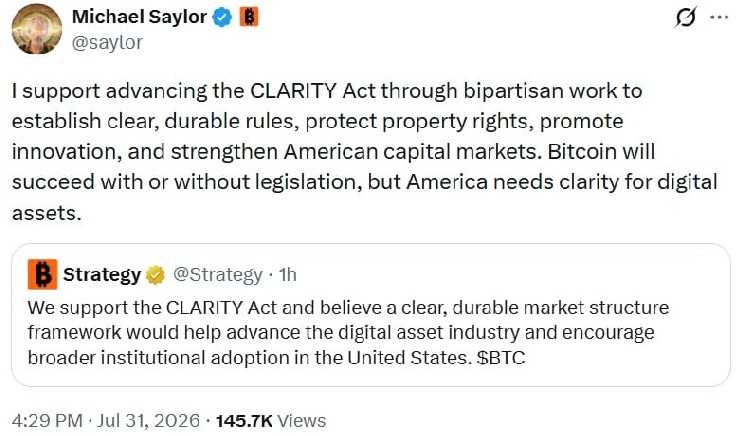
Weekly Editor's Picks (0725-0731) provides a curated selection of deep analysis, filtering out market noise. Key themes from this week include: **Macro & Policy:** The Federal Reserve's upcoming meeting is marked by high uncertainty, balancing cooling inflation data against persistent price pressures. Meanwhile, the U.S. crypto regulatory Clarity Act faces critical political hurdles, with its 2026 passage probability seen as low. **Investing & Crypto:** Analysis suggests long-term crypto success depends on conviction through volatile cycles, focusing on assets like Bitcoin and core smart contract platforms. A trend noted is the increasing similarity between global equity markets (especially tech) and crypto, driven by narrative and leverage. Several major crypto protocols show strong revenue growth, but this isn't always translating to token price appreciation due to sell pressure and structural factors. **AI & Semiconductors:** Nvidia's rising credit default swap rates signal market concern over AI infrastructure financing risks. The storage sector experienced volatility as markets began pricing in potential 2027 oversupply. Despite a record profitable quarter, SK Hynix's results were deemed "below expectations," reflecting heightened investor demands for future growth visibility. **Markets & DeFi:** TradeXYZ demonstrated remarkable accuracy in pre-market pricing for a major A股 listing. The token ONDO saw gains, linked to its growing role in the on-chain tokenized stock ecosystem. **Ethereum:** Post-Pectra upgrade, a major structural shift is underway as Lido begins migrating millions of ETH to new validator architectures designed for capital efficiency. **Also Highlighted:** Butian's bullish stock market move; OpenAI's Altman promising major advances; Samsung and SK Hynix securing large AI chip deals; Apple reaching a $5T market cap; and ongoing discussions around exchange security following Poolin's bankruptcy case.

marsbit2h ago

Weekly Editor's Picks (0725-0731)

marsbit2h ago

Trading

Spot

Hot Articles

How to Buy SEI

Welcome to HTX.com! We've made purchasing Sei Network (SEI) simple and convenient. Follow our step-by-step guide to embark on your crypto journey.Step 1: Create Your HTX AccountUse your email or phone number to sign up for a free account on HTX. Experience a hassle-free registration journey and unlock all features.Get My AccountStep 2: Go to Buy Crypto and Choose Your Payment MethodCredit/Debit Card: Use your Visa or Mastercard to buy Sei Network (SEI) instantly.Balance: Use funds from your HTX account balance to trade seamlessly.Third Parties: We've added popular payment methods such as Google Pay and Apple Pay to enhance convenience.P2P: Trade directly with other users on HTX.Over-the-Counter (OTC): We offer tailor-made services and competitive exchange rates for traders.Step 3: Store Your Sei Network (SEI)After purchasing your Sei Network (SEI), store it in your HTX account. Alternatively, you can send it elsewhere via blockchain transfer or use it to trade other cryptocurrencies.Step 4: Trade Sei Network (SEI)Easily trade Sei Network (SEI) on HTX's spot market. Simply access your account, select your trading pair, execute your trades, and monitor in real-time. We offer a user-friendly experience for both beginners and seasoned traders.

3.0k Total ViewsPublished 2024.03.29Updated 2026.06.02

How to Buy SEI

Discussions

Welcome to the HTX Community. Here, you can stay informed about the latest platform developments and gain access to professional market insights. Users' opinions on the price of SEI (SEI) are presented below.

活动图片