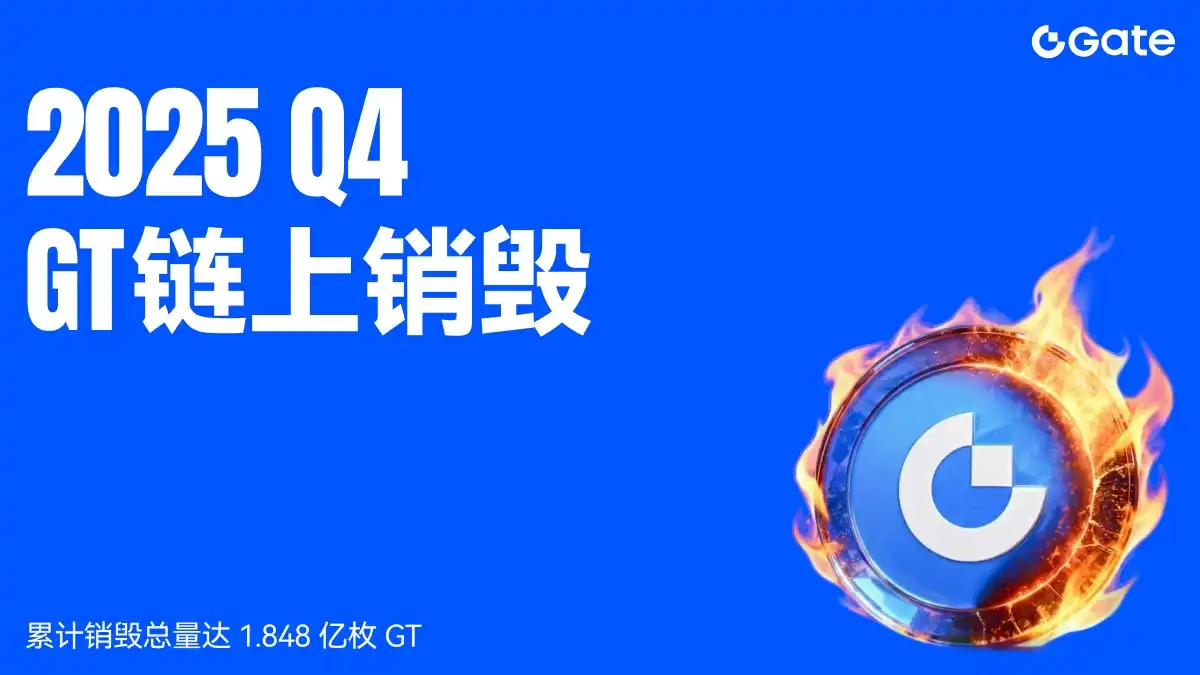
GateToken (GT) Détruit 2 163 900 Pièces au Quatrième Trimestre 2025, Construisant une Structure Économique de Jetons Plus Robuste dans l'Expansion de l'Écosystème

marsbitPublished on 2026-01-08Last updated on 2026-01-08

Abstract

Selon l'annonce officielle, GateToken (GT) a procédé à la destruction de 2 163 900,48229 GT au quatrième trimestre 2025, d'une valeur dépassant 26,92 millions de dollars. Le nombre total de GT détruits s'élève désormais à 184 819 426, pour une valeur cumulative supérieure à 1,901 milliard de dollars. GT, le token natif de GateChain, est au cœur de l'écosystème Gate. Il est utilisé pour payer les frais de transaction (Gas) et soutient l'infrastructure fondamentale de la blockchain. Depuis le lancement de GateChain en 2019, un mécanisme de destruction continue a réduit l'offre totale de tokens d'environ 61,61 % par rapport à son maximum initial de 300 millions. Alors que Gate Layer et ses produits Web3 évoluent vers une phase de fonctionnement stable et de croissance, le rôle fondamental de GT se renforce. Il est désormais intégré de manière profonde dans des applications clés comme Gate Perp DEX, Gate Fun, Meme Go, et Gate Swap, où sa consommation et ses cas d'usage ne cessent de croître. Gate poursuit sa stratégie de destruction pour renforcer la rareté et la valeur de GT, créant un cycle vertueux avec la demande réelle de l'écosystème. La plateforme continue également de développer son infrastructure et ses scénarios d'application décentralisés, conformément à sa stratégie "All in Web3", pour offrir une expérience plus sûre, efficace et riche à ses utilisateurs.

Selon une annonce officielle, la destruction sur chaîne de GateToken (GT) pour le quatrième trimestre 2025 est officiellement terminée. Au total, 2 163 900,48229 GT ont été transférés vers une adresse de destruction, pour une valeur dépassant 26,92 millions de dollars US. À ce jour, 184 819 426 GT ont été détruits au total, pour une valeur cumulative supérieure à 1,901 milliard de dollars US (au prix actuel).

Les détails de la transaction sur chaîne peuvent être consultés à l'adresse : https://etherscan.io/tx/0x03773d485c05dc26a541f5d74e15097d02e010dea34c5cc4f6d3a127ac0126ce

GT (GateToken) est le jeton central de la plateforme Gate et l'actif natif de GateChain. En tant que jeton utilitaire (Utility Token) et jeton de paiement des frais de gaz (Gas Fee) sur GateChain, GT soutient le système sous-jacent des transferts de GateChain. Depuis le lancement de la mainnet de GateChain en 2019, GT a mis en œuvre un mécanisme de destruction continue, réduisant le nombre total de jetons d'environ 61,61 % par rapport au montant initial de 300 millions.

Alors que Gate Layer et ses produits d'écosystème Web3 entrent dans une phase de fonctionnement stable et de développement à grande échelle, la position fondamentale de GT dans l'ensemble de l'écosystème Gate ne cesse de se consolider. Autour d'applications centrales telles que Gate Perp DEX, Gate Fun, Meme Go, Gate Swap, Gate a progressivement construit un système complet d'applications Web3 couvrant les transactions, l'émission, la liquidité et les interactions sur chaîne, avec une activité sur chaîne et une demande d'utilisation réelle en libération continue. En tant que seul jeton de gaz de Gate Layer, GT est profondément intégré dans des liens clés tels que le fonctionnement du réseau, l'exécution des transactions et les interactions applicatives, sa consommation sur chaîne et ses cas d'utilisation augmentant continuellement avec l'expansion de l'écosystème.

Gate s'engage fermement à exécuter le plan de destruction de GT, faisant progresser régulièrement le processus déflationniste dans le respect de la légalité et de la conformité. Grâce à un mécanisme de destruction à long terme, stable et durable, Gate renforce continuellement l'attribut de rareté et la base de valeur de GT, permettant au modèle économique du jeton de former une boucle de rétroaction positive plus étroite avec la demande réelle d'utilisation sur chaîne et la croissance de l'écosystème.

Parallèlement, Gate persévère dans la promotion de sa stratégie « All in Web3 », approfondissant continuellement la construction d'infrastructures sous-jacentes, développant les scénarios de trading décentralisé et d'applications variées sur chaîne, offrant ainsi aux utilisateurs une expérience Web3 plus sûre, efficace et riche. En combinant la promotion conjointe du mécanisme déflationniste et de la construction de l'écosystème, Gate, en tant que bâtisseur à long terme, promeut l'infrastructure Web3 vers une voie de développement plus mature et durable.

À propos de Gate

Fondée en 2013 par le Dr. Han, son PDG, Gate est l'une des principales plateformes d'échange de crypto-monnaies au monde. La plateforme dessert plus de 47 millions d'utilisateurs et prend en charge les transactions de plus de 4 200 actifs cryptographiques. Établissant une référence dans le secteur, Gate a été la première à réaliser une preuve de réserves à 100 %. Son écosystème comprend des services diversifiés tels que Gate Wallet, Gate Ventures, etc.

Pour en savoir plus, veuillez visiter : Site Web | X | Telegram | LinkedIn | Instagram | YouTube

Clause de non-responsabilité :

Ce contenu ne constitue aucune invitation, sollicitation ou conseil. Vous devez toujours rechercher des conseils professionnels indépendants avant de prendre toute décision d'investissement. Veuillez noter que Gate peut restreindre ou interdire tout ou partie des services dans les régions restreintes. Veuillez lire l'accord utilisateur pour plus d'informations, lien : https://www.gate.com/zh/user-agreement.


Related Questions

QCombien de GateToken (GT) ont été détruits au quatrième trimestre 2025 et quelle était leur valeur ?

AAu quatrième trimestre 2025, 2 163 900,48229 GT ont été détruits, d'une valeur de plus de 26,92 millions de dollars américains.

QQuel est le nombre total de GT détruits à ce jour et quelle est leur valeur cumulative ?

AJusqu'à présent, un total de 184 819 426 GT ont été détruits, d'une valeur cumulative de plus de 1,901 milliard de dollars américains (au prix actuel).

QQuel est le rôle principal du GT (GateToken) dans l'écosystème Gate ?

ALe GT est le jeton utilitaire principal de la monnaie native de GateChain. Il sert de jeton utilitaire et de moyen de paiement pour les frais de gaz (Gas Fee), soutenant le système de transfert de base de GateChain.

QComment le mécanisme de destruction a-t-il affecté l'offre totale de GT depuis le lancement ?

ADepuis le lancement de GateChain en 2019, le mécanisme de destruction continu a réduit l'offre totale initiale de GT de 300 millions de jetons d'environ 61,61%.

QQuels sont les produits clés de l'écosystème Web3 de Gate qui utilisent le GT ?

ALes produits clés de l'écosystème Web3 de Gate qui utilisent le GT incluent Gate Perp DEX, Gate Fun, Meme Go et Gate Swap. Le GT est le seul jeton de gaz pour Gate Layer et est intégré dans les opérations du réseau, l'exécution des transactions et les interactions des applications.

Related Reads

The 'Chip' Challenge and Breakthroughs in China's Optical Industry Chain

China's Photonics Industry: Bottlenecks and Breakthroughs In the global AI race, computing chips dominate the narrative, but the underlying bottleneck increasingly defining the scale of AI clusters is light—or more specifically, optical connectivity. Optical modules, which translate electrical signals to light and vice versa, are crucial for connecting thousands of GPUs in AI data centers, preventing data congestion and ensuring efficient model training. High-speed modules (800G, 1.6T) are now standard, with performance hinging on advanced DSP (Digital Signal Processor) chips. This is where a critical dependency lies. Two US giants—Marvell and Broadcom—collectively dominate over 90% of the high-end DSP chip market. Chinese optical module leaders like Zhongji Innolight and Eoptolink rely on these chips to manufacture modules for overseas AI customers, primarily in North America. While this creates a supply chain vulnerability, complete decoupling is difficult. Marvell derives over half its revenue from Greater China, and the US firms depend on Chinese partners for chip packaging and optical components. The risk from laser chips (e.g., from Lumentum), another key component, is considered more manageable due to multiple global suppliers and faster progress in domestic alternatives from companies like YOFC and Accelink. To mitigate risks, China's industry is pursuing a multi-pronged strategy: diversifying supply chains and locking in long-term orders; fostering a domestic market ecosystem to adopt homegrown DSPs from firms like Huawei HiSilicon and CETC; accelerating R&D in high-speed DSPs and advanced packaging; and investing in next-gen technologies like silicon photonics and Co-Packaged Optics (CPO) to reduce reliance on discrete DSPs. The ultimate solution lies not in short-term博弈 but in persistent advancement of domestic high-end chip R&D and manufacturing. While challenges remain in performance, certification, and ecosystem building, China's vast domestic market and manufacturing base provide a crucial buffer, buying time for the industry to achieve greater technological independence.

marsbit2m ago

The 'Chip' Challenge and Breakthroughs in China's Optical Industry Chain

marsbit2m ago

Behind SpaceX's $2 Trillion Market Cap: Why Does Musk Always Have the Next Move Planned?

On June 12th, SpaceX debuted on the Nasdaq, reaching a valuation that briefly touched $2 trillion. This marked the culmination of a 24-year journey from its founding in 2002, driven by Elon Musk's frustration at the high cost of buying rockets. The company's path was defined by early failures, with its first three Falcon 1 launches ending in explosions before a successful 2008 flight opened the era of commercial spaceflight. Key to its model was a fixed-price NASA contract, incentivizing cost reduction. SpaceX mastered rocket reusability, first achieving a Falcon 9 landing in 2015, which drastically cut launch costs. This enabled its profitable Starlink satellite internet constellation, envisioned years before reusability was proven, to create an internal market for frequent launches. Similarly, the next-generation Starship rocket was in development long before its first flight, with its business case evolving from Mars colonization to supporting the emerging concept of in-orbit data centers for AI—a story now central to its valuation. The company's recent IPO, a reversal of its long-standing "no IPO" stance, is funding this ambitious "space-based compute" vision. While major tech players like Google, Blue Origin, and others are investing heavily, significant technical and cost hurdles remain. Ultimately, SpaceX's history is one of creating its own demand: first with Starlink and now with space-based AI compute, betting that its next rocket will enable its next giant market.

marsbit5m ago

Behind SpaceX's $2 Trillion Market Cap: Why Does Musk Always Have the Next Move Planned?

marsbit5m ago

When Crypto Meets the World Cup: CoinW and Modrić's Art of "Navigating Cycles"

When Encryption Meets the World Cup: CoinW and Modrić's "Transcending Cycles" Philosophy In the context of the 2026 FIFA World Cup and its massive global audience, the crypto exchange CoinW announced football legend Luka Modrić as its global brand ambassador. This move is framed not merely as a marketing tactic, but as a strategic experiment in user profile migration. It targets mature, financially stable football fans—particularly in Europe, Southeast Asia, and Latin America—who traditionally have low crypto awareness but value trusted, time-tested authority figures like Modrić. The article draws parallels between Modrić's enduring, disciplined career—marked by consistency and success at the highest level over two decades—and CoinW's own development path. Founded in 2017 during a volatile industry period, CoinW focused on building robust infrastructure and risk management. It weathered the 2022 industry crisis without major security incidents, subsequently earning recognition like "Europe's Most Trusted Exchange" and growing to over 20 million registered users. This "long-termism" is translated into user-centric products. CoinW Academy lowers the initial knowledge barrier. Its integrated ecosystem (CoinW, GemW, DeriW, PropW) and the recent launch of a TradFi section—offering perpetual contracts on traditional assets like stocks, gold, and oil—aim to create a unified platform for diverse assets. For the World Cup, CoinW launched the "We Are The Game" campaign, collaborating with Alchemy Pay to offer zero-fee deposits and local payment options, aiming to transform spectators into participants and lower entry barriers. Ultimately, CoinW's sports partnerships and product strategy are presented as a concerted effort to build trust and accessibility for the "silent majority" still outside crypto—shifting the industry narrative toward inclusivity and long-term value.

Foresight News11m ago

When Crypto Meets the World Cup: CoinW and Modrić's Art of "Navigating Cycles"

Foresight News11m ago

A Panoramic View of the Solana Privacy Ecosystem: The Complete Privacy Stack from Computation to AI

**Solana Privacy Ecosystem: A Comprehensive Overview from Computation to AI** Solana's privacy ecosystem, while nascent, is rapidly evolving to address key challenges across multiple layers. Key figures like Helius CEO Mert acknowledge that Solana has lagged in privacy but highlight its unique potential for scalable, composable privacy protocols, potentially leveraging technologies like ZK compression without persistent rollups. The foundational layer is **Private Compute**, addressed by providers like Arcium and Magic Block. Arcium utilizes Multi-Party Computation (MPC) networks to process encrypted data off-chain with final settlement on Solana, supporting use cases like confidential payments (via its C-SPL token standard) and encrypted data analysis. Magic Block employs Trusted Execution Environments (TEEs) to create private, ephemeral rollups, offering confidentiality, scalability, and composability. Both enable private order books, dark pools, and DeFi rails. Building on this infrastructure are applications for **Private Transfers and Balances**. Umbra, built on Arcium, offers encrypted token accounts with amount, balance, and sender-receiver linkage privacy, plus compliance features. Privacy Cash uses Tornado-style shielded pools for SOL, while Hush provides private staking and trading with integrated swaps via Jupiter. To eliminate **On-Chain Trails** from everyday activities like trading, protocols like encifherio and VanishTrade are emerging. encifherio privately routes swaps through Jupiter by encrypting transaction details within TEEs. VanishTrade routes trades through shielded liquidity pools. Darklake offers a ZK-native "blind slippage" AMM and private perpetuals to hide trading intent and prevent front-running. More advanced applications include **Private Prediction Markets**. Platforms like Melee Markets use Arcium's MPC to encrypt order books, allowing participants to place hidden bets without revealing their market position until settlement. Finally, the ecosystem is expanding into **Private AI**. Loyal leverages both Magic Block and Arcium to create a decentralized protocol where user-AI interactions, queries, and preferences are encrypted on-chain, giving users ownership and control over their data while enabling private transactions and yield generation. In summary, Solana's privacy stack is developing from core compute and transfer privacy towards sophisticated applications in DeFi, prediction markets, and AI, aiming for a future where Fully Homomorphic Encryption (FHE) and Zero-Knowledge (ZK) proofs combine for a complete privacy solution.

marsbit12m ago

A Panoramic View of the Solana Privacy Ecosystem: The Complete Privacy Stack from Computation to AI

marsbit12m ago

Trading

Spot
Futures

Hot Articles

How to Buy GT

Welcome to HTX.com! We've made purchasing Gatechain (GT) simple and convenient. Follow our step-by-step guide to embark on your crypto journey.Step 1: Create Your HTX AccountUse your email or phone number to sign up for a free account on HTX. Experience a hassle-free registration journey and unlock all features.Get My AccountStep 2: Go to Buy Crypto and Choose Your Payment MethodCredit/Debit Card: Use your Visa or Mastercard to buy Gatechain (GT) instantly.Balance: Use funds from your HTX account balance to trade seamlessly.Third Parties: We've added popular payment methods such as Google Pay and Apple Pay to enhance convenience.P2P: Trade directly with other users on HTX.Over-the-Counter (OTC): We offer tailor-made services and competitive exchange rates for traders.Step 3: Store Your Gatechain (GT)After purchasing your Gatechain (GT), store it in your HTX account. Alternatively, you can send it elsewhere via blockchain transfer or use it to trade other cryptocurrencies.Step 4: Trade Gatechain (GT)Easily trade Gatechain (GT) on HTX's spot market. Simply access your account, select your trading pair, execute your trades, and monitor in real-time. We offer a user-friendly experience for both beginners and seasoned traders.

1.7k Total ViewsPublished 2024.03.29Updated 2026.06.02

How to Buy GT

Discussions

Welcome to the HTX Community. Here, you can stay informed about the latest platform developments and gain access to professional market insights. Users' opinions on the price of GT (GT) are presented below.

活动图片












