Lebih dari 80% Token Baru Capai Puncak Saat TGE, Akar Masalah dan Solusi Kemakmuran Palsu Web3 Ada di Sini

Odaily星球日报Published on 2025-12-23Last updated on 2025-12-23

Abstract

Analisis data 113 token baru yang TGE pada 2025 mengungkap tren mengkhawatirkan: 84.7% token memiliki FDV lebih rendah dari saat peluncuran, dengan median penurunan 71%. Hanya 15% token yang naik. Faktor konvensional seperti pendanaan besar, komunitas aktif, dan listing exchange terbukti tidak memengaruhi performa token. Korelasi statistik hampir nol. Projek berpendanaan rendah ($30-500 ribu) justru menunjukkan ROI lebih baik. Harga token ideal bertahan di $0.01-0.05. Sektor AI unggul dengan ROI tertinggi, sementara GameFi dan DeFi stagnan. Platform IDO/IEO tidak menjamin kesuksesan. Solusi 2026: fokus pada pendanaan moderat, produk nyata bukan gimmick token, metrik substansial (bukan jumlah follower), serta realistis terhadap kondisi sektor. Timing dan eksekusi menjadi kunci absolut.

Penulis Asli:Solus Group,Peneliti Kripto

Disusun oleh: CryptoLeo(@LeoAndCrypto)

Catatan Editor: Baru-baru ini, analis Ash dalam sebuah postingan populernya menyatakan, dari lebih 100 token baru yang TGE pada tahun 2025, 84.7% token memiliki FDV lebih rendah daripada FDV saat TGE. Median FDV token-token ini turun 71% dibandingkan saat penerbitan (median kapitalisasi pasar turun 67%).Hanya 15% token yang mengalami kenaikan FDV dibandingkan saat TGE. Secara keseluruhan, pada tahun 2025, sebagian besar token baru termasuk dalam kategori "harga saat TGE adalah puncaknya".

Melanjutkan temuan data ini, saya menemukan artikel yang lebih menarik (dari Solus Group), yang juga dimulai dari TGE token proyek, menganalisis pergerakan 113 token setelah TGE tahun 2025 dan korelasinya dengan kondisi pendanaan, aktivitas komunitas, dan pencatatan di bursa. Setelah diteliti, ditemukan bahwa pendanaan besar, komunitas aktif, pencatatan di bursa – yang dianggap sebagai standar penyaringan kualitas proyek – tidak banyak berpengaruh pada pergerakan harga token proyek. Sebelumnya kita sering menggabungkan kondisi ini untuk menyaring proyek bagus, tetapi pada tahun 2025 model penilaian proyek ini sudah "tidak berlaku". Ada satu set data yang membuat kita berpikir:

- Proyek dengan harga perdagangan di bawah harga IDO memiliki pendapatan rata-rata 1,36 juta dolar AS.

- Proyek dengan harga perdagangan di atas harga penerbitan IDO memiliki pendapatan rata-rata 790 ribu dolar AS.

Namun semua proyek ini didukung oleh modal ventura, yang sampai batas tertentu menunjukkan bahwa pasar lebih mementingkan hype daripada kinerja aktual, lebih mementingkan cerita daripada data, lebih mementingkan janji daripada produk itu sendiri. Web3 tidak bisa lagi berpura-pura "semuanya baik-baik saja", tidak bisa lagi menyebut traffic bot sebagai "pertumbuhan". Tentu saja, artikel ini hanya menyimpulkan beberapa hal secara statistik, tidak cocok sebagai standar untuk semua proyek. Proyek bagus dan pendanaan besar tetap dapat mewakili arah perkembangan industri kripto. Odaily Planet Daily menyusunnya sebagai berikut:

Pendanaan 2 juta dolar AS, partisipasi modal ventura top, 500 ribu penggemar komunitas, terdaftar di bursa utama, sukses besar pada hari pertama peluncuran, Discord riuh rendah, media sosial dipenuhi suasana perayaan.

Dalam artikel sebelumnya, kami mengungkapkan realitas ROI 0,96 kali: pada tahun 2025, rata-rata token sebenarnya mati pada hari pertama, kami membuktikan bahwa sistem ini sudah tidak efektif. Sekarang, kami menganalisis 113 kasus penerbitan token sejak 2025, membuktikannya dengan data yang pasti – dan kebanyakan pendiri tidak berani menghadapi data ini.

Hasil penelitian mengejutkan: Pendanaan besar tidak membantu, komunitas besar tidak relevan, setiap variabel yang Anda optimalkan secara statistik tidak berharga.

Namun di balik permukaan tersembunyi sesuatu yang lebih terdistorsi, yang masih menghantui banyak pendiri:

Saat ini, kondisi pendapatan proyek adalah sinyal bearish, token proyek yang profitable diperdagangkan di bawah harga token proyek yang tidak profitable, dinamika ini menyangkut hidup dan mati. Jika terus menghukum yang profitable dan memberi imbalan pada spekulator, seluruh industri tidak akan bisa bertahan.

Catatan Odaily Planet Daily: Sebelumnya Solus Group menerbitkan artikel mengungkap data terkait, ROI rata-rata token proyek baru TGE 2025 yang dihitung dari hari pertama setelah penerbitan adalah 0,96, berarti produk mereka sejak hari pertama sudah dalam keadaan rugi.

Jebakan Data Pengusaha: Paradoks Pendanaan, Pendanaan Tinggi Tidak Sama Dengan Keunggulan Token
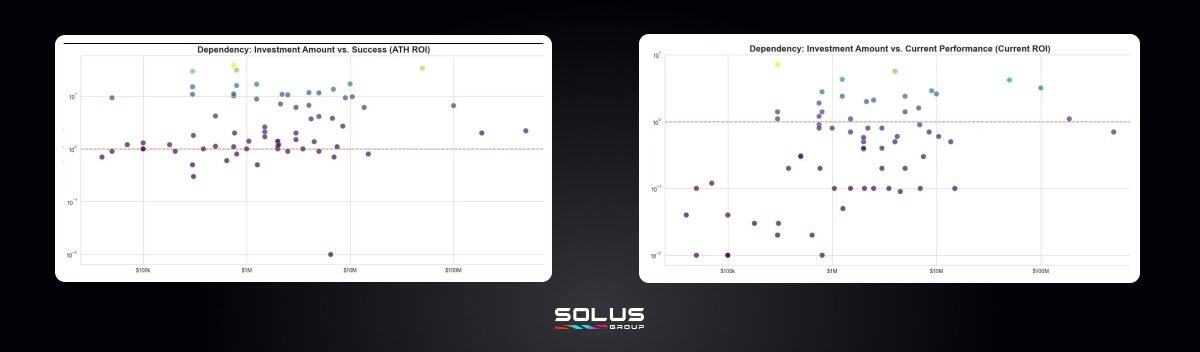
Korelasi antara pendanaan dan kinerja token: 0,04, secara statistik dapat dianggap nol.

Proyek dengan pendanaan 10 juta dolar AS memiliki kinerja token yang sama persis dengan proyek berpendanaan 1 juta dolar AS. Grafik di atas membuktikannya – terlepas dari jumlah pendanaan, distribusi kinerja token dalam rentang ROI adalah acak. Proyek dengan kinerja terbaik: Myshell, B2 Network, Bubblemaps, Mind Network, Particle Network, Creator.Bid (naik 10x hingga 30x pada valuasi ATH) mengumpulkan 300 ribu hingga 3 juta dolar AS. Sementara itu, proyek seperti Boundless dan Analog yang mengumpulkan lebih dari 10 juta dolar AS, hanya memiliki kelipatan valuasi sekitar 1x.

Kinerja token saat ini lebih buruk, terlepas dari skala pendanaan, sebagian besar token memiliki ROI di bawah 1x. Misalnya, token dengan skala pendanaan 5 juta hingga 100 juta dolar AS memiliki ROI 0,1x hingga 0,7x (contoh: Fleek, Pipe Network, Sahara AI), sama dengan token proyek yang hampir tidak memiliki pendanaan.

Faktanya: Pendanaan besar mempercepat kematian token proyek.

Proyek dengan pendanaan paling sedikit (30 ribu hingga 5 juta dolar AS) memiliki ROI lebih tinggi per dolar yang dikumpulkan, mereka mengeksekusi lebih cepat, biaya pivot lebih rendah, dan tidak tenggelam dalam jadwal unlock token venture capital triwulanan, unlock token dalam jumlah besar merusak pendapatan proyek.

Jika Anda mengejar 10 juta dolar AS untuk "bersaing", maka Anda sedang mempersiapkan kegagalan.

Mitos Penggemar: Komunitas Proyek Besar Juga Hanya "Macan Kertas"

500 ribu pengikut media sosial dan 50 ribu pengikut, hasil statistiknya完全相同 persis sama.
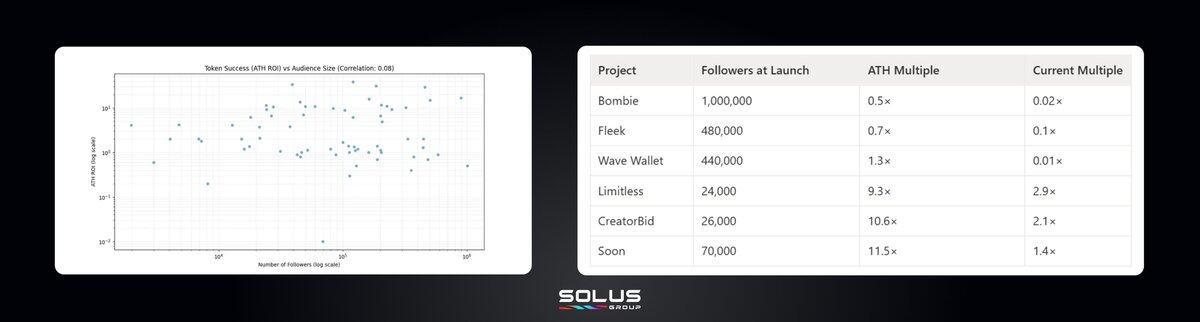
Koefisien korelasi: 0,08 (token ATH) dan -0,06 (kondisi token saat ini)

Data menunjukkan bahwa ukuran audiens pengikut tidak memiliki nilai prediktif apa pun untuk kinerja token, proyek dengan basis pengikut besar menunjukkan kinerja beragam – ada yang melonjak, ada yang anjlok, proyek dengan audiens kecil juga sama, tidak ada tren, tidak ada pola, tidak ada korelasi.

Grup Discord Anda bukanlah komunitas, melainkan audiens spekulatif yang menunggu untuk pergi.
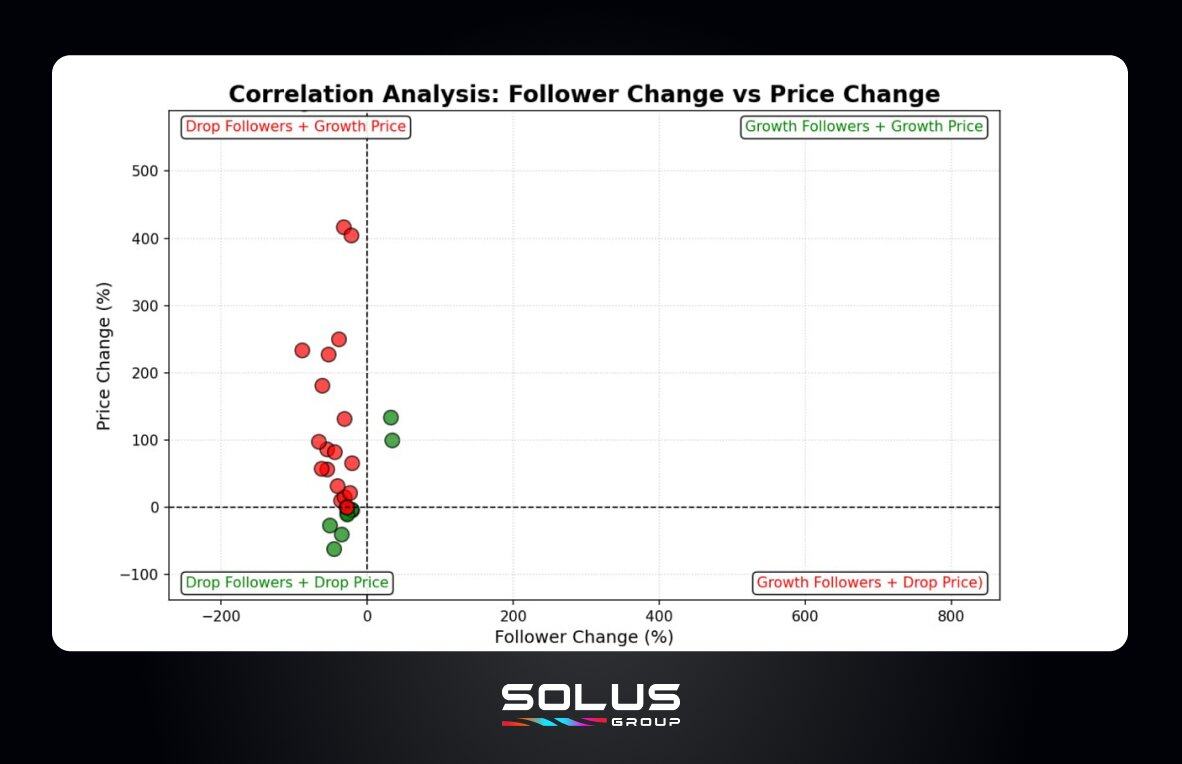
Realitasnya: Harga yang menentukan perkembangan komunitas, bukan komunitas yang mendorong harga.

Ketika harga anjlok, pengikut akan menghilang. Grafik membuktikan ini – kuadran kiri bawah (pengikut berkurang + harga turun) sangat padat. Ketika harga melonjak, pengikut terkadang tumbuh mengikutinya, tetapi tidak konsisten.

Ini berarti:

"Komunitas aktif" Anda tidak pernah benar-benar peduli pada produk – mereka peduli pada pergerakan harga token. Begitu kinerja token mengecewakan, mereka akan menghilang, pertumbuhan komunitas adalah indikator tertinggal, bukan indikator leading.

Ini bukan hanya teori, tetapi pandangan yang diungkapkan secara terbuka oleh @belizardd (peneliti dan trader/KOL):

Kebanyakan orang datang ke sini murni untuk spekulasi, bukan untuk produk itu sendiri. Kami menemukan sangat sedikit protokol yang berkinerja baik setelah TGE, dan terutama adalah protokol dengan FDV token awal rendah, jumlah pendanaan tidak tinggi, dan airdrop yang dermawan. Jujur saja, saya sekarang tidak akan membabi buta mengikuti investasi apa pun. Risiko/imbalan tidak sepadan, saya hanya menunggu pasar membaik.

Spekulator tahu permainannya sudah rusak. Mereka sedang menunggu dan melihat. Sementara itu, pendiri terus membakar 60% anggaran untuk bot Discord, giveaway Twitter, dan promosi KOL – membakar uang untuk metrik yang secara statistik tidak relevan.

Pertanyaan sesungguhnya adalah: "Jika token anjlok 50% besok, berapa banyak orang yang akan bertahan?"

Jawaban: Hampir tidak ada.

Jebakan Harga Token, Waspadai Harga Terlalu Tinggi/Terlalu Rendah
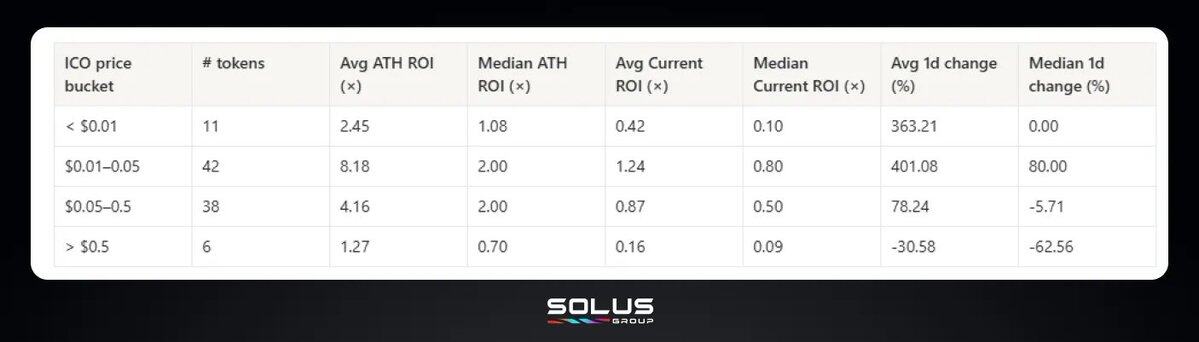
Median ROI berdasarkan harga listing token:

Di bawah $0.01: 0.1x (rugi 90%)

$0.01 hingga $0.05: 0.8x (zona bertahan hidup)

$0.05 hingga $0.50: 0.5x (rugi 50%)

Di atas $0.50: 0.09x (rugi 91%)

Dijelaskan lagi:

Harga penerbitan di bawah $0.01 tidak membuat token Anda "lebih mudah diakses", hanya membuat Anda menjadi koin murah yang menarik modal oportunis, mereka naik cepat, turun juga cepat.

Harga di atas $0.50 tidak membuat token Anda menjadi "token premium", hanya terlihat overpriced, harga token yang terlalu tinggi membunuh pasar retail, paus juga tidak akan membeli.

Rentang harga token $0.01 hingga $0.05 adalah satu-satunya rentang harga yang memiliki kelayakan bertahan, harga ini cukup tinggi untuk menunjukkan legitimasi proyek, dan cukup rendah untuk menyisakan ruang naik. Dalam rentang harga ini, hanya 42 dari 97 proyek token yang menunjukkan kinerja median positif.

Jika model tokenomics Anda menempatkan valuasi Anda pada $0.003 atau $1.20, hentikan pembangunan kembali model, data menunjukkan proyeknya sudah gagal.

Kondisi Industri: Hentikan Pembangunan Ala 2021
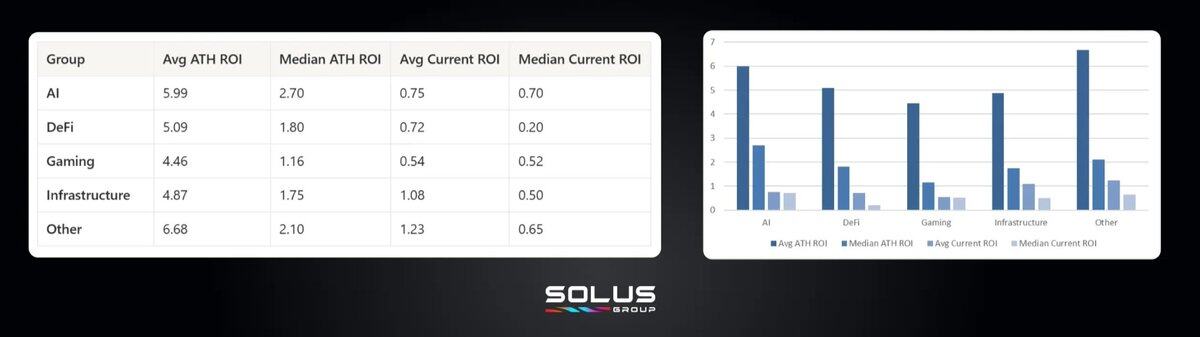
Yang kalah: Gaming

ROI ATH Rata-rata: 4.46x (terendah)

Median ROI Saat Ini: 0.52x

Token GameFi seperti lotere, dimainkan sekali, lalu dilupakan selamanya.

Jebakan: DeFi

ROI ATH Rata-rata: 5.09x (terlihat bagus)

Median ROI Saat Ini: 0.2x (bencana)

DeFi mengalami kenaikan harga awal yang cepat, kemudian anjlok lebih dalam daripada sektor lainnya, kesenjangan antara hype dan realitas sangat kejam.

Pemenang: AI

ROI ATH Rata-rata: 5.99x (kenaikan tertinggi)

Median ROI Saat Ini: 0.70x (retensi terbaik)

Token AI melonjak dan tetap stabil. Tren ini memiliki daya tahan, dan modal mengalir masuk.

Jika Anda mengembangkan GameFi, maka eksekusi Anda perlu 10x lebih baik dari rata-rata untuk mencapai hasil yang biasa-biasa saja. Jika Anda di bidang DeFi, bersiaplah untuk kenaikan cepat dan penurunan tajam. Jika Anda di bidang AI, pasar akan memberi Anda kesempatan, tetapi dengan syarat Anda dapat memberikan hasil. Sektor infrastruktur lebih menuntut: Dibandingkan dengan dApp standar (seperti agen AI), Anda akan menghabiskan lebih banyak waktu dan sumber daya, tetapi median ROI saat ini Anda justru sedikit lebih rendah dari sektor GameFi yang pesimis.

Data tidak peduli pada proyek yang Anda minati.

Sekilas Data IDO/IEO: Platform Bagus Tidak Menyelamatkan Proyek
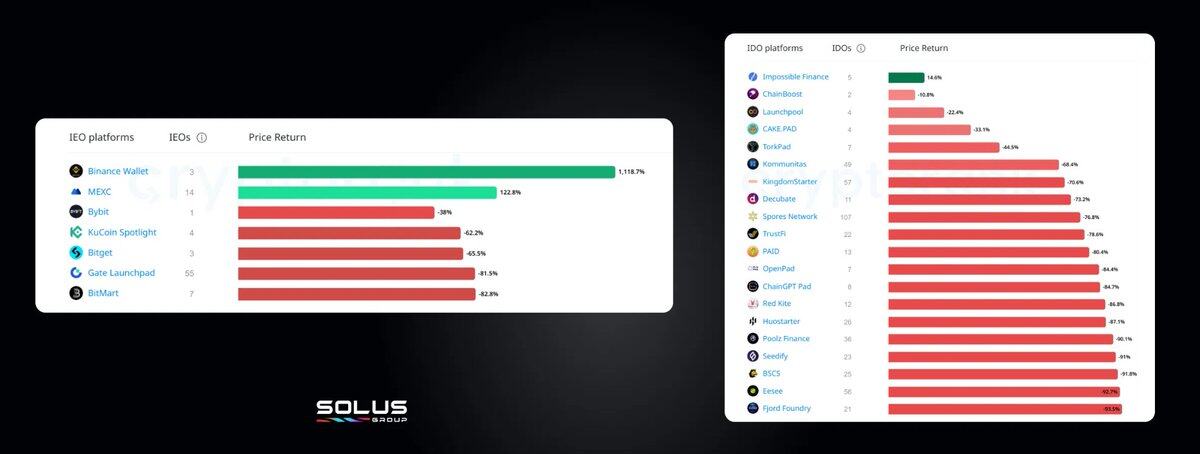
Anda menghabiskan berbulan-bulan membangun jaringan, hanya untuk mendapatkan kursi di Binance Launchpad atau alokasi IDO tier-1, Anda mengira lolos penyaringan platform berarti dilindungi. Data menunjukkan sebaliknya.

Platform IDO: Hampir semua proyek dalam kondisi rugi

Hanya satu proyek yang memiliki ROI +14.6% di 5 platform IDO, hanya itu. Semua proyek lainnya memiliki ROI antara -70% hingga -93%.

Yang disebut "Launchpad premium" tidak memberikan perlindungan bagi pembeli, hanya memberi mereka cara untuk kehilangan uang.

Platform IEO: Perwujudan ekstrim dari survival bias

Dompet Binance menunjukkan imbal hasil 11x. Terlihat luar biasa, tetapi hanya 3 kali penerbitan, sampel terlalu sedikit. MEXC dalam 14 penerbitan menunjukkan imbal hasil +122.8% – ukuran sampel lebih besar, tetapi tetap anomali. Semua proyek lainnya? Kinerja buruk. Token IEO Bybit rugi 38%, proyek lainnya rugi lebih parah.

Ini membuktikan:

Pemilihan platform seperti lotere dengan merek yang lebih baik. Kemenangan dari beberapa data anomali mendistorsi rata-rata, sementara sebagian besar token setelah penerbitan didominasi penurunan, biaya "layanan kurasi" yang Anda bayar – baik melalui hubungan, biaya listing, atau alokasi token – tidak dapat diandalkan melindungi ROI token.

Platform tidak bisa menyelamatkan token sampah, dan juga tidak bisa membantu token bagus.

Refleksi 2025, Proyeksi 2026

Perkembangan proyek berbasis 2025 gagal di setiap lapisan.

Lapisan Nol: Yayasan

Masalah: "Tokenomics berbasis tebakan". Menjual token tanpa kendali ke pasar yang tidak likuid tanpa model pendapatan organik untuk menyerap guncangan.

Lapisan Satu: Pendanaan

Masalahnya: "Edit di PDF dulu, urusi nanti."

Lapisan Dua: Pemasaran

Masalah: Model KOL, pengguna sewaan buzzer bayaran, menghilang begitu berhenti bayar.

Lapisan Tiga: Likuiditas

Masalah: Berasumsi likuiditas akan meningkat dengan hype, tetapi kenyataannya tidak, investor institusi menunggu bukti.

Lapisan Empat: Retensi Pengguna

Masalah: Infrastruktur retensi nol. "Komunitas proyek" adalah 10 ribu pengguna Telegram, yang akan meninggalkan Anda dalam 90 hari.

2026 tidak boleh lagi memainkan permainan lama. Ada masalah yang lebih dalam di balik semua ini, infrastruktur memang penting, bahkan jika infrastruktur sempurna, timing menentukan segalanya. Seperti yang dikatakan Ivan Paskar (Kepala Pertumbuhan Altius Labs):

Token tidak memperbaiki hal yang rusak – mereka memperbesar realitas. Timing benar = momentum menguat. Timing salah = tahun-tahun usaha hancur dalam sekejap. Kebanyakan tim gagal bukan pada desain token, mereka gagal karena salah menilai tahapan dan lingkungan makro, timing bukan detail, itu menentukan segalanya.

Tahun 2026, Apa yang Harus Dilakukan Proyek

Bertahan hidup bukan mengikuti naskah lama, tetapi membangun naskah baru.

1. Rancang dengan Hati-hati

Targetkan jumlah 300 ribu hingga 5 juta dolar AS, ROI tertinggi per dolar ada di sini. Lebih banyak uang = lebih banyak masalah.

2. Biaya Bertahan Hidup

Harga penerbitan antara $0.01 hingga $0.05. Harga lain sulit bertahan. Jika tokenomics Anda tidak sesuai dengan kisaran ini, maka ada yang salah.

3. Produk Utama, Token Sekunder

Jika Anda tidak dapat menjelaskan dalam satu kalimat mengapa token Anda ada, maka itu tidak ada. Pendapatan harus mendahului spekulasi.

4. Abaikan Metrik Vanity

Jumlah pengikut adalah gangguan, aktivitas dompet, tingkat retensi, dan pendapatan per pengguna adalah metrik kunci.

5. Realisme Industri

Sebelum menulis kode, pahami tingkat kegagalan industri Anda. GameFi membutuhkan efisiensi eksekusi dua kali lipat untuk mencapai titik impas. AI memiliki angin sepoi-sepoi – asalkan Anda dapat memberikan hasil.

6. Konsolidasi, atau Mati

Era merger dan akuisisi akan datang. Jika Anda tidak dapat berkembang secara independen, carilah akuisitor. Akuisisi bukan kegagalan, tetapi keputusan bijak.

Keenam prinsip ini penting. Tetapi kenyataannya: Naskah standar sudah usang, sekarang tidak ada lagi mode standar yang cocok untuk segala hal.


Trending Cryptos

Related Questions

QMenurut data, berapa persen token baru di tahun 2025 yang FDV-nya lebih rendah dibandingkan saat TGE?

AData menunjukkan bahwa 84.7% token baru di tahun 2025 memiliki FDV yang lebih rendah daripada saat TGE (Token Generation Event).

QApakah jumlah pendanaan yang besar menjamin performa token yang baik?

ATidak. Penelitian menunjukkan korelasi yang sangat rendah (0.04) antara besarnya pendanaan dan performa token. Proyek dengan pendanaan kecil (misalnya $300 ribu - $5 juta) justru seringkali memiliki Return on Investment (ROI) per dolar yang lebih tinggi.

QBagaimana pengaruh ukuran komunitas (seperti jumlah pengikut media sosial) terhadap harga token?

AUkuran komunitas (jumlah pengikut) tidak memiliki nilai prediktif terhadap performa token. Korelasi statistiknya hampir nol (0.08 untuk ATH dan -0.06 untuk harga terkini). Komunitas seringkali bersifat spekulatif dan menghilang ketika harga token turun.

QKisaran harga token apa yang dianggap 'layak bertahan' berdasarkan penelitian ini?

AKisaran harga token $0.01 hingga $0.05 adalah satu-satunya rentang harga yang dianggap memiliki viabilitas bertahan (survivable zone). Harga di bawah $0.01 atau di atas $0.50 cenderung berkinerja sangat buruk.

QSektor apa yang menunjukkan performa token terbaik dan terburuk di tahun 2025?

ASektor AI menunjukkan performa terbaik dengan rata-rata ROI ATH tertinggi (5.99x) dan ROI median terkini terbaik (0.70x). Sektor Gaming dan DeFi menunjukkan performa terburuk, dengan ROI median terkini masing-masing hanya 0.52x dan 0.2x.

Related Reads

After Three Consecutive Quarters of Decline, Can the Crypto Market Find a Window for Stabilization in Q3?

The cryptocurrency market has just concluded its worst-performing quarter since 2022, with total capitalization dropping 12.6% to $2.1 trillion. All core metrics indicate capital is leaving the sector, not just rotating within it. Bitcoin fell 14.2% and Ethereum dropped 25.4% in Q2, breaking their previous correlation with US tech stocks. A key driver is the reversal in US spot Bitcoin ETF flows, which saw a net outflow of approximately $4.67 billion in Q2, including a record monthly outflow near $4.5 billion in June. While recent data suggests long-term holders are accumulating again, sustained ETF outflows mean continued selling pressure. Market focus is now singularly on the Federal Reserve. The upcoming July FOMC meeting is seen as the most critical event for Q3. A dovish signal could support Bitcoin reclaiming a $68,000-$84,000 range, while a hawkish stance might establish a new trading band around $50,000-$56,000. Additionally, regulatory uncertainty persists, with the progress of the crucial *CLARITY Act* stalling in the Senate, reducing its perceived 2026 passage probability to 40-45%. Despite the broad downturn, a few sectors showed growth. Prediction markets saw nominal volume surge 48.7% year-over-year to $113.8 billion, and tokenized collectibles transaction volume rose 143% quarterly to $1.4 billion. The Real-World Asset (RWA) tokenization sector also continued steady growth, now representing ~$28.1 billion in on-chain value. The market's foundation for an extreme crash appears limited, with Bitcoin price hovering near its 200-week moving average. However, the trading paradigm has shifted from narrative-driven speculation to decisions based on price action, policy developments, and interest rate expectations, making a broad sentiment-driven rally unlikely in the near term.

marsbit15h ago

After Three Consecutive Quarters of Decline, Can the Crypto Market Find a Window for Stabilization in Q3?

marsbit15h ago

BIT Trading Moment: BTC Still Suppressed by Weekly 200 EMA, Rejection May Restart Decline; Storage and Semiconductors that Surged Last Night Begin Falling in Evening Trading

**Crypto & Stock Market Wrap: Bitcoin Tests Resistance, Stocks Retreat After AI Surge** Bitcoin consolidates around $66,000, facing key resistance near $68,000—an area seen as a major psychological and technical hurdle where previous rallies have failed. Analysts note the cryptocurrency is caught between its 200-week moving average (~$63,333) and 200-week EMA (~$68,328). A clear break above $68k is needed to signal a stronger bullish trend, while a rejection could lead to a retest of $63k support. Market sentiment remains cautious, with low futures open interest pointing to a low-liquidity rebound rather than a full bull market. Bitcoin spot ETFs saw another $203 million inflow. US stock futures pointed lower after a strong Tuesday session led by a massive rebound in semiconductors and memory stocks. The rally was fueled by renewed optimism about AI-driven hardware demand, with Micron, SanDisk, and SK Hynix surging. However, those gains reversed in pre-market trading. Super Micro Computer (SMCI) soared over 20% after hours on strong guidance and a record backlog. Other standouts included Rocket Lab and nuclear energy plays Oklo and X-Energy. Rising oil prices (Brent above $91) and climbing Treasury yields (10-year near 4.64%), however, are reigniting inflation concerns and acting as a headwind for equities. In Asia, markets were mixed. South Korea's KOSPI pared early gains to close slightly higher as semiconductor stocks like SK Hynix gave back initial surges. Japan's Nikkei edged lower as the yen hit a fresh 38-year low against the dollar, raising fears of potential market intervention. Key events to watch include the Samsung Galaxy launch, AMD's AI event, and a slew of major tech earnings from Alphabet, Tesla, and IBM after the close on Wednesday, followed by the ECB meeting and Intel's earnings on Thursday.

marsbit15h ago

BIT Trading Moment: BTC Still Suppressed by Weekly 200 EMA, Rejection May Restart Decline; Storage and Semiconductors that Surged Last Night Begin Falling in Evening Trading

marsbit15h ago

Former CFTC Chairman, Circle President Tarbert: Preaching Long-Termism While Cashing Out $30 Million Himself

Former CFTC Chairman and Circle President Heath Tarbert has consistently advocated for a long-term vision in public, urging patience from investors as Circle’s stock price has fallen significantly from its peak. However, it has been revealed that since Circle’s IPO, Tarbert has continuously sold his CRCL shares through pre-arranged trading plans, cashing out approximately $30 million, without making any public market purchases. This contrast between his public messaging and personal actions has drawn criticism. Tarbert joined Circle in July 2023 as Chief Legal Officer, leveraging his regulatory experience to help guide the company through its IPO and expansion. Despite promoting stablecoins as long-term infrastructure, he established a 10b5-1 trading plan just before Circle went public, leading to substantial stock sales over the following year. In March 2026, he initiated another plan to sell more shares. His career trajectory highlights a pattern of moving between high-level regulatory roles and influential positions in the financial sector. After resigning as CFTC Chairman in early 2021, he joined Citadel Securities as Chief Legal Officer just 27 days later, during a period of intense regulatory scrutiny for the firm. He later joined Circle, aiding its efforts to navigate regulatory challenges for its public listing. While Tarbert's expertise in policy and compliance is valuable to companies like Circle, his actions—advocating long-term confidence while personally divesting—raise questions about the alignment between his public statements and his private financial decisions, leaving investors who followed his advice to bear the market risks.

marsbit15h ago

Former CFTC Chairman, Circle President Tarbert: Preaching Long-Termism While Cashing Out $30 Million Himself

marsbit15h ago

Gate Research Institute: The 'Wall Street-ization' Wave of Crypto Financial Products – Competition or Integration?

The article titled "Gate Research Institute: Are Crypto Financial Products Sparking a 'Wall Street' Wave—Competition or Convergence?" explores the evolving relationship between the crypto ecosystem and traditional finance (TradFi). The piece begins by reflecting on Bitcoin's original 2009 vision of decentralization, disintermediation, and moving away from banks. It then contrasts this with the 2024 landscape, where key crypto assets like Bitcoin are increasingly held through Wall Street products like ETFs issued by giants like BlackRock. The article questions whether this signifies that TradFi is systematically taking over the rights to issue, price, custody, and distribute crypto financial assets. The core argument is that this is not a zero-sum takeover but rather a bidirectional convergence where each side addresses the other's weaknesses. Crypto offers 24/7 global markets, programmable settlement, and open access but lacks compliant channels, institutional-grade custody, deep fiat liquidity, and mainstream distribution. TradFi possesses these but is constrained by legacy systems, limited operating hours, and slow settlement. Two primary convergence paths are highlighted: * **Path A (CEX to TradFi):** Exemplified by Gate, which has progressed from offering tokenized stocks and CFDs to providing direct, real stock trading (US, Hong Kong, South Korea) within its platform, using USDT. * **Path B (TradFi to Crypto):** Exemplified by Robinhood, which has integrated crypto trading, acquired exchanges like Bitstamp, and is moving traditional assets like stocks onto the blockchain via tokenization and its own Layer 2. Both paths are ultimately competing to become the next-generation, unified financial account—a "super account" where users can seamlessly trade cryptocurrencies, stocks, ETFs, RWA (Real World Assets), and tokenized treasury products in one interface. The growth of RWA and tokenized treasuries (e.g., BlackRock's BUIDL) is presented as the asset-layer fusion, providing stable, yield-bearing assets on-chain and acting as a bridge between the two worlds. In conclusion, the "Wall Street-ization" of crypto is framed as a mutual transformation. Decentralized ideals persist in the protocol layer, while at the application layer, a more efficient, global, and accessible unified capital market is emerging from this convergence. The future competition lies not between crypto exchanges and stockbrokers, but between platforms vying to offer the most comprehensive asset coverage, liquidity, and user experience within a single account.

marsbit15h ago

Gate Research Institute: The 'Wall Street-ization' Wave of Crypto Financial Products – Competition or Integration?

marsbit15h ago

Trading

Spot

Hot Articles

What is SONIC

Sonic: Pioneering the Future of Gaming in Web3 Introduction to Sonic In the ever-evolving landscape of Web3, the gaming industry stands out as one of the most dynamic and promising sectors. At the forefront of this revolution is Sonic, a project designed to amplify the gaming ecosystem on the Solana blockchain. Leveraging cutting-edge technology, Sonic aims to deliver an unparalleled gaming experience by efficiently processing millions of requests per second, ensuring that players enjoy seamless gameplay while maintaining low transaction costs. This article delves into the intricate details of Sonic, exploring its creators, funding sources, operational mechanics, and the timeline of significant events that have shaped its journey. What is Sonic? Sonic is an innovative layer-2 network that operates atop the Solana blockchain, specifically tailored to enhance the existing Solana gaming ecosystem. It accomplishes this through a customised, VM-agnostic game engine paired with a HyperGrid interpreter, facilitating sovereign game economies that roll up back to the Solana platform. The primary goals of Sonic include: Enhanced Gaming Experiences: Sonic is committed to offering lightning-fast on-chain gameplay, allowing players and developers to engage with games at previously unattainable speeds. Atomic Interoperability: This feature enables transactions to be executed within Sonic without the need to redeploy Solana programmes and accounts. This makes the process more efficient and directly benefits from Solana Layer1 services and liquidity. Seamless Deployment: Sonic allows developers to write for Ethereum Virtual Machine (EVM) based systems and execute them on Solana’s SVM infrastructure. This interoperability is crucial for attracting a broader range of dApps and decentralised applications to the platform. Support for Developers: By offering native composable gaming primitives and extensible data types - dining within the Entity-Component-System (ECS) framework - game creators can craft intricate business logic with ease. Overall, Sonic's unique approach not only caters to players but also provides an accessible and low-cost environment for developers to innovate and thrive. Creator of Sonic The information regarding the creator of Sonic is somewhat ambiguous. However, it is known that Sonic's SVM is owned by the company Mirror World. The absence of detailed information about the individuals behind Sonic reflects a common trend in several Web3 projects, where collective efforts and partnerships often overshadow individual contributions. Investors of Sonic Sonic has garnered considerable attention and support from various investors within the crypto and gaming sectors. Notably, the project raised an impressive $12 million during its Series A funding round. The round was led by BITKRAFT Ventures, with other notable investors including Galaxy, Okx Ventures, Interactive, Big Brain Holdings, and Mirana. This financial backing signifies the confidence that investment foundations have in Sonic’s potential to revolutionise the Web3 gaming landscape, further validating its innovative approaches and technologies. How Does Sonic Work? Sonic utilises the HyperGrid framework, a sophisticated parallel processing mechanism that enhances its scalability and customisability. Here are the core features that set Sonic apart: Lightning Speed at Low Costs: Sonic offers one of the fastest on-chain gaming experiences compared to other Layer-1 solutions, powered by the scalability of Solana’s virtual machine (SVM). Atomic Interoperability: Sonic enables transaction execution without redeployment of Solana programmes and accounts, effectively streamlining the interaction between users and the blockchain. EVM Compatibility: Developers can effortlessly migrate decentralised applications from EVM chains to the Solana environment using Sonic’s HyperGrid interpreter, increasing the accessibility and integration of various dApps. Ecosystem Support for Developers: By exposing native composable gaming primitives, Sonic facilitates a sandbox-like environment where developers can experiment and implement business logic, greatly enhancing the overall development experience. Monetisation Infrastructure: Sonic natively supports growth and monetisation efforts, providing frameworks for traffic generation, payments, and settlements, thereby ensuring that gaming projects are not only viable but also sustainable financially. Timeline of Sonic The evolution of Sonic has been marked by several key milestones. Below is a brief timeline highlighting critical events in the project's history: 2022: The Sonic cryptocurrency was officially launched, marking the beginning of its journey in the Web3 gaming arena. 2024: June: Sonic SVM successfully raised $12 million in a Series A funding round. This investment allowed Sonic to further develop its platform and expand its offerings. August: The launch of the Sonic Odyssey testnet provided users with the first opportunity to engage with the platform, offering interactive activities such as collecting rings—a nod to gaming nostalgia. October: SonicX, an innovative crypto game integrated with Solana, made its debut on TikTok, capturing the attention of over 120,000 users within a short span. This integration illustrated Sonic’s commitment to reaching a broader, global audience and showcased the potential of blockchain gaming. Key Points Sonic SVM is a revolutionary layer-2 network on Solana explicitly designed to enhance the GameFi landscape, demonstrating great potential for future development. HyperGrid Framework empowers Sonic by introducing horizontal scaling capabilities, ensuring that the network can handle the demands of Web3 gaming. Integration with Social Platforms: The successful launch of SonicX on TikTok displays Sonic’s strategy to leverage social media platforms to engage users, exponentially increasing the exposure and reach of its projects. Investment Confidence: The substantial funding from BITKRAFT Ventures, among others, emphasizes the robust backing Sonic has, paving the way for its ambitious future. In conclusion, Sonic encapsulates the essence of Web3 gaming innovation, striking a balance between cutting-edge technology, developer-centric tools, and community engagement. As the project continues to evolve, it is poised to redefine the gaming landscape, making it a notable entity for gamers and developers alike. As Sonic moves forward, it will undoubtedly attract greater interest and participation, solidifying its place within the broader narrative of blockchain gaming.

1.9k Total ViewsPublished 2024.04.04Updated 2024.12.03

What is SONIC

What is $S$

Understanding SPERO: A Comprehensive Overview Introduction to SPERO As the landscape of innovation continues to evolve, the emergence of web3 technologies and cryptocurrency projects plays a pivotal role in shaping the digital future. One project that has garnered attention in this dynamic field is SPERO, denoted as SPERO,$$s$. This article aims to gather and present detailed information about SPERO, to help enthusiasts and investors understand its foundations, objectives, and innovations within the web3 and crypto domains. What is SPERO,$$s$? SPERO,$$s$ is a unique project within the crypto space that seeks to leverage the principles of decentralisation and blockchain technology to create an ecosystem that promotes engagement, utility, and financial inclusion. The project is tailored to facilitate peer-to-peer interactions in new ways, providing users with innovative financial solutions and services. At its core, SPERO,$$s$ aims to empower individuals by providing tools and platforms that enhance user experience in the cryptocurrency space. This includes enabling more flexible transaction methods, fostering community-driven initiatives, and creating pathways for financial opportunities through decentralised applications (dApps). The underlying vision of SPERO,$$s$ revolves around inclusiveness, aiming to bridge gaps within traditional finance while harnessing the benefits of blockchain technology. Who is the Creator of SPERO,$$s$? The identity of the creator of SPERO,$$s$ remains somewhat obscure, as there are limited publicly available resources providing detailed background information on its founder(s). This lack of transparency can stem from the project's commitment to decentralisation—an ethos that many web3 projects share, prioritising collective contributions over individual recognition. By centring discussions around the community and its collective goals, SPERO,$$s$ embodies the essence of empowerment without singling out specific individuals. As such, understanding the ethos and mission of SPERO remains more important than identifying a singular creator. Who are the Investors of SPERO,$$s$? SPERO,$$s$ is supported by a diverse array of investors ranging from venture capitalists to angel investors dedicated to fostering innovation in the crypto sector. The focus of these investors generally aligns with SPERO's mission—prioritising projects that promise societal technological advancement, financial inclusivity, and decentralised governance. These investor foundations are typically interested in projects that not only offer innovative products but also contribute positively to the blockchain community and its ecosystems. The backing from these investors reinforces SPERO,$$s$ as a noteworthy contender in the rapidly evolving domain of crypto projects. How Does SPERO,$$s$ Work? SPERO,$$s$ employs a multi-faceted framework that distinguishes it from conventional cryptocurrency projects. Here are some of the key features that underline its uniqueness and innovation: Decentralised Governance: SPERO,$$s$ integrates decentralised governance models, empowering users to participate actively in decision-making processes regarding the project’s future. This approach fosters a sense of ownership and accountability among community members. Token Utility: SPERO,$$s$ utilises its own cryptocurrency token, designed to serve various functions within the ecosystem. These tokens enable transactions, rewards, and the facilitation of services offered on the platform, enhancing overall engagement and utility. Layered Architecture: The technical architecture of SPERO,$$s$ supports modularity and scalability, allowing for seamless integration of additional features and applications as the project evolves. This adaptability is paramount for sustaining relevance in the ever-changing crypto landscape. Community Engagement: The project emphasises community-driven initiatives, employing mechanisms that incentivise collaboration and feedback. By nurturing a strong community, SPERO,$$s$ can better address user needs and adapt to market trends. Focus on Inclusion: By offering low transaction fees and user-friendly interfaces, SPERO,$$s$ aims to attract a diverse user base, including individuals who may not previously have engaged in the crypto space. This commitment to inclusion aligns with its overarching mission of empowerment through accessibility. Timeline of SPERO,$$s$ Understanding a project's history provides crucial insights into its development trajectory and milestones. Below is a suggested timeline mapping significant events in the evolution of SPERO,$$s$: Conceptualisation and Ideation Phase: The initial ideas forming the basis of SPERO,$$s$ were conceived, aligning closely with the principles of decentralisation and community focus within the blockchain industry. Launch of Project Whitepaper: Following the conceptual phase, a comprehensive whitepaper detailing the vision, goals, and technological infrastructure of SPERO,$$s$ was released to garner community interest and feedback. Community Building and Early Engagements: Active outreach efforts were made to build a community of early adopters and potential investors, facilitating discussions around the project’s goals and garnering support. Token Generation Event: SPERO,$$s$ conducted a token generation event (TGE) to distribute its native tokens to early supporters and establish initial liquidity within the ecosystem. Launch of Initial dApp: The first decentralised application (dApp) associated with SPERO,$$s$ went live, allowing users to engage with the platform's core functionalities. Ongoing Development and Partnerships: Continuous updates and enhancements to the project's offerings, including strategic partnerships with other players in the blockchain space, have shaped SPERO,$$s$ into a competitive and evolving player in the crypto market. Conclusion SPERO,$$s$ stands as a testament to the potential of web3 and cryptocurrency to revolutionise financial systems and empower individuals. With a commitment to decentralised governance, community engagement, and innovatively designed functionalities, it paves the way toward a more inclusive financial landscape. As with any investment in the rapidly evolving crypto space, potential investors and users are encouraged to research thoroughly and engage thoughtfully with the ongoing developments within SPERO,$$s$. The project showcases the innovative spirit of the crypto industry, inviting further exploration into its myriad possibilities. While the journey of SPERO,$$s$ is still unfolding, its foundational principles may indeed influence the future of how we interact with technology, finance, and each other in interconnected digital ecosystems.

156 Total ViewsPublished 2024.12.17Updated 2024.12.17

What is $S$

What is AGENT S

Agent S: The Future of Autonomous Interaction in Web3 Introduction In the ever-evolving landscape of Web3 and cryptocurrency, innovations are constantly redefining how individuals interact with digital platforms. One such pioneering project, Agent S, promises to revolutionise human-computer interaction through its open agentic framework. By paving the way for autonomous interactions, Agent S aims to simplify complex tasks, offering transformative applications in artificial intelligence (AI). This detailed exploration will delve into the project's intricacies, its unique features, and the implications for the cryptocurrency domain. What is Agent S? Agent S stands as a groundbreaking open agentic framework, specifically designed to tackle three fundamental challenges in the automation of computer tasks: Acquiring Domain-Specific Knowledge: The framework intelligently learns from various external knowledge sources and internal experiences. This dual approach empowers it to build a rich repository of domain-specific knowledge, enhancing its performance in task execution. Planning Over Long Task Horizons: Agent S employs experience-augmented hierarchical planning, a strategic approach that facilitates efficient breakdown and execution of intricate tasks. This feature significantly enhances its ability to manage multiple subtasks efficiently and effectively. Handling Dynamic, Non-Uniform Interfaces: The project introduces the Agent-Computer Interface (ACI), an innovative solution that enhances the interaction between agents and users. Utilizing Multimodal Large Language Models (MLLMs), Agent S can navigate and manipulate diverse graphical user interfaces seamlessly. Through these pioneering features, Agent S provides a robust framework that addresses the complexities involved in automating human interaction with machines, setting the stage for myriad applications in AI and beyond. Who is the Creator of Agent S? While the concept of Agent S is fundamentally innovative, specific information about its creator remains elusive. The creator is currently unknown, which highlights either the nascent stage of the project or the strategic choice to keep founding members under wraps. Regardless of anonymity, the focus remains on the framework's capabilities and potential. Who are the Investors of Agent S? As Agent S is relatively new in the cryptographic ecosystem, detailed information regarding its investors and financial backers is not explicitly documented. The lack of publicly available insights into the investment foundations or organisations supporting the project raises questions about its funding structure and development roadmap. Understanding the backing is crucial for gauging the project's sustainability and potential market impact. How Does Agent S Work? At the core of Agent S lies cutting-edge technology that enables it to function effectively in diverse settings. Its operational model is built around several key features: Human-like Computer Interaction: The framework offers advanced AI planning, striving to make interactions with computers more intuitive. By mimicking human behaviour in tasks execution, it promises to elevate user experiences. Narrative Memory: Employed to leverage high-level experiences, Agent S utilises narrative memory to keep track of task histories, thereby enhancing its decision-making processes. Episodic Memory: This feature provides users with step-by-step guidance, allowing the framework to offer contextual support as tasks unfold. Support for OpenACI: With the ability to run locally, Agent S allows users to maintain control over their interactions and workflows, aligning with the decentralised ethos of Web3. Easy Integration with External APIs: Its versatility and compatibility with various AI platforms ensure that Agent S can fit seamlessly into existing technological ecosystems, making it an appealing choice for developers and organisations. These functionalities collectively contribute to Agent S's unique position within the crypto space, as it automates complex, multi-step tasks with minimal human intervention. As the project evolves, its potential applications in Web3 could redefine how digital interactions unfold. Timeline of Agent S The development and milestones of Agent S can be encapsulated in a timeline that highlights its significant events: September 27, 2024: The concept of Agent S was launched in a comprehensive research paper titled “An Open Agentic Framework that Uses Computers Like a Human,” showcasing the groundwork for the project. October 10, 2024: The research paper was made publicly available on arXiv, offering an in-depth exploration of the framework and its performance evaluation based on the OSWorld benchmark. October 12, 2024: A video presentation was released, providing a visual insight into the capabilities and features of Agent S, further engaging potential users and investors. These markers in the timeline not only illustrate the progress of Agent S but also indicate its commitment to transparency and community engagement. Key Points About Agent S As the Agent S framework continues to evolve, several key attributes stand out, underscoring its innovative nature and potential: Innovative Framework: Designed to provide an intuitive use of computers akin to human interaction, Agent S brings a novel approach to task automation. Autonomous Interaction: The ability to interact autonomously with computers through GUI signifies a leap towards more intelligent and efficient computing solutions. Complex Task Automation: With its robust methodology, it can automate complex, multi-step tasks, making processes faster and less error-prone. Continuous Improvement: The learning mechanisms enable Agent S to improve from past experiences, continually enhancing its performance and efficacy. Versatility: Its adaptability across different operating environments like OSWorld and WindowsAgentArena ensures that it can serve a broad range of applications. As Agent S positions itself in the Web3 and crypto landscape, its potential to enhance interaction capabilities and automate processes signifies a significant advancement in AI technologies. Through its innovative framework, Agent S exemplifies the future of digital interactions, promising a more seamless and efficient experience for users across various industries. Conclusion Agent S represents a bold leap forward in the marriage of AI and Web3, with the capacity to redefine how we interact with technology. While still in its early stages, the possibilities for its application are vast and compelling. Through its comprehensive framework addressing critical challenges, Agent S aims to bring autonomous interactions to the forefront of the digital experience. As we move deeper into the realms of cryptocurrency and decentralisation, projects like Agent S will undoubtedly play a crucial role in shaping the future of technology and human-computer collaboration.

824 Total ViewsPublished 2025.01.14Updated 2025.01.14

What is AGENT S

Discussions

Welcome to the HTX Community. Here, you can stay informed about the latest platform developments and gain access to professional market insights. Users' opinions on the price of S (S) are presented below.

活动图片












