Pas d'altseaon crypto en 2026 selon un analyste : seuls les 'survivants de premier ordre' l'emporteront

cointelegraphPublished on 2025-12-23Last updated on 2025-12-23

Abstract

L'analyste Jeff Ko de CoinEx Research prédit qu'il n'y aura pas de "altseason" (saison des altcoins) traditionnelle en 2026. Selon lui, la liquidité sera sélective et se concentrera principalement sur les cryptomonnaies "blue-chip" ayant une adoption réelle, décevant ainsi les investisseurs particuliers qui s'attendaient à une hausse généralisée. Ko anticipe des vents favorables modestes de liquidité mondiale en 2026 et prévoit que le Bitcoin pourrait atteindre 180 000 dollars d'ici là. Cependant, l'analyste vétéran Peter Brandt a une vision différente, prédisant un marché baissier prolongé. Il estime que le cycle actuel n'est pas terminé et projette que le prochain sommet du marché haussier se produira en septembre 2029, s'alignant sur la théorie du cycle de quatre ans. Un déclin de 80% par rapport aux cycles précédents pourrait faire chuter le BTC à 25 000 dollars avant cette hausse. Historiquement, le quatrième trimestre est généralement fort pour le Bitcoin, mais cette année, il a enregistré une baisse de plus de 22%, son deuxième pire quatrième trimestre. Le Bitcoin trade actuellement autour de 88 000 dollars, en baisse de 30% par rapport à son sommet d'octobre.

Le rallye habituel des altcoins devrait s'estomper l'année prochaine, seules les cryptomonnaies « blue chip » bénéficiant de la part du lion de la liquidité, déclare Jeff Ko, analyste en chef de CoinEx Research.

« Les investisseurs particuliers qui s'attendent à ce que la marée montante fasse monter tous les bateaux seront déçus », a déclaré Ko à Cointelegraph. « Nous prévoyons qu'il n'y aura pas d'altseason traditionnel ; à la place, la liquidité sera impitoyablement sélective, n'affluant que vers les survivants de premier ordre ayant une adoption réelle. »

Ko anticipait « de modestes vents favorables de liquidité mondiale en 2026 », tempérés par des politiques de banques centrales divergentes, mais a ajouté que la sensibilité historique du Bitcoin à la croissance de la masse monétaire M2 « s'est atténuée depuis le lancement des ETF en 2024, la corrélation diminuant ».

Il a ajouté que le « scénario de base de l'entreprise voit le Bitcoin viser 180 000 dollars d'ici 2026 ».

Cependant, tous les analystes ne sont pas d'accord, l'analyste vétéran Peter Brandt prédisant un autre marché baissier long et prolongé.

Le Bitcoin atteindra son prochain pic en 2029

Brandt, un trader de futures chevronné, a déclaré mardi qu'en 15 ans, le Bitcoin a connu cinq avancées paraboliques sur une échelle logarithmique suivies de baisses d'au moins 80 %, mais que « le cycle actuel n'est pas encore terminé ».

Cependant, interrogé sur le creux de ce cycle, il a « projeté que le prochain sommet du marché haussier se produirait en septembre 2029 ».

Cette prédiction coïnciderait parfaitement avec la théorie du cycle de quatre ans et le pic survenant un an après l'événement de halving, prévu vers avril 2028. Cependant, une baisse de 80 % comme lors des cycles précédents pourrait faire chuter le BTC à 25 000 dollars avant que cela ne se produise.
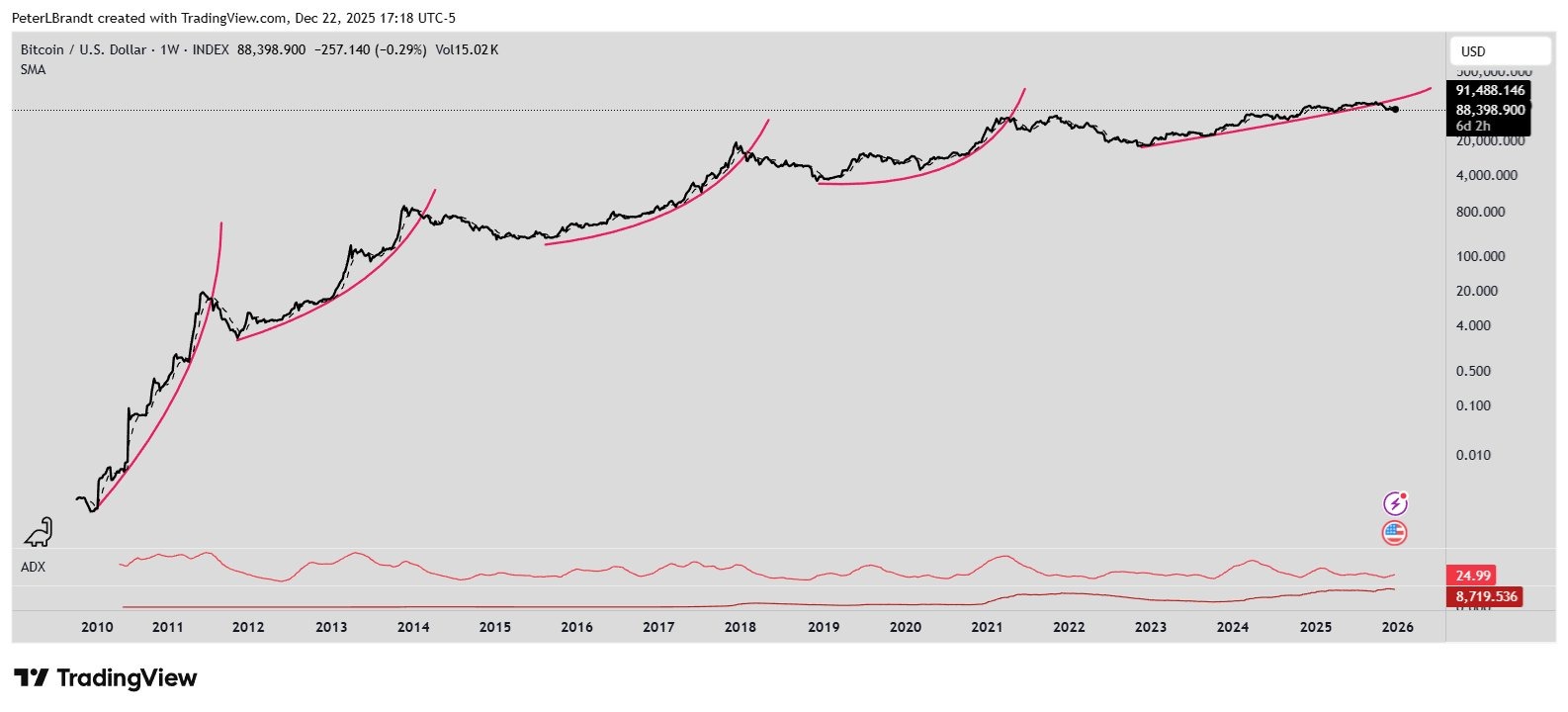
Les cinq avancées paraboliques du Bitcoin. Source : Peter Brandt

Le cycle de quatre ans est-il mort ?

Historiquement, le quatrième trimestre de l'année a souvent été l'une des périodes les plus fortes pour le Bitcoin. Huit des 12 derniers quatrièmes trimestres ont enregistré les plus fortes gains trimestriels du Bitcoin, et un seul d'entre eux était un gain à un chiffre, selon Coinglass.

Article connexe : La demande apparente de Bitcoin diminue, signalant un nouveau marché baissier : Analysts

Cependant, le Bitcoin a perdu plus de 22 % sur le trimestre en cours, marquant son deuxième quatrième trimestre le plus mauvais de l'histoire jusqu'à présent.

Le flux d'investissement macro Milk Road a déclaré lundi que « cela signifie généralement que le marché a évacué beaucoup de risques excessifs et de positions faibles ».

« Donc pour 2026, cela ne garantit pas automatiquement une hausse, mais historiquement, les cycles qui se terminent par une lourde remise à zéro ont tendance à avoir de meilleures conditions pour se renforcer. »

Le Bitcoin (BTC) s'échange actuellement autour de 88 000 dollars, en baisse de 30 % par rapport à son plus haut historique d'octobre.

Magazine : Le niveau critique du Bitcoin est de 82,5 K$, Ethereum 'n'a pas encore fini' : Trade Secrets


Related Questions

QSelon l'analyste Jeff Ko de CoinEx, à quoi peut-on s'attendre concernant le marché des altcoins en 2026 ?

AJeff Ko prédit qu'il n'y aura pas de 'altseason' traditionnelle en 2026. La liquidité sera sélective et se concentrera principalement sur les cryptomonnaies 'blue-chip' ayant une adoption réelle, décevant ainsi les investisseurs particuliers qui s'attendaient à une hausse généralisée.

QQuelle est la prévision de prix de Bitcoin pour 2026 selon l'analyse de base de CoinEx ?

ALa prévision de base de CoinEx Research est que Bitcoin atteindra 180 000 dollars d'ici 2026.

QQuelle est l'opinion contraire de l'analyste Peter Brandt concernant le marché ?

APeter Brandt prédit un autre marché baissier prolongé. Il estime que le cycle actuel n'est pas terminé et projette que le prochain sommet du marché haussier se produira en septembre 2029, après une possible chute de 80% qui pourrait ramener le BTC à 25 000 dollars.

QPourquoi le quatrième trimestre 2025 est-il remarquable pour Bitcoin selon l'article ?

ALe quatrième trimestre 2025 est remarquable car Bitcoin a enregistré une baisse de plus de 22%, ce qui en fait son deuxième quatrième trimestre le plus faible de l'histoire, alors que cette période est traditionnellement l'une des plus fortes pour le BTC.

QQuel est le prix actuel du Bitcoin mentionné à la fin de l'article et comment se compare-t-il à son plus haut ?

ALe Bitcoin (BTC) se négocie actuellement autour de 88 000 dollars, ce qui représente une baisse de 30% par rapport à son plus haut historique atteint en octobre.

Related Reads

NodeStrategy: The First Ordinals DAT Project, Bringing the Strategy Treasury Narrative to NFTs

**Summary: The Fundamental Flaws of NodeStrategy, the 'First Ordinals DAT'** NodeStrategy presents itself as the first Ordinals Digital Asset Treasury (DAT) on Bitcoin. Its model mirrors MicroStrategy's treasury narrative but for NFTs, specifically targeting the NodeMonkes collection (not officially affiliated). The project's core mechanism is a four-step flywheel: a 10% fee on all trades (90% to treasury, 10% to radFi/Bound marketplace) is used to buy NodeMonkes. These NFTs are then listed for sale on Satflow, with 100% of the sale proceeds used to buy back and burn the project's token, NODESTRAT, aiming to create a perpetual value cycle. However, the design contains critical, self-defeating flaws: 1. **Platform Lock-In:** As a Bitcoin Rune, NODESTRAT lacks smart contract functionality and cannot natively enforce the 10% fee. The fee can only be collected on the radFi/Bound marketplace itself. This makes the entire flywheel dependent on a single platform. If liquidity moves elsewhere, fee revenue drops to zero, halting the mechanism. 2. **Self-Suffocating Economics:** The 10% fee acts both as the flywheel's fuel and a major drag on demand. A buy/sell roundtrip incurs a 20% cost, creating a massive hurdle for traders. This strangles the very trading volume needed to generate fees. 3. **Ineffective Value Support:** The flywheel is starved. Low daily volume (~$9K) generates minimal fees for NFT purchases. The NFT "ladder" sales are slow and unpredictable (only 39 total sold), meaning buybacks are infrequent. While 30.77% of the supply has been burned, this supply reduction cannot lift price without corresponding demand, which is suppressed by the high transaction tax. 4. **Meaningless NAV:** The Net Asset Value (NAV), currently at a 0.46x discount to market cap, is merely a marketing figure. There is no redemption mechanism for token holders to claim the underlying NodeMonkes assets. Price is set by market liquidity flows, not by this theoretical backing. In essence, NodeStrategy's design forces its revenue source (trading fees) to simultaneously cripple the demand and liquidity required for its own success, trapping the project in a stagnant state.

marsbit4m ago

NodeStrategy: The First Ordinals DAT Project, Bringing the Strategy Treasury Narrative to NFTs

marsbit4m ago

Agentic Design Patterns: A Book That Made Me Re-Understand "What Is an Agent, Really?"

"Agentic Design Patterns" is a 2025 book by Antonio Gullí, a Google engineering director, which offers a systematic framework for AI Agent development through 21 design patterns. A core contribution is the "Four Levels of Agency": Level 0 (bare LLMs) are not true agents. Level 1 agents actively decide when and how to use tools. Level 2 agents engage in strategic planning, context engineering (curating and filtering information), and self-reflection. Level 3 involves multi-agent collaboration with defined communication topologies. The book introduces **Context Engineering** as a superset of prompt engineering, managing four layers of information for the agent: system prompts, external data, implicit context (user history, environment), and feedback loops for automated optimization. A key pattern is **Reflection (Producer-Critic)**, where two distinct agents with different prompts collaborate iteratively—one produces output, the other critiques it—until quality is satisfactory or a max iteration limit is reached. For **Memory**, a three-layer model is proposed: Session (ephemeral conversation context), State (temporary task data), and Memory (persistent, long-term storage). Regarding **Multi-Agent Systems**, the book advises against unnecessary complexity, recommending simple topologies like Supervisor or Peer-to-Peer based on task needs. It emphasizes perfecting a single Level 2 agent before moving to multi-agent setups. The author concludes with three actionable takeaways: 1) Add a Critic agent to existing workflows, 2) Practice Context Engineering beyond simple prompts, and 3) Avoid premature multi-agent complexity; first master a robust single agent. The book provides a practical map, codifying common challenges like reflection, memory, and coordination into reusable patterns, saving developers from reinventing foundational solutions.

链捕手50m ago

Agentic Design Patterns: A Book That Made Me Re-Understand "What Is an Agent, Really?"

链捕手50m ago

An AI Read SpaceX's Prospectus and Wrote This Investment Memo in 12 Minutes

An AI agent autonomously analyzed SpaceX's 226MB S-1 filing, purchased real-time market data on-chain for $1.87, and generated a comprehensive investment memo in 12 minutes. The memo concludes a "Hold" recommendation. Bull Thesis: SpaceX holds a near-monopoly in commercial launch (80% of global orbital mass since 2023), operates the profitable Starlink business (10.3M subscribers, $7.2B adj. EBITDA), and is vertically integrated from rockets to AI via the xAI acquisition. Starlink alone is a standout, high-margin business. Bear Thesis: The AI division is a massive cash burn ($6.4B operating loss on $3.2B revenue in 2025). True debt obligations approach ~$42B, not the headline $29B, due to bridge loans and X-related debt. Significant contingent liabilities exist, including a potential $10B fee from a Cursor option agreement. The company faces concentrated counterparty risk (e.g., a $45B Anthropic contract), slowing revenue growth, and complex governance as a controlled company with four share classes. Valuation anchors Starlink's standalone value at ~$84B (applying Iridium's 7.4x sales multiple), suggesting the current ~$500B+ IPO target prices in immense future execution risk for Starship and AI. Key risks include Starship delays, accelerating AI losses, and underwriter conflicts (the IPO's lead banks are also lenders on the $20B bridge loan it aims to refinance). Investment triggers: upgrade to "Overweight" if priced ≤$350B and Starship meets milestones; downgrade to "Pass" if priced >$510B or key risks materialize.

marsbit1h ago

An AI Read SpaceX's Prospectus and Wrote This Investment Memo in 12 Minutes

marsbit1h ago

Trading

Spot
Futures

Hot Articles

What is $BLUE

Blue on Base ($BLUE): The New Frontier in the Meme Economy Introduction In the continuously evolving landscape of digital technologies, the emergence of innovative projects in the realm of Web3 has captured the attention of many. Among these, Blue on Base, denoted by its ticker symbol $BLUE, stands out as a unique concept within the burgeoning world of cryptocurrencies. This project serves as a testament to the fusion of memes, art, and digital progress. Through its novel approach, it encapsulates the essence of what it means to ride the wave of the meme economy, while contributing significantly to the wider dialogue in the blockchain community. What is Blue on Base ($BLUE)? At its core, Blue on Base is described as the first-ever base metameme, a digital construct that captures the distinctive spirit of blue-themed memes. The project aspires to elevate these memes to what it refers to as “the blue sky,” symbolising an expansive horizon of possibilities within the digital landscape. The creators of Blue on Base envision a metameme representing the collective voice of the burgeoning blue meme culture—offering a spectrum from the deepest cobalt hues to the brightest cerulean shades. This project aims to provide a conduit for cultural expression, allowing participants to engage with an expansive library of memes that resonate across various digital platforms. Central to the ambition of Blue on Base is the understanding that memes are more than fleeting images—they embody social commentary, artistic expression, and cultural identities. By tapping into the vast potential of meme culture, the project hopes to engage users by providing a multifaceted platform that brings both entertainment and a sense of community. Who is the Creator of Blue on Base ($BLUE)? The information regarding the creator of Blue on Base ($BLUE) is regrettably sparse. As of now, details pertaining to the individuals or team behind this innovative project remain unknown. This lack of transparency raises questions about accountability and identity in a project that is standard in the crypto space, but it also emphasises the project's focus on the community rather than singular personalities. Who are the Investors of Blue on Base ($BLUE)? While investment dynamics are crucial for the success of any cryptocurrency project, explicit details regarding the financial backers or investment foundations associated with Blue on Base ($BLUE) are not readily available. This lack of defined investor identity raises a critical point regarding transparency in crypto projects—a vital aspect that keeps potential investors and participants apprised of the project’s sustainability. How Does Blue on Base ($BLUE) Work? Central to understanding Blue on Base is its operational framework, which revolves around the concept of being a metameme. This unique approach allows the project to harness the viral nature of memes and engage with a broad audience on Web3 platforms. The project does this by embracing various blue-themed meme constructs which serve as both community engagement tools and frameworks for digital expression. At its heart, Blue on Base works to establish itself as a pivotal player in the meme economy, inviting users to contribute, create, and engage with content defined by its blue theme. The project facilitates interactions among community members, thereby enhancing user experience while pushing the blue meme narrative forward. It's important to note that while the project hinges on community-generated content, specifics regarding its technological infrastructure, such as smart contract dynamics or tokenomics, are not extensively detailed in the current information set. As the project advances, clearer technical specifications will likely emerge, providing a more comprehensive understanding of its functionality. Timeline of Blue on Base ($BLUE) Although detailed chronological milestones of Blue on Base are limited, the conceptualisation and positioning of the project highlight its relevance in the timeline of Web3 innovations. As the atmosphere surrounding cryptocurrencies and meme cultures evolves, Blue on Base fits within the broader context of digital advancement. The timeline of Blue on Base can be inferred generally through key events typical of crypto projects, including conceptual announcement, initial community engagements, and launching phases. It would be critical for interested parties to remain vigilant for updates as the project's trajectory develops over time, possibly yielding significant milestones and growth phases. Key Points About Blue on Base ($BLUE) Concept: Blue on Base ($BLUE) is a digital project that represents the first-ever base metameme, reflecting the intertwining of memes, art, and digital progress. Objective: The project seeks to assemble the strength of various blue-themed memes and represent the collective voice of a new digital dawn. Creator: Currently unknown, emphasising a community-oriented ethos. Investors: Information about specific investors or backing foundations remains unspecified. Operation: Utilises its metameme concept to foster engagement and innovation within Web3, focusing on user participation and cultural significance. Additional Information While Blue on Base ($BLUE) has a unique identity within the cryptocurrency realm, it is paramount that engaging with such projects be conducted with due diligence. Clarity on the potential impacts and innovations of these emerging projects must be approached with discerning optimism. In conclusion, Blue on Base ($BLUE) emerges as an intriguing facet of the evolving digital and meme economies. By framing itself as a metameme, it seeks to challenge conventional interpretations of meme culture while embracing the collective creativity of its community. As the Web3 landscape continues to expand, projects like Blue on Base offer valuable insights into the future intersection of culture, technology, and digital interaction. As the project evolves, further examinations will be needed to provide insights into how it carves its niche in the meme economy and broader cryptocurrency space—ultimately shaping the conversation surrounding digital culture.

59 Total ViewsPublished 2024.04.22Updated 2024.12.03

What is $BLUE

What is VRJAM(BLUE)

VRJAM(BLUE): Revolutionising Live Experiences in the Virtual World Introduction to VRJAM(BLUE), $vrjam(blue) In an age where virtual experiences are becoming increasingly prevalent, VRJAM(BLUE), represented by the token $vrjam(blue), emerges as a pioneering project within the cryptocurrency space. Launched in 2022, VRJAM(BLUE) seeks to transform how live events are conducted in the digital realm by utilising the power of blockchain technology and the Hedera Hashgraph platform. As a unique blend of immersive social gaming and interactive virtual events, VRJAM(BLUE) strives to create a comprehensive, engaging experience that resonates with users worldwide. What is VRJAM(BLUE), $vrjam(blue)? At its core, VRJAM(BLUE) is a live experience platform harnessing blockchain to facilitate immersive interactions during virtual events. It stands out as a futuristic solution that allows users to engage with one another in real time, bridging the gap between the physical and digital worlds. The platform leverages advanced technologies, including AI-powered virtual humans, which introduce customisable digital representations of users. These entities serve as avatars that enhance the social dynamics of virtual gatherings. Coupling these virtual beings with the use of non-fungible tokens (NFTs) introduces a layer of security and authenticity, ensuring that unique digital assets can be traded and valued properly within the platform's ecosystem. Moreover, VRJAM(BLUE) integrates a native cryptocurrency, the VRJAM Coin, which acts as the medium of exchange within its virtual world. This digital currency facilitates transactions for services, content, and assets while enabling users to participate seamlessly in live events and interactive experiences. Creator of VRJAM(BLUE), $vrjam(blue) The specific identity of the creator of VRJAM(BLUE) remains undisclosed, though the project is under the leadership of CEO Sam Speaight. His vision for the platform aims at leveraging innovative technology and strategic partnerships to expand the reach and impact of VRJAM(BLUE) in the rapidly evolving web3 ecosystem. Investors of VRJAM(BLUE), $vrjam(blue) VRJAM(BLUE) has garnered considerable interest from various investors and funding rounds, successfully raising a total of $5.34 million throughout 12 funding events. These various initiatives, including Initial DEX Offerings (IDO) and token launches, have provided the necessary capital to propel the project forward. However, specific details regarding the individual investors or organisations backing VRJAM(BLUE) have not been disclosed. How Does VRJAM(BLUE), $vrjam(blue) Work? The innovative approach of VRJAM(BLUE) revolves around multiple cutting-edge technologies, notably artificial intelligence, virtual reality, and blockchain. AI-Powered Virtual Humans A distinguishing feature of VRJAM(BLUE) is its integration of AI-powered virtual humans. These customisable characters respond dynamically to user interactions, enriching the overall experience of virtual events. This personalisation allows users to create unique identities and facilitates more meaningful connections within the community. NFT Technology By incorporating NFT technology into its framework, VRJAM(BLUE) provides users with enhanced security and ownership of digital assets. Users can purchase, sell, or trade NFTs that represent virtual tickets, memorabilia, or other digital creations linked to live events, ensuring that ownership is verifiable and protected. Native Cryptocurrency The VRJAM Coin serves as the platform's native currency, allowing users to transact seamlessly within the virtual environment. This cryptocurrency not only supports traditional user activities but also bolsters a larger economic ecosystem tailored to the needs of VRJAM’s community. DeFi Solutions The project also embraces decentralised finance (DeFi) by incorporating trustless protocols. These solutions aim to stabilise token prices and enhance liquidity, allowing users to engage in financial transactions without intermediary restrictions. Timeline of VRJAM(BLUE), $vrjam(blue) To fully understand the evolution of VRJAM(BLUE), it's essential to take a closer look at its timeline: 2022: Launch of VRJAM(BLUE) – The platform made its debut, ushering in a new era for virtual event experiences. November 30, 2022: Completion of the Token Generation Event (TGE) – This marked a significant milestone, as the platform's native cryptocurrency became available for investor engagement. Post-TGE: Following the TGE, the distribution of tokens initiated, featuring a 20% immediate release, followed by a linear vesting phase of the remaining 80% over a period of six months. Key Features and Partnerships The success of VRJAM(BLUE) can also be attributed to its strategic partnerships and innovative features. Partnerships In its quest to bring life to the metaverse, VRJAM(BLUE) has formed alliances with prominent entities in the industry. Notably, its collaboration with Polygon aims to enhance the efficiency and reach of live events. Additional partnerships with organisations such as Agora and Enjin further bolster content distribution and the utilisation of NFT technology. These collaborations are enhancing VRJAM(BLUE)'s capabilities and expanding its influence in the web3 ecosystem. Token Liquidity Protocol Operating on the Hedera Hashgraph, VRJAM(BLUE) employs a token liquidity protocol that aggregates liquidity across various trading platforms. This initiative is designed to unify token pricing, thus enhancing user confidence in the VRJAM Coin and promoting stability within the ecosystem. Web3 Economy With the overarching aim of fostering a sustainable web3 economy, VRJAM(BLUE) is diligently working on its DeFi product suite. By providing users with tools for financial engagement, such as yield farming or staking, the project is paving the way for broader participation in its virtual economy. Conclusion VRJAM(BLUE), with its token $vrjam(blue), stands at the forefront of the revolution in virtual experiences and live interactions within the digital space. By intertwining advanced technologies such as AI, virtual reality, and blockchain, the project has developed a platform that not only facilitates immersive experiences but also builds a vibrant, interactive community. As the landscape of the crypto and web3 industries continues to evolve, VRJAM(BLUE) aims to play a critical role in shaping the future of virtual events and experiences. With its commitment to innovation and community engagement, VRJAM(BLUE) is well-positioned to pave a prosperous path for digital interactions in the years to come.

32 Total ViewsPublished 2024.12.03Updated 2024.12.03

What is VRJAM(BLUE)

Discussions

Welcome to the HTX Community. Here, you can stay informed about the latest platform developments and gain access to professional market insights. Users' opinions on the price of BLUE (BLUE) are presented below.

活动图片












