Es improbable una altasea de criptomonedas en 2026, ya que los 'superviventes de primera categoría' saldrán ganando: Analista

cointelegraphPublished on 2025-12-23Last updated on 2025-12-23

Abstract

Según el analista Jeff Ko de CoinEx Research, es poco probable que ocurra un "altseason" (temporada de alzas de altcoins) tradicional en 2026. En su lugar, prevé que la liquidez será selectiva y fluirá principalmente hacia criptomonedas "blue-chip" con adopción real, decepcionando a los inversores minoristas. Ko anticipa vientos de cola de liquidez global moderados en 2026 y proyecta que Bitcoin podría alcanzar los $180,000 para ese año. Sin embargo, otros analistas como Peter Brandt predicen un mercado bajista prolongado, sugiriendo que el próximo pico alcista de Bitcoin ocurriría en septiembre de 2029, siguiendo el ciclo de cuatro años. Bitcoin actualmente cotiza alrededor de $88,000, un 30% por debajo de su máximo histórico de octubre.

Es probable que el típico repunte de los altcoins disminuya el próximo año, y solo las criptomonedas de "primera categoría" obtendrán la mayor parte de la liquidez, afirma Jeff Ko, analista jefe de CoinEx Research.

"Los inversores minoristas que esperan que la marea alta levante todos los barcos se sentirán decepcionados", dijo Ko a Cointelegraph. "Predecimos que no habrá una altseason tradicional; en cambio, la liquidez será despiadadamente selectiva, fluyendo solo hacia los supervivientes de primera categoría con adopción real".

Ko anticipó "modestos vientos de cola de liquidez global en 2026", atenuados por políticas divergentes de los bancos centrales, pero añadió que la sensibilidad histórica de Bitcoin al crecimiento de la oferta monetaria M2 "se ha suavizado desde el lanzamiento de los ETF en 2024, con una correlación decreciente".

Añadió que el "escenario base de la compañía ve a Bitcoin apuntando a $180,000 para 2026".

Sin embargo, no todos los analistas están de acuerdo, y el analista veterano Peter Brandt predice otro mercado bajista prolongado.

Bitcoin alcanzará su próximo pico en 2029

Brandt, un comerciante veterano de futuros, dijo el martes que en 15 años, Bitcoin ha experimentado cinco avances parabólicos en una escala logarítmica seguidos de disminuciones de al menos el 80%, pero el "ciclo actual aún no ha terminado".

Sin embargo, cuando se le preguntó sobre el fondo de este ciclo, "proyectó que el próximo máximo del mercado alcista ocurriría en septiembre de 2029".

La predicción se alinearía perfectamente con la teoría del ciclo de cuatro años y el pico que llega un año después del evento de halving, programado para alrededor de abril de 2028. Sin embargo, una disminución del 80% como se vio en ciclos anteriores podría enviar a BTC cayendo de nuevo a $25,000 antes de que eso suceda.
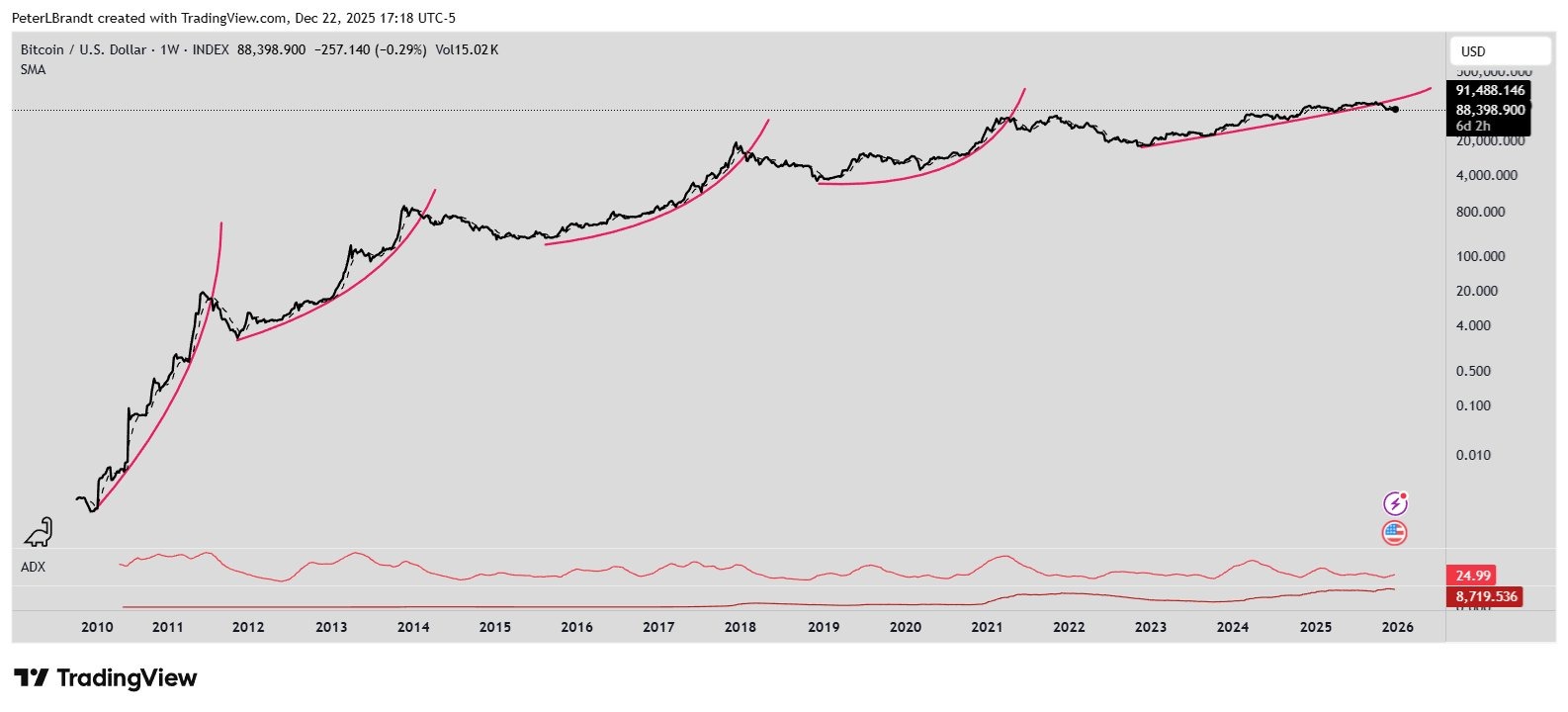
Los cinco avances parabólicos de Bitcoin. Fuente: Peter Brandt

¿Está muerto el ciclo de cuatro años?

Históricamente, el cuarto trimestre del año a menudo ha sido uno de los períodos más fuertes de Bitcoin. Ocho de los últimos 12 cuartos trimestres han visto las mayores ganancias trimestrales de Bitcoin, y solo una de ellas fue una ganancia de un solo dígito, según Coinglass.

Relacionado: La aparente demanda de Bitcoin se reduce, señalando un nuevo mercado bajista: Analistas

Sin embargo, Bitcoin ha bajado más del 22% durante el trimestre actual, marcando su segundo peor cuarto trimestre de la historia hasta ahora.

El feed de inversión macro Milk Road dijo el lunes que "esto generalmente significa que el mercado ha eliminado mucho riesgo excesivo y posiciones débiles".

"Así que para 2026, no garantiza automáticamente una subida, pero históricamente, los ciclos que terminan con un reinicio pesado tienden a tener mejores condiciones para construir fuerza".

Bitcoin (BTC) se cotiza actualmente alrededor de $88,000, un 30% menos que su máximo histórico de octubre.

Revista: El nivel crítico de Bitcoin es de $82.5K, Ethereum 'no ha terminado todavía': Secretos Comerciales


Related Questions

Q¿Qué predice Jeff Ko, analista jefe de CoinEx Research, sobre el mercado de altcoins para 2026?

AJeff Ko predice que no habrá un 'altseason' tradicional en 2026. En su lugar, la liquidez será selectiva y fluirá principalmente hacia las criptomonedas 'blue-chip' con adopción real, decepcionando a los inversores minoristas que esperaban que todo el mercado subiera.

Q¿Cuál es el precio objetivo que CoinEx Research prevé para el Bitcoin en 2026?

ALa previsión de caso base de CoinEx Research es que el Bitcoin alcance los 180.000 dólares para el año 2026.

Q¿Qué predicción hace el analista veterano Peter Brandt sobre el próximo máximo del mercado alcista de Bitcoin?

APeter Brandt proyecta que el próximo máximo del mercado alcista (bull market high) ocurrirá en septiembre de 2029, lo que se alinearía con la teoría del ciclo de cuatro años y el pico que suele llegar un año después del halving.

QSegún el artículo, ¿cómo ha sido históricamente el cuarto trimestre para el precio de Bitcoin y cómo se está comportando actualmente?

AHistóricamente, el cuarto trimestre ha sido uno de los periodos más fuertes para Bitcoin, con 8 de los últimos 12 trimestres cerrando con ganancias. Sin embargo, en el trimestre actual (cuando se escribió el artículo), Bitcoin ha caído más de un 22%, marcando su segundo peor cuarto trimestre de la historia.

Q¿A qué nivel podría caer Bitcoin si experimentara una disminución del 80% como en ciclos anteriores, según se menciona en el artículo?

ASi Bitcoin experimentara una disminución del 80% desde sus máximos, similar a ciclos anteriores, podría caer hasta alrededor de los 25.000 dólares antes de que comience el próximo mercado alcista.

Related Reads

Uncovering the Truth About Agent Commerce, Payments, and Infrastructure

Decoding Agent Commerce, Payments, and Infrastructure: The Reality Over the past year, I've been building infrastructure for the Agent economy, engaging with major players like Stripe, Visa, Coinbase, Google, and dozens of startups. A clear conclusion emerges: true, large-scale demand does not yet exist. Startups face structural challenges. Data points illustrate this gap. Stripe's Agent commerce platform has over 1,000 merchants but only single-digit transacting agents. Visa's Agent payment token requires 9-month KYC and a $250M revenue threshold, accessible only to giants like Amazon. On-chain analysis reveals actual daily Agent transaction volume is around $17k, half of which are test transactions. The article analyzes four potential markets: **1. Agent-to-Merchant (A2M):** Current AI shopping UX is often inferior to traditional e-commerce for visual, comparison-heavy purchases (clothing, electronics). Chat interfaces are a step back. Real merchant interest is defensive "Agent Engine Optimization," fearing future obsolescence, not current demand. Potential exists in high-frequency, low-decision purchases (e.g., food delivery) or simplifying terrible UX (complex checkouts, non-native shoppers), but these require massive consumer distribution channels dominated by giants like DoorDash and Amazon. **2. Agent-to-API (A2A):** Developers already have subscriptions and billing for core APIs (compute, data). The argument for micro-payments via crypto for sub-dollar API calls is addressed by pre-paid balances today. The deeper issue is supplier resistance; major SaaS firms rely on enterprise contracts, not fractional cent pricing. Opportunity lies in the long tail of niche services, but this is a smaller market catering to developers, a historically low-paying group. **3. Agent-to-Agent (A2A):** This remains a theoretical long-term vision with near-zero current transaction volume. It involves unique challenges: discovery, trust, negotiation, dispute resolution. When it materializes, it will require a fundamentally new settlement infrastructure for high-speed, variable-value, multi-party transactions. It's a real long-term bet, but not the current market. **4. Agent-to-Finance (A2F):** This is the only category with existing, paying demand. Integrating AI into financial workflows (trading, portfolio management) is a natural evolution and enables new capabilities like autonomous rebalancing. However, competition favors incumbents with regulatory licenses, compliance infrastructure, and existing client relationships. **The Real Issue:** Why is infrastructure still being built? Incumbents can afford long-term bets, and payment companies see every problem as a nail for their payment hammer. However, payment is just one piece. The core challenge is *coordination*—orchestrating work between Agents and humans, verifying outcomes, and settling results. Payment is part of settlement, which is part of coordination. Companies that solve the coordination problem will subsume payments, not the other way around. Startups lack the infinite runway of giants and must find today's real market, which, after a year of exploration, lies outside these four categories—in an area with real, growing, and underserved activity.

marsbit6h ago

Uncovering the Truth About Agent Commerce, Payments, and Infrastructure

marsbit6h ago

Trading

Spot
Futures

Hot Articles

What is $BLUE

Blue on Base ($BLUE): The New Frontier in the Meme Economy Introduction In the continuously evolving landscape of digital technologies, the emergence of innovative projects in the realm of Web3 has captured the attention of many. Among these, Blue on Base, denoted by its ticker symbol $BLUE, stands out as a unique concept within the burgeoning world of cryptocurrencies. This project serves as a testament to the fusion of memes, art, and digital progress. Through its novel approach, it encapsulates the essence of what it means to ride the wave of the meme economy, while contributing significantly to the wider dialogue in the blockchain community. What is Blue on Base ($BLUE)? At its core, Blue on Base is described as the first-ever base metameme, a digital construct that captures the distinctive spirit of blue-themed memes. The project aspires to elevate these memes to what it refers to as “the blue sky,” symbolising an expansive horizon of possibilities within the digital landscape. The creators of Blue on Base envision a metameme representing the collective voice of the burgeoning blue meme culture—offering a spectrum from the deepest cobalt hues to the brightest cerulean shades. This project aims to provide a conduit for cultural expression, allowing participants to engage with an expansive library of memes that resonate across various digital platforms. Central to the ambition of Blue on Base is the understanding that memes are more than fleeting images—they embody social commentary, artistic expression, and cultural identities. By tapping into the vast potential of meme culture, the project hopes to engage users by providing a multifaceted platform that brings both entertainment and a sense of community. Who is the Creator of Blue on Base ($BLUE)? The information regarding the creator of Blue on Base ($BLUE) is regrettably sparse. As of now, details pertaining to the individuals or team behind this innovative project remain unknown. This lack of transparency raises questions about accountability and identity in a project that is standard in the crypto space, but it also emphasises the project's focus on the community rather than singular personalities. Who are the Investors of Blue on Base ($BLUE)? While investment dynamics are crucial for the success of any cryptocurrency project, explicit details regarding the financial backers or investment foundations associated with Blue on Base ($BLUE) are not readily available. This lack of defined investor identity raises a critical point regarding transparency in crypto projects—a vital aspect that keeps potential investors and participants apprised of the project’s sustainability. How Does Blue on Base ($BLUE) Work? Central to understanding Blue on Base is its operational framework, which revolves around the concept of being a metameme. This unique approach allows the project to harness the viral nature of memes and engage with a broad audience on Web3 platforms. The project does this by embracing various blue-themed meme constructs which serve as both community engagement tools and frameworks for digital expression. At its heart, Blue on Base works to establish itself as a pivotal player in the meme economy, inviting users to contribute, create, and engage with content defined by its blue theme. The project facilitates interactions among community members, thereby enhancing user experience while pushing the blue meme narrative forward. It's important to note that while the project hinges on community-generated content, specifics regarding its technological infrastructure, such as smart contract dynamics or tokenomics, are not extensively detailed in the current information set. As the project advances, clearer technical specifications will likely emerge, providing a more comprehensive understanding of its functionality. Timeline of Blue on Base ($BLUE) Although detailed chronological milestones of Blue on Base are limited, the conceptualisation and positioning of the project highlight its relevance in the timeline of Web3 innovations. As the atmosphere surrounding cryptocurrencies and meme cultures evolves, Blue on Base fits within the broader context of digital advancement. The timeline of Blue on Base can be inferred generally through key events typical of crypto projects, including conceptual announcement, initial community engagements, and launching phases. It would be critical for interested parties to remain vigilant for updates as the project's trajectory develops over time, possibly yielding significant milestones and growth phases. Key Points About Blue on Base ($BLUE) Concept: Blue on Base ($BLUE) is a digital project that represents the first-ever base metameme, reflecting the intertwining of memes, art, and digital progress. Objective: The project seeks to assemble the strength of various blue-themed memes and represent the collective voice of a new digital dawn. Creator: Currently unknown, emphasising a community-oriented ethos. Investors: Information about specific investors or backing foundations remains unspecified. Operation: Utilises its metameme concept to foster engagement and innovation within Web3, focusing on user participation and cultural significance. Additional Information While Blue on Base ($BLUE) has a unique identity within the cryptocurrency realm, it is paramount that engaging with such projects be conducted with due diligence. Clarity on the potential impacts and innovations of these emerging projects must be approached with discerning optimism. In conclusion, Blue on Base ($BLUE) emerges as an intriguing facet of the evolving digital and meme economies. By framing itself as a metameme, it seeks to challenge conventional interpretations of meme culture while embracing the collective creativity of its community. As the Web3 landscape continues to expand, projects like Blue on Base offer valuable insights into the future intersection of culture, technology, and digital interaction. As the project evolves, further examinations will be needed to provide insights into how it carves its niche in the meme economy and broader cryptocurrency space—ultimately shaping the conversation surrounding digital culture.

59 Total ViewsPublished 2024.04.22Updated 2024.12.03

What is $BLUE

What is VRJAM(BLUE)

VRJAM(BLUE): Revolutionising Live Experiences in the Virtual World Introduction to VRJAM(BLUE), $vrjam(blue) In an age where virtual experiences are becoming increasingly prevalent, VRJAM(BLUE), represented by the token $vrjam(blue), emerges as a pioneering project within the cryptocurrency space. Launched in 2022, VRJAM(BLUE) seeks to transform how live events are conducted in the digital realm by utilising the power of blockchain technology and the Hedera Hashgraph platform. As a unique blend of immersive social gaming and interactive virtual events, VRJAM(BLUE) strives to create a comprehensive, engaging experience that resonates with users worldwide. What is VRJAM(BLUE), $vrjam(blue)? At its core, VRJAM(BLUE) is a live experience platform harnessing blockchain to facilitate immersive interactions during virtual events. It stands out as a futuristic solution that allows users to engage with one another in real time, bridging the gap between the physical and digital worlds. The platform leverages advanced technologies, including AI-powered virtual humans, which introduce customisable digital representations of users. These entities serve as avatars that enhance the social dynamics of virtual gatherings. Coupling these virtual beings with the use of non-fungible tokens (NFTs) introduces a layer of security and authenticity, ensuring that unique digital assets can be traded and valued properly within the platform's ecosystem. Moreover, VRJAM(BLUE) integrates a native cryptocurrency, the VRJAM Coin, which acts as the medium of exchange within its virtual world. This digital currency facilitates transactions for services, content, and assets while enabling users to participate seamlessly in live events and interactive experiences. Creator of VRJAM(BLUE), $vrjam(blue) The specific identity of the creator of VRJAM(BLUE) remains undisclosed, though the project is under the leadership of CEO Sam Speaight. His vision for the platform aims at leveraging innovative technology and strategic partnerships to expand the reach and impact of VRJAM(BLUE) in the rapidly evolving web3 ecosystem. Investors of VRJAM(BLUE), $vrjam(blue) VRJAM(BLUE) has garnered considerable interest from various investors and funding rounds, successfully raising a total of $5.34 million throughout 12 funding events. These various initiatives, including Initial DEX Offerings (IDO) and token launches, have provided the necessary capital to propel the project forward. However, specific details regarding the individual investors or organisations backing VRJAM(BLUE) have not been disclosed. How Does VRJAM(BLUE), $vrjam(blue) Work? The innovative approach of VRJAM(BLUE) revolves around multiple cutting-edge technologies, notably artificial intelligence, virtual reality, and blockchain. AI-Powered Virtual Humans A distinguishing feature of VRJAM(BLUE) is its integration of AI-powered virtual humans. These customisable characters respond dynamically to user interactions, enriching the overall experience of virtual events. This personalisation allows users to create unique identities and facilitates more meaningful connections within the community. NFT Technology By incorporating NFT technology into its framework, VRJAM(BLUE) provides users with enhanced security and ownership of digital assets. Users can purchase, sell, or trade NFTs that represent virtual tickets, memorabilia, or other digital creations linked to live events, ensuring that ownership is verifiable and protected. Native Cryptocurrency The VRJAM Coin serves as the platform's native currency, allowing users to transact seamlessly within the virtual environment. This cryptocurrency not only supports traditional user activities but also bolsters a larger economic ecosystem tailored to the needs of VRJAM’s community. DeFi Solutions The project also embraces decentralised finance (DeFi) by incorporating trustless protocols. These solutions aim to stabilise token prices and enhance liquidity, allowing users to engage in financial transactions without intermediary restrictions. Timeline of VRJAM(BLUE), $vrjam(blue) To fully understand the evolution of VRJAM(BLUE), it's essential to take a closer look at its timeline: 2022: Launch of VRJAM(BLUE) – The platform made its debut, ushering in a new era for virtual event experiences. November 30, 2022: Completion of the Token Generation Event (TGE) – This marked a significant milestone, as the platform's native cryptocurrency became available for investor engagement. Post-TGE: Following the TGE, the distribution of tokens initiated, featuring a 20% immediate release, followed by a linear vesting phase of the remaining 80% over a period of six months. Key Features and Partnerships The success of VRJAM(BLUE) can also be attributed to its strategic partnerships and innovative features. Partnerships In its quest to bring life to the metaverse, VRJAM(BLUE) has formed alliances with prominent entities in the industry. Notably, its collaboration with Polygon aims to enhance the efficiency and reach of live events. Additional partnerships with organisations such as Agora and Enjin further bolster content distribution and the utilisation of NFT technology. These collaborations are enhancing VRJAM(BLUE)'s capabilities and expanding its influence in the web3 ecosystem. Token Liquidity Protocol Operating on the Hedera Hashgraph, VRJAM(BLUE) employs a token liquidity protocol that aggregates liquidity across various trading platforms. This initiative is designed to unify token pricing, thus enhancing user confidence in the VRJAM Coin and promoting stability within the ecosystem. Web3 Economy With the overarching aim of fostering a sustainable web3 economy, VRJAM(BLUE) is diligently working on its DeFi product suite. By providing users with tools for financial engagement, such as yield farming or staking, the project is paving the way for broader participation in its virtual economy. Conclusion VRJAM(BLUE), with its token $vrjam(blue), stands at the forefront of the revolution in virtual experiences and live interactions within the digital space. By intertwining advanced technologies such as AI, virtual reality, and blockchain, the project has developed a platform that not only facilitates immersive experiences but also builds a vibrant, interactive community. As the landscape of the crypto and web3 industries continues to evolve, VRJAM(BLUE) aims to play a critical role in shaping the future of virtual events and experiences. With its commitment to innovation and community engagement, VRJAM(BLUE) is well-positioned to pave a prosperous path for digital interactions in the years to come.

32 Total ViewsPublished 2024.12.03Updated 2024.12.03

What is VRJAM(BLUE)

Discussions

Welcome to the HTX Community. Here, you can stay informed about the latest platform developments and gain access to professional market insights. Users' opinions on the price of BLUE (BLUE) are presented below.

活动图片












