Galaxy Memprediksi Stablecoin Akan Melampaui Volume Transaksi ACH pada 2026

cointelegraphPublished on 2025-12-19Last updated on 2025-12-19

Abstract

Menurut laporan Galaxy Research, stablecoin diprediksi akan melampaui volume transaksi sistem Automated Clearing House (ACH) AS pada tahun 2026. Hal ini didorong oleh kejelasan regulasi dan adopsi yang meningkat. Saat ini, transaksi stablecoin bahkan telah melampaui jaringan kartu kredit besar seperti Visa dan setara dengan setengah volume ACH. Pasokan stablecoin tumbuh 30-40% per tahun, dengan volume transaksi yang terus naik. Implementasi GENIUS Act pada awal 2026 juga akan mendukung pertumbuhan ini. Laporan ini juga memprediksi harga Bitcoin bisa mencapai $250.000 pada akhir 2027. Pasar stablecoin yang dipatok ke dolar AS kini bernilai $309 miliar, didominasi USDT dan USDC. Perusahaan seperti Western Union, Sony Bank, dan SoFi telah meluncurkan stablecoin mereka. Galaxy memperkirakan konsolidasi stablecoin dari institusi tradisional pada 2026, dengan hanya beberapa yang paling banyak digunakan yang akan dominan.

Stablecoin berpotensi memproses volume transaksi lebih besar daripada sistem Automated Clearing House (ACH) AS pada tahun 2026, seiring dengan kejelasan regulasi dan adopsi yang meningkat yang memperluas penggunaannya, menurut perkiraan terbaru.

Galaxy Research, divisi penelitian perusahaan aset digital Galaxy Digital, mengacu pada data transaksi yang ada dan perkembangan regulasi untuk mendukung prediksinya, dengan mencatat bahwa "transaksi stablecoin sudah melampaui jaringan kartu kredit besar seperti Visa dan kini memproses sekitar setengah volume transaksi sistem automated clearing house (ACH)."

Thad Pinakiewicz, wakil presiden penelitian, mengatakan pasokan stablecoin terus tumbuh pada tingkat pertumbuhan tahunan gabungan (CAGR) 30-40%, dengan volume transaksi meningkat seiring dengan penerbitannya. Galaxy juga menyebutkan implementasi yang diharapkan dari definisi di bawah GENIUS Act pada awal 2026 sebagai faktor yang mendukung pertumbuhan lebih lanjut dalam penggunaan stablecoin.
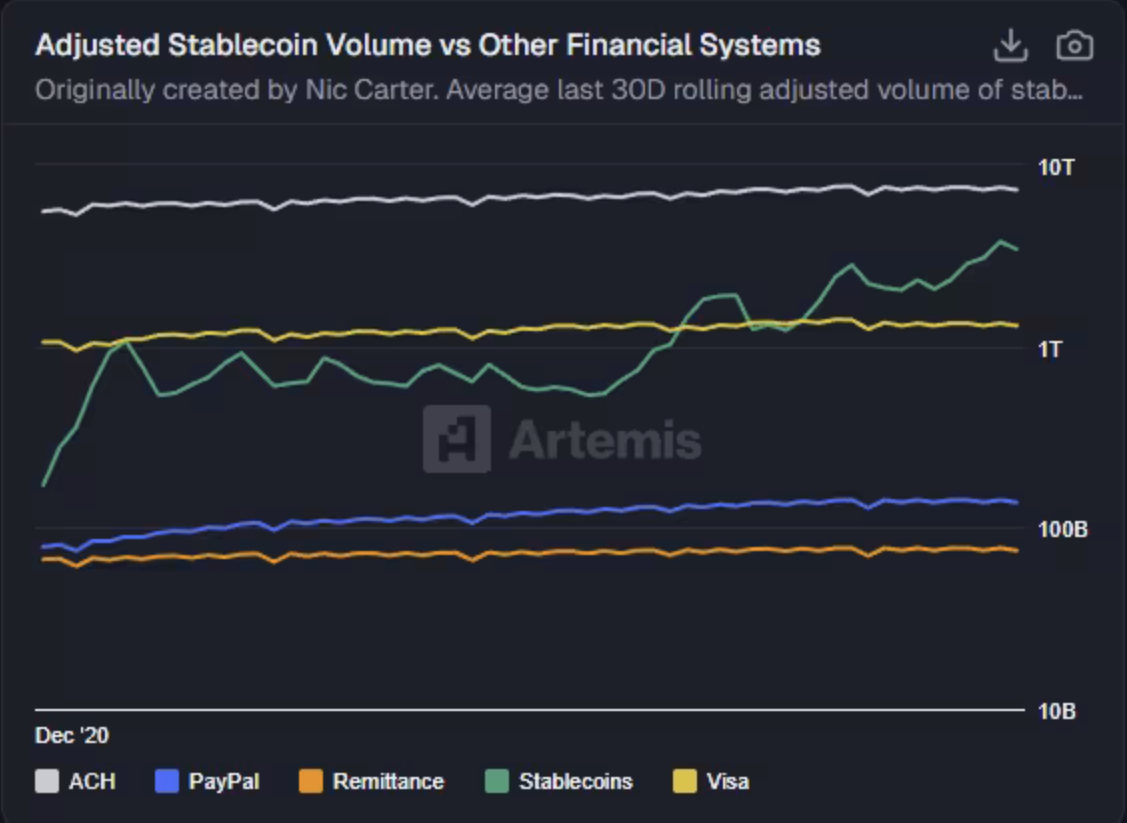
Volume stablecoin vs. sistem keuangan lainnya. Sumber: Galaxy Digital

Makalah ini juga membawa prediksi untuk harga Bitcoin (BTC), yang menuliskan bahwa harganya bisa mencapai $250.000 pada akhir 2027. Menurut kepala penelitian perusahaan Galaxy Research Alex Thorn, tahun 2026 "terlalu kacau untuk diprediksi, meskipun Bitcoin mencapai rekor tertinggi baru pada 2026 masih mungkin."

Related: Coinbase 'hati-hati optimis' untuk 2026 saat crypto mendekati titik belok institusional

Pasar stablecoin yang dipatok dolar mengembang

Menurut data dari DefiLlama, kapitalisasi pasar stablecoin saat ini sekitar $309 miliar. Sementara USDt (USDT) milik Tether dan USDC (USDC) milik Circle terus mendominasi, semakin banyak lembaga keuangan dan perusahaan pembayaran yang memasuki perlombaan stablecoin dalam beberapa bulan terakhir.
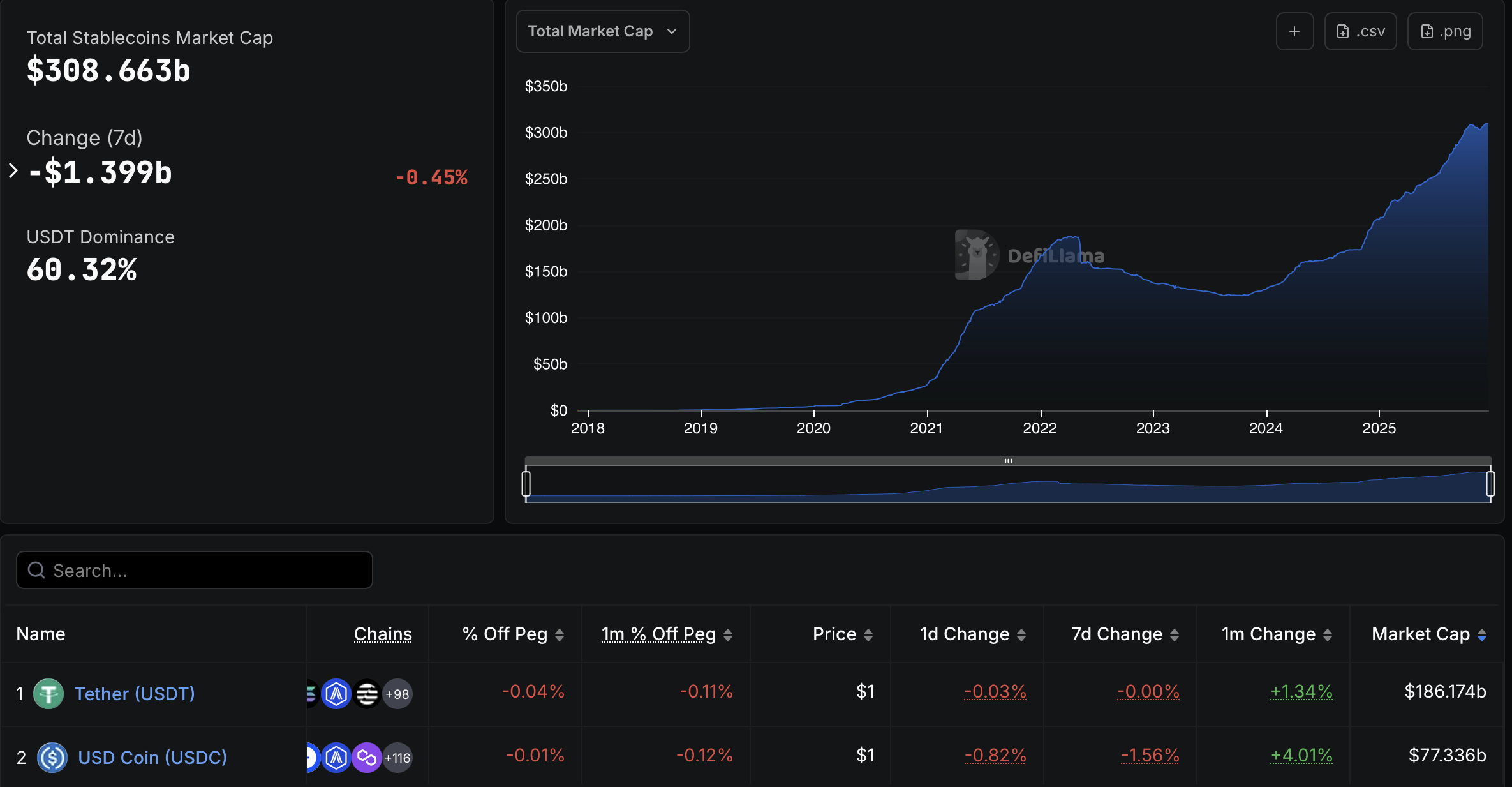
Kapitalisasi pasar stablecoin. Sumber: DefiLlama

Pada bulan Oktober, Western Union mengumumkan rencana untuk meluncurkan stablecoin-nya sendiri yang dipatok dolar AS, US Dollar Payment Token, yang akan dibangun di blockchain Solana dan diterbitkan oleh Anchorage Digital Bank sebagai bagian dari jaringan penyelesaian aset digital yang lebih luas.

Dilaporkan bahwa Sony Bank sedang mempersiapkan stablecoin yang dipatok dolar AS untuk digunakan di seluruh ekosistem AS Sony, termasuk game PlayStation, langganan, dan konten anime. Stablecoin ini diharapkan diluncurkan pada tahun 2026.

Pada hari Kamis, SoFi Technologies meluncurkan SoFiUSD, sebuah stablecoin dolar AS yang sepenuhnya dijamin yang diterbitkan oleh anak perusahaannya di bidang perbankan, SoFi Bank. Perusahaan mengatakan token ini akan debut di Ethereum dan dirancang untuk mendukung penyelesaian biaya rendah bagi bank, fintech, dan platform perusahaan.

Associate Galaxy Research Jianing Wu mengatakan dia mengharapkan stablecoin yang bermitra dengan TradFi akan terkonsolidasi pada tahun 2026, karena pengguna dan pedagang tidak mungkin mengadopsi daftar panjang dolar digital dan justru akan memilih satu atau dua dengan "penerimaan terluas".

Majalah: Serangan kuantum terhadap Bitcoin akan membuang-buang waktu: Kevin O’Leary

Related Questions

QApa prediksi Galaxy Research mengenai volume transaksi stablecoin dibandingkan dengan sistem ACH pada tahun 2026?

AGalaxy Research memprediksi bahwa stablecoin akan memproses lebih banyak volume transaksi daripada sistem Automated Clearing House (ACH) AS pada tahun 2026.

QApa faktor kunci yang mendukung pertumbuhan penggunaan stablecoin menurut laporan Galaxy?

AFaktor kunci termasuk kejelasan regulasi, adopsi yang meningkat, dan implementasi yang diharapkan dari definisi di bawah GENIUS Act pada awal 2026.

QBerapa nilai kapitalisasi pasar stablecoin saat ini menurut data DefiLlama?

AKapitalisasi pasar stablecoin saat ini sekitar $309 miliar menurut data dari DefiLlama.

QPerusahaan mana saja yang baru-baru ini meluncurkan stablecoin yang dipatok ke dolar AS?

AWestern Union (US Dollar Payment Token), Sony Bank (stablecoin untuk ekosistem AS), dan SoFi Technologies (SoFiUSD) telah meluncurkan atau mengumumkan stablecoin yang dipatok ke dolar AS.

QApa prediksi Galaxy Research mengenai harga Bitcoin (BTC) pada akhir tahun 2027?

AGalaxy Research menulis bahwa Bitcoin (BTC) dapat mencapai $250.000 pada akhir tahun 2027.

Related Reads

AI Giants Queueing Up for IPOs: Is This the 'Last Dance' for the U.S. Stock Market?

A massive wave of IPOs from AI giants like OpenAI, Anthropic, and SpaceX is taking shape, potentially reshaping the U.S. stock market. OpenAI is reportedly preparing for a historic IPO, targeting a valuation over $1 trillion and raising roughly $60 billion, which would dwarf previous records. Anthropic is also advancing its own IPO plans, projecting significant revenue growth and achieving quarterly operating profit. However, their financial profiles starkly differ. While Anthropic is nearing profitability with a focus on enterprise clients, OpenAI continues to report substantial losses, with a negative operating margin and expectations for positive cash flow only by 2029-2030. Analysts warn these listings could trigger a major "passive fund reshuffle," forcing index funds to sell holdings in established tech giants to make room for the new entrants, potentially pressuring the broader market. Some observers view the IPO rush as a "risk transfer," allowing early private investors to cash out at peak valuations while passing future financial uncertainty to public market investors. The divergent paths of Anthropic's near-term profitability versus OpenAI's long-term, high-cost growth narrative present a critical choice for investors. The outcome of these IPOs is seen as a major swing factor for risk assets in 2026, testing whether this surge marks a new cycle or a potential peak.

marsbit1m ago

AI Giants Queueing Up for IPOs: Is This the 'Last Dance' for the U.S. Stock Market?

marsbit1m ago

The Richest Fed Chair in 112 Years Is Here: Kevin Warsh Is Rewriting the Rules

Kevin Warsh, with a personal fortune exceeding $130 million, became the 112nd and wealthiest Chair of the U.S. Federal Reserve on May 22nd. A former Wall Street investment banker and key figure during the 2008 financial crisis, Warsh lacks a traditional academic background for a central banker but brings deep market experience. He proposes an unconventional policy approach of simultaneously reducing the Fed's balance sheet ("quantitative tightening") while cutting interest rates, arguing that a smaller balance sheet would allow for more effective rate policy. His ascent marks a potential regime change at the Fed. Warsh aims to reform the institution's decision-making processes, tighten communication discipline among officials, and reduce reliance on forward guidance like the "dot plot." This shift responds to the Fed's current dilemma: fiscal policy is expanding the government's balance sheet through deficits, while monetary policy's ability to shrink its own $6.7 trillion balance sheet is severely constrained, creating pressure on long-term interest rates. Analysts expect Warsh's tenure to sustain high volatility in the U.S. Treasury market due to persistent supply pressures. Furthermore, his leadership coincides with a gradual, structural erosion of dollar dominance, evidenced by its declining share in global reserves and cracks in the petrodollar system, with increased use of alternatives like the Chinese yuan in oil trade. For investors, this environment underscores the importance of portfolio diversification, including assets like gold and Chinese sovereign bonds, amid a fluctuating dollar credit anchor.

链捕手15m ago

The Richest Fed Chair in 112 Years Is Here: Kevin Warsh Is Rewriting the Rules

链捕手15m ago

τ Scaling: Huawei's New Growth Engine Designed for the Post-Moore Era

**Tau Scaling: Huawei's New Growth Engine for the Post-Moore Era** For 60 years, progress in semiconductors was driven by Moore's Law – making transistors smaller, denser, and cheaper. This path has now stalled due to plummeting returns below 7nm, astronomical lithography costs, and rising per-transistor expenses. After six years and testing 381 production chips, Huawei’s semiconductor team proposes a fundamental shift: **stop competing on size, start competing on time**. This is the core of their "τ (Tau) Scaling" theory. It treats *time* as the key optimization metric, compressing characteristic delays (τ) across all levels – from transistor switching (picoseconds) to data center tasks (seconds), spanning 12 orders of magnitude. **What is τ Scaling?** It holistically minimizes delay/time constants (τ) across four layers: transistors (switching speed), circuits (signal delay), chips (compute/memory access), and systems (end-to-end communication). The goal is to align optimization from process and circuit design to architecture and systems using this unified metric. **Mobile Application: LogicFolding** Without advancing the process node, this technique vertically stacks chips using ultra-precision hybrid bonding, distributing critical paths across layers ("stacking floors"). Results include a 55% transistor density increase, 41% better energy efficiency, over 40% higher SRAM frequency, and a roadmap targeting 4GHz by 2029. **AI Data Center Application: Full-Link Latency Compression** With 80% of AI cluster energy and 70% cost spent on data movement, the focus is slashing communication time. Key innovations include: 1. **Unified Bus:** Cuts multi-layer protocols, reducing remote access latency from microseconds to ~100 nanoseconds – 500x faster. 2. **Hi-ONE Optical Interconnect:** Replaces copper with fiber, enabling 8Tb/s per module and scaling distances from 1m to 100m for 10,000-chip clusters. 3. **3D Folding:** Solves the "interface bottleneck" of 2.5D packaging by vertically integrating memory, power, and optical I/O alongside compute, predicting over 100x integration density gain by 2035. **Re-fusion of Logic and Memory** The AI era, where data movement is more critical than computation, demands tight 3D integration of logic and memory, shifting industry influence towards memory and advanced packaging. **Remaining Challenges** include adapting EDA tools for 3D design, optimizing wafer-to-wafer process variation and vertical interconnect losses, and establishing new energy efficiency and benchmarking standards. **Conclusion:** The era of scaling physical dimensions is over. The era of scaling time has begun. By leveraging 3D stacking, system architecture, and interconnect optimization—rather than solely chasing advanced lithography—performance and efficiency can continue to advance. This is poised to be the semiconductor industry's core roadmap for the next decade.

marsbit53m ago

τ Scaling: Huawei's New Growth Engine Designed for the Post-Moore Era

marsbit53m ago

NodeStrategy: The First Ordinals DAT Project, Bringing the Strategy Treasury Narrative to NFTs

**Summary: The Fundamental Flaws of NodeStrategy, the 'First Ordinals DAT'** NodeStrategy presents itself as the first Ordinals Digital Asset Treasury (DAT) on Bitcoin. Its model mirrors MicroStrategy's treasury narrative but for NFTs, specifically targeting the NodeMonkes collection (not officially affiliated). The project's core mechanism is a four-step flywheel: a 10% fee on all trades (90% to treasury, 10% to radFi/Bound marketplace) is used to buy NodeMonkes. These NFTs are then listed for sale on Satflow, with 100% of the sale proceeds used to buy back and burn the project's token, NODESTRAT, aiming to create a perpetual value cycle. However, the design contains critical, self-defeating flaws: 1. **Platform Lock-In:** As a Bitcoin Rune, NODESTRAT lacks smart contract functionality and cannot natively enforce the 10% fee. The fee can only be collected on the radFi/Bound marketplace itself. This makes the entire flywheel dependent on a single platform. If liquidity moves elsewhere, fee revenue drops to zero, halting the mechanism. 2. **Self-Suffocating Economics:** The 10% fee acts both as the flywheel's fuel and a major drag on demand. A buy/sell roundtrip incurs a 20% cost, creating a massive hurdle for traders. This strangles the very trading volume needed to generate fees. 3. **Ineffective Value Support:** The flywheel is starved. Low daily volume (~$9K) generates minimal fees for NFT purchases. The NFT "ladder" sales are slow and unpredictable (only 39 total sold), meaning buybacks are infrequent. While 30.77% of the supply has been burned, this supply reduction cannot lift price without corresponding demand, which is suppressed by the high transaction tax. 4. **Meaningless NAV:** The Net Asset Value (NAV), currently at a 0.46x discount to market cap, is merely a marketing figure. There is no redemption mechanism for token holders to claim the underlying NodeMonkes assets. Price is set by market liquidity flows, not by this theoretical backing. In essence, NodeStrategy's design forces its revenue source (trading fees) to simultaneously cripple the demand and liquidity required for its own success, trapping the project in a stagnant state.

marsbit59m ago

NodeStrategy: The First Ordinals DAT Project, Bringing the Strategy Treasury Narrative to NFTs

marsbit59m ago

Agentic Design Patterns: A Book That Made Me Re-Understand "What Is an Agent, Really?"

"Agentic Design Patterns" is a 2025 book by Antonio Gullí, a Google engineering director, which offers a systematic framework for AI Agent development through 21 design patterns. A core contribution is the "Four Levels of Agency": Level 0 (bare LLMs) are not true agents. Level 1 agents actively decide when and how to use tools. Level 2 agents engage in strategic planning, context engineering (curating and filtering information), and self-reflection. Level 3 involves multi-agent collaboration with defined communication topologies. The book introduces **Context Engineering** as a superset of prompt engineering, managing four layers of information for the agent: system prompts, external data, implicit context (user history, environment), and feedback loops for automated optimization. A key pattern is **Reflection (Producer-Critic)**, where two distinct agents with different prompts collaborate iteratively—one produces output, the other critiques it—until quality is satisfactory or a max iteration limit is reached. For **Memory**, a three-layer model is proposed: Session (ephemeral conversation context), State (temporary task data), and Memory (persistent, long-term storage). Regarding **Multi-Agent Systems**, the book advises against unnecessary complexity, recommending simple topologies like Supervisor or Peer-to-Peer based on task needs. It emphasizes perfecting a single Level 2 agent before moving to multi-agent setups. The author concludes with three actionable takeaways: 1) Add a Critic agent to existing workflows, 2) Practice Context Engineering beyond simple prompts, and 3) Avoid premature multi-agent complexity; first master a robust single agent. The book provides a practical map, codifying common challenges like reflection, memory, and coordination into reusable patterns, saving developers from reinventing foundational solutions.

链捕手1h ago

Agentic Design Patterns: A Book That Made Me Re-Understand "What Is an Agent, Really?"

链捕手1h ago

Trading

Spot
Futures

Hot Articles

How to Buy ACH

Welcome to HTX.com! We've made purchasing Alchemy Pay (ACH) simple and convenient. Follow our step-by-step guide to embark on your crypto journey.Step 1: Create Your HTX AccountUse your email or phone number to sign up for a free account on HTX. Experience a hassle-free registration journey and unlock all features.Get My AccountStep 2: Go to Buy Crypto and Choose Your Payment MethodCredit/Debit Card: Use your Visa or Mastercard to buy Alchemy Pay (ACH) instantly.Balance: Use funds from your HTX account balance to trade seamlessly.Third Parties: We've added popular payment methods such as Google Pay and Apple Pay to enhance convenience.P2P: Trade directly with other users on HTX.Over-the-Counter (OTC): We offer tailor-made services and competitive exchange rates for traders.Step 3: Store Your Alchemy Pay (ACH)After purchasing your Alchemy Pay (ACH), store it in your HTX account. Alternatively, you can send it elsewhere via blockchain transfer or use it to trade other cryptocurrencies.Step 4: Trade Alchemy Pay (ACH)Easily trade Alchemy Pay (ACH) on HTX's spot market. Simply access your account, select your trading pair, execute your trades, and monitor in real-time. We offer a user-friendly experience for both beginners and seasoned traders.

3.4k Total ViewsPublished 2024.03.29Updated 2025.05.13

How to Buy ACH

Discussions

Welcome to the HTX Community. Here, you can stay informed about the latest platform developments and gain access to professional market insights. Users' opinions on the price of ACH (ACH) are presented below.

活动图片