Les métriques onchain de Ronin et ZKsync ont le plus baissé en 2025

cointelegraphPublished on 2025-12-16Last updated on 2025-12-16

Abstract

Selon les données de Nansen, l'activité on-chain a considérablement diminué sur plusieurs grands réseaux en 2025. Ronin a enregistré la baisse la plus importante avec 70% d'adresses actives en moins, largement dû au déclin du jeu Pixels qui avait initialement boosté son utilisation. ZKsync a subi une chute de 90% de ses transactions après son airdrop de juin 2024. Ethereum a vu une augmentation de 25% de ses adresses actives, tandis que des Layer-2 comme Arbitrum ont affiché des baisses modérées. Solana reste le réseau le plus actif avec plus d'un milliard d'adresses, malgré un recul de l'engouement pour les memecoins. Les baisses ne reflètent pas nécessairement des échecs définitifs, mais plutôt des cycles d'hype temporaires, comme le montre l'exemple de TON dont l'activité a chuté après le pic provoqué par Hamster Kombat. Les réseaux comme Base et BNB Chain ont mieux retenu leur activité post-hype.

L'activité onchain a fortement diminué sur plusieurs grands réseaux, selon les données de Nansen, avec 11 blockchains enregistrant des baisses d'adresses actives au cours de l'année écoulée.

Ronin a enregistré la plus forte baisse à 70 %, tandis que Bitcoin a enregistré un déclin de 7,2 %. Plusieurs réseaux de couche 2 d'Ethereum figuraient sur la liste.

Les données de Nansen ont également montré des baisses de l'activité transactionnelle sur bon nombre des mêmes réseaux. ZKsync a enregistré l'une des baisses les plus prononcées, avec une chute de 90 % des transactions.

Pendant ce temps, la couche de base d'Ethereum a enregistré une augmentation de 25 % des adresses actives et une hausse de plus de 20 % des transactions, même si le débat se poursuivait autour de la feuille de route centrée sur les rollups d'Ethereum et les préoccupations concernant la fragmentation de la liquidité entre les réseaux de couche 2.
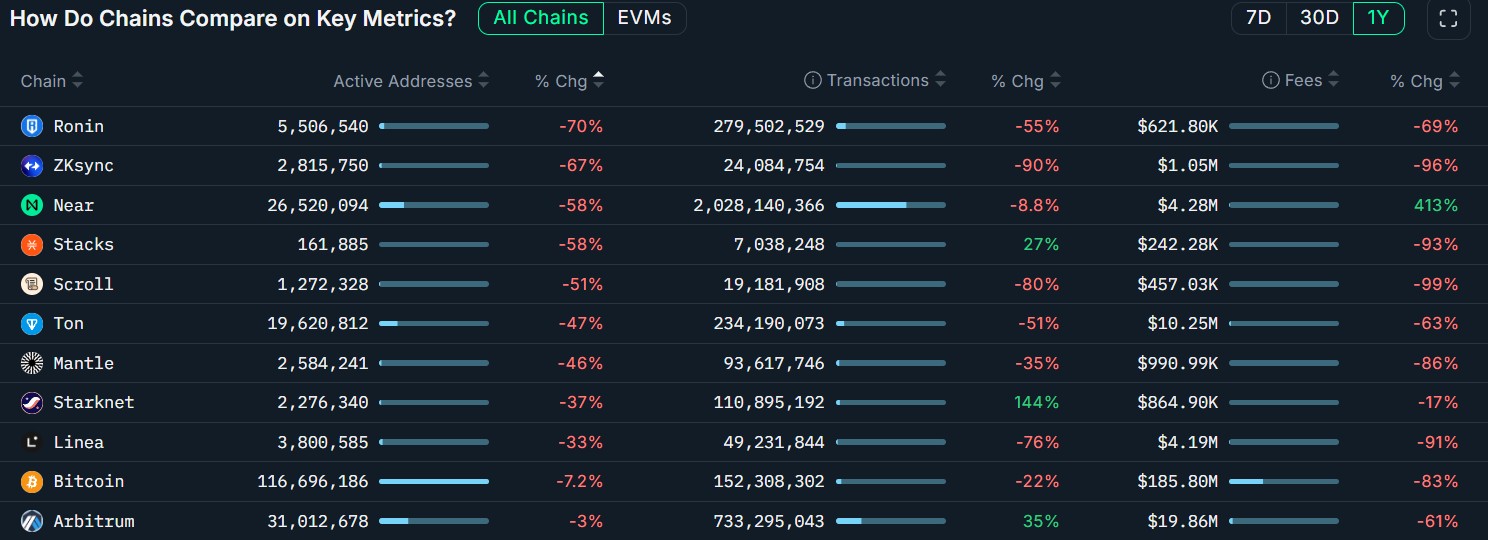
Ronin et les chaînes de couche 2 d'Ethereum dominent les baisses d'activité alors que Bitcoin s'insère dans la liste. Source : Nansen

Réseaux avec les plus fortes baisses d'utilisation

Pixels est un jeu populaire qui a migré vers Ronin depuis Polygon au second semestre 2023. À l'époque, Ronin comptait environ 20 000 utilisateurs actifs quotidiens avant que l'arrivée de Pixels ne provoque une forte augmentation de l'activité, faisant brièvement de Ronin la deuxième chaîne la plus active en termes d'utilisateurs quotidiens.

En décembre 2024, Pixels enregistrait environ 300 000 utilisateurs actifs quotidiens, selon DappRadar. La popularité du jeu a depuis décliné, et l'activité onchain de Ronin a chuté en parallèle, montrant la dépendance du réseau aux jeux à succès.
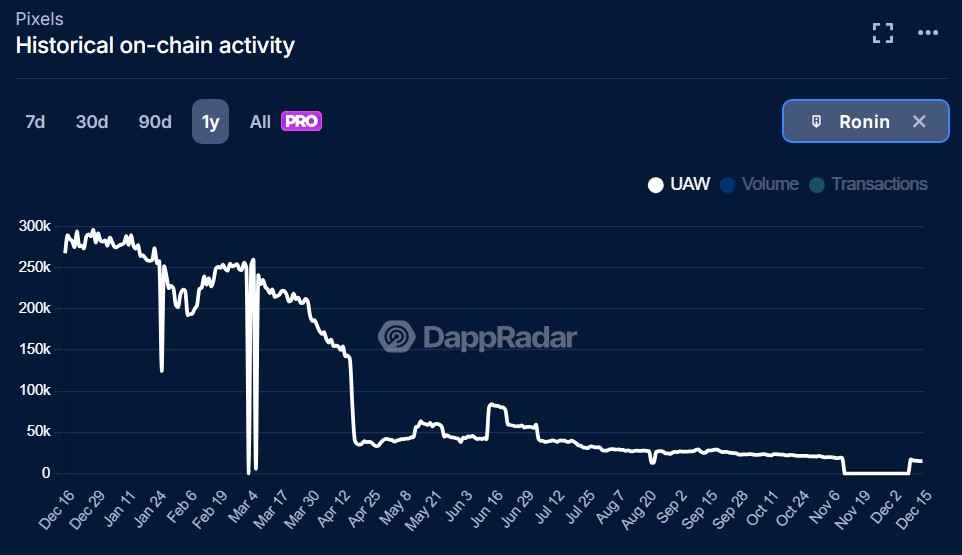
L'activité de Pixels a chuté tout au long de 2025. Source : DappRadar

Plusieurs réseaux de couche 2 d'Ethereum ont également connu un déclin de leur utilisation alors que l'activité liée aux airdrops se refroidissait. La réclamation de l'airdrop du jeton ZKsync a ouvert en juin 2024. Le réseau a déclaré que près de 700 000 portefeuilles étaient éligibles tout en repoussant les critiques concernant son filtrage Sybil. Les données de Nansen ont montré que plus de 40 % des principaux portefeuilles ayant reçu l'airdrop ont immédiatement vendu leurs allocations. Scroll est également apparu sur la liste suite à son airdrop d'octobre 2024, après quoi l'activité onchain a ralenti.

Arbitrum a vu ses adresses actives chuter de 3 %, bien que ses quelque 31 millions d'utilisateurs le classent toujours parmi les 10 premiers réseaux en termes d'activité. Le rollup Ethereum a effectué son airdrop en 2023, et son volume de transactions a augmenté de 36 % au cours de l'année écoulée pour atteindre environ 734,5 millions, dépassant les 507 millions de transactions d'Ethereum. Arbitrum a attiré l'activité d'actifs tokenisés, y compris 500 actions américaines estampillées sur le réseau par Robinhood.

Lire aussi : Comment la crypto est utilisée en 2025 : YouTube, cartes Pokémon et plus

Base et Optimism se sont distingués parmi les réseaux de couche 2 d'Ethereum. Les deux ont affiché des augmentations des adresses actives et des volumes de transactions. Base n'a pas de jeton natif et n'a jamais effectué d'airdrop. L'activité onchain a augmenté parallèlement à l'intérêt pour des domaines tels que les memecoins, les applications liées à l'IA et les échanges décentralisés.

Solana a enregistré le plus grand nombre d'adresses actives de l'industrie avec plus d'un milliard, suivi par Tron et Ethereum. BNB Chain a affiché une augmentation de 159 % des adresses actives, tandis que Bitcoin était le seul réseau du top cinq à enregistrer une baisse, parallèlement à une chute de 22 % des transactions.
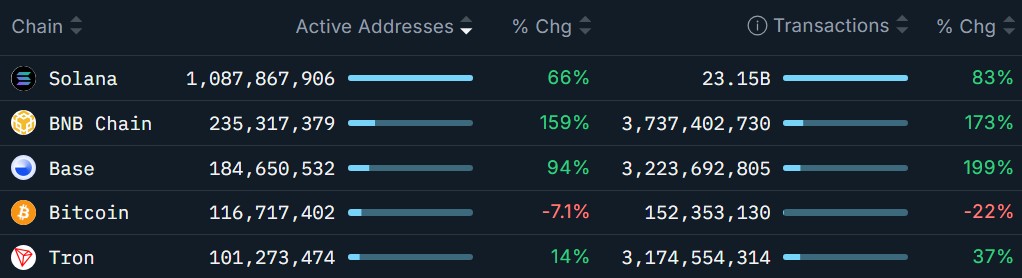
L'activité des memecoins s'est refroidie, mais Solana mène toujours l'industrie en activité onchain. Source : Nansen

Ce que les baisses montrent et ne montrent pas

Les données ont montré peu de relation cohérente entre l'utilisation onchain et les prix des jetons. Le prix de Solana a baissé au cours de l'année écoulée malgré une augmentation de 66 % des adresses actives, tandis que le prix du jeton BNB (BNB) a augmenté parallèlement à l'activité accrue du réseau.
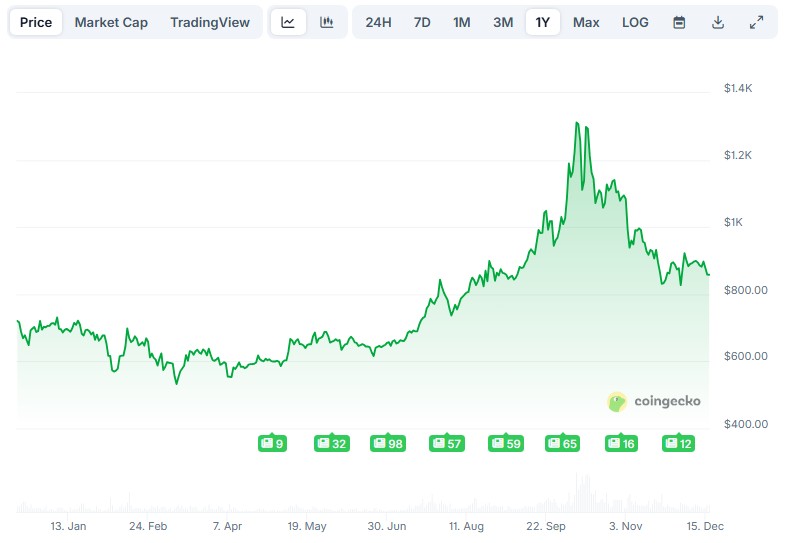
Le BNB a augmenté de près de 20 % au cours de l'année écoulée. Source : CoinGecko

Les baisses en glissement annuel ne pointent pas nécessairement vers des problèmes terminaux pour les réseaux concernés. L'activité onchain peut fluctuer brusquement à mesure que les applications migrent, que les programmes d'incitation s'achèvent ou que les utilisateurs changent de chaîne, en particulier parmi les réseaux plus récents qui établissent encore leurs cas d'utilisation principaux.

La blockchain liée à Telegram, The Open Network (TON), a également enregistré une baisse de 47 % des adresses actives et un déclin de 51 % des transactions, un renversement qui a suivi une croissance démesurée en 2024. Les mini-jeux basés sur Telegram ont alimenté une grande partie de cette activité antérieure, attirant des utilisateurs au-delà du public typiquement crypto-natif de la plateforme.

Lire aussi : Bitcoin se découple des actions au second semestre 2025

Hamster Kombat était l'un des exemples les plus marquants. Le jeu de tapotement a abaissé la barrière à l'entrée grâce à une mécanique simple et a attiré une forte participation d'utilisateurs anticipant un futur airdrop de jetons. Selon le PDG de Telegram, Pavel Durov, le jeu viral a attiré 239 millions d'utilisateurs en trois mois, avec plus de 130 millions éligibles pour son airdrop fin septembre.

Les données de Nansen montrent que les adresses actives de TON ont culminé à environ 2,5 millions par jour le 30 septembre. L'activité a depuis chuté alors que l'engagement lié à Hamster Kombat se refroidissait, soulignant comment les poussées de courte durée peuvent fausser les comparaisons en glissement annuel.
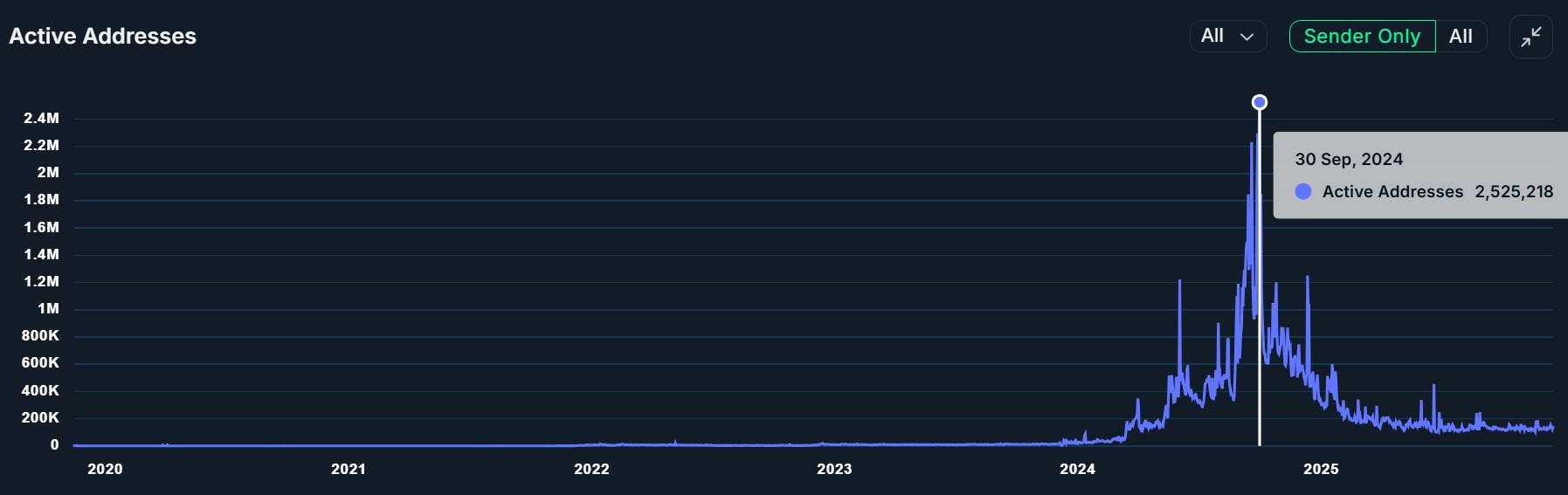
Hamster Kombat a poussé l'activité de Ton à de nouveaux records. Source : Nansen

Quelques chaînes ont conservé leur utilisation après l'engouement

Les données blockchain de l'année écoulée montrent que l'activité onchain se déplace rapidement entre les réseaux plutôt que de rester ancrée à une seule chaîne. L'utilisation a le plus fortement chuté sur les blockchains où l'activité avait été concentrée autour d'un petit nombre d'applications, de programmes d'incitation ou de moments viraux.

Dans le même temps, ces baisses ne signalent pas automatiquement un échec plus large de l'écosystème. Dans plusieurs cas, l'activité s'est refroidie après des périodes de croissance démesurée, soulignant comment les comparaisons en glissement annuel peuvent être faussées par les cycles d'engouement, les airdrops ou les applications de courte durée.

Solana offre un contraste utile. Alors que l'activité driven par les memecoins a explosé tout au long de 2024 et début 2025 avant de se refroidir vers la fin de l'année, la poussée a également attiré des utilisateurs, de la liquidité et des applications qui ont continué à soutenir le réseau.
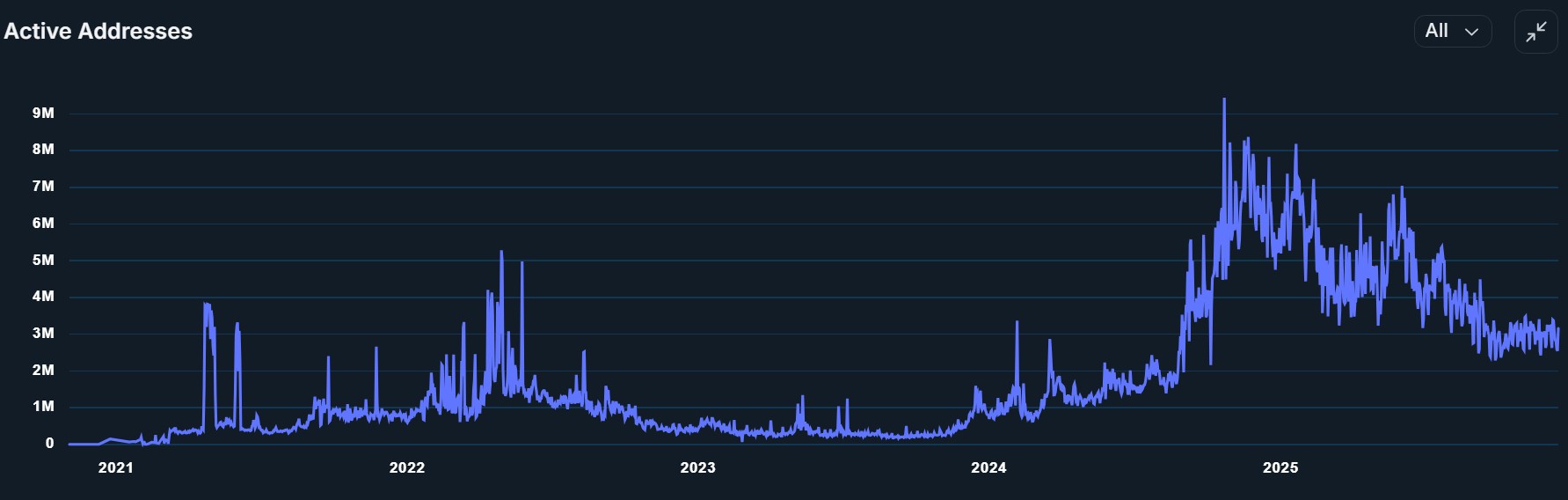
Le boom des memecoins de Solana a attiré de nouvelles adresses qui sont restées après le boom. Source : Nansen

Les adresses actives quotidiennes de Solana ont culminé au-dessus de 9 millions le 22 octobre 2024, pendant le pic du trading de memecoins. En décembre, les utilisateurs quotidiens ont fluctué entre 2 et 3 millions. Bien que cela ait marqué un net recul par rapport aux niveaux de pointe, l'activité est restée constamment plus élevée qu'avant le boom.

Une grande partie de la baisse de l'activité onchain de l'année écoulée a été driven par la recherche de profit à court terme, mais des réseaux tels que Solana, BNB Chain et Base ont montré des signes de rétention de l'utilisation au-delà des poussées virales, les distinguant des chaînes qui ont connu des renversements plus prononcés.

Magazine : Grandes questions : Bitcoin survivrait-il à une panne de courant de 10 ans ?

Trending Cryptos

Related Questions

QQuels réseaux ont enregistré les baisses les plus importantes d'adresses actives en 2025 selon Nansen ?

ARonin a enregistré la baisse la plus importante, soit 70%, suivi par plusieurs réseaux de couche 2 d'Ethereum. ZKsync a également connu l'une des baisses les plus marquées avec une chute de 90% du nombre de transactions.

QPourquoi l'activité sur le réseau Ronin a-t-elle autant chuté ?

AL'activité sur Ronin a fortement chuté en raison de la baisse de popularité du jeu Pixels, qui avait initialement dopé son activité après sa migration de Polygon en 2023. Le réseau est très dépendant des jeux à succès.

QQuel a été l'impact des airdrops sur l'activité des réseaux de couche 2 ?

ALes airdrops ont initialement stimulé l'activité, mais celle-ci a considérablement refroidi après leur distribution. Par exemple, plus de 40% des portefeuilles ayant reçu l'airdrop de ZKsync ont immédiatement vendus leurs allocations, et l'activité sur Scroll a ralenti après son airdrop d'octobre 2024.

QQuels réseaux se sont distingués par une augmentation de leur activité malgré la tendance générale à la baisse ?

ABase et Optimism ont affiché une augmentation des adresses actives et des volumes de transactions. BNB Chain a enregistré une hausse de 159% des adresses actives, et la couche de base d'Ethereum a vu ses transactions augmenter de plus de 20%.

QLa baisse d'activité onchain signifie-t-elle nécessairement l'échec d'un réseau ?

ANon, les baisses d'activité ne signalent pas automatiquement un échec. Elles reflètent souvent la fin de cycles de hype, d'airdrops ou d'applications éphémères. Des réseaux comme Solana ont retenu une partie de leur activité accrue même après l'effondrement de la bulle des memecoins, montrant une adoption plus durable.

Related Reads

Behind the AI Scorecards Lies a Chinese 'Question Setter'

Behind the AI scorecards that dominate industry discussions—benchmarks like MMLU-Pro, MMMU, and MMMU-Pro—stands a Chinese-Canadian researcher: Wenhu Chen. As an assistant professor at the University of Waterloo and founder of the TIGER Lab, Chen has become a key "exam-setter" for evaluating large language and multimodal models. Chen first gained broader recognition with MMLU-Pro, a more challenging and stable update to the popular MMLU benchmark. As top models like OpenAI’s o3 began achieving near-perfect scores on the original MMLU, it became difficult to distinguish their true capabilities. MMLU-Pro introduced more complex reasoning questions, expanded answer choices, and filtered out ambiguous or simple items, effectively reintroducing differentiation among state-of-the-art models. His work on MMMU addressed the evaluation of multimodal models, requiring them to integrate visual information (like charts, diagrams, or tables) with textual knowledge across diverse academic subjects. Even the strongest models initially scored only around 56-59%, highlighting significant room for improvement in genuine multimodal reasoning. MMMU-Pro further refined this by preventing models from bypassing visual cues. Chen’s research focus has long been on complex information understanding and reasoning. His background—including a PhD at UC Santa Barbara, research at Google/DeepMind on Gemini, and now a role in Meta’s superintelligence lab—provides deep insight into model development and their potential weaknesses. His TIGER Lab also builds models (e.g., for video understanding and generation), ensuring his evaluation benchmarks are grounded in practical challenges. While AI headlines often spotlight company leaders and product launches, Chen’s work exemplifies the critical, behind-the-scenes contributions of researchers crafting the rigorous standards that define and drive progress in AI capabilities.

marsbit54m ago

Behind the AI Scorecards Lies a Chinese 'Question Setter'

marsbit54m ago

STRC Unpegged by 11%, Can Strategy's Perpetual Motion Machine Keep Turning?

STRC, the perpetual preferred stock of MicroStrategy, is experiencing a persistent de-pegging from its target par value of $100, with the discount recently widening to over 11%. This de-anchoring challenges the core design of STRC, which was intended as a stable, income-oriented security operating near $100. As a crucial funding engine for MicroStrategy's Bitcoin acquisition strategy, STRC's price reflects market confidence in the company's entire capital model. The company's "capital flywheel" relies on issuing STRC at or above $100 via an At-the-Market (ATM) program to raise cash for buying Bitcoin, thereby boosting company equity and theoretically supporting STRC's value. A monthly adjustable dividend mechanism was designed to maintain this peg. Despite raising the dividend to 11.5% and increasing payment frequency, the de-pegging persists. Market concerns extend beyond technical factors like leveraged arbitrage unwinding. Analysts point to MicroStrategy's limited cash reserves relative to its ~$1.7 billion annual dividend obligation for preferred shares. While the company counters that its vast Bitcoin holdings could cover decades of payments, this argument hinges on the potential need to sell Bitcoin—a shift from its longstanding "hodl" narrative. The company's recent sale of a small amount of BTC, framed as a test, amplified these liquidity and strategy concerns. If STRC remains discounted, impairing MicroStrategy's ability to raise cheap capital, fears may grow that the company could sell more Bitcoin to meet obligations. This scenario could transform MicroStrategy from a major market buyer into a potential seller, posing significant downside risk for Bitcoin. The re-pegging of STRC is thus a key indicator for the health of MicroStrategy's capital structure and its market impact.

Odaily星球日报1h ago

STRC Unpegged by 11%, Can Strategy's Perpetual Motion Machine Keep Turning?

Odaily星球日报1h ago

Silicon Valley's Most Sought-After New Role Has Emerged

Silicon Valley's New Most Wanted Job: The Rise of the Forward Deployment Engineer The AI industry is witnessing a significant shift. The focus has moved from developing cutting-edge models to deploying them effectively within enterprises. This has made the "Forward Deployment Engineer" (FDE) a critical and highly sought-after role at major firms like OpenAI, Anthropic, and Google. For the past three years, the industry prioritized model scientists. However, companies are now facing a harsh reality: purchasing powerful AI tools does not guarantee productivity gains or organizational change. The biggest hurdle is not the technology itself, but integrating it into complex legacy systems, workflows, and corporate cultures. This includes challenges like data silos, compliance requirements, and internal resistance. The FDE role, pioneered by Palantir Technologies, addresses this "last-mile" problem. FDEs are deployed on-site with clients for extended periods. Their job is to deeply understand the client's specific organizational structure, processes, and pain points, then tailor and implement the AI solution accordingly. They combine skills in technology, project management, and organizational change. A clear signal of this trend emerged in May 2026 when three AI giants made major moves. Anthropic launched a $1.5B joint venture for enterprise deployment. OpenAI formed an independent deployment subsidiary, DeployCo, with over $4B in commitments and acquired a deployment consultancy. Google Cloud's CEO publicly announced a large-scale recruitment drive for FDEs. This shift represents a fundamental change in the software business model: from selling tools to selling guaranteed outcomes. FDEs are the agents of this change, responsible for delivering a working system within the production environment, not just a demo. Real-world cases, such as challenges at Goldman Sachs (compliance barriers) and Target (internal cultural resistance), illustrate that the primary obstacles to AI adoption are organizational, not technical. An FDE's value lies in navigating these human and procedural complexities to facilitate a successful "AI migration." In essence, as core AI technology becomes more accessible and affordable, the true premium is shifting to the human expertise required to understand organizations and drive change—making the FDE role pivotal for the next phase of the AI revolution.

marsbit1h ago

Silicon Valley's Most Sought-After New Role Has Emerged

marsbit1h ago

When the World Cup Collides with Agents: From Web2 to Web3, How Are Wallets Evolving into Agentic Wallets?

World Cup as a Catalyst for Agentic Wallets: From Web2 to Web3 This article explores how the World Cup provides a real-world scenario for observing the evolution of digital wallets from simple asset managers towards "Agentic Wallets"—intelligent, AI-powered interfaces. Using the example of prediction markets like Polymarket, it illustrates how AI Agents can lower the barrier to Web3 interaction. Instead of navigating complex DApps, users can express intent in natural language (e.g., "I think Portugal will win") within platforms like Discord or web pages. The Agent then interprets this intent, finds the relevant market, and seamlessly guides the user through the on-chain transaction via their wallet. The core shift is from wallets as mere "function menus" for signing transactions to "intent interpreters" that understand user goals. The article highlights parallel developments in traditional finance, such as Mastercard's "Agent Pay" and WeChat Pay's AI tests, which focus on granting AI controlled, authorized, and auditable payment capabilities. This underscores a broader trend of AI entering the financial layer. However, the article emphasizes that the primary challenge for Agentic Wallets in Web3 is not automation but establishing clear security boundaries. Unlike traditional systems with chargebacks, on-chain transactions are often irreversible. Therefore, future wallets must ensure users retain ultimate control and comprehension. They need to transparently communicate an Agent's permissions, spending limits, authorized durations, and provide easy ways to pause or revoke access. The World Cup experiments represent early steps toward wallets that are not just applications but ubiquitous, intelligent interfaces that simplify Web3 while keeping users securely in control.

marsbit2h ago

When the World Cup Collides with Agents: From Web2 to Web3, How Are Wallets Evolving into Agentic Wallets?

marsbit2h ago

Trading

Spot
Futures

Hot Articles

What is SONIC

Sonic: Pioneering the Future of Gaming in Web3 Introduction to Sonic In the ever-evolving landscape of Web3, the gaming industry stands out as one of the most dynamic and promising sectors. At the forefront of this revolution is Sonic, a project designed to amplify the gaming ecosystem on the Solana blockchain. Leveraging cutting-edge technology, Sonic aims to deliver an unparalleled gaming experience by efficiently processing millions of requests per second, ensuring that players enjoy seamless gameplay while maintaining low transaction costs. This article delves into the intricate details of Sonic, exploring its creators, funding sources, operational mechanics, and the timeline of significant events that have shaped its journey. What is Sonic? Sonic is an innovative layer-2 network that operates atop the Solana blockchain, specifically tailored to enhance the existing Solana gaming ecosystem. It accomplishes this through a customised, VM-agnostic game engine paired with a HyperGrid interpreter, facilitating sovereign game economies that roll up back to the Solana platform. The primary goals of Sonic include: Enhanced Gaming Experiences: Sonic is committed to offering lightning-fast on-chain gameplay, allowing players and developers to engage with games at previously unattainable speeds. Atomic Interoperability: This feature enables transactions to be executed within Sonic without the need to redeploy Solana programmes and accounts. This makes the process more efficient and directly benefits from Solana Layer1 services and liquidity. Seamless Deployment: Sonic allows developers to write for Ethereum Virtual Machine (EVM) based systems and execute them on Solana’s SVM infrastructure. This interoperability is crucial for attracting a broader range of dApps and decentralised applications to the platform. Support for Developers: By offering native composable gaming primitives and extensible data types - dining within the Entity-Component-System (ECS) framework - game creators can craft intricate business logic with ease. Overall, Sonic's unique approach not only caters to players but also provides an accessible and low-cost environment for developers to innovate and thrive. Creator of Sonic The information regarding the creator of Sonic is somewhat ambiguous. However, it is known that Sonic's SVM is owned by the company Mirror World. The absence of detailed information about the individuals behind Sonic reflects a common trend in several Web3 projects, where collective efforts and partnerships often overshadow individual contributions. Investors of Sonic Sonic has garnered considerable attention and support from various investors within the crypto and gaming sectors. Notably, the project raised an impressive $12 million during its Series A funding round. The round was led by BITKRAFT Ventures, with other notable investors including Galaxy, Okx Ventures, Interactive, Big Brain Holdings, and Mirana. This financial backing signifies the confidence that investment foundations have in Sonic’s potential to revolutionise the Web3 gaming landscape, further validating its innovative approaches and technologies. How Does Sonic Work? Sonic utilises the HyperGrid framework, a sophisticated parallel processing mechanism that enhances its scalability and customisability. Here are the core features that set Sonic apart: Lightning Speed at Low Costs: Sonic offers one of the fastest on-chain gaming experiences compared to other Layer-1 solutions, powered by the scalability of Solana’s virtual machine (SVM). Atomic Interoperability: Sonic enables transaction execution without redeployment of Solana programmes and accounts, effectively streamlining the interaction between users and the blockchain. EVM Compatibility: Developers can effortlessly migrate decentralised applications from EVM chains to the Solana environment using Sonic’s HyperGrid interpreter, increasing the accessibility and integration of various dApps. Ecosystem Support for Developers: By exposing native composable gaming primitives, Sonic facilitates a sandbox-like environment where developers can experiment and implement business logic, greatly enhancing the overall development experience. Monetisation Infrastructure: Sonic natively supports growth and monetisation efforts, providing frameworks for traffic generation, payments, and settlements, thereby ensuring that gaming projects are not only viable but also sustainable financially. Timeline of Sonic The evolution of Sonic has been marked by several key milestones. Below is a brief timeline highlighting critical events in the project's history: 2022: The Sonic cryptocurrency was officially launched, marking the beginning of its journey in the Web3 gaming arena. 2024: June: Sonic SVM successfully raised $12 million in a Series A funding round. This investment allowed Sonic to further develop its platform and expand its offerings. August: The launch of the Sonic Odyssey testnet provided users with the first opportunity to engage with the platform, offering interactive activities such as collecting rings—a nod to gaming nostalgia. October: SonicX, an innovative crypto game integrated with Solana, made its debut on TikTok, capturing the attention of over 120,000 users within a short span. This integration illustrated Sonic’s commitment to reaching a broader, global audience and showcased the potential of blockchain gaming. Key Points Sonic SVM is a revolutionary layer-2 network on Solana explicitly designed to enhance the GameFi landscape, demonstrating great potential for future development. HyperGrid Framework empowers Sonic by introducing horizontal scaling capabilities, ensuring that the network can handle the demands of Web3 gaming. Integration with Social Platforms: The successful launch of SonicX on TikTok displays Sonic’s strategy to leverage social media platforms to engage users, exponentially increasing the exposure and reach of its projects. Investment Confidence: The substantial funding from BITKRAFT Ventures, among others, emphasizes the robust backing Sonic has, paving the way for its ambitious future. In conclusion, Sonic encapsulates the essence of Web3 gaming innovation, striking a balance between cutting-edge technology, developer-centric tools, and community engagement. As the project continues to evolve, it is poised to redefine the gaming landscape, making it a notable entity for gamers and developers alike. As Sonic moves forward, it will undoubtedly attract greater interest and participation, solidifying its place within the broader narrative of blockchain gaming.

1.7k Total ViewsPublished 2024.04.04Updated 2024.12.03

What is SONIC

What is $S$

Understanding SPERO: A Comprehensive Overview Introduction to SPERO As the landscape of innovation continues to evolve, the emergence of web3 technologies and cryptocurrency projects plays a pivotal role in shaping the digital future. One project that has garnered attention in this dynamic field is SPERO, denoted as SPERO,$$s$. This article aims to gather and present detailed information about SPERO, to help enthusiasts and investors understand its foundations, objectives, and innovations within the web3 and crypto domains. What is SPERO,$$s$? SPERO,$$s$ is a unique project within the crypto space that seeks to leverage the principles of decentralisation and blockchain technology to create an ecosystem that promotes engagement, utility, and financial inclusion. The project is tailored to facilitate peer-to-peer interactions in new ways, providing users with innovative financial solutions and services. At its core, SPERO,$$s$ aims to empower individuals by providing tools and platforms that enhance user experience in the cryptocurrency space. This includes enabling more flexible transaction methods, fostering community-driven initiatives, and creating pathways for financial opportunities through decentralised applications (dApps). The underlying vision of SPERO,$$s$ revolves around inclusiveness, aiming to bridge gaps within traditional finance while harnessing the benefits of blockchain technology. Who is the Creator of SPERO,$$s$? The identity of the creator of SPERO,$$s$ remains somewhat obscure, as there are limited publicly available resources providing detailed background information on its founder(s). This lack of transparency can stem from the project's commitment to decentralisation—an ethos that many web3 projects share, prioritising collective contributions over individual recognition. By centring discussions around the community and its collective goals, SPERO,$$s$ embodies the essence of empowerment without singling out specific individuals. As such, understanding the ethos and mission of SPERO remains more important than identifying a singular creator. Who are the Investors of SPERO,$$s$? SPERO,$$s$ is supported by a diverse array of investors ranging from venture capitalists to angel investors dedicated to fostering innovation in the crypto sector. The focus of these investors generally aligns with SPERO's mission—prioritising projects that promise societal technological advancement, financial inclusivity, and decentralised governance. These investor foundations are typically interested in projects that not only offer innovative products but also contribute positively to the blockchain community and its ecosystems. The backing from these investors reinforces SPERO,$$s$ as a noteworthy contender in the rapidly evolving domain of crypto projects. How Does SPERO,$$s$ Work? SPERO,$$s$ employs a multi-faceted framework that distinguishes it from conventional cryptocurrency projects. Here are some of the key features that underline its uniqueness and innovation: Decentralised Governance: SPERO,$$s$ integrates decentralised governance models, empowering users to participate actively in decision-making processes regarding the project’s future. This approach fosters a sense of ownership and accountability among community members. Token Utility: SPERO,$$s$ utilises its own cryptocurrency token, designed to serve various functions within the ecosystem. These tokens enable transactions, rewards, and the facilitation of services offered on the platform, enhancing overall engagement and utility. Layered Architecture: The technical architecture of SPERO,$$s$ supports modularity and scalability, allowing for seamless integration of additional features and applications as the project evolves. This adaptability is paramount for sustaining relevance in the ever-changing crypto landscape. Community Engagement: The project emphasises community-driven initiatives, employing mechanisms that incentivise collaboration and feedback. By nurturing a strong community, SPERO,$$s$ can better address user needs and adapt to market trends. Focus on Inclusion: By offering low transaction fees and user-friendly interfaces, SPERO,$$s$ aims to attract a diverse user base, including individuals who may not previously have engaged in the crypto space. This commitment to inclusion aligns with its overarching mission of empowerment through accessibility. Timeline of SPERO,$$s$ Understanding a project's history provides crucial insights into its development trajectory and milestones. Below is a suggested timeline mapping significant events in the evolution of SPERO,$$s$: Conceptualisation and Ideation Phase: The initial ideas forming the basis of SPERO,$$s$ were conceived, aligning closely with the principles of decentralisation and community focus within the blockchain industry. Launch of Project Whitepaper: Following the conceptual phase, a comprehensive whitepaper detailing the vision, goals, and technological infrastructure of SPERO,$$s$ was released to garner community interest and feedback. Community Building and Early Engagements: Active outreach efforts were made to build a community of early adopters and potential investors, facilitating discussions around the project’s goals and garnering support. Token Generation Event: SPERO,$$s$ conducted a token generation event (TGE) to distribute its native tokens to early supporters and establish initial liquidity within the ecosystem. Launch of Initial dApp: The first decentralised application (dApp) associated with SPERO,$$s$ went live, allowing users to engage with the platform's core functionalities. Ongoing Development and Partnerships: Continuous updates and enhancements to the project's offerings, including strategic partnerships with other players in the blockchain space, have shaped SPERO,$$s$ into a competitive and evolving player in the crypto market. Conclusion SPERO,$$s$ stands as a testament to the potential of web3 and cryptocurrency to revolutionise financial systems and empower individuals. With a commitment to decentralised governance, community engagement, and innovatively designed functionalities, it paves the way toward a more inclusive financial landscape. As with any investment in the rapidly evolving crypto space, potential investors and users are encouraged to research thoroughly and engage thoughtfully with the ongoing developments within SPERO,$$s$. The project showcases the innovative spirit of the crypto industry, inviting further exploration into its myriad possibilities. While the journey of SPERO,$$s$ is still unfolding, its foundational principles may indeed influence the future of how we interact with technology, finance, and each other in interconnected digital ecosystems.

59 Total ViewsPublished 2024.12.17Updated 2024.12.17

What is $S$

What is AGENT S

Agent S: The Future of Autonomous Interaction in Web3 Introduction In the ever-evolving landscape of Web3 and cryptocurrency, innovations are constantly redefining how individuals interact with digital platforms. One such pioneering project, Agent S, promises to revolutionise human-computer interaction through its open agentic framework. By paving the way for autonomous interactions, Agent S aims to simplify complex tasks, offering transformative applications in artificial intelligence (AI). This detailed exploration will delve into the project's intricacies, its unique features, and the implications for the cryptocurrency domain. What is Agent S? Agent S stands as a groundbreaking open agentic framework, specifically designed to tackle three fundamental challenges in the automation of computer tasks: Acquiring Domain-Specific Knowledge: The framework intelligently learns from various external knowledge sources and internal experiences. This dual approach empowers it to build a rich repository of domain-specific knowledge, enhancing its performance in task execution. Planning Over Long Task Horizons: Agent S employs experience-augmented hierarchical planning, a strategic approach that facilitates efficient breakdown and execution of intricate tasks. This feature significantly enhances its ability to manage multiple subtasks efficiently and effectively. Handling Dynamic, Non-Uniform Interfaces: The project introduces the Agent-Computer Interface (ACI), an innovative solution that enhances the interaction between agents and users. Utilizing Multimodal Large Language Models (MLLMs), Agent S can navigate and manipulate diverse graphical user interfaces seamlessly. Through these pioneering features, Agent S provides a robust framework that addresses the complexities involved in automating human interaction with machines, setting the stage for myriad applications in AI and beyond. Who is the Creator of Agent S? While the concept of Agent S is fundamentally innovative, specific information about its creator remains elusive. The creator is currently unknown, which highlights either the nascent stage of the project or the strategic choice to keep founding members under wraps. Regardless of anonymity, the focus remains on the framework's capabilities and potential. Who are the Investors of Agent S? As Agent S is relatively new in the cryptographic ecosystem, detailed information regarding its investors and financial backers is not explicitly documented. The lack of publicly available insights into the investment foundations or organisations supporting the project raises questions about its funding structure and development roadmap. Understanding the backing is crucial for gauging the project's sustainability and potential market impact. How Does Agent S Work? At the core of Agent S lies cutting-edge technology that enables it to function effectively in diverse settings. Its operational model is built around several key features: Human-like Computer Interaction: The framework offers advanced AI planning, striving to make interactions with computers more intuitive. By mimicking human behaviour in tasks execution, it promises to elevate user experiences. Narrative Memory: Employed to leverage high-level experiences, Agent S utilises narrative memory to keep track of task histories, thereby enhancing its decision-making processes. Episodic Memory: This feature provides users with step-by-step guidance, allowing the framework to offer contextual support as tasks unfold. Support for OpenACI: With the ability to run locally, Agent S allows users to maintain control over their interactions and workflows, aligning with the decentralised ethos of Web3. Easy Integration with External APIs: Its versatility and compatibility with various AI platforms ensure that Agent S can fit seamlessly into existing technological ecosystems, making it an appealing choice for developers and organisations. These functionalities collectively contribute to Agent S's unique position within the crypto space, as it automates complex, multi-step tasks with minimal human intervention. As the project evolves, its potential applications in Web3 could redefine how digital interactions unfold. Timeline of Agent S The development and milestones of Agent S can be encapsulated in a timeline that highlights its significant events: September 27, 2024: The concept of Agent S was launched in a comprehensive research paper titled “An Open Agentic Framework that Uses Computers Like a Human,” showcasing the groundwork for the project. October 10, 2024: The research paper was made publicly available on arXiv, offering an in-depth exploration of the framework and its performance evaluation based on the OSWorld benchmark. October 12, 2024: A video presentation was released, providing a visual insight into the capabilities and features of Agent S, further engaging potential users and investors. These markers in the timeline not only illustrate the progress of Agent S but also indicate its commitment to transparency and community engagement. Key Points About Agent S As the Agent S framework continues to evolve, several key attributes stand out, underscoring its innovative nature and potential: Innovative Framework: Designed to provide an intuitive use of computers akin to human interaction, Agent S brings a novel approach to task automation. Autonomous Interaction: The ability to interact autonomously with computers through GUI signifies a leap towards more intelligent and efficient computing solutions. Complex Task Automation: With its robust methodology, it can automate complex, multi-step tasks, making processes faster and less error-prone. Continuous Improvement: The learning mechanisms enable Agent S to improve from past experiences, continually enhancing its performance and efficacy. Versatility: Its adaptability across different operating environments like OSWorld and WindowsAgentArena ensures that it can serve a broad range of applications. As Agent S positions itself in the Web3 and crypto landscape, its potential to enhance interaction capabilities and automate processes signifies a significant advancement in AI technologies. Through its innovative framework, Agent S exemplifies the future of digital interactions, promising a more seamless and efficient experience for users across various industries. Conclusion Agent S represents a bold leap forward in the marriage of AI and Web3, with the capacity to redefine how we interact with technology. While still in its early stages, the possibilities for its application are vast and compelling. Through its comprehensive framework addressing critical challenges, Agent S aims to bring autonomous interactions to the forefront of the digital experience. As we move deeper into the realms of cryptocurrency and decentralisation, projects like Agent S will undoubtedly play a crucial role in shaping the future of technology and human-computer collaboration.

733 Total ViewsPublished 2025.01.14Updated 2025.01.14

What is AGENT S

Discussions

Welcome to the HTX Community. Here, you can stay informed about the latest platform developments and gain access to professional market insights. Users' opinions on the price of S (S) are presented below.

活动图片