Pendiri Curve usulkan hibah 17 juta CRV untuk dukung penelitian dan tim pengembangan

cointelegraphPublished on 2025-12-15Last updated on 2025-12-15

Abstract

Pendiri Curve Finance, Michael Egorov, mengusulkan pemberian hibah 17,45 juta token CRV (senilai sekitar $6,6 juta) kepada Swiss Stake AG untuk mendukung pengembangan ekosistem, penelitian, dan peningkatan teknologi protokol lending. Dana ini akan digunakan untuk pengembangan perangkat lunak, infrastruktur, keamanan, serta mendukung tim kontributor beranggotakan 25 orang. Tujuan utama termasuk meluncurkan versi baru sistem pinjaman Llamalend, mengembangkan pertukaran mata uang asing onchain, dan meningkatkan antarmuka pengguna. Swiss Stake AG juga berkomitmen untuk merilis semua hasil pengembangan sebagai open-source dan memberikan laporan berkala tentang penggunaan dana. Meskipun perusahaan telah memiliki beberapa sumber pendapatan, mereka masih bergantung pada dukungan komunitas untuk mencapai keberlanjutan. Curve Finance saat ini merupakan protokol DeFi terbesar ke-21 dengan total nilai terkunci sekitar $2,2 miliar.

Pendiri Curve Finance Michael Egorov mengusulkan hibah token CRV 17,45 juta untuk mendukung pertumbuhan ekosistem, penelitian, dan pengembangan teknologi protokol lending.

Hibah senilai sekitar $6,6 juta pada harga saat ini akan diberikan kepada Swiss Stake AG, perusahaan di belakang Curve, dan melanjutkan hibah yang diberikan sebelumnya pada akhir 2024.

Dalam proposal yang diposting di forum governance Curve DAO pada Minggu, Egorov menyatakan bahwa dana tersebut akan digunakan untuk mendukung berbagai peningkatan teknologi dan keamanan untuk protokol lending, serta menopang tim kontributornya.

"Hibah ini akan mendanai penelitian dan pengembangan perangkat lunak, infrastruktur, keamanan, dan dukungan ekosistem, memastikan bahwa tim 25 anggota di Swiss Stake AG dapat melanjutkan kontribusinya yang berkelanjutan untuk Curve," kata Egorov.

Pendiri tersebut memberikan daftar panjang tujuan yang dituju Swiss Stake AG untuk Curve pada tahun 2026. Daftar tersebut termasuk meluncurkan dan meningkatkan skala versi baru sistem lendingnya, Llamalend, membuat pertukaran mata uang asing onchain, dan meningkatkan antarmuka pengguna Curve.

"Proposal ini berupaya untuk melanjutkan pendanaan pengembangan dan pemeliharaan ekosistem kontrak pintar Curve dan repositori perangkat lunak, mendukung integrasi lebih lanjut, fungsionalitas crosschain, dan peningkatan antarmuka pengguna, memperkuat tata kelola dan infrastruktur operasional Curve DAO," kata Egorov.
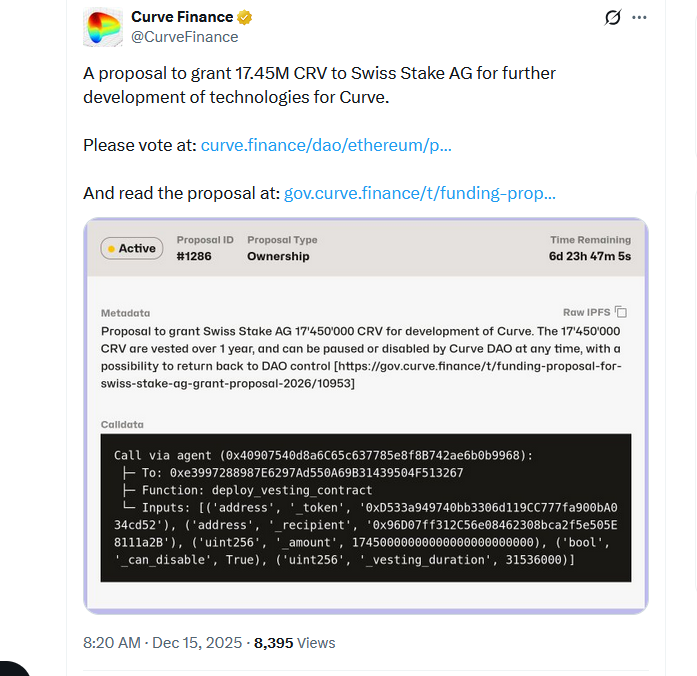
Sumber: Curve Finance

Perusahaan juga akan merilis semua Kekayaan Intelektual (IP) yang dibuat melalui penggunaan hibah sebagai "di bawah lisensi open-source yang kompatibel dengan repositori perangkat lunak Curve."

Terkait: DeFi sudah 30% menuju adopsi massal: Pendiri Chainlink

Jika disetujui, Swiss Stake AG akan diizinkan untuk melakukan staking sebagian dari CRV yang diterima untuk menghasilkan yield tambahan untuk usahanya, tetapi tidak dapat menggunakan dana untuk tujuan apa pun yang tercantum dalam proposal. Perusahaan mengatakan akan berkomitmen pada "laporan semesteran tentang pengeluaran Jumlah Hibah."

Swiss Stake AG dorong keberlanjutan mandiri

Dalam proposal tersebut, Ergorov menguraikan bahwa meskipun Swiss Stake AG telah menghasilkan beberapa aliran pendapatan melalui CRV, perusahaan "tetap sangat bergantung pada dukungan komunitas untuk melanjutkan pekerjaannya."

Oleh karena itu, pendanaan ini akan membantu menjaga tim tetap bertahan sambil membangun ekosistem Curve dan mendorong keberlanjutan mandiri.

"Swiss Stake AG telah berhasil membentuk beberapa aliran pendapatan tambahan, terutama melalui penerapan Curve Lite di jaringan lain. Kami juga telah memperoleh biaya sistem dengan melakukan staking veCRV melalui beberapa protokol wrapper (Convex, StakeDAO, Yearn) sebagai peserta minoritas," katanya.

"Semua pendapatan tersebut telah digunakan secara ketat sesuai dengan tujuan yang diuraikan dalam hibah. Namun, pendapatan ini belum membuat perusahaan berkelanjutan pada tahap ini," tambah sang pendiri.

Didirikan pada awal 2020, Curve Finance memiliki total nilai terkunci (TVL) sekitar $2,2 miliar, menurut data DefiLlama, menjadikannya protokol DeFi terbesar ke-21 di pasar.

Majalah: Stake dan dapatkan fee juga: Tushar Aggarwal tentang double dipping di DeFi

Trending Cryptos

Related Questions

QApa yang diusulkan oleh pendiri Curve Finance, Michael Egorov, dalam proposal terbaru?

AMichael Egorov mengusulkan pemberian hibah (grant) sebesar 17,45 juta token CRV untuk mendukung pertumbuhan ekosistem, penelitian, dan pengembangan teknologi protokol lending Curve.

QBerapa nilai hibah CRV yang diusulkan dalam dolar AS berdasarkan harga saat ini?

ANilai hibah tersebut diperkirakan sekitar $6,6 juta berdasarkan harga token CRV saat ini.

QKepada siapa hibah ini akan diberikan dan untuk tujuan apa?

AHibah akan diberikan kepada Swiss Stake AG, perusahaan di belakang Curve, untuk mendukung peningkatan teknologi dan keamanan protokol lending, serta mempertahankan tim kontributor mereka.

QApa saja tujuan utama yang ingin dicapai Swiss Stake AG untuk Curve pada tahun 2026?

ATujuan utama termasuk meluncurkan dan mengembangkan versi baru sistem lending Llamalend, membuat pertukaran mata uang asing onchain, dan meningkatkan antarmuka pengguna Curve.

QMengapa Swiss Stake AG masih membutuhkan dukungan komunitas meskipun telah memiliki beberapa aliran pendapatan?

AMeskipun telah menghasilkan pendapatan dari deployment Curve Lite di jaringan lain dan fee dari staking veCRV, pendapatan tersebut belum membuat perusahaan mandiri secara finansial, sehingga masih memerlukan dukungan komunitas.

Related Reads

Are the Frantic Acquisitions of Crypto Companies by Giants Good or Bad?

In a bear market, giants are actively acquiring crypto companies. Recent months have seen at least five major deals: Samsung Securities bought a 2% stake in Upbit operator Dunamu; Robinhood acquired WonderFi for $180 million to enter the Canadian market; Figure purchased Kiavi for $717 million to expand into on-chain real estate credit; Franklin Templeton bought 250Digital to launch Franklin Crypto; and Blockworks acquired data platform Messari at a steep discount—over 90% less than its 2022 $300 million valuation. These moves highlight a strategic shift. Cash-rich giants are consolidating resources at low cost, targeting companies with established compliance frameworks to navigate tightening global regulations. Acquisitions like WonderFi and the Upbit stake provide immediate market access and licensed user bases. Figure's deal signals real-world asset (RWA) tokenization moving from concept to large-scale implementation, with Kiavi's $7+ billion annual transaction volume being integrated into on-chain capital markets. Franklin Crypto's launch targets institutional investors like pension funds, offering them tailored, compliant crypto strategies. For these strategic players, bear markets present an ideal entry point: valuations are depressed, speculative noise is minimized, and they can acquire robust technology and compliance infrastructure at a fraction of the cost. This acquisition wave marks a transitional phase for crypto—from a wild frontier toward an institutional, regulated financial system. Giants are positioning themselves to capture future growth when macroeconomic conditions and liquidity improve, leaving latecomers behind.

marsbit11m ago

Are the Frantic Acquisitions of Crypto Companies by Giants Good or Bad?

marsbit11m ago

In the MiCA Era, Europe's New Cryptography Landscape: Why is Germany Taking Center Stage?

With MiCA's transitional arrangements concluding, Europe's crypto industry has undergone a regulatory consolidation. Post-MiCA, platforms must secure CASP authorization to operate compliantly within the EU. As of July 1st, only about 12% of crypto firms have received authorization, with Germany emerging as a key player, holding 57 authorizations (roughly 23% of the EU total). This positions Germany as a primary compliance gateway to the EU's unified market. Germany's advantage stems from its established, function-based regulatory framework, which integrated crypto activities into existing banking, securities, and payment systems pre-MiCA. This allowed a smoother transition and attracted both domestic platforms (like Bitcoin.de, BISON) and international ones (like Coinbase Germany). A distinctive trend is German banks becoming direct retail entry points for crypto services. Examples include DZ Bank integrating "meinKrypto" into its VR Banking App and the Sparkassen savings bank network planning to offer crypto trading via DekaBank. This mainstreams crypto access for ordinary users. Beyond trading, Germany is evolving into a digital asset infrastructure hub. Deutsche Börse Group's Clearstream is developing a next-generation platform for issuing, settling, and servicing both traditional and tokenized securities. Furthermore, German banks like DekaBank and DZ Bank are key participants in the Qivalis project, a European initiative for a regulated euro stablecoin, positioning Germany at the intersection of critical future capabilities like custody, settlement, and cross-border services.

marsbit1h ago

In the MiCA Era, Europe's New Cryptography Landscape: Why is Germany Taking Center Stage?

marsbit1h ago

Trading

Spot

Hot Articles

What is DOGE M

Doge Matrix ($doge m): The New Breed of Community-Driven Cryptocurrency Introduction In the ever-evolving landscape of cryptocurrency, new projects constantly emerge, each aiming to capture the interest of investors and enthusiasts alike. One of the latest entrants to this domain is Doge Matrix, represented by the ticker symbol $doge m. This project has attracted attention thanks to its roots in the popular meme culture surrounding Dogecoin, establishing its place within the web3 space. This article aims to provide a comprehensive analysis of Doge Matrix, covering its overview, creator, investors, functionality, timeline, and notable aspects. What is Doge Matrix ($doge m)? Doge Matrix is a community-driven cryptocurrency project that seemingly builds upon the widespread appeal of Dogecoin, a digital currency known for its Shiba Inu mascot and its meme origins. While the overarching objectives of Doge Matrix are not extensively defined, it is characterised by a commitment to harnessing community involvement and support. Unlike traditional cryptocurrencies that often emphasise utility or intrinsic value through underlying technologies, Doge Matrix positions itself within a space that embraces the cultural phenomenon of cryptocurrencies, particularly appealing to those who resonate with the ethos of meme-based assets. Drawing on the strengths of the Dogecoin community, Doge Matrix operates as part of a broader ecosystem, inviting participation and engagement from users who share an interest in cryptocurrency and the digital landscape. Who is the Creator of Doge Matrix ($doge m)? The identity of the creator of Doge Matrix remains unknown. This lack of transparency is not an uncommon occurrence in the cryptocurrency space, where some projects are launched without revealing the identities of their founders. The absence of information regarding the founding team can raise questions among potential investors about the project’s accountability and direction. Who are the Investors of Doge Matrix ($doge m)? As it stands, there is no publicly available information detailing the investors or investment foundations that back Doge Matrix. The project appears to rely primarily on community support rather than institutional investment. This model aligns with the community-driven nature of the initiative, fostering an environment where the direction of the project is shaped by its participants rather than being dictated by a select few financial backers. How Does Doge Matrix ($doge m) Work? The specifics regarding the operational mechanisms of Doge Matrix are somewhat vague, reflecting a broader trend of projects in the meme coin space where innovative functionalities are not always clearly articulated. Nonetheless, Doge Matrix seems designed to tap into the existing cryptocurrency ecosystem by encouraging user participation while tapping into the familiar cultural references associated with Dogecoin. Its potentially unique characteristics derive from community interactions rather than technological advancements, emphasising shared experiences and collaboration among token holders. While the exact innovations have not been explicitly outlined, the project appears to create a space where community members can engage, share ideas, and propel the project's potential forward. Timeline of Doge Matrix ($doge m) Reflecting on the project’s timeline reveals notable events that have defined its journey thus far: November 25, 2024: Doge Matrix reached its all-time high value, marking a significant milestone in its early history. January 1, 2025: Conversely, Doge Matrix hit its all-time low value, illustrating the volatility often associated with cryptocurrencies, especially in the early stages of a project's lifecycle. Ongoing: The project continues to be actively traded and supported by its community, although specific future milestones or objectives have yet to be disclosed. Key Points About Doge Matrix ($doge m) Community Focus At the heart of Doge Matrix is a commitment to community engagement. The project thrives on the premise of collaboration and shared objectives among its members, emphasising the importance of collective effort. Unlike centralised projects that often have a defined leadership structure, Doge Matrix at present showcases a more fluid approach to governance, where every community member's voice matters. Volatility The cryptocurrency market is notorious for its volatility, and Doge Matrix is no exception. Its price history reflects significant fluctuations between high and low values, which is typical of many new cryptocurrencies but underscores the risks associated with investment in emerging tokens. Lack of Detailed Information One of the most striking features about Doge Matrix is the scarcity of detailed information regarding its technological underpinnings and operational mechanisms. This ambiguity necessitates that potential investors conduct thorough due diligence before engaging with the project. Conclusion In summary, Doge Matrix ($doge m) illustrates a new wave of cryptocurrency projects that lean heavily on community engagement and cultural relevance. While lacking in certain specifics—such as clear leadership, defined objectives, and detailed functionality—the project has managed to generate interest within the crypto community, leveraging the established appeal of meme culture. As with any investment in the cryptocurrency space, understanding the inherent risks and conducting comprehensive research is essential for potential participants. Doge Matrix stands as a reminder of the dynamic, sometimes unpredictable nature of the crypto industry, marked by constant evolution and enthusiasm for community-driven initiatives.

555 Total ViewsPublished 2025.02.03Updated 2025.02.03

What is DOGE M

What is $M

Understanding Mantis ($M): A New Era in Cross-Chain Interoperability In the continually evolving landscape of Web3 and cryptocurrency, new projects strive to offer innovative solutions aimed at enhancing the user experience and expanding functional possibilities within the decentralised financial ecosystem. One such project garnering attention is Mantis ($M), a pioneering protocol founded on the principles of cross-chain interoperability and intent-based settlements. This article delves into the essential aspects of Mantis, including its core functionality, creators, investment backing, innovative features, and critical milestones. What is Mantis ($M)? Mantis is described as a multi-domain intent settlement protocol that simplifies cross-chain interactions, enabling users to execute complex financial transactions across various blockchain platforms seamlessly. The protocol operates through three primary layers: Intent Expression: Users can articulate their transaction goals using natural language facilitated by the DISE LLM, an advanced AI language model. For instance, a user might express a desire to swap Ethereum (ETH) for Solana (SOL) with a specific slippage tolerance of 1%. Execution: This layer employs a network of solvers that compete to fulfil user intents. Transactions are executed using mechanisms such as Coincidence of Wants (CoWs) and Order Flow Auctions (OFAs), which ensure that user demands are met optimally. Settlement: Leveraging the Inter-Blockchain Communication (IBC) protocol, Mantis enables atomic cross-chain transactions, allowing users to operate across various supported chains, including Ethereum, Solana, and Cosmos. Mantis is engineered to introduce native yield generation for idle assets, employing cryptographic proofs to maintain the integrity of transactions throughout the entire process. Creators & Development Team Mantis was conceived by the Composable Foundation, a research-driven organisation notable for its emphasis on blockchain interoperability solutions. This foundation collaborates with esteemed academic institutions, including Harvard University and the University of Lisbon, contributing to extensive research and development efforts that inform Mantis's architecture and functionality. The Composable Foundation’s commitment to fostering innovation in the blockchain space positions Mantis as a robust solution for the growing demand for interoperability among multiple blockchain networks. Investors & Backing While specific details about individual investors have not been publicly disclosed, Mantis enjoys substantial backing from various entities, including: Ecosystem grants from IBC-enabled chains, which support the protocol's growth and integration within decentralised finance ecosystems. Strategic partnerships with infrastructure providers that enhance Mantis's network capabilities and deployment strategies. Funding through the Composable Foundation's treasury, ensuring sustained financial support for ongoing development and operational costs. These collaborative efforts reflect a consensus among stakeholders about the importance of enhancing cross-chain functionality and the potential utility of Mantis's infrastructural innovations. Key Innovations Mantis sets itself apart through several pioneering innovations that enhance its functionality and utility: Chain-Agnostic Intents: Users can initiate transactions from any supported chain while settling on another. This flexibility empowers users, driving increased interaction among different platforms. AI-Powered Interface: The integration of DISE LLM allows users to conduct complex DeFi operations using natural language, thereby simplifying interactions and making blockchain technology accessible to a broader audience. Cross-Domain MEV Capture: Mantis creates an internal market for maximal extractable value (MEV) through competitions among solvers. This innovative approach allows for greater efficiency and value extraction in complex transactions. Modular Settlement Layer: The protocol supports various verification methods, including zero-knowledge proofs and optimistic rollups, providing a versatile framework that can adapt to emerging blockchain technologies. Historical Timeline Mantis's development is marked by several critical milestones that chart its trajectory and growth: | Year | Milestone | |————|————————————————————————-| | 2022 | Initial concept development within the Composable Foundation's research division. | | Q3 2024 | Launch of the testnet with bridging capabilities between Solana and Ethereum. | | Q1 2025 | Anticipated Token Generation Event (TGE) alongside the mainnet launch. | | Q2 2025 | Expected integration of DISE LLM and expansion of cross-chain capabilities. | | 2025 H2 | Planned support for over 15 chains through further IBC upgrades. | This timeline outlines Mantis's evolution, from conceptual discussions to active implementation and future growth phases. Ecosystem Growth Strategy Mantis's strategy for ecosystem growth includes several initiatives designed to encourage user participation and developer engagement: Credits System: Users can earn protocol credits by providing liquidity and engaging in referral programmes. These credits are redeemable for incentives in the future, fostering a robust user community. Modular Software Development Kit (SDK): This toolkit empowers developers to create applications based on intent-driven models utilising Mantis's infrastructure, thus promoting innovation within its ecosystem. Governance Model: As the protocol matures, $M token holders will have a voice in protocol governance, allowing them to vote on proposed upgrades and changes, thereby enhancing community engagement and decentralisation. Mantis represents a significant advancement in the realm of cross-chain architecture. By seamlessly integrating advanced AI algorithms with a robust settlement framework, Mantis seeks to tackle the problems of fragmentation within multi-chain ecosystems. Its innovative approach prioritises improved user experiences while adhering to the foundational principles of decentralisation and security, setting a new standard for the future interoperability of blockchain technologies. As Mantis continues its journey of growth and implementation, it promises to be a project to watch closely in the competitive landscape of Web3 and decentralised finance. With its focus on crossing boundaries and elevating user engagement, Mantis is poised to be an integral part of the future developments in the cryptocurrency space.

80 Total ViewsPublished 2025.03.18Updated 2025.03.18

What is $M

Discussions

Welcome to the HTX Community. Here, you can stay informed about the latest platform developments and gain access to professional market insights. Users' opinions on the price of M (M) are presented below.

活动图片