Người sáng lập Curve đề xuất tài trợ 17 triệu CRV để tài trợ nghiên cứu và đội ngũ phát triển

cointelegraphPublished on 2025-12-15Last updated on 2025-12-15

Abstract

Nhà sáng lập Curve Finance, Michael Egorov, đã đề xuất khoản tài trợ 17,45 triệu token CRV (trị giá khoảng 6,6 triệu USD) cho công ty Swiss Stake AG để thúc đẩy tăng trưởng hệ sinh thái, nghiên cứu và phát triển công nghệ cho giao thức cho vay. Khoản tài trợ sẽ được sử dụng để nâng cấp công nghệ, bảo mật, hỗ trợ hệ sinh thái và duy trì đội ngũ 25 thành viên. Các mục tiêu bao gồm ra mắt phiên bản mới của hệ thống cho vay Llamalend, phát triển tính năng hoán đổi ngoại tệ onchain và cải thiện giao diện người dùng. Swiss Stake AG cam kết sử dụng nguồn vốn minh bạch, báo cáo định kỳ và phát hành mọi sản phẩm sở hữu trí tuệ dưới dạng mã nguồn mở. Mặc dù đã có một số nguồn thu phụ, công ty vẫn phụ thuộc vào sự hỗ trợ từ cộng đồng và hướng tới mục tiêu tự chủ tài chính lâu dài.

Người sáng lập Curve Finance Michael Egorov đã đề xuất khoản tài trợ 17,45 triệu token CRV để hỗ trợ tăng trưởng hệ sinh thái, nghiên cứu và phát triển công nghệ cho giao thức cho vay.

Khoản tài trợ, trị giá khoảng 6,6 triệu USD theo giá hiện tại, sẽ được trao cho Swiss Stake AG, công ty đứng sau Curve, và tiếp nối khoản tài trợ trước đó vào cuối năm 2024.

Trong một đề xuất được đăng trên diễn đàn quản trị Curve DAO vào Chủ nhật, Egorov cho biết số tiền này sẽ được sử dụng để hỗ trợ một loạt cải tiến công nghệ và bảo mật cho giao thức cho vay, cũng như duy trì đội ngũ đóng góp của nó.

“Khoản tài trợ này sẽ tài trợ cho nghiên cứu và phát triển phần mềm, cơ sở hạ tầng, bảo mật và hỗ trợ hệ sinh thái, đảm bảo rằng đội ngũ 25 thành viên tại Swiss Stake AG có thể tiếp tục đóng góp cho Curve,” Egorov nói.

Người sáng lập đã cung cấp một danh sách dài các mục tiêu mà Swiss Stake AG đang hướng tới cho Curve vào năm 2026. Danh sách bao gồm ra mắt và mở rộng quy mô phiên bản mới của hệ thống cho vay Llamalend, tạo ra giao dịch hoán đổi ngoại tệ trên chuỗi và cải thiện giao diện người dùng của Curve.

“Đề xuất này nhằm tiếp tục tài trợ cho việc phát triển và bảo trì hệ sinh thái hợp đồng thông minh và kho lưu trữ phần mềm của Curve, hỗ trợ các tích hợp sâu hơn, chức năng đa chuỗi và cải tiến giao diện người dùng, củng cố cơ sở hạ tầng quản trị và vận hành của Curve DAO,” Egorov nói.
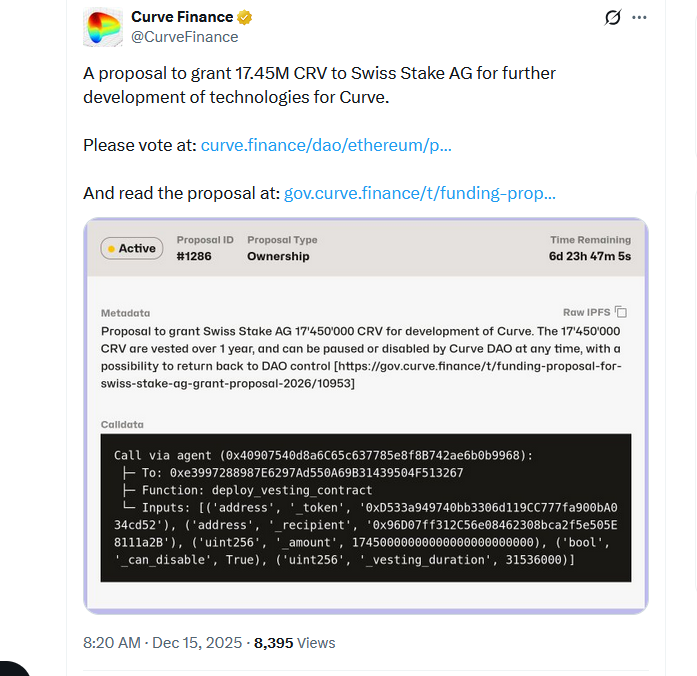
Nguồn: Curve Finance

Công ty cũng sẽ phát hành bất kỳ IP nào được tạo ra thông qua việc sử dụng khoản tài trợ “theo giấy phép mã nguồn mở tương thích với các kho lưu trữ phần mềm Curve.”

Liên quan: DeFi đã đạt 30% chặng đường đến với việc áp dụng đại trà: Người sáng lập Chainlink

Nếu được chấp thuận, Swiss Stake AG sẽ được phép stake một phần CRV nhận được để tạo ra lợi nhuận bổ sung cho các dự án của mình, nhưng không thể sử dụng số tiền cho bất kỳ mục đích nào được liệt kê trong đề xuất. Công ty cho biết sẽ cam kết “báo cáo nửa năm một lần về việc chi tiêu số tiền tài trợ.”

Swiss Stake AG thúc đẩy tính tự chủ bền vững

Trong đề xuất, Ergorov nêu rõ rằng mặc dù Swiss Stake AG đã tạo ra một số dòng doanh thu thông qua CRV, nhưng nó “vẫn phần lớn phụ thuộc vào sự hỗ trợ của cộng đồng để tiếp tục công việc.”

Do đó, khoản tài trợ sẽ giúp duy trì hoạt động của đội ngũ trong khi họ xây dựng hệ sinh thái Curve và thúc đẩy tính tự chủ bền vững.

“Swiss Stake AG đã thành công trong việc thiết lập một số dòng thu nhập phụ, chủ yếu thông qua các triển khai Curve Lite trên các mạng khác. Chúng tôi cũng đã kiếm được phí hệ thống bằng cách staking veCRV thông qua một số giao thức wrapper (Convex, StakeDAO, Yearn) với tư cách là người tham gia thiểu số,” ông nói.

“Tất cả các doanh thu như vậy đã được sử dụng nghiêm ngặt theo đúng các mục đích nêu trong khoản tài trợ. Tuy nhiên, doanh thu này vẫn chưa giúp công ty tự chủ ở giai đoạn này,” người sáng lập bổ sung.

Được thành lập vào đầu năm 2020, Curve Finance có tổng giá trị bị khóa (TVL) khoảng 2,2 tỷ USD, theo dữ liệu từ DefiLlama, biến nó thành giao thức DeFi lớn thứ 21 trên thị trường.

Tạp chí: Vừa stake vừa kiếm phí: Tushar Aggarwal nói về việc 'ăn đôi' trong DeFi

Trending Cryptos

Related Questions

QNgười sáng lập Curve Finance đề xuất khoản tài trợ bao nhiêu CRV để hỗ trợ phát triển hệ sinh thái?

AMichael Egorov, người sáng lập Curve Finance, đã đề xuất một khoản tài trợ trị giá 17,45 triệu token CRV.

QKhoản tài trợ này có giá trị bao nhiêu USD theo giá hiện tại?

AKhoản tài trợ có giá trị xấp xỉ 6,6 triệu USD theo giá thị trường hiện tại.

QCông ty nào sẽ nhận được khoản tài trợ này và mục đích sử dụng là gì?

ACông ty Swiss Stake AG, đứng sau Curve, sẽ nhận khoản tài trợ. Số tiền sẽ được sử dụng để hỗ trợ nghiên cứu và phát triển phần mềm, cơ sở hạ tầng, bảo mật, hỗ trợ hệ sinh thái và duy trì đội ngũ 25 thành viên của họ.

QMột trong những mục tiêu phát triển chính cho Curve vào năm 2026 là gì?

ACác mục tiêu bao gồm ra mắt và mở rộng quy mô phiên bản mới của hệ thống cho vay Llamalend, tạo ra một giao dịch hoán đổi ngoại tệ trên chuỗi (onchain foreign currency swap) và cải thiện giao diện người dùng của Curve.

QTại sao Swiss Stake AG vẫn cần sự hỗ trợ từ cộng đồng mặc dù đã có một số nguồn thu?

AMặc dù đã thiết lập được một số nguồn thu phụ (chủ yếu thông qua triển khai Curve Lite trên các mạng khác và kiếm phí hệ thống từ staking veCRV), các khoản thu này vẫn chưa đủ để công ty tự chủ về tài chính ở giai đoạn hiện tại, do đó họ vẫn phụ thuộc nhiều vào sự hỗ trợ từ cộng đồng.

Related Reads

Mysterious "Ox Alpha" Large Model Goes Viral with Limited-Time Free Access

A mysterious anonymous AI model named "Ox Alpha," nicknamed "Cow is Coming" by Chinese netizens, has appeared on OpenRouter, sparking widespread speculation. The model offers a 1 million token context, supports text, image, and video inputs, can call tools, and is currently free. Its standout feature is strong coding ability. Initial tests on the DeepSWE benchmark, which evaluates real-world software engineering tasks, showed an 80% pass rate on a subset of tasks, reportedly nearing top-tier code models. However, follow-up tests yielded a 63% score, with variations attributed to different task sets and configurations. The model's true developer is a major topic of debate. The prevailing theory points to Zhipu AI's unreleased GLM-5.3 Flash or its multimodal variant. Evidence cited includes identical visual token consumption patterns with GLM-5V-Turbo for videos, a consistent offset in text token counts compared to GLM-5.3, and similar behavioral traits like refusing audio processing. Zhipu has a precedent of anonymous testing. Simultaneously, another anonymous model, "korrine," appeared on Code Arena, with guesses ranging from Moonshot's Kimi K3.1 to models from Qwen or MiMo, adding to the industry's guessing game. This trend of anonymous "undercover" testing allows for unbiased performance evaluation in platforms like Arena and provides real-world, high-pressure testing through tools like OpenRouter before official release. It also serves as an effective marketing tactic, prolonging discussion through suspense. If Ox Alpha is indeed a "Flash" model, its performance raises expectations for the full-scale version's potential.

marsbit58m ago

Mysterious "Ox Alpha" Large Model Goes Viral with Limited-Time Free Access

marsbit58m ago

Breaking News: DeepSeek Announces All-Day Off-Peak Pricing on Weekends, Making Weekend Work More Cost-Effective?

DeepSeek has announced a significant change to its API pricing model, effective August 23. The new policy removes peak/off-peak distinctions on weekends (Saturdays and Sundays), charging the lower off-peak rate for the entire two-day period. This adjustment has sparked mixed reactions within the developer and professional communities. For developers and businesses heavily reliant on DeepSeek's V4-Flash and V4-Pro APIs, this is welcome news. It allows them to schedule bulk processing tasks on weekends without the higher peak-hour costs, potentially halving their API bills for such workloads. Some users have celebrated the move for making weekend work more cost-effective. However, the announcement has also raised concerns among employees. There is apprehension that companies, particularly in cost-sensitive sectors like AI-powered short drama production, might reorganize work schedules to align with these new cost incentives. Instances are already emerging where teams schedule high-token tasks during cheaper nighttime hours or adjust staff shifts. This has led to worries about a potential shift towards weekend workdays and weekday time-off, prioritizing cost savings over traditional work-life balance. Debate has ensued regarding the practicality of such schedule changes, with questions about increased communication overhead and overall efficiency. Speculation about DeepSeek's motives for the change includes theories that peak pricing correlates with internal model training schedules, though others counter that training is largely automated. The new pricing structure is now in effect, prompting users to reconsider their task scheduling strategies.

marsbit1h ago

Breaking News: DeepSeek Announces All-Day Off-Peak Pricing on Weekends, Making Weekend Work More Cost-Effective?

marsbit1h ago

Just Now, The World's First Human vs. Robot Tennis Match Begins, Robot's Desperate Save Leaves Zheng Jie Astonished

Just now, the world's first human vs. robot tennis match began, featuring stunning robotic saves that left tennis star Zheng Jie in awe. This historic event, part of the second World Humanoid Robot Games and broadcast live globally by China Media Group, marked a pivotal moment in Chinese technological innovation and embodied artificial intelligence. The match featured both mixed human-robot doubles and a groundbreaking singles match between Zheng Jie and the "Galaxy Xingzai" humanoid robot developed by Galaxy General. The robot demonstrated impressive skills including serving, forehands, backhands, and strategic court movement, with serves exceeding 100 km/h. It exhibited remarkable adaptability, recovering from a fall to continue play and handling slices and spins. The doubles match highlighted its ability to coordinate dynamically with a human partner. The event's significance extends far beyond a novelty match. Tennis represents an ultimate pressure test for embodied AI, demanding real-time integration of perception, decision-making, full-body motion control, and live博弈 within fractions of a second—a stark contrast to the discrete, contemplative environment of board games like Go mastered by AlphaGo. It directly confronts Moravec's paradox, showcasing AI's move from digital cognition to physical execution. This capability is powered by Galaxy General's proprietary "Galaxy Star Brain" (AstraBrain) model. Its key innovation is a unified architecture that integrates high-level task understanding/tactical decision-making ("brain") and dynamic whole-body motion control ("cerebellum") into a single model, eliminating latency and information loss between separate modules. The model was trained using a two-step process via the "Galaxy Star Workshop" platform. First, it learned foundational movement priors from "imperfect" human motion data (both amateur and professional). Second, it underwent massive-scale evolution in a virtual tennis simulator where multiple AI agents played millions of games against each other. Through this adversarial training, skills like极限救球and recovery from falls emerged autonomously without explicit programming, before being transferred to the physical robot. This "AstraTennis" moment symbolizes a major leap: a decade after AlphaGo conquered the digital world, embodied AI from China has now demonstrated it can operate under the extreme, unpredictable physical pressures of real-world competition.

marsbit1h ago

Just Now, The World's First Human vs. Robot Tennis Match Begins, Robot's Desperate Save Leaves Zheng Jie Astonished

marsbit1h ago

The Biggest Dark Horse in AI Payments Might Be Coinbase Giving Agents a Wallet

In the AI payments race, while most focus on traditional giants like Visa or AI platforms like OpenAI, Coinbase has quietly emerged as a key player. Data from 2026 shows over 90% of on-chain Agent transactions occur on Coinbase's Base network, with 99% settled in USDC and over 97% using the x402 protocol. Coinbase's pivotal move was launching "Agentic Wallets" in February 2026—a dedicated wallet infrastructure giving AI Agents their own financial identity. Unlike Visa or Stripe, which connect Agents to existing payment rails, Coinbase provides Agents with autonomous wallets to hold assets (like stablecoins), initiate transfers, and execute transactions under predefined rules. This solves core issues for machine-to-machine payments: high credit card fees for micropayments, the need for constant human authorization, and unclear transaction attribution. Coinbase's strength lies in its closed-loop ecosystem: the Base blockchain (low-cost, high-throughput), the x402 payment protocol, Agentic Wallets, and native assets like USDC. This integrated stack, built through years of infrastructure investment, positioned Coinbase to capture early Agent payment demand as the AI economy surged. The key insight is that AI payment adoption may depend less on whose standard wins and more on whose usable infrastructure is ready first. While debates over protocols and payment rails continue, real Agent transactions are already flowing—primarily through Coinbase's ecosystem. It may not be the ultimate winner, but for now, it's the frontrunner by being prepared.

marsbit2h ago

The Biggest Dark Horse in AI Payments Might Be Coinbase Giving Agents a Wallet

marsbit2h ago

Trading

Spot

Hot Articles

What is DOGE M

Doge Matrix ($doge m): The New Breed of Community-Driven Cryptocurrency Introduction In the ever-evolving landscape of cryptocurrency, new projects constantly emerge, each aiming to capture the interest of investors and enthusiasts alike. One of the latest entrants to this domain is Doge Matrix, represented by the ticker symbol $doge m. This project has attracted attention thanks to its roots in the popular meme culture surrounding Dogecoin, establishing its place within the web3 space. This article aims to provide a comprehensive analysis of Doge Matrix, covering its overview, creator, investors, functionality, timeline, and notable aspects. What is Doge Matrix ($doge m)? Doge Matrix is a community-driven cryptocurrency project that seemingly builds upon the widespread appeal of Dogecoin, a digital currency known for its Shiba Inu mascot and its meme origins. While the overarching objectives of Doge Matrix are not extensively defined, it is characterised by a commitment to harnessing community involvement and support. Unlike traditional cryptocurrencies that often emphasise utility or intrinsic value through underlying technologies, Doge Matrix positions itself within a space that embraces the cultural phenomenon of cryptocurrencies, particularly appealing to those who resonate with the ethos of meme-based assets. Drawing on the strengths of the Dogecoin community, Doge Matrix operates as part of a broader ecosystem, inviting participation and engagement from users who share an interest in cryptocurrency and the digital landscape. Who is the Creator of Doge Matrix ($doge m)? The identity of the creator of Doge Matrix remains unknown. This lack of transparency is not an uncommon occurrence in the cryptocurrency space, where some projects are launched without revealing the identities of their founders. The absence of information regarding the founding team can raise questions among potential investors about the project’s accountability and direction. Who are the Investors of Doge Matrix ($doge m)? As it stands, there is no publicly available information detailing the investors or investment foundations that back Doge Matrix. The project appears to rely primarily on community support rather than institutional investment. This model aligns with the community-driven nature of the initiative, fostering an environment where the direction of the project is shaped by its participants rather than being dictated by a select few financial backers. How Does Doge Matrix ($doge m) Work? The specifics regarding the operational mechanisms of Doge Matrix are somewhat vague, reflecting a broader trend of projects in the meme coin space where innovative functionalities are not always clearly articulated. Nonetheless, Doge Matrix seems designed to tap into the existing cryptocurrency ecosystem by encouraging user participation while tapping into the familiar cultural references associated with Dogecoin. Its potentially unique characteristics derive from community interactions rather than technological advancements, emphasising shared experiences and collaboration among token holders. While the exact innovations have not been explicitly outlined, the project appears to create a space where community members can engage, share ideas, and propel the project's potential forward. Timeline of Doge Matrix ($doge m) Reflecting on the project’s timeline reveals notable events that have defined its journey thus far: November 25, 2024: Doge Matrix reached its all-time high value, marking a significant milestone in its early history. January 1, 2025: Conversely, Doge Matrix hit its all-time low value, illustrating the volatility often associated with cryptocurrencies, especially in the early stages of a project's lifecycle. Ongoing: The project continues to be actively traded and supported by its community, although specific future milestones or objectives have yet to be disclosed. Key Points About Doge Matrix ($doge m) Community Focus At the heart of Doge Matrix is a commitment to community engagement. The project thrives on the premise of collaboration and shared objectives among its members, emphasising the importance of collective effort. Unlike centralised projects that often have a defined leadership structure, Doge Matrix at present showcases a more fluid approach to governance, where every community member's voice matters. Volatility The cryptocurrency market is notorious for its volatility, and Doge Matrix is no exception. Its price history reflects significant fluctuations between high and low values, which is typical of many new cryptocurrencies but underscores the risks associated with investment in emerging tokens. Lack of Detailed Information One of the most striking features about Doge Matrix is the scarcity of detailed information regarding its technological underpinnings and operational mechanisms. This ambiguity necessitates that potential investors conduct thorough due diligence before engaging with the project. Conclusion In summary, Doge Matrix ($doge m) illustrates a new wave of cryptocurrency projects that lean heavily on community engagement and cultural relevance. While lacking in certain specifics—such as clear leadership, defined objectives, and detailed functionality—the project has managed to generate interest within the crypto community, leveraging the established appeal of meme culture. As with any investment in the cryptocurrency space, understanding the inherent risks and conducting comprehensive research is essential for potential participants. Doge Matrix stands as a reminder of the dynamic, sometimes unpredictable nature of the crypto industry, marked by constant evolution and enthusiasm for community-driven initiatives.

682 Total ViewsPublished 2025.02.03Updated 2025.02.03

What is DOGE M

What is $M

Understanding Mantis ($M): A New Era in Cross-Chain Interoperability In the continually evolving landscape of Web3 and cryptocurrency, new projects strive to offer innovative solutions aimed at enhancing the user experience and expanding functional possibilities within the decentralised financial ecosystem. One such project garnering attention is Mantis ($M), a pioneering protocol founded on the principles of cross-chain interoperability and intent-based settlements. This article delves into the essential aspects of Mantis, including its core functionality, creators, investment backing, innovative features, and critical milestones. What is Mantis ($M)? Mantis is described as a multi-domain intent settlement protocol that simplifies cross-chain interactions, enabling users to execute complex financial transactions across various blockchain platforms seamlessly. The protocol operates through three primary layers: Intent Expression: Users can articulate their transaction goals using natural language facilitated by the DISE LLM, an advanced AI language model. For instance, a user might express a desire to swap Ethereum (ETH) for Solana (SOL) with a specific slippage tolerance of 1%. Execution: This layer employs a network of solvers that compete to fulfil user intents. Transactions are executed using mechanisms such as Coincidence of Wants (CoWs) and Order Flow Auctions (OFAs), which ensure that user demands are met optimally. Settlement: Leveraging the Inter-Blockchain Communication (IBC) protocol, Mantis enables atomic cross-chain transactions, allowing users to operate across various supported chains, including Ethereum, Solana, and Cosmos. Mantis is engineered to introduce native yield generation for idle assets, employing cryptographic proofs to maintain the integrity of transactions throughout the entire process. Creators & Development Team Mantis was conceived by the Composable Foundation, a research-driven organisation notable for its emphasis on blockchain interoperability solutions. This foundation collaborates with esteemed academic institutions, including Harvard University and the University of Lisbon, contributing to extensive research and development efforts that inform Mantis's architecture and functionality. The Composable Foundation’s commitment to fostering innovation in the blockchain space positions Mantis as a robust solution for the growing demand for interoperability among multiple blockchain networks. Investors & Backing While specific details about individual investors have not been publicly disclosed, Mantis enjoys substantial backing from various entities, including: Ecosystem grants from IBC-enabled chains, which support the protocol's growth and integration within decentralised finance ecosystems. Strategic partnerships with infrastructure providers that enhance Mantis's network capabilities and deployment strategies. Funding through the Composable Foundation's treasury, ensuring sustained financial support for ongoing development and operational costs. These collaborative efforts reflect a consensus among stakeholders about the importance of enhancing cross-chain functionality and the potential utility of Mantis's infrastructural innovations. Key Innovations Mantis sets itself apart through several pioneering innovations that enhance its functionality and utility: Chain-Agnostic Intents: Users can initiate transactions from any supported chain while settling on another. This flexibility empowers users, driving increased interaction among different platforms. AI-Powered Interface: The integration of DISE LLM allows users to conduct complex DeFi operations using natural language, thereby simplifying interactions and making blockchain technology accessible to a broader audience. Cross-Domain MEV Capture: Mantis creates an internal market for maximal extractable value (MEV) through competitions among solvers. This innovative approach allows for greater efficiency and value extraction in complex transactions. Modular Settlement Layer: The protocol supports various verification methods, including zero-knowledge proofs and optimistic rollups, providing a versatile framework that can adapt to emerging blockchain technologies. Historical Timeline Mantis's development is marked by several critical milestones that chart its trajectory and growth: | Year | Milestone | |————|————————————————————————-| | 2022 | Initial concept development within the Composable Foundation's research division. | | Q3 2024 | Launch of the testnet with bridging capabilities between Solana and Ethereum. | | Q1 2025 | Anticipated Token Generation Event (TGE) alongside the mainnet launch. | | Q2 2025 | Expected integration of DISE LLM and expansion of cross-chain capabilities. | | 2025 H2 | Planned support for over 15 chains through further IBC upgrades. | This timeline outlines Mantis's evolution, from conceptual discussions to active implementation and future growth phases. Ecosystem Growth Strategy Mantis's strategy for ecosystem growth includes several initiatives designed to encourage user participation and developer engagement: Credits System: Users can earn protocol credits by providing liquidity and engaging in referral programmes. These credits are redeemable for incentives in the future, fostering a robust user community. Modular Software Development Kit (SDK): This toolkit empowers developers to create applications based on intent-driven models utilising Mantis's infrastructure, thus promoting innovation within its ecosystem. Governance Model: As the protocol matures, $M token holders will have a voice in protocol governance, allowing them to vote on proposed upgrades and changes, thereby enhancing community engagement and decentralisation. Mantis represents a significant advancement in the realm of cross-chain architecture. By seamlessly integrating advanced AI algorithms with a robust settlement framework, Mantis seeks to tackle the problems of fragmentation within multi-chain ecosystems. Its innovative approach prioritises improved user experiences while adhering to the foundational principles of decentralisation and security, setting a new standard for the future interoperability of blockchain technologies. As Mantis continues its journey of growth and implementation, it promises to be a project to watch closely in the competitive landscape of Web3 and decentralised finance. With its focus on crossing boundaries and elevating user engagement, Mantis is poised to be an integral part of the future developments in the cryptocurrency space.

218 Total ViewsPublished 2025.03.18Updated 2025.03.18

What is $M

Discussions

Welcome to the HTX Community. Here, you can stay informed about the latest platform developments and gain access to professional market insights. Users' opinions on the price of M (M) are presented below.

活动图片