Bão lửa bùng nổ trong diễn đàn quản trị Aave về phí CoW Swap

cointelegraphPublished on 2025-12-14Last updated on 2025-12-14

Abstract

Một cuộc tranh cãi đã bùng lên trong diễn đàn quản trị Aave liên quan đến việc phân phối phí từ tích hợp gần đây với sàn giao dịch phi tập trung CoW Swap. Thành viên Aave DAO với bí danh EzR3aL chỉ ra rằng phí giao dịch, ước tính 200.000 USD ETH mỗi tuần (khoảng 10 triệu USD/năm), đang được chuyển đến một địa chỉ ví riêng do Aave Labs kiểm soát thay vì kho bạc của DAO. EzR3aL chất vấn tại sao DAO không được tham vấn và khẳng định khoản phí này thuộc về cộng đồng. Aave Labs phản hồi rằng các thành phần front-end luôn thuộc thẩm quyền của họ, và nhấn mạnh rằng chỉ các thay đổi ở cấp giao thức mới cần sự giám sát của DAO. Họ cũng tuyên bố đã tài trợ cho việc phát triển các "bộ chuyển đổi" (adapters) kỹ thuật cho tích hợp này. Tuy nhiên, nhiều thành viên DAO phản đối, lập luận rằng chính DAO đã tài trợ cho công nghệ adapter gốc, nên doanh thu phải thuộc về DAO. Marc Zeller, nhà sáng lập Aave-Chan Initiative, gọi quyết định này là "cực kỳ đáng lo ngại" và cho rằng Aave Labs đang chuyển hướng người dùng để theo đuổi lợi nhuận riêng.

Một cuộc tranh chấp giữa tổ chức tự trị phi tập trung (DAO) Aave, cơ quan quản trị giao thức tài chính phi tập trung (DeFi) Aave, và Aave Labs, công ty phát triển chính cho các sản phẩm Aave, về phí từ việc tích hợp mới được công bố với trình tổng hợp sàn giao dịch phi tập trung CoW Swap, tiếp tục bùng lên.

Vấn đề được nêu ra bởi thành viên Aave DAO ẩn danh EzR3aL, người cho biết các khoản phí được tạo ra từ việc hoán đổi tài sản crypto bằng CoW Swap đang được chuyển đến một địa chỉ onchain khác, không phải kho bạc của tổ chức tự trị phi tập trung Aave.

Thay vào đó, các khoản phí đang được chuyển đến một địa chỉ riêng do Aave Labs kiểm soát. EzR3aL đã đặt ra một số câu hỏi, bao gồm lý do tại sao DAO không được tham vấn trước khi các khoản phí được định tuyến, và lập luận rằng các khoản phí này thuộc về DAO.
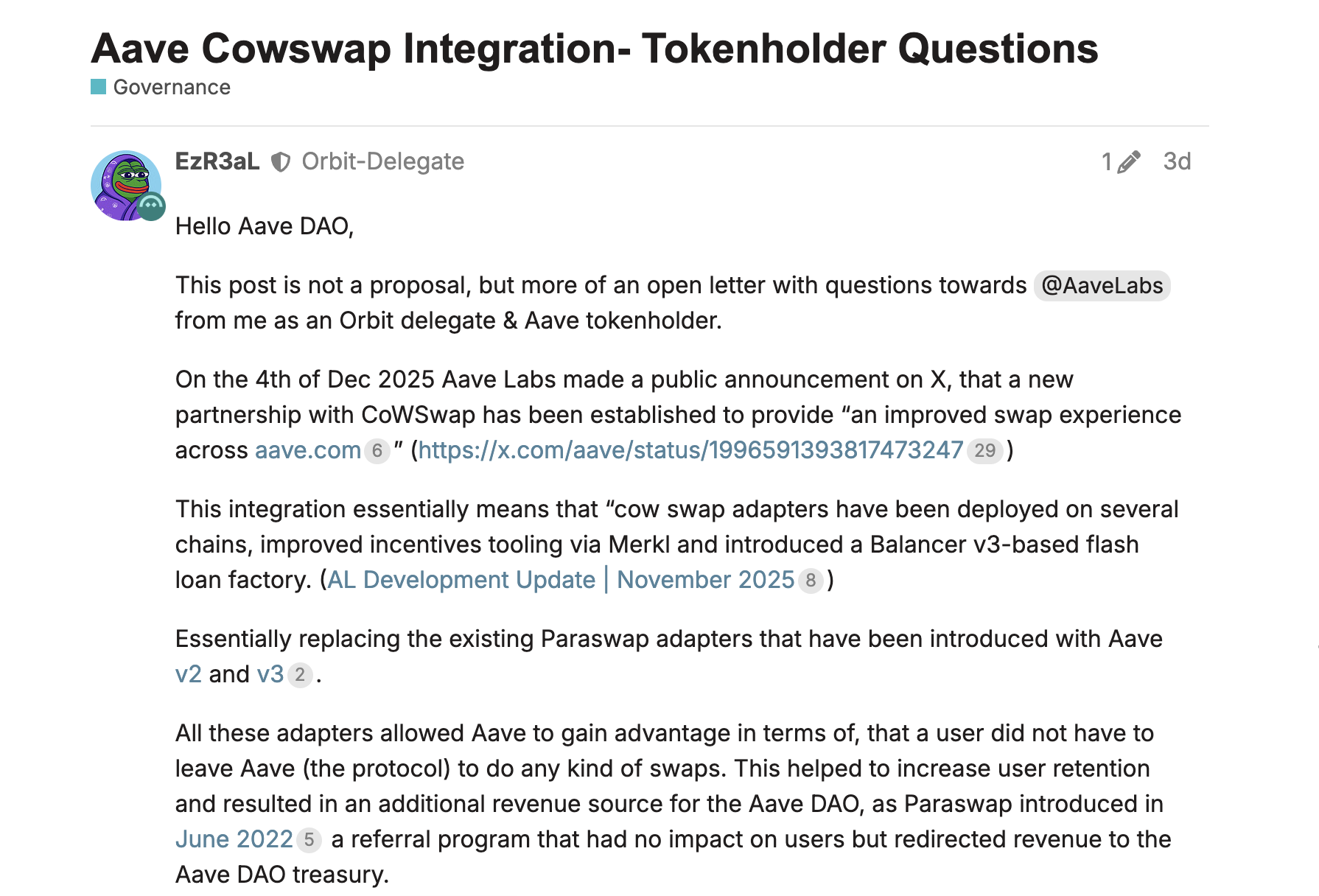
Bài đăng trên diễn đàn quản trị đã châm ngòi cho cuộc tranh luận. Nguồn: Aave Governance

“Một thực thể khác, thay vì Aave DAO, đang nhận được ít nhất 200.000 đô la mỗi tuần trị giá Ether,” EzR3aL cho biết, đồng thời nói thêm rằng con số này tương đương với 10 triệu đô la doanh thu tiềm năng hàng năm bị giữ lại từ DAO.

Aave Labs phản hồi rằng các thành phần front-end cho trang web và giao diện ứng dụng luôn thuộc quyền quản lý chính đáng của Aave Labs.

Liên quan: Aave ra mắt ứng dụng tiết kiệm bán lẻ với lãi suất lên đến 9% APY để cạnh tranh với ngân hàng

Các thay đổi ở cấp độ giao thức, như chính sách lãi suất và phê duyệt thay đổi mã hợp đồng thông minh, luôn thuộc quyền quản lý của DAO, Aave Labs cho biết.

Aave Labs cũng tuyên bố rằng họ là thực thể đã tài trợ cho việc phát triển các “bộ chuyển đổi” (adapters), những dòng mã cho phép hoán đổi và các tích hợp khác hoạt động.
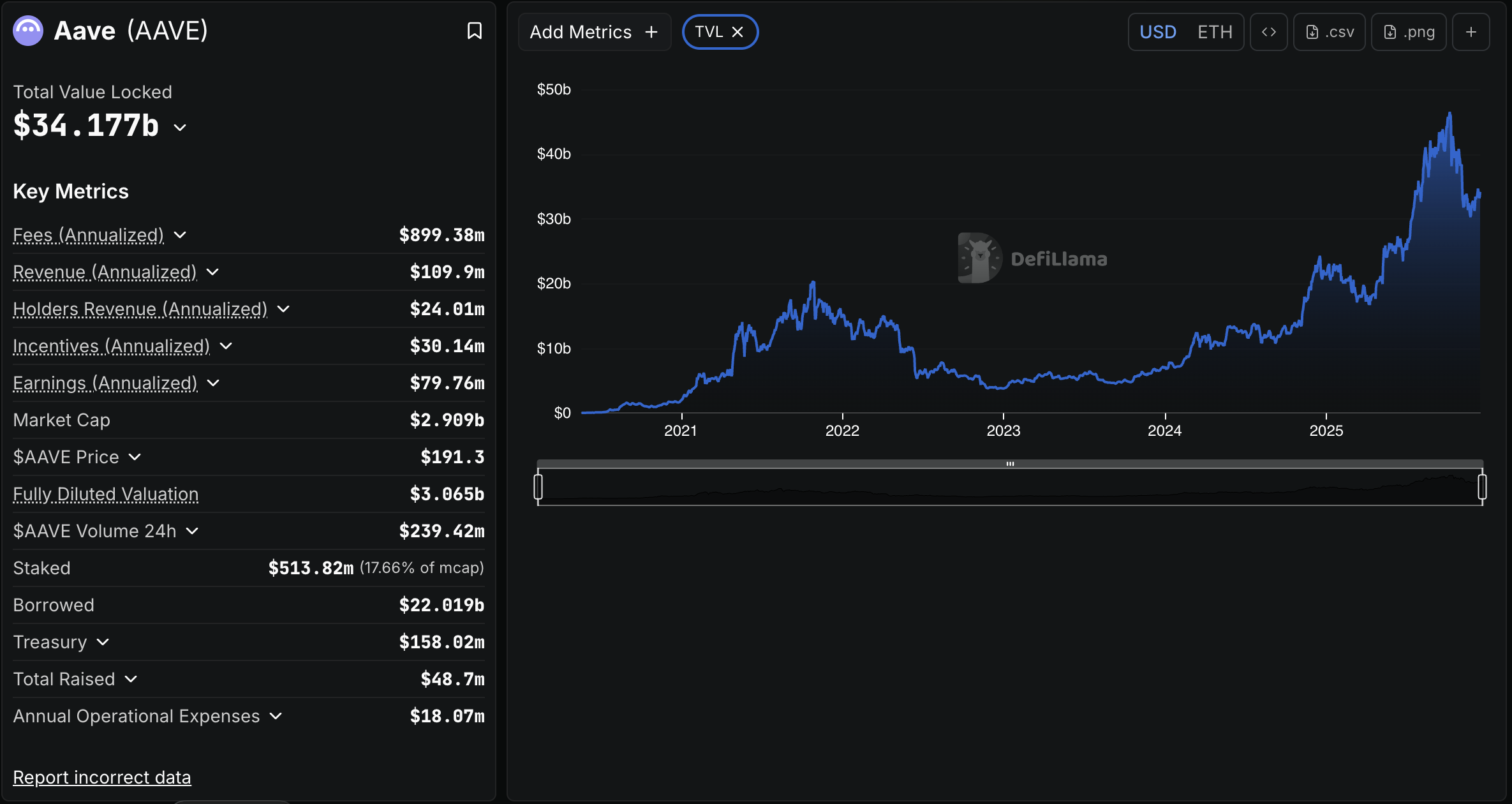
Tổng giá trị bị khóa (TVL) trong giao thức Aave và tổng quan tài chính của nền tảng DeFi. Nguồn: DeFiLlama

Tuy nhiên, phản hồi này ít có tác dụng làm giảm căng thẳng, khi một số thành viên DAO nói rằng Aave DAO đã tài trợ cho việc phát triển công nghệ bộ chuyển đổi ban đầu; do đó, doanh thu từ việc tích hợp nên chảy về lại DAO.

Marc Zeller, người sáng lập Aave-Chan Initiative, một nền tảng đại biểu phục vụ cộng đồng quản trị Aave, cho biết quyết định định tuyến phí độc quyền cho Aave Labs là “cực kỳ đáng lo ngại”.

“Aave Labs, trong quá trình theo đuổi việc kiếm tiền cho riêng mình, đã chuyển hướng lưu lượng người dùng Aave về phía đối thủ cạnh tranh. Điều này là không thể chấp nhận được,” Zeller nói.

Cointelegraph đã liên hệ với Aave Labs nhưng không nhận được phản hồi ngay lập tức tại thời điểm xuất bản.

Xung đột này làm nổi bật sự phức tạp của việc điều hành một DAO, một hình thức quản trị và tổ chức mới lạ có những lợi ích so với cấu trúc kinh doanh truyền thống nhưng cũng mang lại những thách thức độc đáo riêng.

Tạp chí: Một điểm chung mà 6 trung tâm crypto toàn cầu này đều có...

Trending Cryptos

Related Questions

QTranh cãi trong diễn đàn quản trị Aave liên quan đến vấn đề gì?

ATranh cãi xoay quanh việc phí giao dịch từ tích hợp CoW Swap đang được chuyển đến địa chỉ ví do Aave Labs kiểm soát thay vì kho bạc của Aave DAO.

QThành viên EzR3aL đã nêu ra những lo ngại nào?

AEzR3aL chỉ ra rằng Aave Labs đang về ít nhất 200.000 USD ETH mỗi tuần mà không tham vấn DAO, đồng thời khẳng định khoản phí này thuộc về cộng đồng quản trị.

QAave Labs biện minh bằng lập luận gì?

AAave Labs tuyên bố giao diện front-end và ứng dụng luôn thuộc quyền quản lý của họ, đồng thời nhấn mạnh chính họ là đơn vị tài trợ phát triển các bộ chuyển đổi (adapters) kỹ thuật.

QPhản ứng của cộng đồng DAO trước giải thích từ Aave Labs như thế nào?

ANhiều thành viên DAO bác bỏ lập luận này, cho rằng công nghệ adapter ban đầu được phát triển bằng ngân sách DAO nên doanh thu phải được chia sẻ lại cho cộng đồng.

QMarc Zeller - nhà sáng lập Aave-Chan Initiative đã có nhận định gì?

AÔng đánh giá việc chuyển hướng phí cho Aave Labs là 'cực kỳ đáng lo ngại' và chỉ trích hành động này làm lợi cho đối thủ cạnh tranh thay vì cộng đồng Aave.

Related Reads

Goldman Sachs' Summary After Silicon Valley Investigation: Agents Enter the Execution Era, AI Competition Shifts to Workflows, World Models Rise

Based on a recent field research in Silicon Valley, Goldman Sachs highlights a key shift in the AI industry: moving from systems that "answer questions" to autonomous AI agents that "execute tasks." Commercial models are transitioning from per-seat subscriptions to usage- and outcome-based pricing. The competition is shifting from raw model capability to mastery over specific business workflows, with value accruing to proprietary data, domain context, and operational expertise. A major hurdle for enterprise Agent deployment is not technical ability but "controllability"—issues of accountability, auditability, and error correction, especially in regulated fields. Workflows with clear rules, verifiable outcomes, and reversible actions (e.g., invoice processing) are being automated first. The model landscape is evolving toward a division of labor. Frontier models (like GPT-4) are expected to handle high-value, high-reliability core tasks, while improving open-source models will likely capture the majority (~90%) of inference tokens for standardized, high-volume tasks due to cost advantages. Finally, attention is moving from Large Language Models (LLMs) to "World Models," which understand physical environments, causality, and dynamic interactions. This shift elevates the importance of proprietary, real-world data (from industrial, scientific, and robotic systems) and could drive a second wave of compute demand. Goldman Sachs projects compute needs could grow ~24x over five years, benefiting cloud and infrastructure providers.

marsbit6m ago

Goldman Sachs' Summary After Silicon Valley Investigation: Agents Enter the Execution Era, AI Competition Shifts to Workflows, World Models Rise

marsbit6m ago

Fidelity Warns: The Boom in AI Agents May Not Be a Feast for Public Blockchains

Fidelity Digital Assets cautions that the anticipated boom in AI agents does not automatically guarantee a corresponding surge in public blockchain adoption or token value. While AI agents that can autonomously perform tasks like payments and data calls could theoretically utilize blockchain for settlement, a significant gap exists between "can use" and "must use." The analysis highlights six key risks. First, many AI agents, especially in corporate settings, may prefer closed, permissioned systems over public blockchains due to needs for speed, cost, compliance, and control. Second, increased on-chain transactions from AI-driven micropayments may not benefit native tokens if fees remain low or if value is captured by stablecoins and payment service providers instead. Third, while AI lowers development costs and increases the number of projects, more code does not equal more economic value and can lead to market oversaturation. Fourth, AI commoditizes coding, making pure technological advantage less of a sustainable moat; competition may shift to brand, liquidity, and user networks. Fifth, AI can also lower the cost of attacks by making vulnerability discovery easier, potentially outpacing security auditing and increasing ecosystem risk. Sixth, institutions may require "controlled blockchain" systems with robust identity, permissioning, and audit trails, conflicting with the permissionless nature of public chains. Ultimately, Fidelity argues against simply equating AI growth with blockchain prosperity. The narrative requires moving from speculation to a concrete analysis of which infrastructures can convert real AI agent needs into sustainable economic value, critically examining each step of the assumed value chain.

marsbit6m ago

Fidelity Warns: The Boom in AI Agents May Not Be a Feast for Public Blockchains

marsbit6m ago

Telegram Introduces WEB-Proxy Technology: Masks Traffic as Regular Website Visits

Telegram has introduced a new experimental WEB-Proxy technology designed to circumvent blocking by disguising messenger traffic as regular, secure website visits. Announced on August 21, 2026, the technology routes MTProxy data through an in-app WebView using HTTPS or WebSocket transport, making the data stream indistinguishable from legitimate web surfing. The core innovation is a multiplexed stream sent through a single WebView session. It uses special frame formats to pack multiple logical Telegram connections into one encrypted channel that externally resembles loading a web page. A server-side relay receives this stream, separates it into individual connections for the standard MTProxy, without decrypting content or knowing final destinations, thus preserving privacy. The WEB-Proxy operates on a standard HTTPS domain that also hosts a public website. The proxy bridge page is only activated by a specific URL parameter derived via HMAC-SHA256 from the proxy configuration; all other requests receive the normal site homepage. This provides reliable cover against automated detection systems. Currently a proof-of-concept, the system includes a desktop implementation, an experimental Android client, and plans for iOS support. The technology represents a shift towards more sophisticated integration with legitimate web infrastructure, complicating filtering systems that must choose between blocking HTTPS traffic entirely or allowing service access. Its long-term value will depend on resilience to adaptive traffic analysis and scalability without performance loss.

cryptonews.ru22m ago

Telegram Introduces WEB-Proxy Technology: Masks Traffic as Regular Website Visits

cryptonews.ru22m ago

MiCA is coming for DeFi vaults, but regulation will be difficult

The European Commission is exploring whether to extend the Markets in Crypto-Assets (MiCA) regulation to cover decentralized finance (DeFi) lending and borrowing, including lending vaults. These vaults, which channel billions into on-chain credit markets, present significant regulatory challenges because their decentralized structure doesn't map neatly onto existing financial frameworks. Their legal status is currently based on non-binding interpretations that they fall outside MiCA and EU fund rules. The article uses Morpho's decentralized lending protocol as an example, illustrating how responsibilities are divided among various participants (owner, curator, allocator, sentinel), making it difficult to identify a single "provider" to regulate. Experts warn that broadly categorizing "DeFi lending" could inadvertently capture vastly different structures. They argue that any regulatory approach should focus on the specific structure and control mechanisms of a vault, rather than using decentralization as a simple dividing line, and that DeFi lending may require a dedicated, carefully crafted framework distinct from traditional finance. The Commission's consultation closes on September 30, 2026. The core challenge for regulators is not just whether to regulate DeFi lending, but how to design rules that distinguish between different forms of on-chain lending and the entities that control them.

cointelegraph2h ago

MiCA is coming for DeFi vaults, but regulation will be difficult

cointelegraph2h ago

Trading

Spot

Hot Articles

How to Buy AAVE

Welcome to HTX.com! We've made purchasing Aave Protocol (AAVE) simple and convenient. Follow our step-by-step guide to embark on your crypto journey.Step 1: Create Your HTX AccountUse your email or phone number to sign up for a free account on HTX. Experience a hassle-free registration journey and unlock all features.Get My AccountStep 2: Go to Buy Crypto and Choose Your Payment MethodCredit/Debit Card: Use your Visa or Mastercard to buy Aave Protocol (AAVE) instantly.Balance: Use funds from your HTX account balance to trade seamlessly.Third Parties: We've added popular payment methods such as Google Pay and Apple Pay to enhance convenience.P2P: Trade directly with other users on HTX.Over-the-Counter (OTC): We offer tailor-made services and competitive exchange rates for traders.Step 3: Store Your Aave Protocol (AAVE)After purchasing your Aave Protocol (AAVE), store it in your HTX account. Alternatively, you can send it elsewhere via blockchain transfer or use it to trade other cryptocurrencies.Step 4: Trade Aave Protocol (AAVE)Easily trade Aave Protocol (AAVE) on HTX's spot market. Simply access your account, select your trading pair, execute your trades, and monitor in real-time. We offer a user-friendly experience for both beginners and seasoned traders.

6.2k Total ViewsPublished 2024.03.29Updated 2026.06.02

How to Buy AAVE

Discussions

Welcome to the HTX Community. Here, you can stay informed about the latest platform developments and gain access to professional market insights. Users' opinions on the price of AAVE (AAVE) are presented below.

活动图片