HIVE uji minat investor terhadap infrastruktur AI-Bitcoin di pasar Andean

cointelegraphPublished on 2025-12-11Last updated on 2025-12-11

Abstract

HIVE Digital Technologies telah menjadi perusahaan infrastruktur Bitcoin dan AI pertama yang terdaftar di Bursa Efek Kolombia dengan kode saham HIVECO. Pencatatan ini memperluas akses investasi di pasar regional Andes (Kolombia, Peru, dan Chili), yang biasanya didominasi sektor energi dan sumber daya alam. HIVE sebelumnya sudah tercatat di bursa Amerika Utara dan Eropa. Perusahaan ini telah mengembangkan pusat data ramah lingkungan di Paraguay dan berekspansi ke Amerika Latin sejak akhir 2024. Seperti penambang Bitcoin publik lainnya, HIVE beralih ke komputasi kinerja tinggi (HPC) dan AI akibat tekanan ekonomi pasca-halving Bitcoin 2024 yang memotong pendapatan tambang, serta kenaikan biaya listrik dan peralatan. Diversifikasi ke AI menjadi strategi kritis di tengah margin yang semakin tipis dalam industri penambangan Bitcoin.

HIVE Digital Technologies telah memulai debut di Bursa Efek Kolombia dengan kode ticker HIVECO, menjadi perusahaan infrastruktur Bitcoin dan AI pertama yang diperdagangkan secara publik di bursa Amerika Latin. Langkah ini menandai tanda lain dari ekspansi sektor ini seiring perusahaan penambang Bitcoin dan komputasi kinerja tinggi (HPC) yang semakin mendalami pasar modal global.

Diumumkan pada Kamis, pencatatan ini membuat HIVE tersedia bagi investor di seluruh sistem pasar Andean, yang menghubungkan bursa Kolombia, Peru, dan Chili.

Bagi wilayah yang secara tradisional didominasi oleh emiten energi dan sumber daya alam, penambahan perusahaan infrastruktur digital menawarkan eksposur ke sektor yang sedang tumbuh yang berada di persimpangan komputasi kinerja tinggi, tenaga terbarukan, dan Bitcoin (BTC).

Bursa Kolombia adalah salah satu platform yang paling terhubung secara institusional di pasar Andean, memberikan HIVE akses ke basis investor yang lebih luas dan terintegrasi dibandingkan dengan tempat lain di Amerika Latin.

Sumber: HIVE Digital Technologies

Saham HIVE sudah diperdagangkan di Amerika Utara dan Eropa, termasuk di TSX Venture Exchange, Nasdaq, dan Bursa Efek Frankfurt.

Di Nasdaq, saham HIVE turun lebih dari 1% pada hari Kamis, meskipun masih naik untuk tahun ini.

Terkait: Penambang Bitcoin bertaruh pada AI tahun lalu, dan itu terbayar

Kehadiran HIVE di Amerika Latin berkembang seiring ketatnya ekonomi penambangan Bitcoin

HIVE sudah memiliki kehadiran operasional di Amerika Latin, dengan mengembangkan pusat data Tier I di Paraguay yang sepenuhnya ditenagai oleh hidroelektrik. Perusahaan mulai memperluas kehadirannya di sana pada akhir 2024 dan menyelesaikan akuisisi situs Yguazú pada Maret tahun ini, seperti yang sebelumnya dilaporkan oleh Cointelegraph.

HIVE termasuk di antara penambang Bitcoin awal yang beralih ke AI dan komputasi kinerja tinggi seiring ketatnya ekonomi penambangan dan melonjaknya permintaan infrastruktur GPU.

Penambang publik besar lainnya, termasuk Core Scientific, Hut 8, Riot Platforms, TeraWulf, dan Marathon Holdings juga telah memperluas ke dalam beban kerja AI dan HPC dalam berbagai tingkat.
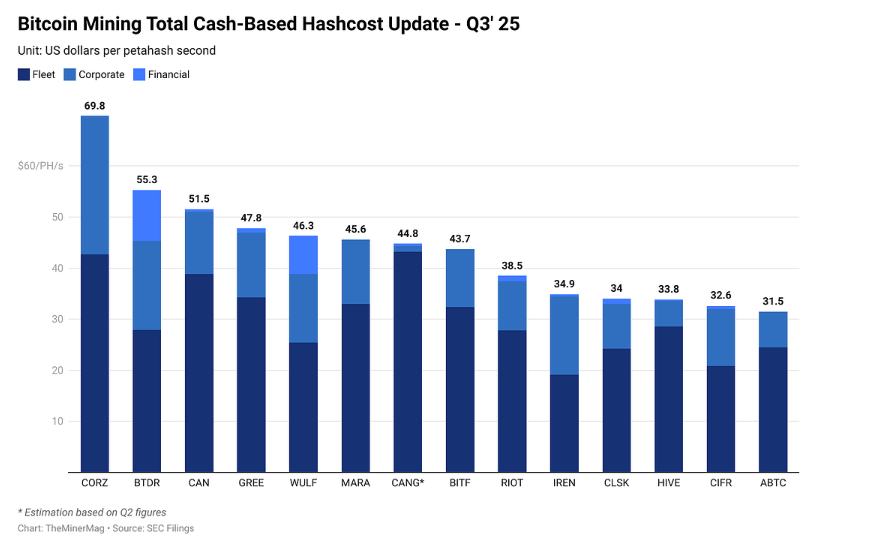
Biaya penambangan saat ini untuk penambang Bitcoin publik. Sumber: TheMinerMag

Meskipun perusahaan-perusahaan ini tetap aktif dalam penambangan Bitcoin, sektor ini beroperasi di salah satu lingkungan tersulit hingga saat ini. Penelitian industri menggambarkan margin penambang saat ini secara historis tertekan, dengan pendapatan pada "posisi terendah struktural" di tengah turunnya harga hash dan naiknya biaya operasional.

Sebagian besar tekanan berasal dari halving Bitcoin 2024, yang mengurangi hadiah blok menjadi 3,125 BTC dan secara efektif memotong pendapatan penambangan menjadi separuh. Biaya listrik yang lebih tinggi dan biaya peralatan yang berkelanjutan telah menambah tekanan lebih lanjut, membuat diversifikasi ke AI dan HPC semakin penting bagi banyak penambang.

Terkait: Tiga belas tahun setelah halving pertama, penambangan Bitcoin terlihat sangat berbeda pada tahun 2025


Trending Cryptos

Related Questions

QApa yang membuat pencatatan saham HIVE Digital Technologies di Bursa Efek Kolombia menjadi signifikan?

APencatatan saham HIVE di Bursa Efek Kolombia dengan kode HIVECO signifikan karena ini merupakan pertama kalinya perusahaan infrastruktur Bitcoin dan AI tercatat di bursa publik Amerika Latin, menandai ekspansi sektor ini ke pasar modal global.

QBagaimana pencatatan saham HIVE di Kolombia memberikan keuntungan bagi investor?

APencatatan ini membuka akses bagi investor di sistem pasar Andea (Kolombia, Peru, dan Chili) untuk berinvestasi di perusahaan infrastruktur digital yang menggabungkan komputasi kinerja tinggi, energi terbarukan, dan Bitcoin, sektor yang sedang tumbuh.

QApa yang mendorong perusahaan penambang Bitcoin seperti HIVE untuk diversifikasi ke AI dan komputasi kinerja tinggi?

ADorongan utama adalah ekonomi penambangan Bitcoin yang semakin ketat pasca halving 2024 yang memotong imbalan blok menjadi 3,125 BTC, ditambah biaya listrik dan peralatan yang meningkat, sehingga diversifikasi ke AI dan HPC menjadi penting untuk sustainability.

QApa keuntungan operasional yang dimiliki HIVE di Amerika Latin?

AHIVE telah mengembangkan pusat data Tier I di Paraguay yang sepenuhnya menggunakan tenaga hidroelektrik, memberikan keunggulan operasional berkelanjutan dan efisiensi energi di kawasan tersebut.

QBagaimana kondisi margin penambang Bitcoin publik menurut penelitian industri saat ini?

AMenurut penelitian industri, margin penambang Bitcoin publik saat ini tertekan secara historis dengan pendapatan pada 'level terendah struktural' akibat penurunan hash price dan kenaikan biaya operasional, menciptakan lingkungan yang sangat menantang.

Related Reads

Behind the AI Scorecards Lies a Chinese 'Question Setter'

Behind the AI scorecards that dominate industry discussions—benchmarks like MMLU-Pro, MMMU, and MMMU-Pro—stands a Chinese-Canadian researcher: Wenhu Chen. As an assistant professor at the University of Waterloo and founder of the TIGER Lab, Chen has become a key "exam-setter" for evaluating large language and multimodal models. Chen first gained broader recognition with MMLU-Pro, a more challenging and stable update to the popular MMLU benchmark. As top models like OpenAI’s o3 began achieving near-perfect scores on the original MMLU, it became difficult to distinguish their true capabilities. MMLU-Pro introduced more complex reasoning questions, expanded answer choices, and filtered out ambiguous or simple items, effectively reintroducing differentiation among state-of-the-art models. His work on MMMU addressed the evaluation of multimodal models, requiring them to integrate visual information (like charts, diagrams, or tables) with textual knowledge across diverse academic subjects. Even the strongest models initially scored only around 56-59%, highlighting significant room for improvement in genuine multimodal reasoning. MMMU-Pro further refined this by preventing models from bypassing visual cues. Chen’s research focus has long been on complex information understanding and reasoning. His background—including a PhD at UC Santa Barbara, research at Google/DeepMind on Gemini, and now a role in Meta’s superintelligence lab—provides deep insight into model development and their potential weaknesses. His TIGER Lab also builds models (e.g., for video understanding and generation), ensuring his evaluation benchmarks are grounded in practical challenges. While AI headlines often spotlight company leaders and product launches, Chen’s work exemplifies the critical, behind-the-scenes contributions of researchers crafting the rigorous standards that define and drive progress in AI capabilities.

marsbit56m ago

Behind the AI Scorecards Lies a Chinese 'Question Setter'

marsbit56m ago

STRC Unpegged by 11%, Can Strategy's Perpetual Motion Machine Keep Turning?

STRC, the perpetual preferred stock of MicroStrategy, is experiencing a persistent de-pegging from its target par value of $100, with the discount recently widening to over 11%. This de-anchoring challenges the core design of STRC, which was intended as a stable, income-oriented security operating near $100. As a crucial funding engine for MicroStrategy's Bitcoin acquisition strategy, STRC's price reflects market confidence in the company's entire capital model. The company's "capital flywheel" relies on issuing STRC at or above $100 via an At-the-Market (ATM) program to raise cash for buying Bitcoin, thereby boosting company equity and theoretically supporting STRC's value. A monthly adjustable dividend mechanism was designed to maintain this peg. Despite raising the dividend to 11.5% and increasing payment frequency, the de-pegging persists. Market concerns extend beyond technical factors like leveraged arbitrage unwinding. Analysts point to MicroStrategy's limited cash reserves relative to its ~$1.7 billion annual dividend obligation for preferred shares. While the company counters that its vast Bitcoin holdings could cover decades of payments, this argument hinges on the potential need to sell Bitcoin—a shift from its longstanding "hodl" narrative. The company's recent sale of a small amount of BTC, framed as a test, amplified these liquidity and strategy concerns. If STRC remains discounted, impairing MicroStrategy's ability to raise cheap capital, fears may grow that the company could sell more Bitcoin to meet obligations. This scenario could transform MicroStrategy from a major market buyer into a potential seller, posing significant downside risk for Bitcoin. The re-pegging of STRC is thus a key indicator for the health of MicroStrategy's capital structure and its market impact.

Odaily星球日报1h ago

STRC Unpegged by 11%, Can Strategy's Perpetual Motion Machine Keep Turning?

Odaily星球日报1h ago

Silicon Valley's Most Sought-After New Role Has Emerged

Silicon Valley's New Most Wanted Job: The Rise of the Forward Deployment Engineer The AI industry is witnessing a significant shift. The focus has moved from developing cutting-edge models to deploying them effectively within enterprises. This has made the "Forward Deployment Engineer" (FDE) a critical and highly sought-after role at major firms like OpenAI, Anthropic, and Google. For the past three years, the industry prioritized model scientists. However, companies are now facing a harsh reality: purchasing powerful AI tools does not guarantee productivity gains or organizational change. The biggest hurdle is not the technology itself, but integrating it into complex legacy systems, workflows, and corporate cultures. This includes challenges like data silos, compliance requirements, and internal resistance. The FDE role, pioneered by Palantir Technologies, addresses this "last-mile" problem. FDEs are deployed on-site with clients for extended periods. Their job is to deeply understand the client's specific organizational structure, processes, and pain points, then tailor and implement the AI solution accordingly. They combine skills in technology, project management, and organizational change. A clear signal of this trend emerged in May 2026 when three AI giants made major moves. Anthropic launched a $1.5B joint venture for enterprise deployment. OpenAI formed an independent deployment subsidiary, DeployCo, with over $4B in commitments and acquired a deployment consultancy. Google Cloud's CEO publicly announced a large-scale recruitment drive for FDEs. This shift represents a fundamental change in the software business model: from selling tools to selling guaranteed outcomes. FDEs are the agents of this change, responsible for delivering a working system within the production environment, not just a demo. Real-world cases, such as challenges at Goldman Sachs (compliance barriers) and Target (internal cultural resistance), illustrate that the primary obstacles to AI adoption are organizational, not technical. An FDE's value lies in navigating these human and procedural complexities to facilitate a successful "AI migration." In essence, as core AI technology becomes more accessible and affordable, the true premium is shifting to the human expertise required to understand organizations and drive change—making the FDE role pivotal for the next phase of the AI revolution.

marsbit1h ago

Silicon Valley's Most Sought-After New Role Has Emerged

marsbit1h ago

When the World Cup Collides with Agents: From Web2 to Web3, How Are Wallets Evolving into Agentic Wallets?

World Cup as a Catalyst for Agentic Wallets: From Web2 to Web3 This article explores how the World Cup provides a real-world scenario for observing the evolution of digital wallets from simple asset managers towards "Agentic Wallets"—intelligent, AI-powered interfaces. Using the example of prediction markets like Polymarket, it illustrates how AI Agents can lower the barrier to Web3 interaction. Instead of navigating complex DApps, users can express intent in natural language (e.g., "I think Portugal will win") within platforms like Discord or web pages. The Agent then interprets this intent, finds the relevant market, and seamlessly guides the user through the on-chain transaction via their wallet. The core shift is from wallets as mere "function menus" for signing transactions to "intent interpreters" that understand user goals. The article highlights parallel developments in traditional finance, such as Mastercard's "Agent Pay" and WeChat Pay's AI tests, which focus on granting AI controlled, authorized, and auditable payment capabilities. This underscores a broader trend of AI entering the financial layer. However, the article emphasizes that the primary challenge for Agentic Wallets in Web3 is not automation but establishing clear security boundaries. Unlike traditional systems with chargebacks, on-chain transactions are often irreversible. Therefore, future wallets must ensure users retain ultimate control and comprehension. They need to transparently communicate an Agent's permissions, spending limits, authorized durations, and provide easy ways to pause or revoke access. The World Cup experiments represent early steps toward wallets that are not just applications but ubiquitous, intelligent interfaces that simplify Web3 while keeping users securely in control.

marsbit2h ago

When the World Cup Collides with Agents: From Web2 to Web3, How Are Wallets Evolving into Agentic Wallets?

marsbit2h ago

Trading

Spot
Futures

Hot Articles

How to Buy HIVE

Welcome to HTX.com! We've made purchasing Hive (HIVE) simple and convenient. Follow our step-by-step guide to embark on your crypto journey.Step 1: Create Your HTX AccountUse your email or phone number to sign up for a free account on HTX. Experience a hassle-free registration journey and unlock all features.Get My AccountStep 2: Go to Buy Crypto and Choose Your Payment MethodCredit/Debit Card: Use your Visa or Mastercard to buy Hive (HIVE) instantly.Balance: Use funds from your HTX account balance to trade seamlessly.Third Parties: We've added popular payment methods such as Google Pay and Apple Pay to enhance convenience.P2P: Trade directly with other users on HTX.Over-the-Counter (OTC): We offer tailor-made services and competitive exchange rates for traders.Step 3: Store Your Hive (HIVE)After purchasing your Hive (HIVE), store it in your HTX account. Alternatively, you can send it elsewhere via blockchain transfer or use it to trade other cryptocurrencies.Step 4: Trade Hive (HIVE)Easily trade Hive (HIVE) on HTX's spot market. Simply access your account, select your trading pair, execute your trades, and monitor in real-time. We offer a user-friendly experience for both beginners and seasoned traders.

1.9k Total ViewsPublished 2024.03.29Updated 2026.06.02

How to Buy HIVE

Discussions

Welcome to the HTX Community. Here, you can stay informed about the latest platform developments and gain access to professional market insights. Users' opinions on the price of HIVE (HIVE) are presented below.

活动图片