HIVE tests investor appetite for AI-Bitcoin infrastructure in Andean markets

cointelegraphPublished on 2025-12-11Last updated on 2025-12-11

Abstract

HIVE Digital Technologies has become the first Bitcoin and AI infrastructure company to list on a Latin American exchange, debuting on the Colombian Stock Exchange under the ticker HIVECO. This listing provides access to investors across the Andean market system, which includes Colombia, Peru, and Chile. The move reflects the sector’s expansion as Bitcoin mining and high-performance computing (HPC) companies seek broader capital market opportunities. HIVE, which already trades in North America and Europe, has existing operations in Latin America, including hydroelectric-powered data centers in Paraguay. The company, like other major Bitcoin miners, has been diversifying into AI and HPC due to compressed mining margins following the 2024 Bitcoin halving, rising costs, and falling revenues. This strategic shift highlights the growing importance of diversification in the current challenging mining economy.

HIVE Digital Technologies has debuted on the Colombian Stock Exchange under the ticker HIVECO, becoming the first Bitcoin and AI infrastructure company to trade publicly on a Latin American exchange. The move marks another sign of the sector’s expansion as Bitcoin miners and high-performance computing (HPC) companies push deeper into global capital markets.

Announced on Thursday, the listing makes HIVE available to investors across the Andean market system, which links the exchanges of Colombia, Peru and Chile.

For a region traditionally dominated by energy and natural-resources issuers, the addition of a digital infrastructure company offers exposure to a growing sector that sits at the intersection of high-performance computing, renewable power and Bitcoin (BTC).

Colombia’s exchange is one of the Andean marketplace’s most institutionally connected platforms, giving HIVE access to a broader, more integrated investor base than is typical elsewhere in Latin America.

Source: HIVE Digital Technologies

HIVE shares are already traded in North America and Europe, including on the TSX Venture Exchange, the Nasdaq and the Frankfurt Stock Exchange.

On the Nasdaq, HIVE shares slipped more than 1% on Thursday, though they remain up for the year.

Related: Bitcoin miners gambled on AI last year, and it paid off

HIVE’s Latin American footprint grows as Bitcoin mining economics tighten

HIVE already has an operational footprint in Latin America, having developed Tier I data centers in Paraguay powered entirely by hydroelectricity. The company began expanding its presence there in late 2024 and completed the acquisition of its Yguazú site in March of this year, as previously reported by Cointelegraph.

HIVE was among the early Bitcoin miners to pivot toward AI and high-performance computing as mining economics tightened and demand for GPU infrastructure surged.

Other major public miners, including Core Scientific, Hut 8, Riot Platforms, TeraWulf and Marathon Holdings have also expanded into AI and HPC workloads in varying degrees.
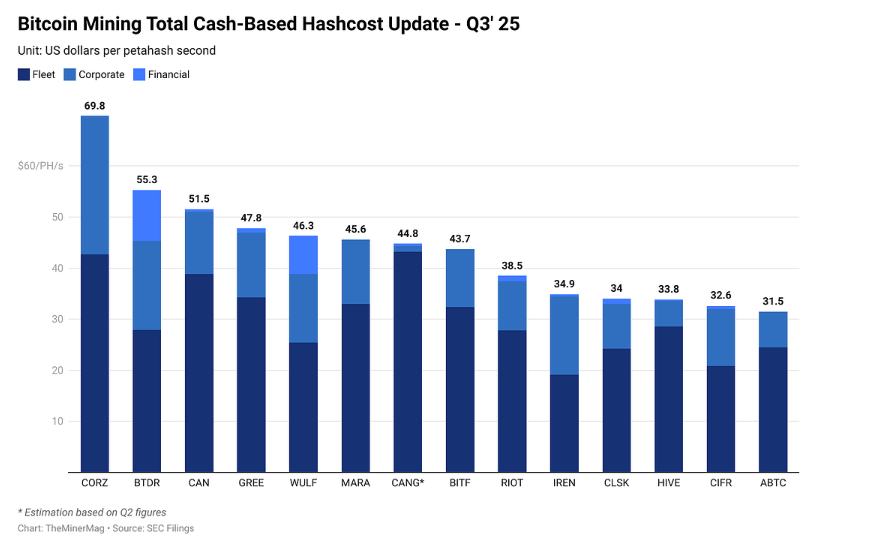
Current mining costs for public Bitcoin miners. Source: TheMinerMag

While these companies remain active in Bitcoin mining, the sector is operating in one of its toughest environments to date. Industry research describes current miner margins as historically compressed, with revenue at “structural lows” amid falling hash price and rising operating costs.

Much of the pressure stems from the 2024 Bitcoin halving, which reduced block rewards to 3.125 BTC and effectively halved mining revenue. Higher electricity costs and ongoing equipment expenses have added further strain, making diversification into AI and HPC increasingly important for many miners.

Related: Thirteen years after the first halving, Bitcoin mining looks very different in 2025

Trending Cryptos

Related Reads

Conversation with Investor Zheng Di: MicroStrategy's Coin Sale Experiment, AI Economy, and Opportunities in US Stocks

Frontier tech investor Zheng "Didier" Di discusses the recent Bitcoin price drop, the financial strategy shift at MicroStrategy, the AI-driven surge in U.S. stocks, and the evolving role of crypto exchanges. Didier posits that the recent BTC decline stems less from macro factors or ETF outflows, and more from market repricing due to MicroStrategy's new financial structure. Following a wave of preferred stock and debt issuance (STRC, STRZ, etc.), MicroStrategy must now manage cash flow to pay dividends, potentially leading to a market expectation of sustained, small-scale BTC sales to maintain its "per-share bitcoin neutral" principle. Didier views this as a financial "experiment" testing market capacity for such recurring sell pressure, which, while creating near-term structural headwinds, likely avoids a true "death spiral" absent major new external shocks. Shifting to AI, Didier argues that tokens are becoming the new form of labor, with AI models and compute (tokenized inputs) increasingly replacing human roles in execution and middle-management. This drives enterprise efficiency and higher margins, fueling the sustained rally in U.S. semiconductor, data center, and infrastructure stocks. He foresees an emerging "machine economy" where automated agents transact and collaborate on-chain. Regarding crypto exchanges offering U.S. equities, Didier sees this as a natural evolution. With few crypto-native assets generating lasting value, exchanges are pivoting towards real-world assets (RWAs) like stocks and bonds. This doesn't necessarily cannibalize crypto but reflects a maturing industry focusing on blockchain's core utilities: decentralized choice and efficient settlement. He notes that trading logic for crypto natives doesn't need to drastically change, as meme-driven and fundamentalist strategies find analogs in U.S. markets. The "1011 event" (likely referring to a major market crash) severely damaged crypto market liquidity, marking a probable end to the altcoin speculative cycle, with capital flowing towards the deeper liquidity of U.S. markets. For the macro outlook, Didier is cautious about near-term market pressure from potential mega-IPOs (e.g., SpaceX) and the U.S. midterm elections, which could bring more regulatory scrutiny. Long-term, he remains bullish on AI's productivity gains and its convergence with blockchain/Web3, predicting a shift from speculative frenzy to a more institutionalized, industrial phase for the crypto sector.

marsbit7m ago

Conversation with Investor Zheng Di: MicroStrategy's Coin Sale Experiment, AI Economy, and Opportunities in US Stocks

marsbit7m ago

Playnance’s $GCOIN Lists on KoinBX Amid Rapid Growth in India

Playnance's native token, $GCOIN, has been listed on the cryptocurrency exchange KoinBX as of June 18. This move aims to enhance accessibility for its rapidly growing community, particularly in India, where the blockchain-powered Web3 iGaming ecosystem has gained significant traction. Over 130 partners in Playnance's "Be the Boss" program have built communities engaging thousands of active players in the region. The "Be the Boss" model allows participants to create and manage their own gaming communities, earning rewards tied to community activity. CEO Pini Peter noted India's high engagement, with community leaders successfully building player networks. One partner, Dr. Nicolas, reported earning over $57,000 through the program in recent months, highlighting both the financial rewards and the opportunity to grow an engaged community. $GCOIN serves as the ecosystem's core utility token, incentivizing participation and aligning the interests of players and community leaders ("Bosses"). The listing on KoinBX is part of Playnance's strategy to expand globally, increasing the token's utility and accessibility by combining community ownership, gamified engagement, and blockchain-based incentives. Founded in 2020, Playnance is a Web3 iGaming infrastructure company focused on creating live, non-custodial, on-chain products to onboard mainstream users. It currently processes approximately one million transactions daily, aiming to simplify the user experience while maintaining full on-chain transparency.

TheNewsCrypto47m ago

Playnance’s $GCOIN Lists on KoinBX Amid Rapid Growth in India

TheNewsCrypto47m ago

STRC Hits Historic Low, Saylor's Perpetual Motion Machine Grinds to a Halt

STRC, the perpetual preferred stock issued by MicroStrategy to fund its Bitcoin purchases, hit a historic low of $85.32, a 17% discount to its $100 par value. Designed as a "digital credit engine" to trade stably near par and enable continuous share issuance for buying Bitcoin, its plunge signals a breakdown in this model. Three key factors drove the decline: 1. Bitcoin's price fell over 50% from its peak, trading around $63,000 amid hawkish Fed signals. 2. MicroStrategy's cash reserves were depleted after a $1.5 billion convertible note repayment, slashing the dividend coverage for STRC's 11.5% yield to ~7 months. The company then sold 32 BTC to cover dividends—Michael Saylor's first Bitcoin sale since 2022—damaging the "never sell" narrative. 3. A competing Bitcoin-backed preferred stock, Strive's SATA, offers a higher yield (~13%) and daily dividends, drawing investors away from STRC. The drop triggers a negative cycle: STRC below par halts ATM share issuances, cutting off a key funding source for Bitcoin buys and potentially forcing more BTC sales for dividends, further eroding confidence. While Saylor argues the model is mathematically sound—needing only 2.3% annual Bitcoin growth to sustain itself—the market is testing the resilience of the leveraged Bitcoin treasury strategy in a bear market. The STRC price now reflects rising skepticism about this financial machinery's durability during downturns.

marsbit1h ago

STRC Hits Historic Low, Saylor's Perpetual Motion Machine Grinds to a Halt

marsbit1h ago

A Guide to Grayscale’s ‘Bottom Fishing’: Using Cash Flow to Assess Cryptocurrency Value

**Title:** Grayscale's Guide to Bottom-Fishing: Valuing Cryptoassets Using Cash Flows **Summary:** This report by Grayscale Research presents a fundamental valuation framework for cryptocurrency assets, moving beyond pure speculation to analyze those with underlying cash flows. It distinguishes between "commodity-like" assets (e.g., Bitcoin) and "cash-flow" assets, primarily within DeFi. Using the leading decentralized lending protocol Aave as a case study, the analysis applies traditional financial methodologies like Discounted Cash Flow (DCF) and Price-to-Earnings (P/E) multiples. Key findings indicate that AAVE tokens are currently undervalued. Despite recent challenges, the protocol's strong revenue growth, ~50% net profit margin, and diversified treasury support a fundamental valuation range of $80-$100 per token (compared to a ~$75 market price at the time of writing). In a base-case scenario driven by stablecoin adoption and regulatory clarity, the fair value could rise to around $175 within a year. The report emphasizes that protocol success does not automatically translate to token value. It critically examines the "value capture" mechanisms—such as buybacks, burns, and staking rewards—that channel protocol profits to token holders. Furthermore, it addresses the legal and governance complexities of Decentralized Autonomous Organizations (DAOs), noting their difference from traditional corporate equity but highlighting how robust, transparent governance can align protocol economics with holder interests. The conclusion is that the crypto market is maturing, with capital increasingly flowing towards projects with demonstrable fundamentals, real adoption, and disciplined capital allocation, creating opportunities for value-based investors.

marsbit2h ago

A Guide to Grayscale’s ‘Bottom Fishing’: Using Cash Flow to Assess Cryptocurrency Value

marsbit2h ago

Trading

Spot
Futures

Hot Articles

How to Buy HIVE

Welcome to HTX.com! We've made purchasing Hive (HIVE) simple and convenient. Follow our step-by-step guide to embark on your crypto journey.Step 1: Create Your HTX AccountUse your email or phone number to sign up for a free account on HTX. Experience a hassle-free registration journey and unlock all features.Get My AccountStep 2: Go to Buy Crypto and Choose Your Payment MethodCredit/Debit Card: Use your Visa or Mastercard to buy Hive (HIVE) instantly.Balance: Use funds from your HTX account balance to trade seamlessly.Third Parties: We've added popular payment methods such as Google Pay and Apple Pay to enhance convenience.P2P: Trade directly with other users on HTX.Over-the-Counter (OTC): We offer tailor-made services and competitive exchange rates for traders.Step 3: Store Your Hive (HIVE)After purchasing your Hive (HIVE), store it in your HTX account. Alternatively, you can send it elsewhere via blockchain transfer or use it to trade other cryptocurrencies.Step 4: Trade Hive (HIVE)Easily trade Hive (HIVE) on HTX's spot market. Simply access your account, select your trading pair, execute your trades, and monitor in real-time. We offer a user-friendly experience for both beginners and seasoned traders.

1.9k Total ViewsPublished 2024.03.29Updated 2026.06.02

How to Buy HIVE

Discussions

Welcome to the HTX Community. Here, you can stay informed about the latest platform developments and gain access to professional market insights. Users' opinions on the price of HIVE (HIVE) are presented below.

活动图片