Animoca与Solv合作,助力日本比特币公司创造收益

cointelegraphPublished on 2025-12-10Last updated on 2025-12-10

Abstract

Web3游戏巨头Animoca Brands与去中心化金融平台Solv Protocol合作,旨在帮助日本大型比特币持有企业通过其持有的比特币产生收益。该合作将结合Solv的基础设施和Animoca的机构网络,目标客户为持有大量比特币(BTC)储备的企业及上市公司。 Animoca Brands日本首席执行官表示,多数企业仅持有比特币,而此次合作旨在推动企业将其转化为增长引擎。比特币本身不产生利息或分红,需通过借贷或锁仓等外部机制创造收益。 Solv Protocol通过其比特币抵押封装技术,为企业提供年化4%至12%的收益,具体通过借贷市场、流动性提供及结构化质押项目实现。Solv目前管理资产超28亿美元,投资者包括Binance Labs和Blockchain Capital。 日本目前有11家上市公司持有比特币,其中Metaplanet以约30,823枚比特币位居日本第一、全球第四。其他重要持有者包括游戏公司Nexon和咨询公司Remixpoint。此外,已破产的交易所Mt. Gox仍持有超过34,000枚比特币。

Web3游戏巨头Animoca Brands已与去中心化金融平台Solv Protocol达成合作,旨在帮助日本的大型比特币持有者从其持有的资产中创造收益。

根据周三与Cointelegraph分享的一份声明,该合作旨在将Solv的基础设施与Animoca Brands的机构网络相结合,目标客户为拥有大量比特币(BTC)储备的公司和上市实体。

Animoca Brands日本首席执行官Kensuke Amo表示,大多数公司仅持有比特币,但与Solv的新合作旨在改变这一现状。

"通过这次合作,我们的目标是创造一个环境,让公司不仅可以持有比特币作为金融资产,还可以将其作为推动企业增长的新收入引擎,"他说。

比特币传统上不是一种产生收益的资产,因为将其存放在钱包中不会产生利息、股息或质押奖励;相反,它需要外部系统,如借贷或锁定。

Solv提供4%至12%的比特币收益率

新合作将利用Solv的通用比特币支持包装器,使 treasury 公司能够产生4%至12%的年化收益率。

根据其白皮书,Solv通过借贷市场、为AMM池提供流动性以及参与结构化质押计划来产生比特币收益。

SOLV的联合创始人兼首席执行官Ryan Chow表示,他的协议已经证明"比特币可以作为生产性资本",下一阶段的扩张将是"为日本最具前瞻性的公司提供安全、合规和高收益的 treasury 解决方案"。

相关:Metaplanet计划通过发行新的B类股票筹集1.35亿美元,以购买更多比特币

据该公司称,SOLV得到了包括Binance Labs和Blockchain Capital在内的投资者的支持,管理资产超过28亿美元。

Metaplanet拥有日本最大的比特币储备

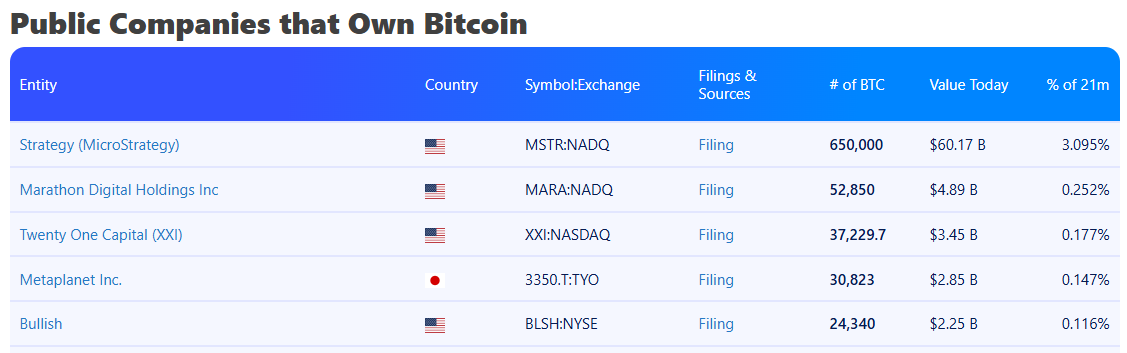
根据Bitbo的数据,有11家日本上市公司在其资产负债表上持有比特币。持有比特币最多的公司,也是整体排名第四的公司是Metaplanet,其资产负债表上大约有30,823枚比特币。

总部位于日本的Metaplanet拥有第四大上市比特币储备。来源:Bitbo

其次是韩国视频游戏开发商Nexon,其总部位于日本,持有1,117枚比特币。排名第三的是咨询服务公司Remixpoint。

只有一家私营公司持有比特币,即已倒闭的交易所Mt. Gox,尽管在2014年破产,但它仍持有超过34,000枚代币。

杂志:《神秘的Mr Nakamoto》作者——找到中本聪会伤害比特币

Related Questions

QAnimoca Brands和Solv Protocol合作的主要目标是什么?

A合作的主要目标是结合Solv的基础设施和Animoca Brands的机构网络,帮助日本持有大量比特币的公司和上市实体从其持有的比特币中产生收益。

Q通过Solv Protocol,比特币持有者可以获得多少年化收益率?

A通过Solv Protocol的比特币支持包装器,企业可以生成4%至12%的年化收益率。

QSolv Protocol通过哪些方式生成比特币收益?

ASolv Protocol通过借贷市场、为自动做市商(AMM)池提供流动性以及参与结构化质押计划来生成比特币收益。

Q日本持有比特币最多的上市公司是哪家?持有多少比特币?

A日本持有比特币最多的上市公司是Metaplanet,其资产负债表上持有约30,823枚比特币。

Q除了上市公司,还有哪家日本私人公司持有大量比特币?持有量是多少?

A除了上市公司,已破产的交易所Mt. Gox(门头沟)持有超过34,000枚比特币,尽管该公司在2014年已破产。

Related Reads

Uncovering the Truth About Agent Commerce, Payments, and Infrastructure

Decoding Agent Commerce, Payments, and Infrastructure: The Reality Over the past year, I've been building infrastructure for the Agent economy, engaging with major players like Stripe, Visa, Coinbase, Google, and dozens of startups. A clear conclusion emerges: true, large-scale demand does not yet exist. Startups face structural challenges. Data points illustrate this gap. Stripe's Agent commerce platform has over 1,000 merchants but only single-digit transacting agents. Visa's Agent payment token requires 9-month KYC and a $250M revenue threshold, accessible only to giants like Amazon. On-chain analysis reveals actual daily Agent transaction volume is around $17k, half of which are test transactions. The article analyzes four potential markets: **1. Agent-to-Merchant (A2M):** Current AI shopping UX is often inferior to traditional e-commerce for visual, comparison-heavy purchases (clothing, electronics). Chat interfaces are a step back. Real merchant interest is defensive "Agent Engine Optimization," fearing future obsolescence, not current demand. Potential exists in high-frequency, low-decision purchases (e.g., food delivery) or simplifying terrible UX (complex checkouts, non-native shoppers), but these require massive consumer distribution channels dominated by giants like DoorDash and Amazon. **2. Agent-to-API (A2A):** Developers already have subscriptions and billing for core APIs (compute, data). The argument for micro-payments via crypto for sub-dollar API calls is addressed by pre-paid balances today. The deeper issue is supplier resistance; major SaaS firms rely on enterprise contracts, not fractional cent pricing. Opportunity lies in the long tail of niche services, but this is a smaller market catering to developers, a historically low-paying group. **3. Agent-to-Agent (A2A):** This remains a theoretical long-term vision with near-zero current transaction volume. It involves unique challenges: discovery, trust, negotiation, dispute resolution. When it materializes, it will require a fundamentally new settlement infrastructure for high-speed, variable-value, multi-party transactions. It's a real long-term bet, but not the current market. **4. Agent-to-Finance (A2F):** This is the only category with existing, paying demand. Integrating AI into financial workflows (trading, portfolio management) is a natural evolution and enables new capabilities like autonomous rebalancing. However, competition favors incumbents with regulatory licenses, compliance infrastructure, and existing client relationships. **The Real Issue:** Why is infrastructure still being built? Incumbents can afford long-term bets, and payment companies see every problem as a nail for their payment hammer. However, payment is just one piece. The core challenge is *coordination*—orchestrating work between Agents and humans, verifying outcomes, and settling results. Payment is part of settlement, which is part of coordination. Companies that solve the coordination problem will subsume payments, not the other way around. Startups lack the infinite runway of giants and must find today's real market, which, after a year of exploration, lies outside these four categories—in an area with real, growing, and underserved activity.

marsbit5h ago

Uncovering the Truth About Agent Commerce, Payments, and Infrastructure

marsbit5h ago

Trading

Spot
Futures

Hot Articles

What is $BITCOIN

DIGITAL GOLD ($BITCOIN): A Comprehensive Analysis Introduction to DIGITAL GOLD ($BITCOIN) DIGITAL GOLD ($BITCOIN) is a blockchain-based project operating on the Solana network, which aims to combine the characteristics of traditional precious metals with the innovation of decentralized technologies. While it shares a name with Bitcoin, often referred to as “digital gold” due to its perception as a store of value, DIGITAL GOLD is a separate token designed to create a unique ecosystem within the Web3 landscape. Its goal is to position itself as a viable alternative digital asset, although specifics regarding its applications and functionalities are still developing. What is DIGITAL GOLD ($BITCOIN)? DIGITAL GOLD ($BITCOIN) is a cryptocurrency token explicitly designed for use on the Solana blockchain. In contrast to Bitcoin, which provides a widely recognized value storage role, this token appears to focus on broader applications and characteristics. Notable aspects include: Blockchain Infrastructure: The token is built on the Solana blockchain, known for its capacity to handle high-speed and low-cost transactions. Supply Dynamics: DIGITAL GOLD has a maximum supply capped at 100 quadrillion tokens (100P $BITCOIN), although details regarding its circulating supply are currently undisclosed. Utility: While precise functionalities are not explicitly outlined, there are indications that the token could be utilized for various applications, potentially involving decentralized applications (dApps) or asset tokenization strategies. Who is the Creator of DIGITAL GOLD ($BITCOIN)? At present, the identity of the creators and development team behind DIGITAL GOLD ($BITCOIN) remains unknown. This situation is typical among many innovative projects within the blockchain space, particularly those aligning with decentralized finance and meme coin phenomena. While such anonymity may foster a community-driven culture, it intensifies concerns about governance and accountability. Who are the Investors of DIGITAL GOLD ($BITCOIN)? The available information indicates that DIGITAL GOLD ($BITCOIN) does not have any known institutional backers or prominent venture capital investments. The project seems to operate on a peer-to-peer model focused on community support and adoption rather than traditional funding routes. Its activity and liquidity are primarily situated on decentralized exchanges (DEXs), such as PumpSwap, rather than established centralized trading platforms, further highlighting its grassroots approach. How DIGITAL GOLD ($BITCOIN) Works The operational mechanics of DIGITAL GOLD ($BITCOIN) can be elaborated on based on its blockchain design and network attributes: Consensus Mechanism: By leveraging Solana’s unique proof-of-history (PoH) combined with a proof-of-stake (PoS) model, the project ensures efficient transaction validation contributing to the network's high performance. Tokenomics: While specific deflationary mechanisms have not been extensively detailed, the vast maximum token supply implies that it may cater to microtransactions or niche use cases that are still to be defined. Interoperability: There exists the potential for integration with Solana’s broader ecosystem, including various decentralized finance (DeFi) platforms. However, the details regarding specific integrations remain unspecified. Timeline of Key Events Here is a timeline that highlights significant milestones concerning DIGITAL GOLD ($BITCOIN): 2023: The initial deployment of the token occurs on the Solana blockchain, marked by its contract address. 2024: DIGITAL GOLD gains visibility as it becomes available for trading on decentralized exchanges like PumpSwap, allowing users to trade it against SOL. 2025: The project witnesses sporadic trading activity and potential interest in community-led engagements, although no noteworthy partnerships or technical advancements have been documented as of yet. Critical Analysis Strengths Scalability: The underlying Solana infrastructure supports high transaction volumes, which could enhance the utility of $BITCOIN in various transaction scenarios. Accessibility: The potential low trading price per token could attract retail investors, facilitating wider participation due to fractional ownership opportunities. Risks Lack of Transparency: The absence of publicly known backers, developers, or an audit process may yield skepticism regarding the project's sustainability and trustworthiness. Market Volatility: The trading activity is heavily reliant on speculative behavior, which can result in significant price volatility and uncertainty for investors. Conclusion DIGITAL GOLD ($BITCOIN) emerges as an intriguing yet ambiguous project within the rapidly evolving Solana ecosystem. While it attempts to leverage the “digital gold” narrative, its departure from Bitcoin's established role as a store of value underscores the need for a clearer differentiation of its intended utility and governance structure. Future acceptance and adoption will likely depend on addressing the current opacity and defining its operational and economic strategies more explicitly. Note: This report encompasses synthesised information available as of October 2023, and developments may have transpired beyond the research period.

363 Total ViewsPublished 2025.05.13Updated 2025.05.13

What is $BITCOIN

Discussions

Welcome to the HTX Community. Here, you can stay informed about the latest platform developments and gain access to professional market insights. Users' opinions on the price of BTC (BTC) are presented below.

活动图片