Предложение стейблкоинов на Solana достигло нового максимума

cryptonews.ruPublished on 2025-12-19Last updated on 2025-12-19

Предложение стейблкоинов на Solana достигло нового исторического максимума и, по данным Dune Analytics, превысило $16,2 млрд.

На долю USDC от Circle приходится более 58% ($8 млрд) от общего объёма стейблкоинов Solana, за ним следует USDT с почти 20% ($2,7 млрд). USDC также лидирует — $10,45 млрд, а на долю USDT приходится $2,7 млрд. Впервые предложение активов с привязкой к фиату в сети превзошло показатель биткоина и эфириума.

Такой скачок вызвал обеспокоенность Международного валютного фонда (МВФ), который предупредил, что увеличение предложения стейблкоинов может нарушить движение капитала и ускорить замещение валют.
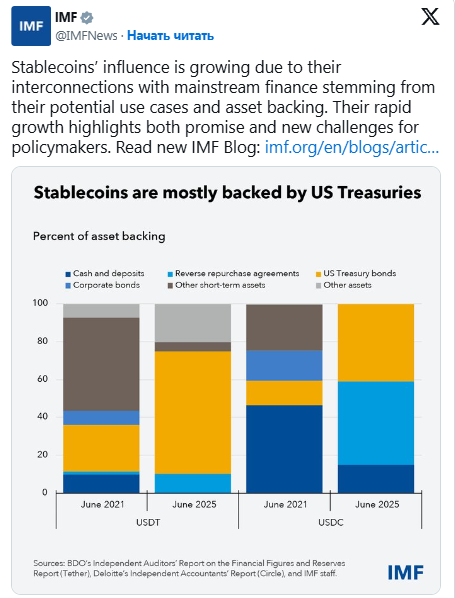
рис 11

В МВФ заявили, что рынок стейблкоинов уже превысил $300 млрд, что составляет примерно 7% от общего рынка криптовалют. Оборотное предложение USDT находится на уровне $185,5 млрд, а USDC — $77,6 млрд. В фонде отметили, что стоимость двух крупнейших актива с привязкой к доллару за последние два года выросла более чем в три раза и составила около $260 млрд.

В МВФ считают, что стейблкоины могут усложнить проведение денежно-кредитной политики и дестабилизировать финансовую стабильность на развивающихся рынках. При этом трансграничный характер этого вида активов может упростить переводы и платежи.

Trending Cryptos

Related Reads

NVIDIA CPU Advances, China's RISC-V Responds: Semiconductor Deep Dive - Part Four

NVIDIA is set to launch its new Vera AI data center CPU in China as early as August, with high pricing. While this move offers a new option, it highlights China's continued dependence on foreign-controlled Arm architecture. In response, the Chinese semiconductor industry is increasingly turning to RISC-V as a strategic alternative for achieving high-performance computing autonomy. The article explores the concept of the "impossible triangle" in CPU development—balancing prosperity, control, and autonomy—and posits that RISC-V's open-source, modular nature offers a unique path to achieving all three. While RISC-V is already dominant in embedded systems, the focus is now shifting to data centers and AI workloads. China has become a global hotspot for RISC-V development, driven by AI-driven compute demand, supply chain concerns from export controls, cost benefits of open-source, and strong policy support. Multiple Chinese companies have reportedly crossed the key performance threshold of 15 SPECint per GHz, a benchmark for entering the high-performance CPU club. Progress extends beyond single-core benchmarks. Companies are developing complete computing subsystems, including commercial-grade coherent network-on-chip (NoC) technology and server processors with up to 40 cores that strictly adhere to the RVA23 standard to ensure software compatibility. Real-world applications are emerging in areas like video transcoding and edge AI. However, significant challenges remain. The RISC-V ecosystem faces fragmentation, immature toolchains and verification processes, and gaps in single-core performance and energy efficiency compared to mature x86 and Arm architectures. The formidable software moat, epitomized by NVIDIA's CUDA, is a long-term hurdle. In conclusion, while RISC-V cannot immediately replace offerings like NVIDIA's Vera, it represents a viable long-term path for China to develop a self-sufficient, high-performance CPU ecosystem. The journey is acknowledged to be long and arduous, requiring sustained effort to overcome technical and ecosystem challenges.

marsbit6h ago

NVIDIA CPU Advances, China's RISC-V Responds: Semiconductor Deep Dive - Part Four

marsbit6h ago

Trading

Spot
Futures

Hot Articles

Discussions

Welcome to the HTX Community. Here, you can stay informed about the latest platform developments and gain access to professional market insights. Users' opinions on the price of SOL (SOL) are presented below.

活动图片