8 万刀的比特币,会不会让 Strategy 模型破功?

比推Published on 2025-12-03Last updated on 2025-12-03

本报告由Tiger Research撰写。随着比特币价格下跌,人们的注意力转向持有最大规模比特币的DAT公司。Strategy是这一群体中最引人注目的参与者之一。关键问题在于该公司如何积累其资产,以及在市场波动加剧时如何管理风险。

要点总结

  • Strategy静态破产阈值预计在2025年约为23,000美元,几乎是2023年12,000美元水平的两倍。

  • 该公司于2024年将其融资模式从简单的现金和小额可转换债券转变为可转换债券、优先股和ATM发行等多元化组合。

  • 投资者持有的看涨期权允许他们在到期前提前赎回。如果比特币价格下跌,投资者很可能会行使该期权,这使得2028年成为一个关键的风险窗口期。

  • 如果2028年再融资失败,假设比特币价格为9万美元,Strategy可能需要出售约7.1万枚比特币。这相当于日均交易量的20%至30%,将对市场造成重大压力。

1. 关于Strategy稳定性的问题

比特币近期的下跌导致DAT公司股价下跌约50%。这引发了市场的一个核心问题:在股价和公司核心资产双双下跌的情况下,Strategy的稳定性是否依然存在?摩根大通指出Strategy可能被MSCI指数剔除后,这种担忧进一步加剧。

人们关注的不只是这只股票。Strategy持有数额庞大的比特币,足以影响更广泛的市场,远超一般巨鲸的规模。这引发了两个关键问题。

  1. 比特币价格达到什么水平时,Strategy的资产负债表会崩溃。

  2. 该公司何时以及在何种条件下能够对市场产生影响?

本报告审查了美国证券交易委员会(SEC)的文件,以确定Strategy的有效破产门槛、风险增加的时期以及如果出现压力情景可能对市场产生的潜在影响。

2. Strategy面临风险:23,000美元阈值

在展开分析之前,我们先阐明静态破产的概念。静态破产指的是即便公司所有资产都变现,也无法偿还其债务的情况。

简单来说,静态破产是指资产小于负债的情况。例如,如果Echo公司拥有一套价值10亿韩元的房产和1亿韩元的现金,但负债12亿韩元,那么从资产负债表来看,该公司已经资不抵债。DAT公司也面临同样的情况。如果比特币价格跌破某个特定水平,账面权益就会变为负值,公司将无力偿还债务。这一水平被称为静态破产阈值。

为了确定Strategy的静态破产阈值,我们首先研究该公司是如何积累其比特币持仓的。

Strategy自2020年起便将比特币视为战略资产持有,但其积累模式在2023年后发生了变化。在此之前,该公司主要依靠现金储备和小额可转换债券购买比特币。其持仓量维持在10万枚比特币以下,再融资需求也较为有限。

自2024年起,Strategy融资方式发生转变。该公司通过结合发行优先股、ATM股票计划和大规模可转换债券来提高杠杆率,从而为购买更多比特币筹集资金。

这导致比特币的积累速度迅速加快。这种结构形成了一个循环:比特币价格越高,该公司的市值就越大,杠杆率也就越高,从而支持了更多的购买。

目标不变,但资金结构和风险状况发生了变化。这种结构性转变如今已成为加剧Strategy破产风险的核心因素。
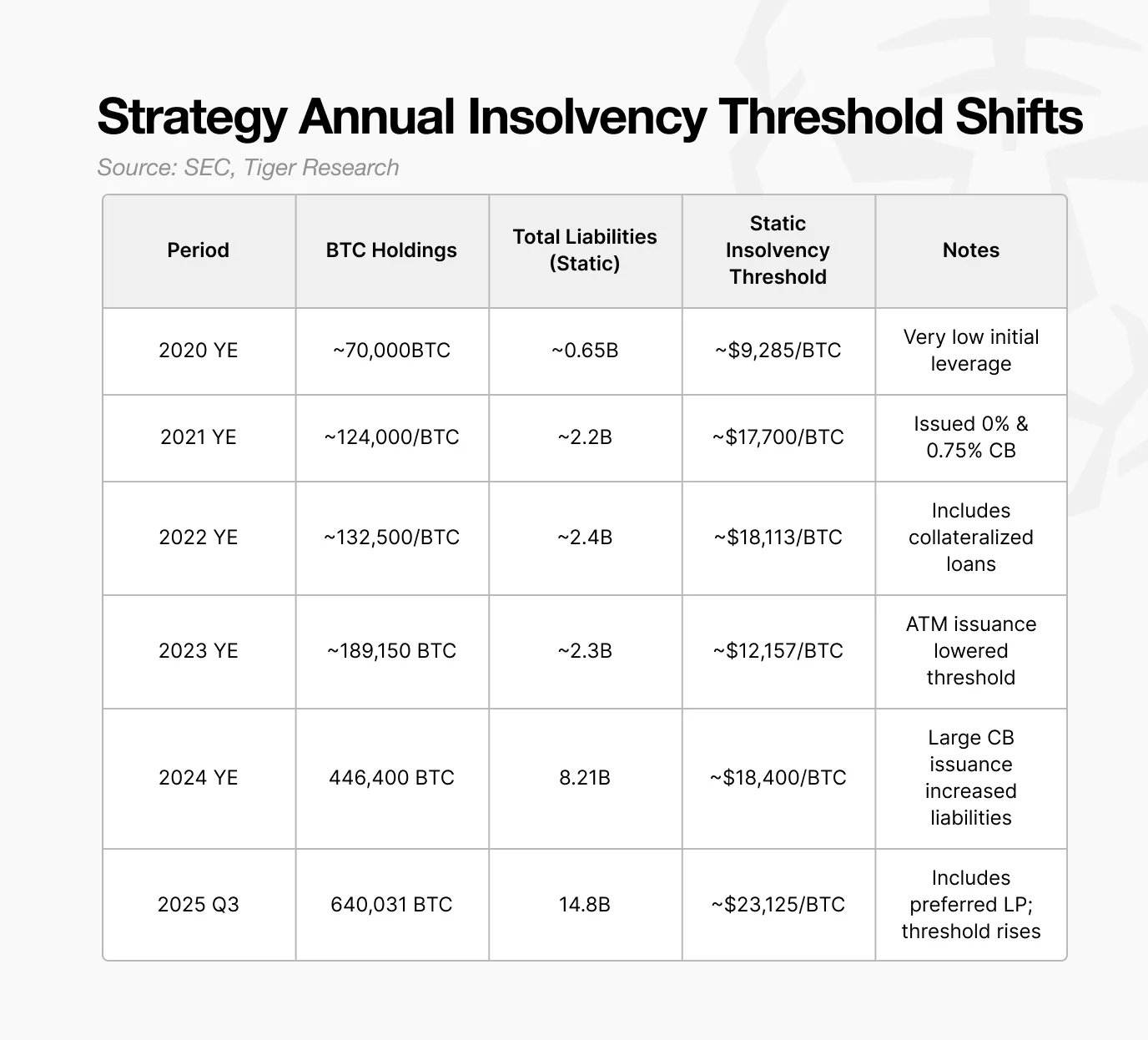
Strategy预计2025年的静态破产阈值水平约为23,000美元。低于此水平,其持有的比特币价值将低于其负债,导致该公司在资产负债表上资不抵债。

关键在于,这个阈值一直在上升。2023年,该公司能够承受比特币约12,000美元的价格。2024年这一阈值升至18,000美元,到2025年则达到23,000美元。随着Strategy增持比特币,这一关键水平也随之提高。

因此,23,000 美元的门槛代表了比特币稳定运营所需的最低价格。这意味着比特币需要从当前水平下跌约73%才会触发破产风险。

3. 可转换债券:问题在于持有人回售权而非到期日

如前所述,由于负债增长速度超过比特币持有量,Strategy的静态破产阈值提高至23,000美元。下一个问题是,这些债务是如何构建的。

2024年至2025年间,Strategy采用了一种新的融资模式,该模式结合了可转换债券、优先股和ATM股票计划。在这些工具中,可转换债券占比最大,对市场的影响也最为显著。
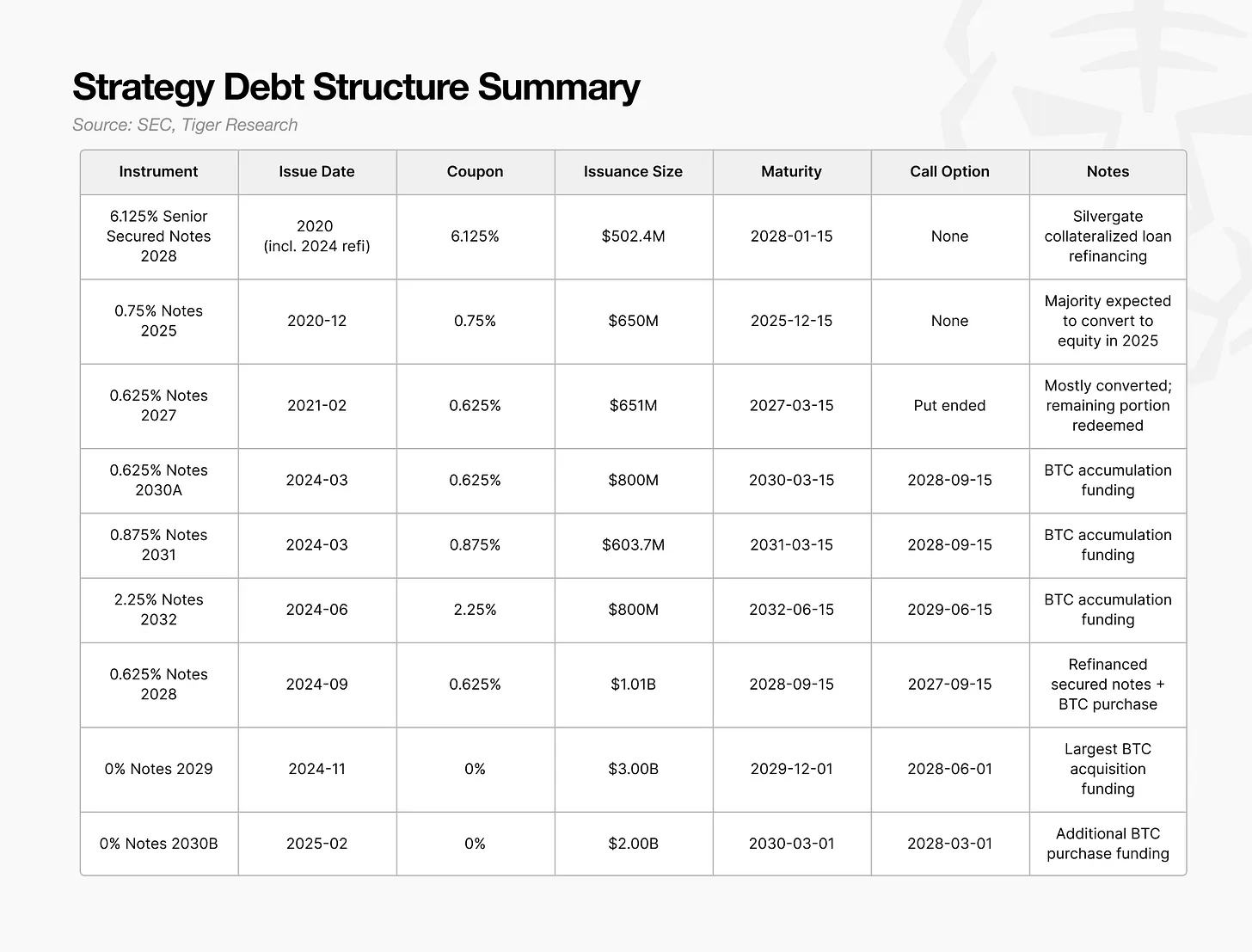
关键不在于可转换债券的规模或到期日,而在于持有人行使回售权的时机。

该条款允许投资者要求提前偿还,公司不得拒绝。2024-2025年发行的大部分大型可转换债券的持有人赎回日都集中在2028年左右,因此2028年是Strategy公司证明其再融资能力的关键一年。

如果比特币价格在2028年接近破产阈值或市场状况恶化,投资者很可能会行使看跌期权,而不是等待到期。一波看跌期权行使潮将需要Strategy立即筹集数十亿美元的现金。

问题在于,通过这些可转换债券筹集的资金几乎全部用于购买比特币。如果这些资金投资于能够产生现金流的生产性资产,公司自然就有了偿还资金的来源。然而,专注于积累比特币的做法导致可用于赎回的现金所剩无几。

因此,偿还债务将需要通过出售资产来实现。如果比特币价格在期权窗口开启时处于低位,Strategy可能会立即面临流动性短缺。强制抛售会进一步压低价格,提高破产阈值,并可能引发恶性循环。

4. 优先股:为何选择10%的股息负担
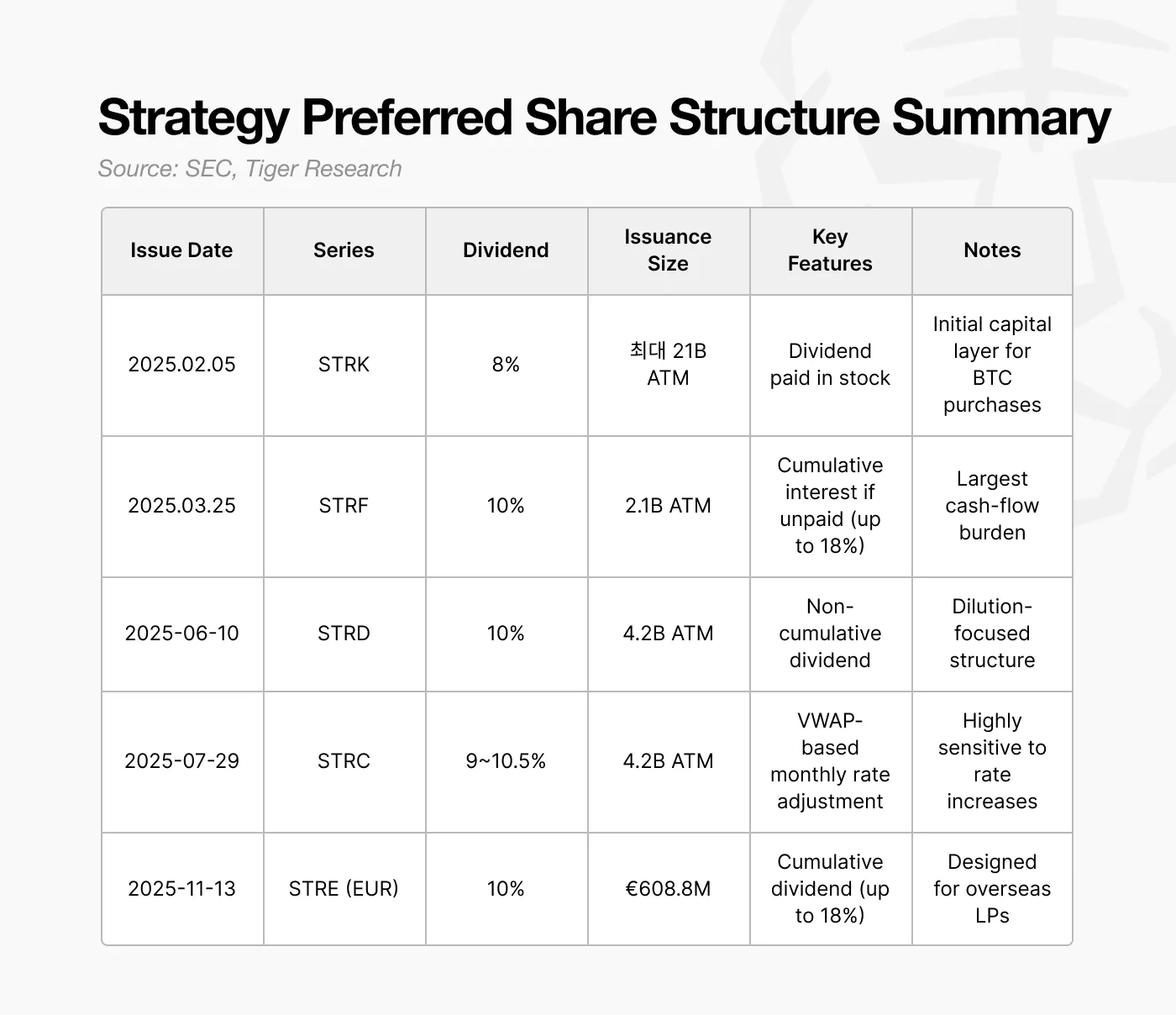
从2025年开始,Strategy从发行近乎零息可转换债券转向发行股息率约为10%的优先股。乍一看,这似乎是一个成本更高的选择。

然而,该决定反映了2027-2028年日益增长的再融资压力。2028 年大量债券持有人选择回售债券将显著增加中期偿付风险。在此期间任何持续的现金流出都将增加破产风险。

优先股的关键特点在于股息无需以现金支付。Strategy发行设计使得股息可以在需要时以股票形式支付。这使得公司能够在不立即造成现金流失的情况下筹集资金,并在不使用现金的情况下履行股息支付义务。实际上,优先股帮助Strategy避免在关键的2027-2028年期间出售比特币。

虽然10%的股息率看起来很高,但以股票形式支付股息使其成为保持流动性和防止短期现金短缺的工具。

然而,这种结构也带来了新的挑战。以股票形式支付股息会持续稀释普通股股东的权益。Strategy本身就面临着未来可转换债券转换可能带来的权益稀释,而优先股又增加了另一方面的权益压力。

优先股也享有优先偿付权。如果公司同时面临偿债和运营成本的压力,优先股股东的偿付必须优先于普通股股东。虽然优先股没有固定的到期日,但其股息义务构成结构性固定成本,并影响公司的实际破产阈值。

到2024-2025年,Strategy已从基于低成本可转换债券的模式转向可转换债券、优先股和 ATM 发行相结合的混合结构。这一转变使得比特币持有量在短期内得以快速扩张。

5. 如果Strategy失败会怎样
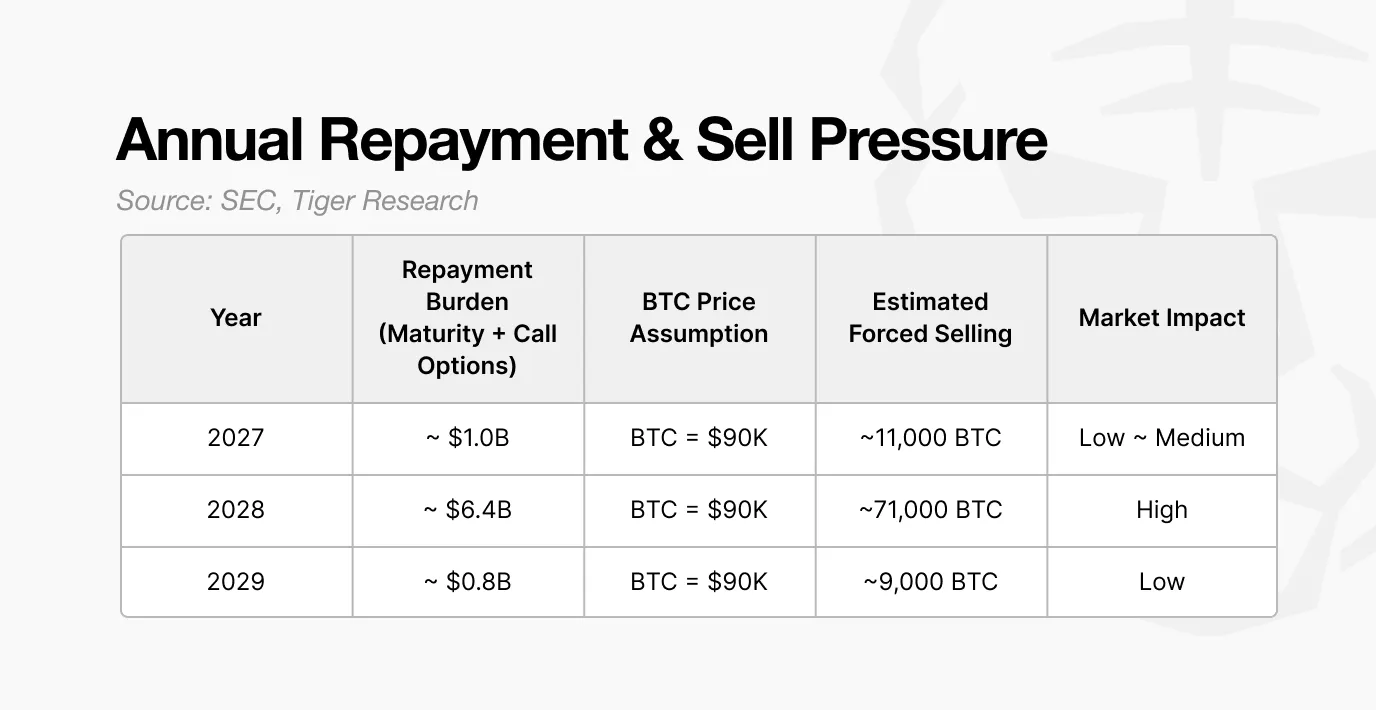
如果Strategy在2028年无法进行再融资,其对市场的影响可以通过偿还义务来估算。

2024-2025年发行的大量可转换债券将在2028年产生约64亿美元的潜在偿还额。如果市场状况恶化,优先股发行、ATM发行和新的可转换债券都无法进行,该公司将别无选择,只能出售比特币。

假设比特币价格为9万美元,Strategy需要出售约7.1万枚比特币才能履行这些义务。这与典型的机构出售规模不具可比性。

目前现货市场日均交易量为200亿至300亿美元。以9万美元的价格出售71,000枚比特币,相当于约64亿美元,约占日交易量的20%至30%。在短时间内进行如此大规模的抛售,几乎肯定会对市场造成价格压力。

更令人担忧的是,此类抛售并非一次性事件。随着比特币价格下跌,Strategy公司的资产价值会立即缩水,从而削弱其财务比率。这将进一步限制其筹集资金的能力,并可能迫使其抛售更多比特币。

结果形成了一个恶性循环:再融资失败导致被迫抛售,被迫抛售导致价格下跌,价格下跌降低资产价值,公司被迫进一步出售资产。这种动态持续几个季度就可能使资产负债表恶化到无法恢复的地步。

因此,Strategy的结构性风险集中在2028年。在此窗口期之外,杠杆模型似乎可控,但如果2028年未能进行再融资,可能会引发足以影响整个比特币市场的抛售压力。

因此,2028年不仅对Strategy的生存至关重要,而且对整个比特币生态系统的潜在波动也至关重要。

6. Strategy相对稳定,但后入者面临更高风险

市场叙事通常将DAT风险简化为一个简单的问题:一家公司能否在比特币每次下跌中幸存下来。然而,这项分析表明,决定公司能否生存的关键并非短期价格波动或股票波动性,而是公司的资产负债表及其资本结构设计。

因此,评估DAT公司不仅仅需要关注其股价或比特币价格的下跌。关键指标包括其静态破产阈值的位置、现金偿还压力的时间以及用于弥补融资缺口的工具。这些因素有助于我们了解其结构性韧性,而非短期波动。

并非所有风险都能预测。ETF资金流动、宏观经济状况和监管政策变化都可能随时重塑市场环境。即便如此,最可靠的基准仍然是财务数据所隐含的破产阈值以及公司的基本现金流机制。

Strategy公司在这方面独树一帜。该公司于2020年进入比特币市场,经受住了2022年的低迷期,并在2024年通过杠杆融资加速了积累。其可转换债券和优先股的组合构建了一个多层次的缓冲机制。

因此,Strategy拥有相对稳定的基础。而新进入者尚未建立成熟的DAT框架,其抵御价格大幅下跌的能力也远没有那么稳定。


说明: 比推所有文章只代表作者观点,不构成投资建议

Trending Cryptos

Related Reads

Top 8 DEXs of July 2026

This article presents the top 8 decentralized exchanges (DEXs) for July 2026, highlighting their key features and evolution within the DeFi space. DEXs, which enable peer-to-peer cryptocurrency trading via smart contracts without intermediaries, are praised for offering users greater control, privacy, transparency, and global access compared to centralized platforms. The listed DEXs are: 1. **Shadow Exchange**: A Sonic-native DEX specializing in concentrated liquidity for efficient trading and reduced slippage. 2. **Uniswap**: A leading protocol using an Automated Market Maker (AMM) model across multiple blockchains. 3. **SushiSwap**: An evolved platform offering token swaps, yield farming, and governance via its SUSHI token across 40+ networks. 4. **Orca**: A user-friendly AMM on Solana featuring capital-efficient "Whirlpools" for concentrated liquidity. 5. **Meteora**: A Solana-based DEX focusing on dynamic liquidity infrastructure and vaults for advanced strategies. 6. **Raydium**: A hybrid exchange on Solana combining AMM pools with a central limit order book for deep liquidity. 7. **Hyperliquid**: A Layer 1 blockchain hosting a non-custodial perpetual futures exchange using an on-chain order book. 8. **PancakeSwap**: A multi-chain AMM hub originating on BNB Chain, now supporting thousands of trading pairs across several networks. The article concludes by noting the significant role of DEXs in crypto, their expansion beyond simple swaps into areas like derivatives and cross-chain interoperability, and advises users to conduct their own research before engaging with any platform.

ambcrypto2m ago

Top 8 DEXs of July 2026

ambcrypto2m ago

USDT Market Cap Approaches Ethereum's: What Signal Does This Convey?

The market capitalization of USDT has nearly reached that of Ethereum, making it the second-largest cryptocurrency after Bitcoin. This prompts an examination of what this signifies and what it does not. Firstly, this does not relate to economic security. Unlike some Web3 systems where a governance token's value must underpin the security of its applications (e.g., oracles), USDT's stability is not backed by the value of the underlying blockchains it operates on. Tether, the issuer, controls the assets, and can freeze, reissue, or abandon tokens on a compromised chain. While stablecoins require functional blockchains, a chain's native token market cap does not provide direct security for the stablecoin. Secondly, USDT's growth does not inherently reflect poorly on Ethereum. USDT is a dollar-pegged store of value, while ETH represents a claim on future Ethereum network revenue. Their valuations are driven by different factors. USDT's rising market cap simply indicates strong demand for stablecoin utility, independent of Ethereum's technological merits or competitive position. The core insight is the overwhelming market demand for permissionless dollar transfers. This is the most established and essential use case in crypto. It requires minimal technological sophistication—essentially just a trusted issuer's promise of redemption on a functional chain. This explains why stablecoin supply has grown exponentially while the combined market cap of major non-stablecoin cryptocurrencies like Bitcoin, Ethereum, and others has stagnated for years. Users primarily seek accessible dollar-denominated assets. They largely disregard the issuer's credibility (as seen with Tether's dominance over more credible alternatives like USDC or BlackRock's BUIDL) and are indifferent to the governance or decentralization of the underlying blockchain. As long as a stablecoin is widely accepted and easy to transfer, users will adopt it across any chain. The trend suggests that the market for permissionless stablecoins could continue to expand far beyond the total value of the smart contract platforms that host them, driven by this singular, powerful use case.

Foresight News20m ago

USDT Market Cap Approaches Ethereum's: What Signal Does This Convey?

Foresight News20m ago

Crypto 美股观察:CRCL、HOOD、COIN 与 MSTR,最近在交易什么?

Recent weeks have seen significant developments for four key US-listed crypto-related stocks—Circle (CRCL), Robinhood (HOOD), Coinbase (COIN), and MicroStrategy (MSTR)—with their core investment theses diverging. For **Circle (CRCL)**, its stock price is increasingly realigning with the fundamental driver of **USDC circulation**. After IPO exuberance faded, CRCL's performance now correlates closely with changes in USDC supply, which is heavily influenced by DeFi activity and risk appetite. The recent contraction in USDC, linked to events like the KelpDAO incident, has pressured the stock. A sustainable recovery signal for CRCL would require a confluence of recovering DeFi TVL, stablecoin demand, and consecutive weeks of USDC net issuance. **Robinhood (HOOD)** gained market attention with the launch of its **Robinhood Chain**, an Ethereum L2. While not an immediate threat to Coinbase's dominant Base network in terms of scale or developer ecosystem, it represents a strategic encroachment. Robinhood's path—leveraging its traditional retail brokerage user base and assets to build a chain-based financial system—challenges Coinbase's narrative as the sole listed company integrating crypto-native infrastructure with traditional finance. This could dilute COIN's long-term scarcity premium. **MicroStrategy (MSTR)** made a notable shift by **selling Bitcoin** for the first time in a meaningful way (3,588 BTC), breaking its long-standing "buy-only" posture. The sales, used to fund dividends and replenish USD reserves, signal a move towards active capital management. While not indicative of a bearish turn on Bitcoin, it introduces new complexity for MSTR investors. The stock must now be evaluated not just as a leveraged Bitcoin proxy, but also considering fixed cash obligations from preferred dividends and debt, alongside its capital allocation strategy between holding BTC and maintaining liquidity. In summary, the investment narratives for these stocks are evolving beyond simple crypto market beta. Key variables now include stablecoin fundamentals, competition in chain-based financial ecosystems, and the balance between asset accumulation and corporate capital structure management.

marsbit32m ago

Crypto 美股观察:CRCL、HOOD、COIN 与 MSTR,最近在交易什么?

marsbit32m ago

Trading

Spot

Hot Articles

What is $BITCOIN

DIGITAL GOLD ($BITCOIN): A Comprehensive Analysis Introduction to DIGITAL GOLD ($BITCOIN) DIGITAL GOLD ($BITCOIN) is a blockchain-based project operating on the Solana network, which aims to combine the characteristics of traditional precious metals with the innovation of decentralized technologies. While it shares a name with Bitcoin, often referred to as “digital gold” due to its perception as a store of value, DIGITAL GOLD is a separate token designed to create a unique ecosystem within the Web3 landscape. Its goal is to position itself as a viable alternative digital asset, although specifics regarding its applications and functionalities are still developing. What is DIGITAL GOLD ($BITCOIN)? DIGITAL GOLD ($BITCOIN) is a cryptocurrency token explicitly designed for use on the Solana blockchain. In contrast to Bitcoin, which provides a widely recognized value storage role, this token appears to focus on broader applications and characteristics. Notable aspects include: Blockchain Infrastructure: The token is built on the Solana blockchain, known for its capacity to handle high-speed and low-cost transactions. Supply Dynamics: DIGITAL GOLD has a maximum supply capped at 100 quadrillion tokens (100P $BITCOIN), although details regarding its circulating supply are currently undisclosed. Utility: While precise functionalities are not explicitly outlined, there are indications that the token could be utilized for various applications, potentially involving decentralized applications (dApps) or asset tokenization strategies. Who is the Creator of DIGITAL GOLD ($BITCOIN)? At present, the identity of the creators and development team behind DIGITAL GOLD ($BITCOIN) remains unknown. This situation is typical among many innovative projects within the blockchain space, particularly those aligning with decentralized finance and meme coin phenomena. While such anonymity may foster a community-driven culture, it intensifies concerns about governance and accountability. Who are the Investors of DIGITAL GOLD ($BITCOIN)? The available information indicates that DIGITAL GOLD ($BITCOIN) does not have any known institutional backers or prominent venture capital investments. The project seems to operate on a peer-to-peer model focused on community support and adoption rather than traditional funding routes. Its activity and liquidity are primarily situated on decentralized exchanges (DEXs), such as PumpSwap, rather than established centralized trading platforms, further highlighting its grassroots approach. How DIGITAL GOLD ($BITCOIN) Works The operational mechanics of DIGITAL GOLD ($BITCOIN) can be elaborated on based on its blockchain design and network attributes: Consensus Mechanism: By leveraging Solana’s unique proof-of-history (PoH) combined with a proof-of-stake (PoS) model, the project ensures efficient transaction validation contributing to the network's high performance. Tokenomics: While specific deflationary mechanisms have not been extensively detailed, the vast maximum token supply implies that it may cater to microtransactions or niche use cases that are still to be defined. Interoperability: There exists the potential for integration with Solana’s broader ecosystem, including various decentralized finance (DeFi) platforms. However, the details regarding specific integrations remain unspecified. Timeline of Key Events Here is a timeline that highlights significant milestones concerning DIGITAL GOLD ($BITCOIN): 2023: The initial deployment of the token occurs on the Solana blockchain, marked by its contract address. 2024: DIGITAL GOLD gains visibility as it becomes available for trading on decentralized exchanges like PumpSwap, allowing users to trade it against SOL. 2025: The project witnesses sporadic trading activity and potential interest in community-led engagements, although no noteworthy partnerships or technical advancements have been documented as of yet. Critical Analysis Strengths Scalability: The underlying Solana infrastructure supports high transaction volumes, which could enhance the utility of $BITCOIN in various transaction scenarios. Accessibility: The potential low trading price per token could attract retail investors, facilitating wider participation due to fractional ownership opportunities. Risks Lack of Transparency: The absence of publicly known backers, developers, or an audit process may yield skepticism regarding the project's sustainability and trustworthiness. Market Volatility: The trading activity is heavily reliant on speculative behavior, which can result in significant price volatility and uncertainty for investors. Conclusion DIGITAL GOLD ($BITCOIN) emerges as an intriguing yet ambiguous project within the rapidly evolving Solana ecosystem. While it attempts to leverage the “digital gold” narrative, its departure from Bitcoin's established role as a store of value underscores the need for a clearer differentiation of its intended utility and governance structure. Future acceptance and adoption will likely depend on addressing the current opacity and defining its operational and economic strategies more explicitly. Note: This report encompasses synthesised information available as of October 2023, and developments may have transpired beyond the research period.

702 Total ViewsPublished 2025.05.13Updated 2025.05.13

What is $BITCOIN

Discussions

Welcome to the HTX Community. Here, you can stay informed about the latest platform developments and gain access to professional market insights. Users' opinions on the price of BTC (BTC) are presented below.

活动图片