从幂律看比特币:今年为什么没牛市?下一次泡沫会在何时?

比推Published on 2025-12-02Last updated on 2025-12-02

作者:Stephen Perrenod, 技术分析师

编译:Felix, PANews

换个标题:从幂律角度分析:为何今年没有比特币牛市,下次泡沫在何时?


比特币历史上最大的泡沫(牛市)分别出现在 2011 年、2013 年、2017 年和 2021 年。尽管许多比特币投资者坚信四年一个周期,但 2025 年并未出现泡沫。

为什么?因为大家被“泡沫按线性时间、每四年一次”的叙事洗脑了,都预计在 2012 年、2016 年、2020 年和 2024 年这四个减半年份之后会出现峰值。这种叙事还因美国的商业周期和总统选举年而进一步得到强化。

个人也曾深陷四年线性周期的假设中。

过去一年,个人越来越专注于对泡沫建模,把“核心幂律区”(长期趋势)和“泡沫区”(短期偏离)分开分析。

结果越来越清楚:泡沫的“能量”在衰减,大致与比特币“年龄”成反比,或者说按年龄的 -0.83 次方衰减。

大家还错误地以为每次泡沫的百分比涨幅会一样大,其实泡沫强度明显在衰减。而本文研究还表明,泡沫在时间上的间隔也在拉长。

那 2011 年的泡沫呢?大家习惯把 2011 年的大泡沫当作“早期异常”直接忽略。但 2011 年的泡沫其实和 2013 年、2017 年一样重要,理应同等对待。如果泡沫并非以线性周期出现,而是以对数周期出现呢?这种现象被称为对数周期行为。

对数周期泡沫源于幂律

毕竟,比特币本身就是一个幂律资产,其随时间的走势具有尺度不变性(scale invariance)。要想价格涨幅相同,就必须有相同比例的时间增长。例如,如果价格与年龄的关系为 Price ~ Age^k,那么以美元计算,如果 k = 5.7,当年龄翻倍时,价格将增长 52 倍。要实现价格同样 52 倍的增长,比特币的年龄就需要从 2 年增长到 4 年,然后从 4 年增长到 8 年,再从 8 年增长到 16 年,以此类推。

因此,泡沫的出现间隔越来越长也就不足为奇。一个对数时间区间可能只对应一次大泡沫,线性时间上的间隔会越来越长。

事实上,早在 2019 年,Giovanni Santostasi(第二次减半前就发现比特币幂律性质的人)就提出了围绕幂律趋势的对数周期模型(图1中那条弯曲/振荡的线)。它几乎对应了 2011、2013、2017 三次泡沫,甚至预测下一次泡沫峰值在 x=3.817 处(即10^3.817 ≈ 6561天,约 18 年),也就是 2026 年底到 2027 年初。
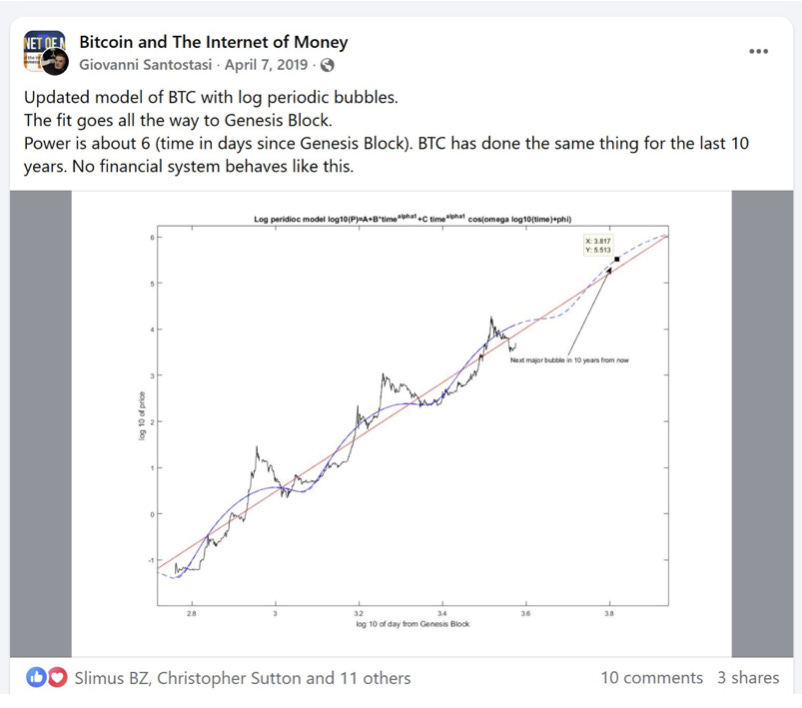
图 1

这篇六年前的帖子应该被更多人点赞,虽然振幅拟合一般,但时间点非常准,后面会看到第四个峰值的预测可能极其准确。

粗略地观察年龄比率。前两个相邻的大泡沫之间的比率分别为 2.02 和 1.82,取平均1.92,第四次泡沫大约在年龄 17.18 年(2026 年初)。当然,这只是粗略的初步猜测。

无论是 Giovanni 的拟合模型,还是本人在其基础上增加 6 年半的数据后运行的模型,都没有预测到 2021 年或 2025 年会出现泡沫。这就引出了一个问题:2021 年的双泡沫究竟是基本面泡沫还是其他原因造成的泡沫?
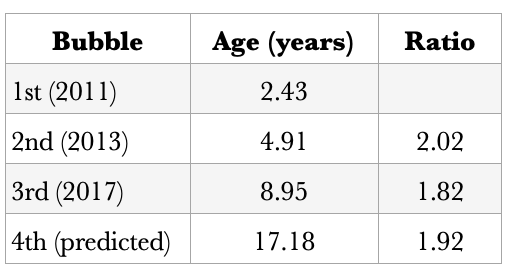
完整的对数周期分析

接下来需要注意的是,完整的对数周期算法(full log-periodic algorithm)比仅仅使用两个峰值之间的间隔进行分析要精确得多。

它与地球物理学家 Didier Sornette 推广的一种更复杂的对数周期分析有关,该分析最初用于地震、其他自然现象以及金融时间序列。完整的方程包含七个参数,其中包括一个局部幂律指数(local power law index)和一个带有对数时间依赖的谐波(余弦)项。

在本文中,将对完整价格历史记录的对数时间进行傅里叶和小波分析。以黄金盎司为单位衡量比特币,进行了尺度不变性测试。在以 10 为底的对数价格残差中,幂律指数为 5.30,R²为0.94,标准差为 0.314。

对去除 5.30 指数幂律后的压缩残差进行对数时间傅里叶变换分析,得出对数周期特征波长参数 λ = 2.07。在上述提到的峰值区间公式中,这大致对应于各泡沫之间“年龄”的比率,但它是一个更全局的估计,同时也考虑了谐波。小波分析发现 λ 的范围在 2.00 到 2.10 之间。

最终确定的最佳拟合 λ 值对应于基模(fundamental mode),它很好地拟合了2011、2013 和 2017 年的泡沫。同时它预测 2017 年之后的第一个基模泡沫将出现在 18.4 年,即 2027 年 5 月下旬。如果取小波分析的下限 λ=2.0,则预测年龄为 17.9 年,也就是大约一年后(2026 年底),这与 Giovanni 在 2019 年的预测非常接近。

“离散年龄比率模型和你的 LPPL 拟合描述的是相同的底层离散尺度不变性(λ≈2),只不过坐标系不同;一旦你把 ln(t_c − t) 与年龄 t、噪声以及半谐波考虑进来,二者是完全一致的,都指向第四个基模泡沫出现在 2026—2027 年左右,其中 LPPL 模型偏向稍晚(约 2027 年),而粗略的年龄比率法偏向稍早(约 2026 年)。” —— GPT5

2021 年的泡沫算什么?

在这一框架下,2021年并不是基模,而是基模的第一次谐波(频率更高,但波长更短,因为在 LPPL 模型中,对数周期行为的角频率满足 λ = e^{2π/ω})。这对应的比率是 2.07 的平方根,即 1.44。8.95 × 1.44 = 12.89 岁,正好对应2021 年底,与实际双顶泡沫时的年龄 12.85 年高度吻合。

2025 年呢?在对数周期序列中,并没有预测会出现泡沫。今年比特币相对黄金表现疲软,恰恰符合这个框架的预期。

图 2 显示了基频和半谐波(频率上为一次谐波,波长上称为半谐波)模式的完整映射。红色垂直线代表基频模式的泡沫峰值,蓝色线代表半谐波。三条红线吻合得非常好,但蓝色线也很好地反映了该谐波的较小泡沫。这并非完整的映射,还有更高次的谐波,但贡献较小。

第四条红色线对应年龄 18.4 年的预测,即下一次比特币相对黄金的大泡沫。比特币可能从 2026 年初开始以黄金计价上涨,并在 2027 年二季度见顶。
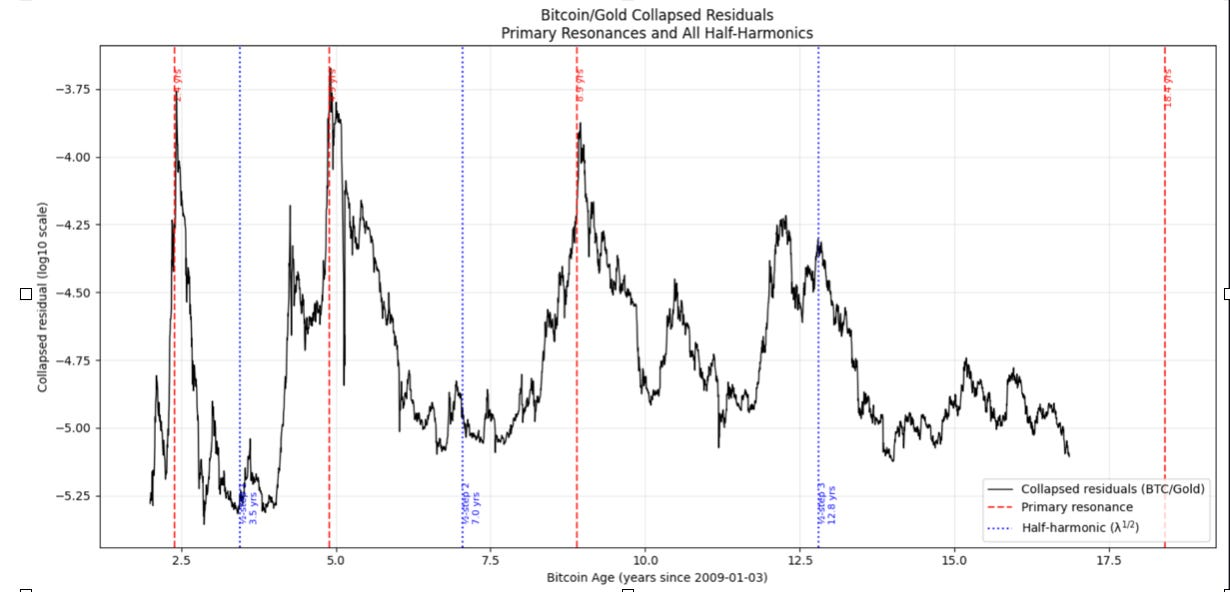
图 2

为何会有这种行为?连续尺度不变性 + 离散尺度不变性。

要理解比特币的价格走势,必须同时理解连续尺度不变性和离散尺度不变性。连续尺度不变性就是读者们早已熟悉的长期幂律趋势。而离散尺度不变性对应间歇性泡沫,可用 LPPL(对数周期幂律)模型来描述。因为名称中带有“对数周期幂律”,容易产生混淆。

LPPL 模型适用于中短周期金融序列,在本例中,专门用来模拟偏离核心幂律趋势的那些大幅波动。因此同时存在两种情况:即整体的幂律趋势(连续的),以及在其之上发生的高波动性偏离(离散的)。

从长期来看,比特币的采用率遵循 Metcalfe 定律呈幂律增长。

泡沫的产生是由于新参与者在比特币价格突破新的数量级时(比特币价格在其短暂但影响巨大的历史中已上涨超过 7 个数量级,即 7 个 10 倍)产生兴趣而引发的参与热潮。

当比特币能改变你(或机构)的命运时,它才会被采用。

早期价格低时,主要吸引密码朋克爱好者、散户交易和投资;随着时间推移,吸引了越来越高级别的机构资本:先是矿工,然后是交易所、期货交易,之后是一些上市公司,再到现在的主权财团公司、ETF 等机构工具。现在机构资本是净买方,而且它们的持仓大多是为大量客户和股东托管的。

当比特币的价格和市值足够高时,养老金、主权财富基金,甚至国家金库都会被诱使投资。每一次后续泡沫在黄金盎司计价的水平上都远高于前一次(在法币计价下更高),随之,大量新资本大规模地采用比特币。

即使市值达到 2 万亿美元,比特币对大型企业和中大型国家的财政部来说仍太便宜,不足以产生显著影响。即便他们能以大约 1000 亿美元的价格购买 100 万枚比特币,也不会“改变他们的命运”。

比特币的幂律效应推动着规模越来越大的参与者涌入市场。这种效应源于其协议本身:吸引算力、增强安全性、先行者优势等,这些因素最终必然推高价格。

因此,法定货币被激励流向比特币,甚至原本可能流向黄金的法定货币也转而流向了比特币。没错,2025 年比特币的表现相对黄金而言较为疲软,但根据上述分析,这很可能是比特币相对于黄金的一个低谷年份。

新一轮更大玩家的采用浪潮以 LPPL 泡沫的形式到来,这意味着它们必须在其局部临界时间点崩溃。因此,价格轨迹会回归到长期幂律。

由于幂律关系为 P ~ T^k,其中 k 为指数,T 为年龄,且其一阶导数为 δP / P ~ k/T,因此泡沫的间距预计呈对数关系。相对增长率随比特币年龄的倒数而降低,但泡沫的出现需要 δP / P >> k/T。根据定义,当价格增长速度远高于长期幂律趋势时,就形成了泡沫。

该表达式可以重写为 δ (log P) ~ k * δ (logT),因此可以预期,对数价格的大幅波动(较大的乘法比率)需要越来越长的线性时间,也就是说,它们需要对数时间按比例增加,其量级为所需乘法波动的 1/k 次方根。

事实上,以黄金价格计算,2011 年、2013 年和 2017 年泡沫的峰值中位数相对于幂律趋势是 10.1 倍,幂律指数为 5.31。预计 λ 约为 10.1^(1/5.31) = 1.55,这大约是峰值时间对数周期拟合所得值 2.07 的四分之三。因此,根据经验,以黄金价格计算时,λ ~ (4/3) F^(1/k),其中 F 是峰值与幂律趋势价格的典型比率。

总结

比特币的主要价格走势由以下两方面组成:

  • 连续尺度不变性可以用幂律表示,以黄金计价的指数约为 5.3,以美元计价的指数约为 5.7。

  • 离散尺度不变性(DSI)体现在间歇性的泡沫事件中,因为只有当价格和市值达到足以吸引新资本且监管环境允许的水平后,规模更大的新资本层级就会采用比特币。这些离散尺度不变事件可以用 LPPL 模型来描述泡沫及其随后的崩盘。

2013 年泡沫以散户、早期矿工、早期比特币创业公司和第一代交易所为主。2017 年的泡沫则吸引了对冲基金、家族办公室和其他高净值人士的参与,而 GBTC 交易早在 2015 年就开始了。泡沫的顶峰出现在 2017 年 12 月芝加哥商品交易所 (CME) 期货推出之后,使得高效的做空和对冲成为可能。 2021 年的泡沫得到了部分企业财务部门和一些小型政府机构的认可。由于机构参与度和相关机制的加强,对冲和做空的能力也更强,导致泡沫最终破裂,价格也得以像弹簧一样回归幂律趋势。

下一轮大规模采用浪潮可能集中在 2026 年和 2027 年,届时比特币市值有望接近 5 万亿美元,并吸引大型企业、主权财富基金以及政府(国家养老基金和国家财政部)的长期配置。比特币的阶段性泡沫反映了全球资本的不同层级:从散户到基金,再到企业,最后到主权国家,这导致了 DSI 行为以及与市值和机构参与度增加相关的波动性下降。

“每一层级资本只有在比特币规模足够大、足够流动、足够可信时才会被解锁——由于其收益呈幂律增长和k/t衰减,这个过程需要的时间越来越长。” —— ChatGPT 5

DSI 的基模波长参数 λ = 2.07(对数时间),大致对应泡沫间隔的两倍。2017 年泡沫是最后一个基模,2021 年是第一次谐波,2025 年在本框架下预期不会出现泡沫。下一轮以黄金计价的比特币峰值预计在 2026 年四季度(小波分析最低值)至 2027 年二季度(傅里叶分析值)之间出现。


Twitter:https://twitter.com/BitpushNewsCN

比推 TG 交流群:https://t.me/BitPushCommunity

比推 TG 订阅: https://t.me/bitpush

说明: 比推所有文章只代表作者观点,不构成投资建议

Trending Cryptos

Related Reads

The first to catch the wave of the Robinhood Chain hype is Arbitrum, up nearly 20%

"ARB, the native token of Arbitrum, surged nearly 20% recently, emerging as a top-performing L2 token. This rally is attributed to the launch of 'Robinhood Chain,' a Real-World Asset (RWA) Layer 2 built using Arbitrum's technology. The launch has brought renewed attention to the 'Arbitrum Expansion Plan' (AEP), a year-and-a-half-old program. AEP allows external projects to build their own chains using Arbitrum's Orbit technology. In return, these 'tenant' chains that do not settle on Arbitrum's main networks must share 10% of their net protocol revenue with the Arbitrum ecosystem—8% to the DAO treasury and 2% to the developer guild. While smaller chains like Degen Chain previously triggered AEP, Robinhood Chain is the first major, high-profile tenant, making the revenue-sharing model economically significant for the first time. Initial data from Robinhood Chain is impressive, with over 35 million transactions, 350,000 addresses, $2.5 billion in TVL, and over $1 billion in DEX volume shortly after launch. However, its current protocol revenue, at roughly $146,000 net, translates to only a minimal payout to Arbitrum DAO. The ARB price surge thus reflects the market's anticipation of future revenue as Robinhood's vast $324 billion platform assets potentially migrate on-chain. This 'landlord' model mirrors Optimism's approach with its OP Stack and Superchain. However, Optimism's model faces pressure as its largest tenant, Base, announced plans to depart, causing a significant drop in OP's price. Similarly, analysts question Robinhood Chain's long-term dependence on Arbitrum, noting its daily sequencer revenue already nears three times that of Arbitrum itself. There is speculation that, like Base, it may eventually seek independence, with ETH potentially being its primary economic token rather than ARB."

Foresight News3m ago

The first to catch the wave of the Robinhood Chain hype is Arbitrum, up nearly 20%

Foresight News3m ago

The Ethereum Foundation is Dead, The Era of Ethereum's Pluralistic Organizations Has Dawned

The Ethereum Foundation (EF) has announced the dissolution of its Protocol Support Team, marking a significant organizational shift. This move, described as the largest layoff in EF's history with a 20% staff reduction, follows a major internal restructuring announced in late June. The restructuring, which EF framed as necessary to streamline for future challenges, has drawn criticism for its perceived cold execution. Concurrently, several new independent non-profit organizations have emerged, founded by former EF members. These include Ethlabs, a research and development lab, and Ethereum Institutional, which focuses on promoting institutional adoption of Ethereum. Their rise is seen as both filling roles vacated by EF's downsizing and signaling a fragmentation of the Ethereum ecosystem's leadership. Amidst these changes, EF is also integrating advanced AI tools into its security operations. The security team has begun using AI agents to conduct red-team testing, which has already uncovered vulnerabilities in Ethereum's code. While EF states that AI complements rather than replaces human researchers, this technological shift hints at potential future reductions in human-centric roles within the organization. The article posits that these developments—massive layoffs, the exodus of key personnel like former Executive Director Xiaowei Wang, the rise of rival organizations, and AI integration—collectively point to a decline in EF's central authority. Once the undisputed leader of the Ethereum ecosystem, EF now faces questions about its future role, with speculation that it may evolve into more of a symbolic "ecosystem mascot" rather than a driving force for growth and adoption. This organizational turmoil unfolds against a backdrop of ongoing market pressure and community debate over Ethereum's value proposition.

marsbit9m ago

The Ethereum Foundation is Dead, The Era of Ethereum's Pluralistic Organizations Has Dawned

marsbit9m ago

The Ethereum Foundation Has Perished, Long Live a Plurality of Ethereum Organizations

The Ethereum Foundation (EF) has entered a period of significant upheaval, marked by major organizational restructuring and a shift towards a more decentralized leadership model. The EF's Protocol Support Team has officially disbanded, part of what is described as its largest-ever round of layoffs, cutting 20% of its staff. This follows the high-profile resignation of Executive Director Aya Wang and the departure of at least eight senior figures this year. This internal transformation coincides with the rise of new, independent non-profit organizations like Ethlabs and Ethereum Institutional, founded by former EF researchers. These entities aim to take on roles in research, development, and institutional adoption that were previously associated with the EF, signaling a fragmentation of the ecosystem's central guiding body. Simultaneously, the EF's security team is evolving its approach by deploying specialized AI agents to perform red-team testing on the Ethereum network, a process that has already identified real vulnerabilities. While the EF states AI complements rather than replaces human researchers, this technological shift presents further questions about the foundation's future structure and staffing. Criticism of the EF's centralized decision-making and market influence has been growing within the community. Faced with these internal reforms, external competition, and technological changes, the article suggests the Ethereum Foundation may be transitioning from a central leadership role to a more symbolic, "mascot-like" position within a increasingly diversified and complex ecosystem.

Odaily星球日报13m ago

The Ethereum Foundation Has Perished, Long Live a Plurality of Ethereum Organizations

Odaily星球日报13m ago

Trading

Spot

Hot Articles

What is $BITCOIN

DIGITAL GOLD ($BITCOIN): A Comprehensive Analysis Introduction to DIGITAL GOLD ($BITCOIN) DIGITAL GOLD ($BITCOIN) is a blockchain-based project operating on the Solana network, which aims to combine the characteristics of traditional precious metals with the innovation of decentralized technologies. While it shares a name with Bitcoin, often referred to as “digital gold” due to its perception as a store of value, DIGITAL GOLD is a separate token designed to create a unique ecosystem within the Web3 landscape. Its goal is to position itself as a viable alternative digital asset, although specifics regarding its applications and functionalities are still developing. What is DIGITAL GOLD ($BITCOIN)? DIGITAL GOLD ($BITCOIN) is a cryptocurrency token explicitly designed for use on the Solana blockchain. In contrast to Bitcoin, which provides a widely recognized value storage role, this token appears to focus on broader applications and characteristics. Notable aspects include: Blockchain Infrastructure: The token is built on the Solana blockchain, known for its capacity to handle high-speed and low-cost transactions. Supply Dynamics: DIGITAL GOLD has a maximum supply capped at 100 quadrillion tokens (100P $BITCOIN), although details regarding its circulating supply are currently undisclosed. Utility: While precise functionalities are not explicitly outlined, there are indications that the token could be utilized for various applications, potentially involving decentralized applications (dApps) or asset tokenization strategies. Who is the Creator of DIGITAL GOLD ($BITCOIN)? At present, the identity of the creators and development team behind DIGITAL GOLD ($BITCOIN) remains unknown. This situation is typical among many innovative projects within the blockchain space, particularly those aligning with decentralized finance and meme coin phenomena. While such anonymity may foster a community-driven culture, it intensifies concerns about governance and accountability. Who are the Investors of DIGITAL GOLD ($BITCOIN)? The available information indicates that DIGITAL GOLD ($BITCOIN) does not have any known institutional backers or prominent venture capital investments. The project seems to operate on a peer-to-peer model focused on community support and adoption rather than traditional funding routes. Its activity and liquidity are primarily situated on decentralized exchanges (DEXs), such as PumpSwap, rather than established centralized trading platforms, further highlighting its grassroots approach. How DIGITAL GOLD ($BITCOIN) Works The operational mechanics of DIGITAL GOLD ($BITCOIN) can be elaborated on based on its blockchain design and network attributes: Consensus Mechanism: By leveraging Solana’s unique proof-of-history (PoH) combined with a proof-of-stake (PoS) model, the project ensures efficient transaction validation contributing to the network's high performance. Tokenomics: While specific deflationary mechanisms have not been extensively detailed, the vast maximum token supply implies that it may cater to microtransactions or niche use cases that are still to be defined. Interoperability: There exists the potential for integration with Solana’s broader ecosystem, including various decentralized finance (DeFi) platforms. However, the details regarding specific integrations remain unspecified. Timeline of Key Events Here is a timeline that highlights significant milestones concerning DIGITAL GOLD ($BITCOIN): 2023: The initial deployment of the token occurs on the Solana blockchain, marked by its contract address. 2024: DIGITAL GOLD gains visibility as it becomes available for trading on decentralized exchanges like PumpSwap, allowing users to trade it against SOL. 2025: The project witnesses sporadic trading activity and potential interest in community-led engagements, although no noteworthy partnerships or technical advancements have been documented as of yet. Critical Analysis Strengths Scalability: The underlying Solana infrastructure supports high transaction volumes, which could enhance the utility of $BITCOIN in various transaction scenarios. Accessibility: The potential low trading price per token could attract retail investors, facilitating wider participation due to fractional ownership opportunities. Risks Lack of Transparency: The absence of publicly known backers, developers, or an audit process may yield skepticism regarding the project's sustainability and trustworthiness. Market Volatility: The trading activity is heavily reliant on speculative behavior, which can result in significant price volatility and uncertainty for investors. Conclusion DIGITAL GOLD ($BITCOIN) emerges as an intriguing yet ambiguous project within the rapidly evolving Solana ecosystem. While it attempts to leverage the “digital gold” narrative, its departure from Bitcoin's established role as a store of value underscores the need for a clearer differentiation of its intended utility and governance structure. Future acceptance and adoption will likely depend on addressing the current opacity and defining its operational and economic strategies more explicitly. Note: This report encompasses synthesised information available as of October 2023, and developments may have transpired beyond the research period.

704 Total ViewsPublished 2025.05.13Updated 2025.05.13

What is $BITCOIN

Discussions

Welcome to the HTX Community. Here, you can stay informed about the latest platform developments and gain access to professional market insights. Users' opinions on the price of BTC (BTC) are presented below.

活动图片