当市场陷入极度恐惧,谁在逆势抄底?

深潮TechFlowPublished on 2025-11-30Last updated on 2025-12-01

Abstract

对于积极型交易者:在目前震荡市中,可考虑在支撑位附近轻仓做多,在阻力位附近减仓或考虑做空。所有交易务必设置止损。

作者:Hotcoin Research


加密市场表现

当前,加密货币总市值为 3.09 万亿美元,BTC占比 58.5%,为 1.8 万亿美元。稳定币市值为 3061 亿美元,最近7日增加 1.08%,稳定币数量在本周逆转,开始出现正增长,主要增长的公司为 Circle,其中USDT占比60.31%。


CoinMarketCap前200的项目中,大部分下跌小部分上涨,其中:BTC7日跌幅 0.78%,SOL7日跌幅 2.23%,SAHARA 7 日跌幅 12.05%,AIOZ7日跌幅 8.09%,PI7日跌幅 7.85%。加密世界经历下跌后,开启复苏,但局势仍未得到大面积好转。


本周,美国比特币现货ETF净流入:7050万美元;美国以太坊现货ETF净流入:3.12亿美元。


市场预测(12月1日-12月7日):


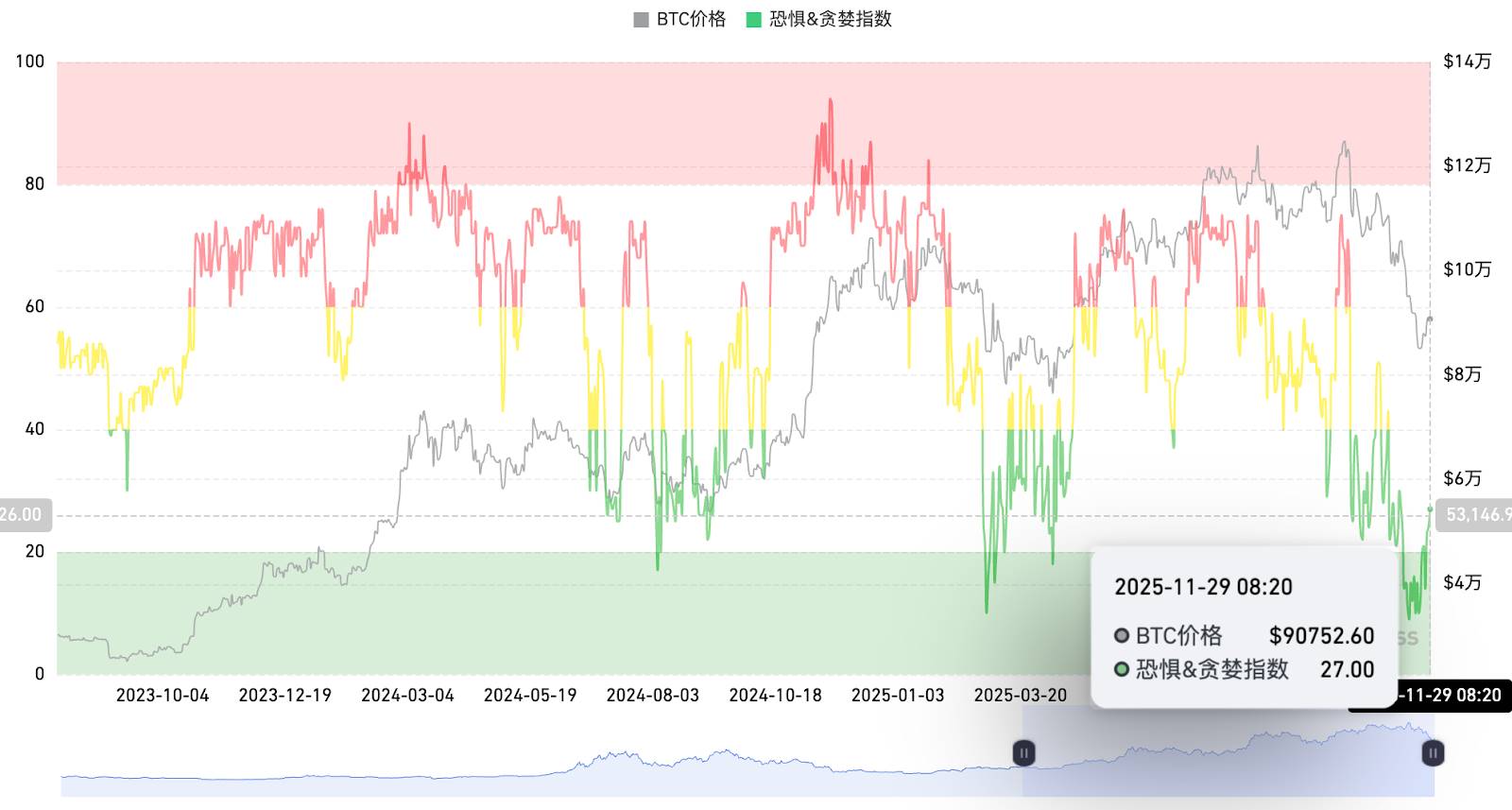
目前RSI指数为48.71(中性区间),恐惧贪婪指数为27(指数高于上周,一般恐惧区间),山寨季指数为37(中性,高于上周)。


BTC核心区间:$85,000-95,000
ETH核心区间:$2,800-3,300
SOL核心区间:$126-156


市场情绪:市场已摆脱“极度恐慌”阶段,开始慢慢复苏,但因四年周期论和巨鲸抛售,价格并未实现V型反转。Bitmine 在继续囤积ETH,本周美国现货ETF都呈现净流入,“木头姐”在抄底Coinbase、Circle 等加密概念股票。目前聚焦点在美联储12月10日的议息会议上。市场对降息的预期很高,如果实现降息,通常意味着流动性改善,可能提振包括加密货币在内的风险资产。反之,若预期落空,可能引发市场波动。现美联储利率观测,12月降息的概率为82.8%。以太坊预计在12月4日进行Fusaka升级,韩国交易所Upbit 被盗事件后,SOL 价格承压,但近期的美国现货ETF净流入也对价格起到了一定的支撑作用。


对于稳健型投资者:市场处于"极度恐惧"区间时,往往是中长期布局的时机。你可以考虑在关键支撑位附近分批、小额买入,以降低平均成本,不必急于一次重仓。


对于积极型交易者:在目前震荡市中,可考虑在支撑位附近轻仓做多,在阻力位附近减仓或考虑做空。所有交易务必设置止损。


了解现在


回顾一周大事件


1. 11 月 24 日,中信证券研报称,纽约联储主席威廉姆斯暗示 12 月进一步降息,市场降息预期扭转,目前市场认为美联储 12 月有七成概率降息。美联储将于 11 月 29 日开始进入静默期,静默期前鲍威尔没有公开发言或接受媒体采访的日程安排,其「亲密盟友」威廉姆斯的发言可能便是最后一次影响市场预期的美联储官员发言;


2. 11 月 24 日,据行情数据显示,美股盘初拉升,纳指涨超 1.5%,标普 500 指数涨幅扩大至 1%,加密货币股普涨;


3. 11 月 25 日,美国白宫正试图通过应用人工智能来加速提升美国的科研实力。美国总统特朗普周一签署行政令启动「创世使命(Genesis Mission)」计划,要求能源部及其他科研机构积极推进人工智能部署。白宫科技政策办公室主任迈克尔·克拉茨奥斯将其称为「自阿波罗计划以来对联邦科研资源的最大规模整合」;


4. 11 月 25 日,美国大型银行摩根大通关闭比特币支付公司 Strike CEO Jack Mallers 的个人账户,引发美国加密行业对「去银行化」(debanking)浪潮的再度担忧;
5. 11 月 26 日,据 The Block 报道,Cathie Wood 旗下的 Ark Invest 在加密货币价格下跌和整体加密货币市场低迷的情况下,本周二继续增持Block、Circle与Coinbase等加密概念股票。


6. 11 月 27 日,昨夜今晨,加密市场主流币种反弹明显。据 HTX 行情信息,比特币时隔一周重回 9 万美元,现报价 90,355 美元,24 小时涨幅达 3.83%;


7. 11 月 27 日,Tether CEO Paolo Ardoino 回应标普(S&P)对 Tether 的最新评级时表示,「我们以被你们厌恶为荣」。Paolo Ardoino 指出,传统评级体系长期将投资者引向最终倒塌的「投资级」机构,已让全球监管对评级机构的独立性产生质疑。他称,传统金融体系不愿看到任何企业脱离其「失灵的重力」,但 Tether 已打造行业首个超额资本化、无有毒资产、且持续高盈利的公司,证明旧体系的脆弱正令「皇帝的新衣式」的掌权者感到不安;


8. 11 月 27 日,据 DL News 报道,韩国金融监管机构已敦促 Bithumb 暂停其 Tether 市场服务,该服务允许客户使用 USDT 买卖比特币及九种市值较高的山寨币,但这 10 种资产均可在韩元(KRW)市场继续交易;


9. 11 月 27 日,韩国最大加密交易平台 Upbit 披露,于 11 月 27 日凌晨 4:42 检测到异常提取行为,约 540 亿韩元(约 3600 万美元)的 Solana 网络相关数字资产被转移至未知外部钱包地址。Upbit 将承担所有客户损失;


10. 11 月 28 日,据官方消息,YZi Labs Management Ltd. 表示,作为 CEA Industries Inc.(纳斯达克代码:BNC)的重要股东,已向美国证券交易委员会(SEC)提交初步同意声明,寻求股东以书面同意的方式扩大公司董事会规模,以增补具有经验且高度资质的董事。


宏观经济


1. 11 月 26 日,美国至 11 月 22 日当周初请失业金人数 21.6 万人,预期 22.5 万人;
2. 11月28日,据美联储利率观测器,12月降息25个基点的概率为82.8%。
ETF
据统计,在11月24日-11月28日期间,美国比特币现货ETF净流入:7050万美元;截止到11月28日,GBTC(灰度)共计流出:249.71亿美元,目前持有152.1亿美元,IBIT(贝莱德)目前持有706.11 亿美元。美国比特币现货ETF总市值为:1196.82亿美元。
美国以太坊现货ETF净流入:3.12亿美元。


预见未来


活动预告


1. Bitcoin MENA 将于 12 月 8 日至 9 日在阿布扎比国家展览中心 (ADNEC) 举行;
2. Solana Breakpoint 2025 将于 12 月 11 日至 13 日在阿布扎比举行。
项目进展
1. Aster Stage 3 空投检查器开放时间为 2025 年 12 月 1 日,空投领取开始时间为 12 月 15 日;
2. FTX 第四轮赔偿预计将于 2026 年 1 月启动,资格确认截止日期或为 12 月;
3. 西班牙经济和数字化转型部宣布将于 2025 年 12 月在国家层面实施欧盟加密资产市场法(MiCA)。欧盟所有 27 个成员国实施 MiCA 的截止日期是 2026 年 7 月;
4. 美股上市公司 Sonnet BioTherapeutics 将合并投票推迟至 12 月 2 日,其计划将与 Rorschach I LLC 合并为 Hyperliquid Strategies,并推进HYPE储备战略;
5. Aztec 的 AZTEC 代币销售计划于 2025 年 12 月 2 日至 6 日举行,由Uniswap新推出的连续清算拍卖协议 CCA 支持。CCA 是一个可定制协议,用于在 Uniswap v4 上启动流动性和发行代币。该协议与 Aztec 合作设计,他们提供了一个 ZK Passport 模块,以实现私密且可验证的参与。此次销售起始价格设定为 3.5 亿美元完全稀释估值 (FDV),比基于最新股权融资的隐含网络估值低约 75%。


重要事件


1. 12月3日,美国将公布11月ADP就业人数(万人);
2. 12月4日,美国将公布至11月29日当周初请失业金人数(万人);
3. 12月5日,美国将公布9月核心PCE物价指数年率。
代币解锁
1. Audiera(BEAT)**将于12月1日解锁2125万枚代币,价值约2026万美元,占流通量的2.12%;
2. Lagrange(LA)**将于12月4日解锁1270万枚代币,价值约500万美元,占流通量的1.27%;
3. MYX Finance(MYX)**12月6日解锁3037万枚代币,价值约7750万美元,占流通量的3.04%;
4. Jito(JTO)**将于12月7日解锁1131万枚代币,价值约547万美元,占流通量的1.13%。


Trending Cryptos

Related Reads

Goldman Sachs In-Depth Report: Who Will Be the Long-Term Winners in China's AI Large Model Industry?

Goldman Sachs Report: China's AI Models at an Inflection Point China's open-source/open-weight large language models (LLMs) have reached performance parity with top global proprietary models, according to a Goldman Sachs report. This is driven by architectural innovations and higher parameter efficiency, allowing Chinese models to achieve comparable capabilities at 2%-10% the parameter size and significantly lower cost. The market is evolving into a two-tiered structure: a high-end segment (e.g., GLM5.2, Qwen3.7 Max) with premium pricing and a low-end, price-sensitive segment for global SMEs and individual users. Key points: * **Cost & Performance:** Innovations like Mixture of Experts (MoE) enable high performance with smaller models. Projects like Meituan's LongCat 2.0, trained on domestic hardware, highlight progress in tech self-sufficiency. * **Open-Source Strategy:** Most Chinese players use open-source/open-weight models for flexibility and ecosystem growth. However, Goldman notes this may underreport actual deployment and revenue. A shift toward "open-weight + community license" models with revenue sharing (e.g., MiniMax) could improve monetization. * **Market Shift & Global Expansion:** Enterprise AI adoption is shifting from "token maximization" to "ROI-first." International expansion, especially in non-US markets, is a major growth driver. Chinese models are increasingly available on global platforms like AWS Bedrock and Microsoft Copilot. * **Competitive Landscape:** Using a framework based on pricing power, cost advantage, and financial strength, Goldman identifies **Zhipu AI and DeepSeek** as the strongest in foundational text models, and **ByteDance** as the leader in multimodal/video generation. The report maintains Buy ratings on MiniMax and Kuaishou. * **Market Growth:** China's AI model API and subscription revenue is projected to grow from an estimated ¥35 billion in 2026 to ¥879 billion by 2030.

marsbit15m ago

Goldman Sachs In-Depth Report: Who Will Be the Long-Term Winners in China's AI Large Model Industry?

marsbit15m ago

Goldman Sachs Deep Dive Report: Who Will Become the Long-Term Winners in China's AI Large Model Industry?

Goldman Sachs Report: Who Will Be the Long-Term Winners in China's AI Large Model Industry? China's AI large model sector is at a historic inflection point. Goldman Sachs argues that the intelligence of Chinese open-source/open-weight models is approaching top global proprietary models. Rapid adoption by domestic enterprises and global SMEs is creating a data flywheel effect that will further drive model iteration. The evolution is summarized as moving from "DeepSeek's cost-efficiency moment last year to GLM's model-intelligence moment this year." Chinese models achieve near-state-of-the-art performance at significantly lower cost, primarily due to architectural innovations like Mixture of Experts (MoE) and higher parameter efficiency. Models like DeepSeek V4 Pro (1.6T params), GLM5.2 (0.7T), and MiniMax M3 (0.4T) are much smaller than global leaders. Recent advancements in coding capability are attributed to better data curation and RLHF. Landmarks like Meituan's LongCat 2.0, trained fully on domestic AI chips, demonstrate progress in hardware stack independence. The market is forming a "two-tiered structure." The high-end tier (e.g., GLM5.2, Alibaba's Qwen3.7 Max) prices around $1 per million tokens, about 10-25% of US top models, with estimated inference gross margins of 10-20%. The low-end tier (priced as low as $0.06-$0.2 per million tokens) targets price-sensitive global SMEs and individuals. MiniMax derives 60-70% of revenue overseas. Goldman forecasts China's AI model API/subscription revenue to grow from an estimated RMB 35bn in 2026 to RMB 879bn by 2030. Most Chinese players adopt open-source/open-weight strategies for deployment flexibility and community feedback, though this limits monetization as deployments on third-party platforms (e.g., Alibaba Cloud) may not generate direct revenue. A shift towards "open-weight + community license" models with revenue-sharing agreements (like MiniMax's approach) could improve unit economics. International expansion, particularly in non-US markets, is the key growth driver. The global enterprise AI paradigm is shifting from "token maximization" to "ROI prioritization." Chinese models are already hosted on major global platforms like AWS Bedrock and are under consideration for integration into Microsoft Copilot. Using a competitive framework based on pricing power, cost advantage, and financial strength, Goldman identifies the strongest players: In foundational text models, Zhipu AI (initiated coverage) and DeepSeek lead. In multimodal/video generation, ByteDance's Seed is the frontrunner, with Kuaishou's Kling and MiniMax's Hailuo also well-positioned. Goldman maintains a Buy rating on MiniMax, citing its attractive valuation.

链捕手19m ago

Goldman Sachs Deep Dive Report: Who Will Become the Long-Term Winners in China's AI Large Model Industry?

链捕手19m ago

Is Ethereum Truly a "World Computer"?

Title: Is Ethereum Really a "World Computer"? Ethereum, envisioned as a "world computer" by its founder Vitalik Buterin, aims to be a decentralized platform for global applications. However, a recent analysis by Four Pillars raises questions about whether it is more accurately a "Western computer," based on the geographical distribution of its validators. Currently, the United States dominates with 38.19% of all validators, followed by Germany at 13.04%. Combined, these two countries account for over half of the network. In contrast, Asian representation is minimal, with Singapore holding only 3.15%. The concentration is partly due to affordable cloud hosting services like Hetzner and OVH in Europe and North America, as well as the prevalence of residential validators in the U.S., where individuals run nodes via home internet connections. When examining professionally operated validators, the distribution becomes more balanced. The U.S. share drops to 25.81%, while Asian countries like Singapore (7.28%), Hong Kong (6.44%), Japan (6.38%), and South Korea (4.59%) collectively approach the U.S. level. This shift reflects strategic deployments by institutions to meet regulatory requirements and reduce latency for local users. However, regions like South America, the Middle East, and Africa remain underrepresented. Ethereum's peer-to-peer network mechanisms, such as gossipsub, disadvantage areas with low node density, creating a feedback loop where delayed message propagation reduces validator performance and rewards. This imbalance challenges Ethereum's promises of censorship resistance and global accessibility. Despite these issues, opportunities exist for growth in underrepresented regions. As demand for localized staking infrastructure rises, early entrants in areas like the Middle East could establish dominant positions by offering compliant, low-latency solutions. The evolving validator landscape highlights both the structural challenges and the potential for Ethereum to move closer to its "world computer" ideal.

Foresight News2h ago

Is Ethereum Truly a "World Computer"?

Foresight News2h ago

Trading

Spot

Hot Articles

What is $BITCOIN

DIGITAL GOLD ($BITCOIN): A Comprehensive Analysis Introduction to DIGITAL GOLD ($BITCOIN) DIGITAL GOLD ($BITCOIN) is a blockchain-based project operating on the Solana network, which aims to combine the characteristics of traditional precious metals with the innovation of decentralized technologies. While it shares a name with Bitcoin, often referred to as “digital gold” due to its perception as a store of value, DIGITAL GOLD is a separate token designed to create a unique ecosystem within the Web3 landscape. Its goal is to position itself as a viable alternative digital asset, although specifics regarding its applications and functionalities are still developing. What is DIGITAL GOLD ($BITCOIN)? DIGITAL GOLD ($BITCOIN) is a cryptocurrency token explicitly designed for use on the Solana blockchain. In contrast to Bitcoin, which provides a widely recognized value storage role, this token appears to focus on broader applications and characteristics. Notable aspects include: Blockchain Infrastructure: The token is built on the Solana blockchain, known for its capacity to handle high-speed and low-cost transactions. Supply Dynamics: DIGITAL GOLD has a maximum supply capped at 100 quadrillion tokens (100P $BITCOIN), although details regarding its circulating supply are currently undisclosed. Utility: While precise functionalities are not explicitly outlined, there are indications that the token could be utilized for various applications, potentially involving decentralized applications (dApps) or asset tokenization strategies. Who is the Creator of DIGITAL GOLD ($BITCOIN)? At present, the identity of the creators and development team behind DIGITAL GOLD ($BITCOIN) remains unknown. This situation is typical among many innovative projects within the blockchain space, particularly those aligning with decentralized finance and meme coin phenomena. While such anonymity may foster a community-driven culture, it intensifies concerns about governance and accountability. Who are the Investors of DIGITAL GOLD ($BITCOIN)? The available information indicates that DIGITAL GOLD ($BITCOIN) does not have any known institutional backers or prominent venture capital investments. The project seems to operate on a peer-to-peer model focused on community support and adoption rather than traditional funding routes. Its activity and liquidity are primarily situated on decentralized exchanges (DEXs), such as PumpSwap, rather than established centralized trading platforms, further highlighting its grassroots approach. How DIGITAL GOLD ($BITCOIN) Works The operational mechanics of DIGITAL GOLD ($BITCOIN) can be elaborated on based on its blockchain design and network attributes: Consensus Mechanism: By leveraging Solana’s unique proof-of-history (PoH) combined with a proof-of-stake (PoS) model, the project ensures efficient transaction validation contributing to the network's high performance. Tokenomics: While specific deflationary mechanisms have not been extensively detailed, the vast maximum token supply implies that it may cater to microtransactions or niche use cases that are still to be defined. Interoperability: There exists the potential for integration with Solana’s broader ecosystem, including various decentralized finance (DeFi) platforms. However, the details regarding specific integrations remain unspecified. Timeline of Key Events Here is a timeline that highlights significant milestones concerning DIGITAL GOLD ($BITCOIN): 2023: The initial deployment of the token occurs on the Solana blockchain, marked by its contract address. 2024: DIGITAL GOLD gains visibility as it becomes available for trading on decentralized exchanges like PumpSwap, allowing users to trade it against SOL. 2025: The project witnesses sporadic trading activity and potential interest in community-led engagements, although no noteworthy partnerships or technical advancements have been documented as of yet. Critical Analysis Strengths Scalability: The underlying Solana infrastructure supports high transaction volumes, which could enhance the utility of $BITCOIN in various transaction scenarios. Accessibility: The potential low trading price per token could attract retail investors, facilitating wider participation due to fractional ownership opportunities. Risks Lack of Transparency: The absence of publicly known backers, developers, or an audit process may yield skepticism regarding the project's sustainability and trustworthiness. Market Volatility: The trading activity is heavily reliant on speculative behavior, which can result in significant price volatility and uncertainty for investors. Conclusion DIGITAL GOLD ($BITCOIN) emerges as an intriguing yet ambiguous project within the rapidly evolving Solana ecosystem. While it attempts to leverage the “digital gold” narrative, its departure from Bitcoin's established role as a store of value underscores the need for a clearer differentiation of its intended utility and governance structure. Future acceptance and adoption will likely depend on addressing the current opacity and defining its operational and economic strategies more explicitly. Note: This report encompasses synthesised information available as of October 2023, and developments may have transpired beyond the research period.

706 Total ViewsPublished 2025.05.13Updated 2025.05.13

What is $BITCOIN

Discussions

Welcome to the HTX Community. Here, you can stay informed about the latest platform developments and gain access to professional market insights. Users' opinions on the price of BTC (BTC) are presented below.

活动图片