Вот сколько сегодня стоило бы вложение $1000 в Bitcoin 10 лет назад
cryptonews.ru_editorialPublished on 2025-06-26Last updated on 2025-11-27

Вот сколько сегодня стоило бы вложение $1000 в Bitcoin 10 лет назад

6 м
image

За последнее десятилетие Bitcoin вырос из нишевого цифрового эксперимента в один из самых влиятельных инвестиционных активов. Его долгосрочная динамика сформировалась под влиянием резких всплесков, глубоких коррекций, регуляторных изменений, краха бирж и сильных институциональных притоков. Из-за такой впечатляющей траектории многие инвесторы задаются вопросом, сколько бы сегодня стоило раннее вложение в Bitcoin.

Эта статья освещает ключевые моменты, проходит по динамике цены Bitcoin с 2015 по 2025 год и объясняет, сколько бы стоило вложение $1000, сделанное десять лет назад.

История цены Bitcoin с 2015 по 2025 год

Цена биткоина за последнее десятилетие показывает, насколько волатильным, непредсказуемым и при этом прибыльным может быть этот актив. Период начался с одного из самых резких падений в истории Bitcoin, за которым последовали несколько рекордных бычьих рынков и длительные фазы консолидации.

2015 год: последствия краха биржи Mt. Gox

После краха Mt. Gox в 2014 году доверие к Bitcoin рухнуло. Цена упала с примерно $1000 в конце 2013 года до минимума в $218, что составило около 75%. Большую часть 2015 года Bitcoin торговался в диапазоне низких сотен. Восстановление началось ближе к концу года, когда цена вновь поднялась выше $430.

Несмотря на негативное настроение, крупные компании, такие как Dell, Newegg и Zynga, начали экспериментировать с оплатой в биткоинах. Этот период заложил основу для последующего роста.

2016–2017: полное восстановление и первый глобальный бум Bitcoin

В 2016 году Bitcoin вошел в мощный восходящий тренд. Цена выросла с примерно $430 в начале года до почти $20 000 в декабре 2017. Рост превысил 3100%. К концу 2017 года интерес к криптовалютам резко вырос по всему миру благодаря медиа, розничным инвесторам и популярности ICO. Bitcoin завершил 2017 год выше $14 000.

2018–2023: криптозима, глобальное восстановление и максимум 2021 года

Этот цикл был значительно более турбулентным. В 2018 году Bitcoin упал ниже $10 000 и достиг минимальных уровней около $4000. Рынок оставался спокойным до середины 2020 года. Неопределенность, связанная с пандемией COVID, и масштабные вливания ликвидности подтолкнули Bitcoin к новому росту.

В начале 2021 года Bitcoin преодолел отметки $50 000 и $60 000, а затем установил максимум $68 770 в ноябре. В 2022 году цена снова упала ниже $20 000. К концу 2023 года рынок восстановился, и Bitcoin закрыл год выше $42 000.

2024: спрос, связанный с ETF, и новый рост

Одобрение спотовых Bitcoin ETF в США в январе 2024 года сильно изменило рынок. Приток капитала со стороны традиционных инвесторов усилил рост. Bitcoin поднялся с $43 000 в начале года до $73 608 в марте. После нескольких месяцев консолидации около $60 000 новый рост начался в ноябре. Bitcoin достиг $94 837 перед выборами в США и впервые превысил $100 000 в декабре. Перед окончанием года цена поднялась до $106 052.

2025: новый исторический максимум и резкая коррекция

В начале 2025 года Bitcoin продолжил рост и достиг нового рекордного максимума $126 025. Затем началась коррекция. На протяжении ноября 2025 года цена снизилась с уровней выше $110 000 к диапазону $80 000. 25 ноября Bitcoin закрылся на уровне $88 271. Коррекция была заметной, но типичной после стремительного роста.

Сколько бы сегодня стоило вложение $1000 в Bitcoin 10 лет назад?

Вложив $1000 в начале 2015 года, когда цена была около $250, инвестор получил бы примерно 4 BTC. При текущей цене около $87 000 такая позиция стоила бы около $350 000.

Такой результат соответствует доходности около 34 700%. Это один из самых ярких примеров того, как Bitcoin вознаграждает долгосрочных инвесторов.

Если вы хотите оценить потенциальную доходность собственных инвестиций, вы можете воспользоваться калькулятором прибыли CoinCodex.
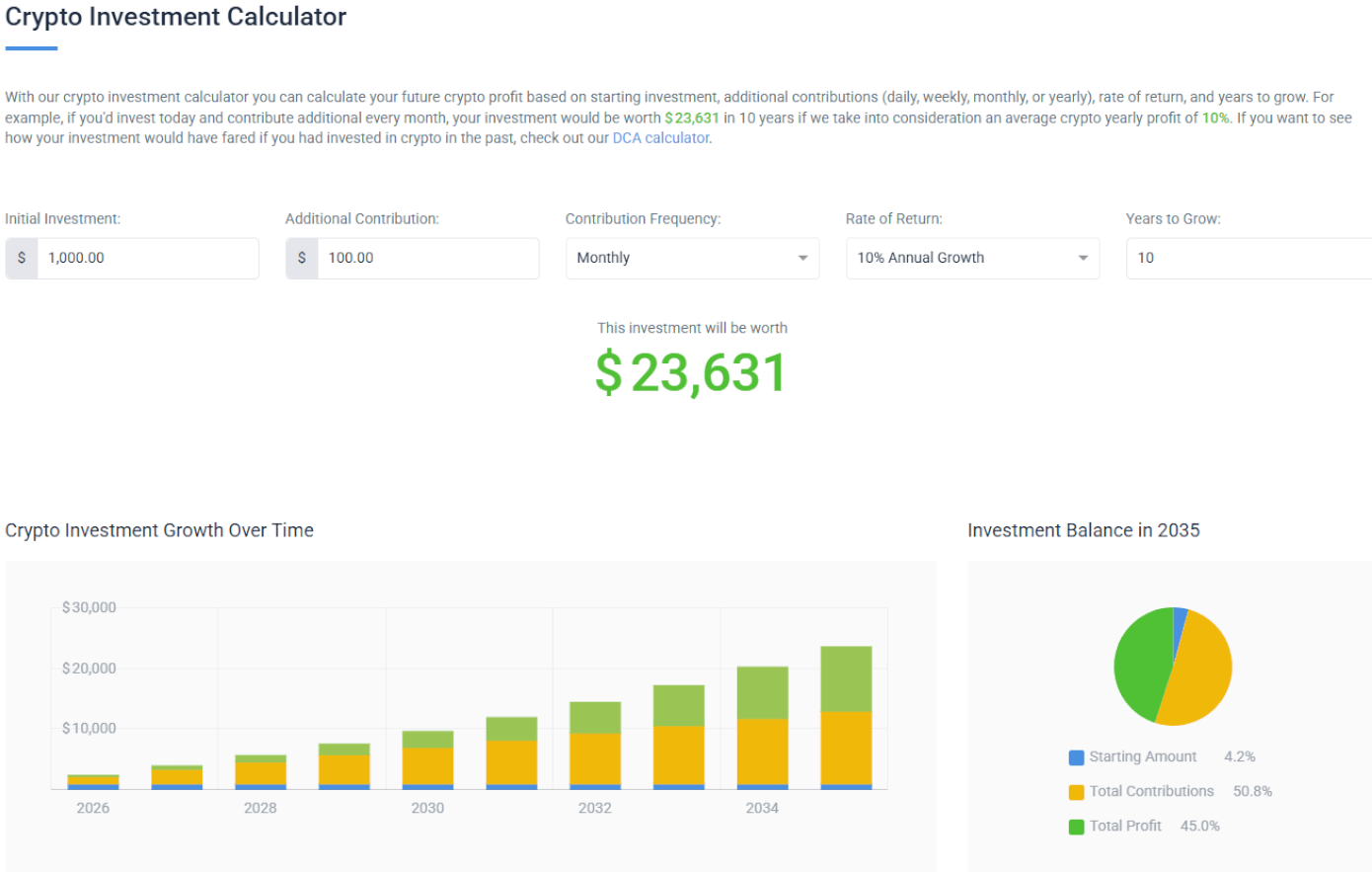
В примере инвестиционного калькулятора показано, как начальное вложение $1000 и ежемесячные взносы $100 росли бы в течение 10 лет при годовой доходности 10%.

Инструмент автоматически показывает рост инвестиций за выбранный период и формирует таблицу с разбивкой по годам. Она показывает стоимость начального вклада и всех дополнительных взносов как в процентах, так и в абсолютных значениях. Так вы сможете быстро оценить, подходит ли вам эта инвестиция.

Долгосрочный подход с помощью стратегии DCA

Не все инвесторы предпочитают разовое вложение. DCA, или усреднение, распределяет покупки по времени. Это снижает влияние волатильности и делает процесс более предсказуемым.
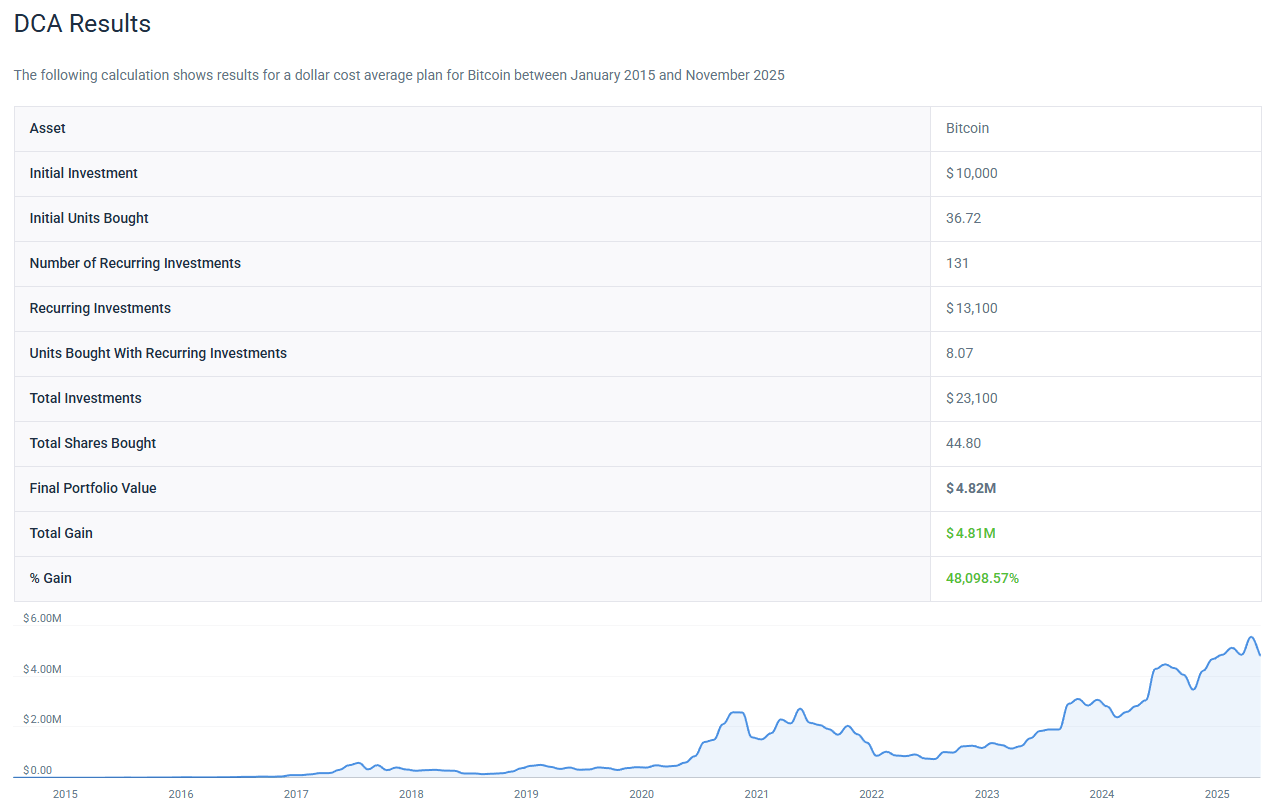
Результаты плана DCA, начатого с $1000 в 2015 году и с ежемесячными вложениями $100 до 2025 года, показывают эффективность этого метода.

Калькулятор DCA от CoinCodex помогает оценить стратегию на разных временных интервалах. Он рассчитывает среднюю цену входа, количество накопленного Bitcoin, учитывает ежемесячные взносы и показывает итоговую доходность. Используя его вместе с калькулятором прибыли, можно сравнить стратегию DCA с разовой инвестицией и выбрать подходящий долгосрочный метод.

Trending Cryptos

Related Reads

Russian Suspected of Stealing Cryptocurrency from Cold Wallet Worth Almost 10 Million Rubles

Russian authorities are investigating a suspect accused of stealing nearly 10 million rubles worth of cryptocurrency from a cold wallet. According to investigators, the wallet belonged to an unnamed commercial company executive's assistant. In March, the suspect allegedly gained access to the victim's wallet by "an unidentified method" and transferred the digital assets to another address. During a search of the suspect's home, police seized three computers and three mobile phones for forensic examination, as they may contain important digital evidence. The case is being investigated as grand larceny under the Russian Criminal Code, carrying a potential sentence of up to ten years in prison. Police are also checking the suspect's possible involvement in other cryptocurrency thefts and identifying potential accomplices. The article notes that while cold wallets (hardware wallets storing private keys offline) are considered more secure against remote hacking, they remain vulnerable if a perpetrator gains physical or direct access to the keys. In a related case earlier in June, a court in Tomsk sentenced two men to 8 and 9.5 years in a strict-regime colony for a robbery and cryptocurrency theft. They forced an acquaintance at knifepoint to log into a crypto exchange account and transfer over 85 bitcoins, valued at approximately $5.1 million at the time.

cryptonews.ru26m ago

Russian Suspected of Stealing Cryptocurrency from Cold Wallet Worth Almost 10 Million Rubles

cryptonews.ru26m ago

Bitwise Names Three Mistakes Investors Make When Assessing the Cryptocurrency Market

Bitwise's chief investment officer, Matt Hougan, identifies three common mistakes investors make when evaluating the cryptocurrency market, all stemming from a disconnect between its current perception and potential evolution. First, investors often view crypto applications like Uniswap or Aave solely through the lens of the $2 trillion crypto market. However, with the tokenization of traditional assets (like $150 trillion in equities and $350 trillion in bonds), the potential market for these platforms could become 100 times larger. Second, there's an underestimation of crypto-native companies. Despite entry by major financial firms (e.g., PayPal in stablecoins, Fidelity in custody), native players like Tether, Circle, and Coinbase retain dominant market shares due to speed, focus, and established user bases (though exceptions like BlackRock's Bitcoin ETF success exist). Third, future blockchain transaction volumes are underestimated. Tokenized securities could trade 24/7, not just 33 hours per week, and the rise of AI agents managing portfolios could increase transaction activity by 50-100 times. Hougan concludes that investors assess the sector based on its present state while the underlying infrastructure is rapidly changing through tokenization, expanding use cases, and increased operational scale. This gap between current perception and future potential creates significant investment opportunities.

cryptonews.ru28m ago

Bitwise Names Three Mistakes Investors Make When Assessing the Cryptocurrency Market

cryptonews.ru28m ago

Grayscale Submits Fourth Amendment to Agreement for Zcash Trust, Whose Shares Will Be Listed on the NYSE Arca

Grayscale has submitted a fourth amendment to its S-3 registration form for the Grayscale Zcash Trust, a key step toward converting it into a U.S. exchange-traded fund (ETF) listed on NYSE Arca under the ticker ZCSH. This would be the first U.S. ETF providing regulated stock market access to the privacy-focused cryptocurrency ZEC ($ZEC). The amendment details the creation and redemption of shares, primarily through cash, though authorized participants can create shares in-kind by depositing ZEC. The trust is sponsored by Grayscale Investments, with Coinbase as the prime broker and custodian, and Bank of New York Mellon as administrator. The filing also notes non-binding discussions where Digital Currency Group's DCG International Investments could acquire shares by contributing 200,000 ZEC. A ZEC ETF is seen as a breakthrough due to regulatory caution around privacy-enhancing tokens. Following the filing, ZEC's price rose over 9% in 24 hours. Demand for the existing trust product has grown, with its average daily trading volume doubling from March to April, and shielded ZEC balances reaching a record ~30% of the circulating supply. Despite this momentum, Zcash has faced challenges in 2026, including a vulnerability discovered in its shielded Orchard pool that briefly caused its price to drop significantly. Developers quickly patched the issue. A regulated ETF would offer traditional investors exposure to this dual-faceted privacy asset.

cryptonews.ru29m ago

Grayscale Submits Fourth Amendment to Agreement for Zcash Trust, Whose Shares Will Be Listed on the NYSE Arca

cryptonews.ru29m ago

Trading

Spot

Hot Articles

What is $BITCOIN

DIGITAL GOLD ($BITCOIN): A Comprehensive Analysis Introduction to DIGITAL GOLD ($BITCOIN) DIGITAL GOLD ($BITCOIN) is a blockchain-based project operating on the Solana network, which aims to combine the characteristics of traditional precious metals with the innovation of decentralized technologies. While it shares a name with Bitcoin, often referred to as “digital gold” due to its perception as a store of value, DIGITAL GOLD is a separate token designed to create a unique ecosystem within the Web3 landscape. Its goal is to position itself as a viable alternative digital asset, although specifics regarding its applications and functionalities are still developing. What is DIGITAL GOLD ($BITCOIN)? DIGITAL GOLD ($BITCOIN) is a cryptocurrency token explicitly designed for use on the Solana blockchain. In contrast to Bitcoin, which provides a widely recognized value storage role, this token appears to focus on broader applications and characteristics. Notable aspects include: Blockchain Infrastructure: The token is built on the Solana blockchain, known for its capacity to handle high-speed and low-cost transactions. Supply Dynamics: DIGITAL GOLD has a maximum supply capped at 100 quadrillion tokens (100P $BITCOIN), although details regarding its circulating supply are currently undisclosed. Utility: While precise functionalities are not explicitly outlined, there are indications that the token could be utilized for various applications, potentially involving decentralized applications (dApps) or asset tokenization strategies. Who is the Creator of DIGITAL GOLD ($BITCOIN)? At present, the identity of the creators and development team behind DIGITAL GOLD ($BITCOIN) remains unknown. This situation is typical among many innovative projects within the blockchain space, particularly those aligning with decentralized finance and meme coin phenomena. While such anonymity may foster a community-driven culture, it intensifies concerns about governance and accountability. Who are the Investors of DIGITAL GOLD ($BITCOIN)? The available information indicates that DIGITAL GOLD ($BITCOIN) does not have any known institutional backers or prominent venture capital investments. The project seems to operate on a peer-to-peer model focused on community support and adoption rather than traditional funding routes. Its activity and liquidity are primarily situated on decentralized exchanges (DEXs), such as PumpSwap, rather than established centralized trading platforms, further highlighting its grassroots approach. How DIGITAL GOLD ($BITCOIN) Works The operational mechanics of DIGITAL GOLD ($BITCOIN) can be elaborated on based on its blockchain design and network attributes: Consensus Mechanism: By leveraging Solana’s unique proof-of-history (PoH) combined with a proof-of-stake (PoS) model, the project ensures efficient transaction validation contributing to the network's high performance. Tokenomics: While specific deflationary mechanisms have not been extensively detailed, the vast maximum token supply implies that it may cater to microtransactions or niche use cases that are still to be defined. Interoperability: There exists the potential for integration with Solana’s broader ecosystem, including various decentralized finance (DeFi) platforms. However, the details regarding specific integrations remain unspecified. Timeline of Key Events Here is a timeline that highlights significant milestones concerning DIGITAL GOLD ($BITCOIN): 2023: The initial deployment of the token occurs on the Solana blockchain, marked by its contract address. 2024: DIGITAL GOLD gains visibility as it becomes available for trading on decentralized exchanges like PumpSwap, allowing users to trade it against SOL. 2025: The project witnesses sporadic trading activity and potential interest in community-led engagements, although no noteworthy partnerships or technical advancements have been documented as of yet. Critical Analysis Strengths Scalability: The underlying Solana infrastructure supports high transaction volumes, which could enhance the utility of $BITCOIN in various transaction scenarios. Accessibility: The potential low trading price per token could attract retail investors, facilitating wider participation due to fractional ownership opportunities. Risks Lack of Transparency: The absence of publicly known backers, developers, or an audit process may yield skepticism regarding the project's sustainability and trustworthiness. Market Volatility: The trading activity is heavily reliant on speculative behavior, which can result in significant price volatility and uncertainty for investors. Conclusion DIGITAL GOLD ($BITCOIN) emerges as an intriguing yet ambiguous project within the rapidly evolving Solana ecosystem. While it attempts to leverage the “digital gold” narrative, its departure from Bitcoin's established role as a store of value underscores the need for a clearer differentiation of its intended utility and governance structure. Future acceptance and adoption will likely depend on addressing the current opacity and defining its operational and economic strategies more explicitly. Note: This report encompasses synthesised information available as of October 2023, and developments may have transpired beyond the research period.

2.0k Total ViewsPublished 2025.05.13Updated 2025.05.13

What is $BITCOIN

Discussions

Welcome to the HTX Community. Here, you can stay informed about the latest platform developments and gain access to professional market insights. Users' opinions on the price of BTC (BTC) are presented below.

活动图片