Has Bitcoin And Crypto Really Bottomed? On-Chain Firm Responds

bitcoinistPublished on 2025-11-27Last updated on 2025-11-27

Abstract

Has Bitcoin genuinely carved out a cycle low or just staged another reflexive bounce? After briefly threatening to lose the...

Trusted Editorial content, reviewed by leading industry experts and seasoned editors. Ad Disclosure

Has Bitcoin genuinely carved out a cycle low or just staged another reflexive bounce? After briefly threatening to lose the $80,000 level and then rebounding toward $88,000, the “bottom” debate is back in full force. On-chain analytics firm Santiment has weighed in – and its answer is cautiously skeptical.

Did Bitcoin Just Print Its Cycle Low?

The firm begins by criticizing the way market labels are thrown around. “The terms ‘bull market’, ‘bear market’, ‘topped’, or ‘bottomed’ can truly mean whatever narrative a trader, investor, or community wants it to mean,” Santiment notes, pointing out that few commentators define a clear timeframe when they call a top or bottom. This opens the door to extreme confirmation bias “after the uptrend or downtrend of prices are already well established.”

Still, the recent move off sub-$80,000 levels has been enough for some to argue that forced selling is behind us. Santiment acknowledges that “content that covers whether the ‘bottom’ has been established will always get some anxious traders excited again,” but stresses that price alone is not sufficient evidence.

On sentiment, the data looks contrarian-constructive. Santiment highlights “how far traders’ optimism regarding Bitcoin (as an investment) can fall after monthly gains are no longer a guarantee.” Its social metrics show an uptick in declarations that crypto is in a bear market and a rise in bearish commentary.

“The uptick in declaration of crypto being in a bear market, and rise of bearish sentiment are both clearly great signs,” the firm writes, reminding readers that “most major turnarounds occur when retail’s hope is mainly lost.” The open question: “Is the crowd’s hopes and dreams of getting their lambos really truly gone?”

Bearish Arguments Still Predominant

Derivatives positioning adds nuance. Aggregated funding rates show meaningful short exposure, but not yet at the extremes seen after the October 6 all-time high. “When we see many shorts like this […] it often stops the downtrend in its tracks,” Santiment explains, recalling how “many shorted about a week after the October 6th all-time high, and there was a temporary relief rally in late October as a result.” For now, though, “we’re not seeing quite the level of bets against the price of Bitcoin […] just yet anyways.”

Profitability metrics paint a similar picture. Both 30-day and 365-day MVRV remain negative, indicating the average holder sits on unrealized losses. Santiment underlines that MVRV “shows the ratio between the current price and the average price of every token acquired,” and that as it rises, “more market participants become willing sellers.” With MVRV still depressed, the firm argues that “a rebound above $90K again soon wouldn’t be a major surprise at all.”

The more concerning signals come from network fundamentals and holder structure. “If we look at the overall utility of Bitcoin, however, things look a bit dicey,” Santiment warns. Weekly new addresses have fallen from over 3.37 million at a mid-December 2023 peak to about 2.21 million now. Weekly active addresses are down from more than 963,900 to roughly 729,200. That underscores “declining utility” at a time when a durable bottom would typically coincide with stabilization or re-acceleration in network use.

Even more problematic is the whale-to-retail shift. Santiment calls this “one other major elephant in the room that should bring you a bit of hesitance that ‘the bottom is in’.” Addresses holding 10–10,000 BTC “continue to shrink their collective supply held,” while wallets with less than 0.1 BTC “continue to grow theirs.”

The firm is blunt: “This is the wrong combination to mark a bottom.” Since COVID-19, “institutionals have driven up just about every bull rally,” and this 10–10,000 BTC cohort “had a lot to do with the October 6th all-time high.” Yet “by October 8th […] [they] began to flat-line their holdings, and have been shrinking them for about six weeks straight now,” while “small wallets […] are the ones scooping up dips in hopes that they ‘catch the falling knife’.”

The verdict is split across timeframes. “Overall, data points to the most likely scenario being a short-term bounce,” backed by negative MVRV and vocal retail panic. But “Bitcoin clawing its way all the way to six figures looks like a stretch when […] whale bags are continuously appearing to be in ‘sell mode’.”

Santiment concludes that “the long-term direction is still pointing to down” as long as “declining utility and declining whale and shark holdings” persist – while reminding investors that “crypto markets could be full of surprises” as the New Year approaches.

At press time, Bitcoin traded at $86,884.
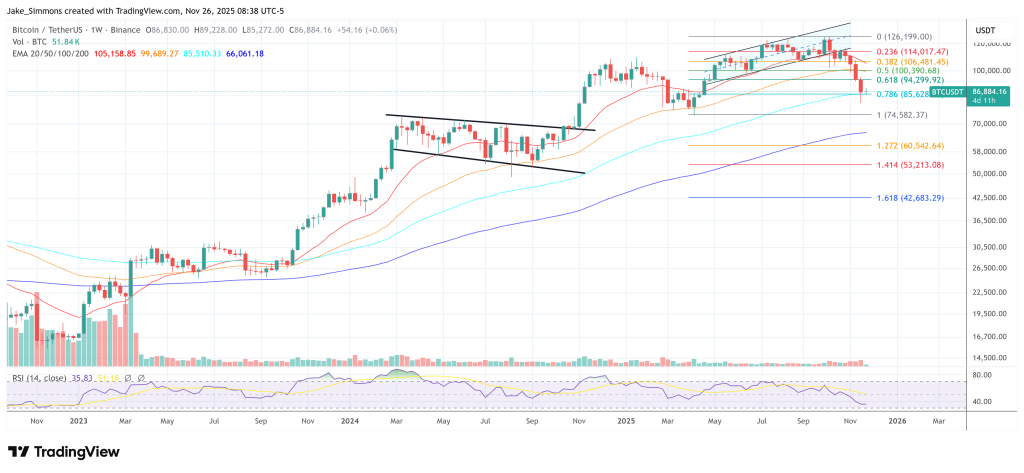
Bitcoin price
Bitcoin remains above the 100-week EMA, 1-week chart | Source: BTCUSDT on TradingView.com
Featured image created with DALL.E, chart from TradingView.com
Editorial Process for bitcoinist is centered on delivering thoroughly researched, accurate, and unbiased content. We uphold strict sourcing standards, and each page undergoes diligent review by our team of top technology experts and seasoned editors. This process ensures the integrity, relevance, and value of our content for our readers.

Jake Simmons has been a Bitcoin enthusiast since 2016. Ever since he heard about Bitcoin, he has been studying the topic every day and trying to share his knowledge with others. His goal is to contribute to Bitcoin's financial revolution, which will replace the fiat money system. Besides BTC and crypto, Jake studied Business Informatics at a university. After graduation in 2017, he has been working in the blockchain and crypto sector. You can follow Jake on Twitter at @realJakeSimmons.

Trending Cryptos

Related Reads

Trading

Spot

Hot Articles

What is $BITCOIN

DIGITAL GOLD ($BITCOIN): A Comprehensive Analysis Introduction to DIGITAL GOLD ($BITCOIN) DIGITAL GOLD ($BITCOIN) is a blockchain-based project operating on the Solana network, which aims to combine the characteristics of traditional precious metals with the innovation of decentralized technologies. While it shares a name with Bitcoin, often referred to as “digital gold” due to its perception as a store of value, DIGITAL GOLD is a separate token designed to create a unique ecosystem within the Web3 landscape. Its goal is to position itself as a viable alternative digital asset, although specifics regarding its applications and functionalities are still developing. What is DIGITAL GOLD ($BITCOIN)? DIGITAL GOLD ($BITCOIN) is a cryptocurrency token explicitly designed for use on the Solana blockchain. In contrast to Bitcoin, which provides a widely recognized value storage role, this token appears to focus on broader applications and characteristics. Notable aspects include: Blockchain Infrastructure: The token is built on the Solana blockchain, known for its capacity to handle high-speed and low-cost transactions. Supply Dynamics: DIGITAL GOLD has a maximum supply capped at 100 quadrillion tokens (100P $BITCOIN), although details regarding its circulating supply are currently undisclosed. Utility: While precise functionalities are not explicitly outlined, there are indications that the token could be utilized for various applications, potentially involving decentralized applications (dApps) or asset tokenization strategies. Who is the Creator of DIGITAL GOLD ($BITCOIN)? At present, the identity of the creators and development team behind DIGITAL GOLD ($BITCOIN) remains unknown. This situation is typical among many innovative projects within the blockchain space, particularly those aligning with decentralized finance and meme coin phenomena. While such anonymity may foster a community-driven culture, it intensifies concerns about governance and accountability. Who are the Investors of DIGITAL GOLD ($BITCOIN)? The available information indicates that DIGITAL GOLD ($BITCOIN) does not have any known institutional backers or prominent venture capital investments. The project seems to operate on a peer-to-peer model focused on community support and adoption rather than traditional funding routes. Its activity and liquidity are primarily situated on decentralized exchanges (DEXs), such as PumpSwap, rather than established centralized trading platforms, further highlighting its grassroots approach. How DIGITAL GOLD ($BITCOIN) Works The operational mechanics of DIGITAL GOLD ($BITCOIN) can be elaborated on based on its blockchain design and network attributes: Consensus Mechanism: By leveraging Solana’s unique proof-of-history (PoH) combined with a proof-of-stake (PoS) model, the project ensures efficient transaction validation contributing to the network's high performance. Tokenomics: While specific deflationary mechanisms have not been extensively detailed, the vast maximum token supply implies that it may cater to microtransactions or niche use cases that are still to be defined. Interoperability: There exists the potential for integration with Solana’s broader ecosystem, including various decentralized finance (DeFi) platforms. However, the details regarding specific integrations remain unspecified. Timeline of Key Events Here is a timeline that highlights significant milestones concerning DIGITAL GOLD ($BITCOIN): 2023: The initial deployment of the token occurs on the Solana blockchain, marked by its contract address. 2024: DIGITAL GOLD gains visibility as it becomes available for trading on decentralized exchanges like PumpSwap, allowing users to trade it against SOL. 2025: The project witnesses sporadic trading activity and potential interest in community-led engagements, although no noteworthy partnerships or technical advancements have been documented as of yet. Critical Analysis Strengths Scalability: The underlying Solana infrastructure supports high transaction volumes, which could enhance the utility of $BITCOIN in various transaction scenarios. Accessibility: The potential low trading price per token could attract retail investors, facilitating wider participation due to fractional ownership opportunities. Risks Lack of Transparency: The absence of publicly known backers, developers, or an audit process may yield skepticism regarding the project's sustainability and trustworthiness. Market Volatility: The trading activity is heavily reliant on speculative behavior, which can result in significant price volatility and uncertainty for investors. Conclusion DIGITAL GOLD ($BITCOIN) emerges as an intriguing yet ambiguous project within the rapidly evolving Solana ecosystem. While it attempts to leverage the “digital gold” narrative, its departure from Bitcoin's established role as a store of value underscores the need for a clearer differentiation of its intended utility and governance structure. Future acceptance and adoption will likely depend on addressing the current opacity and defining its operational and economic strategies more explicitly. Note: This report encompasses synthesised information available as of October 2023, and developments may have transpired beyond the research period.

1.9k Total ViewsPublished 2025.05.13Updated 2025.05.13

What is $BITCOIN

Discussions

Welcome to the HTX Community. Here, you can stay informed about the latest platform developments and gain access to professional market insights. Users' opinions on the price of BTC (BTC) are presented below.

活动图片