Bitmine Accumulates Nearly 70K Ethereum But Faces $4.25B Unrealized Loss At Current Prices

bitcoinistPublished on 2025-11-25Last updated on 2025-11-26

Abstract

Ethereum has lost the $3,000 mark and hasn’t been able to reclaim it for days, reinforcing growing concerns that the...

Trusted Editorial content, reviewed by leading industry experts and seasoned editors. Ad Disclosure

Ethereum has lost the $3,000 mark and hasn’t been able to reclaim it for days, reinforcing growing concerns that the market may be entering a deeper corrective phase. Selling pressure continues to mount as traders unwind positions and sentiment shifts toward caution.

The broader crypto market is also weakening, adding to speculation that a bear market could be forming earlier than many expected. Fear and uncertainty now dominate social metrics, derivatives data, and spot flows, with investors questioning whether ETH has already set its cycle top. Yet, despite the pessimism and deteriorating price structure, not all players are retreating. In fact, some of the largest market participants are aggressively accumulating.

New data from Lookonchain reveals that Tom Lee’s Bitmine bought 69,822 ETH valued at $197.25 million last week alone. This brings their total holdings to a staggering 3,629,701 ETH worth approximately $10.25 billion.

Bitmine Faces Massive Unrealized Loss as Market Awaits Direction

According to a press release from Bitmine, the firm’s average buying price sits near $3,997, leaving its position at an unrealized loss of roughly $4.25 billion at current market levels. This disclosure highlights the scale of conviction behind Bitmine’s accumulation strategy, but it also underscores how deeply Ethereum has retraced since its recent highs. The continued drawdown reflects the broader uncertainty gripping the market, where fear and hesitation are overpowering momentum and liquidity remains thin.
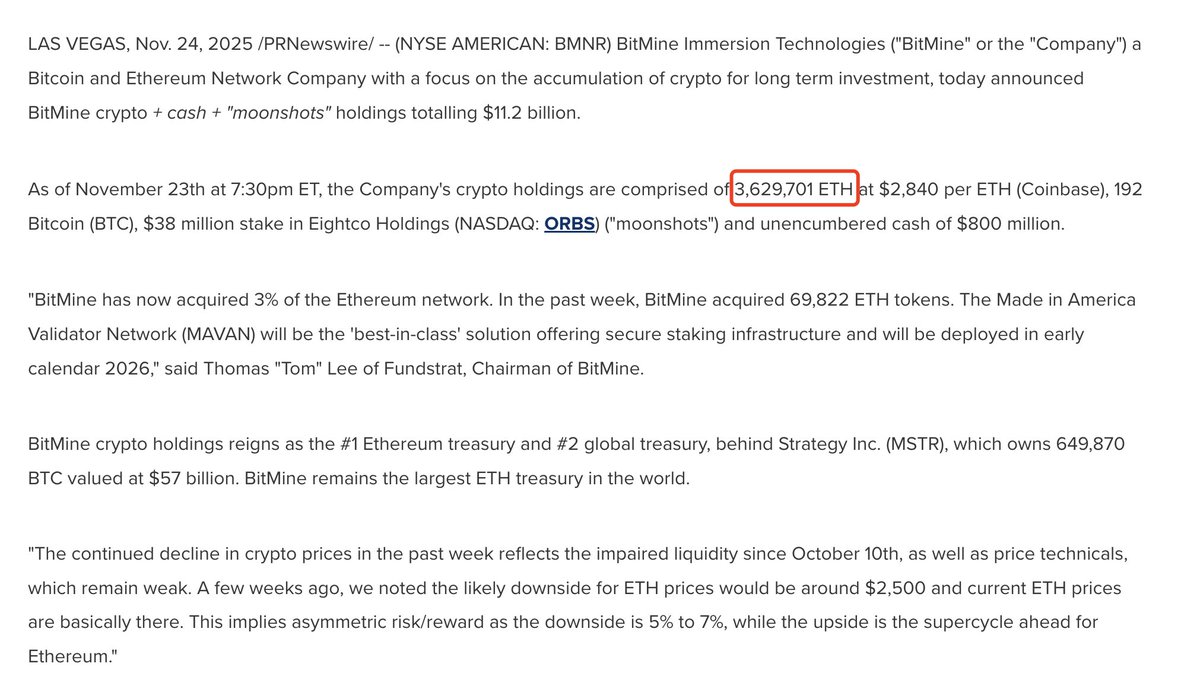
Bitmine Press Release | Source: Bitmine
Bitmine Press Release | Source: Lookonchain

The market is now entering a critical phase that could define price behavior for the coming months, as traders assess whether ETH can stabilize and begin reclaiming lost ground. Many analysts argue that despite the sharp retracement, Ethereum remains positioned for a recovery, especially if macro conditions improve and selling pressure eases. They point out that historically, similar periods of aggressive whale accumulation during market weakness have preceded strong rebounds and renewed investor confidence.

However, others warn that if ETH fails to regain momentum above key psychological levels, downside continuation could deepen. This moment has therefore become a dividing line between bullish expectation and bearish caution.

Ethereum Price Action Shows Weak Recovery Attempts Amid Bearish Structure

Ethereum’s price action on the daily chart continues to reflect a market struggling to regain upward momentum after losing the $3,000 level. The recent bounce toward $2,900 shows a temporary reaction, yet the broader structure remains bearish as ETH trades below the 50-day, 100-day, and 200-day moving averages.
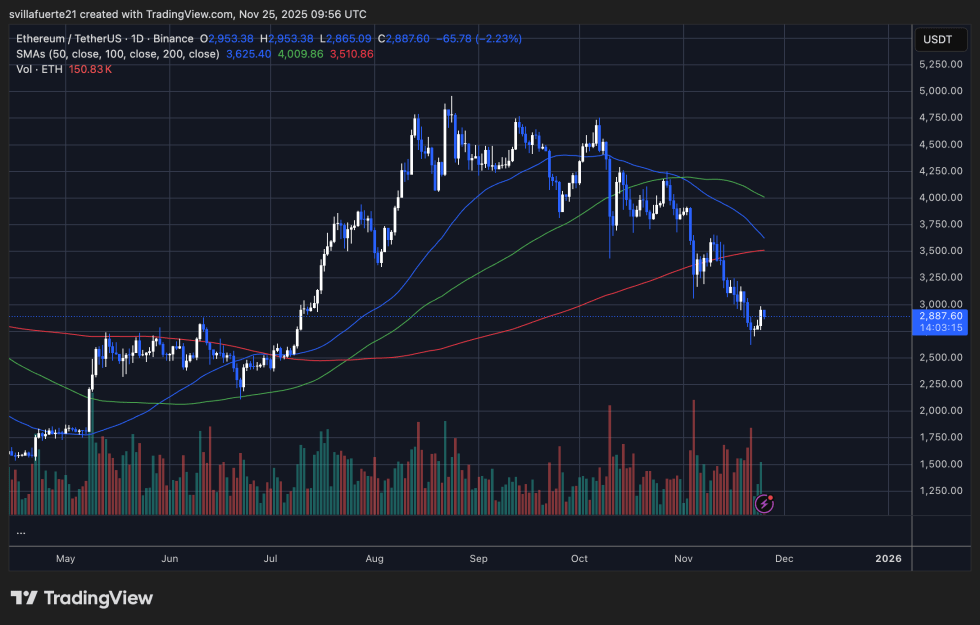
ETH struggling to reclaim higher prices | Source: ETHUSDT chart on TradingView

This alignment of moving averages — with the faster averages positioned beneath the slower ones — confirms a sustained downward trend that has been developing since early October.

The chart also shows declining highs and lower lows, reinforcing that buyers have not yet regained control. Volume spikes during selloffs indicate that bearish activity is driving market movement more than accumulation. Despite brief recoveries, each attempt to push higher has been rejected near resistance around the $3,150–$3,250 range, suggesting that sentiment remains fragile.

Additionally, the red 200-day moving average near the $3,500 zone is now a critical long-term threshold. If ETH cannot reclaim this region in the coming weeks, the probability of continued consolidation or even deeper correction increases.

For now, Ethereum remains in a vulnerable position, requiring stronger demand to shift the trend back in favor of bulls.

Featured image from ChatGPT, chart from TradingView.com

Editorial Process for bitcoinist is centered on delivering thoroughly researched, accurate, and unbiased content. We uphold strict sourcing standards, and each page undergoes diligent review by our team of top technology experts and seasoned editors. This process ensures the integrity, relevance, and value of our content for our readers.

Sebastian's journey into the world of crypto began four years ago, driven by a fascination with the potential of blockchain technology to revolutionize financial systems. His initial exploration focused on understanding the intricacies of various crypto projects, particularly those focused on building innovative financial solutions. Through countless hours of research and learning, Sebastian developed a deep understanding of the underlying technologies, market dynamics, and potential applications of cryptocurrencies. As his knowledge grew, Sebastian felt compelled to share his insights with others. He began actively contributing to online discussions on platforms like X and LinkedIn, focusing on fintech and crypto-related content. His goal was to expose valuable trends and insights to a wider audience, fostering a deeper understanding of the rapidly evolving crypto landscape. Sebastian's contributions quickly gained recognition, and he became a trusted voice in the online crypto community. To further enhance his expertise, Sebastian pursued a UC Berkeley Fintech: Frameworks, Applications, and Strategies certification. This rigorous program equipped him with valuable skills and knowledge regarding Financial Technology, bridging the gap between traditional finance (TradFi) and decentralized finance (DeFi). The certification deepened his understanding of the broader financial landscape and its intersection with blockchain technology. Sebastian's passion for finance and writing is evident in his work. He enjoys delving into financial research, analyzing market trends, and exploring the latest developments in the crypto space. In his spare time, Sebastian can often be found immersed in charts, studying 10-K forms, or engaging in thought-provoking discussions about the future of finance. Sebastian's journey as a crypto analyst and investor has been marked by a relentless pursuit of knowledge and a dedication to sharing his insights. His ability to navigate the complex world of crypto, combined with his passion for financial research and communication, makes him a valuable asset to the industry. As the crypto landscape continues to evolve, Sebastian remains at the forefront, providing valuable insights and contributing to the growth of this revolutionary technology.

Trending Cryptos

Related Reads

Pax Silica vs. WAICO: The US Wants to Prohibit Europe from Using Chinese Artificial Intelligence

The United States is preparing to demand that European and other partners abandon Chinese artificial intelligence initiatives, threatening exclusion from the American-led "Pax Silica" coalition, according to a leaked U.S. State Department document. This ultimatum forces signatories of the "AI Opportunity Statement" to choose between the Western technological ecosystem and alternative frameworks, with China not explicitly named but clearly targeted. Pax Silica is a U.S. strategy for AI and semiconductor hegemony, launched in late 2025. Its European presence expanded significantly in mid-2026. Concurrently, China, Russia, and 27 other nations established the World AI Cooperation Organization (WAICO) in July 2026 as an independent intergovernmental platform promoting AI governance based on UN principles. This situation creates a difficult choice, especially for European nations balancing strategic autonomy with dependence on U.S. tech and security. It also pressures Global South countries with pragmatic ties to both Washington and Beijing. The formation of competing blocks risks fragmenting the global tech landscape, forcing companies to split supply chains, increasing costs, and potentially leading to incompatible standards and protocols. The era of open globalization in AI may be ending, replaced by geopolitical confrontation where technological sovereignty trumps economic efficiency. The decisions made will shape the global digital economy for decades.

cryptonews.ru1h ago

Pax Silica vs. WAICO: The US Wants to Prohibit Europe from Using Chinese Artificial Intelligence

cryptonews.ru1h ago

Robert Kiyosaki Shares His Mentor's Predictions About the Emergence of Bitcoin and AI

American entrepreneur and author of "Rich Dad Poor Dad," Robert Kiyosaki, discussed the influence of futurist R. Buckminster Fuller on his worldview, linking Fuller's past technological predictions to the emergence of Bitcoin and the development of artificial intelligence. In an X post, Kiyosaki also reflected on personal purpose, sharing his journey from the music business—where he worked with bands like The Police and Iron Maiden—to creating the "Cashflow" board game and writing his famous book. He described feeling an inner emptiness despite his success, a turning point that came after meeting Fuller, whom he studied with for three summers. Kiyosaki described Fuller as a "friendly genius" who foresaw world-changing developments like Bitcoin and AI. However, the core of his post focused on Fuller's philosophical impact, particularly a quote about belonging to the universe and finding purpose by dedicating one's life to the maximum benefit of others. The entrepreneur remains a vocal advocate for cryptocurrencies. He regularly advises buying Bitcoin during market panics, viewing it and assets like Ethereum, gold, and silver as hedges against traditional financial system failures. Kiyosaki has predicted a major market crash by 2026, seeing it as an opportunity for prepared investors, with long-term price targets including $750,000 for Bitcoin and $95,000 for Ethereum.

cryptonews.ru3h ago

Robert Kiyosaki Shares His Mentor's Predictions About the Emergence of Bitcoin and AI

cryptonews.ru3h ago

Etherealize CEO Calls Wall Street's Private Blockchains a 'Race to the Bottom'

Etherealize co-founder and CEO Vivek Raman criticized Wall Street's growing interest in private, permissioned blockchains, calling them a "race to the bottom." In an interview with CoinDesk, Raman argued that consortium networks fragment liquidity and return the industry to the siloed systems that blockchain technology was meant to overcome. He stated that closed networks do not interoperate, undermining two key advantages of the technology: system compatibility and liquidity concentration. Etherealize promotes Ethereum as an open, foundational layer for institutional players. Raman insists that privacy and access restrictions should be built on top of public infrastructure—at the application or L2 level—rather than creating separate, closed networks. He compared Ethereum to HTTP as a base layer, with additional permissioned and private layers akin to HTTPS. Examples of this new wave of "closed" solutions mentioned include Canton Network from Digital Asset, Circle's Arc project, and Stripe's Tempo. Raman termed this trend "consortium chains 2.0," recalling earlier initiatives like the R3 interbank consortium and the Hyperledger corporate ecosystem from 2016 that failed to gain significant traction. He reiterated his firm belief that a global, open, permissionless infrastructure is necessary as a foundational base layer. Raman previously noted in June that traditional financial institutions had begun implementing Ethereum-based solutions into real business processes.

cryptonews.ru3h ago

Etherealize CEO Calls Wall Street's Private Blockchains a 'Race to the Bottom'

cryptonews.ru3h ago

Trading

Spot

Hot Articles

Discussions

Welcome to the HTX Community. Here, you can stay informed about the latest platform developments and gain access to professional market insights. Users' opinions on the price of ETH (ETH) are presented below.

活动图片