XRP Volume Explodes As Smart Money Rotates Into Higher-Beta Plays Like PEPENODE

bitcoinistPublished on 2025-11-20Last updated on 2025-11-20

Abstract

Quick Facts: ➡️ $XRP's recent volume acceleration, from $118K to $2.8M, signals institutional-style positioning rather than casual retail flows. ➡️...

Trusted Editorial content, reviewed by leading industry experts and seasoned editors. Ad Disclosure

Quick Facts:

  • ➡️ $XRP’s recent volume acceleration, from $118K to $2.8M, signals institutional-style positioning rather than casual retail flows.
  • ➡️ If $XRP pumps above $2.16 and retains momentum, a sustained bull run may follow; if not a crash below $1.94 could follow.
  • ➡️ PEPENODE ($PEPENODE) introduces a mine-to-earn memecoin model, using virtual Miner Nodes and gamified rewards to replace hardware-based mining complexity.
  • ➡️ The presale is at over $2.1M so far, with a token price of $0.0011546 and staking rewards of 594%.

Crypto researcher Ripple Bull Winkle has flagged a structural shift in XRP flows that traders can no longer ignore.

Spot volume, which sat around $118K during periods of quiet accumulation, recently spiked to $2.8 million, then stabilized near $1.4 million per day.
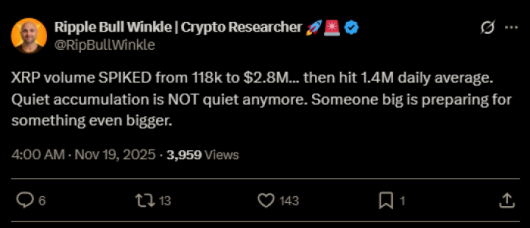
Analyst Rypple Bull Winkle hinting at something big following a massive increase in $XRP trading volume.

That is not retail noise. That is a coordinated size.

For months, $XRP was a slow grind story. Larger wallets added incrementally during chop, using volatility as cover. Now, the tape looks different. Order books show thicker bids, aggressive market buys, and stacked open interest on derivatives venues.

When accumulation turns into velocity, it usually means one thing. A larger player, or set of players, is positioning for a scenario where $XRP breaks out of its range and drags liquidity across the majors and high-beta altcoins.

If that move materializes, capital rarely stays confined to the parent asset. It fans out into satellites: leveraged perps, small-cap narratives, and memecoins that can move 5-10 times faster.

That is where newer experiments like PEPENODE ($PEPENODE) start to matter.

The project sits at the intersection of two proven, reflexive trades: memecoins and mining incentives, and aims to remove the usual hardware and complexity barriers.

If XRP’s renewed energy spills into the long tail, miners without rigs and casual meme traders will look for accessible, gamified yield.

Buy your $PEPENODE on the official presale page today.

How An XRP Liquidity Wave Resets The Altcoin Playbook

When a large-cap asset experiences an xrp price surge in both volume and participation, correlations across the alt complex tighten. You see beta clusters form.

High-liquidity majors like $ETH and $SOL move first, then capital cascades into riskier plays that can outperform on a percentage basis.

$XRP could follow a similar path if it manages to reclaim and retain momentum above $2.16. If not, a crash to $1.94 could follow. Right now, the token trades at $2.12.
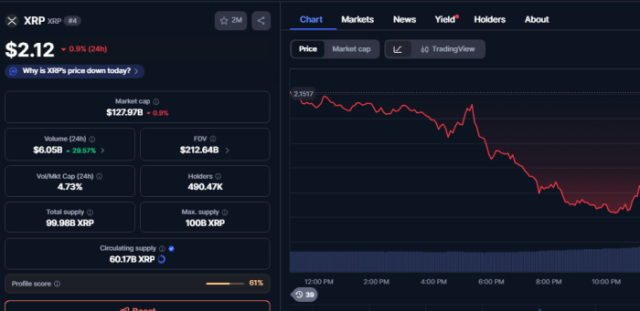
$XRP’s chart performance on CoinMarketCap.

Fortunately, the coin shows signs of recovery, despite investors remaining bearish for the time being and turning their attention to more utility-based meme coins.

This is where the mine-to-earn niche is emerging. Instead of requiring GPUs or ASICs, it abstracts mining into software or game mechanics. Users spin up virtual miners, upgrade digital infrastructure, and receive rewards in meme-denominated assets.

Within that landscape, PEPENODE ($PEPENODE) is one of several experiments. Others focus on browser-based mining or social tasks. Some lean heavily into staking multipliers.

PEPENODE stakes its identity on binding virtual mining, tiered node power, and meme rewards like $PEPE and $FARTCOIN inside a single Ethereum-native ERC‑20 ecosystem.

You can buy your $PEPENODE off the official presale page today.

PEPENODE’s Mine‑to‑Earn Design And What The Market Is Pricing In

Zooming in, PEPENODE ($PEPENODE) frames itself as the “world’s first mine-to-earn memecoin,” but the more interesting angle is infrastructure. It tries to turn mining from a hardware arms race into a virtual, on-chain participation market living on Ethereum proof of stake.

Instead of buying GPUs, users acquire and customize tiered Miner Nodes, which are represented within the protocol.

Early adopters can secure more powerful configurations that, according to the design, carry higher reward coefficients over time.

$PEPENODE’s presale numbers and mine-to-earn mechanics.

Presale flows suggest that investors are willing to underwrite that optionality.

At the time of writing, the $PEPENODE sale has raised over $2.1M, with a token price of $0.0011546. For a project still pre‑gameplay, that is a meaningful vote of confidence in the model and the meme.

As a result, a realistic price prediction for $PEPENODE puts the token at $0.0072 in 2026, which would deliver an ROI of 523% based on today’s price.

Importantly, the model does not rely solely on passive holding. During the presale phase, buyers can stake tokens for a mouth-watering APY of 594%, reinforcing the “mine-to-earn” narrative before the full virtual mining suite launches.

Once live, rewards become more granular. Node power, facility upgrades, and in‑game decisions all influence yield.

If the $XRP-driven rotation into higher beta assets accelerates, projects like PEPENODE ($PEPENODE) that combine a familiar meme wrapper with a clear, gamified participation engine look well-positioned. Which means this is the perfect time to read our guide on how to buy $PEPENODE.

Visit the presale page and buy your $PEPENODE today.

This article is informational and educational only and should not be considered financial, investment, or trading advice.

Authored by Bogdan Patru, Bitcoinist: https://bitcoinist.com/xrp-price-surge-altcoin-rotation-pepenode-mine-to-earn

Editorial Process for bitcoinist is centered on delivering thoroughly researched, accurate, and unbiased content. We uphold strict sourcing standards, and each page undergoes diligent review by our team of top technology experts and seasoned editors. This process ensures the integrity, relevance, and value of our content for our readers.

As a crypto writer, Bogdan’s responsibilities are split between researching and writing articles and entertaining the team with his humor bordering on the politically incorrect, an aspiring Bill Burr, if you will. Thanks to his 12+ years of writing experience in just as many fields, including tech, cybersecurity, modelling, fitness, crypto, and other topics-that-shall-not-be-named, he's become a genuine asset to the team. While his position as a senior writer at PrivacyAffairs thought him valuable lessons about the power of self-management, his entire writing career was and is an exercise in self-improvement. Now, he's ready to sink his teeth into crypto and teach people how to take control of their own money on the blockchain. With fiat as an eternally devaluing currency, Bitcoin and altcoins seem like the best-fitting alternative for Bogdan. Bogdan’s biggest professional accomplishment, aside from securing a position as a main writer for Bitcoinist, was his 5-year run as a writing manager at Blackwood Productions, where he coordinated a team of four writers. During that time, he learned the value of teamwork and that of creating a working environment that breeds efficiency, positivity, and friendship.

Trending Cryptos

Related Reads

Upbit is Anxious: A Hasty Counterattack Aimed at Regaining Stablecoin Market Share

Title: Upbit's Rushed Counterattack to Reclaim Stablecoin Market Share Facing a dramatic shift in South Korea's stablecoin market, leading exchange Upbit launched a promotional campaign from July 26 to August 9, waiving the 0.05% trading fee for stablecoins paired with the Korean Won (KRW) and rapidly listing new stablecoins like RLUSD and USDG. This move is a direct response to its plummeting market share in this sector. Historically a duopoly with Bithumb, the market has been reshaped since October 2025 when Coinone permanently removed fees for USDC trading. By June 2026, Coinone led with 34.8% of stablecoin volume, followed by Bithumb (31.1%) and Upbit (30.1%). This contrasts sharply with the overall crypto market, where Upbit commands 60%. The data shows stablecoin demand is highly sensitive to fees, as users primarily buy them to transfer capital overseas for derivatives trading or forex arbitrage. South Korean exchanges have seen a net outflow of stablecoins for 18 consecutive months, totaling approximately 14.9 trillion KRW, underscoring their role as a cross-border capital conduit. Upbit's limited-time promotion initially boosted its daily stablecoin volume by 162%, but the surge was almost entirely in USDT (98.1% of volume). The newly listed stablecoins saw negligible, fleeting interest. Furthermore, the promotional effect quickly waned in the second week, with volume dropping 33% on weekdays. A concurrent weakening of the KRW also contributed to the trading spike, independent of the fee waiver. The analysis suggests that once the promotion ends, Upbit is unlikely to retain its temporary gains unless it matches Coinone's permanent zero-fee policy, forcing a choice between market share and fee revenue. Upbit's strategic push may be less about immediate profit and more about preparing for future regulatory shifts. With South Korea's *Digital Asset Basic Act* on the horizon, which will regulate KRW-backed stablecoins, and following Dunamu's (Upbit's parent) integration into Naver Financial to build a payment ecosystem, securing a dominant position in the dollar stablecoin distribution channel holds long-term strategic value. However, potential regulatory conflicts could prevent Upbit from listing a future Naver-issued KRW stablecoin, making the current fight for dollar stablecoin flow even more critical.

marsbit2h ago

Upbit is Anxious: A Hasty Counterattack Aimed at Regaining Stablecoin Market Share

marsbit2h ago

Michael Saylor Compares Bitcoin and Gold!

Michael Saylor, founder of MicroStrategy, argues that Bitcoin fundamentally changes how wealth is stored and transferred by transforming digital scarcity into economic value. He describes Bitcoin as the first digital monetary network, combining computers, digital networks, and cryptography. It digitizes monetary assets, allowing their supply to be controlled by public protocols rather than institutions, thus converting economic value into information transmissible over global networks. Comparing Bitcoin to gold, Saylor states that while increasing Bitcoin's supply is harder, its integration with software and transfer is easier. He highlights Bitcoin's proof-of-work mechanism, which ties it to the physical world by consuming real energy to secure the ledger, making past transactions immutable. This creates a shared security system involving miners, energy companies, and investors. Saylor suggests "digital monetary energy" is a more accurate term than "digital gold." He emphasizes that the Bitcoin network is an adaptive ecosystem of miners, nodes, developers, and users. Its core design is intentionally simple, focused on maintaining a secure ledger for scarce digital assets, with complex functionalities built in higher-layer applications. This architecture allows Bitcoin to serve as a foundation for transmitting value and fostering innovation in payments and financial services. Saylor notes Bitcoin's deeper impact lies in creating digital sovereignty, where private keys give individuals permissionless control over their economic power, with ownership verified mathematically, not by institutions. He concludes that while gold's physical scarcity makes it money, Bitcoin's digital scarcity does the same, characterizing Bitcoin as the monetary energy of the digital age.

cryptonews.ru3h ago

Michael Saylor Compares Bitcoin and Gold!

cryptonews.ru3h ago

Trading

Spot

Hot Articles

What is XRP 2.0

XRP 2.0: A New Frontier in the Cryptocurrency Landscape Introduction to XRP 2.0 In the ever-evolving realm of cryptocurrency, new projects continuously emerge, vying for attention and adoption. One such promising initiative is XRP 2.0, a novel cryptocurrency project designed to leverage advanced blockchain technology and robust encryption methodologies. While the name draws parallels with Ripple’s XRP, it’s crucial to note that XRP 2.0 operates independently, focusing on enhancing transaction security, privacy, and scalability. As the digital financial landscape increasingly embraces decentralized solutions, XRP 2.0 aims to contribute meaningfully to web3 and the overall expansion of crypto projects. What is XRP 2.0? At its core, XRP 2.0 is a cryptocurrency project that aims to create a secure and decentralized digital currency ecosystem. Its foundational technology integrates sophisticated blockchain principles with cutting-edge encryption techniques. The overarching goal of XRP 2.0 is to establish itself as a reliable and efficient platform enabling swift transaction execution while prioritizing enhanced privacy protections for its users. The project is promoted as a solution to many limitations faced by existing cryptocurrencies, proposing a system that can handle a higher volume of transactions with improved speed and privacy. This versatility positions XRP 2.0 as a significant contender in a marketplace riddled with various digital currencies. Who is the Creator of XRP 2.0? The identity of the creator behind XRP 2.0 has been flagged as ‘Wilbur.’ However, comprehensive details regarding Wilbur or their associated entity remain elusive. The anonymity of many cryptocurrency creators is not an uncommon phenomenon in the industry, often designed to maintain a degree of privacy and security. Who are the Investors of XRP 2.0? As of now, specific information related to the investment foundations or organizations supporting XRP 2.0 is not publicly available. In the cryptocurrency sector, the backing by reputed investors can significantly influence a project's credibility and success, yet the transparency regarding the financial supporters of XRP 2.0 has not been established. How Does XRP 2.0 Work? XRP 2.0 stands out by employing a combination of blockchain technology and advanced encryption algorithms that ensures secure and decentralized transactions. Its innovative structure includes unique features designed to foster user engagement and broaden functionalities beyond conventional cryptocurrency transactions. Among these features, XRP 2.0 incorporates AI-powered capabilities, such as text-to-image and text-to-speech functionalities. These additions are designed to enhance the interactive experience for users, promoting broader applicability across various sectors. By bridging technological advancements with user-centered design, XRP 2.0 aims to capture the attention of a diverse range of individuals and enterprises looking to integrate cryptocurrency solutions into their operational frameworks. Timeline of XRP 2.0 Understanding XRP 2.0 requires examining the milestones that have defined its journey thus far: July 23, 2023: XRP 2.0 is introduced as a novel cryptocurrency project, aiming to revolutionize secure and decentralized transaction capabilities in the blockchain domain. September 8, 2023: The launching of another project, XRP20, occurs, marking the emergence of an ERC-20 token on the Ethereum blockchain that remains unrelated to XRP 2.0. November 13, 2023: The XRP Ledger undergoes a significant update with the release of rippled server software version 2.0.0. It is essential to note that this development is disconnected from the XRP 2.0 cryptocurrency project. Key Points About XRP 2.0 To distill the essence of XRP 2.0, several critical factors emerge: Unique Features: The inclusion of features like AI-powered text-to-image and text-to-speech further diversifies the potential applications of XRP 2.0. Blockchain Technology: The framework utilizes advanced blockchain mechanisms and encryption protocols, ensuring a secure and decentralized environment for transactions. Scalability and Privacy: XRP 2.0 prioritizes enhanced privacy protections in transaction processes and the scalability necessary to accommodate a growing user base. No Affiliation with Ripple: Importantly, despite its name, XRP 2.0 does not have any allegiance or collaboration with Ripple’s XRP, distinguishing its operational framework and objectives within the cryptocurrency ecosystem. Conclusion XRP 2.0 represents an ambitious venture into the cryptocurrency sphere, aiming to offer a combination of security, privacy, and efficiency in digital transactions. By integrating sophisticated technologies and user-friendly features, the project sets out to broaden the horizons of what cryptocurrency can achieve in today's digital economy. While the anonymity of its creator and lack of disclosed investors might raise questions for some, XRP 2.0's focus on advanced functionalities and decentralisation enhances its appeal amidst an increasingly crowded crypto market. As the cryptocurrency landscape continues to evolve, XRP 2.0 may yet emerge as a pivotal player in the expansion of secure and scalable blockchain solutions.

1.5k Total ViewsPublished 2024.04.01Updated 2024.12.03

What is XRP 2.0

Discussions

Welcome to the HTX Community. Here, you can stay informed about the latest platform developments and gain access to professional market insights. Users' opinions on the price of XRP (XRP) are presented below.

活动图片














