Bitmine Keeps Buying Ethereum Despite Market Drop: 21,054 ETH Arrive In New Wallet

bitcoinistPublished on 2025-11-20Last updated on 2025-11-20

Abstract

Ethereum has come under heavy selling pressure over the past few days as the broader crypto market entered a deep...

Trusted Editorial content, reviewed by leading industry experts and seasoned editors. Ad Disclosure

Ethereum has come under heavy selling pressure over the past few days as the broader crypto market entered a deep corrective phase. Yet, despite the volatility and widespread fear, ETH has managed to hold firmly above the key $3,000 level — a zone many analysts consider essential for maintaining the broader bullish structure.

Now, as price stabilizes and buyers begin to re-emerge, several market observers are starting to call for a potential recovery, arguing that Ethereum may be nearing the end of its downturn.

Adding fuel to this narrative is the continued accumulation from major players, most notably Tom Lee’s Bitmine. Tom Lee — a well-known Wall Street strategist, co-founder of Fundstrat Global Advisors, and long-time Bitcoin and Ethereum bull — has been one of the most influential voices in the digital asset market for nearly a decade. His firm Bitmine operates as a large institutional crypto investment entity focused on long-term accumulation, market-making, and strategic positioning during periods of fear.

According to recent on-chain data, Bitmine has continued buying ETH even as prices fell, signaling strong conviction in the asset’s long-term outlook. This behavior stands in sharp contrast to the broader market, where short-term holders have been capitulating.

Bitmine Continues Accumulating ETH Despite Market Weakness

According to fresh on-chain data from Lookonchain, accumulation activity around Ethereum is far from slowing down. A newly flagged wallet, 0xE2ed, believed to be associated with Tom Lee’s Bitmine, received 21,054 ETH (worth $66.57 million) from Kraken just a few hours ago. This move reinforces the view that large, sophisticated players are treating the recent correction as an opportunity rather than a threat.

Ethereum transactions on Arkham | Source: Lookonchain

The timing of this transfer is notable. Ethereum has been under sustained selling pressure for weeks, with sentiment turning sharply bearish as the market grappled with fear, liquidations, and a broader rotation into stablecoins. Yet despite this environment, Bitmine-linked wallets continue to absorb supply aggressively.

This pattern aligns with Bitmine’s broader strategy: accumulating high-quality crypto assets during periods of uncertainty to position for long-term upside. Large inflows to accumulation wallets during drawdowns have historically suggested strong conviction among institutional players, often preceding phases of recovery and renewed strength.

Suppose this wallet is indeed tied to Bitmine. In that case, it signals that some of the market’s most well-capitalized participants remain confident in Ethereum’s long-term value, regardless of short-term volatility.

ETH Price Analysis: Testing Long-Term Support Amid Heavy Volatility

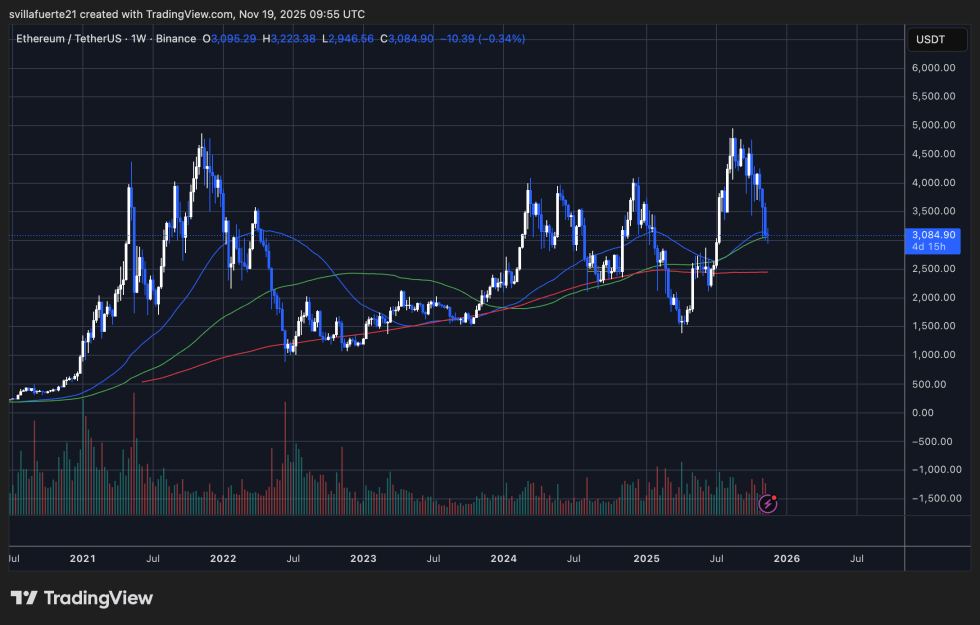
Ethereum’s weekly chart shows the asset navigating a critical zone as price hovers just above $3,000, a level that has historically acted as a major demand area. After weeks of sustained selling pressure, ETH has pulled back from the $4,500 region and is now retesting its long-term moving averages. The 200-week MA, in particular, is positioned closely beneath the current price, acting as a structural anchor that has supported Ethereum in previous cycle corrections, including the deep capitulation seen in mid-2022 and the recovery phase of 2023.
ETH testing $3K Level | Source: ETHUSDT chart on TradingView

The recent candle structure reflects heightened volatility, with long wicks suggesting strong reactions from buyers near the $3,000 threshold. Volume has increased slightly during this downturn, indicating active participation from both sellers locking in profits and buyers positioning for potential reversal. Yet ETH remains below its 50-week MA, showing that short-term momentum continues to lean bearish.

Still, the broader pattern resembles earlier cycle pullbacks where Ethereum retraced sharply before forming higher lows and resuming its macro uptrend. If ETH can maintain this support band and reclaim the $3,300–$3,500 region, it may signal renewed strength. But a weekly close below $3,000 risks opening the door to deeper correction targets near $2,700.

Featured image from ChatGPT, chart from TradingView.com

Editorial Process for bitcoinist is centered on delivering thoroughly researched, accurate, and unbiased content. We uphold strict sourcing standards, and each page undergoes diligent review by our team of top technology experts and seasoned editors. This process ensures the integrity, relevance, and value of our content for our readers.

Sebastian's journey into the world of crypto began four years ago, driven by a fascination with the potential of blockchain technology to revolutionize financial systems. His initial exploration focused on understanding the intricacies of various crypto projects, particularly those focused on building innovative financial solutions. Through countless hours of research and learning, Sebastian developed a deep understanding of the underlying technologies, market dynamics, and potential applications of cryptocurrencies. As his knowledge grew, Sebastian felt compelled to share his insights with others. He began actively contributing to online discussions on platforms like X and LinkedIn, focusing on fintech and crypto-related content. His goal was to expose valuable trends and insights to a wider audience, fostering a deeper understanding of the rapidly evolving crypto landscape. Sebastian's contributions quickly gained recognition, and he became a trusted voice in the online crypto community. To further enhance his expertise, Sebastian pursued a UC Berkeley Fintech: Frameworks, Applications, and Strategies certification. This rigorous program equipped him with valuable skills and knowledge regarding Financial Technology, bridging the gap between traditional finance (TradFi) and decentralized finance (DeFi). The certification deepened his understanding of the broader financial landscape and its intersection with blockchain technology. Sebastian's passion for finance and writing is evident in his work. He enjoys delving into financial research, analyzing market trends, and exploring the latest developments in the crypto space. In his spare time, Sebastian can often be found immersed in charts, studying 10-K forms, or engaging in thought-provoking discussions about the future of finance. Sebastian's journey as a crypto analyst and investor has been marked by a relentless pursuit of knowledge and a dedication to sharing his insights. His ability to navigate the complex world of crypto, combined with his passion for financial research and communication, makes him a valuable asset to the industry. As the crypto landscape continues to evolve, Sebastian remains at the forefront, providing valuable insights and contributing to the growth of this revolutionary technology.

Trending Cryptos

Related Reads

Upbit is Anxious: A Hasty Counterattack Aimed at Regaining Stablecoin Market Share

Title: Upbit's Rushed Counterattack to Reclaim Stablecoin Market Share Facing a dramatic shift in South Korea's stablecoin market, leading exchange Upbit launched a promotional campaign from July 26 to August 9, waiving the 0.05% trading fee for stablecoins paired with the Korean Won (KRW) and rapidly listing new stablecoins like RLUSD and USDG. This move is a direct response to its plummeting market share in this sector. Historically a duopoly with Bithumb, the market has been reshaped since October 2025 when Coinone permanently removed fees for USDC trading. By June 2026, Coinone led with 34.8% of stablecoin volume, followed by Bithumb (31.1%) and Upbit (30.1%). This contrasts sharply with the overall crypto market, where Upbit commands 60%. The data shows stablecoin demand is highly sensitive to fees, as users primarily buy them to transfer capital overseas for derivatives trading or forex arbitrage. South Korean exchanges have seen a net outflow of stablecoins for 18 consecutive months, totaling approximately 14.9 trillion KRW, underscoring their role as a cross-border capital conduit. Upbit's limited-time promotion initially boosted its daily stablecoin volume by 162%, but the surge was almost entirely in USDT (98.1% of volume). The newly listed stablecoins saw negligible, fleeting interest. Furthermore, the promotional effect quickly waned in the second week, with volume dropping 33% on weekdays. A concurrent weakening of the KRW also contributed to the trading spike, independent of the fee waiver. The analysis suggests that once the promotion ends, Upbit is unlikely to retain its temporary gains unless it matches Coinone's permanent zero-fee policy, forcing a choice between market share and fee revenue. Upbit's strategic push may be less about immediate profit and more about preparing for future regulatory shifts. With South Korea's *Digital Asset Basic Act* on the horizon, which will regulate KRW-backed stablecoins, and following Dunamu's (Upbit's parent) integration into Naver Financial to build a payment ecosystem, securing a dominant position in the dollar stablecoin distribution channel holds long-term strategic value. However, potential regulatory conflicts could prevent Upbit from listing a future Naver-issued KRW stablecoin, making the current fight for dollar stablecoin flow even more critical.

marsbit3h ago

Upbit is Anxious: A Hasty Counterattack Aimed at Regaining Stablecoin Market Share

marsbit3h ago

Michael Saylor Compares Bitcoin and Gold!

Michael Saylor, founder of MicroStrategy, argues that Bitcoin fundamentally changes how wealth is stored and transferred by transforming digital scarcity into economic value. He describes Bitcoin as the first digital monetary network, combining computers, digital networks, and cryptography. It digitizes monetary assets, allowing their supply to be controlled by public protocols rather than institutions, thus converting economic value into information transmissible over global networks. Comparing Bitcoin to gold, Saylor states that while increasing Bitcoin's supply is harder, its integration with software and transfer is easier. He highlights Bitcoin's proof-of-work mechanism, which ties it to the physical world by consuming real energy to secure the ledger, making past transactions immutable. This creates a shared security system involving miners, energy companies, and investors. Saylor suggests "digital monetary energy" is a more accurate term than "digital gold." He emphasizes that the Bitcoin network is an adaptive ecosystem of miners, nodes, developers, and users. Its core design is intentionally simple, focused on maintaining a secure ledger for scarce digital assets, with complex functionalities built in higher-layer applications. This architecture allows Bitcoin to serve as a foundation for transmitting value and fostering innovation in payments and financial services. Saylor notes Bitcoin's deeper impact lies in creating digital sovereignty, where private keys give individuals permissionless control over their economic power, with ownership verified mathematically, not by institutions. He concludes that while gold's physical scarcity makes it money, Bitcoin's digital scarcity does the same, characterizing Bitcoin as the monetary energy of the digital age.

cryptonews.ru4h ago

Michael Saylor Compares Bitcoin and Gold!

cryptonews.ru4h ago

Trading

Spot

Hot Articles

Discussions

Welcome to the HTX Community. Here, you can stay informed about the latest platform developments and gain access to professional market insights. Users' opinions on the price of ETH (ETH) are presented below.

活动图片