Ethereum Price Crashes to $3,000 Amid Market Shakeout, Analysts Warn of Volatility Ahead

bitcoinistPublished on 2025-11-18Last updated on 2025-11-19

Abstract

The Ethereum price has plummeted below the critical $3,000 level as the broader cryptocurrency market experiences an intense sell-off, triggering...

Trusted Editorial content, reviewed by leading industry experts and seasoned editors. Ad Disclosure

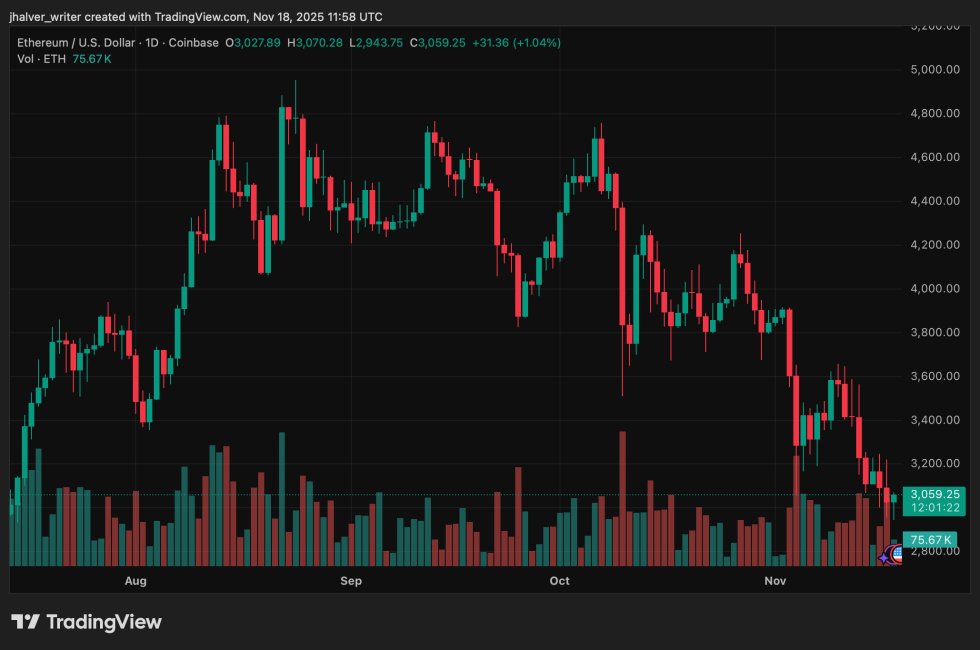
The Ethereum price has plummeted below the critical $3,000 level as the broader cryptocurrency market experiences an intense sell-off, triggering renewed uncertainty among traders.

ETH is currently trading around $3,067, marking a 23% decline over the past month and signaling one of its steepest corrections of 2025.

Long-Term Holders Accumulate, But Pressure Mounts

Despite the sharp correction, on-chain data shows long-term Ethereum holders are doubling down. According to CryptoQuant, Ethereum is trading roughly 8% above the Accumulation Addresses Realized Price, a metric that tracks the cost basis of seasoned holders.

These investors have added 17 million ETH in 2025, increasing their total holdings from 10 million to over 27 million coins, suggesting deep conviction even as markets wobble.

However, the selling pressure across exchanges remains intense. More than 164,000 traders were liquidated in 24 hours, with total liquidations nearing $900 million.

Ethereum price also entered a major liquidation zone between $2,900 and $3,000, amplifying volatility. Outflows from Ethereum ETFs also surged, with over $728 million withdrawn in a week, further weakening sentiment.

Adding to market anxiety, high-profile crypto figure Arthur Hayes reportedly offloaded 1,480 ETH, sparking speculation that influential traders may be bracing for a deeper downside.
Ethereum ETH ETHUSD

ETH's price trends to the downside on the daily chart. Source: ETHUSD on Tradingview

Ethereum Price Technical Levels Signal Caution

From a technical perspective, the Ethereum price structure remains fragile. The asset is trading below the 100-hourly SMA and struggling to reclaim the 50-week moving average, which now acts as resistance. A bearish trend line has formed near $3,150, with additional hurdles at $3,260 and $3,350.

On the downside, immediate support lies at $2,950, followed by a stronger floor at $2,880. A break below this region could open the path toward $2,750 or even $2,680 levels, which analysts warn could trigger broader market contagion.

Is a Recovery Still Possible?

Even amid the chaos, some analysts remain optimistic. Fundstrat’s Tom Lee insists ETH may be bottoming, projecting a potential rally toward $7,000 within 45 days, fueled by the upcoming Fusaka network upgrade, booming stablecoin activity, and growing institutional interest.

For now, the Ethereum price remains caught between strong long-term accumulation and escalating short-term selling pressure. Whether bulls reclaim the $3,150 resistance, or bears push ETH toward fresh lows, will likely hinge on macroeconomic data and Bitcoin’s next major move.

Cover image from ChatGPT, ETHUSD chart from Tradingview

Editorial Process for bitcoinist is centered on delivering thoroughly researched, accurate, and unbiased content. We uphold strict sourcing standards, and each page undergoes diligent review by our team of top technology experts and seasoned editors. This process ensures the integrity, relevance, and value of our content for our readers.

Trending Cryptos

Related Reads

Upbit is Anxious: A Hasty Counterattack Aimed at Regaining Stablecoin Market Share

Title: Upbit's Rushed Counterattack to Reclaim Stablecoin Market Share Facing a dramatic shift in South Korea's stablecoin market, leading exchange Upbit launched a promotional campaign from July 26 to August 9, waiving the 0.05% trading fee for stablecoins paired with the Korean Won (KRW) and rapidly listing new stablecoins like RLUSD and USDG. This move is a direct response to its plummeting market share in this sector. Historically a duopoly with Bithumb, the market has been reshaped since October 2025 when Coinone permanently removed fees for USDC trading. By June 2026, Coinone led with 34.8% of stablecoin volume, followed by Bithumb (31.1%) and Upbit (30.1%). This contrasts sharply with the overall crypto market, where Upbit commands 60%. The data shows stablecoin demand is highly sensitive to fees, as users primarily buy them to transfer capital overseas for derivatives trading or forex arbitrage. South Korean exchanges have seen a net outflow of stablecoins for 18 consecutive months, totaling approximately 14.9 trillion KRW, underscoring their role as a cross-border capital conduit. Upbit's limited-time promotion initially boosted its daily stablecoin volume by 162%, but the surge was almost entirely in USDT (98.1% of volume). The newly listed stablecoins saw negligible, fleeting interest. Furthermore, the promotional effect quickly waned in the second week, with volume dropping 33% on weekdays. A concurrent weakening of the KRW also contributed to the trading spike, independent of the fee waiver. The analysis suggests that once the promotion ends, Upbit is unlikely to retain its temporary gains unless it matches Coinone's permanent zero-fee policy, forcing a choice between market share and fee revenue. Upbit's strategic push may be less about immediate profit and more about preparing for future regulatory shifts. With South Korea's *Digital Asset Basic Act* on the horizon, which will regulate KRW-backed stablecoins, and following Dunamu's (Upbit's parent) integration into Naver Financial to build a payment ecosystem, securing a dominant position in the dollar stablecoin distribution channel holds long-term strategic value. However, potential regulatory conflicts could prevent Upbit from listing a future Naver-issued KRW stablecoin, making the current fight for dollar stablecoin flow even more critical.

marsbit4h ago

Upbit is Anxious: A Hasty Counterattack Aimed at Regaining Stablecoin Market Share

marsbit4h ago

Michael Saylor Compares Bitcoin and Gold!

Michael Saylor, founder of MicroStrategy, argues that Bitcoin fundamentally changes how wealth is stored and transferred by transforming digital scarcity into economic value. He describes Bitcoin as the first digital monetary network, combining computers, digital networks, and cryptography. It digitizes monetary assets, allowing their supply to be controlled by public protocols rather than institutions, thus converting economic value into information transmissible over global networks. Comparing Bitcoin to gold, Saylor states that while increasing Bitcoin's supply is harder, its integration with software and transfer is easier. He highlights Bitcoin's proof-of-work mechanism, which ties it to the physical world by consuming real energy to secure the ledger, making past transactions immutable. This creates a shared security system involving miners, energy companies, and investors. Saylor suggests "digital monetary energy" is a more accurate term than "digital gold." He emphasizes that the Bitcoin network is an adaptive ecosystem of miners, nodes, developers, and users. Its core design is intentionally simple, focused on maintaining a secure ledger for scarce digital assets, with complex functionalities built in higher-layer applications. This architecture allows Bitcoin to serve as a foundation for transmitting value and fostering innovation in payments and financial services. Saylor notes Bitcoin's deeper impact lies in creating digital sovereignty, where private keys give individuals permissionless control over their economic power, with ownership verified mathematically, not by institutions. He concludes that while gold's physical scarcity makes it money, Bitcoin's digital scarcity does the same, characterizing Bitcoin as the monetary energy of the digital age.

cryptonews.ru5h ago

Michael Saylor Compares Bitcoin and Gold!

cryptonews.ru5h ago

Trading

Spot

Hot Articles

Discussions

Welcome to the HTX Community. Here, you can stay informed about the latest platform developments and gain access to professional market insights. Users' opinions on the price of ETH (ETH) are presented below.

活动图片