BlackRock отказалась от запуска ETF на базе Solana

cryptonews.ruPublished on 2025-11-26Last updated on 2025-11-26

Инвестиционная компания Fidelity запускает спотовый фонд для Solana 19 ноября 2025 года. Комиссия за управление составит 25 базисных пунктов. В это же время крупнейший в мире управляющий активами BlackRock демонстративно не участвует в конкурентной борьбе. Финансовый гигант принял решение сосредоточиться исключительно на продуктах для биткоина и Ethereum.

Пока крупные институциональные игроки стремятся захватить долю в растущем секторе альткоинов, стратегия BlackRock вызывает вопросы о будущем подобных фондов.

Экспансия управляющих компаний в сектор Solana

Рынок биржевых фондов (ETF) на базе SOL стремительно расширяется. Сразу несколько фирм анонсировали запуск новых продуктов. Фонд BSOL от Bitwise дебютировал с активами порядка $450 млн. Торги инструментом VSOL от VanEck стартовали 18 ноября 2025 года.

Выход Fidelity с продуктом FSOL считается важной вехой для индустрии. Это событие знаменует приход крупнейшего традиционного управляющего в данный сегмент рынка.

Аналитик Bloomberg Эрик Балчунас отметил высокий уровень конкуренции. Установленная комиссия в размере 0.25% позволяет FSOL бороться за лидерство с другими ведущими инструментами.

Fidelity Solana ETF $FSOL is slated to launch TOMORROW. Fee is 25bps. Easily the biggest asset manager in this category with BlackRock sitting out. $BSOL got out first, has $450m, $VSOL launched today, Grayscale is in mix. Game on. pic.twitter.com/iCXMkAH9qe

— Eric Balchunas (@EricBalchunas) November 17, 2025

Кроме того, на рынок вышла компания Canary Capital. Ее ETF под тикером SOLC включает функцию ончейн-стейкинга благодаря партнерству с протоколом Marinade Finance. Согласно официальным данным Nasdaq, торги паями фонда начались 18 ноября. Конкуренцию в формирующемся сегменте также усиливает компания Grayscale.

ALSO. @CanaryFunds will be launching their Solana ETF — $SOLC — tomorrow too. It’s in partnership with @MarinadeFinance who will be doing the staking. https://t.co/DKsDY3xymg

— James Seyffart (@JSeyff) November 18, 2025

Рыночная активность демонстрирует рост внимания к активу. Открытый интерес к фьючерсам на SOL увеличивается по мере приближения даты запуска новых фондов.
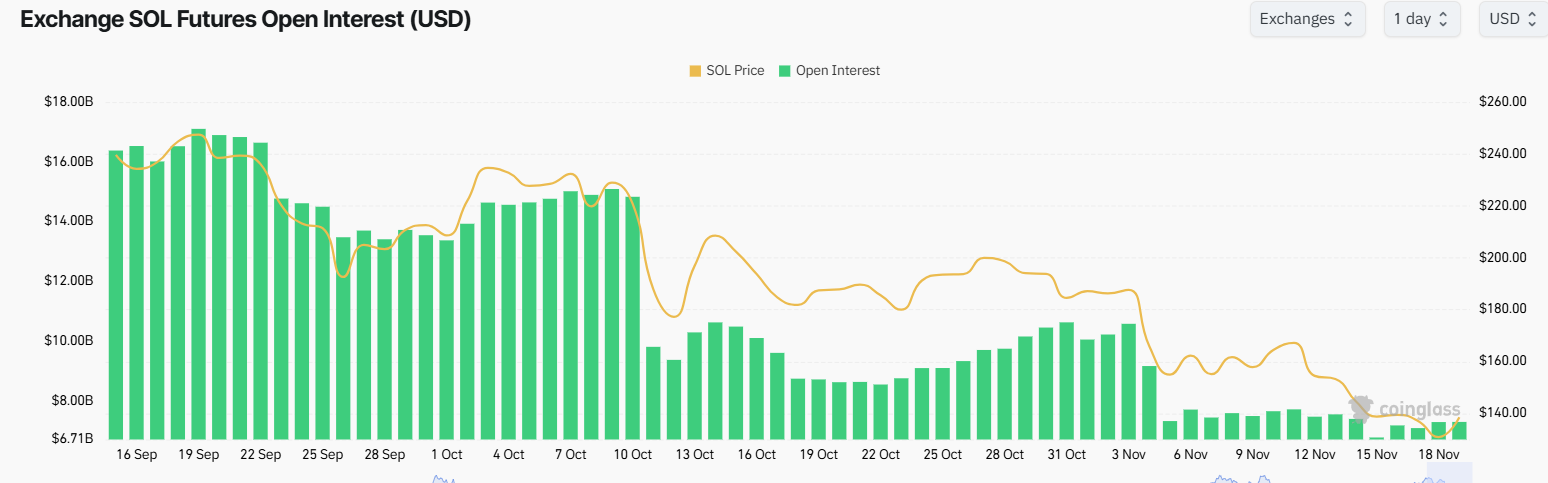
Открытый интерес по фьючерсам Solana
Открытый интерес по фьючерсам Solana. Источник: Coinglass

Это сигнализирует о притоке институционального капитала, несмотря на текущую консолидацию цены.

Стратегический фокус на двух главных криптовалютах

Компания BlackRock четко обозначила свою позицию. Организация планирует концентрироваться только на биткоине и Ethereum, избегая экспансии в другие цифровые активы.

Глава подразделения цифровых активов Роберт Митчник на конференции в Нэшвилле пояснил причины такого решения. По его словам, монеты за пределами двух лидеров не обладают достаточной зрелостью, ликвидностью и рыночной капитализацией.

Руководство BlackRock отмечает, что следующая по величине криптовалюта после Ethereum занимает лишь около 3% рынка. Это значение находится значительно ниже пороговых требований фирмы для запуска продукта.

«Мы не увидим длинного списка криптофондов. Биткоин сегодня занимает 55% рыночной капитализации, Ethereum – 18%. Следующий доступный для инвестирования актив – около 3%. Это просто несопоставимо с необходимым уровнем зрелости и ликвидности», – заявил Митчник.

Представители компании также подчеркнули, что лишь малая часть клиентов BlackRock в настоящее время владеет паями IBIT или ETHA. Это стало дополнительным аргументом в пользу отказа от расширения линейки.

Стоит отметить, что биткоин-фонд IBIT показал сильные результаты после дебюта в январе 2024 года. Он стал самым быстрорастущим ETF, достигшим $10 млрд под управлением. Продукт на базе Ethereum (ETHA) также привлек более $1 млрд активов в течение двух месяцев после запуска.

Тем не менее в последние недели финансовые инструменты фиксируют отток средств. Теоретически это могло бы побудить фирму пересмотреть отношение к Solana, однако позиция остается неизменной.

Аналитики также обсуждают скрытые мотивы традиционных финансовых игроков. Сооснователь BitMEX Артур Хейс считает выход гигантов вроде BlackRock на рынок расчетливой торговлей базисом. По его мнению, институциональные стратегии могут искажать реальную картину потоков капитала.

The post BlackRock отказалась от запуска ETF на базе Solana appeared first on BeInCrypto.

Trending Cryptos

Related Reads

NVIDIA CPU Advances, China's RISC-V Responds: Semiconductor Deep Dive - Part Four

NVIDIA is set to launch its new Vera AI data center CPU in China as early as August, with high pricing. While this move offers a new option, it highlights China's continued dependence on foreign-controlled Arm architecture. In response, the Chinese semiconductor industry is increasingly turning to RISC-V as a strategic alternative for achieving high-performance computing autonomy. The article explores the concept of the "impossible triangle" in CPU development—balancing prosperity, control, and autonomy—and posits that RISC-V's open-source, modular nature offers a unique path to achieving all three. While RISC-V is already dominant in embedded systems, the focus is now shifting to data centers and AI workloads. China has become a global hotspot for RISC-V development, driven by AI-driven compute demand, supply chain concerns from export controls, cost benefits of open-source, and strong policy support. Multiple Chinese companies have reportedly crossed the key performance threshold of 15 SPECint per GHz, a benchmark for entering the high-performance CPU club. Progress extends beyond single-core benchmarks. Companies are developing complete computing subsystems, including commercial-grade coherent network-on-chip (NoC) technology and server processors with up to 40 cores that strictly adhere to the RVA23 standard to ensure software compatibility. Real-world applications are emerging in areas like video transcoding and edge AI. However, significant challenges remain. The RISC-V ecosystem faces fragmentation, immature toolchains and verification processes, and gaps in single-core performance and energy efficiency compared to mature x86 and Arm architectures. The formidable software moat, epitomized by NVIDIA's CUDA, is a long-term hurdle. In conclusion, while RISC-V cannot immediately replace offerings like NVIDIA's Vera, it represents a viable long-term path for China to develop a self-sufficient, high-performance CPU ecosystem. The journey is acknowledged to be long and arduous, requiring sustained effort to overcome technical and ecosystem challenges.

marsbit2h ago

NVIDIA CPU Advances, China's RISC-V Responds: Semiconductor Deep Dive - Part Four

marsbit2h ago

My Coding Betting Dashboard is Profiting, but Polymarket is Truly Not a Good Place for 'Arbitrage'

The author built a custom monitoring dashboard for Polymarket, a prediction market platform, and tested it with $1,600, achieving over 30% returns. However, the core argument is that Polymarket is not a good venue for traditional arbitrage. The dashboard has two main sections: a "Portfolio Dashboard" for tracking active positions with key metrics like total capital, P&L, and a risk-control module using a tier system (T1, T2, T3), and an "Opportunity Watchlist" for monitoring markets. The article details a critical structural trap in binary markets: a bet with a high perceived probability of success still carries a 100% loss risk if wrong. The author's T1/T2/T3 system is designed to manage this by limiting position sizes based on conviction and time horizon, emphasizing that high confidence should not equal high concentration. A key insight is the danger of "pseudo-diversification"—betting on different markets driven by the same underlying variable. The author concludes that Polymarket offers few true low-risk, arbitrage opportunities. It is instead a high-risk environment where wins can create a false sense of mastery, leading to large losses. The platform is better viewed as a training ground for honing judgment through disciplined, framework-driven betting rather than a reliable income source. The tools help transform intuition into structured, rule-based decisions to mitigate the risk of catastrophic errors.

marsbit5h ago

My Coding Betting Dashboard is Profiting, but Polymarket is Truly Not a Good Place for 'Arbitrage'

marsbit5h ago

WeChat AI Card Hands-On Guide: Has the AI Shopping Era Arrived?

**"WeChat AI Card" Practical Test Guide: Has the Era of AI Shopping Arrived?** WeChat has officially launched the "AI Exclusive Card," a feature integrated into its Workbuddy AI assistant. This card is designed to handle payments for AI-initiated purchases. Our hands-on test reveals it's not yet a tool for fully autonomous AI shopping, but rather a controlled payment layer for AI agents. The AI Card functions as an isolated sub-wallet within WeChat Pay. Users must bind the card and transfer funds into it from their main wallet. Crucially, every transaction requires explicit user confirmation via smartphone scan; AI cannot spend autonomously. Currently accessible through the Workbuddy agent, the card targets specific digital consumption scenarios: purchasing paid content (reports, data), calling paid APIs/tools, and subscribing to services. Its design prioritizes security and control by separating funds and mandating approval for each payment. We tested a real-world scenario: ordering bubble tea via Workbuddy using a "Meituan Life Assistant" skill. The process encountered multiple hurdles: high "skill" usage costs (exceeding daily free credits), and most importantly, while a payment was successfully initiated, the AI purchased an incorrect product (a mismatched group-buy coupon instead of the desired drink). This highlights the current limitation: the **AI Card only solves the payment step**. The broader challenge lies in the **AI agent's execution chain**—accurately understanding intent, navigating third-party platforms, selecting the right product, and ensuring proper fulfillment. The payment succeeded, but the purchase failed to meet the user's need. In conclusion, the WeChat AI Exclusive Card is a cautious, early-step experiment in AI commerce. It provides a secure, user-controlled payment method for agent interactions but is not yet capable of reliable, end-to-end complex purchases. For now, it's best used for low-value, low-risk digital services with careful user verification at each step. The vision of AI handling complete shopping tasks remains a work in progress.

marsbit8h ago

WeChat AI Card Hands-On Guide: Has the AI Shopping Era Arrived?

marsbit8h ago

Trading

Spot
Futures

Hot Articles

Discussions

Welcome to the HTX Community. Here, you can stay informed about the latest platform developments and gain access to professional market insights. Users' opinions on the price of SOL (SOL) are presented below.

活动图片