Aziende con Tesoreria in Ethereum Sono in Difficoltà

bitcoinistPublished on 2025-11-18Last updated on 2025-11-18

Abstract

I dati rivelano che la maggior parte delle aziende con tesoreria in Ethereum stanno attualmente scambiando al di sotto del...

Trusted Editorial content, reviewed by leading industry experts and seasoned editors. Ad Disclosure

I dati rivelano che la maggior parte delle aziende con tesoreria in Ethereum stanno attualmente scambiando al di sotto del loro mNAV, a dimostrazione dell’impatto dell’ultimo crollo del prezzo. Ma cerchiamo di comprendere al meglio la situazione. Tanto per cominciare il termine mNAV sta per “Multiple of Net Asset Value”, ed è un rapporto che confronta il valore dell’azienda sul mercato con il valore delle criptovalute che possiede. Quando un’azienda ha un mNAV maggiore di uno significa sostanzialmente che questa vale più delle sue riserve in crypto, e che gli investitori vedono un modello di business sostenibile e promettente.

Le Aziende con Tesoreria in Ethereum Sono in Difficoltà

In un nuovo thread su X, Charles Edwards, fondatore di Capriole Investments, ha discusso alcune metriche relative alle aziende che detengono Ethereum in tesoreria. Una “treasury firm” è una società quotata che ha adottato un asset digitale come Bitcoin o Ethereum come strategia di riserva.

L’idea è stata resa popolare dalla strategia di Michael Saylor (ex MicroStrategy), che nel 2020 ha scelto di diventare una società con riserva in BTC. Da allora, è cresciuta fino a diventare di gran lunga il più grande detentore aziendale di asset digitali, con un investimento enorme di 47,54 miliardi di dollari.

In passato, le aziende vedevano solo Bitcoin come un asset di riserva praticabile, ma quest’anno si è registrato un aumento dei detentori di ETH, la criptovaluta al secondo posto per capitalizzazione.

La “frenesia” delle aziende verso Ethereum ha raggiunto il picco in agosto, ma da allora il ritmo di crescita ha mostrato un rallentamento, come evidenziato dal grafico condiviso da Edwards.

Acquisti Istituzionali di Ethereum

Dal grafico è chiaro che il tasso di variazione delle tesorerie ETH resta positivo nonostante il rallentamento, suggerendo che le aziende continuano ad accumulare. Ciò significa che, nonostante i recenti deflussi dagli ETF spot, gli acquisti istituzionali restano superiori – anche se di poco – alla crescita dell’offerta della criptovaluta.

Il Modello di Business delle Tesorerie ETH Non Sta Funzionando per Molte Aziende

Come sottolinea l’analista, la maggior parte delle aziende ha un valore mNAV inferiore a 1. Come abbiamo già spiegato, il mNAV è una metrica che confronta la capitalizzazione di mercato di un’azienda con il valore totale dei suoi asset di riserva.
Un valore inferiore a 1 implica che la valutazione della società è inferiore al valore delle sue riserve.

Attualmente, circa il 64,3% delle aziende con tesoreria in Ethereum si trova in questa condizione, ergo il mercato non crede molto nella sostenibilità di queste società. Una sostenibilità resa sempre più precaria in una condizione di difficoltà di ETH.

Edwards spiega:

“Ciò significa che il quadro delle aziende con tesoreria in ETH è molto più debole rispetto a quello di Bitcoin.”

Chiaramente, le tesorerie ETH stanno affrontando pressioni. Ma qualcuna sta vendendo?
I dati suggeriscono che la maggior parte non lo sta facendo, poiché il rapporto netto acquisti/vendite rimane solido.

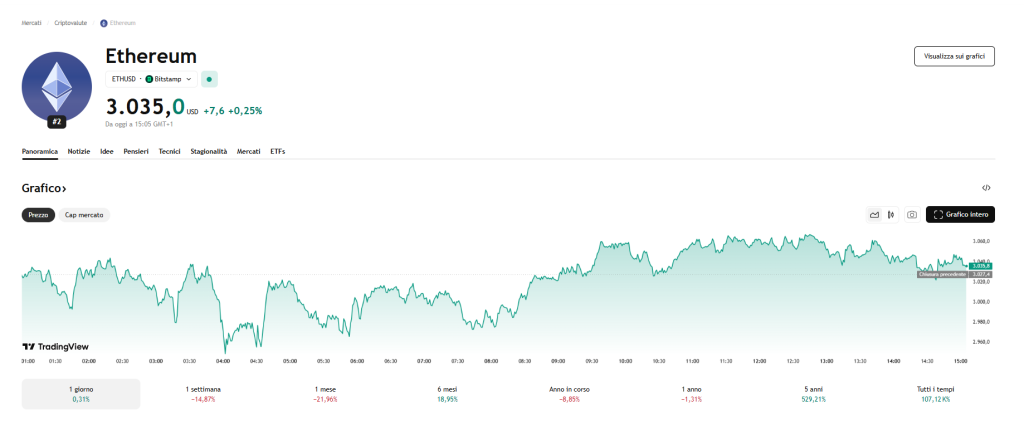
Sebbene quasi tutti i detentori corporate di Ethereum siano ancora acquirenti netti, il rapporto buy/sell ha iniziato a scendere mentre il prezzo dell’asset sta vivendo un periodo ribassista. Attualmente ETH è scambiato per circa 3.000 dollari, in un mese ha perso circa il 21% del proprio valore.
Editorial Process for bitcoinist is centered on delivering thoroughly researched, accurate, and unbiased content. We uphold strict sourcing standards, and each page undergoes diligent review by our team of top technology experts and seasoned editors. This process ensures the integrity, relevance, and value of our content for our readers.
Clara Rosati

Clara Rosati

Copywriter
Follow

Ha conseguito una laurea magistrale con una tesi sull’evoluzione della tecnologia blockchain, approfondendo in particolare le sue applicazioni nei sistemi economici digitali. Ha collaborato con diverse testate scrivendo articoli su criptovalute, finanza decentralizzata e innovazione tecnologica, e ha partecipato come relatrice a conferenze dedicate all’ecosistema Ethereum.

Trending Cryptos

Related Reads

Upbit is Anxious: A Hasty Counterattack Aimed at Regaining Stablecoin Market Share

Title: Upbit's Rushed Counterattack to Reclaim Stablecoin Market Share Facing a dramatic shift in South Korea's stablecoin market, leading exchange Upbit launched a promotional campaign from July 26 to August 9, waiving the 0.05% trading fee for stablecoins paired with the Korean Won (KRW) and rapidly listing new stablecoins like RLUSD and USDG. This move is a direct response to its plummeting market share in this sector. Historically a duopoly with Bithumb, the market has been reshaped since October 2025 when Coinone permanently removed fees for USDC trading. By June 2026, Coinone led with 34.8% of stablecoin volume, followed by Bithumb (31.1%) and Upbit (30.1%). This contrasts sharply with the overall crypto market, where Upbit commands 60%. The data shows stablecoin demand is highly sensitive to fees, as users primarily buy them to transfer capital overseas for derivatives trading or forex arbitrage. South Korean exchanges have seen a net outflow of stablecoins for 18 consecutive months, totaling approximately 14.9 trillion KRW, underscoring their role as a cross-border capital conduit. Upbit's limited-time promotion initially boosted its daily stablecoin volume by 162%, but the surge was almost entirely in USDT (98.1% of volume). The newly listed stablecoins saw negligible, fleeting interest. Furthermore, the promotional effect quickly waned in the second week, with volume dropping 33% on weekdays. A concurrent weakening of the KRW also contributed to the trading spike, independent of the fee waiver. The analysis suggests that once the promotion ends, Upbit is unlikely to retain its temporary gains unless it matches Coinone's permanent zero-fee policy, forcing a choice between market share and fee revenue. Upbit's strategic push may be less about immediate profit and more about preparing for future regulatory shifts. With South Korea's *Digital Asset Basic Act* on the horizon, which will regulate KRW-backed stablecoins, and following Dunamu's (Upbit's parent) integration into Naver Financial to build a payment ecosystem, securing a dominant position in the dollar stablecoin distribution channel holds long-term strategic value. However, potential regulatory conflicts could prevent Upbit from listing a future Naver-issued KRW stablecoin, making the current fight for dollar stablecoin flow even more critical.

marsbit5h ago

Upbit is Anxious: A Hasty Counterattack Aimed at Regaining Stablecoin Market Share

marsbit5h ago

Michael Saylor Compares Bitcoin and Gold!

Michael Saylor, founder of MicroStrategy, argues that Bitcoin fundamentally changes how wealth is stored and transferred by transforming digital scarcity into economic value. He describes Bitcoin as the first digital monetary network, combining computers, digital networks, and cryptography. It digitizes monetary assets, allowing their supply to be controlled by public protocols rather than institutions, thus converting economic value into information transmissible over global networks. Comparing Bitcoin to gold, Saylor states that while increasing Bitcoin's supply is harder, its integration with software and transfer is easier. He highlights Bitcoin's proof-of-work mechanism, which ties it to the physical world by consuming real energy to secure the ledger, making past transactions immutable. This creates a shared security system involving miners, energy companies, and investors. Saylor suggests "digital monetary energy" is a more accurate term than "digital gold." He emphasizes that the Bitcoin network is an adaptive ecosystem of miners, nodes, developers, and users. Its core design is intentionally simple, focused on maintaining a secure ledger for scarce digital assets, with complex functionalities built in higher-layer applications. This architecture allows Bitcoin to serve as a foundation for transmitting value and fostering innovation in payments and financial services. Saylor notes Bitcoin's deeper impact lies in creating digital sovereignty, where private keys give individuals permissionless control over their economic power, with ownership verified mathematically, not by institutions. He concludes that while gold's physical scarcity makes it money, Bitcoin's digital scarcity does the same, characterizing Bitcoin as the monetary energy of the digital age.

cryptonews.ru6h ago

Michael Saylor Compares Bitcoin and Gold!

cryptonews.ru6h ago

Trading

Spot

Hot Articles

Discussions

Welcome to the HTX Community. Here, you can stay informed about the latest platform developments and gain access to professional market insights. Users' opinions on the price of ETH (ETH) are presented below.

活动图片