Мнение: продажи 148 000 BTC «в панике» усилили риск падения биткоина ниже $90 000

cryptonews.ruPublished on 2025-11-16Last updated on 2025-11-17

Главное:

  • Новые держатели цифрового золота продали более 148 000 BTC с убытком 14 ноября.

  • Пробой цены ниже открытия года на $93 000 может запустить движение в зону ниже $90 000.

Биткоин (BTC) продолжил падение на фоне ослабления настроений после завершения шатдауна в США. Новый виток продаж пришелся на инвесторов, вошедших на пике рынка.

Это заставило инвесторов и трейдеров пересмотреть риски и сохранять осторожность: самые поздние покупатели уже продают свои биткоины с убытком.

Новые держатели фиксируют убытки

17 ноября цена первой криптовалюты упала до $92 000, почти полностью стерев рост с начала года. Завершение 43-дневного шатдауна в США так и не улучшило рыночные настроения, и инвесторы пересмотрели риски. Последние покупатели начали продавать актив по цене ниже своей себестоимости.

Биткоин откатился на 25% от исторического максимума $126 000, зафиксированного 6 октября. Пробой ниже 50-недельной скользящей средней и закрытие недели ниже $100 000 впервые за полгода усилили настороженность участников рынка.

Ончейн-данные CryptoQuant показали, что более 148 000 BTC у розничных инвесторов и «новичков» — держателей, чьи кошельки содержат менее 1 млн BTC и удерживали монеты меньше месяца — были проданы с убытком 11 ноября.

Аналитик CryptoQuant Crazzyblockk отметил, что распродажа произошла примерно на $96 853, что значительно ниже их средней цены покупки в диапазоне $102 000–107 000.

При этом Он подчеркнул, что это не фиксация прибыли, а масштабная продажа с явным убытком.

По теме: биткоин — не «волшебный анархо-капиталистический швейцарский нож» — Ник Сабо
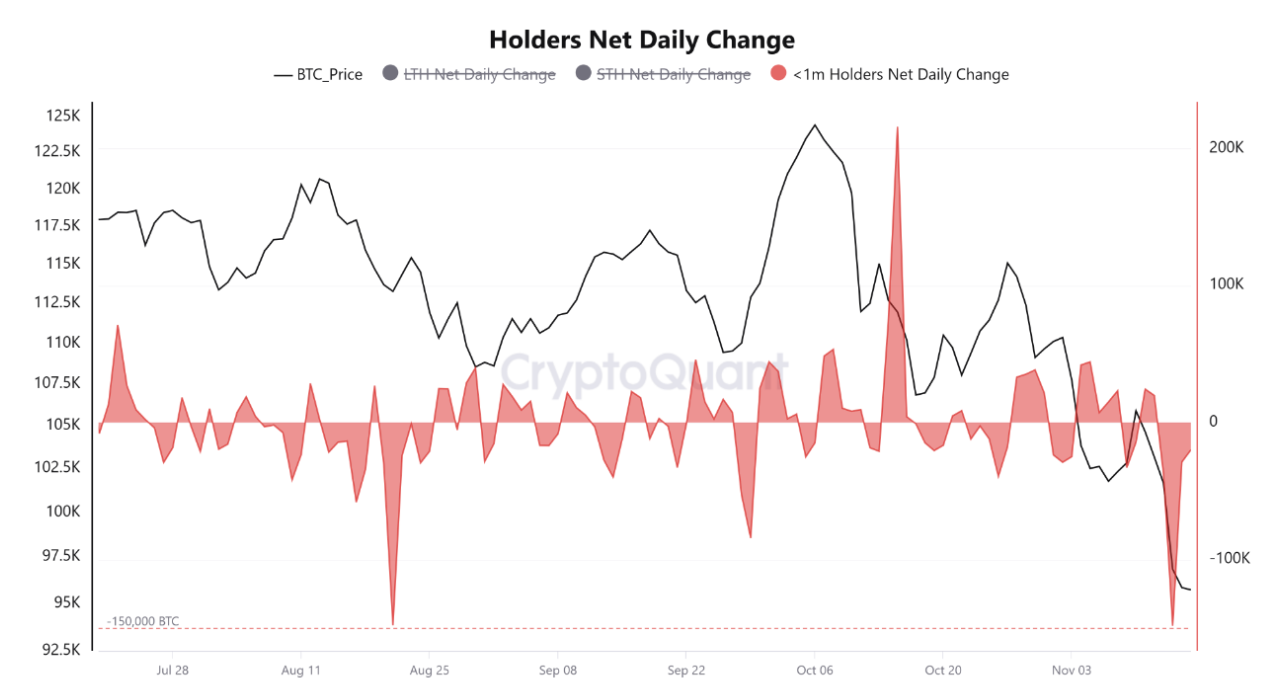
Ежедневный чистый приток и отток держателей биткоина. Источник: CryptoQuant.

Данные Glassnode показали, что краткосрочные держатели отправили 20 175 BTC на биржи с убытком 13 ноября. Этот показатель вырос до 39 034 BTC на следующий день, совпав с падением цены на 13,5% — до $92 900 с $107 500.
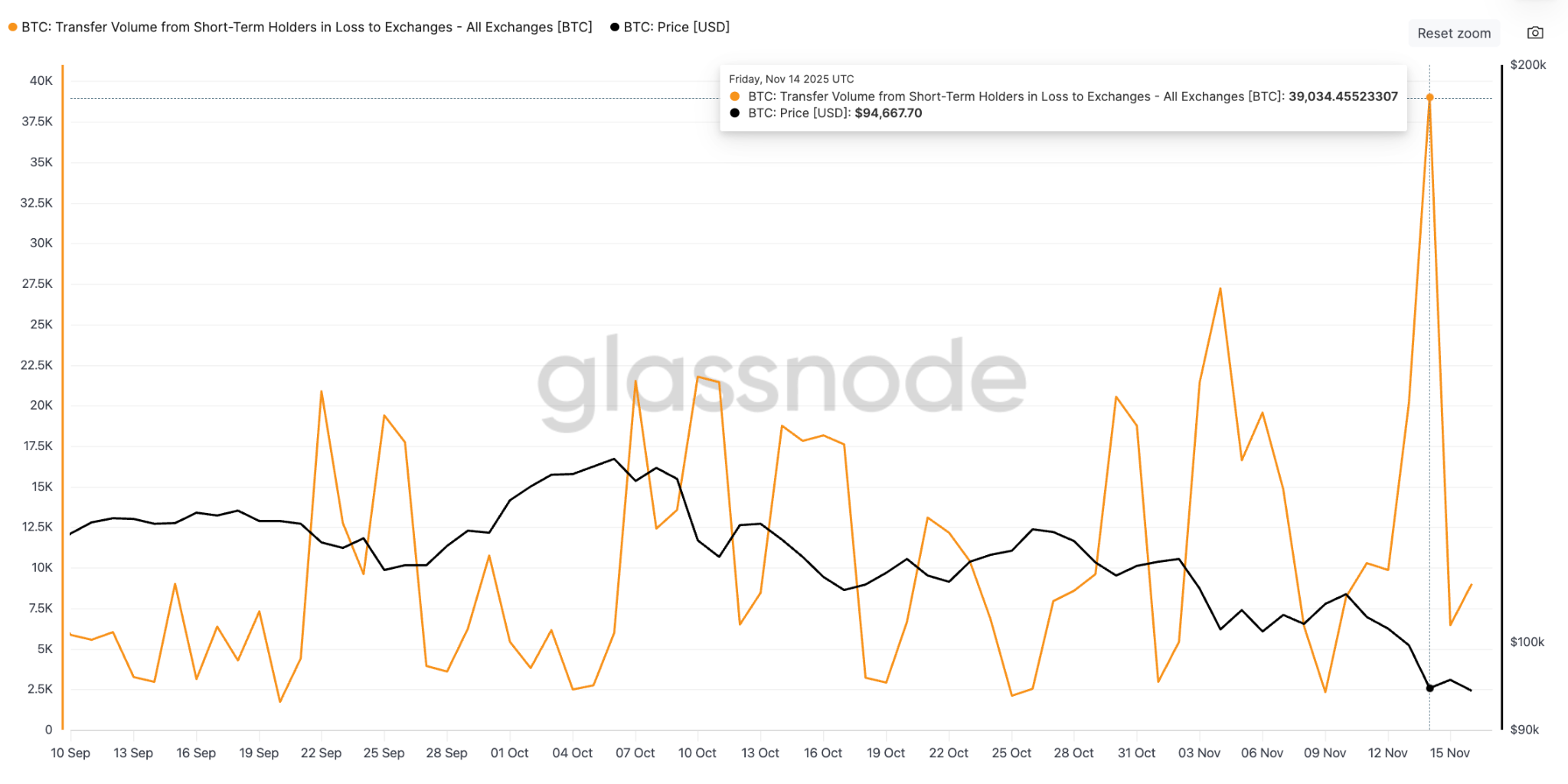
Объем переводов биткоина от краткосрочных держателей на биржи с фиксацией убытка. Источник: Glassnode.

Этот всплеск активности демонстрирует типичную модель поведения спекулянтов, которые в период просадки продают актив в панике.

По словам аналитика, многие из этих инвесторов переживают свое первое крупное падение и предпочитают зафиксировать убыток, чтобы избежать дальнейшего снижения.

«Сброс 148 000 BTC с убытком можно рассматривать как очищение рынка от нетерпеливого капитала. Это создает возможность перехода монет от паникеров к долгосрочным покупателям по сниженной цене, формируя более устойчивую базу на будущее», — добавил он.

По теме: биткоин вернулся в нейтральный режим? Приток монет на биржи совпал с ростом запасов стейблкоинов

Биткоин может упасть ниже $90 000 перед отскоком

Пробой ниже 50-недельной скользящей средней заставил многих аналитиков говорить о возможности более глубокого отката.

Аналитик Jelle считает, что цена находится в очередной коррекции внутри общего восходящего тренда биткоина. Он предположил, что рынок может двигаться боком до конца года либо скорректироваться еще на 5%, а затем начать обновлять максимумы.

«Падение на 5% от текущих уровней приведет пару BTC/USD к области $89 300», — заявил он.
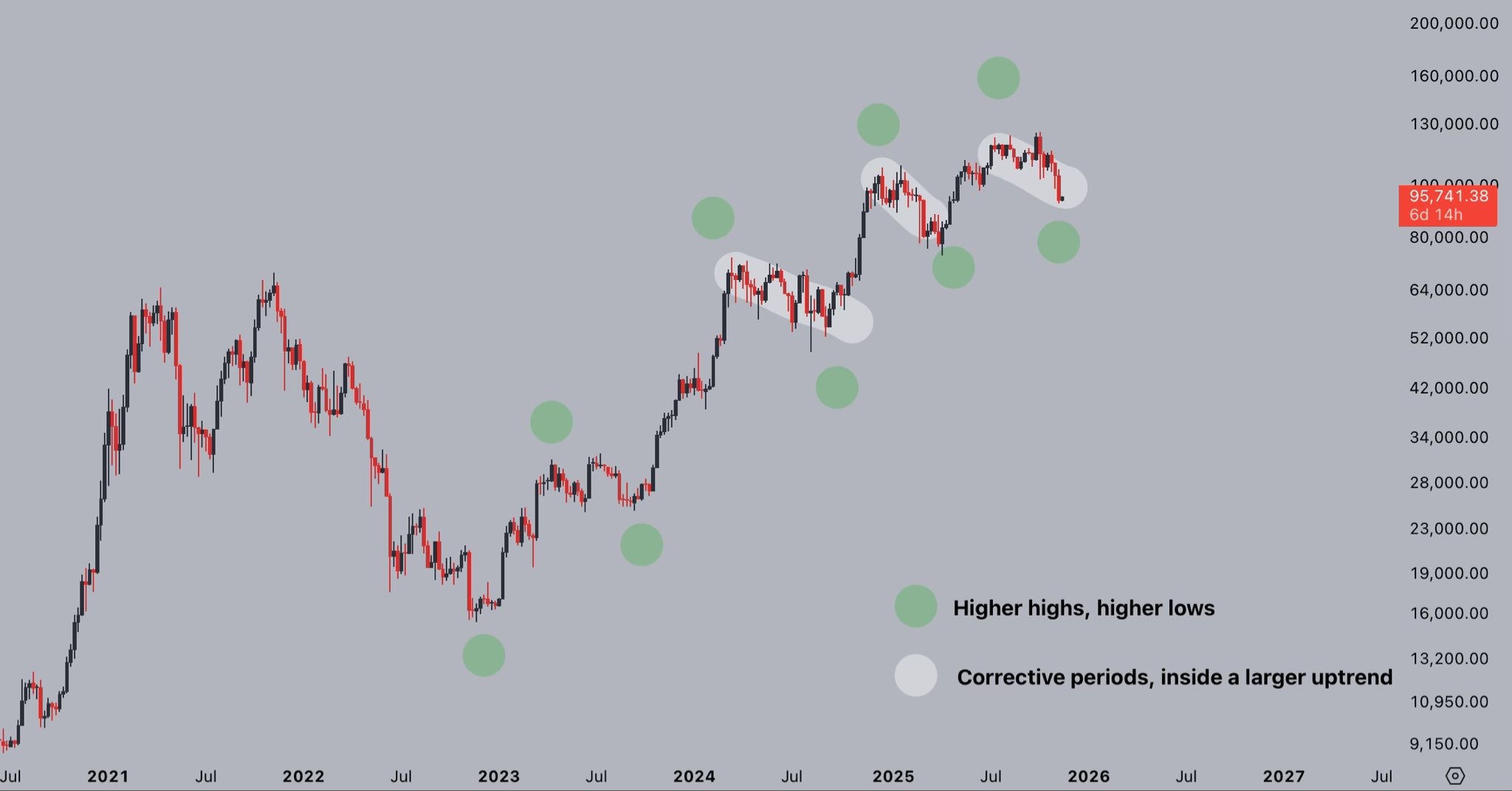
Недельный график BTC/USD. Источник: Jelle.

Аналитик AlphaBTC верит, что первая криптовалюта готова к локальному отскоку, но вероятен еще один заход ниже $90 000. По его мнению, закрытие ниже годового открытия на $93 300 может привести к снижению в сторону апрельских минимумов около $74 000.

Параллельно прогнозы Polymarket показывают разнонаправленные ожидания: сценарий с ценой $98 000 к концу недели оценивается в 70%, вероятность закрытия ниже $92 000 — 55%, а шанс ухода к $90 000 — 35%. Вероятность возврата выше $100 000 держится на уровне 50%.

По теме: Polymarket принял ставки на рост биткоина до $1 млн до релиза GTA VI

Эта статья не содержит инвестиционных советов или рекомендаций. Каждое инвестиционное и торговое решение связано с риском, читатели должны самостоятельно проводить исследование перед принятием решений.


Trending Cryptos

Related Reads

Embodied Intelligence 'Gaokao' is Insanely Hard, Humans Score 100, Best Model Only 12.8

Embodied AI Faces a Daunting "Everest": New Benchmark Reveals Huge Gap Between Models and Humans A comprehensive new benchmark for robotic manipulation, RoboDojo, has been released, painting a stark picture of the current state of embodied AI. It serves as a unified evaluation platform covering both simulation and real-world robot tasks. The benchmark assesses five core capabilities: Generalization (adapting to new scenes/objects), Memory, Precision manipulation, Long-Horizon multi-step tasks, and Open semantic understanding. It includes 42 simulation tasks and 18 standardized real-world tasks across three dual-arm robot platforms. The results are sobering. In simulation, the best-performing generalist robot policy achieved an average success rate of only 8.80%. Performance in the real world was slightly higher but still low, with the top model succeeding 12.8% of the time on average. In stark contrast, human experts scored 76.03% in simulation and 100% in real-world tests. The benchmark highlights significant, uneven gaps in current models' abilities. While some excel in specific areas like visual recognition or simple actions, they struggle with reliability, especially in long-horizon tasks where errors accumulate and in open-ended semantic instructions. The low scores, particularly in real-world deployment with physical uncertainties like camera noise and contact dynamics, underscore that today's models are far from being robust, general-purpose operational robots. RoboDojo is more than just a ranking; it's an infrastructure designed for fair, reproducible comparison. Its companion system, XPolicyLab, standardizes the interface for different models to be evaluated. Maintained by an academic consortium without commercial ties, it aims to provide a community-wide "altitude meter" to track genuine progress toward reliable and generalizable robot manipulation.

marsbit3m ago

Embodied Intelligence 'Gaokao' is Insanely Hard, Humans Score 100, Best Model Only 12.8

marsbit3m ago

Weng Li's New Blog Proposes 'Self-Evolution Should Start from Harness', DeepSeek's Cui Tianyi Endorses with Repost

Lilian Weng, former OpenAI security VP and co-founder of Thinking Machines Lab, has published a new blog post titled "Harness Engineering for Self-Improvement," proposing a pragmatic path for AI self-evolution. She argues that Recursive Self-Improvement (RSI) may practically begin at the "Harness" layer—the external runtime system governing how models use tools, manage context, and execute tasks—rather than directly from the model rewriting its own weights. The blog outlines a progression from optimizing prompts (Context Engineering) to designing workflows, and ultimately to Self-Improving Harness systems. These systems can identify their own weaknesses, propose targeted, verifiable modifications to the harness code, and validate improvements. Works like Self-Harness and Darwin Gödel Machine (DGM) demonstrate significant performance gains on benchmarks like SWE-bench through such automated harness evolution, rivaling handcrafted agents. DeepSeek researcher Tianyi Cui endorsed the view, noting harness-based self-evolution is as promising as model-based approaches. Weng emphasizes this is complementary to model training, with both reinforcing each other. However, key challenges remain: weak evaluators for subjective tasks, reward hacking, diversity collapse, managing long-term system health versus short-term success, and defining the human oversight role. The consensus is growing: the harness is a critical variable, as the same model can exhibit vastly different capabilities within different harness systems.

marsbit1h ago

Weng Li's New Blog Proposes 'Self-Evolution Should Start from Harness', DeepSeek's Cui Tianyi Endorses with Repost

marsbit1h ago

Trading

Spot

Hot Articles

What is $BITCOIN

DIGITAL GOLD ($BITCOIN): A Comprehensive Analysis Introduction to DIGITAL GOLD ($BITCOIN) DIGITAL GOLD ($BITCOIN) is a blockchain-based project operating on the Solana network, which aims to combine the characteristics of traditional precious metals with the innovation of decentralized technologies. While it shares a name with Bitcoin, often referred to as “digital gold” due to its perception as a store of value, DIGITAL GOLD is a separate token designed to create a unique ecosystem within the Web3 landscape. Its goal is to position itself as a viable alternative digital asset, although specifics regarding its applications and functionalities are still developing. What is DIGITAL GOLD ($BITCOIN)? DIGITAL GOLD ($BITCOIN) is a cryptocurrency token explicitly designed for use on the Solana blockchain. In contrast to Bitcoin, which provides a widely recognized value storage role, this token appears to focus on broader applications and characteristics. Notable aspects include: Blockchain Infrastructure: The token is built on the Solana blockchain, known for its capacity to handle high-speed and low-cost transactions. Supply Dynamics: DIGITAL GOLD has a maximum supply capped at 100 quadrillion tokens (100P $BITCOIN), although details regarding its circulating supply are currently undisclosed. Utility: While precise functionalities are not explicitly outlined, there are indications that the token could be utilized for various applications, potentially involving decentralized applications (dApps) or asset tokenization strategies. Who is the Creator of DIGITAL GOLD ($BITCOIN)? At present, the identity of the creators and development team behind DIGITAL GOLD ($BITCOIN) remains unknown. This situation is typical among many innovative projects within the blockchain space, particularly those aligning with decentralized finance and meme coin phenomena. While such anonymity may foster a community-driven culture, it intensifies concerns about governance and accountability. Who are the Investors of DIGITAL GOLD ($BITCOIN)? The available information indicates that DIGITAL GOLD ($BITCOIN) does not have any known institutional backers or prominent venture capital investments. The project seems to operate on a peer-to-peer model focused on community support and adoption rather than traditional funding routes. Its activity and liquidity are primarily situated on decentralized exchanges (DEXs), such as PumpSwap, rather than established centralized trading platforms, further highlighting its grassroots approach. How DIGITAL GOLD ($BITCOIN) Works The operational mechanics of DIGITAL GOLD ($BITCOIN) can be elaborated on based on its blockchain design and network attributes: Consensus Mechanism: By leveraging Solana’s unique proof-of-history (PoH) combined with a proof-of-stake (PoS) model, the project ensures efficient transaction validation contributing to the network's high performance. Tokenomics: While specific deflationary mechanisms have not been extensively detailed, the vast maximum token supply implies that it may cater to microtransactions or niche use cases that are still to be defined. Interoperability: There exists the potential for integration with Solana’s broader ecosystem, including various decentralized finance (DeFi) platforms. However, the details regarding specific integrations remain unspecified. Timeline of Key Events Here is a timeline that highlights significant milestones concerning DIGITAL GOLD ($BITCOIN): 2023: The initial deployment of the token occurs on the Solana blockchain, marked by its contract address. 2024: DIGITAL GOLD gains visibility as it becomes available for trading on decentralized exchanges like PumpSwap, allowing users to trade it against SOL. 2025: The project witnesses sporadic trading activity and potential interest in community-led engagements, although no noteworthy partnerships or technical advancements have been documented as of yet. Critical Analysis Strengths Scalability: The underlying Solana infrastructure supports high transaction volumes, which could enhance the utility of $BITCOIN in various transaction scenarios. Accessibility: The potential low trading price per token could attract retail investors, facilitating wider participation due to fractional ownership opportunities. Risks Lack of Transparency: The absence of publicly known backers, developers, or an audit process may yield skepticism regarding the project's sustainability and trustworthiness. Market Volatility: The trading activity is heavily reliant on speculative behavior, which can result in significant price volatility and uncertainty for investors. Conclusion DIGITAL GOLD ($BITCOIN) emerges as an intriguing yet ambiguous project within the rapidly evolving Solana ecosystem. While it attempts to leverage the “digital gold” narrative, its departure from Bitcoin's established role as a store of value underscores the need for a clearer differentiation of its intended utility and governance structure. Future acceptance and adoption will likely depend on addressing the current opacity and defining its operational and economic strategies more explicitly. Note: This report encompasses synthesised information available as of October 2023, and developments may have transpired beyond the research period.

675 Total ViewsPublished 2025.05.13Updated 2025.05.13

What is $BITCOIN

Discussions

Welcome to the HTX Community. Here, you can stay informed about the latest platform developments and gain access to professional market insights. Users' opinions on the price of BTC (BTC) are presented below.

活动图片