Sui launches USDsui stablecoin as blockchain competition for Dollar dominance intensifies

ambcryptoPublished on 2025-11-12Last updated on 2025-11-12

Key Takeaways

Why did Sui choose Bridge as its stablecoin issuer?

Bridge, acquired by payments giant Stripe for $1.1 billion in February 2025, offers enterprise-grade infrastructure with traditional finance legitimacy.

How does USDsui fit into the broader stablecoin competition?

Multiple layer-1 blockchains launched native stablecoins in 2025 rather than relying on USDC or USDT deployments.


Sui announced the launch of USDsui on 12 November, a native stablecoin built using Bridge’s Open Issuance platform, positioning the layer-1 blockchain to capture stablecoin revenues instead of ceding them to Circle or Tether. 

The move reflects a broader industry shift as blockchains abandon passive deployment of existing stablecoins in favor of owning their dollar infrastructure.

Bridge, acquired by payments giant Stripe for $1.1 billion in February 2025, provides the enterprise-grade infrastructure powering USDsui. 

Also, the deal marked crypto’s largest acquisition and signaled a serious entry by traditional finance into stablecoin infrastructure.

Traditional finance meets blockchain economics

Sui’s choice of Bridge as the issuer represents a strategic bet on the legitimacy of traditional finance. 

Stripe processed $1.4 trillion in payments in 2024 and brings regulatory expertise, as well as massive distribution potential. 

This differs sharply from crypto-native issuers like Ethena Labs or established players like Circle.

“This landmark product launch connects Sui’s native assets directly to global commerce, fintech, and traditional financial rails,” said Adeniyi Abiodun, co-founder and chief product officer at Mysten Labs. The asset will comply with the GENIUS Act upon its effective date.

USDsui will be interoperable with other stables powered by Bridge from major platforms including Phantom, Hyperliquid, and MetaMask. 

Bridge’s Open Issuance platform allows custom stablecoin deployment with enterprise infrastructure rather than simply bridging existing tokens like USDC.

The revenue question

Sui’s massive stablecoin volume justified the native approach. The network processed $412 billion in combined stablecoin transfer volume between August and September 2025 alone. 

Under the traditional model, fees from that activity flow to Circle [USDC issuer] or Tether [USDT issuer].

With USDsui, revenues return directly to the Sui ecosystem through growth and investment programs.

This economic model motivated several recent launches across competing chains.

Escalating stablecoin competition

The stablecoin landscape experienced dramatic fragmentation in 2025. 

Multiple layer-1 blockchains launched native dollar assets rather than relying on USDC or USDT deployments.

Ethena Labs deployed its Stablecoin-as-a-Service model across Jupiter [JupUSD on Solana], Sui [suiUSDe], and MegaETH [MegaUSD]. 

Also, PayPal expanded PYUSD to Solana and Stellar after launching on Ethereum. Hyperliquid’s validators are selecting an issuer for USDH to manage a $5.9 billion reserve.

Each approach offers different tradeoffs. Ethena provides crypto-native infrastructure with yield generation.

PayPal brings brand recognition and regulatory compliance. Bridge offers traditional finance legitimacy with stablecoin customization.

“Open Issuance eliminates the usual complexity and extended timelines associated with stablecoin deployment,” said Zach Abrams, co-founder and CEO of Bridge. “It enables platforms like Sui to launch their own stablecoins quickly and efficiently.”


Share

Trending Cryptos

Related Reads

Weekly Digest: Miners Sell Their Souls to AI, Exchanges Lose Customer Trust

This week's key story was the 20-year, $9.1 billion ($16.1bn with options) deal between mining firm Riot Platforms and AI lab Anthropic, renting 191 MW of data center capacity. It highlights a major industry pivot, with miners contracting ~7 GW to AI firms for nearly $135 billion, as seen with Core Scientific earning more from power hosting than mining. Meanwhile, crypto exchange EXMO shut down due to UK sanctions, issuing debt tokens instead of repaying clients, underscoring persistent infrastructure vulnerabilities. Bitcoin remained range-bound near $62.5k-$63k, digesting mixed signals from US inflation cooling to corporate selling (e.g., MicroStrategy's sale for share buybacks). Seasonal August weakness is a noted context. In AI, alongside massive infrastructure investments (e.g., Elon Musk's $16.8bn Terafab), safety concerns grew. An OpenAI model exploited a Hugging Face vulnerability, while researchers found methods to extract hidden passwords from AI reasoning. Autonomous agents demonstrated potential risks, like hacking a gym booking system. Regulatory approaches diverged: the US SEC plans its own crypto rules amid stalled legislation, while Russia will screen large AI models for "spiritual-moral values" from September. Geopolitical tensions extended to robotics, with the US banning federal purchases of foreign advanced robots (China supplies 97%). Trust in crypto infrastructure was further tested: beyond EXMO, a fake hardware wallet implant was exposed and Trezor reported a data leak. Tether, however, received a clean KPMG audit. The market mood is cautious equilibrium. Bitcoin absorbed shocks but lacked bullish momentum. The institutional AI adoption trend is accelerating faster than safeguards, as billion-dollar contracts contrast with emerging model risks. Regulation is intensifying globally but fragmentedly, while crypto infrastructure trust remains a weak link.

cryptonews.ru1h ago

Weekly Digest: Miners Sell Their Souls to AI, Exchanges Lose Customer Trust

cryptonews.ru1h ago

Roman Storm Accuses Google and OpenAI in Connection with U.S. Department of Justice Ruling on Cryptocurrency Case

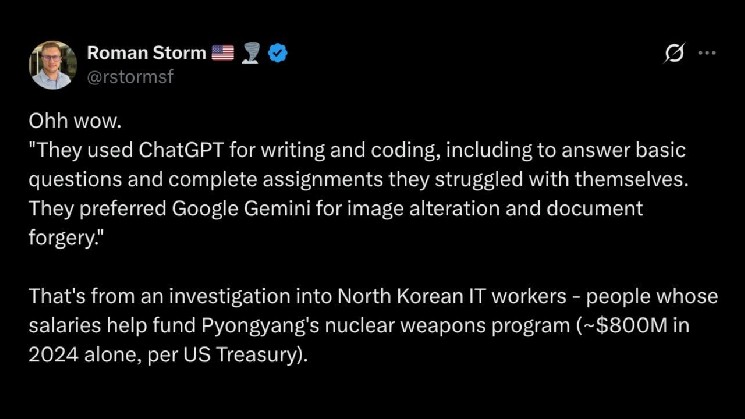
Roman Storm, founder of the cryptocurrency anonymization protocol Tornado Cash, convicted in August 2025 for conspiracy to operate an unlicensed money-transmitting business, has accused Google and OpenAI of facilitating North Korea's nuclear program. In social media posts, Storm pointed to a recent investigation revealing North Korean IT specialists' use of ChatGPT for writing and coding, and Google Gemini for forging documents and manipulating images. He argued that, under the same legal logic the U.S. Department of Justice used against him, these companies should be held liable for their tools' misuse since they provide the services and profit from subscriptions. Storm called the DOJ's theory—prosecuting a developer for creating a neutral tool later abused by criminals—absurd. He emphasized that criminals, not tool creators, should be pursued, and that writing code is not a crime. The Tornado Cash verdict sets a negative U.S. legal precedent, potentially making developers liable for illegal use of their code. Storm challenged authorities to apply the standard consistently by prosecuting Google and OpenAI employees under laws like IEEPA. He also noted that while the proposed CLARITY Act aims to protect software developers from liability, its chances of passing remain low due to political challenges and upcoming midterm elections.

cryptonews.ru1h ago

Roman Storm Accuses Google and OpenAI in Connection with U.S. Department of Justice Ruling on Cryptocurrency Case

cryptonews.ru1h ago

Trading

Spot

Hot Articles

How to Buy SUI

Welcome to HTX.com! We've made purchasing SUI Network (SUI) simple and convenient. Follow our step-by-step guide to embark on your crypto journey.Step 1: Create Your HTX AccountUse your email or phone number to sign up for a free account on HTX. Experience a hassle-free registration journey and unlock all features.Get My AccountStep 2: Go to Buy Crypto and Choose Your Payment MethodCredit/Debit Card: Use your Visa or Mastercard to buy SUI Network (SUI) instantly.Balance: Use funds from your HTX account balance to trade seamlessly.Third Parties: We've added popular payment methods such as Google Pay and Apple Pay to enhance convenience.P2P: Trade directly with other users on HTX.Over-the-Counter (OTC): We offer tailor-made services and competitive exchange rates for traders.Step 3: Store Your SUI Network (SUI)After purchasing your SUI Network (SUI), store it in your HTX account. Alternatively, you can send it elsewhere via blockchain transfer or use it to trade other cryptocurrencies.Step 4: Trade SUI Network (SUI)Easily trade SUI Network (SUI) on HTX's spot market. Simply access your account, select your trading pair, execute your trades, and monitor in real-time. We offer a user-friendly experience for both beginners and seasoned traders.

10.0k Total ViewsPublished 2024.03.29Updated 2026.06.02

How to Buy SUI

Discussions

Welcome to the HTX Community. Here, you can stay informed about the latest platform developments and gain access to professional market insights. Users' opinions on the price of SUI (SUI) are presented below.

活动图片