First Spot XRP ETFs Expected to Launch This Week, Expert Predicts

bitcoinistPublished on 2025-11-10Last updated on 2025-11-10

Abstract

A prominent exchange-traded fund specialist says the first US spot XRP ETFs could debut within days, as Washington moves to...

Trusted Editorial content, reviewed by leading industry experts and seasoned editors. Ad Disclosure

A prominent exchange-traded fund specialist says the first US spot XRP ETFs could debut within days, as Washington moves to end the longest federal shutdown on record and multiple funds surfaced on the Depository Trust & Clearing Corporation’s (DTCC) “active and pre-launch” roster. “Government shutdown ending = spot crypto ETF floodgates opening… In meantime, could see first ‘33 Act spot XRP ETF launch this week,” Nate Geraci wrote on X early Monday, November 10.

Spot XRP ETF Launch This Week?

The timing hinges on fast-moving developments in Washington. On Monday, November 10, Senate leaders advanced a funding package intended to reopen the government, a step that would bring furloughed Securities and Exchange Commission staff back to work and unfreeze routine registration processing.

Even as the shutdown lingers, infrastructure for prospective spot funds is materializing. DTCC’s official “Exchange Traded Funds – Active and Pre Launch” file—updated November 7—now includes several applicants: Bitwise XRP ETF, Canary XRP ETF, CoinShares XRP ETF, 21Shares XRP ETF, and Franklin XRP ETF. DTCC’s own disclaimer on that page is explicit: the file lists both active ETFs and “pre launch” products that “are not yet active” and cannot be processed “unless and until such securities have received all necessary regulatory and other approvals.”

The convergence of DTCC listings with a prospective government reopening is why Geraci—one of the most closely followed voices in the ETF industry—frames the next several days as a potential inflection point. His post also nods to the legal mechanism that could enable a near-term debut: the Securities Act of 1933’s Section 8(a) pathway to automatic effectiveness.

In recent weeks, several crypto ETF issuers have removed the traditional “delaying amendment” from their S-1 registration statements, which—absent SEC action—allows a filing to go effective automatically after 20 days.

None of the above, however, substitutes for an approval order or the passage of the Section 8(a) waiting period. DTCC listings historically function as plumbing—CUSIP, symbol, and processing readiness—rather than a regulatory blessing.

The presence of leveraged or strategy products tied to the token on the same DTCC sheet and the mix of “Y/N” notations in the “Create/Redeem” column further underscore that DTCC is cataloging what could be processed, subject to regulatory status, rather than declaring anything active. The agency’s own header language leaves no ambiguity on that point.

The policy backdrop matters. Multiple newsrooms reported across the weekend and into Monday that the Senate has taken concrete steps toward reopening the government. If the House follows and the President signs, SEC staff would return, potentially accelerating routine correspondence and any last-mile logistics for issuers that chose not to rely on 8(a) automatic effectiveness.

Until then, issuers that did remove delaying amendments technically do not need an affirmative SEC declaration to become effective after the 20-day clock, but they remain exposed to potential SEC comments or interventions once operations normalize.

At press time, XRP traded at $2.48.
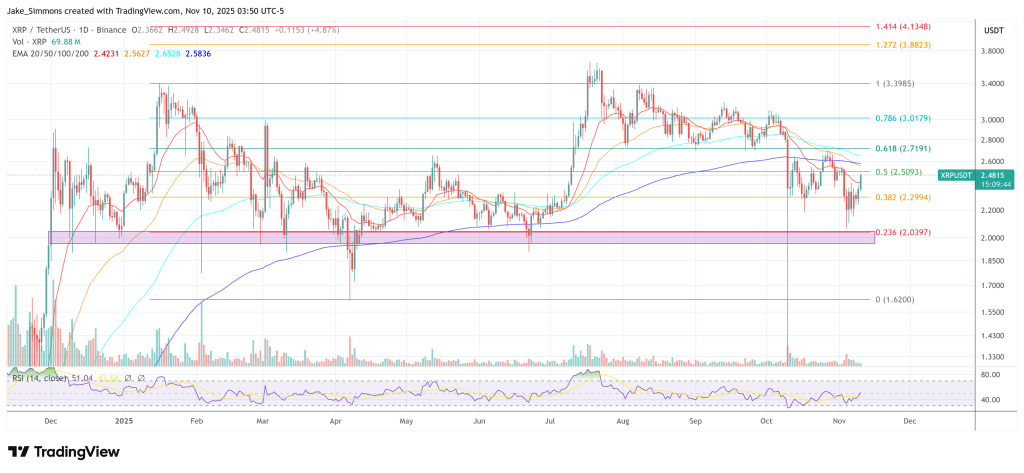
XRP price
XRP price, 1-day chart | Source: XRPUSDT on TradingView.com
Featured image created with DALL.E, chart from TradingView.com
Editorial Process for bitcoinist is centered on delivering thoroughly researched, accurate, and unbiased content. We uphold strict sourcing standards, and each page undergoes diligent review by our team of top technology experts and seasoned editors. This process ensures the integrity, relevance, and value of our content for our readers.

Jake Simmons has been a Bitcoin enthusiast since 2016. Ever since he heard about Bitcoin, he has been studying the topic every day and trying to share his knowledge with others. His goal is to contribute to Bitcoin's financial revolution, which will replace the fiat money system. Besides BTC and crypto, Jake studied Business Informatics at a university. After graduation in 2017, he has been working in the blockchain and crypto sector. You can follow Jake on Twitter at @realJakeSimmons.

Trending Cryptos

Related Reads

The Tokenization of Gold: A Financial Revolution Driven by Regulation

The Tokenization of Gold: A Regulation-Driven Financial Revolution In early 2025, anticipation of US tariffs triggered a rush to withdraw physical gold from the Bank of England, exposing the friction in London's $1.2 trillion gold market. While daily trading of $737 billion occurs via ownership certificates without moving bullion, demand for physical metal revealed a pricing split based on deliverability. This article explores why the UK's Financial Conduct Authority (FCA) is developing rules for tokenized gold, focusing regulation squarely on the ledger system. London's gold market, cleared by four major banks, performs four key functions: physical storage, quality verification, ownership registration, and credit provision. Tokenization excels at the third—offering cheap, precise ownership records—but fundamentally challenges the fourth by potentially rendering banks' credit intermediation obsolete. Currently, most gold is held in "unallocated" accounts, where investors are unsecured creditors of banks, trading speed for credit risk. Tokenized gold combines the instant transfer of unallocated accounts with the direct ownership claim of allocated bullion, eliminating bank risk. The FCA is prioritizing its use as collateral, where speed is critical, unlocking this vast pool of currently illiquid assets for margin calls. This shift is partly driven by post-2008 banking regulations like Basel III's Net Stable Funding Ratio, which penalized banks for holding unallocated gold. The push now comes from the清算 banks themselves, like HSBC, which have launched proprietary tokenization systems. The crucial regulatory decision will be whether these tokens are allowed to circulate outside their creators' closed ecosystems. True adoption will be visible in LBMA data: high overall trading volume paired with a decline in settlements through the traditional central ledger, as transactions move to instant blockchain transfers. Ultimately, tokenization doesn't replace the physical vaults, security, and assayers but could elevate their importance, shifting their revenue to standardized service fees. The revolution lies not in moving the gold, but in reinventing how its ownership is recorded and transferred.

marsbit3m ago

The Tokenization of Gold: A Financial Revolution Driven by Regulation

marsbit3m ago

Yield Leverage and Liquidity Leverage: The STONKBROKER Mechanism is Very Suitable for the RWA Scenario

The article argues that the STONKBROKER mechanism is highly suitable for Real-World Asset (RWA) tokenization scenarios due to its two key leverages: **Profit Leverage** and **Liquidity Leverage**. **Profit Leverage:** Traditional RWA models simply tie tokens to real-world asset yields. STONKBROKER's model is more engaging by allowing NFT holders to earn not only the underlying real-world cash flows but also additional yields generated from the on-chain system's own operations and transaction activity (like fees and slippage). This creates a dual income stream. **Liquidity Leverage:** Standard RWA asset bundles often suffer from poor liquidity. STONKBROKER's mechanism, which allows fixed-ratio swapping between NFTs and a platform's fungible token (and vice versa), solves this. It provides real-time market pricing and flexible exit options for each "RWA asset" NFT by unifying NFT liquidity with ERC-20 token liquidity via an AMM pool. This enhances capital efficiency and attracts more trading activity. The article further speculates on applying this model to broader RWAs (e.g., real estate, bonds). The core idea is to create a more dynamic, liquid, and profitable ecosystem where ordinary users can participate, combining real-world yields with the speculative and transactional energy of a crypto-native system. The author mentions being inspired by the launch of a project called @TheCardWall, which tokenizes high-grade physical trading cards.

marsbit23m ago

Yield Leverage and Liquidity Leverage: The STONKBROKER Mechanism is Very Suitable for the RWA Scenario

marsbit23m ago

Deciphering TapeOut: A Child Built a CPU On-Chain

**Title: Understanding TapeOut: A Kid Built a CPU On-Chain** **Summary:** The article explores a remarkable experiment where a young developer named Blonskr has used blockchain technology to build a functional, on-chain CPU. Named "Behemoth," this CPU is based on the 1971 Intel 4004 processor specification. It runs on the BNB Chain, uses block production as its clock (running at a glacial 2.22 Hz), and is perhaps the slowest CPU in existence, yet it represents a novel and intriguing concept in the on-chain space. The core concept is the TapeOut protocol, named after the final "tape out" stage in semiconductor manufacturing. It treats the blockchain as a silicon wafer, with tokens representing fundamental logic components. The protocol's atomic unit is an ERC-1155 token representing a single NAND gate, the fundamental building block of digital logic. Users can visually design circuits on a "canvas," connecting these logic tokens. Once a design is finalized, the underlying tokens are burned, and an ERC-721 NFT representing the permanent, immutable circuit is minted. Blonskr used 2,300 such tokenized NAND gates to construct the Behemoth CPU. Key features of this and any TapeOut circuit include **permanent operation** (running as long as the chain exists), **free, permissionless evaluation** (anyone can query it without gas), and **safe composability** (circuits cannot call external contracts or modify state, making them inherently safe to use). This enables a new form of open, collaborative hardware design, where anyone can build upon and integrate components created by others. While highly niche, TapeOut reimagines the foundations of computation using blockchain's properties of permanence and openness. It pushes the boundaries of what can be built on-chain, potentially enabling future applications like custom mining circuits or decentralized, specialized processors. The experiment demonstrates an exciting combination of extreme technical vision and creative curiosity.

marsbit57m ago

Deciphering TapeOut: A Child Built a CPU On-Chain

marsbit57m ago

Novig Sues Wisconsin as Sports Prediction Market Dispute Heats Up

Novig, a sports event prediction market operator, has filed a lawsuit against Wisconsin's attorney general. The legal dispute centers on whether prediction markets fall under federal derivatives regulations or state gambling laws. The lawsuit, filed in a U.S. district court, seeks a declaratory judgment after Novig began offering event contracts to Wisconsin residents. This case is part of a broader conflict. In April, Wisconsin sued other prediction market platforms like Kalshi and Polymarket, alleging their sports-related contracts violate state gambling laws. Novig argues its contracts are "swaps" regulated exclusively by the federal Commodity Futures Trading Commission (CFTC), under the Commodity Exchange Act. Wisconsin contends they are sports betting. Federal courts have issued conflicting rulings on similar cases, creating legal uncertainty. The outcome is significant as prediction markets are a fast-growing sector, with trading volume reaching $9.5 billion on a single day in August. These markets are also increasingly intertwined with cryptocurrency infrastructure. Simultaneously, Novig is pursuing a nationwide legal strategy, having filed similar lawsuits in four other states. The company also recently secured a marketing partnership with the New York Mets, marking the first such deal with an MLB team. The Wisconsin case's resolution will influence whether prediction markets can operate as national financial products or remain constrained by individual state laws.

cryptonews.ru1h ago

Novig Sues Wisconsin as Sports Prediction Market Dispute Heats Up

cryptonews.ru1h ago

Держатели XRP могут торговать опционами на платформе Derive, используя FXRP в качестве залога

XRP holders can now trade options on the Derive platform using FXRP as collateral, as announced by Flare on August 12. This integration allows users to open positions from self-custody wallets while the underlying XRP backing the FXRP remains on the XRP Ledger. According to DeFi analyst Will Procheska, this provides XRP's dedicated holder base with a permissionless options market for generating yield or hedging. Derive's platform combines protocol-level settlements with an order book managed by Derive Trading Co., enabling users to retain asset control while professional market-makers provide liquidity. XRP options on Derive are cash-settled in USDC, so profits or obligations adjust the trader's USDC balance without transferring XRP or FXRP. The platform's portfolio margin system assesses overall account risk but may still trigger liquidations if margin levels fall below requirements. The launch expands Flare's XRPFi ecosystem. FXRP, introduced via the FAssets system in September 2025, creates an on-chain representation of XRP for use in smart contracts. It has since been integrated into spot trading and, more recently, permissionless lending markets on Morpho. This addition of options on Derive offers XRP holders hedging and premium-earning capabilities comparable to other major assets. While regulated XRP options debuted on CME Group in October 2025, Derive provides a decentralized alternative with USDC settlement and direct wallet access. The platform also supports perpetual futures, offering further trading strategies. Flare and Derive are exploring automated "strategy vaults" to simplify yield-generating options approaches for users.

cryptonews.ru1h ago

Держатели XRP могут торговать опционами на платформе Derive, используя FXRP в качестве залога

cryptonews.ru1h ago

Trading

Spot

Hot Articles

What is XRP 2.0

XRP 2.0: A New Frontier in the Cryptocurrency Landscape Introduction to XRP 2.0 In the ever-evolving realm of cryptocurrency, new projects continuously emerge, vying for attention and adoption. One such promising initiative is XRP 2.0, a novel cryptocurrency project designed to leverage advanced blockchain technology and robust encryption methodologies. While the name draws parallels with Ripple’s XRP, it’s crucial to note that XRP 2.0 operates independently, focusing on enhancing transaction security, privacy, and scalability. As the digital financial landscape increasingly embraces decentralized solutions, XRP 2.0 aims to contribute meaningfully to web3 and the overall expansion of crypto projects. What is XRP 2.0? At its core, XRP 2.0 is a cryptocurrency project that aims to create a secure and decentralized digital currency ecosystem. Its foundational technology integrates sophisticated blockchain principles with cutting-edge encryption techniques. The overarching goal of XRP 2.0 is to establish itself as a reliable and efficient platform enabling swift transaction execution while prioritizing enhanced privacy protections for its users. The project is promoted as a solution to many limitations faced by existing cryptocurrencies, proposing a system that can handle a higher volume of transactions with improved speed and privacy. This versatility positions XRP 2.0 as a significant contender in a marketplace riddled with various digital currencies. Who is the Creator of XRP 2.0? The identity of the creator behind XRP 2.0 has been flagged as ‘Wilbur.’ However, comprehensive details regarding Wilbur or their associated entity remain elusive. The anonymity of many cryptocurrency creators is not an uncommon phenomenon in the industry, often designed to maintain a degree of privacy and security. Who are the Investors of XRP 2.0? As of now, specific information related to the investment foundations or organizations supporting XRP 2.0 is not publicly available. In the cryptocurrency sector, the backing by reputed investors can significantly influence a project's credibility and success, yet the transparency regarding the financial supporters of XRP 2.0 has not been established. How Does XRP 2.0 Work? XRP 2.0 stands out by employing a combination of blockchain technology and advanced encryption algorithms that ensures secure and decentralized transactions. Its innovative structure includes unique features designed to foster user engagement and broaden functionalities beyond conventional cryptocurrency transactions. Among these features, XRP 2.0 incorporates AI-powered capabilities, such as text-to-image and text-to-speech functionalities. These additions are designed to enhance the interactive experience for users, promoting broader applicability across various sectors. By bridging technological advancements with user-centered design, XRP 2.0 aims to capture the attention of a diverse range of individuals and enterprises looking to integrate cryptocurrency solutions into their operational frameworks. Timeline of XRP 2.0 Understanding XRP 2.0 requires examining the milestones that have defined its journey thus far: July 23, 2023: XRP 2.0 is introduced as a novel cryptocurrency project, aiming to revolutionize secure and decentralized transaction capabilities in the blockchain domain. September 8, 2023: The launching of another project, XRP20, occurs, marking the emergence of an ERC-20 token on the Ethereum blockchain that remains unrelated to XRP 2.0. November 13, 2023: The XRP Ledger undergoes a significant update with the release of rippled server software version 2.0.0. It is essential to note that this development is disconnected from the XRP 2.0 cryptocurrency project. Key Points About XRP 2.0 To distill the essence of XRP 2.0, several critical factors emerge: Unique Features: The inclusion of features like AI-powered text-to-image and text-to-speech further diversifies the potential applications of XRP 2.0. Blockchain Technology: The framework utilizes advanced blockchain mechanisms and encryption protocols, ensuring a secure and decentralized environment for transactions. Scalability and Privacy: XRP 2.0 prioritizes enhanced privacy protections in transaction processes and the scalability necessary to accommodate a growing user base. No Affiliation with Ripple: Importantly, despite its name, XRP 2.0 does not have any allegiance or collaboration with Ripple’s XRP, distinguishing its operational framework and objectives within the cryptocurrency ecosystem. Conclusion XRP 2.0 represents an ambitious venture into the cryptocurrency sphere, aiming to offer a combination of security, privacy, and efficiency in digital transactions. By integrating sophisticated technologies and user-friendly features, the project sets out to broaden the horizons of what cryptocurrency can achieve in today's digital economy. While the anonymity of its creator and lack of disclosed investors might raise questions for some, XRP 2.0's focus on advanced functionalities and decentralisation enhances its appeal amidst an increasingly crowded crypto market. As the cryptocurrency landscape continues to evolve, XRP 2.0 may yet emerge as a pivotal player in the expansion of secure and scalable blockchain solutions.

1.5k Total ViewsPublished 2024.04.01Updated 2024.12.03

What is XRP 2.0

Discussions

Welcome to the HTX Community. Here, you can stay informed about the latest platform developments and gain access to professional market insights. Users' opinions on the price of XRP (XRP) are presented below.

活动图片