US Gov’t Shutdown Deal Sparks Hope For Crypto Market Relief

bitcoinistPublished on 2025-11-10Last updated on 2025-11-10

Abstract

A Washington deal is giving fresh life to global markets, and crypto traders are cautiously optimistic after weeks of turmoil....

Trusted Editorial content, reviewed by leading industry experts and seasoned editors. Ad Disclosure

A Washington deal is giving fresh life to global markets, and crypto traders are cautiously optimistic after weeks of turmoil. Relief is sweeping through digital assets, stocks, and futures amid the recent move to end the US government shutdown.

Senate Moves To End Shutdown

The US Senate has reportedly advanced a funding measure that will keep the government running until January 30, 2026, while reinstating some federal employees affected by the shutdown.

After 40 days of a partial government shutdown that caused problems with food aid, air travel, and public services, US senators and the White House have finally reached a deal to reopen the government, likely bringing an end to one of the longest shutdowns in recent years.

The measure would prohibit federal agencies from ending the job contracts of employees until January 30, a welcome move for federal worker unions and their allies. It would stall US President Donald Trump’s campaign to trim down the federal workforce.

The debate in Congress came as Trump again called on Sunday to replace subsidies for the Affordable Care Act’s health insurance marketplaces with direct payments to individuals. Those subsidies, which helped boost ACA enrollment to 24 million since 2021, are a key reason behind the shutdown. Republicans say they’re willing to talk about the issue, but only after government funding is back in place.

Relief For Crypto

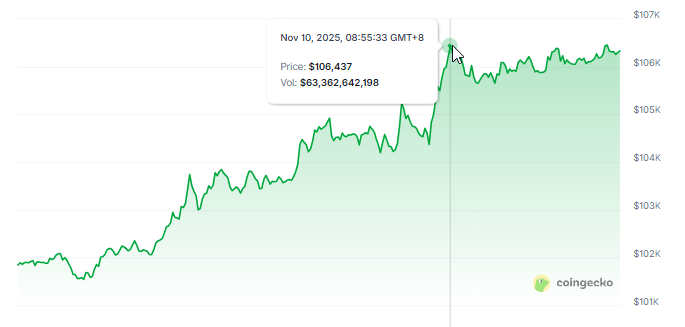
The markets reacted soon after. Bitcoin had tumbled below the $100,000 mark for the first time earlier this week but is now back above $106,000. Ethereum surged around 6% while XRP gained about 8%. Yet the measure still needs final approval from the House and the president’s signature before taking effect.
A Roller-Coaster Month For Bitcoin

According to CoinGecko data, Bitcoin first surged to a new all-time high of $126,080 six days into the government shutdown on October 6. But that rally was short-lived. The world’s largest cryptocurrency has since plunged more than 17% to trade around $105,000 as of Monday.

Its most drastic slide occurred on October 10, when prices plummeted by double digits following an announcement that the US had levied 100% tariffs on China; a move that rattled investors and triggered heavy selling across both traditional and digital markets.
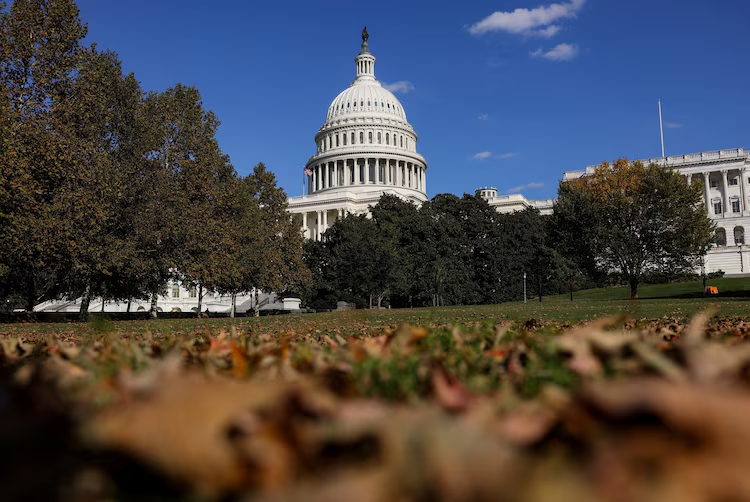
The US Capitol. Image: Kylie Cooper/Reuters

Short-Term Lift For Risk Assets

Reports have revealed that the Senate’s action brought a wave of optimism to markets hungry for clarity. Crypto futures trading volumes rose and funding rates flipped positive as traders bet on a short-term rebound.

But analysts warned such rallies often dissipate quickly. Many described the market reaction as “relief buying” rather than any shift in long-term fundamentals. Restoring economic data releases — including labor reports and federal spending figures — could help recalibrate expectations for Federal Reserve rate decisions, which remain a major driver for cryptocurrencies.

As of today, the market cap of cryptocurrencies stood at $3.52 trillion. Chart: TradingView

Market watchers are now focused on two things: the final passage of the shutdown bill and whether the upcoming US economic data will confirm the signs of cooling inflation. If both events align, then risk assets, including Bitcoin, might have a more stable recovery.

The deal talk has provided a temporary respite after weeks of uncertainty. Yet the market’s recent swings show just how fragile confidence remains in the face of politics, tariffs and global tension.

Featured image from Radu Florin on Unsplash, chart from TradingView

Editorial Process for bitcoinist is centered on delivering thoroughly researched, accurate, and unbiased content. We uphold strict sourcing standards, and each page undergoes diligent review by our team of top technology experts and seasoned editors. This process ensures the integrity, relevance, and value of our content for our readers.

Christian, a journalist and editor with leadership roles in Philippine and Canadian media, is fueled by his love for writing and cryptocurrency. Off-screen, he's a cook and cinephile who's constantly intrigued by the size of the universe.

Trending Cryptos

Related Reads

Anthropic CEO: AI will help defeat most diseases in 5–10 years

Dario Amodei, co-founder and CEO of Anthropic, predicts that artificial intelligence could enable humanity to cure or prevent most diseases within 5 to 10 years. He shared this view on social media, acknowledging it may seem overly optimistic but considers it realistic if the rapid development of powerful AI systems continues. Amodei clarifies this does not mean a single universal cure, but rather a scenario where AI dramatically accelerates biological research and therapy development. He elaborated on this concept in his essay "Machines of Loving Grace," estimating that sufficiently powerful AI could accelerate progress in biology and medicine by roughly tenfold, compressing a 50-100 year timeline into 5-10 years. Potential outcomes include significantly reducing cancer mortality, preventing or treating most genetic diseases, advancing the fight against Alzheimer's, and improving therapies for cardiovascular, autoimmune diseases, diabetes, and obesity. However, Amodei notes that real-world progress will still be constrained by the need for lab research, clinical trials, and regulatory approvals—steps AI cannot bypass. Anthropic is reportedly expanding its projects in biology and medicine, expecting initial signs of results soon and more substantial achievements in the coming years. The company has launched its "AI for Science" program, providing researchers access to its models for biology, genetics, and drug discovery projects. The statement is also viewed within a broader corporate context. Following a funding round valuing Anthropic at over $960 billion and projecting substantial revenue growth, investors are likely expecting tangible results beyond chatbots and code generation. Breakthroughs in biology and medicine represent a key argument to justify such a high market valuation. The open question remains whether AI-driven acceleration will lead to actual treatments or primarily enhanced data analysis tools for researchers.

cryptonews.ru2m ago

Anthropic CEO: AI will help defeat most diseases in 5–10 years

cryptonews.ru2m ago

A Critical Moment for Capital? The AI Narrative Shifts from Technology to Financing, Giants' Cash Flow Dries Up, Debt Markets Sound Alarm

The narrative of AI investment is shifting from a technology story to a capital expenditure story, and now to a financing story. This marks a "critical moment for capital," as noted by Bridgewater's Greg Jensen. Morgan Stanley forecasts that the total cost of AI infrastructure through 2028 will reach $3.2 trillion, with approximately $1.75 trillion expected to be raised from credit markets. However, free cash flow projections for major hyperscale cloud providers are declining sharply, with Oracle's 2027 forecast nearing -$40 billion. The bond market is already pricing in the rising risks. Apollo data shows AI-related bonds constitute 40% of long-duration supply. Credit spreads for hyperscalers have widened significantly this year—around 25 basis points for high-quality names—while the overall investment-grade market remained flat. Oracle's credit default swaps (CDS) have surged dramatically, indicating particular market concern. Renowned bond investor Jeff Gundlach sharply criticized financing plans using AI assets like GPUs as collateral, comparing them to "issuing 30-year ABS backed by bananas" due to the assets' rapid obsolescence. Although current balance sheets for hyperscalers appear strong, the future funding gap is widening. Morgan Stanley has nearly doubled its 2027 cloud capital expenditure growth forecast to 29%, amplifying the financing challenge. Purchasing commitments have exploded to $982 billion, with significant capital expenditures now existing off-balance-sheet, meaning true funding pressure is being underestimated.

marsbit6m ago

A Critical Moment for Capital? The AI Narrative Shifts from Technology to Financing, Giants' Cash Flow Dries Up, Debt Markets Sound Alarm

marsbit6m ago

EtherFi Founder Criticizes: All Crypto Apps Are Variants of Casinos, We Choose to Be a "Boring" Bank

**Title:** EtherFi Founder Criticizes Crypto "Casino" Apps, Embraces "Boring" Banking Model **Summary:** EtherFi CEO Mike Silagadze argues that mainstream crypto applications like Pump.fun, CEXs, and Polymarket are merely "casino" variants—highly profitable but failing to retain ordinary users. In contrast, EtherFi is pursuing a "boring" and sustainable path by building a self-custody neobank that aims to function as a new brokerage. The platform's summer rollout introduces key features aligned with this vision: expanded fiat on-ramps, an integrated Aave credit line, and tokenized stocks/metals (starting with xStocks). This marks a progression from its initial focus on savings (via liquid restaking vaults) and spending (stablecoins & card) to now include "investing" and "borrowing." A core anti-casino design is embedded in its new Aave-powered lending market. Unlike typical DeFi lending pools which Silagadze calls "woodchippers" for users, EtherFi's system features a conservative threshold that halts further borrowing well before liquidation, aiming to serve as a personal finance tool rather than a high-leverage gambling venue. Silagadze highlights the untapped potential, noting that traditional neobanking is a $300 billion revenue industry—roughly 300 times larger than current DeFi. He believes moving beyond the "casino" phase is crucial for crypto's real economic accumulation. Looking ahead, EtherFi's "Autumn" update plans to add a social, peer-to-peer layer, envisioning money transfers that instantly create functional, self-sovereign accounts for recipients. The success of this neobroker model against the dominant "casino" narrative remains to be seen, but EtherFi is positioning itself as a leading contender in the shift.

marsbit12m ago

EtherFi Founder Criticizes: All Crypto Apps Are Variants of Casinos, We Choose to Be a "Boring" Bank

marsbit12m ago

Trading

Spot

Hot Articles

How to Buy T

Welcome to HTX.com! We've made purchasing Threshold Network Token (T) simple and convenient. Follow our step-by-step guide to embark on your crypto journey.Step 1: Create Your HTX AccountUse your email or phone number to sign up for a free account on HTX. Experience a hassle-free registration journey and unlock all features.Get My AccountStep 2: Go to Buy Crypto and Choose Your Payment MethodCredit/Debit Card: Use your Visa or Mastercard to buy Threshold Network Token (T) instantly.Balance: Use funds from your HTX account balance to trade seamlessly.Third Parties: We've added popular payment methods such as Google Pay and Apple Pay to enhance convenience.P2P: Trade directly with other users on HTX.Over-the-Counter (OTC): We offer tailor-made services and competitive exchange rates for traders.Step 3: Store Your Threshold Network Token (T)After purchasing your Threshold Network Token (T), store it in your HTX account. Alternatively, you can send it elsewhere via blockchain transfer or use it to trade other cryptocurrencies.Step 4: Trade Threshold Network Token (T)Easily trade Threshold Network Token (T) on HTX's spot market. Simply access your account, select your trading pair, execute your trades, and monitor in real-time. We offer a user-friendly experience for both beginners and seasoned traders.

13.0k Total ViewsPublished 2024.03.29Updated 2026.06.02

How to Buy T

Discussions

Welcome to the HTX Community. Here, you can stay informed about the latest platform developments and gain access to professional market insights. Users' opinions on the price of T (T) are presented below.

活动图片