Трейдеры Ethereum настроены оптимистично, в то время как остальной рынок по-прежнему напуган

cryptonews.ruPublished on 2025-03-06Last updated on 2025-11-07

Трейдеры, торгующие эфиром в социальных сетях, настроены более оптимистично после того, как в четверг цена токена немного выросла, в то время как остальной криптовалютный рынок по-прежнему испытывает опасения на фоне более масштабного спада.

Рост числа оптимистичных комментариев в социальных сетях был вызван тем, что в четверг цена эфира (ETH) почти достигла 3500 долларов, что трейдеры восприняли как положительный сигнал о том, что токен вернулся на прежний уровень, сообщила платформа рыночной аналитики Santiment в своём посте в X.

В среднем на каждый медвежий комментарий по эфиру приходилось 2,7 бычьих комментария, что стало самым высоким показателем положительного смещения с июля.

«Трейдеры Ethereum быстро перешли от крайне медвежьих настроений к крайне бычьим», — заявили в Santiment, добавив, что, когда ETH «вчера почти восстановился до $3500, толпа восприняла это как сигнал о том, что актив снова в деле».
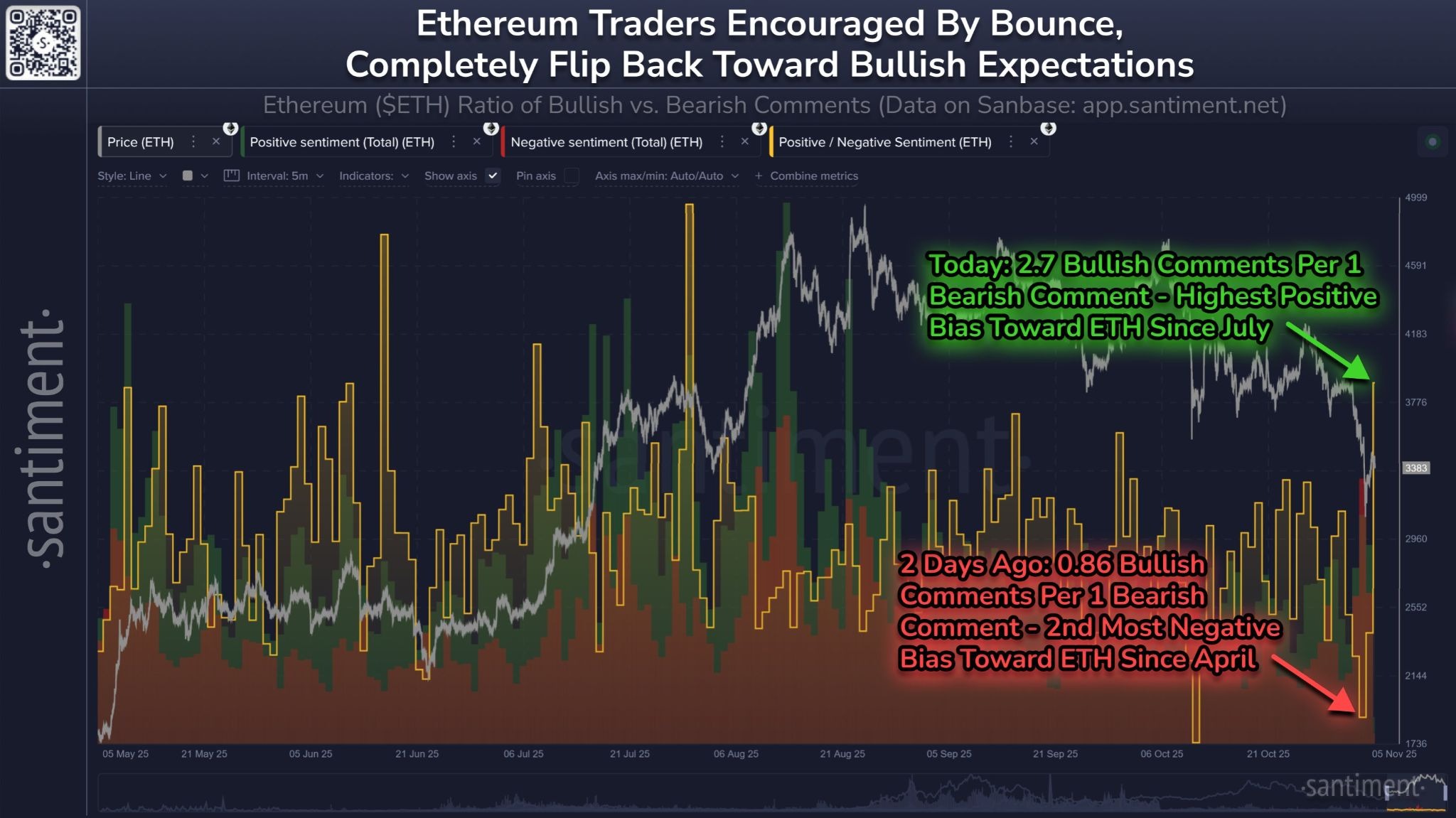
Трейдеры, торгующие эфиром, воодушевились ростом цен и в результате заняли более оптимистичную позицию. Источник: Santiment

По данным CoinGecko, за последние 24 часа цена эфира колебалась от 3251 до 3451 доллара, а по состоянию на утро пятницы составляла 3323 доллара.

FOMO может скорее мешать, чем помогать

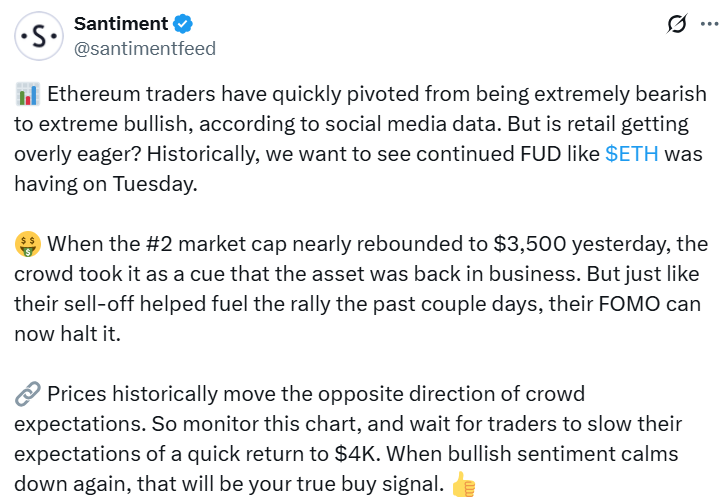
Однако Santiment считает, что рост позитивных настроений в отношении эфира в конечном счёте может оказаться негативным фактором, поскольку «цены исторически движутся в направлении, противоположном ожиданиям толпы».

On Tuesday, the platform recorded an average of 0.86 bullish comments for every bearish comment when Ether was trading at $3,700, the second-highest negative market bias for the token since April.

“Historically, we want to see continued FUD [fear, uncertainty and doubt] like Ether was having on Tuesday,” Santiment said, adding that a “sell-off helped fuel the rally the past couple days,” and traders’ fear of missing out, or FOMO, “can now halt it.”
Source: Santiment

Santiment added that when traders “slow their expectations of a quick return,” to $4,000 and when “bullish sentiment calms down again, that will be your true buy signal.”

The rest of the crypto market still fearful

Sentiment in the rest of the crypto market remains fearful, as the wider market continued to slump, which analysts attribute to trade tensions between the US and China, as well as other macroeconomic factors.

По теме: Падение цены ETH до 3000 долларов США создает предпосылки для «короткого сжатия» на 7 миллиардов долларов, если восстановление криптовалютного рынка продолжится

Индекс страха и жадности в криптовалютном секторе, который отслеживает общее настроение рынка, в пятницу составил 24 балла из 100, что означает «крайний страх» после того, как на прошлой неделе средний показатель составил «страх».

Во вторник индекс упал на 50 % до 21 пункта, что стало самым низким показателем почти за семь месяцев, после того как биткоин (BTC) впервые за три с лишним недели ненадолго опустился ниже 106 000 долларов.

Тем временем Самсон Моу, основатель компании по инфраструктуре биткойн-технологий Jan3, в серии бычьих постов X утверждал, что рост биткойна еще только начинается, и на горизонте много перспектив роста.


Trending Cryptos

Related Reads

Just now, DeepSeek V4 updates with DSpark, improving inference speed by 80%

DeepSeek has updated its DeepSeek V4 model with the DSpark speculative decoding framework, achieving a significant 60-85% speedup in generation for Flash models and 57-78% for Pro models while maintaining the same overall throughput. This engineering-focused update, rather than a core architectural change, introduces DSpark to address latency and throughput bottlenecks in high-concurrency production environments. DSpark combines high-throughput parallel generation with adaptive load-aware verification. Its key innovations include a semi-autoregressive generation architecture to model dependencies within token blocks and a hardware-aware confidence-scheduled verification system. This system uses a confidence head to predict token acceptance probabilities, allowing it to dynamically optimize verification length per request and allocate compute only to tokens with the highest expected payoff. The asynchronous scheduler is designed for real-world deployment, ensuring zero-overhead scheduling and continuous CUDA graph replay while preserving the target model's output distribution. In tests across mathematical reasoning, code generation, and daily dialogue, DSpark outperformed state-of-the-art models like Eagle3 and DFlash, increasing average acceptance length by 26.7%-30.9% and 16.3%-18.4% respectively on Qwen3 target models. DeepSeek also open-sourced DeepSpec, a full-stack codebase for training and evaluating speculative decoding draft models, providing a standardized toolkit that includes data preparation tools, model implementations, training code, and evaluation scripts.

marsbit5h ago

Just now, DeepSeek V4 updates with DSpark, improving inference speed by 80%

marsbit5h ago

BIT Research: The 2028 Halving Is Not the End, the Real Shake-Up of the Bitcoin Mining Industry Is Just Beginning

The Bitcoin mining industry is undergoing its most complex structural adjustment since inception. Despite Bitcoin's price holding near $61,000 and the network hash rate approaching a record 1 ZH/s, miner profitability is deteriorating. The industry is operating close to its breakeven point, with the 2028 halving expected to accelerate consolidation. The challenges extend beyond the halving's subsidy reduction; the industry's revenue model has yet to successfully transition towards a fee-driven structure. Increasingly, mining companies are evolving from simple Bitcoin producers into infrastructure and energy operators, including providers of AI/HPC computing power. Competition is shifting from pure hash rate expansion to business model upgrades. Economic pressure is evident. The theoretical daily mining revenue at current prices is around $78 million, yet the actual figure is only about $33 million—a 136% gap. Transaction fees remain low at roughly $220k daily, far below historical implied levels. With a current estimated industry-wide breakeven price near $65,000, mining alone is struggling to generate ideal profits. The 2028 halving is projected to push the fundamental production cost floor to approximately $93,289. This will likely accelerate a shift towards consolidation among larger, well-capitalized miners with diversified revenue streams. Competitive advantage will belong to institutionalized players with access to low-cost energy, AI/HPC hosting operations, and stronger balance sheets. In essence, Bitcoin mining is transitioning from a "mining business" to an "infrastructure business." Future profitability and resilience will depend less on block rewards and more on diversified income sources like energy management and computational infrastructure services. For investors, the key question is not the halving itself, but which miners can successfully navigate this business model transformation.

marsbit6h ago

BIT Research: The 2028 Halving Is Not the End, the Real Shake-Up of the Bitcoin Mining Industry Is Just Beginning

marsbit6h ago

This is How God Karpathy Uses Claude?

Andrej Karpathy, a prominent figure in AI, has reportedly joined Anthropic, leading to a noticeable decrease in his open-source contributions and social media activity. A document claiming to be his personal "CLAUDE.md" file—a set of instructions for the Claude AI to follow within a specific codebase—has been circulating online. While its authenticity is unverified, the content aligns closely with Karpathy's publicly shared principles on effective AI-assisted programming. The document outlines key rules for AI coding assistants, emphasizing the importance of reading existing code thoroughly before writing new code to maintain consistency. It advises against over-engineering, advocating for simple, surgical modifications that match the project's existing style. Other guidelines include clarifying assumptions upfront, writing meaningful tests, thoughtful debugging, and carefully considering dependencies. The core message is that these principles help prevent common AI coding failures, such as introducing unnecessary abstractions, style drift, or making invisible architectural decisions. The community has noted that even experts like Karpathy require detailed instructions to guide AI effectively, akin to managing a junior developer. A related GitHub repository, "andrej-karpathy-skills," which encapsulates these ideas, is reported to significantly reduce Claude's code error rate. Ultimately, the advice stresses that the best CLAUDE.md is tailored to one's own tech stack and coding practices.

marsbit6h ago

This is How God Karpathy Uses Claude?

marsbit6h ago

Trading

Spot

Hot Articles

Discussions

Welcome to the HTX Community. Here, you can stay informed about the latest platform developments and gain access to professional market insights. Users' opinions on the price of ETH (ETH) are presented below.

活动图片